THE GREAT WAR THE WORLD IN UPHEAVAL CH


- Slides: 21
THE GREAT WAR: THE WORLD IN UPHEAVAL CH. 33
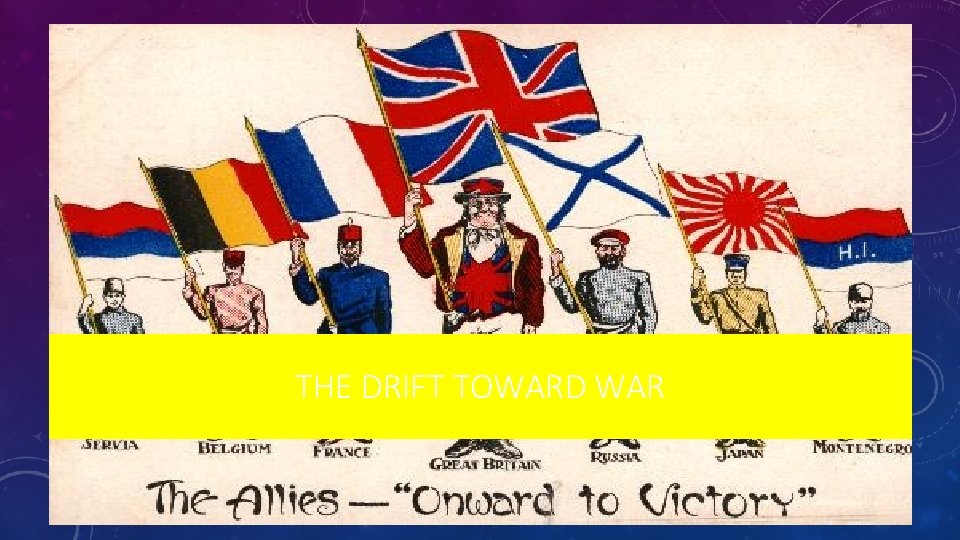
THE DRIFT TOWARD WAR
1. What is selfdetermination? 2. What to empires did not want their ethnic minorities living in their land to have their own countries? NATIONALIST ASPIRATIONS • The idea of nationalism came after the revolutions • Many believed in self determination- people with the same ethnic origin, language and political ideas had the right to form sovereign states • Nationalism was unresolved mainly in E. Europe and Balkans • Opposition to foreign rule helped develop the idea of nationalism • Ottoman territories saw this battle for nationalism • Austria-Hungary had ethnic groups who wanted to have their own country (ex. Poles, Czechs, Slovaks, Croats, Serbs) • Serb were the most militant in pushing for independence • Russia didn’t help because they supported a Pan-Slavism • Russia thought that pushing Pan-Slavism would weaken the Austrian rule and open the door for Russia to annex its territories. 3. Why did Russia support a Pan. Slavism?
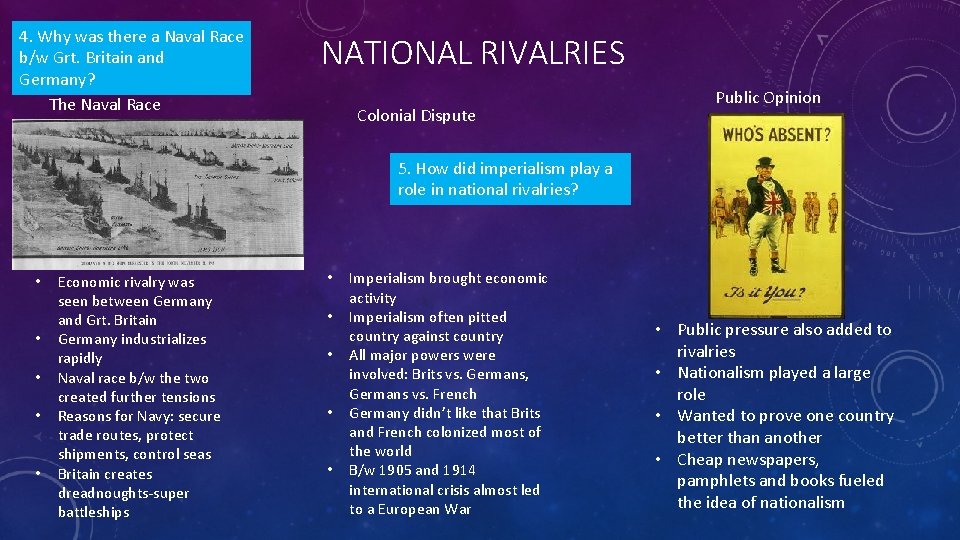
4. Why was there a Naval Race b/w Grt. Britain and Germany? The Naval Race NATIONAL RIVALRIES Colonial Dispute Public Opinion 5. How did imperialism play a role in national rivalries? • • • Economic rivalry was seen between Germany and Grt. Britain Germany industrializes rapidly Naval race b/w the two created further tensions Reasons for Navy: secure trade routes, protect shipments, control seas Britain creates dreadnoughts-super battleships • • • Imperialism brought economic activity Imperialism often pitted country against country All major powers were involved: Brits vs. Germans, Germans vs. French Germany didn’t like that Brits and French colonized most of the world B/w 1905 and 1914 international crisis almost led to a European War • Public pressure also added to rivalries • Nationalism played a large role • Wanted to prove one country better than another • Cheap newspapers, pamphlets and books fueled the idea of nationalism
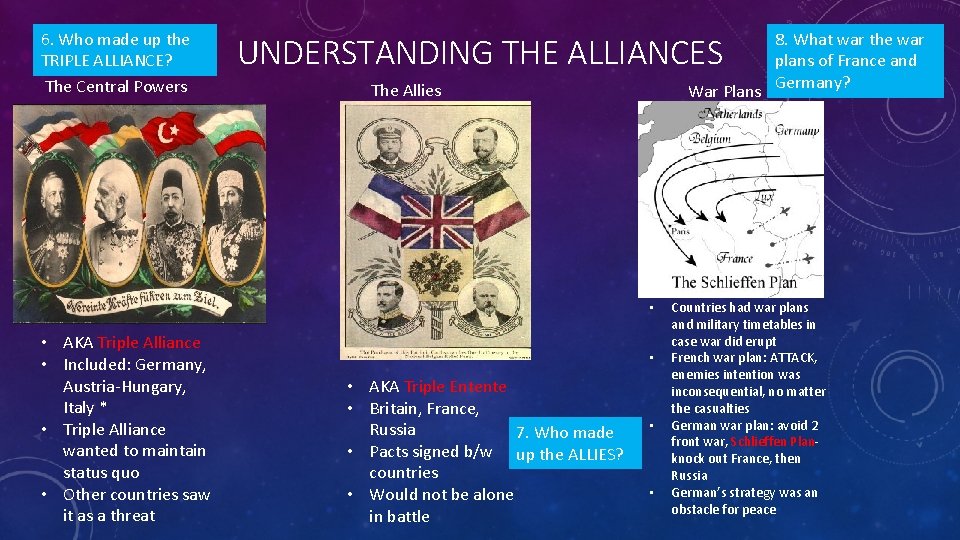
6. Who made up the TRIPLE ALLIANCE? The Central Powers 8. What war the war plans of France and War Plans Germany? UNDERSTANDING THE ALLIANCES The Allies • • AKA Triple Alliance • Included: Germany, Austria-Hungary, Italy * • Triple Alliance wanted to maintain status quo • Other countries saw it as a threat • • AKA Triple Entente • Britain, France, Russia 7. Who made • Pacts signed b/w up the ALLIES? countries • Would not be alone in battle • • Countries had war plans and military timetables in case war did erupt French war plan: ATTACK, enemies intention was inconsequential, no matter the casualties German war plan: avoid 2 front war, Schlieffen Planknock out France, then Russia German’s strategy was an obstacle for peace
GLOBAL WAR
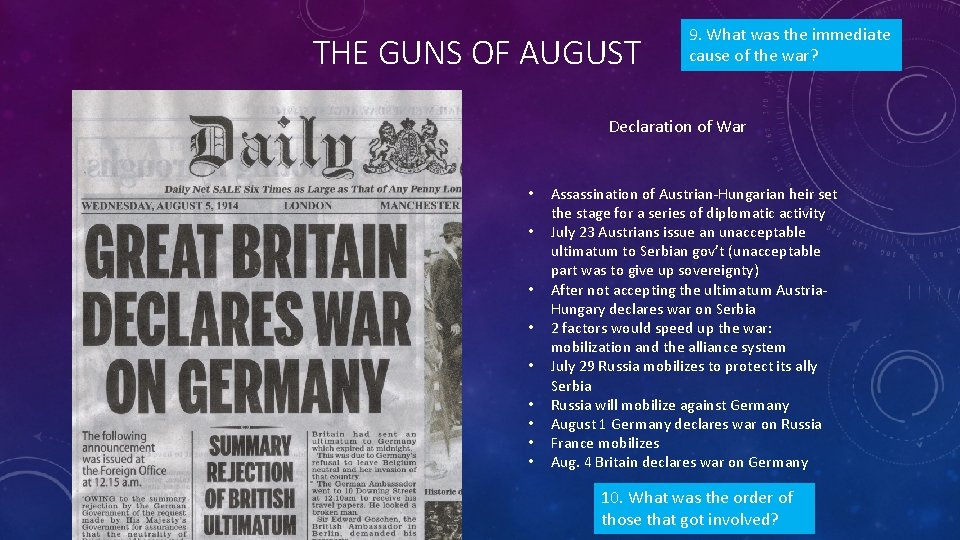
THE GUNS OF AUGUST 9. What was the immediate cause of the war? Declaration of War • • • Assassination of Austrian-Hungarian heir set the stage for a series of diplomatic activity July 23 Austrians issue an unacceptable ultimatum to Serbian gov’t (unacceptable part was to give up sovereignty) After not accepting the ultimatum Austria. Hungary declares war on Serbia 2 factors would speed up the war: mobilization and the alliance system July 29 Russia mobilizes to protect its ally Serbia Russia will mobilize against Germany August 1 Germany declares war on Russia France mobilizes Aug. 4 Britain declares war on Germany 10. What was the order of those that got involved?
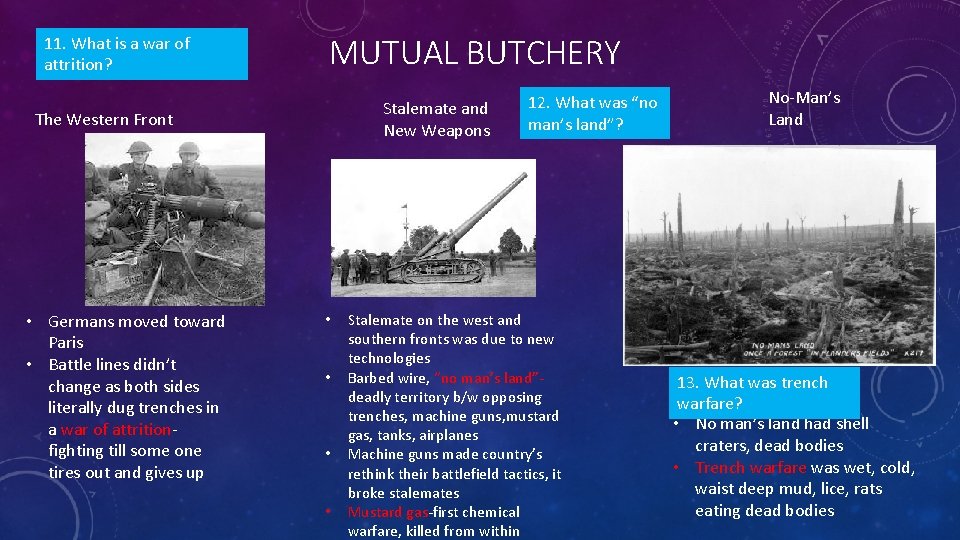
11. What is a war of attrition? MUTUAL BUTCHERY Stalemate and New Weapons The Western Front • Germans moved toward Paris • Battle lines didn’t change as both sides literally dug trenches in a war of attritionfighting till some one tires out and gives up • • 12. What was “no man’s land”? Stalemate on the west and southern fronts was due to new technologies Barbed wire, “no man’s land”deadly territory b/w opposing trenches, machine guns, mustard gas, tanks, airplanes Machine guns made country’s rethink their battlefield tactics, it broke stalemates Mustard gas-first chemical warfare, killed from within No-Man’s Land 13. What was trench warfare? • No man’s land had shell craters, dead bodies • Trench warfare was wet, cold, waist deep mud, lice, rats eating dead bodies
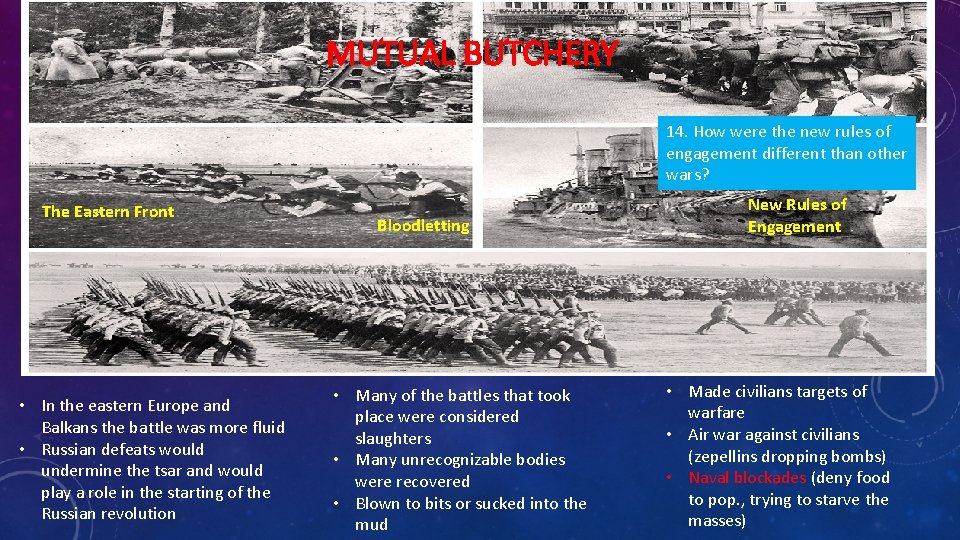
MUTUAL BUTCHERY 14. How were the new rules of engagement different than other wars? The Eastern Front • In the eastern Europe and Balkans the battle was more fluid • Russian defeats would undermine the tsar and would play a role in the starting of the Russian revolution Bloodletting • Many of the battles that took place were considered slaughters • Many unrecognizable bodies were recovered • Blown to bits or sucked into the mud New Rules of Engagement • Made civilians targets of warfare • Air war against civilians (zepellins dropping bombs) • Naval blockades (deny food to pop. , trying to starve the masses)
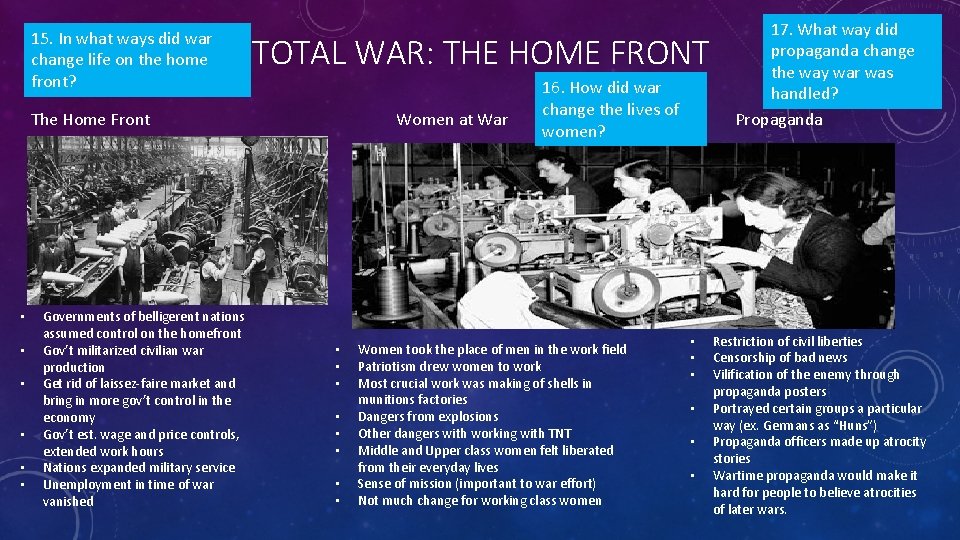
15. In what ways did war change life on the home front? TOTAL WAR: THE HOME FRONT The Home Front • • • Governments of belligerent nations assumed control on the homefront Gov’t militarized civilian war production Get rid of laissez-faire market and bring in more gov’t control in the economy Gov’t est. wage and price controls, extended work hours Nations expanded military service Unemployment in time of war vanished Women at War • • 16. How did war change the lives of women? Women took the place of men in the work field Patriotism drew women to work Most crucial work was making of shells in munitions factories Dangers from explosions Other dangers with working with TNT Middle and Upper class women felt liberated from their everyday lives Sense of mission (important to war effort) Not much change for working class women • • • 17. What way did propaganda change the way war was handled? Propaganda Restriction of civil liberties Censorship of bad news Vilification of the enemy through propaganda posters Portrayed certain groups a particular way (ex. Germans as “Huns”) Propaganda officers made up atrocity stories Wartime propaganda would make it hard for people to believe atrocities of later wars.
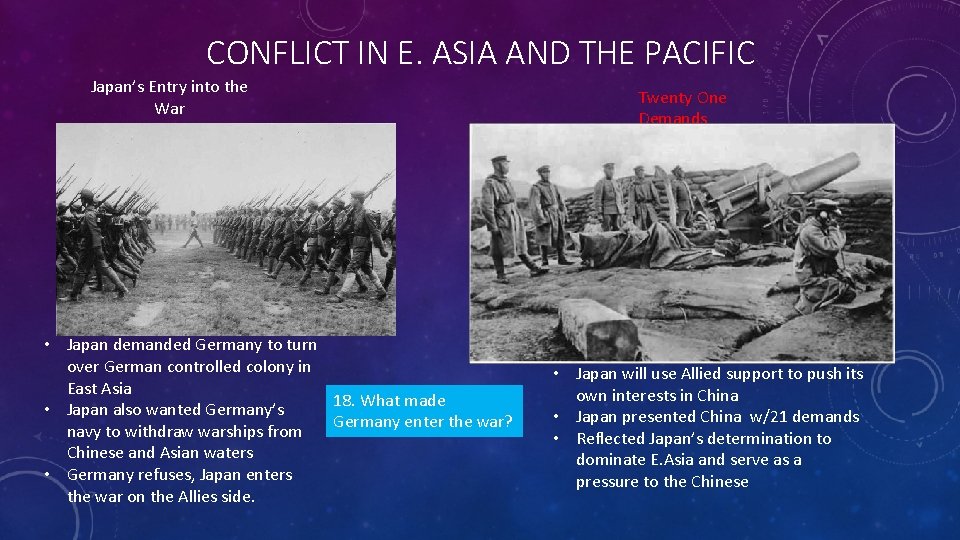
CONFLICT IN E. ASIA AND THE PACIFIC Japan’s Entry into the War • Japan demanded Germany to turn over German controlled colony in East Asia 18. What made • Japan also wanted Germany’s Germany enter the war? navy to withdraw warships from Chinese and Asian waters • Germany refuses, Japan enters the war on the Allies side. Twenty One Demands • Japan will use Allied support to push its own interests in China • Japan presented China w/21 demands • Reflected Japan’s determination to dominate E. Asia and serve as a pressure to the Chinese
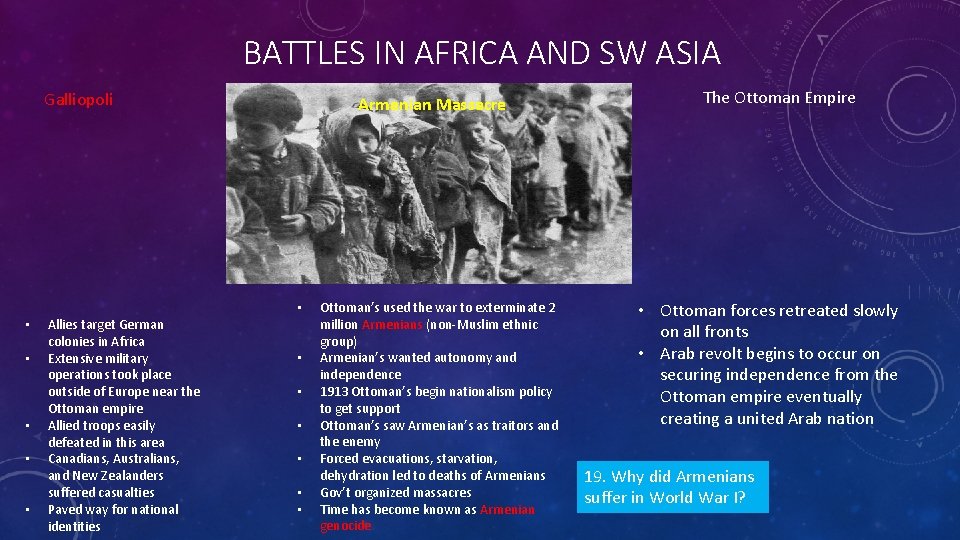
BATTLES IN AFRICA AND SW ASIA Galliopoli Armenian Massacre • • • Allies target German colonies in Africa Extensive military operations took place outside of Europe near the Ottoman empire Allied troops easily defeated in this area Canadians, Australians, and New Zealanders suffered casualties Paved way for national identities • • • Ottoman’s used the war to exterminate 2 million Armenians (non-Muslim ethnic group) Armenian’s wanted autonomy and independence 1913 Ottoman’s begin nationalism policy to get support Ottoman’s saw Armenian’s as traitors and the enemy Forced evacuations, starvation, dehydration led to deaths of Armenians Gov’t organized massacres Time has become known as Armenian genocide The Ottoman Empire • Ottoman forces retreated slowly on all fronts • Arab revolt begins to occur on securing independence from the Ottoman empire eventually creating a united Arab nation 19. Why did Armenians suffer in World War I?
THE END OF WAR
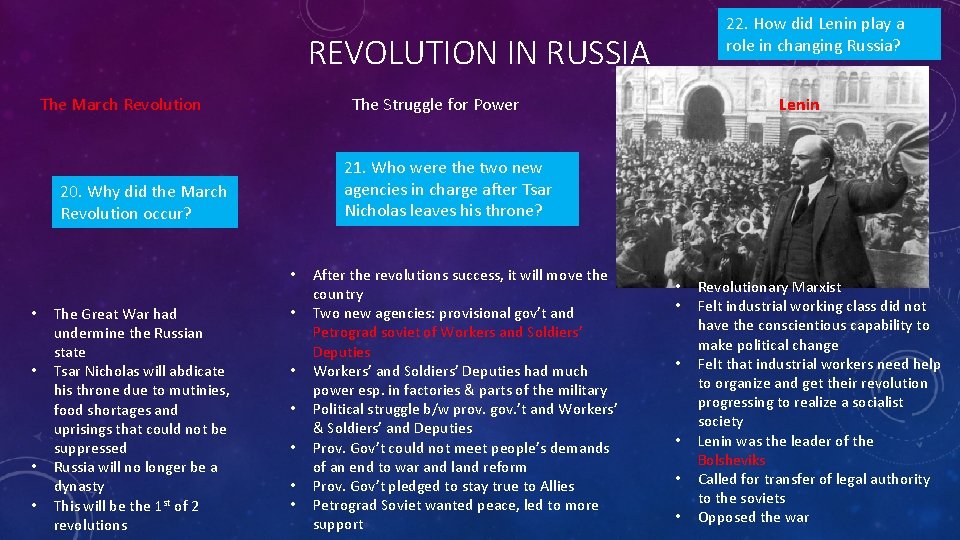
22. How did Lenin play a role in changing Russia? REVOLUTION IN RUSSIA The March Revolution The Struggle for Power 21. Who were the two new agencies in charge after Tsar Nicholas leaves his throne? 20. Why did the March Revolution occur? • • • The Great War had undermine the Russian state Tsar Nicholas will abdicate his throne due to mutinies, food shortages and uprisings that could not be suppressed Russia will no longer be a dynasty This will be the 1 st of 2 revolutions Lenin • • • After the revolutions success, it will move the country Two new agencies: provisional gov’t and Petrograd soviet of Workers and Soldiers’ Deputies Workers’ and Soldiers’ Deputies had much power esp. in factories & parts of the military Political struggle b/w prov. gov. ’t and Workers’ & Soldiers’ and Deputies Prov. Gov’t could not meet people’s demands of an end to war and land reform Prov. Gov’t pledged to stay true to Allies Petrograd Soviet wanted peace, led to more support • • • Revolutionary Marxist Felt industrial working class did not have the conscientious capability to make political change Felt that industrial workers need help to organize and get their revolution progressing to realize a socialist society Lenin was the leader of the Bolsheviks Called for transfer of legal authority to the soviets Opposed the war
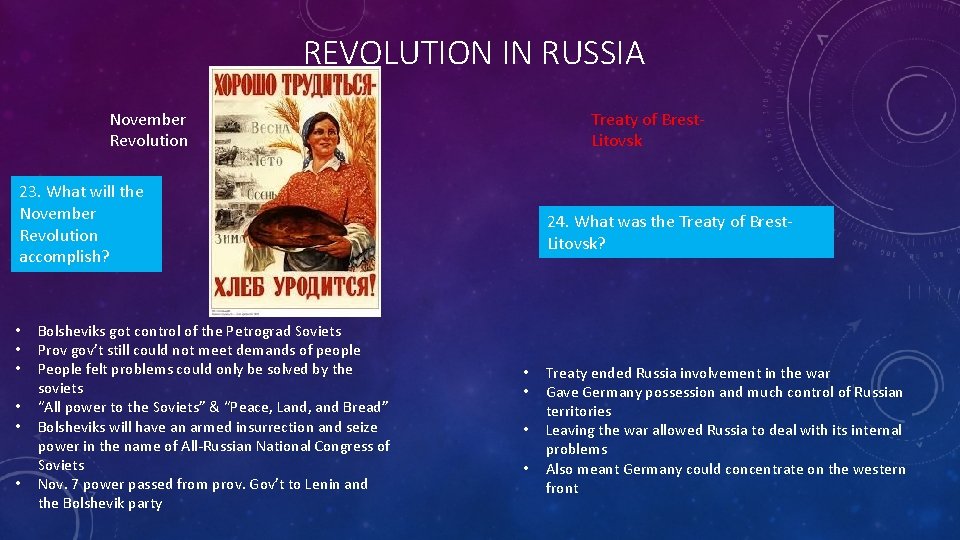
REVOLUTION IN RUSSIA November Revolution Treaty of Brest. Litovsk 23. What will the November Revolution accomplish? • • • Bolsheviks got control of the Petrograd Soviets Prov gov’t still could not meet demands of people People felt problems could only be solved by the soviets “All power to the Soviets” & “Peace, Land, and Bread” Bolsheviks will have an armed insurrection and seize power in the name of All-Russian National Congress of Soviets Nov. 7 power passed from prov. Gov’t to Lenin and the Bolshevik party 24. What was the Treaty of Brest. Litovsk? • • Treaty ended Russia involvement in the war Gave Germany possession and much control of Russian territories Leaving the war allowed Russia to deal with its internal problems Also meant Germany could concentrate on the western front
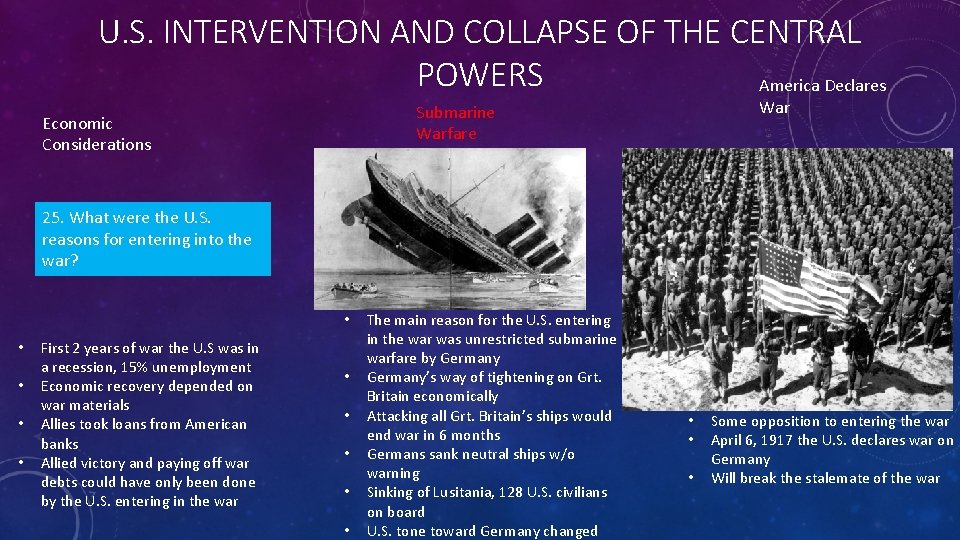
U. S. INTERVENTION AND COLLAPSE OF THE CENTRAL POWERS America Declares War Submarine Warfare Economic Considerations 25. What were the U. S. reasons for entering into the war? • • • First 2 years of war the U. S was in a recession, 15% unemployment Economic recovery depended on war materials Allies took loans from American banks Allied victory and paying off war debts could have only been done by the U. S. entering in the war • • • The main reason for the U. S. entering in the war was unrestricted submarine warfare by Germany’s way of tightening on Grt. Britain economically Attacking all Grt. Britain’s ships would end war in 6 months Germans sank neutral ships w/o warning Sinking of Lusitania, 128 U. S. civilians on board U. S. tone toward Germany changed • • • Some opposition to entering the war April 6, 1917 the U. S. declares war on Germany Will break the stalemate of the war
U. S. INTERVENTION AND COLLAPSE OF THE CENTRAL POWERS Collapse Fronts 26. How did Germany finally lose the war? • • The war had been taking a toll on many nations Easter Rebellion- Irish attempt to overthrow British rule Central Powers suffer food shortages due to British blockade Germany made the final attempt to throw all its power on the western front, didn’t work Allies began to push Germany back Germany had no power to fight Nov. 11, 1918 Germans accept armistice
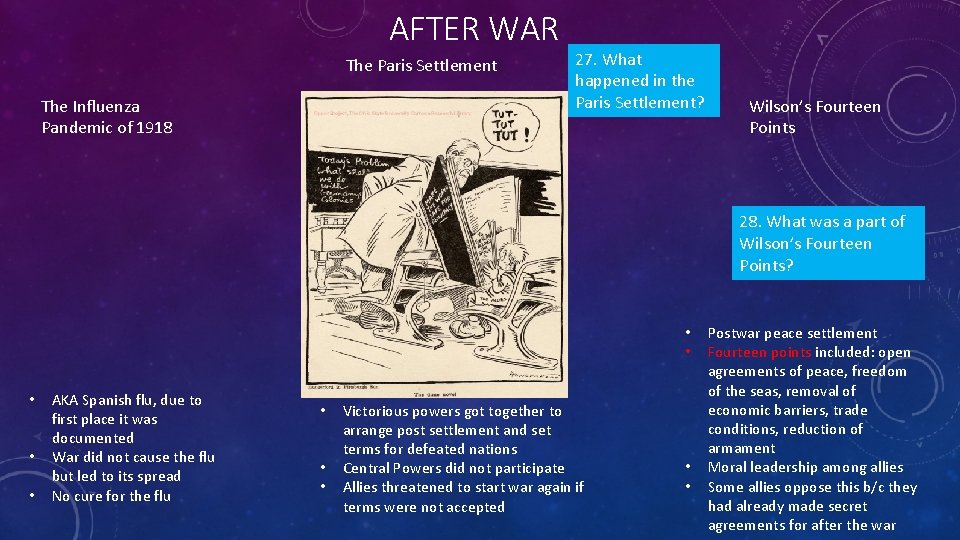
AFTER WAR The Paris Settlement The Influenza Pandemic of 1918 27. What happened in the Paris Settlement? Wilson’s Fourteen Points 28. What was a part of Wilson’s Fourteen Points? • • • AKA Spanish flu, due to first place it was documented War did not cause the flu but led to its spread No cure for the flu • • • Victorious powers got together to arrange post settlement and set terms for defeated nations Central Powers did not participate Allies threatened to start war again if terms were not accepted • • Postwar peace settlement Fourteen points included: open agreements of peace, freedom of the seas, removal of economic barriers, trade conditions, reduction of armament Moral leadership among allies Some allies oppose this b/c they had already made secret agreements for after the war
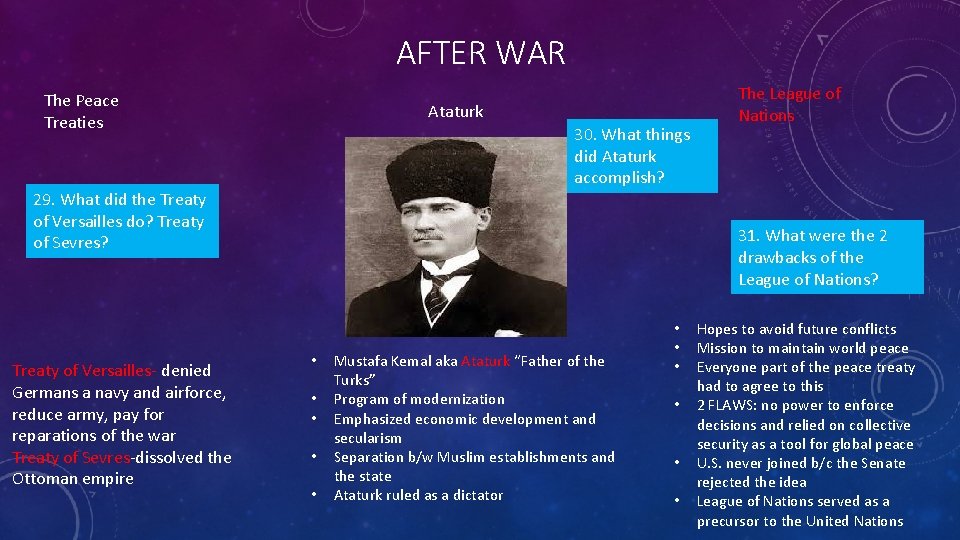
AFTER WAR The Peace Treaties Ataturk 30. What things did Ataturk accomplish? 29. What did the Treaty of Versailles do? Treaty of Sevres? Treaty of Versailles- denied Germans a navy and airforce, reduce army, pay for reparations of the war Treaty of Sevres-dissolved the Ottoman empire The League of Nations 31. What were the 2 drawbacks of the League of Nations? • • • Mustafa Kemal aka Ataturk “Father of the Turks” Program of modernization Emphasized economic development and secularism Separation b/w Muslim establishments and the state Ataturk ruled as a dictator • • • Hopes to avoid future conflicts Mission to maintain world peace Everyone part of the peace treaty had to agree to this 2 FLAWS: no power to enforce decisions and relied on collective security as a tool for global peace U. S. never joined b/c the Senate rejected the idea League of Nations served as a precursor to the United Nations
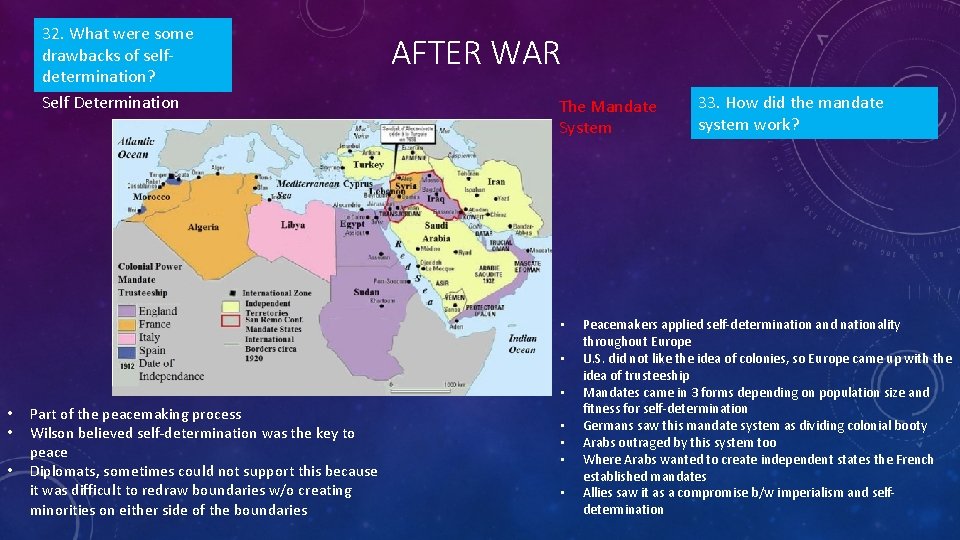
32. What were some drawbacks of selfdetermination? Self Determination AFTER WAR The Mandate System • • • Part of the peacemaking process Wilson believed self-determination was the key to peace Diplomats, sometimes could not support this because it was difficult to redraw boundaries w/o creating minorities on either side of the boundaries • • 33. How did the mandate system work? Peacemakers applied self-determination and nationality throughout Europe U. S. did not like the idea of colonies, so Europe came up with the idea of trusteeship Mandates came in 3 forms depending on population size and fitness for self-determination Germans saw this mandate system as dividing colonial booty Arabs outraged by this system too Where Arabs wanted to create independent states the French established mandates Allies saw it as a compromise b/w imperialism and selfdetermination
CHALLENGES TO EUROPEAN PREEMINENCE Weakened Europe 34. What was the major change that occurred b/c Europe was weakened after the war? • Decline in European power was due to a decline in the economy b/c of total war • Economic problems included: high inflation, public debt, loss of overseas investment, foreign markets • Huge change was the reversal of economic relationship b/w Europe and the U. S. • U. S. became a creditor nation Revolutionary Ideas 35. What did the war do for people living in the colonies? • War spread revolutionary ideas to colonies • Promoted national aspirations • Concept of self-determination and self-rule grew and held strong despite post war setbacks.