The Emory Spine Center A 20 Year History



- Slides: 24
The Emory Spine Center A 20 Year History (1991 -2011) Scott D. Boden, MD – Director, The Emory Spine Center
Outline • Structure of Emory Healthcare • Timeline of Emory Spine Center • Structure of Emory Spine Center – Education – Research – Clinical Care • Pros/Cons of Multidisciplinary Center
Emory Healthcare • School of Medicine – Departments (Surgery, Medicine, NSG, Ortho, …) • Department Chairs • The Emory Clinic (Physician Practice) – Sections (Surgery, Medicine, NSG, Ortho, Spine Ctr) • Section Head – Centers (Spine, Cancer, Neurovascular) • Center Directors • Emory Hospitals
Timeline of Emory Spine Center • 1991 Freestanding 10 k s. f. outpatient clinic in strip mall 1 mile off campus – Combined ortho (4)/nsg(3) but separate funds flow with extra charge for rent and overhead for patients garnered from the new center • 1993 Neurosurgery withdrew – Rent/overhead too high – Didn’t seem beneficial enough
Timeline of ESC -2 • 1994 Managed care beginning. New plan presented to Emory for true multidisciplinary Spine Center – Dean funded, but insisted it be a separate cost center – Emory Clinic funded, but insisted it be a separate Section (with Section Head) – Paved the way for different specialties to be part of the same clinical practice (e. g. true partners)
Timeline of ESC - 3 • 2004 Outgrew 10 k s. f. facility and moved as part of a full Musculoskeletal Center to 100 k s. f. building (now 30 k s. f. plus physiatry injection suites, MRI, CT, physical therapy) – To remain competitive with outside market, access to ancillary revenues became key. – Strategic joint ventures with ASC, Radiology – Recaptured PT from Health South (we had outsourced 10 yrs earlier)
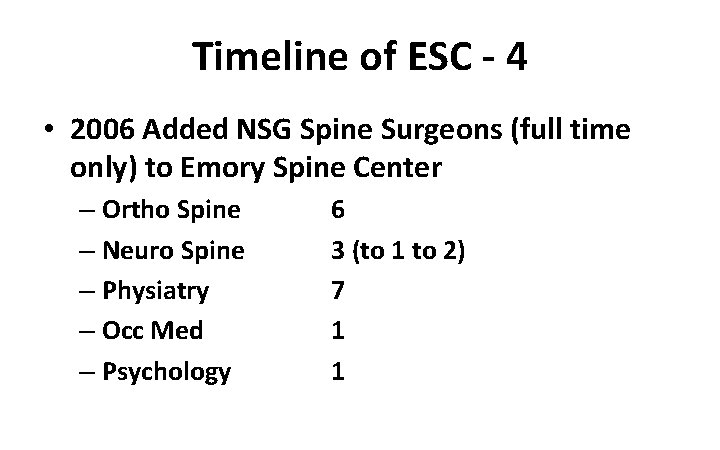
Timeline of ESC - 4 • 2006 Added NSG Spine Surgeons (full time only) to Emory Spine Center – Ortho Spine – Neuro Spine – Physiatry – Occ Med – Psychology 6 3 (to 1 to 2) 7 1 1
Structure - Education • Combined Spine Conferences – Complex Case (complex or long term f/u cases) – Spinal Deformity conference (literature review and case based teaching) • Guest Speakers -shared • Residents – stay with their specialty • Fellows – stay with specialty but will mix in future
Structure - Research • Shared spine research conferences – Projects based on common interest – Everyone helps design and critique projects • Outcomes Data Collection – Automated for patients with wireless tablets – Planning to move to internet based • Clinical Trials Infrastructure – Shared with ortho/sports to decrease cost – Grants are credited to parent SOM department
Structure - Research • Basic Science Laboratory Rotation – NSG residents have spent 12 -18 months in the Bone Research Lab • Molecular Biology • Cellular Biochemistry • Translational Research Models – Won National Research Awards • Biology of Spine Fusion • Bone Graft Substitutes • Enhancing Bone Healing
Structure – Clinical (Logistics) • Primary Outpatient Center – See patients side by side with ortho, nsg, physiatry, occ med, etc – easy to curbside – Common phone and scheduling center • Patients triaged based on medical acuity and first available MD • Priority is on rapid entry into the system • Better access due to critical mass results in better service of referral sources and faster practice growth – A few outreach satellites with non-ops and PT.
Structure – Clinical (Logistics) • Two Inpatient Hospitals – historical locations – Emory University Hospital Midtown – Emory University Orthopaedics & Spine Hospital • Dedicated facility opened in 2008 • Advantages of focused shop (Highest Patient Satisfaction in U. S. – Press Ganey) • Disadvantage of challenges with medically complicated patients (e. g. cardiac ICU, Multi-organ failure, etc) • Able to handle 98% of all spine surgery patients – Future site of integrated ortho/neuro inpt team
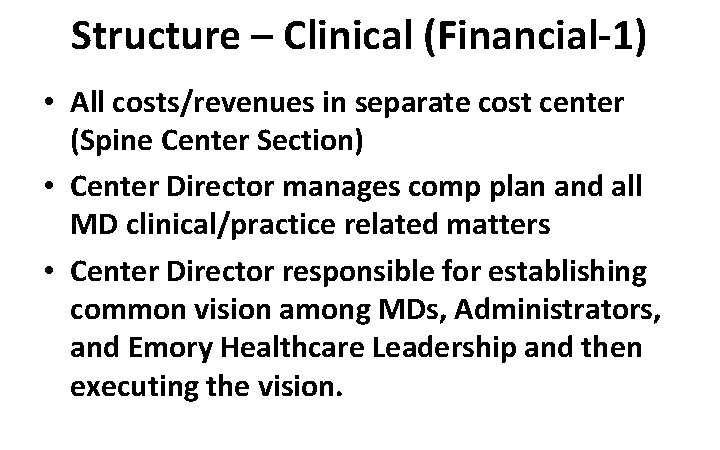
Structure – Clinical (Financial-1) • All costs/revenues in separate cost center (Spine Center Section) • Center Director manages comp plan and all MD clinical/practice related matters • Center Director responsible for establishing common vision among MDs, Administrators, and Emory Healthcare Leadership and then executing the vision.
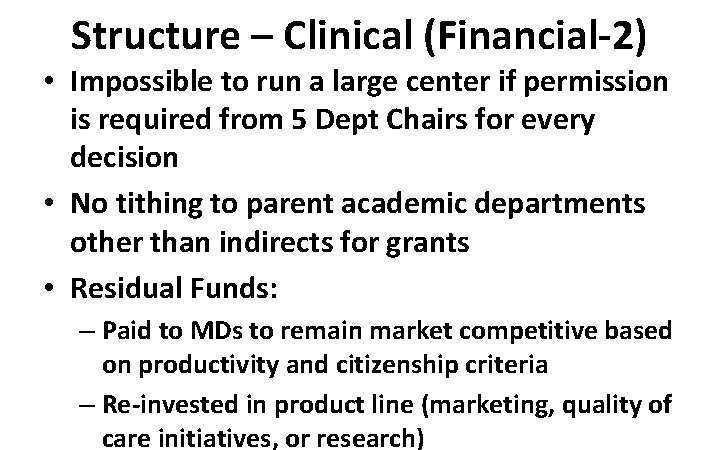
Structure – Clinical (Financial-2) • Impossible to run a large center if permission is required from 5 Dept Chairs for every decision • No tithing to parent academic departments other than indirects for grants • Residual Funds: – Paid to MDs to remain market competitive based on productivity and citizenship criteria – Re-invested in product line (marketing, quality of care initiatives, or research)
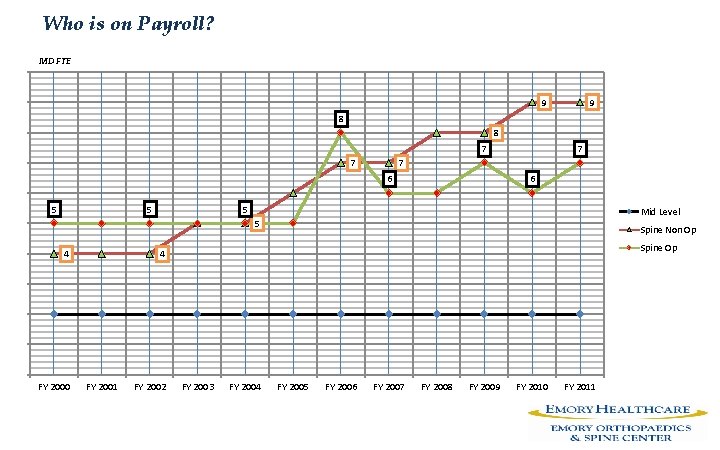
Who is on Payroll? MD FTE 9 9 8 8 7 7 6 5 5 7 7 6 5 Mid Level 5 4 FY 2000 Spine Non Op Spine Op 4 FY 2001 FY 2002 FY 2003 FY 2004 FY 2005 FY 2006 FY 2007 FY 2008 FY 2009 FY 2010 FY 2011
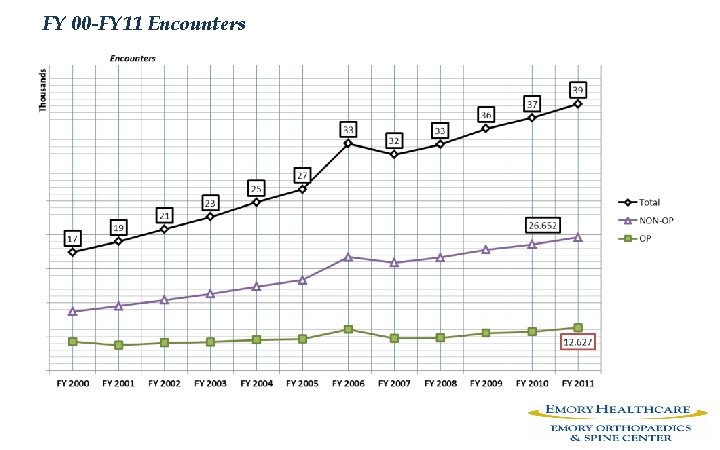
FY 00 -FY 11 Encounters
RVU Thousands RVU 105 95 83 41 39 42 44 14 19 23 26 FY 2000 FY 2001 FY 2002 FY 2003 51 76 93 OP 81 NON-OP MIDLEVEL 56 29 32 FY 2004 FY 2005 39 FY 2006 45 51 53 56 59 FY 2007 FY 2008 FY 2009 FY 2010 FY 2011
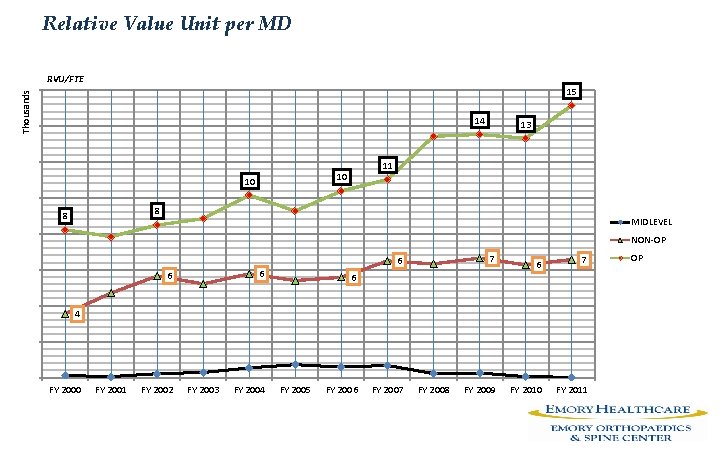
Relative Value Unit per MD RVU/FTE Thousands 15 14 11 10 10 13 8 8 MIDLEVEL NON-OP 7 6 6 7 6 4 FY 2000 FY 2001 FY 2002 FY 2003 FY 2004 FY 2005 FY 2006 FY 2007 FY 2008 FY 2009 FY 2010 FY 2011 OP
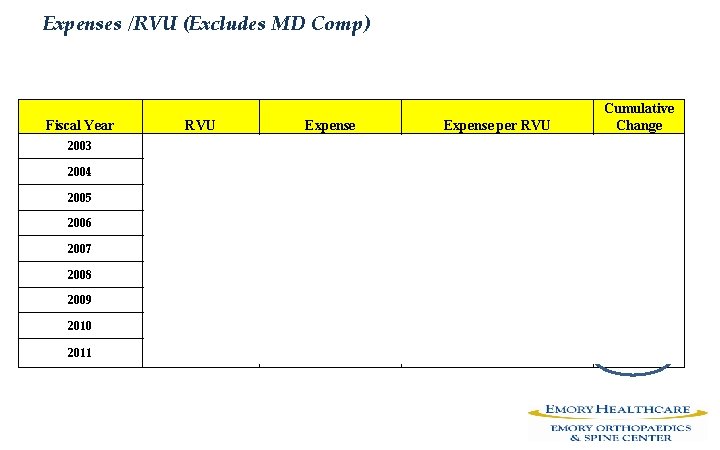
Expenses /RVU (Excludes MD Comp) Fiscal Year RVU Expense per RVU Cumulative Change 2003 70, 807 $4, 552, 409 $64. 29 0% 2004 80, 668 $5, 132, 792 $63. 63 -1% 2005 89, 367 $5, 663, 817 $63. 38 -1% 2006 123, 109 $6, 657, 252 $54. 08 -16% 2007 122, 358 $6, 153, 463 $50. 29 -22% 2008 131, 538 $6, 588, 461 $50. 09 -22% 2009 148, 321 $7, 297, 090 $49. 20 -23% 2010 149, 423 $7, 499, 772 $50. 19 -22% 2011 163, 661 $7, 518, 966 $45. 94 -29%
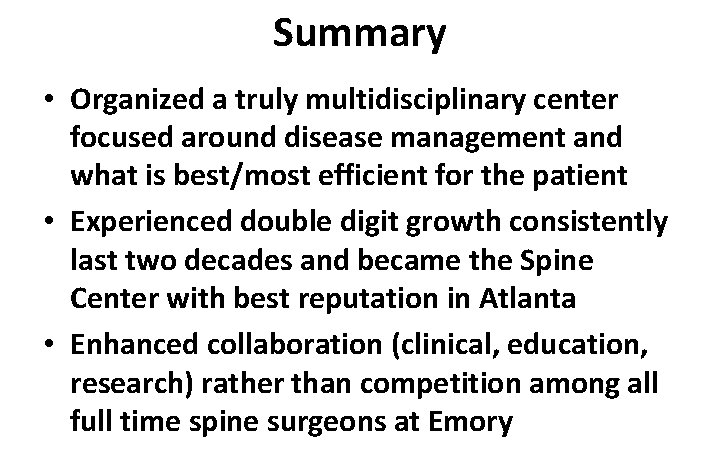
Summary • Organized a truly multidisciplinary center focused around disease management and what is best/most efficient for the patient • Experienced double digit growth consistently last two decades and became the Spine Center with best reputation in Atlanta • Enhanced collaboration (clinical, education, research) rather than competition among all full time spine surgeons at Emory
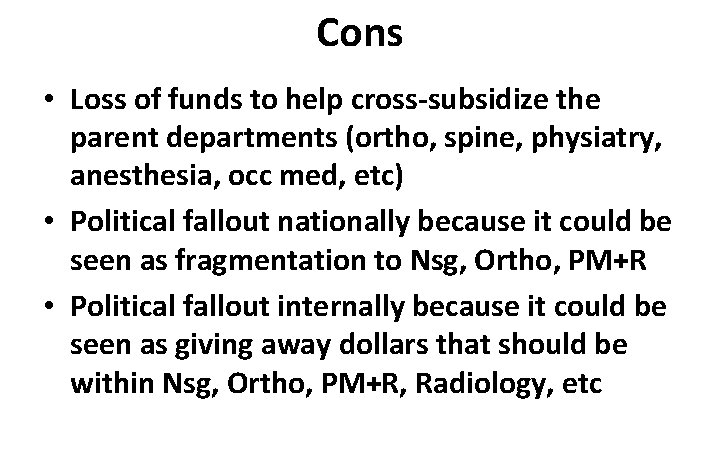
Cons • Loss of funds to help cross-subsidize the parent departments (ortho, spine, physiatry, anesthesia, occ med, etc) • Political fallout nationally because it could be seen as fragmentation to Nsg, Ortho, PM+R • Political fallout internally because it could be seen as giving away dollars that should be within Nsg, Ortho, PM+R, Radiology, etc
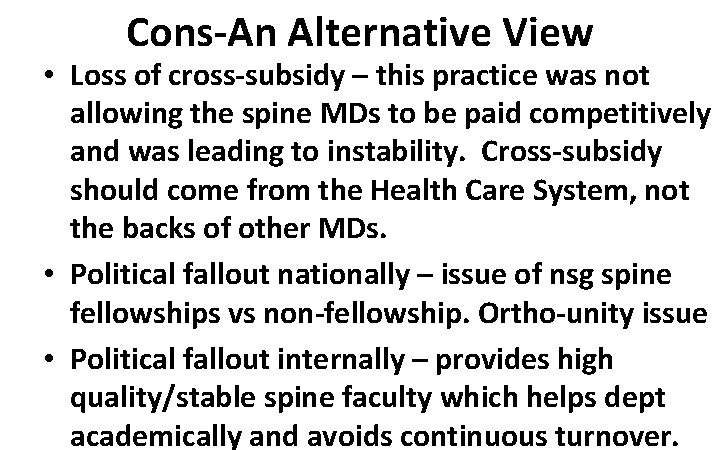
Cons-An Alternative View • Loss of cross-subsidy – this practice was not allowing the spine MDs to be paid competitively and was leading to instability. Cross-subsidy should come from the Health Care System, not the backs of other MDs. • Political fallout nationally – issue of nsg spine fellowships vs non-fellowship. Ortho-unity issue • Political fallout internally – provides high quality/stable spine faculty which helps dept academically and avoids continuous turnover.
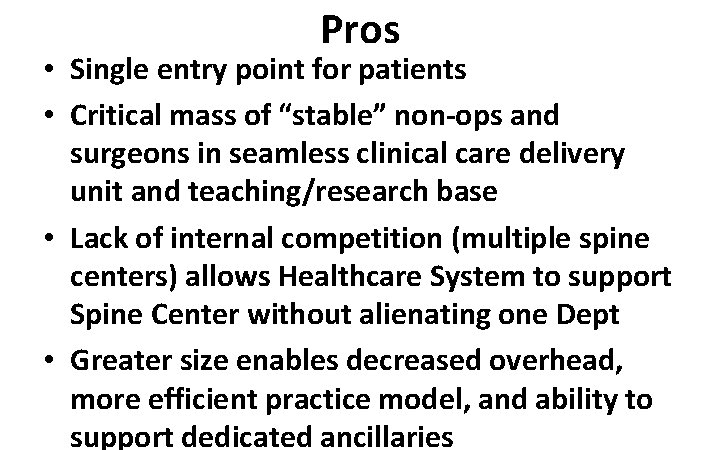
Pros • Single entry point for patients • Critical mass of “stable” non-ops and surgeons in seamless clinical care delivery unit and teaching/research base • Lack of internal competition (multiple spine centers) allows Healthcare System to support Spine Center without alienating one Dept • Greater size enables decreased overhead, more efficient practice model, and ability to support dedicated ancillaries