THE DAILY SHOW JON STEWART Satire Poking fun
- Slides: 29
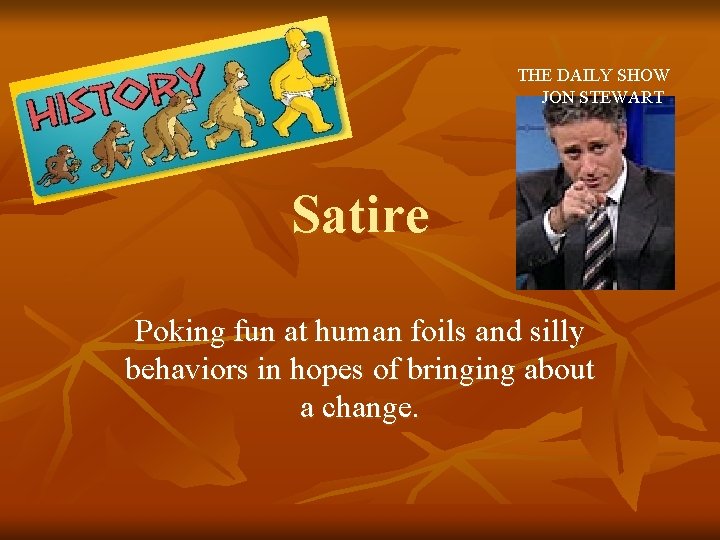
THE DAILY SHOW JON STEWART Satire Poking fun at human foils and silly behaviors in hopes of bringing about a change.
Implications for Satire n . “One must get out of the habit of measuring man against an ideal. ” Einstein
2010 AP® ENGLISH LANGUAGE AND COMPOSITION - Question 3 In his 2004 book, Status Anxiety, Alain de Botton argues that the chief aim of humorists is not merely to entertain but “to convey with impunity messages that might be dangerous or impossible to state directly. ” Because society allows humorists to say things that other people cannot or will not say, de Botton sees humorists as serving a vital function in society. Think about the implications of de Botton’s view of the role of humorists (cartoonists, stand-up comics, satirical writers, hosts of television programs, etc. ). Then write an essay that defends, challenges, or qualifies de Botton’s claim about the vital role of humorists.
Northrup Frye on Satire n n n Satire must have a degree of fantasy [because the author is selecting absurdities to satirize, realism is distorted. If irony is portrayed in a totally plausible way, we have tragedy]. The grotesque items an author chooses reflects his or her moral judgment and contains the satire. “Satire breaks down when the irony is too oppressively real to maintain fantasy. ”
Three Essentials of SATIRE: n n n 1. wit or humor founded on fantasy or a sense of the absurd /grotesque 2. an object of attack 3. defined societal values Northrup Frye
Wit n n n Wit – [V. and N. OE – Consciousness] Originally meant to learn or to know. Verb – “The peril of this place I better wot than you. ” Edmund Spenser Noun – “I am well in my wits, fool as you are. ” Shakespeare – 12 th Night
Changing Connotation n n Chaucer – Intellect and Intelligence Shakespeare – Wisdom or Fancy John Donne (17 th Century) – Fancy, originality and agility of poetic expressions. Austen/Swift – Judgment, reason, ability to articulate universal truths.
A Literary Genre n Purpose: To Expose Human Folly In Order To Bring About Change n n n Fine Line Exists Between Ridicule for Ridicule’s Sake and Satire. Comedy Just Exposes Folly The Satirist is a Moralist Who Wants A Better Society Even The Most Pessimistic Satirist Is An Optimist The Satirist Does Not Poke Fun At Unchangeable Characteristics Such As Physical Deformities
Two Categories Of Satire Direct and Indirect n Direct Satire n n n 1 st Person Narrator Who Directly Addresses the Audience or the Adversary Horatian - Pokes Fun of Humble Foils With a Witty Tone Juvenalian Satire – Denounces Human Vice and Error in Dignified and Solemn Tones
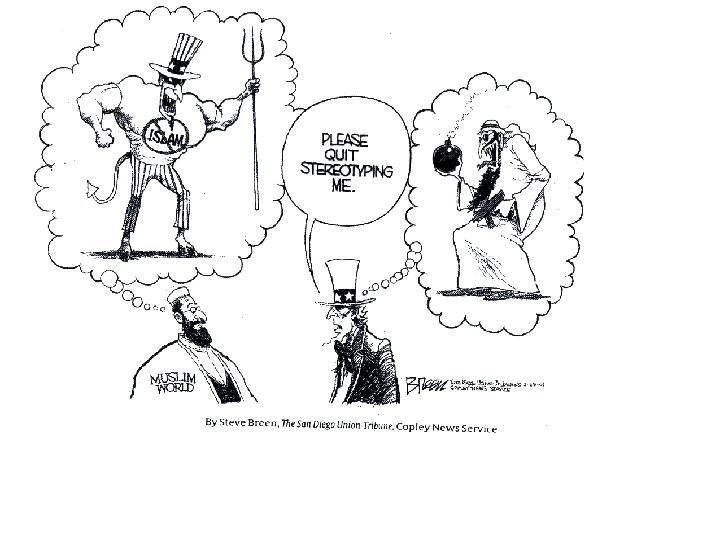
n Indirect Satire n Mennippean Satire Most Common n Stock Characters: Those based on common stereotypes n Non Sequitur: (it does not follow) An absurd, seemingly unrelated comment meant to be humorous or confusing n Centers on Esoteric and Erudite Ideas n
Tone: Bitter or Light? n Satire is bounded by two extremes: n n pure invective (insulting, abusive language directed towards another) romance when the satire moves to the romance end, it must be pulled back by certain literary devices – n Frye maintains that most often the device is allegory that has a “mythos” to it. n
Fun Satire-Related Terms n n n Parody: A literary or artistic work that imitates the characteristic style of an Parody: author or a work for comic effect or ridicule Farce: Humor that depends upon a skillfully exploited situation rather than Farce: Humor that depends upon the development of character. Slapstick: broad comedy characterized by boisterous action, as the throwing Slapstick: of pies in actors' faces, mugging, and obvious farcical situations and jokes. Burlesque: satire / humor that, for the sake of laughter, vulgarizes lofty Burlesque: satire / humor material or treats ordinary material with mock dignity. Black Humor: a form of humor that regards human suffering as absurd Black Humor: rather than pitiable, or that considers human existence as ironic and pointless but somehow comic.
Fun Satire-Related Terms n n n n Euphemism: the substitution of a mild, indirect, or vague expression for Euphemism: one thought to be offensive, harsh, or blunt. Caricature: a picture, description, editorial cartoon ludicrously exaggerating Caricature: the peculiarities or defects of persons or things Bathos: Insincere pathos; a quick descent from high, exalted ideas to the Bathos: commonplace Mock Heroic: Imitating or burlesquing that which is heroic Oxymoron: a figure of speech by which a phrase creates an incongruous, seemingly self-contradictory effect (jumbo shrimp…military intelligence? ) Repartee: Conversation involving quick, witty banter Paralipsis: Stating and drawing attention to something in the very act of pretending to pass it over. A kind of irony.
Hyperbolic Statements n n Overstatement / Exaggeration Understatement / Litotes: Litotes, derived from a Greek word meaning “simple”, is a figure of speech which employs an understatement by using double negatives or, in other words, positive statement is expressed by negating its opposite expressions. For example, using the expression “not too bad” for “very good” is an understatement as well as a double negative statement that confirms a positive idea by negating the opposite. Similarly, saying “She is not a beauty queen, ” means “She is ugly” or saying “I am not as young as I used to be” in order to avoid saying “I am old”. Litotes, therefore, is an intentional use of understatement that renders an ironic effect.
Types of Irony n n n Verbal Irony: A speaker says one thing and means another. Dramatic Irony: The audience viewing a work knows more than characters in the work. Situational Irony: What actually happens is vastly different from what is expected to happen. Check out this cartoon from The Oatmeal about this topic: http: //theoatmeal. com/comics/irony
Wise Geek’s Take on the Difference Between Irony / Sarcasm Verbal irony occurs when a speaker makes a statement that means something opposite of what the literal interpretation implies. Sarcasm is the most common, purest form of verbal irony, but verbal irony and sarcasm are not interchangeable terms. Overstatement and understatement also fall under the category of verbal irony. A speaker who says that he is having "the best day of his life" to describe an ordinarily good day uses overstatement, also called exaggeration or hyperbole. Conversely, someone who says that her day is "not too bad" when she is having an extraordinarily great day uses understatement. With sarcasm, the surface meaning of the speaker's statement stands in direct opposition to the true meaning behind his or her words. Sarcasm is often meant in a bitter, critical manner. For instance, a girl who tells her rival, "I just love your new blouse, " when she actually hates it, uses verbal irony and sarcasm in a harsh way. Not all sarcasm is negative, however. A boy who tells a brother, "Mom and Dad will be so disappointed, " after that brother aces a test or wins a sporting match, uses sarcasm in a friendly, light-hearted manner.
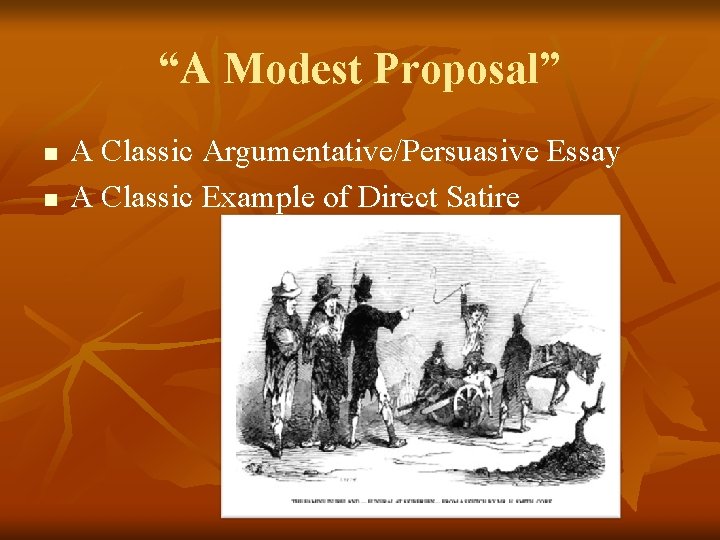
“A Modest Proposal” n n A Classic Argumentative/Persuasive Essay A Classic Example of Direct Satire
Classic Argumentation n Three Types of Thesis Statements n Claim of Fact n n n Claim of Policy. n n n Marijuana is (or is not) an addictive drug. OJ is guilty of murder The Iraq War is Illegal We need a cabinet position to oversee all intelligence agencies Claim of Value n n Abortion is immoral. A woman should have the right to choose whether to have children.
Classic Argumentation n Presents Need for Change and Begins to Establish Trustworthiness Presents Proposal and Continues to Promote Trustworthiness by Overcoming Possible Objections (Warrants) Shows Advantages for Change and Reinforces Trustworthiness
Elements Of Effective Argumentation n n Trustworthy Speaker Balance of n n n Logos (facts) Ethos (values/ethics) Pathos (emotions)
Homework n Read and “A Modest Proposal” for the following: n n n Structure of a class argumentative essay Devices of Satire Shifts in Tone Audience Purpose
Claim of Policy? ? n I do therefore humbly offer it to public consideration …. the remaining hundred thousand may, at a year old, be offered in the sale to the persons of quality and fortune through the kingdom; always advising the mother to let them suck plentifully in the last month, so as to render them plump and fat for a good table.
n Classical Argumentation Step 1 Presents Need for Change n n n Describes the Irish towns “crowded with beggars of the female sex” We need a “fair, cheap, and easy method of making these children sound, useful members of the commonwealth. ” Establishes Trustworthiness n “But my intention is very far from being confined to provide only for the children of professed beggars…”
Step 2 – The Proposal n n “That the remaining hundred thousand [children] may at a year old be offered in sale to the persons of quality and fortune through the kingdom. ” Overcomes possible objections: n n “I grant this food will be somewhat dear…” “I have already computed the charge of nursing a beggar’s child…”
Step 3 – The Advantages n “I have too long digressed, and therefore shall return to my subject. I think the advantages by the proposal which I have made are obvious and many, as well as of the highest importance. ” n n “For first. . ” “Secondly…” “Sixthly…” “Many other advatages might be enumerated. ” How can I employ devices of satire
Swift’s Satire n Presents facts but they are punctuated with loaded diction (pathos)that should cause suspicion: n n Women murdering babies Women referred to as “breeders”
Analysis of “A Modest Proposal” n n Number your paragraphs from 1 -33 As a group analyze your assigned paragraphs for n n n Purpose and Rhetorical Devices that achieve that purpose Speaker Audience Target(s) of Satire and Tone Toward the Target(s) Include ASR that Supports Your Analysis
Paradox