The Commercial Revolution In this lesson students will


- Slides: 19
The Commercial Revolution In this lesson, students will be able to define the following terms: The Commercial Revolution Mercantilism Colonies Mother Country Capitalism Joint Stock Company S E. Napp
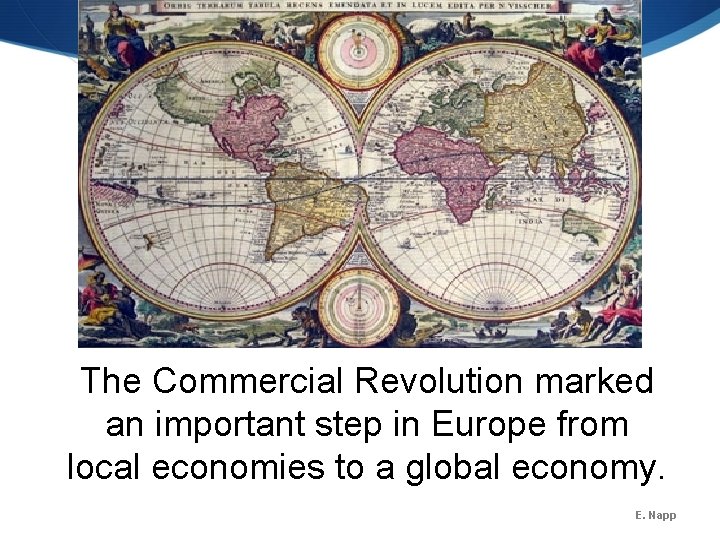
The Commercial Revolution marked an important step in Europe from local economies to a global economy. E. Napp
Mercantilism • Mercantilism was an economic policy aimed at self-reliance and strengthening the national economy of a nation. • S In order to acquire gold and silver, European countries established overseas colonies. E. Napp
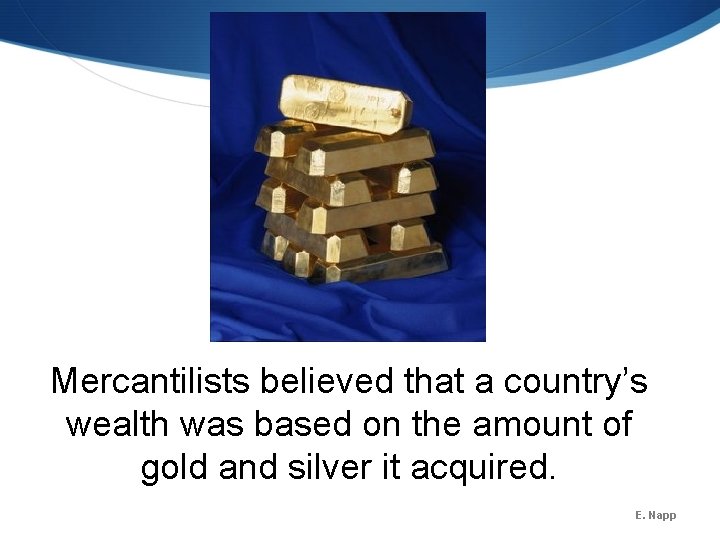
Mercantilists believed that a country’s wealth was based on the amount of gold and silver it acquired. E. Napp
Basic Ideas of Mercantilism S There is a fixed amount of wealth in the world. S In order to build up a supply of gold and silver, a nation must export more goods and it imported S Government regulation of the economy to support a favorable balance of trade S Wealth needed to create/support a large military E. Napp
Role of Colonies S Colonies existed for the benefit of the parent country S Colonies provided resources and raw materials not available in Europe S Colonies enriched the parent country by serving as a market for its manufactured goods E. Napp
Role of Colonies Cont. S To achieve this European powers passed strict laws regulating trade with their colonies S Colonies could not set up their own industries to manufacture goods S Enumerated goods – items that can only be sold to the parent country. Examples include tobacco, sugar, and cotton. S Colonies couldn’t buy goods from foreign countries E. Napp S In addition, only ships from the parent (“mother”) country
Mother Countries and Colonies S Mother countries were conquerors. S The conquered land was a colony. S In addition to mining for gold and silver, Mother countries imported natural resources or raw materials and exported finished goods. E. Napp
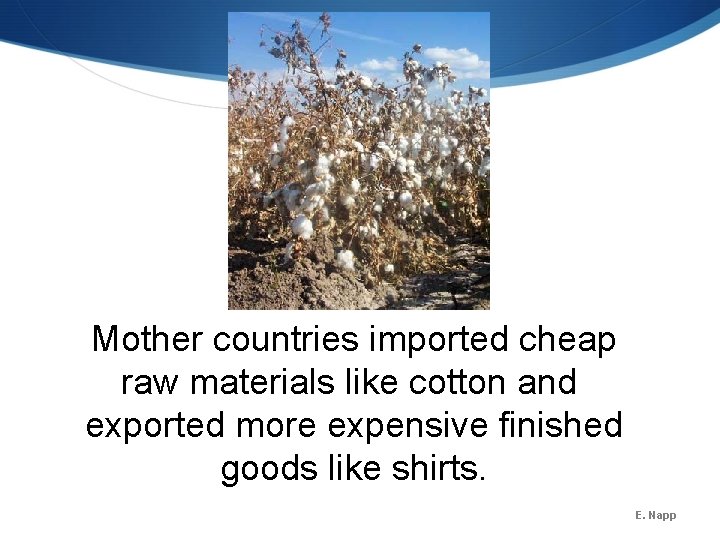
Mother countries imported cheap raw materials like cotton and exported more expensive finished goods like shirts. E. Napp
Increasing National Wealth S Mercantilists urged the government to increase revenue and the national wealth. Therefore, the governments exploited natural resources like minerals and timber, built roads, and funded new industries. S A single national currency was created along with standard weights and measures S Governments created monopolies in certain industries S Protectionist policies S Tariffs S In this case, taxes on imported goods S Protected local industries from competition by increasing price of foreign goods
Capitalism S Merchants and bankers laid the foundations for capitalism. S In a capitalist system, business owners risk their capital (money) to start new businesses hoping to make profits. S Individuals formed joint-stock companies. E. Napp
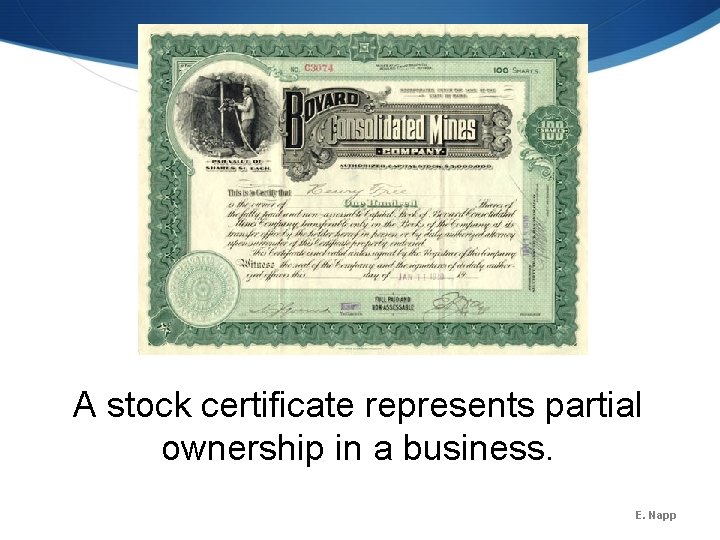
A stock certificate represents partial ownership in a business. E. Napp
Joint Stock Companies S A Joint stock company is a privately owned company that sells stock or partial ownership in the company to investors. S Investors risk their capital or money when they purchase stock. S If the company is successful, the investor receives his share of the profits. E. Napp
Who gained & lost with Mercantilism? S Merchants – invested in overseas ventures gained wealth. Business people formed the new middle class and their power increased. S Nobles – wealth rested in land ownership did not benefit. Those who sold off their land reduced their income further S Colonists –losing out as a result of mercantilism. Restrictions on trade and production meant they could not earn money at their full potential. Still, colonists did benefit in some ways from mercantilism. For example, colonists gained a built-in market for their raw products/materials. E. Napp
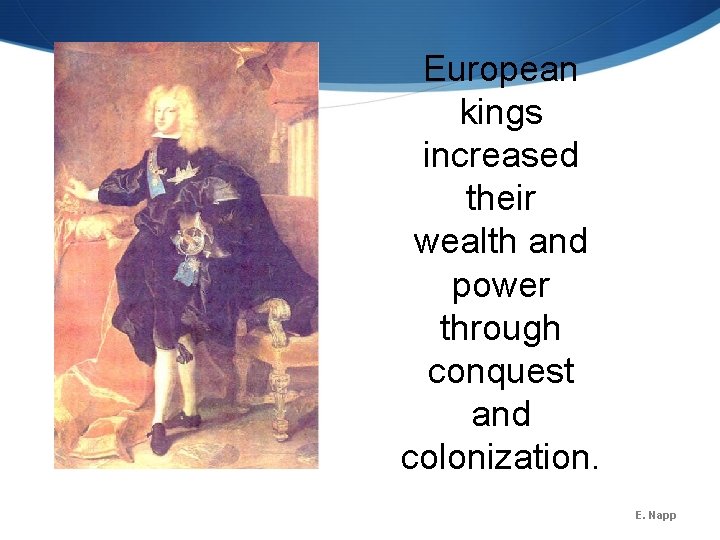
European kings increased their wealth and power through conquest and colonization. E. Napp
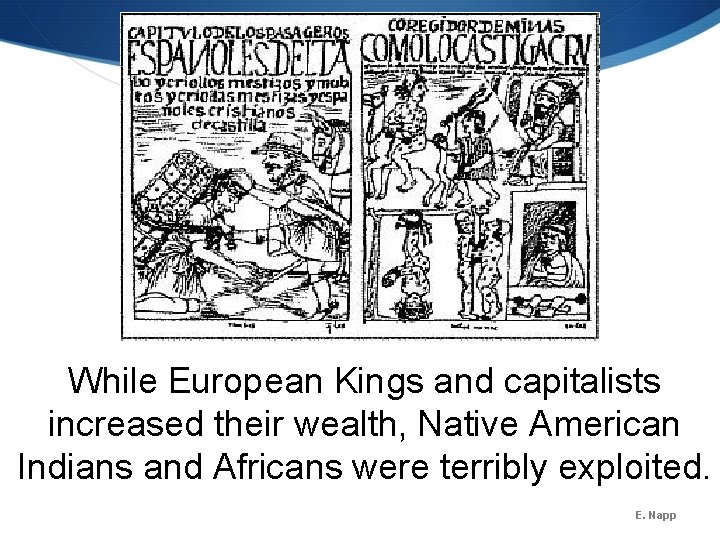
While European Kings and capitalists increased their wealth, Native American Indians and Africans were terribly exploited. E. Napp
Global Trade/ Imperialism S Mercantilism is one factor Western European countries found new trading routes. which pushed European countries to expand their territories and influence S Main European around the world. explorers/powers S Spain S Exploration – added to wealth of the middle class S Portugal S France in countries with Atlantic S England ports. The economic S The Netherlands power of the Italian city- E. Napp
Global Trade/ Imperialism S Competition for empire sparked wars between European powers such as the French and Indian War (part of the Seven Years’ War) fought between France and Great Britain. S Europeans transplanted their culture and goods throughout the world S Effects S Taxation and a greater role for the government in the economy led to increased royal power. Governments consolidated power and strengthened national unity.
Questions for Reflection: S Define mercantilism. S How did European nations increase their wealth and power? S Define capitalism. S Why did individuals invest in Joint stock companies? S What was “Triangular” trade? S What was the relationship between a mother country and a colony? E. Napp