THE CHEMISTRY OF POLYMERS A guide for A
- Slides: 34
THE CHEMISTRY OF POLYMERS A guide for A level students KNOCKHARDY PUBLISHING 2008 SPECIFICATIONS
KNOCKHARDY PUBLISHING POLYMERS INTRODUCTION This Powerpoint show is one of several produced to help students understand selected topics at AS and A 2 level Chemistry. It is based on the requirements of the AQA and OCR specifications but is suitable for other examination boards. Individual students may use the material at home for revision purposes or it may be used for classroom teaching if an interactive white board is available. Accompanying notes on this, and the full range of AS and A 2 topics, are available from the KNOCKHARDY SCIENCE WEBSITE at. . . www. knockhardy. org. uk/sci. htm Navigation is achieved by. . . either clicking on the grey arrows at the foot of each page or using the left and right arrow keys on the keyboard
POLYMERS CONTENTS • Prior knowledge • Types of polymerisation • Addition polymerisation • Polymerisation of propene • Condensation polymerisation • Peptides • Hydrolysis of peptides
POLYMERS Before you start it would be helpful to… • know the functional groups found in organic chemistry • know the arrangement of bonds around carbon atoms • recall and explain electrophilic addition reactions of alkenes
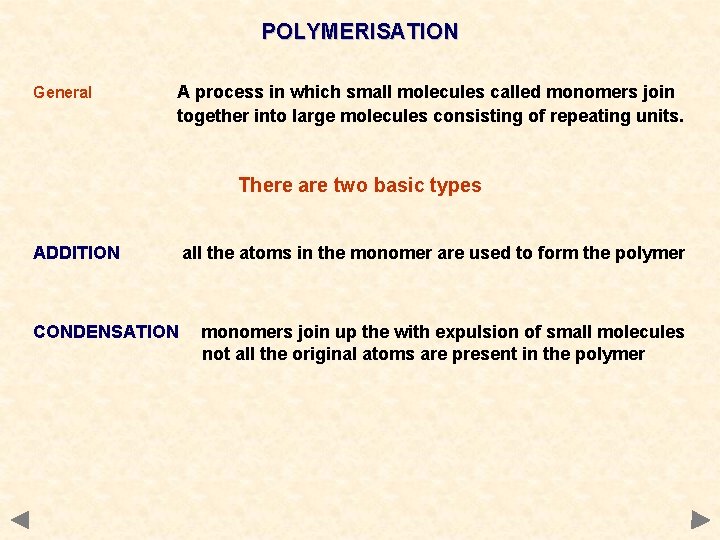
POLYMERISATION General A process in which small molecules called monomers join together into large molecules consisting of repeating units. There are two basic types ADDITION CONDENSATION all the atoms in the monomer are used to form the polymer monomers join up the with expulsion of small molecules not all the original atoms are present in the polymer
ADDITION POLYMERISATION • all the atoms in the monomer are used to form the polymer • occurs with alkenes • mechanism can be free radical or ionic
POLYMERISATION OF ALKENES ADDITION POLYMERISATION Preparation Often by a free radical process involving high pressure, high temperature and a catalyst. The catalyst is usually a substance (e. g. an organic peroxide) which readily breaks up to form radicals which initiate a chain reaction. Another catalyst is a Ziegler-Natta catalyst (named after the scientists who developed it). Such catalysts are based on the compound Ti. Cl 4.
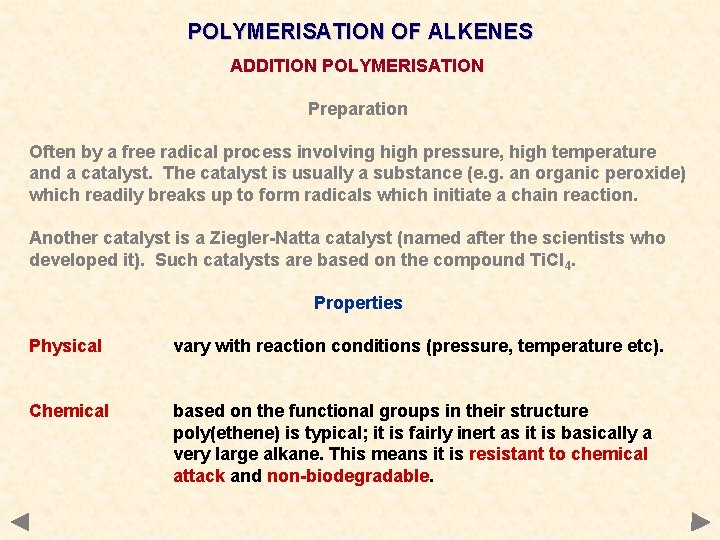
POLYMERISATION OF ALKENES ADDITION POLYMERISATION Preparation Often by a free radical process involving high pressure, high temperature and a catalyst. The catalyst is usually a substance (e. g. an organic peroxide) which readily breaks up to form radicals which initiate a chain reaction. Another catalyst is a Ziegler-Natta catalyst (named after the scientists who developed it). Such catalysts are based on the compound Ti. Cl 4. Properties Physical vary with reaction conditions (pressure, temperature etc). Chemical based on the functional groups in their structure poly(ethene) is typical; it is fairly inert as it is basically a very large alkane. This means it is resistant to chemical attack and non-biodegradable.
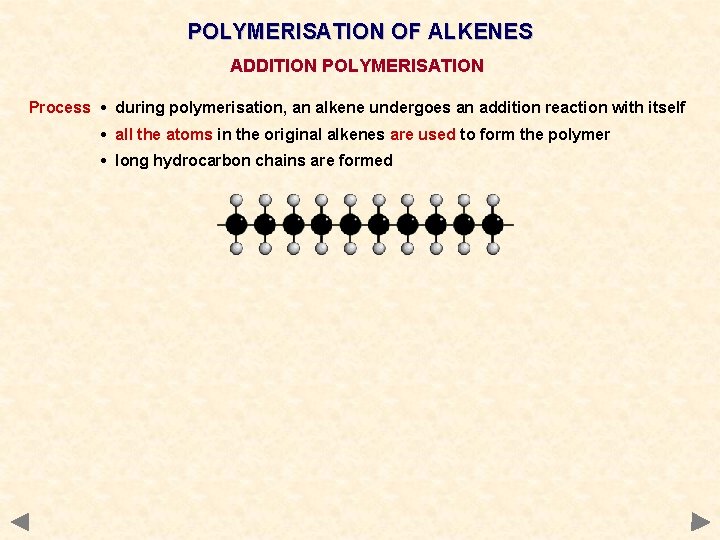
POLYMERISATION OF ALKENES ADDITION POLYMERISATION Process • during polymerisation, an alkene undergoes an addition reaction with itself • all the atoms in the original alkenes are used to form the polymer • long hydrocarbon chains are formed
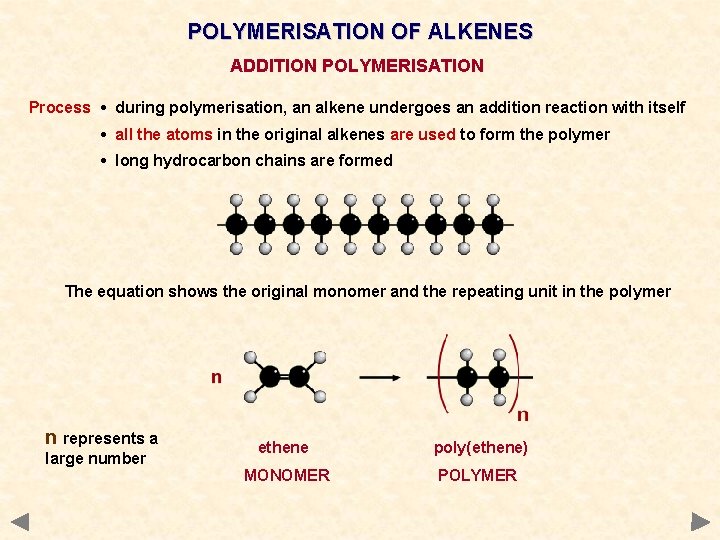
POLYMERISATION OF ALKENES ADDITION POLYMERISATION Process • during polymerisation, an alkene undergoes an addition reaction with itself • all the atoms in the original alkenes are used to form the polymer • long hydrocarbon chains are formed The equation shows the original monomer and the repeating unit in the polymer n represents a large number ethene poly(ethene) MONOMER POLYMER
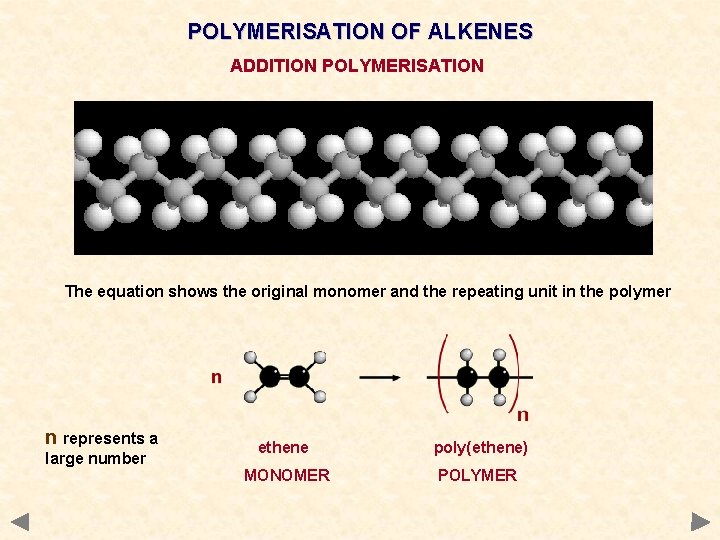
POLYMERISATION OF ALKENES ADDITION POLYMERISATION The equation shows the original monomer and the repeating unit in the polymer n represents a large number ethene poly(ethene) MONOMER POLYMER
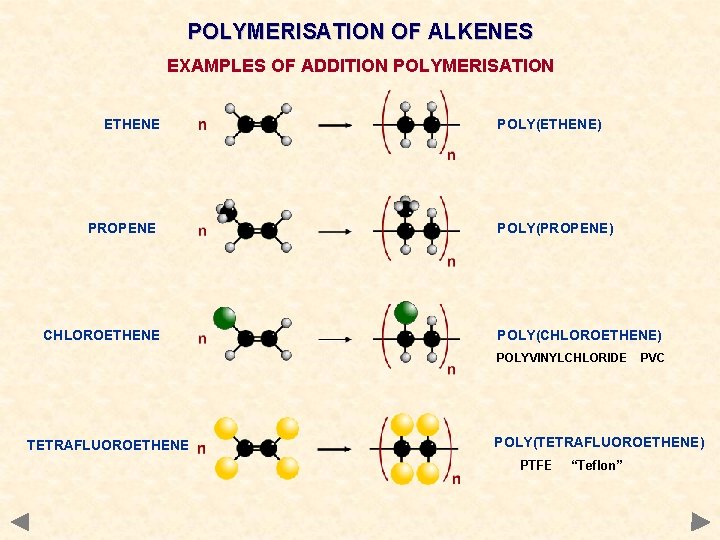
POLYMERISATION OF ALKENES EXAMPLES OF ADDITION POLYMERISATION ETHENE PROPENE CHLOROETHENE POLY(ETHENE) POLY(PROPENE) POLY(CHLOROETHENE) POLYVINYLCHLORIDE TETRAFLUOROETHENE PVC POLY(TETRAFLUOROETHENE) PTFE “Teflon”
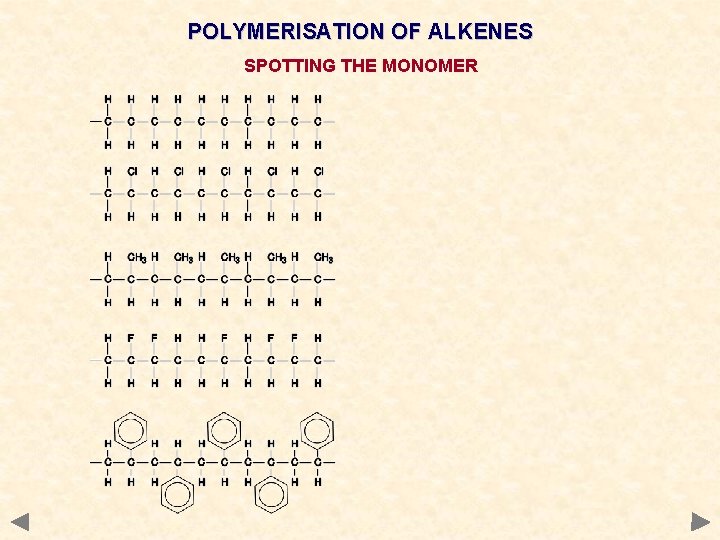
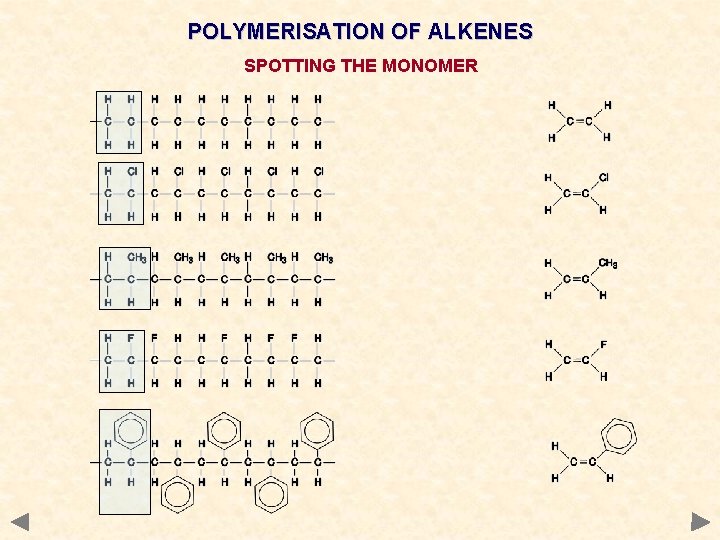
POLYMERISATION OF ALKENES SPOTTING THE MONOMER
POLYMERISATION OF ALKENES SPOTTING THE MONOMER
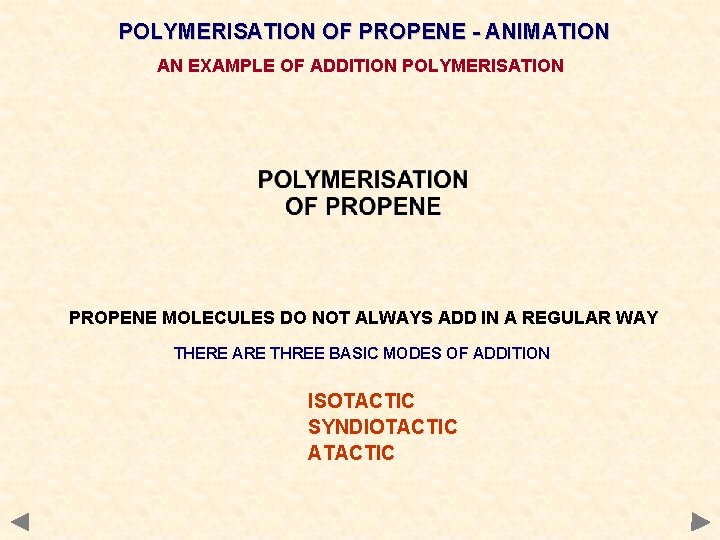
POLYMERISATION OF PROPENE - ANIMATION AN EXAMPLE OF ADDITION POLYMERISATION PROPENE MOLECULES DO NOT ALWAYS ADD IN A REGULAR WAY THERE ARE THREE BASIC MODES OF ADDITION ISOTACTIC SYNDIOTACTIC ATACTIC
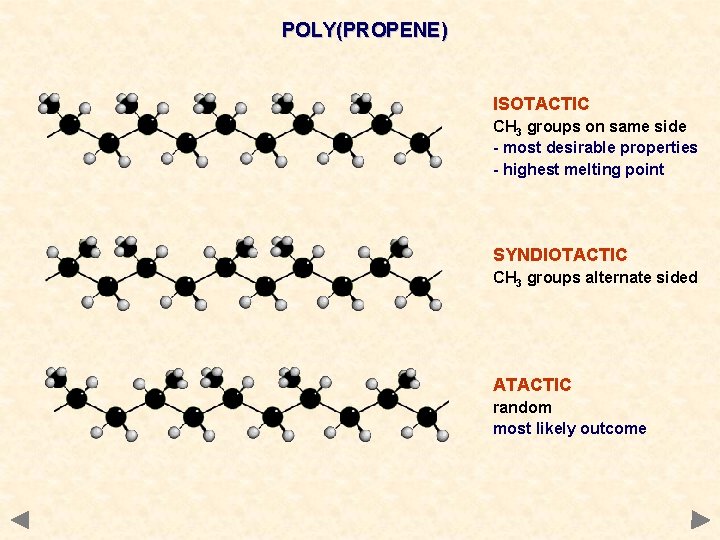
POLY(PROPENE) ISOTACTIC CH 3 groups on same side - most desirable properties - highest melting point SYNDIOTACTIC CH 3 groups alternate sided ATACTIC random most likely outcome
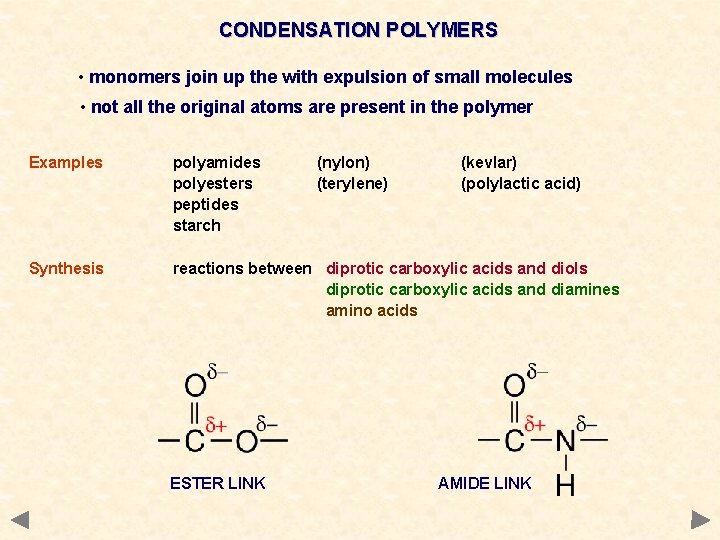
CONDENSATION POLYMERS • monomers join up the with expulsion of small molecules • not all the original atoms are present in the polymer Examples polyamides polyesters peptides starch Synthesis reactions between diprotic carboxylic acids and diols diprotic carboxylic acids and diamines amino acids ESTER LINK (nylon) (terylene) (kevlar) (polylactic acid) AMIDE LINK
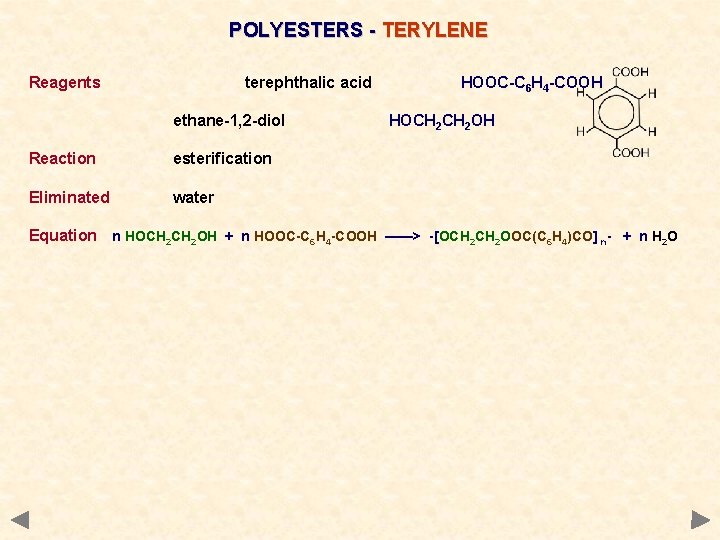
POLYESTERS - TERYLENE Reagents terephthalic acid ethane-1, 2 -diol Reaction esterification Eliminated water HOOC-C 6 H 4 -COOH HOCH 2 OH Equation n HOCH 2 OH + n HOOC-C 6 H 4 -COOH ——> -[OCH 2 OOC(C 6 H 4)CO] n- + n H 2 O
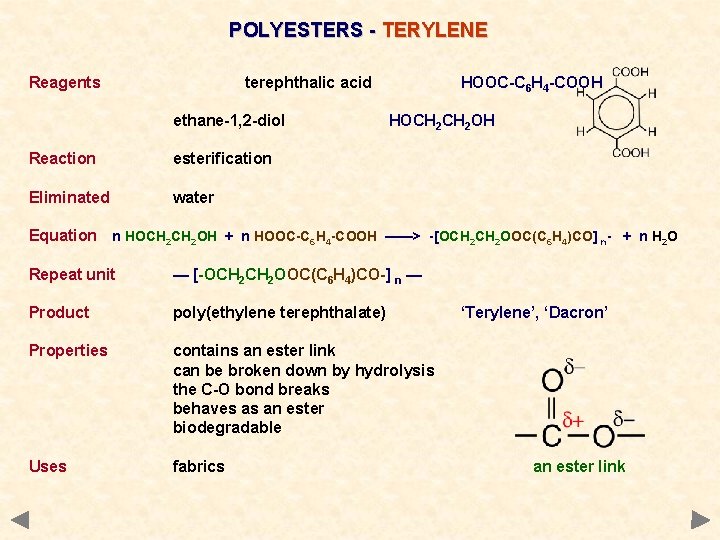
POLYESTERS - TERYLENE Reagents terephthalic acid ethane-1, 2 -diol Reaction esterification Eliminated water HOOC-C 6 H 4 -COOH HOCH 2 OH Equation n HOCH 2 OH + n HOOC-C 6 H 4 -COOH ——> -[OCH 2 OOC(C 6 H 4)CO] n- + n H 2 O Repeat unit — [-OCH 2 OOC(C 6 H 4)CO-] n — Product poly(ethylene terephthalate) Properties contains an ester link can be broken down by hydrolysis the C-O bond breaks behaves as an ester biodegradable Uses fabrics ‘Terylene’, ‘Dacron’ an ester link
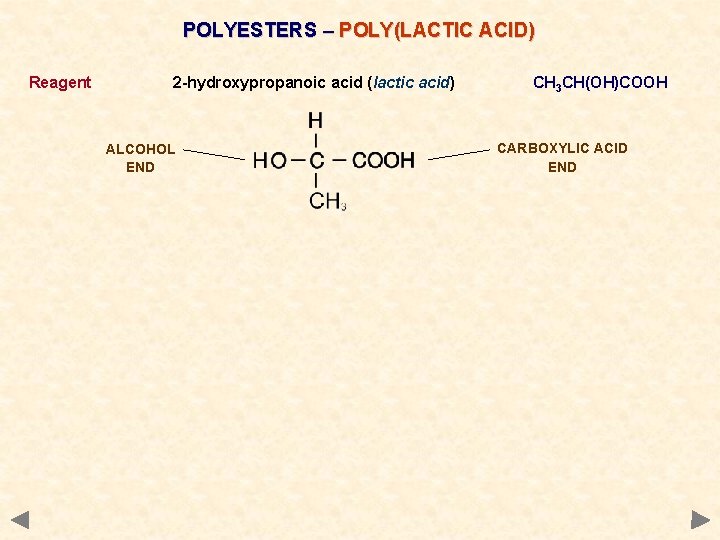
POLYESTERS – POLY(LACTIC ACID) Reagent 2 -hydroxypropanoic acid (lactic acid) ALCOHOL END CH 3 CH(OH)COOH CARBOXYLIC ACID END
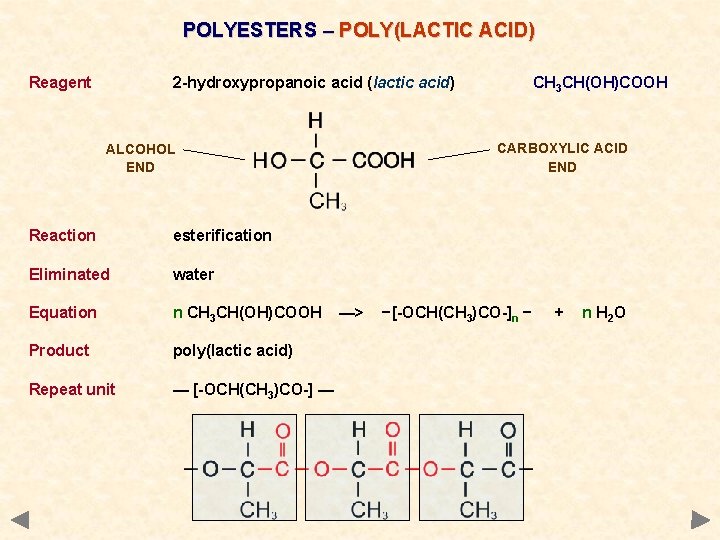
POLYESTERS – POLY(LACTIC ACID) Reagent 2 -hydroxypropanoic acid (lactic acid) CARBOXYLIC ACID END ALCOHOL END Reaction esterification Eliminated water Equation n CH 3 CH(OH)COOH Product poly(lactic acid) Repeat unit — [-OCH(CH 3)CO-] — CH 3 CH(OH)COOH —> −[-OCH(CH 3)CO-]n − + n H 2 O
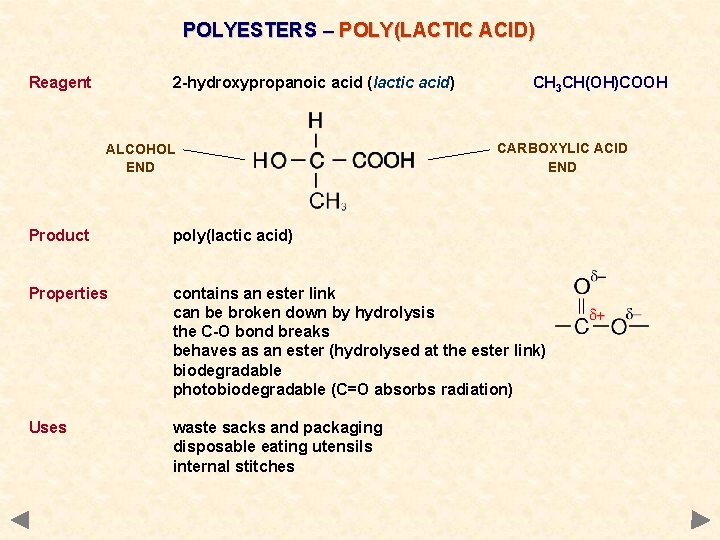
POLYESTERS – POLY(LACTIC ACID) Reagent 2 -hydroxypropanoic acid (lactic acid) ALCOHOL END CH 3 CH(OH)COOH CARBOXYLIC ACID END Product poly(lactic acid) Properties contains an ester link can be broken down by hydrolysis the C-O bond breaks behaves as an ester (hydrolysed at the ester link) biodegradable photobiodegradable (C=O absorbs radiation) Uses waste sacks and packaging disposable eating utensils internal stitches
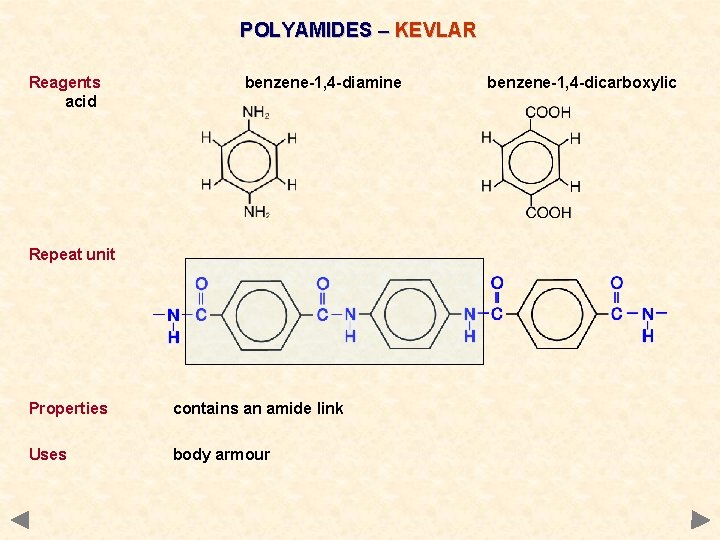
POLYAMIDES – KEVLAR Reagents acid benzene-1, 4 -diamine Repeat unit Properties contains an amide link Uses body armour benzene-1, 4 -dicarboxylic
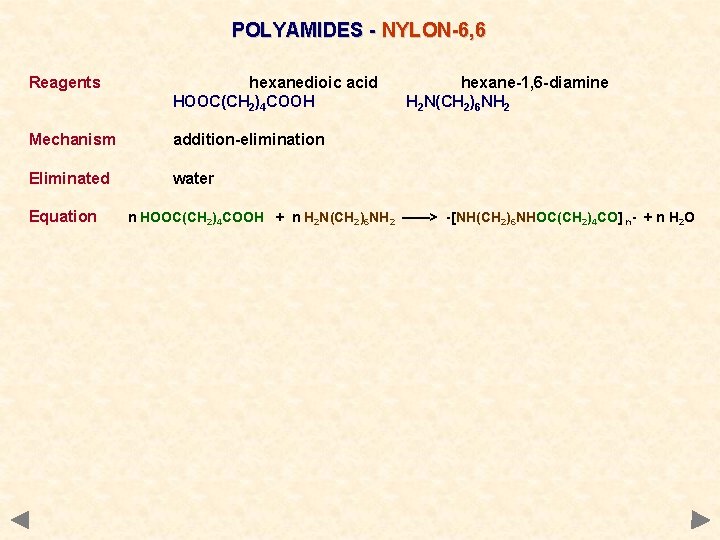
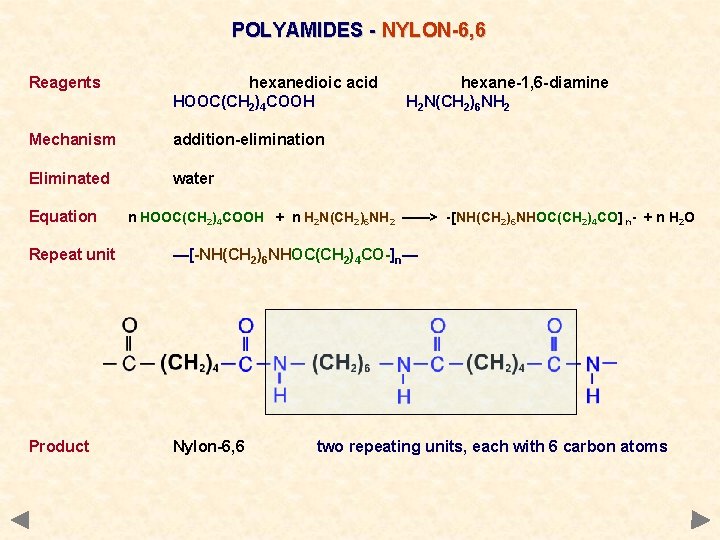
POLYAMIDES - NYLON-6, 6 Reagents hexanedioic acid HOOC(CH 2)4 COOH Mechanism addition-elimination Eliminated water Equation hexane-1, 6 -diamine H 2 N(CH 2)6 NH 2 n HOOC(CH 2)4 COOH + n H 2 N(CH 2)6 NH 2 ——> -[NH(CH 2)6 NHOC(CH 2)4 CO] n- + n H 2 O
POLYAMIDES - NYLON-6, 6 Reagents hexanedioic acid HOOC(CH 2)4 COOH Mechanism addition-elimination Eliminated water Equation hexane-1, 6 -diamine H 2 N(CH 2)6 NH 2 n HOOC(CH 2)4 COOH + n H 2 N(CH 2)6 NH 2 ——> -[NH(CH 2)6 NHOC(CH 2)4 CO] n- + n H 2 O Repeat unit —[-NH(CH 2)6 NHOC(CH 2)4 CO-]n— Product Nylon-6, 6 two repeating units, each with 6 carbon atoms
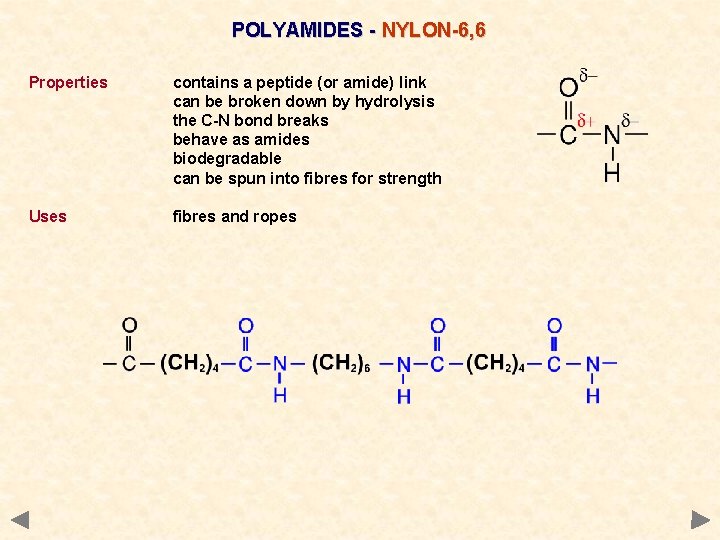
POLYAMIDES - NYLON-6, 6 Properties contains a peptide (or amide) link can be broken down by hydrolysis the C-N bond breaks behave as amides biodegradable can be spun into fibres for strength Uses fibres and ropes
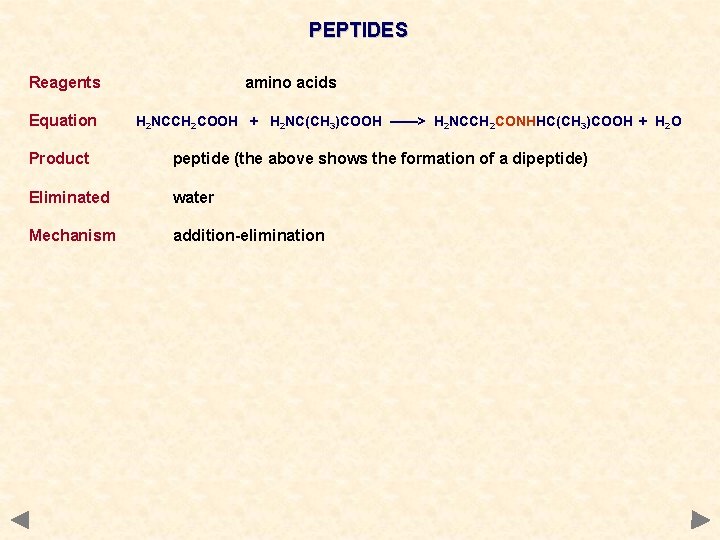
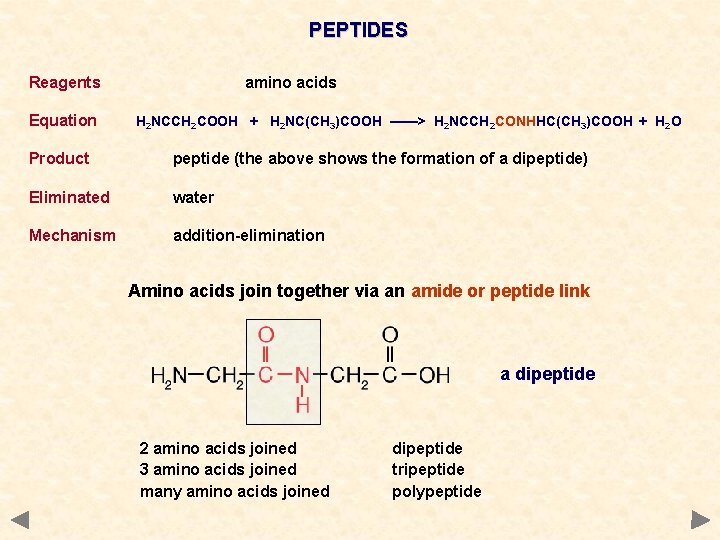
PEPTIDES Reagents Equation amino acids H 2 NCCH 2 COOH + H 2 NC(CH 3)COOH ——> H 2 NCCH 2 CONHHC(CH 3)COOH + H 2 O Product peptide (the above shows the formation of a dipeptide) Eliminated water Mechanism addition-elimination
PEPTIDES Reagents Equation amino acids H 2 NCCH 2 COOH + H 2 NC(CH 3)COOH ——> H 2 NCCH 2 CONHHC(CH 3)COOH + H 2 O Product peptide (the above shows the formation of a dipeptide) Eliminated water Mechanism addition-elimination Amino acids join together via an amide or peptide link a dipeptide 2 amino acids joined 3 amino acids joined many amino acids joined dipeptide tripeptide polypeptide
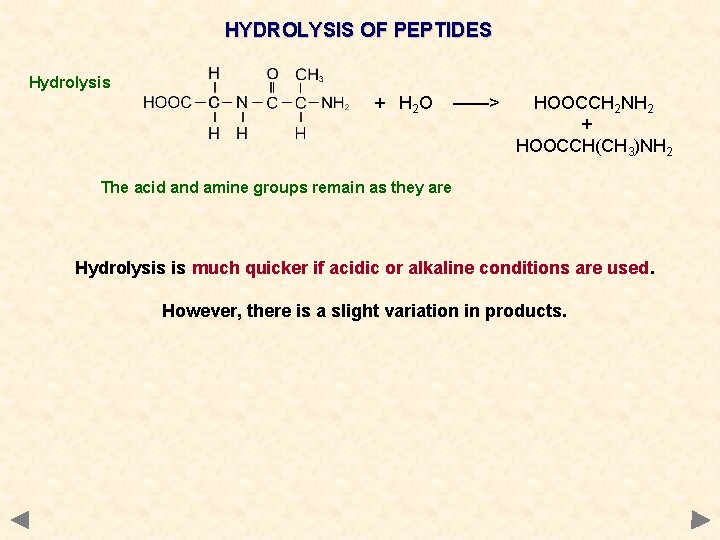
HYDROLYSIS OF PEPTIDES Hydrolysis + H 2 O ——> HOOCCH 2 NH 2 + HOOCCH(CH 3)NH 2 The acid and amine groups remain as they are Hydrolysis is much quicker if acidic or alkaline conditions are used. However, there is a slight variation in products.
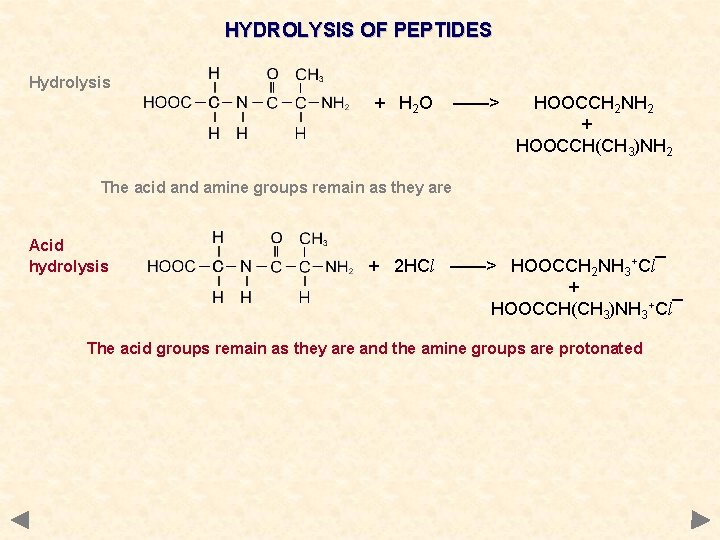
HYDROLYSIS OF PEPTIDES Hydrolysis + H 2 O ——> HOOCCH 2 NH 2 + HOOCCH(CH 3)NH 2 The acid and amine groups remain as they are Acid hydrolysis + 2 HCl ——> HOOCCH 2 NH 3+Cl¯ + HOOCCH(CH 3)NH 3+Cl¯ The acid groups remain as they are and the amine groups are protonated
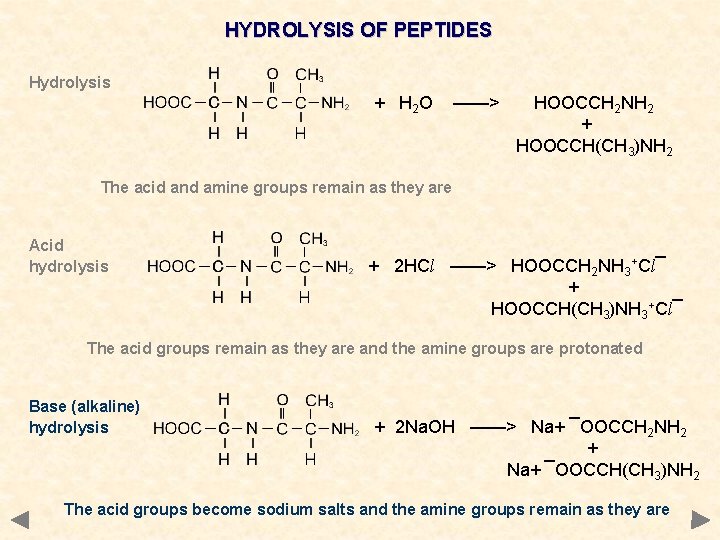
HYDROLYSIS OF PEPTIDES Hydrolysis + H 2 O ——> HOOCCH 2 NH 2 + HOOCCH(CH 3)NH 2 The acid and amine groups remain as they are Acid hydrolysis + 2 HCl ——> HOOCCH 2 NH 3+Cl¯ + HOOCCH(CH 3)NH 3+Cl¯ The acid groups remain as they are and the amine groups are protonated Base (alkaline) hydrolysis + 2 Na. OH ——> Na+ ¯OOCCH 2 NH 2 + Na+ ¯OOCCH(CH 3)NH 2 The acid groups become sodium salts and the amine groups remain as they are
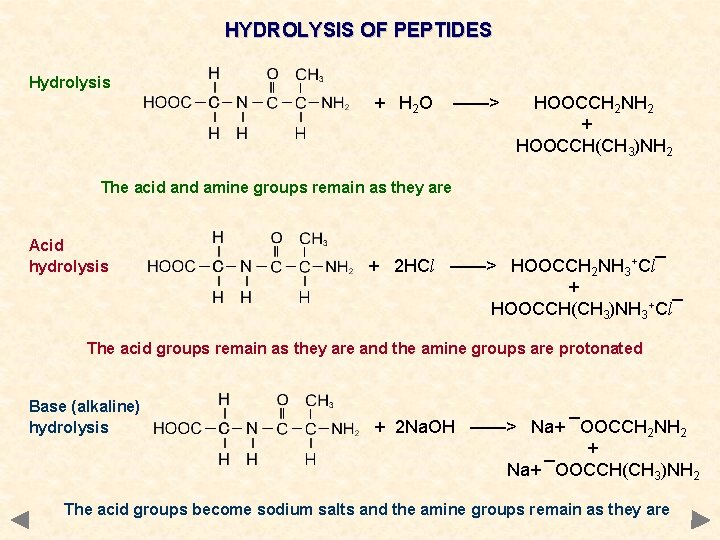
HYDROLYSIS OF PEPTIDES Hydrolysis + H 2 O ——> HOOCCH 2 NH 2 + HOOCCH(CH 3)NH 2 The acid and amine groups remain as they are Acid hydrolysis + 2 HCl ——> HOOCCH 2 NH 3+Cl¯ + HOOCCH(CH 3)NH 3+Cl¯ The acid groups remain as they are and the amine groups are protonated Base (alkaline) hydrolysis + 2 Na. OH ——> Na+ ¯OOCCH 2 NH 2 + Na+ ¯OOCCH(CH 3)NH 2 The acid groups become sodium salts and the amine groups remain as they are
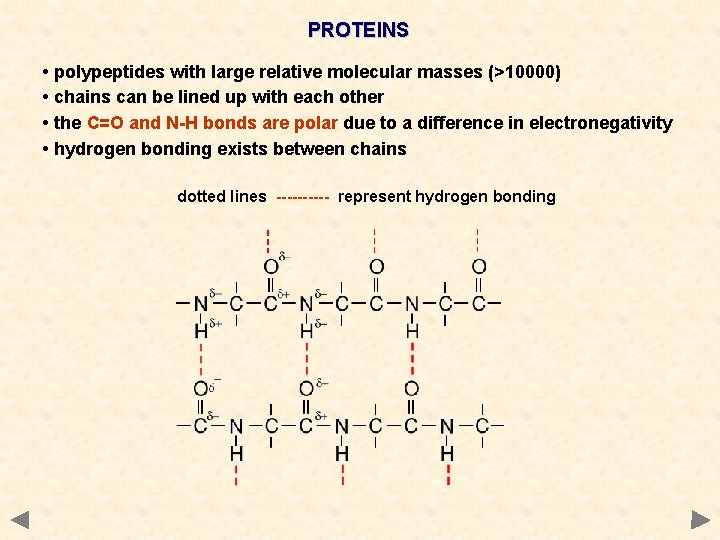
PROTEINS • polypeptides with large relative molecular masses (>10000) • chains can be lined up with each other • the C=O and N-H bonds are polar due to a difference in electronegativity • hydrogen bonding exists between chains dotted lines ----- represent hydrogen bonding
THE CHEMISTRY OF POLYMERS THE END © 2009 JONATHAN HOPTON & KNOCKHARDY PUBLISHING