The California Health Interview Survey Population Health Data
- Slides: 23
The California Health Interview Survey: Population Health Data for Young Children Todd Hughes, CHIS Director UCLA Center for Health Policy Research 1
Why First 5 California’s Support of CHIS is Important for Children and Families § CHIS data help provide the foundation for evidencebased decision making to support healthy children and their families in California § § § 2 How healthy are our children? What is the prevalence of conditions and behaviors? Which children are at greatest risk? Where do they live? What languages do they speak? Are priority outcomes improving, worsening, or staying the same?
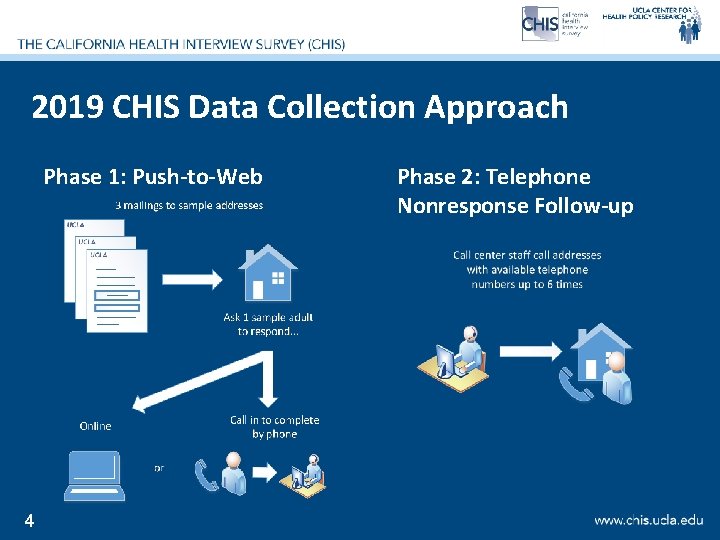
How is CHIS done? § Through 2018, employed Computer-Assisted Telephone Interview (CATI) with a blend of cell phone and landline numbers. In 2019 moving to address-based sampling with a blend of mail push-to-web and telephone response. § CHIS collects detailed information for: § One adult (age 18+) in the household, § One adolescent (age 12 -17) if present, and § One child (age 0 -11) if present (through an interview of a knowledgeable adult) § Interviews conducted in 6 languages: § English, Spanish, Chinese (Cantonese and Mandarin), Korean, Vietnamese, and Tagalog § Ethnic oversamples (Korean and Vietnamese) ensure representativeness 3
2019 CHIS Data Collection Approach Phase 1: Push-to-Web 4 Phase 2: Telephone Nonresponse Follow-up
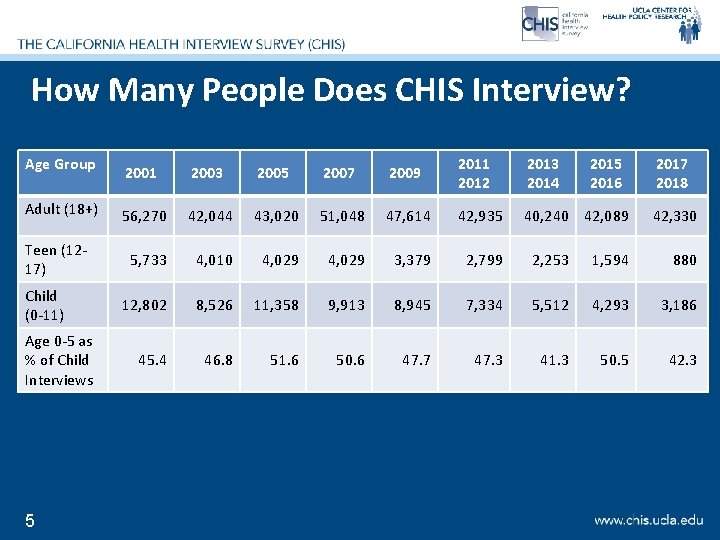
How Many People Does CHIS Interview? Age Group Adult (18+) Teen (1217) Child (0 -11) Age 0 -5 as % of Child Interviews 5 2001 2003 2005 2007 2009 2011 2012 2013 2014 2015 2016 2017 2018 56, 270 42, 044 43, 020 51, 048 47, 614 42, 935 40, 240 42, 089 5, 733 4, 010 4, 029 3, 379 2, 799 2, 253 1, 594 880 12, 802 8, 526 11, 358 9, 913 8, 945 7, 334 5, 512 4, 293 3, 186 45. 4 46. 8 51. 6 50. 6 47. 7 47. 3 41. 3 50. 5 42. 3 42, 330
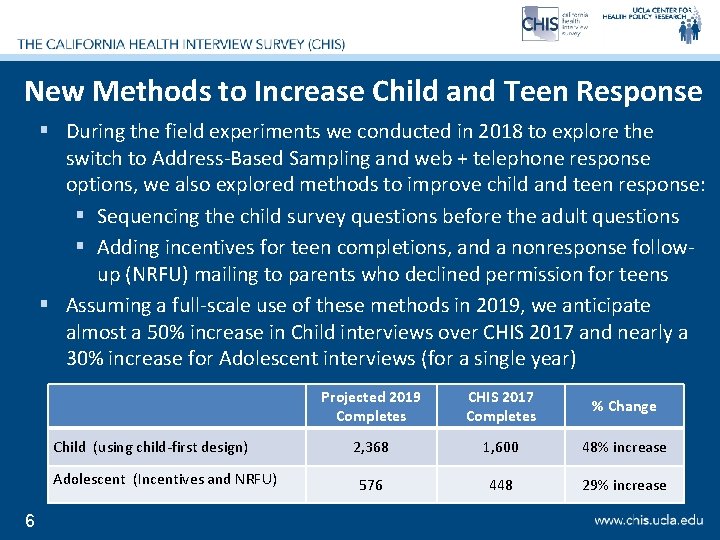
New Methods to Increase Child and Teen Response § During the field experiments we conducted in 2018 to explore the switch to Address-Based Sampling and web + telephone response options, we also explored methods to improve child and teen response: § Sequencing the child survey questions before the adult questions § Adding incentives for teen completions, and a nonresponse followup (NRFU) mailing to parents who declined permission for teens § Assuming a full-scale use of these methods in 2019, we anticipate almost a 50% increase in Child interviews over CHIS 2017 and nearly a 30% increase for Adolescent interviews (for a single year) Child (using child-first design) Adolescent (Incentives and NRFU) 6 Projected 2019 Completes CHIS 2017 Completes % Change 2, 368 1, 600 48% increase 576 448 29% increase
CHIS Funders § CHIS is funded by a variety of state and local agencies, California and national foundations, and others § First 5 California has been a major funding partner for CHIS data on children since 2001 7
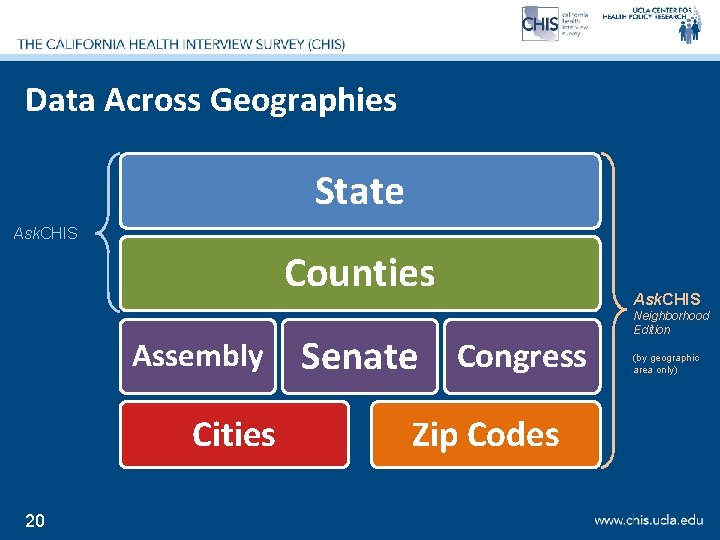
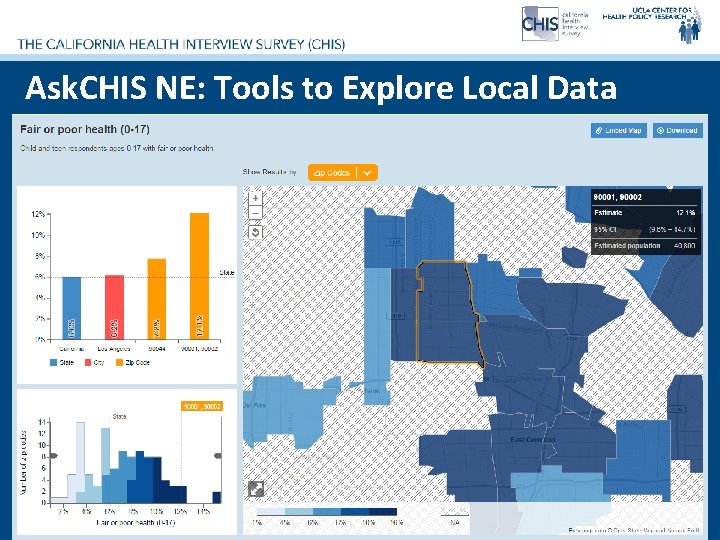
CHIS Provides Estimates for Local First 5 Agencies § Because the CHIS sample is large and represents counties and county groups, CHIS data has relevance for local First 5 Agencies § UCLA CHIS Dissemination Products for Local Estimates § Ask. CHIS (county estimates) § Ask. CHIS Neighborhood Edition (zip code estimates) § Health Profiles (counties and regions) 8
CHIS Data & Findings Widely Disseminated § Dissemination of data & findings: § Publications § Online tools: Ask. CHIS and Health Profiles § Data files § Public use files (adult, child, adolescent) § Confidential (including a child file to First 5 California) § CHIS child health information disseminated by others § Children Now’s California Report Card & County Scorecard of Children’s Well-Being § Kidsdata. org (Lucille Packard Foundation) § Various county health reports 9
First 5 California CHIS Funding § The funding request of $1. 7 M for the 2019 -2020 CHIS cycle represents 8. 6% of the total estimated program budget of $19. 7 M § Roughly half of this amount supports UCLA staff who design and analyze the survey, and the other half supports data collection about children § First 5 California funds for data collection are allocated as follows: § 60% for requested content for child-related questions § 20% for questions for adults related to those children § 20% for oversampling to ensure sufficient sample size for completed child questionnaires for children age 0 -5 10
CHIS Collects Policy-Relevant Information § § § § § 11 Rich set of demographic data Health behaviors and conditions Health care access and utilization (doctors and dentists) Health insurance coverage and uninsured (eligibility of uninsured for Medi-Cal, Covered California) Social engagement Pre-school attendance Neighborhood safety Neighborhood environment for raising young children Park access and safety
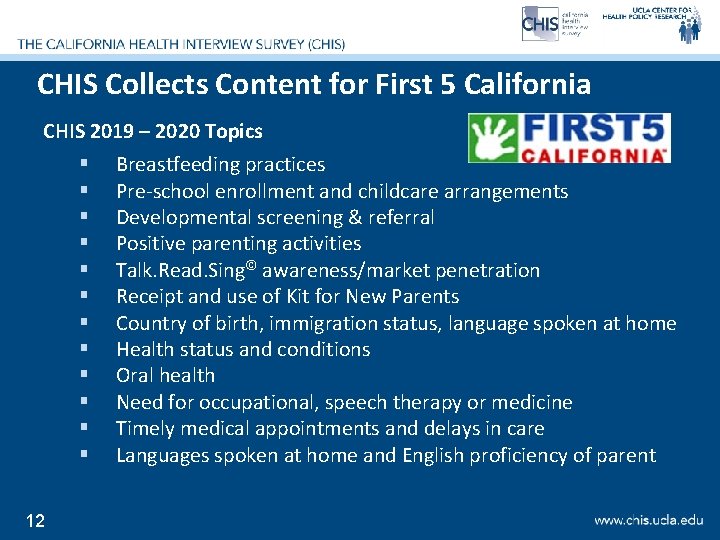
CHIS Collects Content for First 5 California CHIS 2019 – 2020 Topics § Breastfeeding practices § Pre-school enrollment and childcare arrangements § Developmental screening & referral § Positive parenting activities § Talk. Read. Sing© awareness/market penetration § Receipt and use of Kit for New Parents § Country of birth, immigration status, language spoken at home § Health status and conditions § Oral health § Need for occupational, speech therapy or medicine § Timely medical appointments and delays in care § Languages spoken at home and English proficiency of parent 12
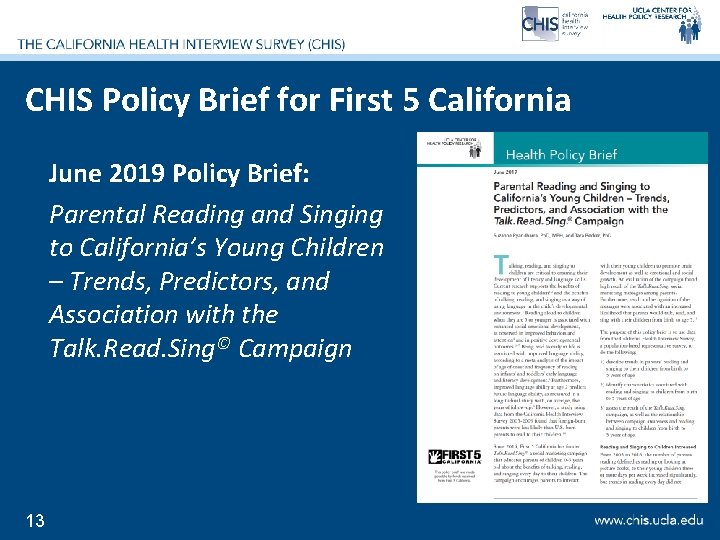
CHIS Policy Brief for First 5 California June 2019 Policy Brief: Parental Reading and Singing to California’s Young Children – Trends, Predictors, and Association with the Talk. Read. Sing© Campaign 13
Findings from the Talk. Read. Sing© Policy Brief § Based on an analysis of 2015 -16 CHIS data, UCLA researchers found: § Most parents are reading and singing to their young children (88% reading three times or more per week, 91% singing three times or more per week) § Recognition of the message of the TRS campaign is high (87%) § Parents who have seen the message are: § Nearly 3 times more likely to read to their child three days or more per week § Twice as likely to sing to their child three days or more per week 14
Findings from the Talk. Read. Sing© Policy Brief § There is still room for improvement: § Parents who are foreign-born or who speak Spanish at home are less likely to read or sing to their young children than both their U. S. -born counterparts and those who do not speak Spanish at home § Parents that speak Spanish at home or that speak both English and Spanish at home are less likely to read to their children compared to parents who speak only English, even when adjusting for education § Foreign-born parents are less likely to sing to their children, even when adjusting for education and race-ethnicity 15
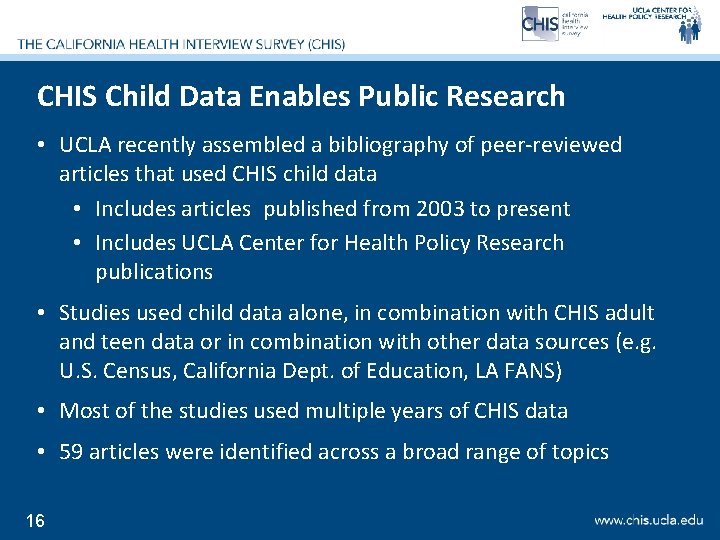
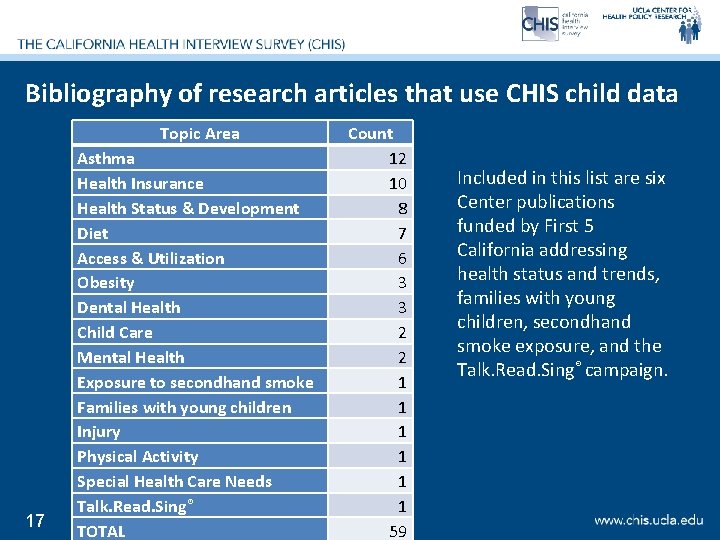
CHIS Child Data Enables Public Research • UCLA recently assembled a bibliography of peer-reviewed articles that used CHIS child data • Includes articles published from 2003 to present • Includes UCLA Center for Health Policy Research publications • Studies used child data alone, in combination with CHIS adult and teen data or in combination with other data sources (e. g. U. S. Census, California Dept. of Education, LA FANS) • Most of the studies used multiple years of CHIS data • 59 articles were identified across a broad range of topics 16
Bibliography of research articles that use CHIS child data Topic Area 17 Asthma Health Insurance Health Status & Development Diet Access & Utilization Obesity Dental Health Child Care Mental Health Exposure to secondhand smoke Families with young children Injury Physical Activity Special Health Care Needs Talk. Read. Sing® TOTAL Count 12 10 8 7 6 3 3 2 2 1 1 1 59 Included in this list are six Center publications funded by First 5 California addressing health status and trends, families with young children, secondhand smoke exposure, and the Talk. Read. Sing® campaign.
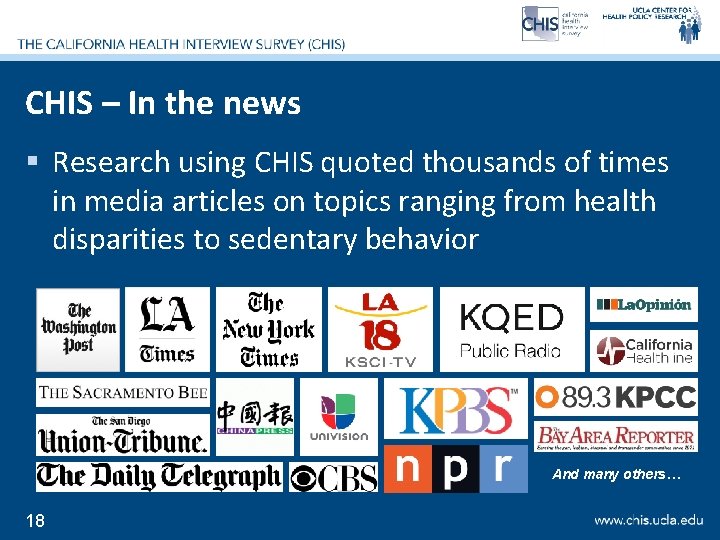
CHIS – In the news § Research using CHIS quoted thousands of times in media articles on topics ranging from health disparities to sedentary behavior And many others… 18
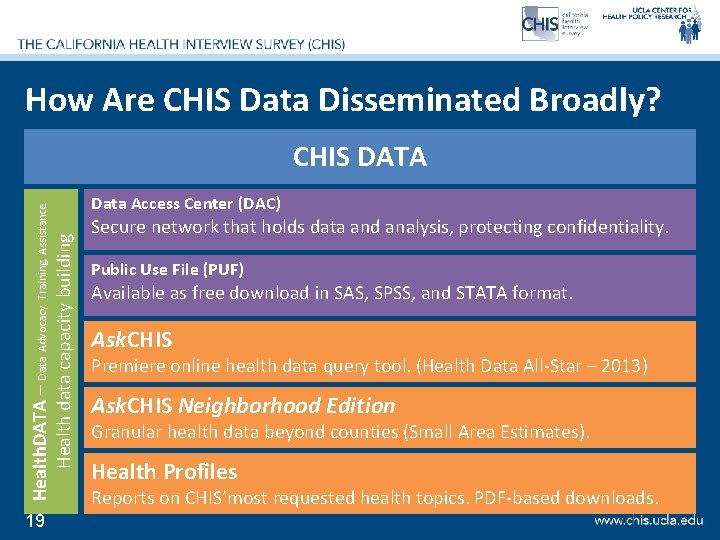
How Are CHIS Data Disseminated Broadly? Health. DATA – Data. Advocacy. Training. Assistance. Health data capacity building CHIS DATA 19 Data Access Center (DAC) Secure network that holds data and analysis, protecting confidentiality. Public Use File (PUF) Available as free download in SAS, SPSS, and STATA format. Ask. CHIS Premiere online health data query tool. (Health Data All-Star – 2013) Ask. CHIS Neighborhood Edition Granular health data beyond counties (Small Area Estimates). Health Profiles Reports on CHIS’most requested health topics. PDF-based downloads.
Data Across Geographies State Ask. CHIS Counties Assembly Cities 20 Senate Congress Zip Codes Ask. CHIS Neighborhood Edition (by geographic area only)
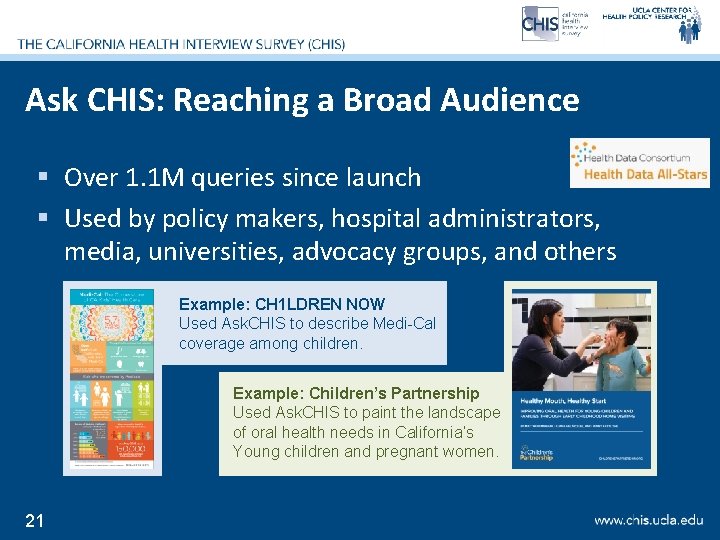
Ask CHIS: Reaching a Broad Audience § Over 1. 1 M queries since launch § Used by policy makers, hospital administrators, media, universities, advocacy groups, and others Example: CH 1 LDREN NOW Used Ask. CHIS to describe Medi-Cal coverage among children. Example: Children’s Partnership Used Ask. CHIS to paint the landscape of oral health needs in California’s Young children and pregnant women. 21
Ask. CHIS NE: Tools to Explore Local Data 22
Thank you CHIS awarded 2019 Health Services Impact Award, Academy. Health 23