The application of the laws of operation Operation



- Slides: 15
The application of the laws of operation
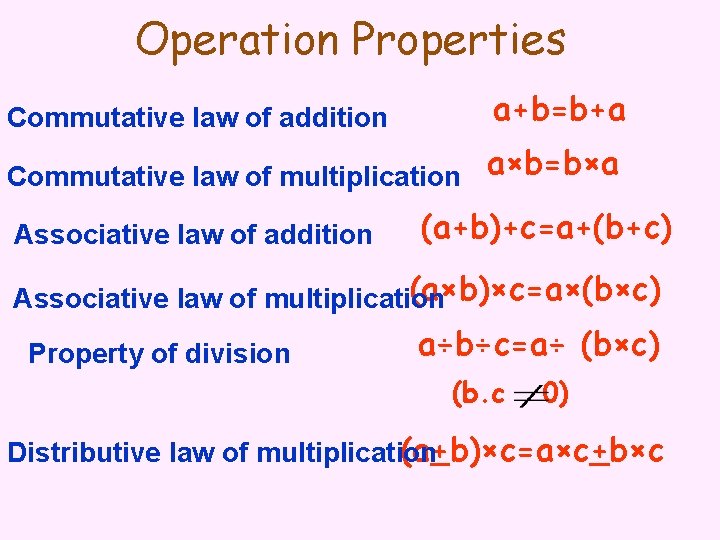
Operation Properties Commutative law of addition a+b=b+a Commutative law of multiplication a×b=b×a Associative law of addition (a+b)+c=a+(b+c) (a×b)×c=a×(b×c) Associative law of multiplication Property of division a÷b÷c=a÷ (b×c) (b. c 0) (a+b)×c=a×c+b×c Distributive law of multiplication
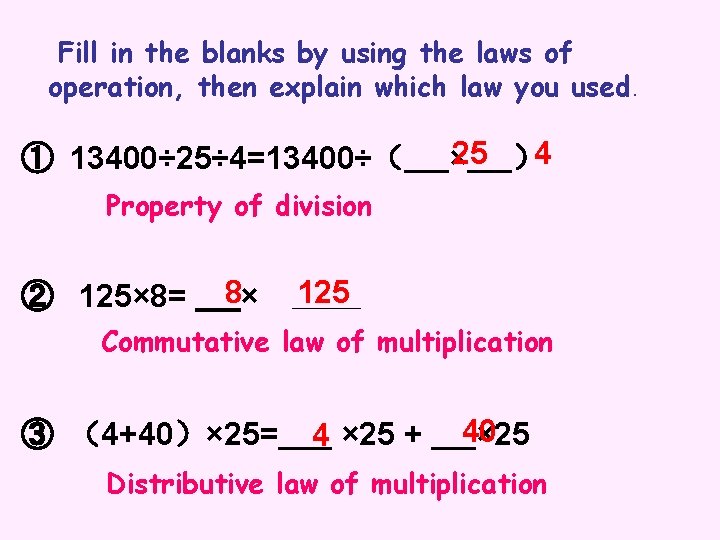
Fill in the blanks by using the laws of operation, then explain which law you used. ① 13400÷ 25÷ 4=13400÷( × 25 )4 Property of division ② 125× 8= 8× 125 Commutative law of multiplication ③ (4+40)× 25= 4 × 25 + 40 × 25 Distributive law of multiplication
Make tens I say “ 1” You say “ 9”
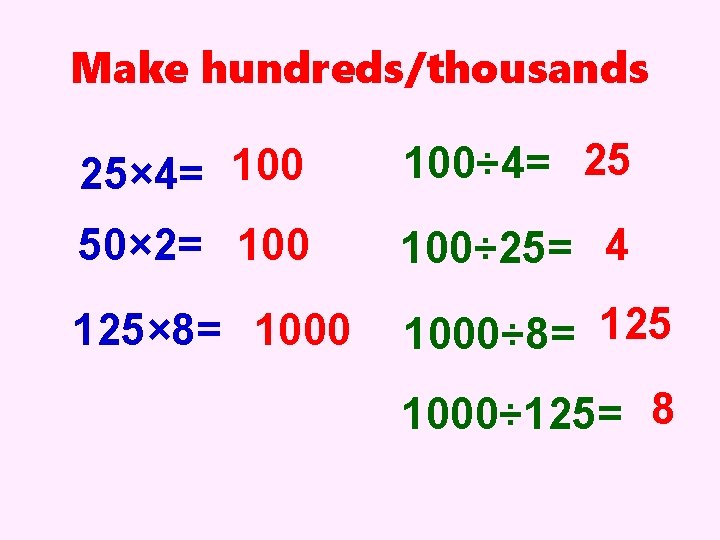
Make hundreds/thousands 25× 4= 100÷ 4= 25 50× 2= 100÷ 25= 4 125× 8= 1000÷ 8= 125 1000÷ 125= 8
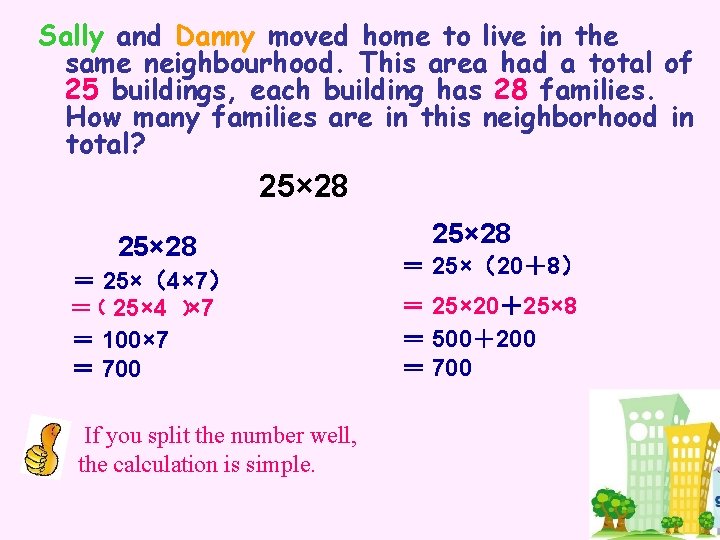
Sally and Danny moved home to live in the same neighbourhood. This area had a total of 25 buildings, each building has 28 families. How many families are in this neighborhood in total? 25× 28 = 25×(4× 7) =( 25× 4 ) × 7 = 100× 7 = 700 If you split the number well, the calculation is simple. 25× 28 = 25×(20+8) = 25× 20+25× 8 = 500+200 = 700
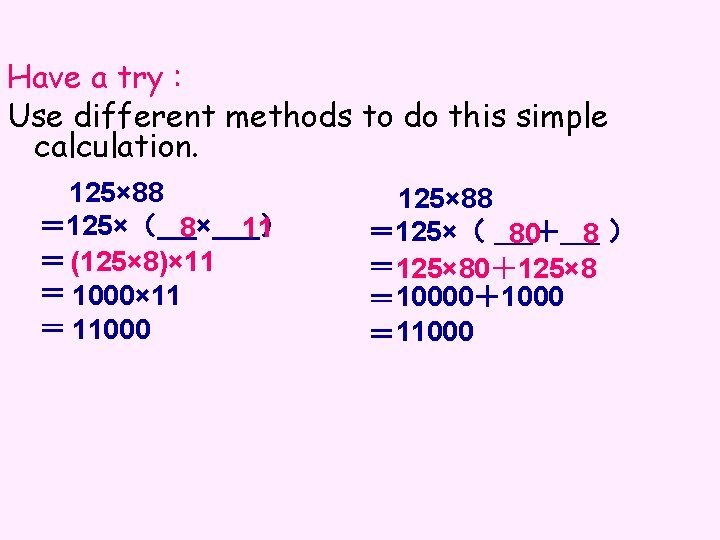
Have a try : Use different methods to do this simple calculation. 125× 88 = 125×( 8× 11) = (125× 8)× 11 = 1000× 11 = 11000 125× 88 = 125×( 80+ 8 ) = 125× 80+125× 8 = 10000+1000 = 11000
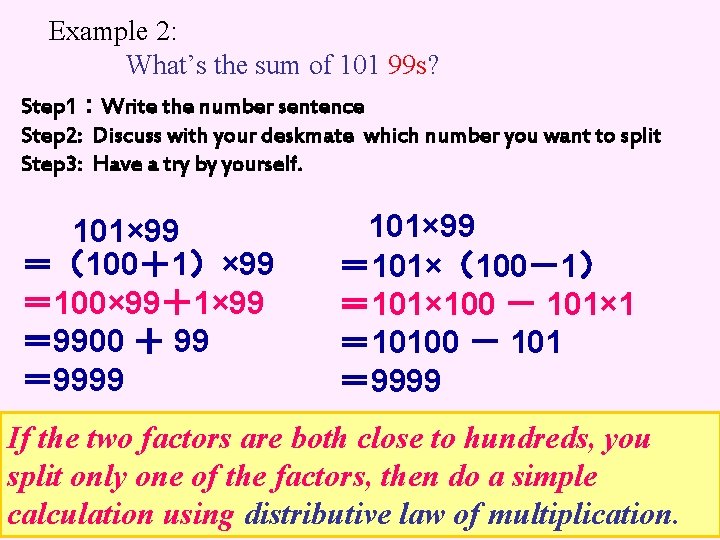
Example 2: What’s the sum of 101 99 s? Step 1:Write the number sentence Step 2: Discuss with your deskmate which number you want to split Step 3: Have a try by yourself. 101× 99 =(100+1)× 99 = 100× 99+1× 99 = 9900 + 99 = 9999 101× 99 = 101×(100-1) = 101× 100 - 101× 1 = 10100 - 101 = 9999 If the two factors are both close to hundreds, you split only one of the factors, then do a simple calculation using distributive law of multiplication.
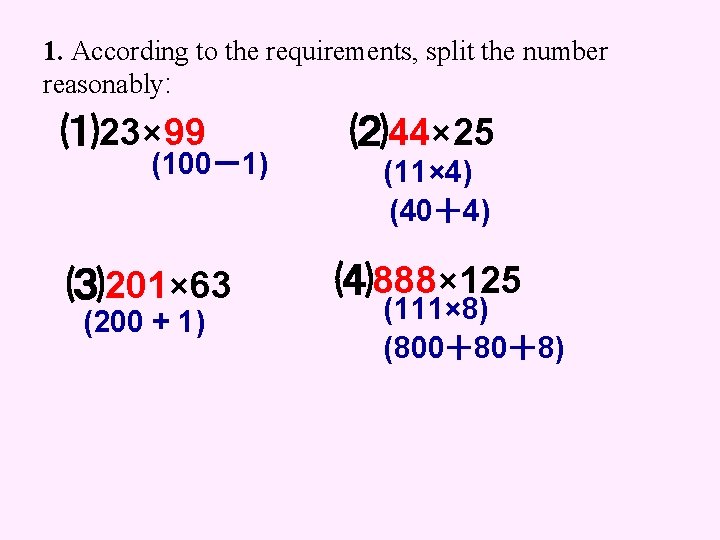
1. According to the requirements, split the number reasonably: ⑴ 23× 99 (100-1) ⑶ 201× 63 (200 + 1) ⑵ 44× 25 (11× 4) (40+4) ⑷ 888× 125 (111× 8) (800+80+8)
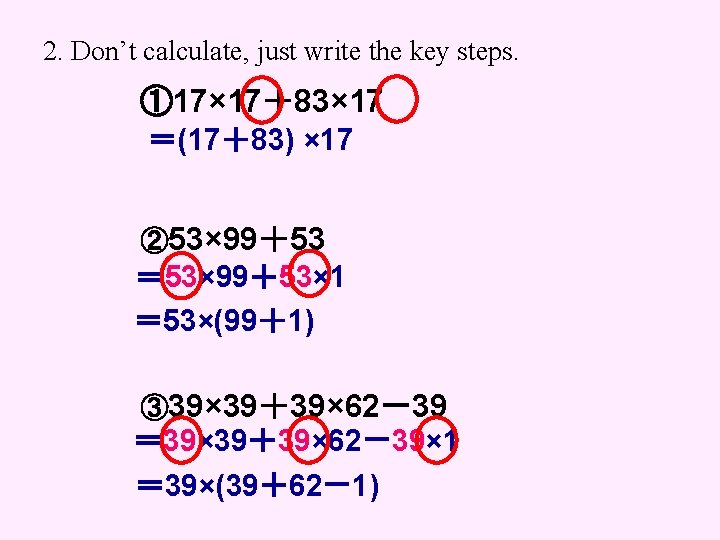
2. Don’t calculate, just write the key steps. ① 17× 17+83× 17 =(17+83) × 17 ② 53× 99+53 = 53× 99+53× 1 = 53×(99+1) ③ 39× 39+39× 62-39 = 39× 39+39× 62-39× 1 = 39×(39+62-1)
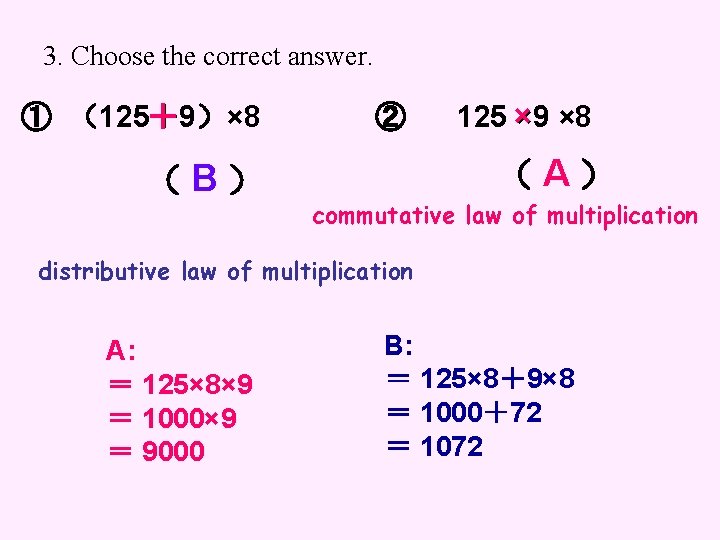
3. Choose the correct answer. ① (125+9)× 8 + (B) ② 125 × × 9 × 8 (A) commutative law of multiplication distributive law of multiplication A: = 125× 8× 9 = 1000× 9 = 9000 B: = 125× 8+9× 8 = 1000+72 = 1072
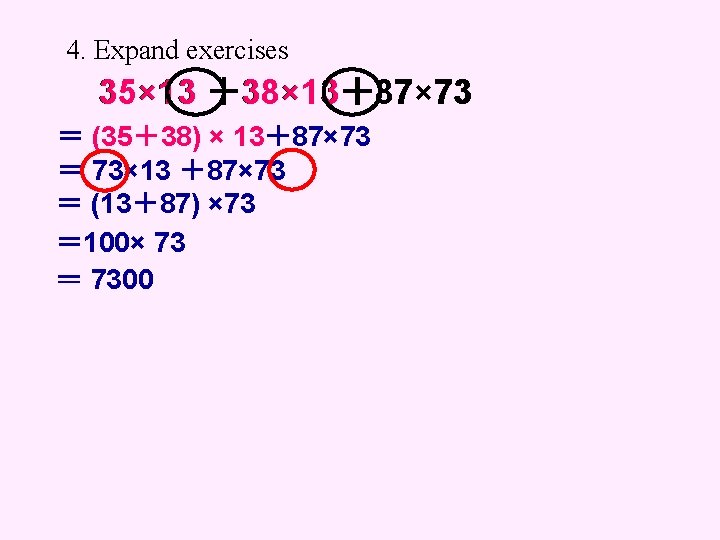
4. Expand exercises 35× 13 +38× 13+87× 73 = (35+38) × 13+87× 73 = 73× 13 +87× 73 = (13+87) × 73 = 100× 73 = 7300
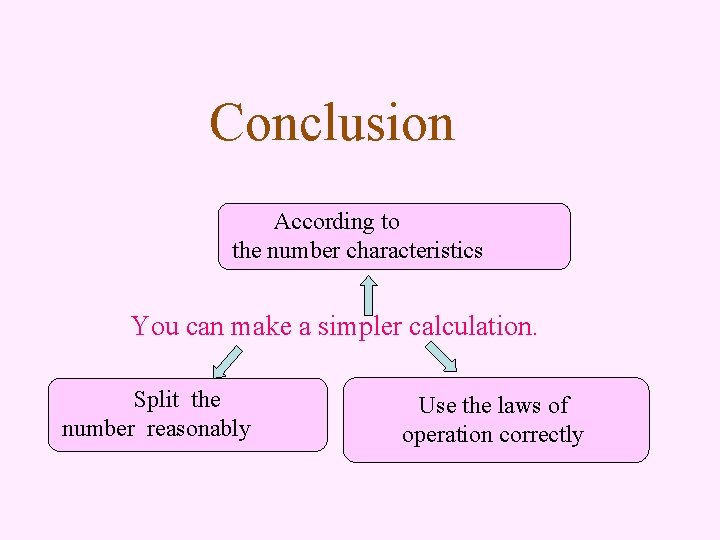
Conclusion According to the number characteristics You can make a simpler calculation. Split the number reasonably Use the laws of operation correctly
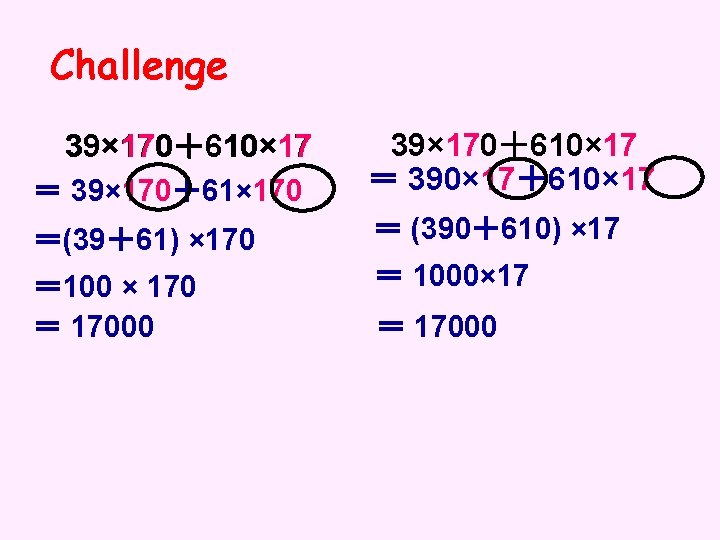
Challenge = 39× 170+61× 170 39× 170+610× 17 = 390× 17+610× 17 =(39+61) × 170 = (390+610) × 17 = 100 × 170 = 17000 = 1000× 17 39× 170+610× 17 = 17000
Thank you!