The 2019 IEEE International Conference on Acoustics Speech

- Slides: 25
The 2019 IEEE International Conference on Acoustics, Speech and Signal Processing BREAST CANCER DETECTION BASED ON MERGING FOUR MODES MRI USING CONVOLUTIONAL NEURAL NETWORKS 1
The 2019 IEEE International Conference on Acoustics, Speech and Signal Processing Outline l Introduction l Experimental Methodology l Dataset l Classification in Breast Cancer Detection l Segmentation l Results l Conclusions in Breast Cancer Detection 2
The 2019 IEEE International Conference on Acoustics, Speech and Signal Processing 3 Introduction l Background: Ø Breast Ø MRI cancer is the most prevalent type of cancer in women worldwide. becomes the most important method for the detection of breast cancer. Ø Deep convolutional neural networks have become effective models for tackling a variety of visual tasks. Ø Using Computer Aided Diagnosis (CAD) systems is an usual method for breast cancer detection now.
The 2019 IEEE International Conference on Acoustics, Speech and Signal Processing Introduction l Disadvantages: Ø The breast cancer detection performance may vary due to subjective observations by radiologists and clinicians. Ø Through Computer Aided Diagnosis (CAD) systems, examiners usually study images from a single sequence imaging mode at a time. Ø Tumor delineation is affected by variations and uncertainties in the automated lesion segmentation process. These variations of the intensity, texture, and morphology of the tumor lead to inconsistency in diagnostic outcome. 4
The 2019 IEEE International Conference on Acoustics, Speech and Signal Processing Outline l Introduction l Experimental Methodology l Dataset l Classification in Breast Cancer Detection l Segmentation l Results l Conclusions in Breast Cancer Detection 5
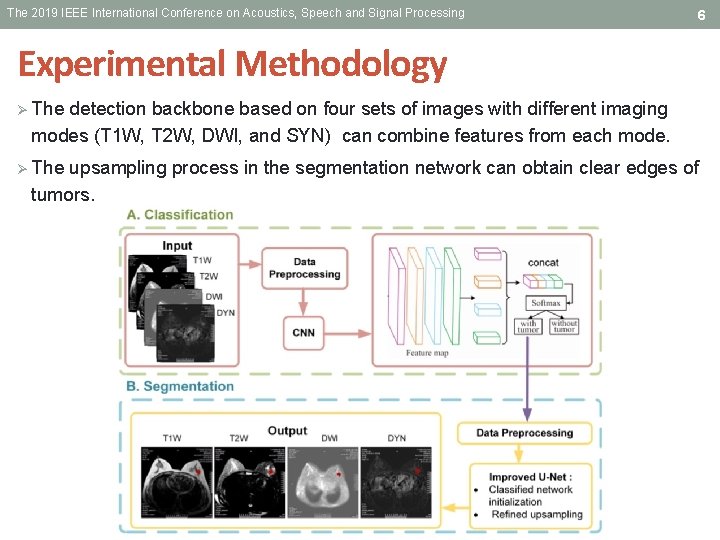
The 2019 IEEE International Conference on Acoustics, Speech and Signal Processing 6 Experimental Methodology Ø The detection backbone based on four sets of images with different imaging modes (T 1 W, T 2 W, DWI, and SYN) can combine features from each mode. Ø The upsampling process in the segmentation network can obtain clear edges of tumors.
The 2019 IEEE International Conference on Acoustics, Speech and Signal Processing Outline l Introduction l Experimental Methodology l Dataset l Classification in Breast Cancer Detection l Segmentation l Results l Conclusions in Breast Cancer Detection 7
The 2019 IEEE International Conference on Acoustics, Speech and Signal Processing Dataset l Dataset • A total of 67 MRI breast examinations from high-risk patients from the Tianjin Center Obstetrics and Gynecology Hospital are included, containing 8, 132 images. After a selection process, 6, 000 images were used for classification, and 1, 800 images are used for segmentation. l Data augmentation • We only focus on effective information related to the tumor. The chest portion in the images is removed, leaving only the breast tissue, the subphrenic region where often shows lymph nodes, and the wall of the thoracic cavity that often adhered to the tumor. • Multiple patches are selected in the images. The methods here are random-size cropping and random horizontal flipping. 8
The 2019 IEEE International Conference on Acoustics, Speech and Signal Processing Outline l Introduction l Experimental Methodology l Dataset l Classification in Breast Cancer Detection l Segmentation l Results l Conclusions in Breast Cancer Detection 9
The 2019 IEEE International Conference on Acoustics, Speech and Signal Processing Classification in Breast Cancer Detection In the proposed backbone, the images of the four sequences are passed through the convolutional neural network in order. Then, four types of feature maps are acquired as the output of the CNN models. The dataset used in our experiment is an MRI database built at the radiology department of the Tianjin Center Obstetrics and Gynecology Hospital. The T 2 W_SPARI, T 1 W_TSE, DWI_SSh, and DYN_e. THRIVE+C images are mainly to be considered in this experiment. The multiple patches are selected in the image. The method here use randomsize cropping and random horizontal flipping. 1 0
The 2019 IEEE International Conference on Acoustics, Speech and Signal Processing Classification in Breast Cancer Detection 1 1
The 2019 IEEE International Conference on Acoustics, Speech and Signal Processing Classification in Breast Cancer Detection 12
The 2019 IEEE International Conference on Acoustics, Speech and Signal Processing Classification in Breast Cancer Detection 13
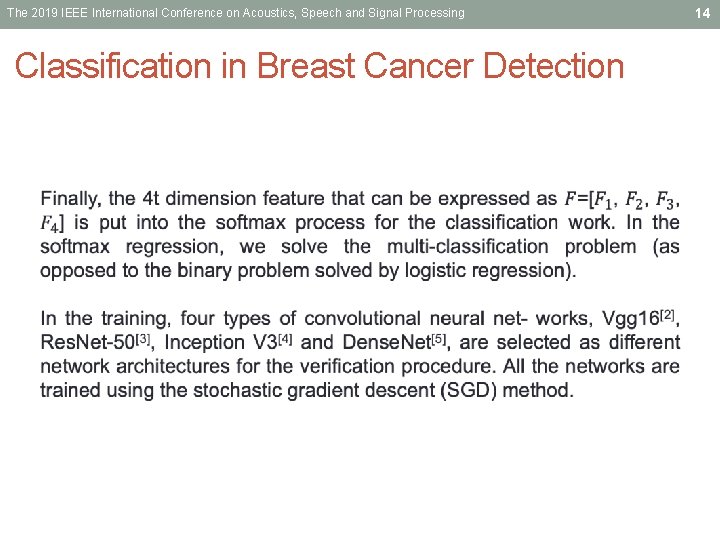
The 2019 IEEE International Conference on Acoustics, Speech and Signal Processing Classification in Breast Cancer Detection 14
The 2019 IEEE International Conference on Acoustics, Speech and Signal Processing Outline l Introduction l Experimental Methodology l Dataset l Classification in Breast Cancer Detection l Segmentation l Results l Conclusions in Breast Cancer Detection 15
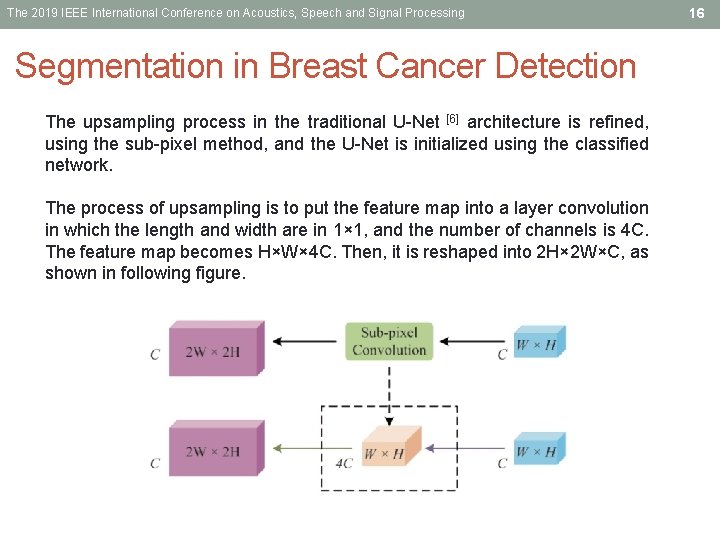
The 2019 IEEE International Conference on Acoustics, Speech and Signal Processing Segmentation in Breast Cancer Detection The upsampling process in the traditional U-Net [6] architecture is refined, using the sub-pixel method, and the U-Net is initialized using the classified network. The process of upsampling is to put the feature map into a layer convolution in which the length and width are in 1× 1, and the number of channels is 4 C. The feature map becomes H×W× 4 C. Then, it is reshaped into 2 H× 2 W×C, as shown in following figure. 16
The 2019 IEEE International Conference on Acoustics, Speech and Signal Processing Outline l Introduction l Experimental Methodology l Dataset l Classification in Breast Cancer Detection l Segmentation l Results l Conclusions in Breast Cancer Detection 17
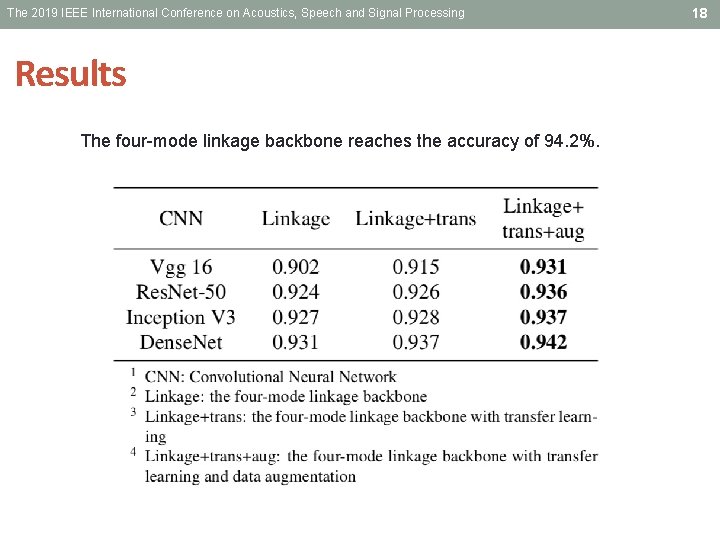
The 2019 IEEE International Conference on Acoustics, Speech and Signal Processing Results The four-mode linkage backbone reaches the accuracy of 94. 2%. 18
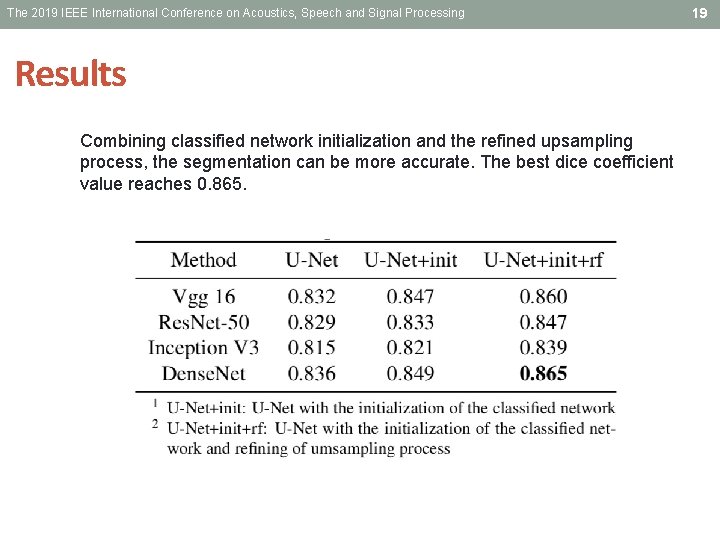
The 2019 IEEE International Conference on Acoustics, Speech and Signal Processing Results Combining classified network initialization and the refined upsampling process, the segmentation can be more accurate. The best dice coefficient value reaches 0. 865. 19
The 2019 IEEE International Conference on Acoustics, Speech and Signal Processing Outline l Introduction l Experimental Methodology l Dataset l Classification in Breast Cancer Detection l Segmentation l Results l Conclusions in Breast Cancer Detection 20
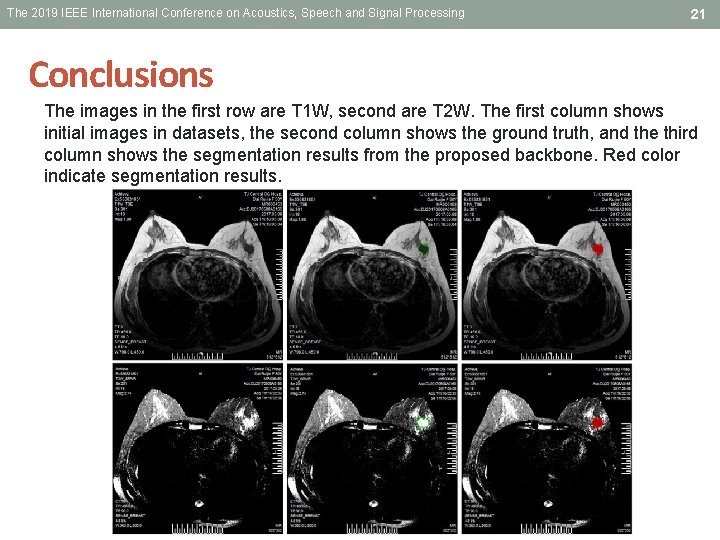
The 2019 IEEE International Conference on Acoustics, Speech and Signal Processing 21 Conclusions The images in the first row are T 1 W, second are T 2 W. The first column shows initial images in datasets, the second column shows the ground truth, and the third column shows the segmentation results from the proposed backbone. Red color indicate segmentation results.
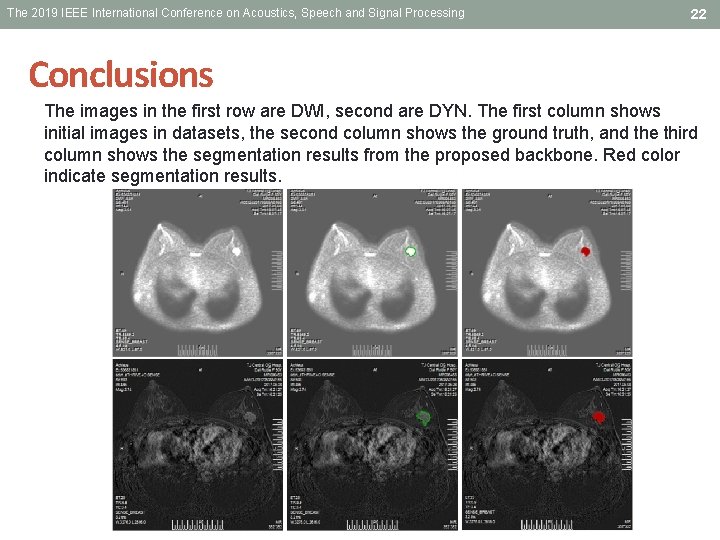
The 2019 IEEE International Conference on Acoustics, Speech and Signal Processing 22 Conclusions The images in the first row are DWI, second are DYN. The first column shows initial images in datasets, the second column shows the ground truth, and the third column shows the segmentation results from the proposed backbone. Red color indicate segmentation results.
The 2019 IEEE International Conference on Acoustics, Speech and Signal Processing Conclusions l. The proposed four-mode linkage backbone for the classification task in tumor detection considers different imaging modalities for detecting tumors in multiple signalweighted imaging sequences. It reaches the accuracy of 94. 2%. l. The e�ective results show that the optimized U-Net architecture for segmentation get the best dice coefficient value of 0. 865. 23
The 2019 IEEE International Conference on Acoustics, Speech and Signal Processing References Parts: 1. Han Hu, Jiayuan Gu, Zheng Zhang, Jifeng Dai, and Yichen Wei, “Relation networks for object detection, ” 2017. 2. Karen Simonyan and Andrew Zisserman, “Very deep convolutional networks for largescale image recogni- tion, ” Computer Science, 2014. 3. Kaiming He, Xiangyu Zhang, Shaoqing Ren, and Jian Sun, “Deep residual learning for image recognition, ” pp. 770– 778, 2015. 4. Christian Szegedy, Vincent Vanhoucke, Sergey Ioffe, Jonathon Shlens, and Zbigniew Wojna, “Rethinking the inception architecture for computer vision, ” Computer Science, pp. 2818– 2826, 2015. 5. Ilya Sutskever, James Martens, George Dahl, and Ge- offrey Hinton, “On the importance of initialization and momentum in deep learning, ” in International Confer- ence on International Conference on Machine Learning, 2013, pp. III– 1139. 6. Olaf Ronneberger, Philipp Fischer, and Thomas Brox, “U-net: Convolutional networks for biomedical image segmentation, ” in International Conference on Medical Image Computing and Computer-Assisted Intervention, 2015, pp. 234– 241. 24
25 International Conference on Neural Information Processing 2018 THANKS Jianguo Wei: jianguo@tju. edu. cn