
BA CONFERENCE 2019 User Stories in a Waterfall
BA CONFERENCE 2019 User Stories in a Waterfall World WHEN A LARGE CROSS-FUNCTIONAL PROJECT IS RUNNING WATERFALL, BUT YOUR TEAM IS AGILE.
Presenter Overview: Sam Wade Project Manager and Agile Coach • • Running teams for over 20 years Background spans e. Comm, Marketing, Finance, Omnichannel, & Supply Chain PMP and several Agile Certification BBA from Ohio U in Finance and MBA from Northwestern’s Kellogg School of Management agile enables individuals to do the best work of their careers in fun and supportive teams. Those teams, in turn, deliver exceptional value to their organizations. I believe strongly that
Kickoff Collection of Research and Articles Many Forms of “Hybrid” Brief Citations on slides Sharing what I have seen work My experiences are of Agile Teams incorporated into Waterfall Program Citation Details on final slide One Project Manager’s Opinion Leveraging research and experience
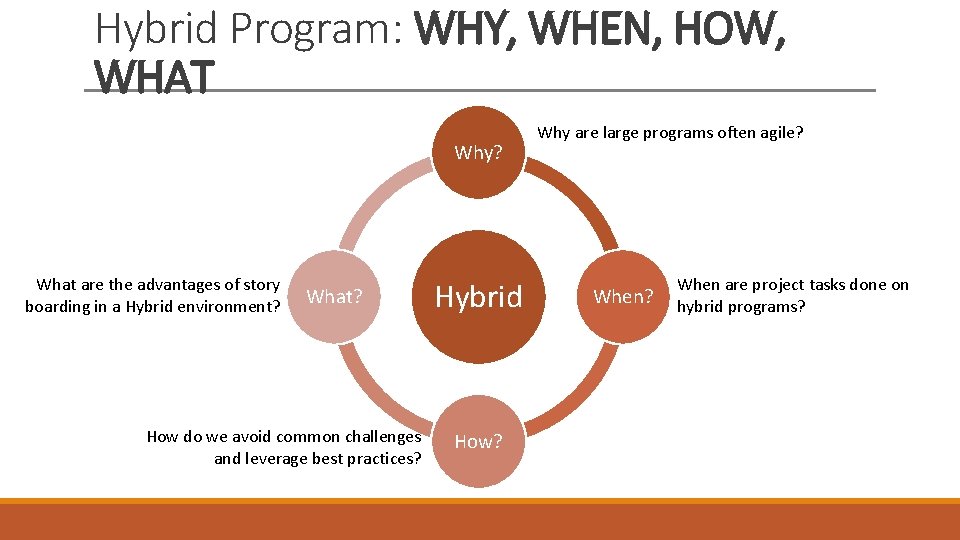
Hybrid Program: WHY, WHEN, HOW, WHAT Why? What are the advantages of story boarding in a Hybrid environment? What? How do we avoid common challenges and leverage best practices? Hybrid How? Why are large programs often agile? When are project tasks done on hybrid programs?
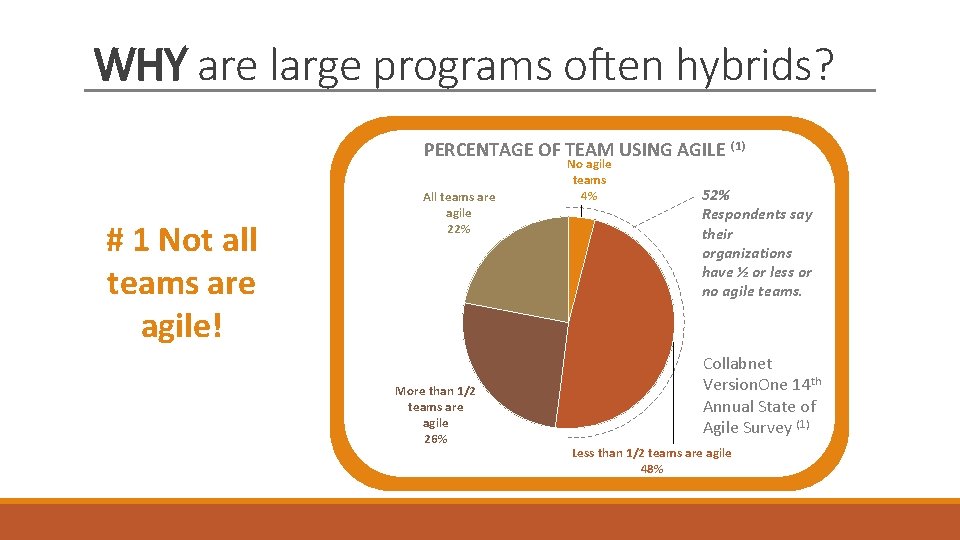
WHY are large programs often hybrids? PERCENTAGE OF TEAM USING AGILE (1) # 1 Not all teams are agile! All teams are agile 22% More than 1/2 teams are agile 26% No agile teams 4% 52% Respondents say their organizations have ½ or less or no agile teams. Collabnet Version. One 14 th Annual State of Agile Survey (1) Less than 1/2 teams are agile 48%
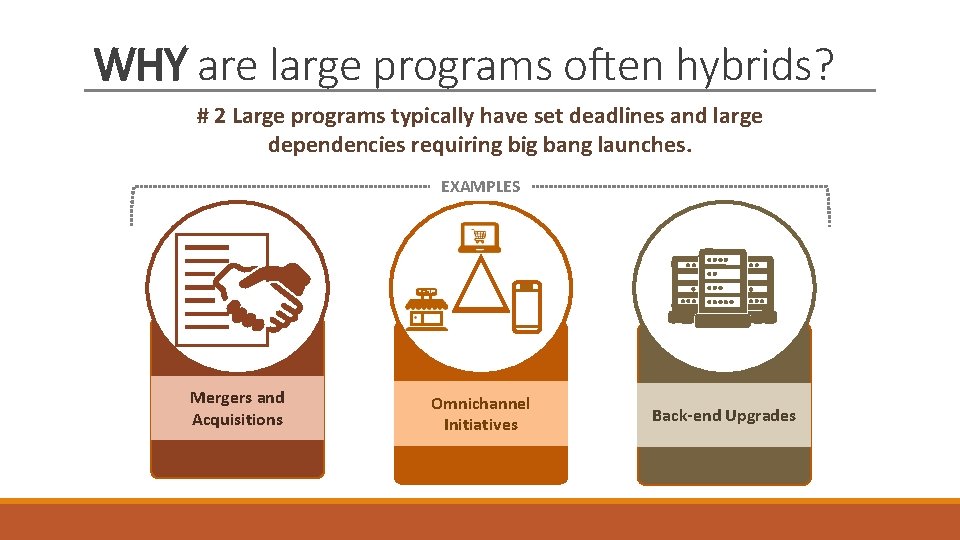
WHY are large programs often hybrids? # 2 Large programs typically have set deadlines and large dependencies requiring big bang launches. EXAMPLES a Mergers and Acquisitions Omnichannel Initiatives Back-end Upgrades
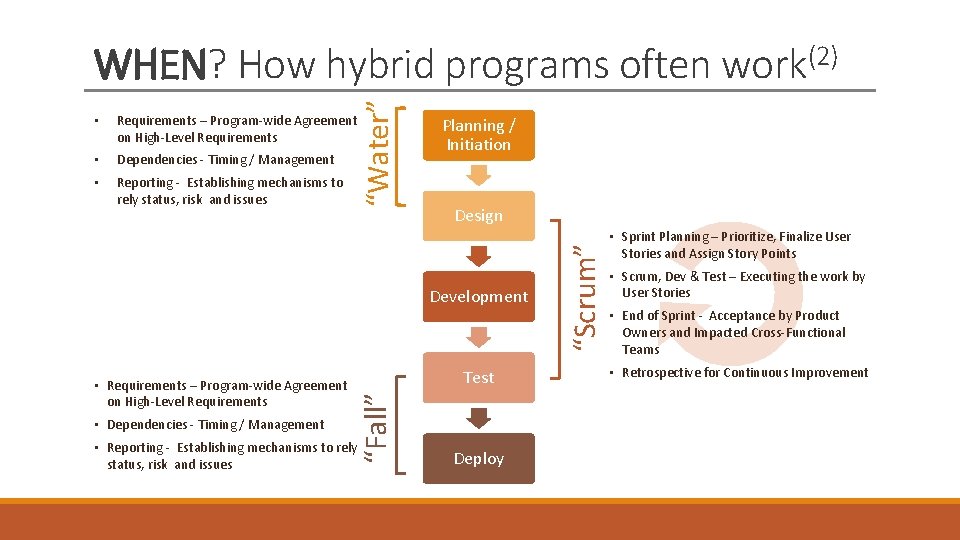
• Requirements – Program-wide Agreement on High-Level Requirements • Dependencies - Timing / Management • Reporting - Establishing mechanisms to rely status, risk and issues Planning / Initiation Design Development • Dependencies - Timing / Management Test “Fall” • Requirements – Program-wide Agreement on High-Level Requirements • Reporting - Establishing mechanisms to rely status, risk and issues Deploy “Scrum” “Water” WHEN? How hybrid programs often work(2) • Sprint Planning – Prioritize, Finalize User Stories and Assign Story Points • Scrum, Dev & Test – Executing the work by User Stories • End of Sprint - Acceptance by Product Owners and Impacted Cross-Functional Teams • Retrospective for Continuous Improvement
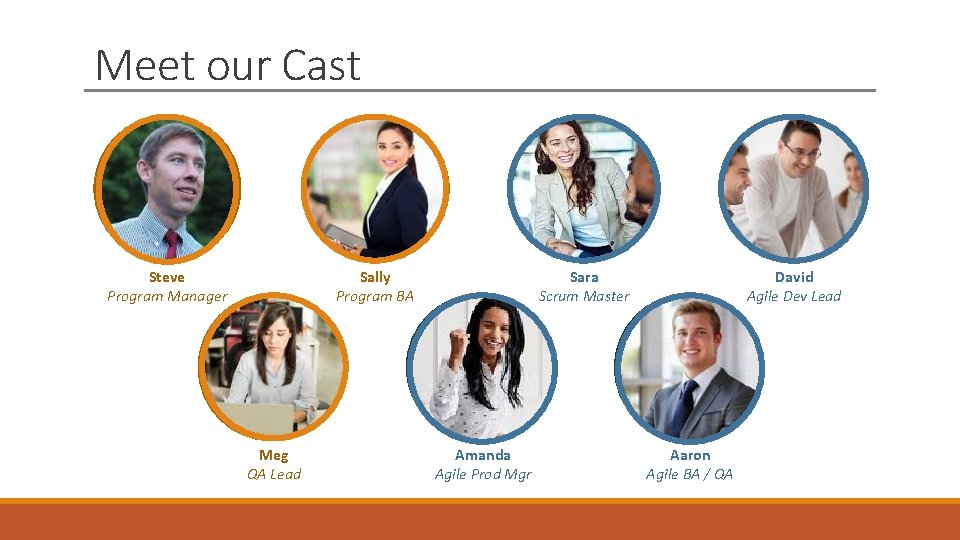
Meet our Cast Steve Program Manager Sally Program BA Meg QA Lead Sara Scrum Master Amanda Agile Prod Mgr David Agile Dev Lead Aaron Agile BA / QA
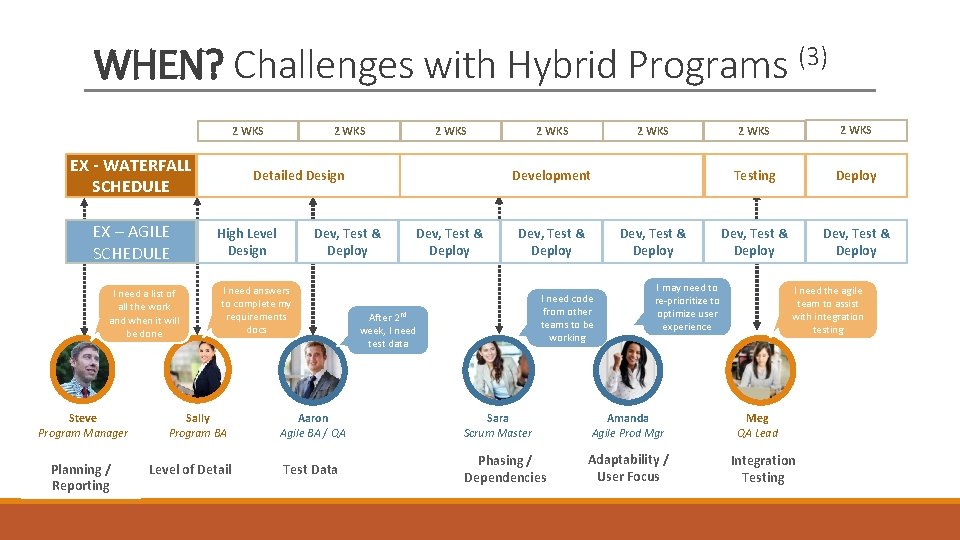
WHEN? Challenges with Hybrid Programs (3) 2 WKS EX - WATERFALL SCHEDULE EX – AGILE SCHEDULE I need a list of all the work and when it will be done Steve Program Manager Planning / Reporting 2 WKS Detailed Design High Level Design Sally Program BA Level of Detail 2 WKS Development Dev, Test & Deploy I need answers to complete my requirements docs 2 WKS Dev, Test & Deploy I need code from other teams to be working After 2 nd week, I need test data 2 WKS Testing Deploy Dev, Test & Deploy I may need to re-prioritize to optimize user experience Aaron Agile BA / QA Sara Scrum Master Amanda Agile Prod Mgr Test Data Phasing / Dependencies Adaptability / User Focus I need the agile team to assist with integration testing Meg QA Lead Integration Testing
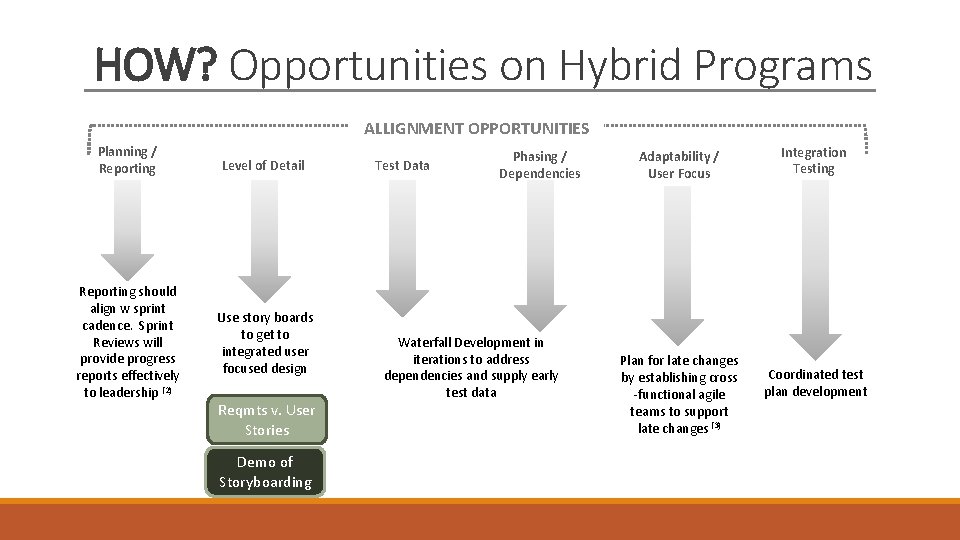
HOW? Opportunities on Hybrid Programs ALLIGNMENT OPPORTUNITIES Planning / Reporting Level of Detail Reporting should align w sprint cadence. Sprint Reviews will provide progress reports effectively to leadership (2) Use story boards to get to integrated user focused design Reqmts v. User Stories Demo of Storyboarding Test Data Phasing / Dependencies Waterfall Development in iterations to address dependencies and supply early test data Adaptability / User Focus Plan for late changes by establishing cross -functional agile teams to support late changes (3) Integration Testing Coordinated test plan development
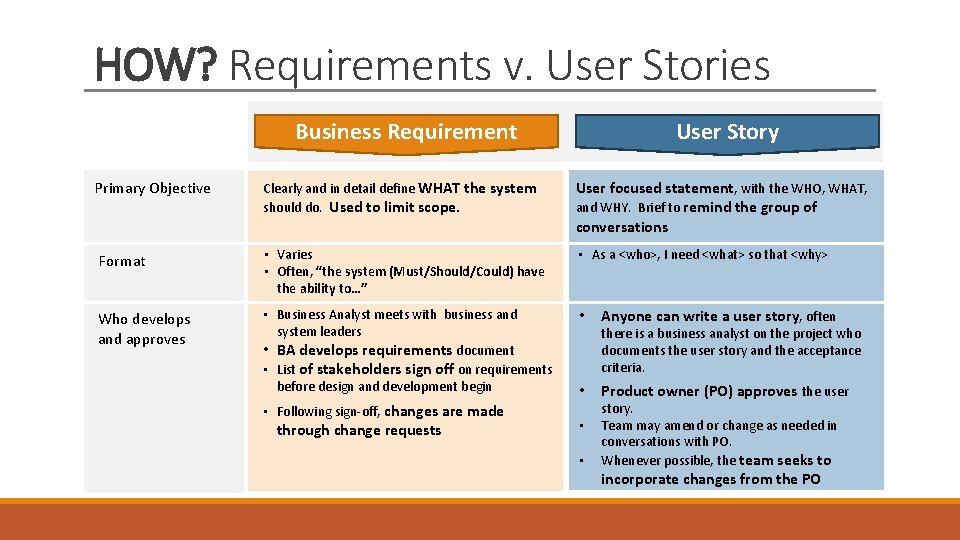
HOW? Requirements v. User Stories Business Requirement User Story Primary Objective Clearly and in detail define WHAT the system should do. Used to limit scope. User focused statement, with the WHO, WHAT, and WHY. Brief to remind the group of conversations Format • Varies • Often, “the system (Must/Should/Could) have the ability to…” • As a <who>, I need <what> so that <why> Who develops and approves • Business Analyst meets with business and system leaders • BA develops requirements document • List of stakeholders sign off on requirements before design and development begin • • Following sign-off, changes are made through change requests Anyone can write a user story, often there is a business analyst on the project who documents the user story and the acceptance criteria. • • • Product owner (PO) approves the user story. Team may amend or change as needed in conversations with PO. Whenever possible, the team seeks to incorporate changes from the PO
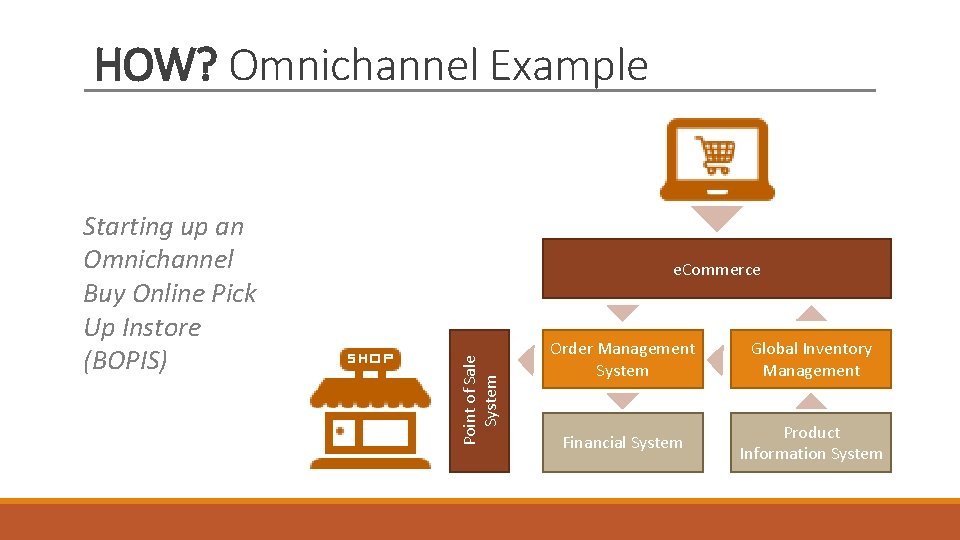
HOW? Omnichannel Example e. Commerce Point of Sale System Starting up an Omnichannel Buy Online Pick Up Instore (BOPIS) Order Management System Global Inventory Management Financial System Product Information System
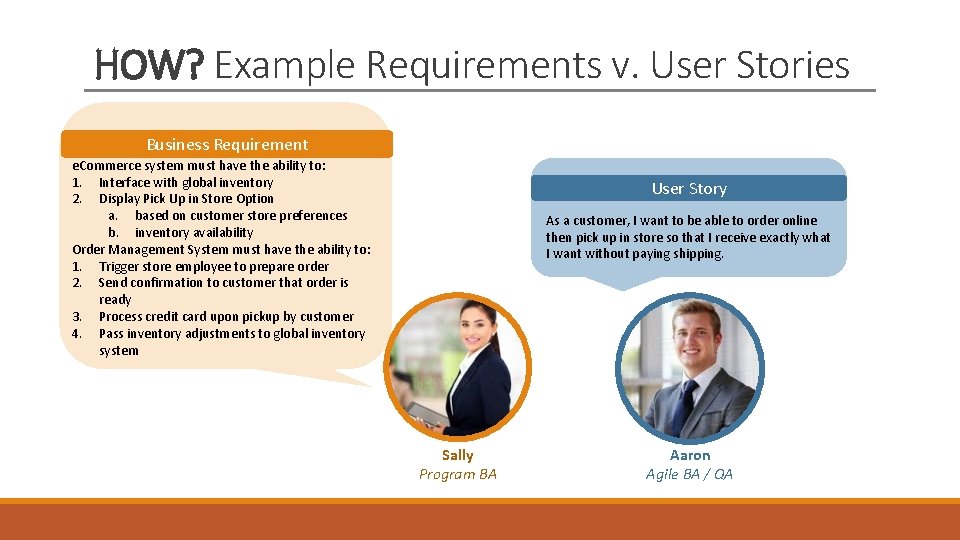
HOW? Example Requirements v. User Stories Business Requirement e. Commerce system must have the ability to: 1. Interface with global inventory 2. Display Pick Up in Store Option a. based on customer store preferences b. inventory availability Order Management System must have the ability to: 1. Trigger store employee to prepare order 2. Send confirmation to customer that order is ready 3. Process credit card upon pickup by customer 4. Pass inventory adjustments to global inventory system User Story As a customer, I want to be able to order online then pick up in store so that I receive exactly what I want without paying shipping. Sally Program BA Aaron Agile BA / QA
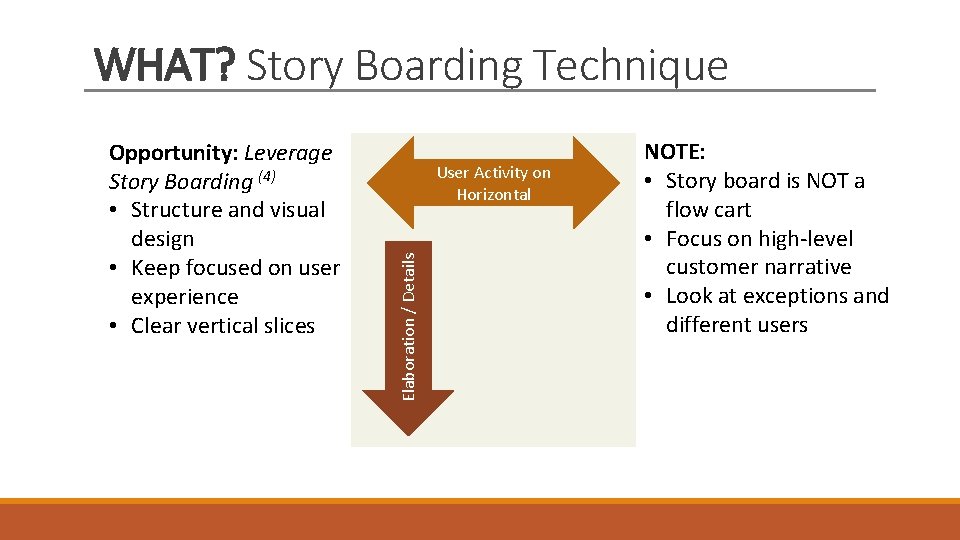
WHAT? Story Boarding Technique User Activity on Horizontal Elaboration / Details Opportunity: Leverage Story Boarding (4) • Structure and visual design • Keep focused on user experience • Clear vertical slices NOTE: • Story board is NOT a flow cart • Focus on high-level customer narrative • Look at exceptions and different users
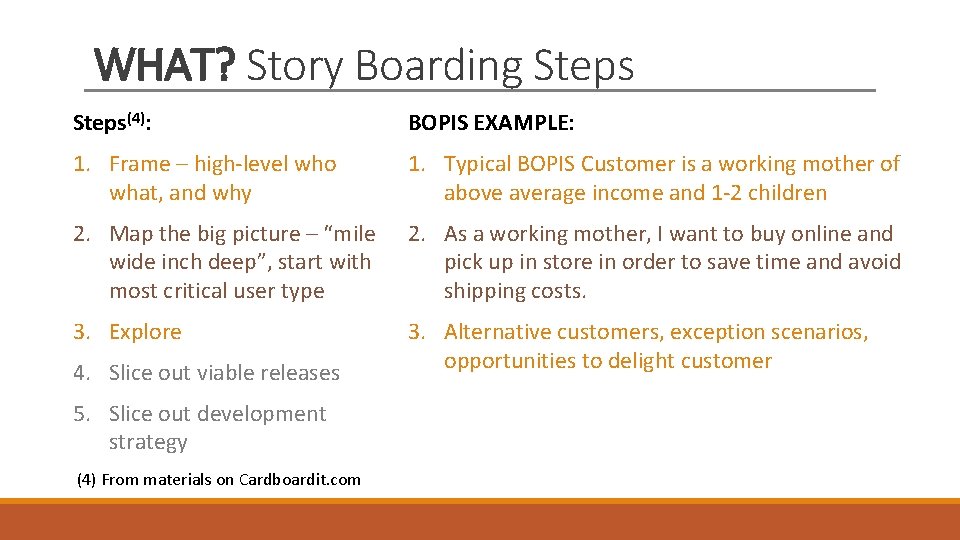
WHAT? Story Boarding Steps(4): BOPIS EXAMPLE: 1. Frame – high-level who what, and why 1. Typical BOPIS Customer is a working mother of above average income and 1 -2 children 2. Map the big picture – “mile wide inch deep”, start with most critical user type 2. As a working mother, I want to buy online and pick up in store in order to save time and avoid shipping costs. 3. Explore 3. Alternative customers, exception scenarios, opportunities to delight customer 4. Slice out viable releases 5. Slice out development strategy (4) From materials on Cardboardit. com
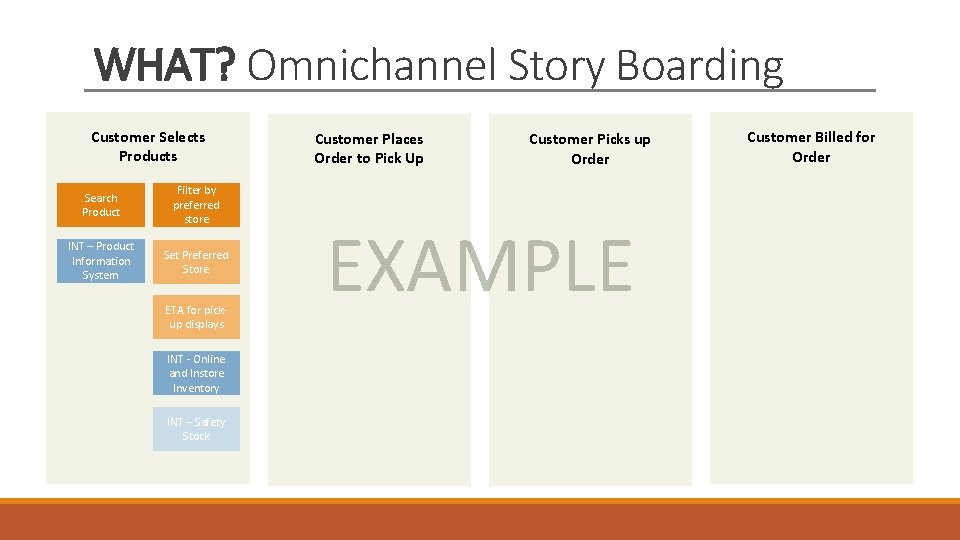
WHAT? Omnichannel Story Boarding Customer Selects Products Search Product Filter by preferred store INT – Product Information System Set Preferred Store ETA for pickup displays INT - Online and Instore Inventory INT – Safety Stock Customer Places Order to Pick Up Customer Picks up Order EXAMPLE Customer Billed for Order
Citations 1. 2. 3. 4. 5. https: //www. stateofagile. com/#ufh-i-521251909 -13 th-annual-state-of-agile-report/473508 https: //bia. ca/improve-project-success-using-a-hybrid-agile-framework/ Agile and Lean Program Management: Scaling Collaboration Across the Organization, Johanna Rothman https: //cardboardit. com/tours/#journeys https: //www. agilealliance. org/what-is-hybrid-agile-anyway/
APPENDIX
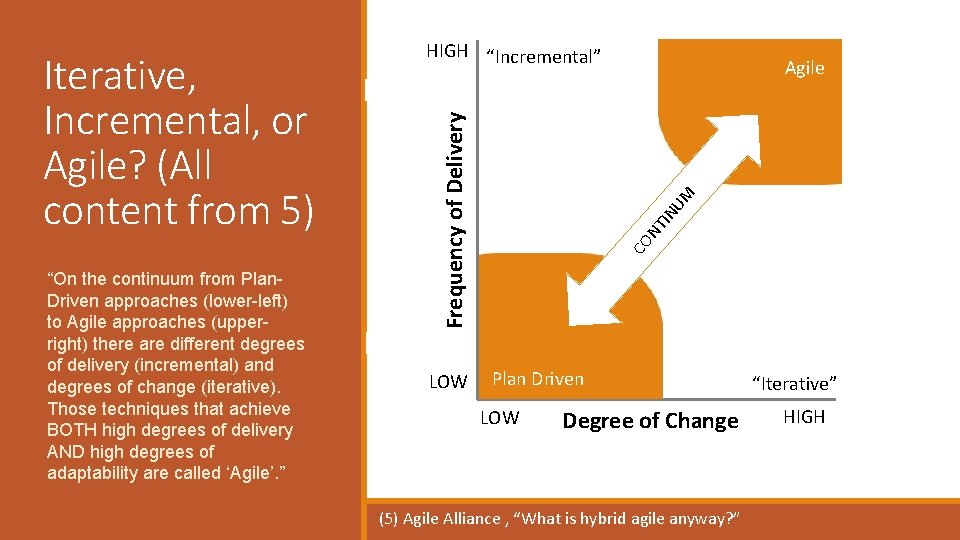
“On the continuum from Plan. Driven approaches (lower-left) to Agile approaches (upperright) there are different degrees of delivery (incremental) and degrees of change (iterative). Those techniques that achieve BOTH high degrees of delivery AND high degrees of adaptability are called ‘Agile’. ” LOW Agile CO N TIN UM Frequency of Delivery Iterative, Incremental, or Agile? (All content from 5) HIGH “Incremental” Plan Driven LOW Degree of Change (5) Agile Alliance , “What is hybrid agile anyway? ” “Iterative” HIGH
- Slides: 19