Taxes Rich Jakotowicz CFP richjudel edu 302 831








- Slides: 36
Taxes Rich Jakotowicz CFP® richj@udel. edu 302. 831. 7226
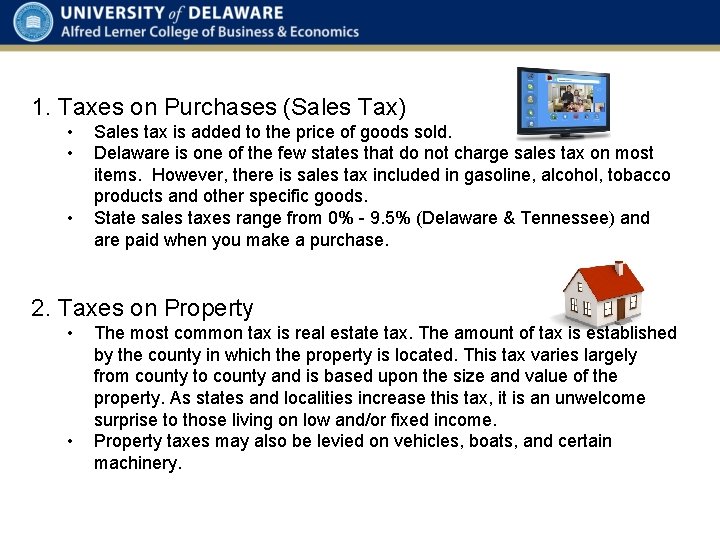
1. Taxes on Purchases (Sales Tax) • • • Sales tax is added to the price of goods sold. Delaware is one of the few states that do not charge sales tax on most items. However, there is sales tax included in gasoline, alcohol, tobacco products and other specific goods. State sales taxes range from 0% - 9. 5% (Delaware & Tennessee) and are paid when you make a purchase. 2. Taxes on Property • • The most common tax is real estate tax. The amount of tax is established by the county in which the property is located. This tax varies largely from county to county and is based upon the size and value of the property. As states and localities increase this tax, it is an unwelcome surprise to those living on low and/or fixed income. Property taxes may also be levied on vehicles, boats, and certain machinery.
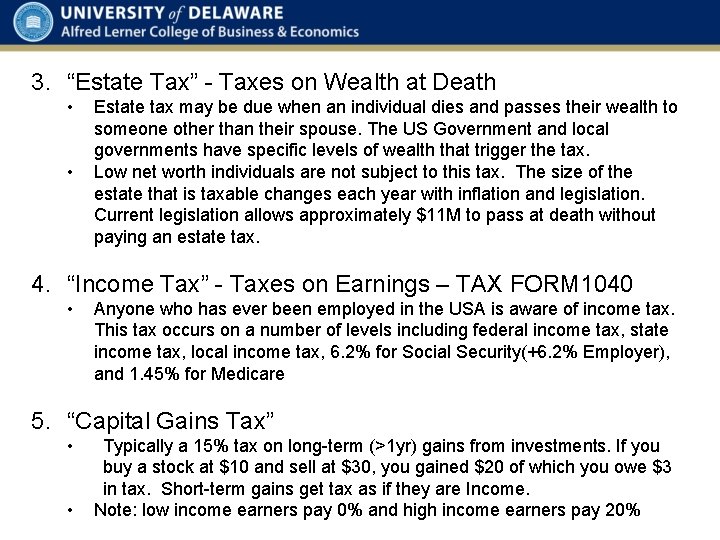
3. “Estate Tax” - Taxes on Wealth at Death • • Estate tax may be due when an individual dies and passes their wealth to someone other than their spouse. The US Government and local governments have specific levels of wealth that trigger the tax. Low net worth individuals are not subject to this tax. The size of the estate that is taxable changes each year with inflation and legislation. Current legislation allows approximately $11 M to pass at death without paying an estate tax. 4. “Income Tax” - Taxes on Earnings – TAX FORM 1040 • Anyone who has ever been employed in the USA is aware of income tax. This tax occurs on a number of levels including federal income tax, state income tax, local income tax, 6. 2% for Social Security(+6. 2% Employer), and 1. 45% for Medicare 5. “Capital Gains Tax” • • Typically a 15% tax on long-term (>1 yr) gains from investments. If you buy a stock at $10 and sell at $30, you gained $20 of which you owe $3 in tax. Short-term gains get tax as if they are Income. Note: low income earners pay 0% and high income earners pay 20%
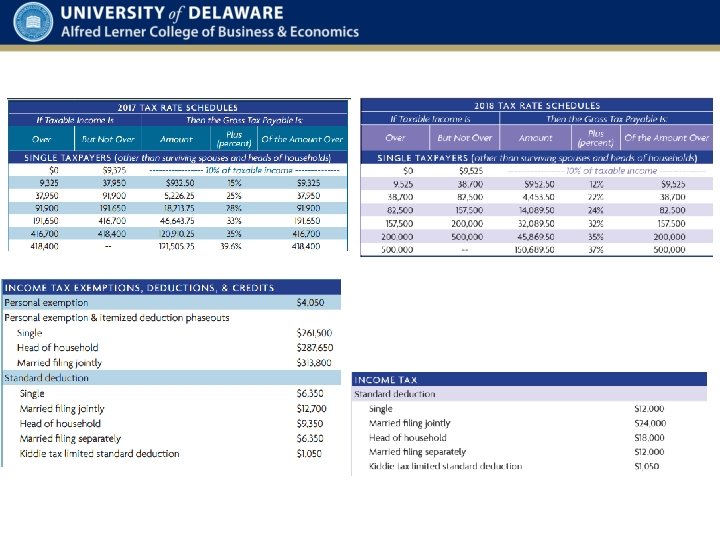
2015 Income Tax Rate Schedule (Single Taxpayer) How much tax would you owe if you earned $100, 000? $18, 481. 25 +. 28 x ($100, 000 -$90, 750) = $21, 071. 25 Tax Payable
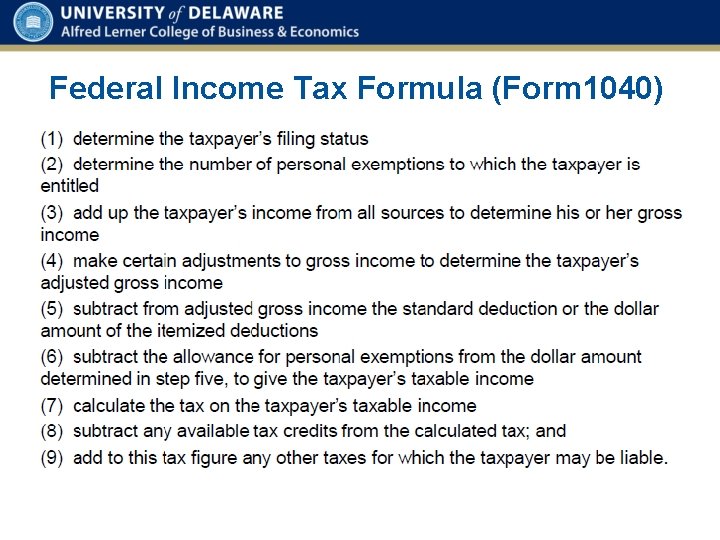
Federal Income Tax Formula (Form 1040)
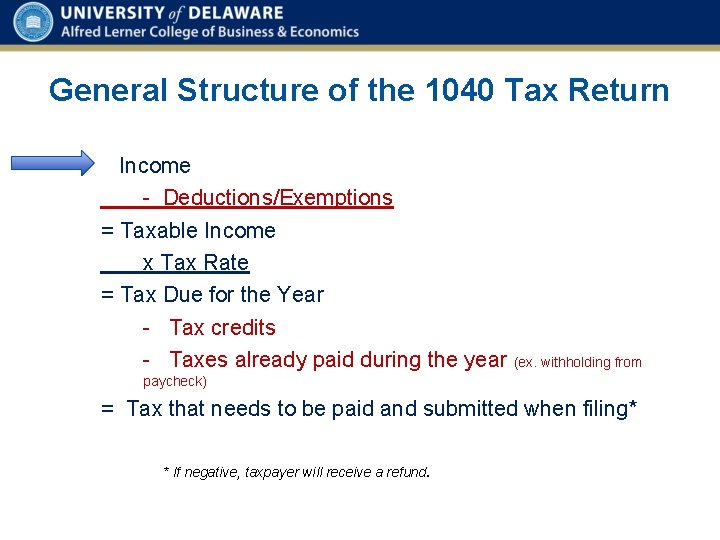
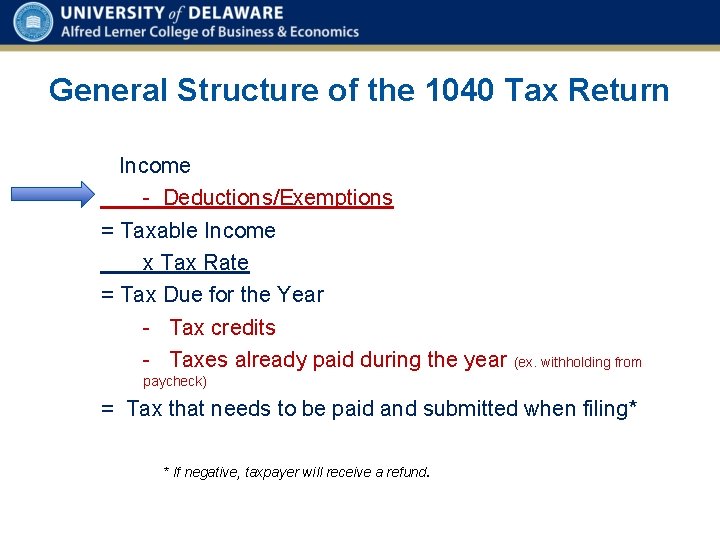
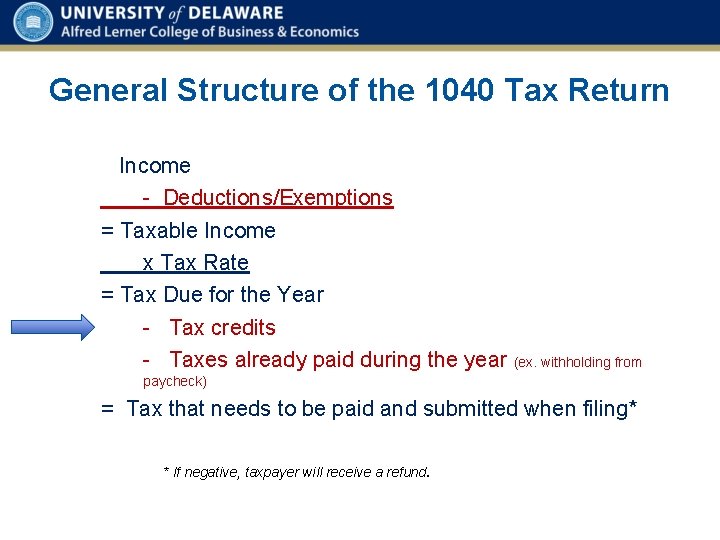
General Structure of the 1040 Tax Return Income - Deductions/Exemptions = Taxable Income x Tax Rate = Tax Due for the Year - Tax credits - Taxes already paid during the year (ex. withholding from paycheck) = Tax that needs to be paid and submitted when filing* * If negative, taxpayer will receive a refund.
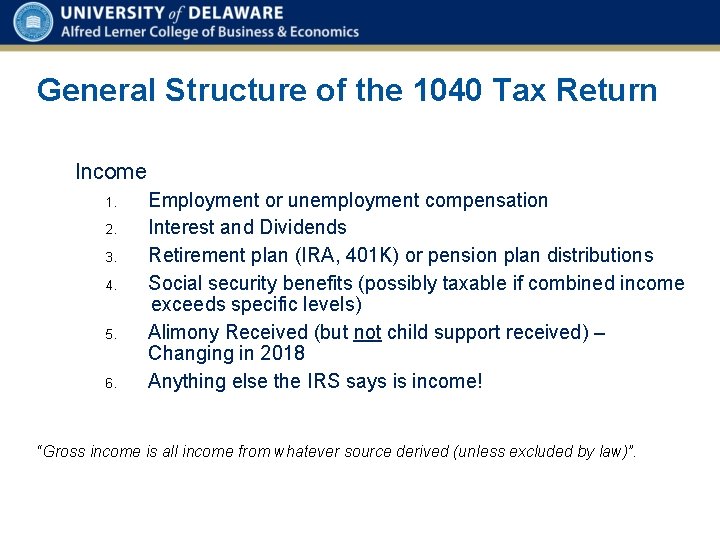
General Structure of the 1040 Tax Return Income 1. 2. 3. 4. 5. 6. Employment or unemployment compensation Interest and Dividends Retirement plan (IRA, 401 K) or pension plan distributions Social security benefits (possibly taxable if combined income exceeds specific levels) Alimony Received (but not child support received) – Changing in 2018 Anything else the IRS says is income! “Gross income is all income from whatever source derived (unless excluded by law)”.
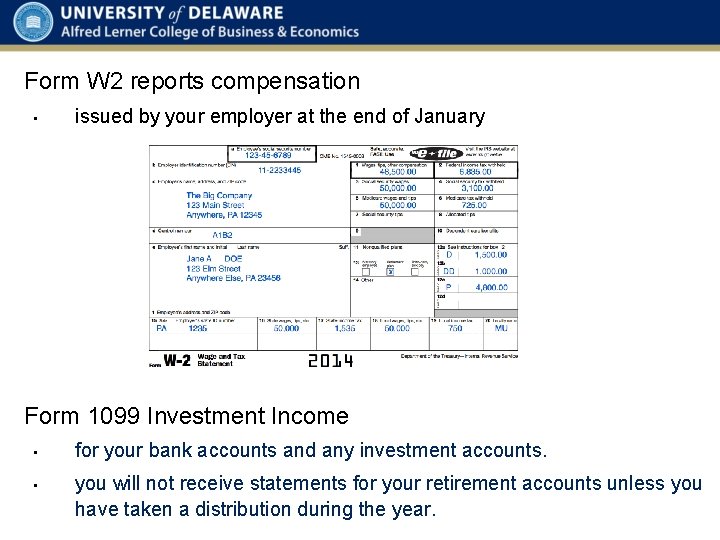
Form W 2 reports compensation • issued by your employer at the end of January Form 1099 Investment Income • for your bank accounts and any investment accounts. • you will not receive statements for your retirement accounts unless you have taken a distribution during the year.
General Structure of the 1040 Tax Return Income - Deductions/Exemptions = Taxable Income x Tax Rate = Tax Due for the Year - Tax credits - Taxes already paid during the year (ex. withholding from paycheck) = Tax that needs to be paid and submitted when filing* * If negative, taxpayer will receive a refund.
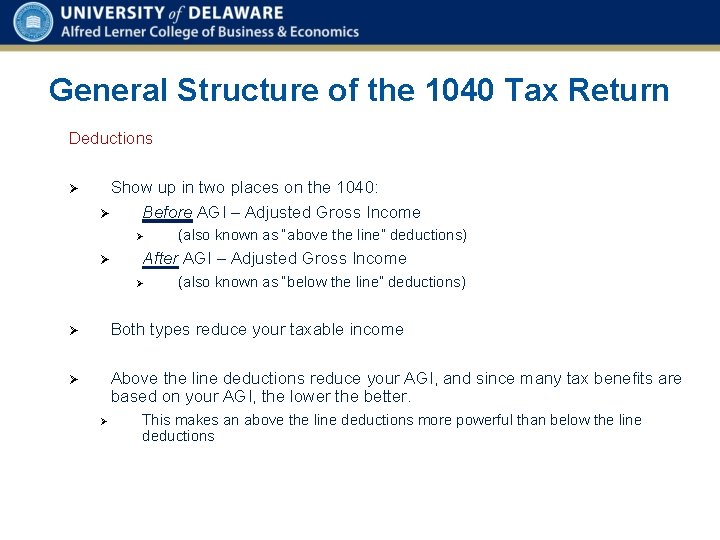
General Structure of the 1040 Tax Return Deductions Ø Show up in two places on the 1040: Ø Before AGI – Adjusted Gross Income Ø Ø (also known as “above the line” deductions) After AGI – Adjusted Gross Income Ø (also known as “below the line” deductions) Ø Both types reduce your taxable income Ø Above the line deductions reduce your AGI, and since many tax benefits are based on your AGI, the lower the better. Ø This makes an above the line deductions more powerful than below the line deductions
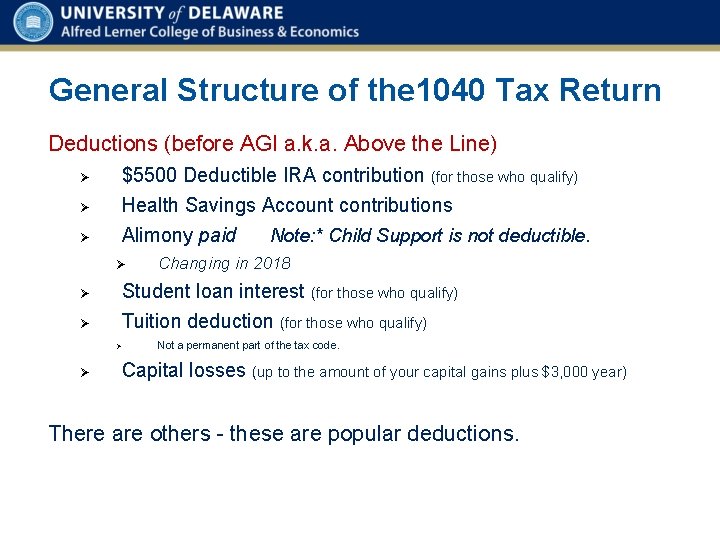
General Structure of the 1040 Tax Return Deductions (before AGI a. k. a. Above the Line) Ø $5500 Deductible IRA contribution (for those who qualify) Ø Health Savings Account contributions Alimony paid Note: * Child Support is not deductible. Ø Ø Student loan interest (for those who qualify) Tuition deduction (for those who qualify) Ø Ø Changing in 2018 Not a permanent part of the tax code. Capital losses (up to the amount of your capital gains plus $3, 000 year) There are others - these are popular deductions.
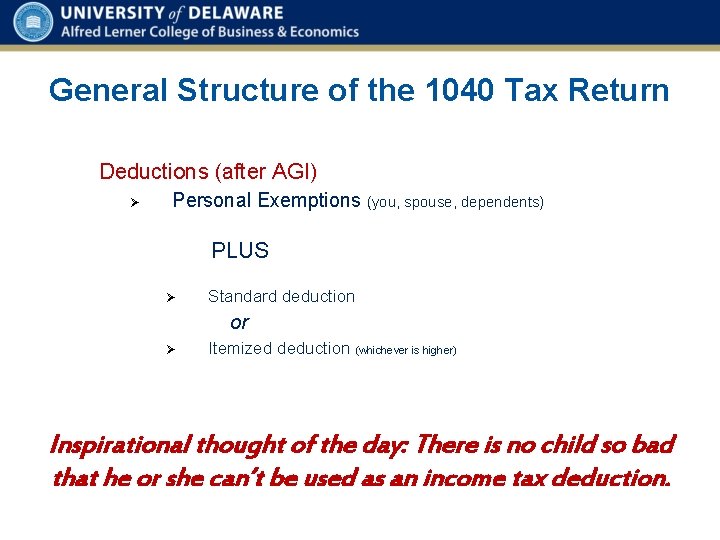
General Structure of the 1040 Tax Return Deductions (after AGI) Ø Personal Exemptions (you, spouse, dependents) PLUS Ø Standard deduction or Ø Itemized deduction (whichever is higher) Inspirational thought of the day: There is no child so bad that he or she can’t be used as an income tax deduction.
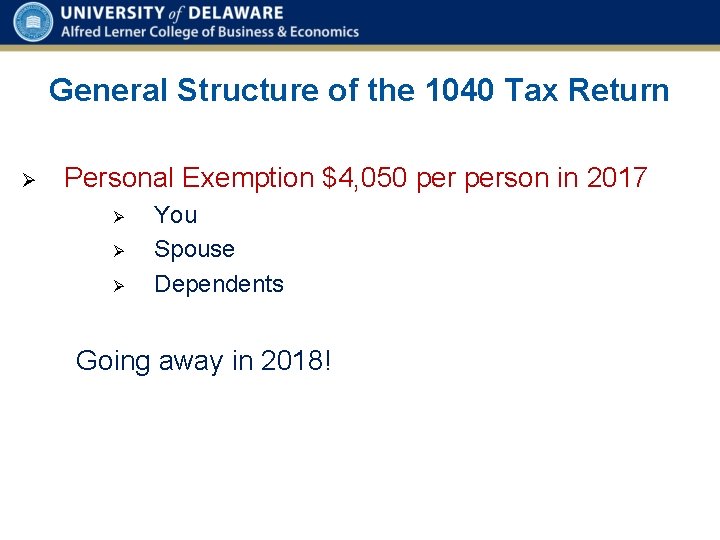
General Structure of the 1040 Tax Return Ø Personal Exemption $4, 050 person in 2017 Ø Ø Ø You Spouse Dependents Going away in 2018!
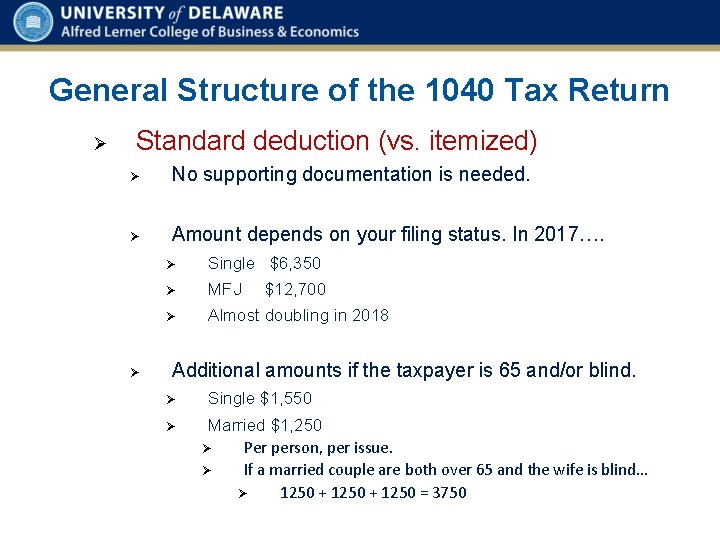
General Structure of the 1040 Tax Return Ø Standard deduction (vs. itemized) Ø No supporting documentation is needed. Ø Amount depends on your filing status. In 2017…. Ø Ø Single $6, 350 Ø MFJ $12, 700 Ø Almost doubling in 2018 Additional amounts if the taxpayer is 65 and/or blind. Ø Ø Single $1, 550 Married $1, 250 Ø Per person, per issue. Ø If a married couple are both over 65 and the wife is blind… Ø 1250 + 1250 = 3750
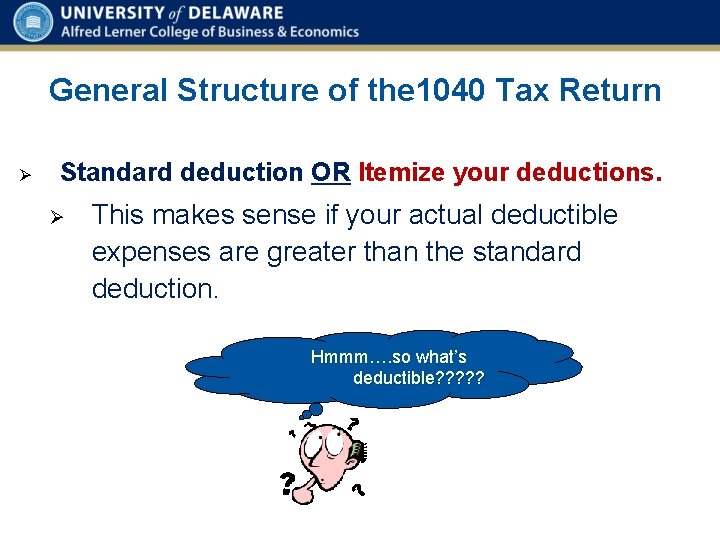
General Structure of the 1040 Tax Return Ø Standard deduction OR Itemize your deductions. Ø This makes sense if your actual deductible expenses are greater than the standard deduction. Hmmm…. so what’s deductible? ? ?
Deductions Home Ownership Ø – the mortgage company will send a statement listing the interest you paid during the year. Interest paid on mortgages is deductible. – Your real estate taxes are deductible (whether they were collected by the mortgage company or you paid the taxes directly to the taxing authority, they are deductible either way).
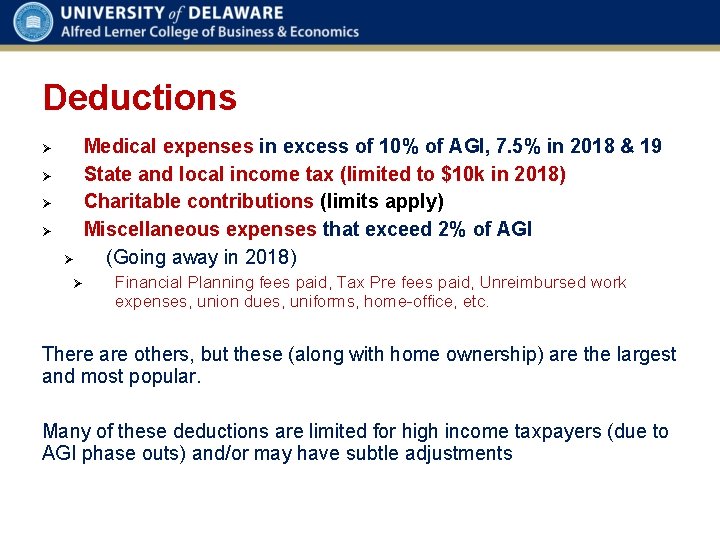
Deductions Ø Ø Ø Medical expenses in excess of 10% of AGI, 7. 5% in 2018 & 19 State and local income tax (limited to $10 k in 2018) Charitable contributions (limits apply) Miscellaneous expenses that exceed 2% of AGI (Going away in 2018) Financial Planning fees paid, Tax Pre fees paid, Unreimbursed work expenses, union dues, uniforms, home-office, etc. There are others, but these (along with home ownership) are the largest and most popular. Many of these deductions are limited for high income taxpayers (due to AGI phase outs) and/or may have subtle adjustments
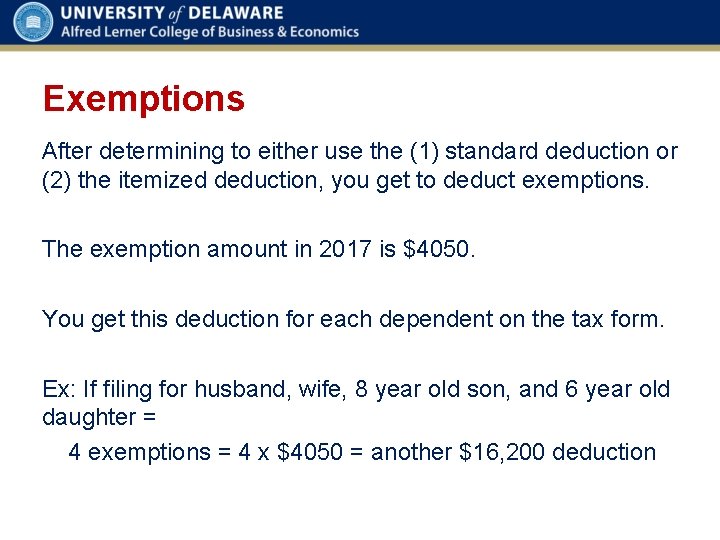
Exemptions After determining to either use the (1) standard deduction or (2) the itemized deduction, you get to deduct exemptions. The exemption amount in 2017 is $4050. You get this deduction for each dependent on the tax form. Ex: If filing for husband, wife, 8 year old son, and 6 year old daughter = 4 exemptions = 4 x $4050 = another $16, 200 deduction
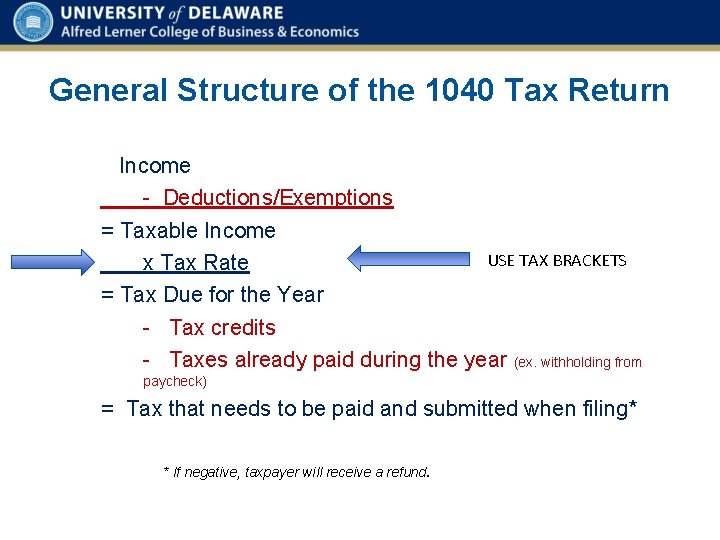
General Structure of the 1040 Tax Return Income - Deductions/Exemptions = Taxable Income USE TAX BRACKETS x Tax Rate = Tax Due for the Year - Tax credits - Taxes already paid during the year (ex. withholding from paycheck) = Tax that needs to be paid and submitted when filing* * If negative, taxpayer will receive a refund.
General Structure of the 1040 Tax Return Income - Deductions/Exemptions = Taxable Income x Tax Rate = Tax Due for the Year - Tax credits - Taxes already paid during the year (ex. withholding from paycheck) = Tax that needs to be paid and submitted when filing* * If negative, taxpayer will receive a refund.
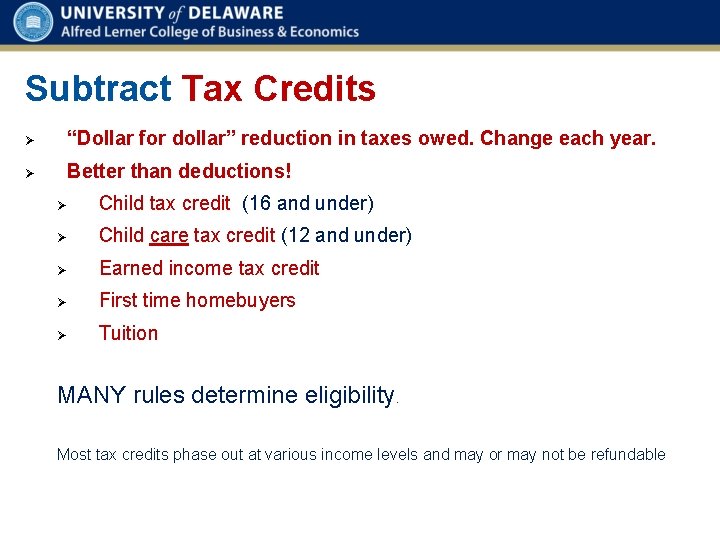
Subtract Tax Credits Ø “Dollar for dollar” reduction in taxes owed. Change each year. Ø Better than deductions! Ø Child tax credit (16 and under) Ø Child care tax credit (12 and under) Ø Earned income tax credit Ø First time homebuyers Ø Tuition MANY rules determine eligibility. Most tax credits phase out at various income levels and may or may not be refundable
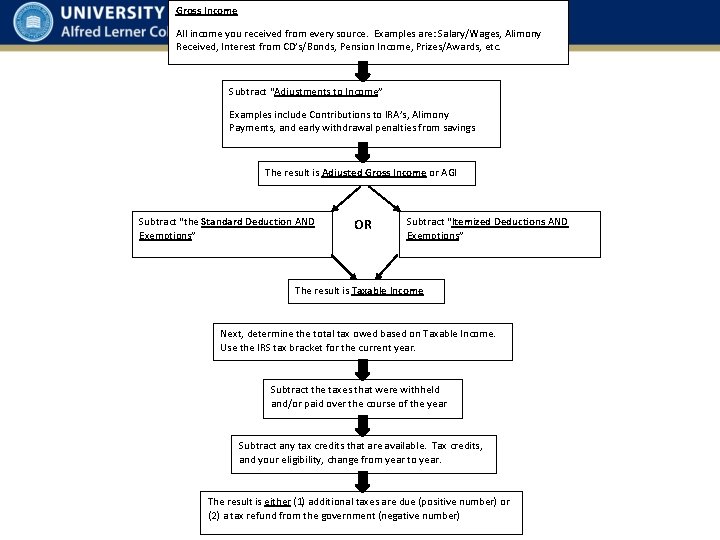
Gross Income All income you received from every source. Examples are: Salary/Wages, Alimony Received, Interest from CD’s/Bonds, Pension Income, Prizes/Awards, etc. Subtract “Adjustments to Income” Examples include Contributions to IRA’s, Alimony Payments, and early withdrawal penalties from savings The result is Adjusted Gross Income or AGI Subtract “the Standard Deduction AND Exemptions” OR Subtract “Itemized Deductions AND Exemptions” The result is Taxable Income Next, determine the total tax owed based on Taxable Income. Use the IRS tax bracket for the current year. Subtract the taxes that were withheld and/or paid over the course of the year Subtract any tax credits that are available. Tax credits, and your eligibility, change from year to year. The result is either (1) additional taxes are due (positive number) or (2) a tax refund from the government (negative number)
Putting it all together Ann Taxpayer is single and has no dependents. Her taxable events in 2017 are: Ø Salary is $55, 000, of which $4, 000 in taxes were withheld from her paychecks Ø She deposited $2, 000 into an IRA Ø She earned $600 in interest from CD’s and a savings account Ø Itemized deductions of $5, 000 (includes $2, 000 in Real Estate Taxes and $3, 000 in interest payments on her mortgage) Ø She is not eligible for any tax credits
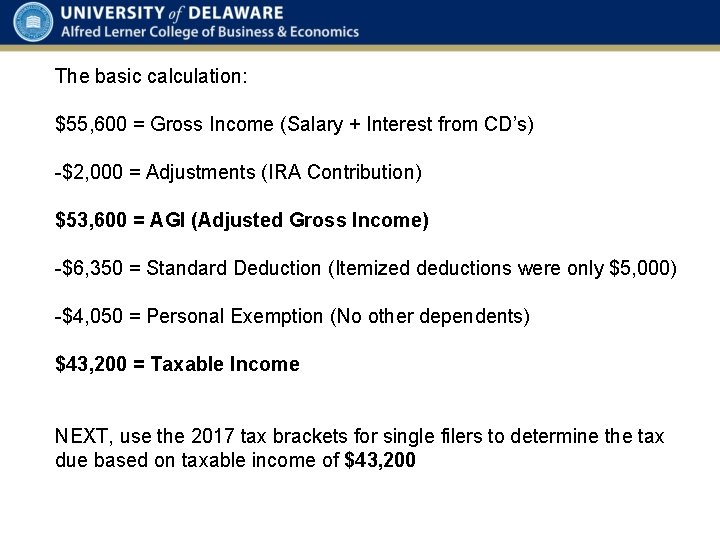
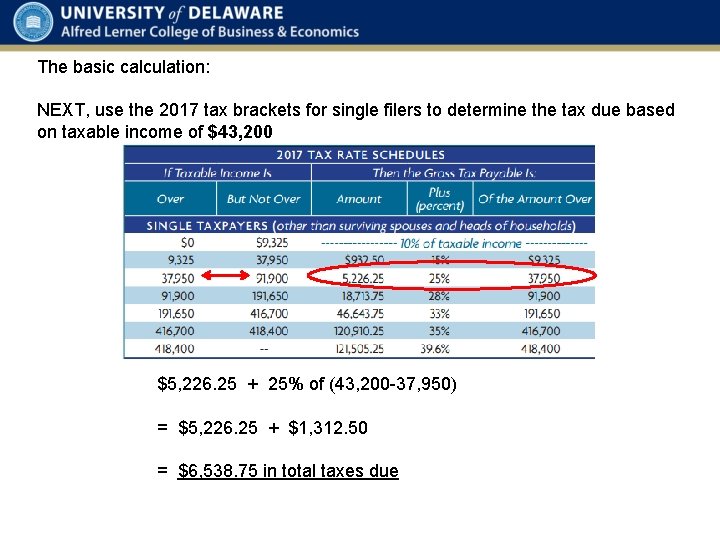
The basic calculation: $55, 600 = Gross Income (Salary + Interest from CD’s) -$2, 000 = Adjustments (IRA Contribution) $53, 600 = AGI (Adjusted Gross Income) -$6, 350 = Standard Deduction (Itemized deductions were only $5, 000) -$4, 050 = Personal Exemption (No other dependents) $43, 200 = Taxable Income NEXT, use the 2017 tax brackets for single filers to determine the tax due based on taxable income of $43, 200
The basic calculation: NEXT, use the 2017 tax brackets for single filers to determine the tax due based on taxable income of $43, 200 $5, 226. 25 + 25% of (43, 200 -37, 950) = $5, 226. 25 + $1, 312. 50 = $6, 538. 75 in total taxes due
The basic calculation: $6, 538 in total taxes due Ø Since her employer already withheld $4, 000 for taxes, she must pay an additional $2, 538 in taxes. Ø If she were eligible for a tax credit, it would be applied here to reduce her tax bill or create a tax refund (if the credit is refundable). For example, if Ann had a $2000 credit she would only owe $538. This is much better than a $2000 deduction. Deductions are not as valuable as credits!
Ann has a Marginal Tax Rate of 25% (just looking at the brackets) However, Ann has an Effective Tax Rate of 15%. Total Tax Due $6, 538 Taxable Income $43, 200 = 15% “The hardest thing in the world to understand is the income tax” – Albert. Einstein
Your turn…. . Ann and Rich Taxpayer are married and have 2 children. Their taxable events in 2017 are: Ø Ann’s Salary is $55, 000, of which $4, 000 in taxes were withheld from her paychecks. Rich’s Salary is $100, 000, of which $7, 000 in taxes were withheld from his paychecks. Ø She deposited $2, 000 and he deposited $3, 000 into IRA accounts Ø They earned $1000 in interest from investments Ø They paid $6, 000 in Real Estate Taxes and $8, 000 in interest payments on the mortgage Ø They are eligible for a $1000 tax credits ØCalculate total taxes, the remaining tax due or owed, and effective rate.
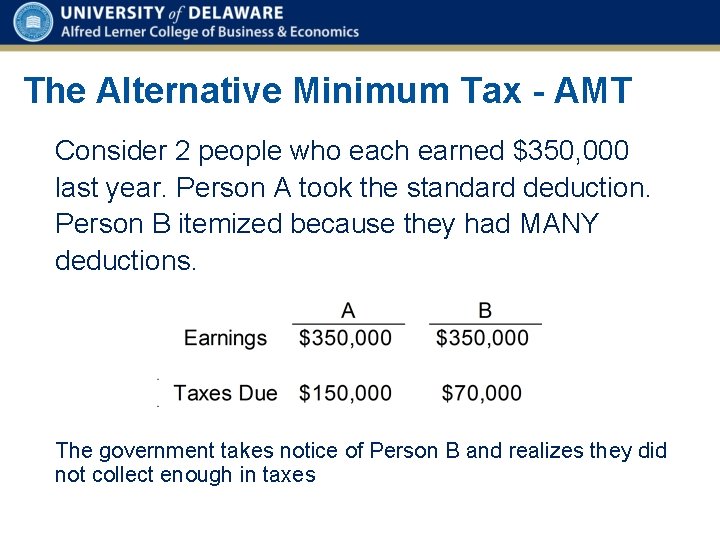
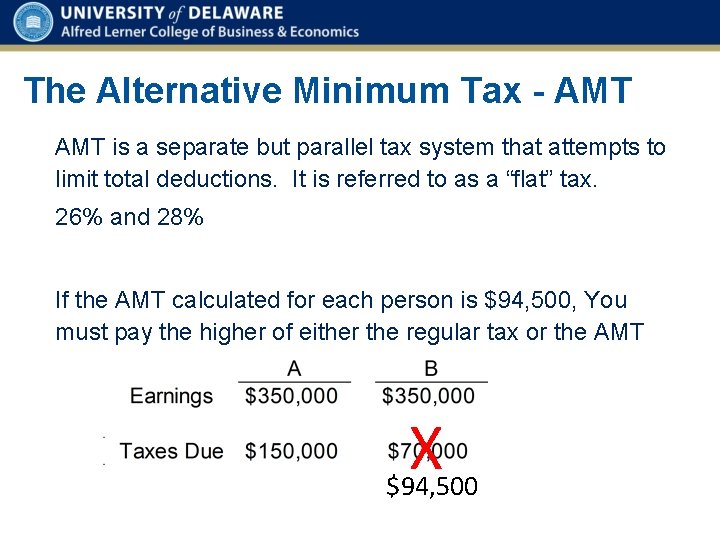
The Alternative Minimum Tax - AMT Consider 2 people who each earned $350, 000 last year. Person A took the standard deduction. Person B itemized because they had MANY deductions. The government takes notice of Person B and realizes they did not collect enough in taxes
The Alternative Minimum Tax - AMT is a separate but parallel tax system that attempts to limit total deductions. It is referred to as a “flat” tax. 26% and 28% If the AMT calculated for each person is $94, 500, You must pay the higher of either the regular tax or the AMT X $94, 500
Common triggers of the AMT • High number of personal exemptions • High State & Local Taxes (because State Taxes paid are a deduction) • High Medical Expenses • Employee Incentive Stock Options (ISO’s) • Too many Tax Credits
Using The Tax Rates Below, Which States Are most Likely To Trigger AMT For Their Residents?
Employee Incentive Stock Options Imagine you work for General Electric and the stock is currently worth $25 per share. At the end of the year you are paid a bonus which includes stock options. The options allow you to purchase 1000 shares of GE Stock from the company at $20 per share. You could instantly make $5 per share ($5000 total) if you buy at $20 and sell at $25. The $5000 would be a capital gain. Alternatively you could buy at $20 and hold the stock in your account. You did not yet realize the gain BUT IT GETS included in the AMT calculation!!!