Take An Internal Look at Hadoop Hairong Kuang

- Slides: 17
Take An Internal Look at Hadoop • Hairong Kuang • Grid Team, Yahoo! Inc • hairong@yahoo-inc. com
What’s Hadoop� • Framework for running applications on large clusters of commodity hardware – Scale: petabytes of data on thousands of nodes • Include – Storage: HDFS – Processing: Map. Reduce • Support the Map/Reduce programming model • Requirements – Economy: use cluster of comodity computers – Easy to use • Users: no need to deal with the complexity of distributed computing – Reliable: can handle node failures automatically 2
Open source Apache project • Implemented in Java • Apache Top Level Project – http: //hadoop. apache. org/core/ – Core (15 Committers) • HDFS • Map. Reduce • Community of contributors is growing – Though mostly Yahoo for HDFS and Map. Reduce – You can contribute too! 3
Hadoop Characteristics • Commodity HW – Add inexpensive servers – Storage servers and their disks are not assumed to be highly reliable and available • Use replication across servers to deal with unreliable storage/servers • Metadata-data separation - simple design – Namenode maintains metadata – Datanodes manage storage • Slightly Restricted file semantics – Focus is mostly sequential access – Single writers – No file locking features • Support for moving computation close to data – Servers have 2 purposes: data storage and computation – Single ‘storage + compute’ cluster vs. Separate clusters 4
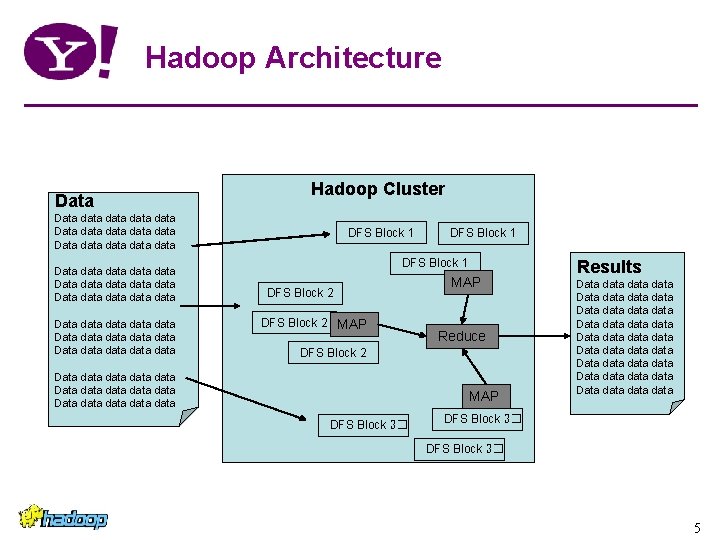
Hadoop Architecture Data Hadoop Cluster Data data data data data Data data data data data Data data DFS Block 1 DFS Block 2 MAP Reduce DFS Block 2 Data data data Data data MAP DFS Block 3� Results Data data data data Data data data data Data data DFS Block 3� 5
HDFS Data Model • Data is organized into files and directories • Files are divided into uniform sized blocks and distributed across cluster nodes • Blocks are replicated to handle hardware failure • Filesystem keeps checksums of data for corruption detection and recovery • HDFS exposes block placement so that computation can be migrated to data 6
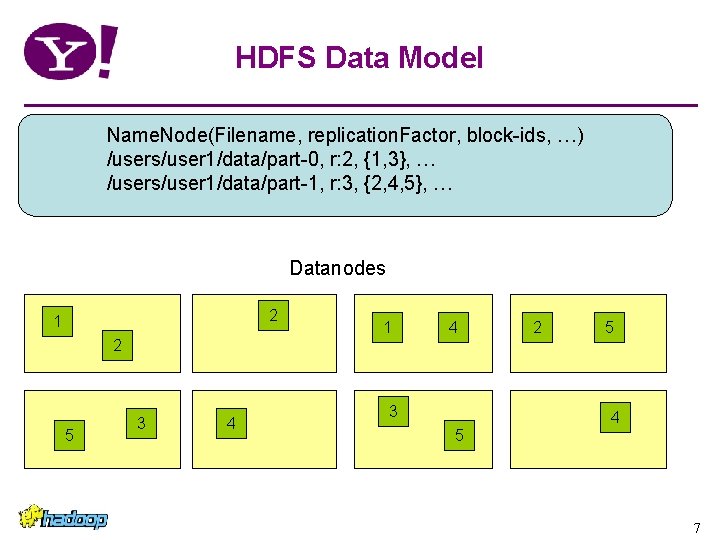
HDFS Data Model Name. Node(Filename, replication. Factor, block-ids, …) /users/user 1/data/part-0, r: 2, {1, 3}, … /users/user 1/data/part-1, r: 3, {2, 4, 5}, … Datanodes 2 1 1 4 2 5 3 4 5 7
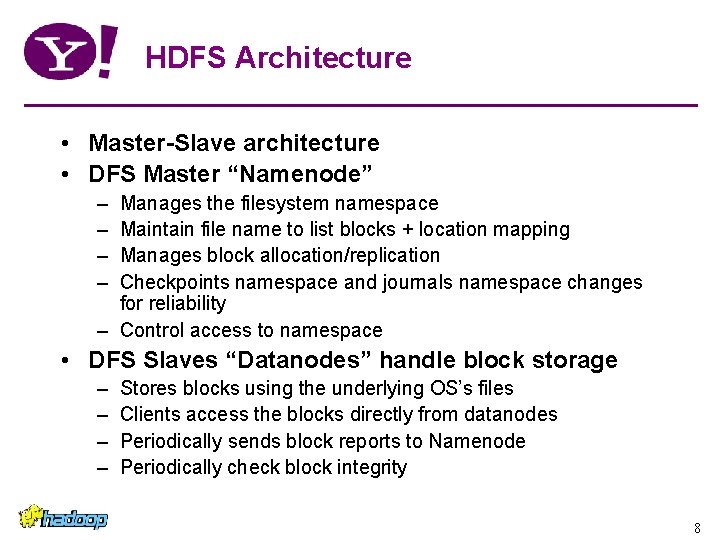
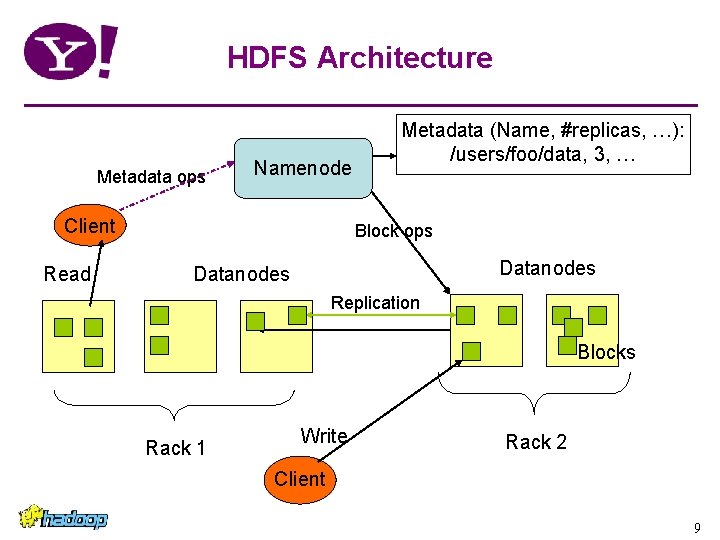
HDFS Architecture • Master-Slave architecture • DFS Master “Namenode” – – Manages the filesystem namespace Maintain file name to list blocks + location mapping Manages block allocation/replication Checkpoints namespace and journals namespace changes for reliability – Control access to namespace • DFS Slaves “Datanodes” handle block storage – – Stores blocks using the underlying OS’s files Clients access the blocks directly from datanodes Periodically sends block reports to Namenode Periodically check block integrity 8
HDFS Architecture Metadata ops Namenode Client Read Metadata (Name, #replicas, …): /users/foo/data, 3, … Block ops Datanodes Replication Blocks Rack 1 Write Rack 2 Client 9
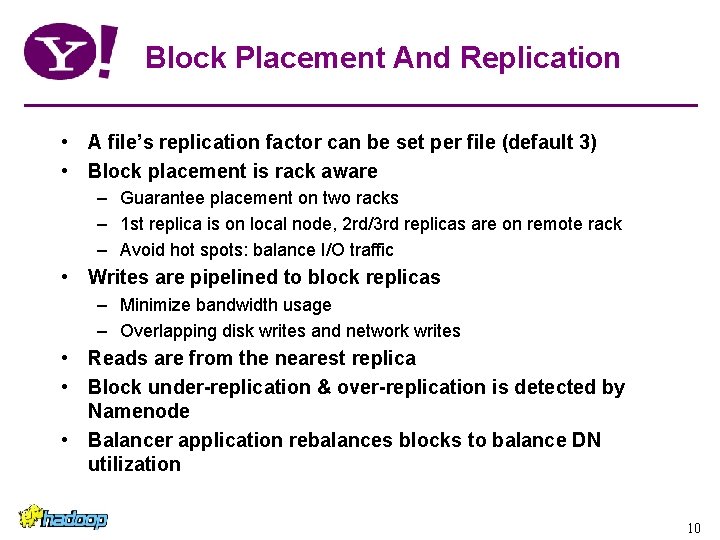
Block Placement And Replication • A file’s replication factor can be set per file (default 3) • Block placement is rack aware – Guarantee placement on two racks – 1 st replica is on local node, 2 rd/3 rd replicas are on remote rack – Avoid hot spots: balance I/O traffic • Writes are pipelined to block replicas – Minimize bandwidth usage – Overlapping disk writes and network writes • Reads are from the nearest replica • Block under-replication & over-replication is detected by Namenode • Balancer application rebalances blocks to balance DN utilization 10
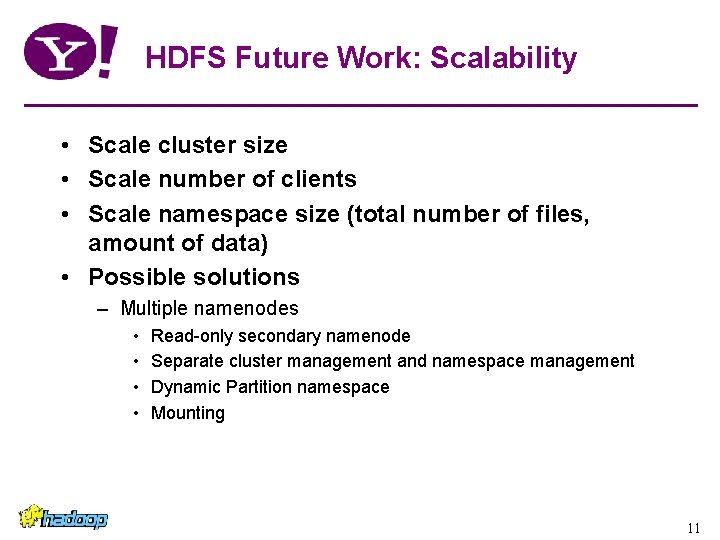
HDFS Future Work: Scalability • Scale cluster size • Scale number of clients • Scale namespace size (total number of files, amount of data) • Possible solutions – Multiple namenodes • • Read-only secondary namenode Separate cluster management and namespace management Dynamic Partition namespace Mounting 11
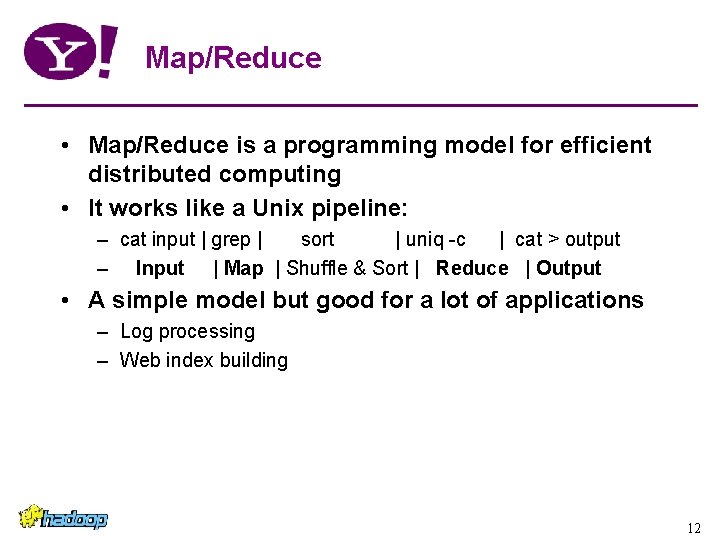
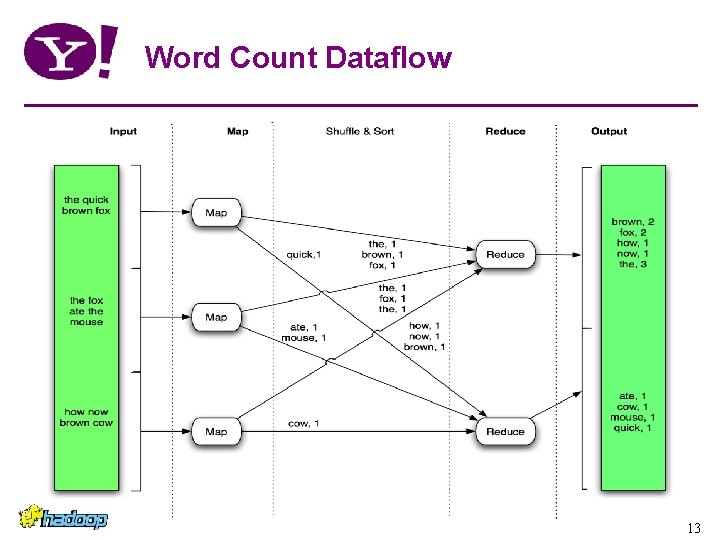
Map/Reduce • Map/Reduce is a programming model for efficient distributed computing • It works like a Unix pipeline: – cat input | grep | sort | uniq -c | cat > output – Input | Map | Shuffle & Sort | Reduce | Output • A simple model but good for a lot of applications – Log processing – Web index building 12
Word Count Dataflow 13
Word Count Example • Mapper – Input: value: lines of text of input – Output: key: word, value: 1 • Reducer – Input: key: word, value: set of counts – Output: key: word, value: sum • Launching program – Defines the job – Submits job to cluster 14
Map/Reduce features • Fine grained Map and Reduce tasks – Improved load balancing – Faster recovery from failed tasks • Automatic re-execution on failure – In a large cluster, some nodes are always slow or flaky – Framework re-executes failed tasks • Locality optimizations – – With large data, bandwidth to data is a problem Map-Reduce + HDFS is a very effective solution Map-Reduce queries HDFS for locations of input data Map tasks are scheduled close to the inputs when possible 15
Documentation • Hadoop Wiki – Introduction • http: //hadoop. apache. org/core/ – Getting Started • http: //wiki. apache. org/hadoop/Getting. Started. With. Hadoop – Map/Reduce Overview • http: //wiki. apache. org/hadoop/Hadoop. Map. Reduce – DFS • http: //hadoop. apache. org/core/docs/current/hdfs_design. html • Javadoc – http: //hadoop. apache. org/core/docs/current/api/index. html 16
Questions? Thank you! 17