
ECE 599692 Deep Learning Lecture 2 Background Hairong
ECE 599/692 – Deep Learning Lecture 2 - Background Hairong Qi, Gonzalez Family Professor Electrical Engineering and Computer Science University of Tennessee, Knoxville http: //www. eecs. utk. edu/faculty/qi Email: hqi@utk. edu 1
Outline • Instructor and TA – Dr. Hairong Qi (hqi@utk. edu) – Chengcheng Li (cli 42@vols. utk. edu) • What’s the difference between different courses and terminologies? • Why deep learning? – Seminar works – Engineered features vs. Automatic features • What do we cover? • What’s the expectation? – ECE 599 – ECE 692 • Programming environment – Tensorflow and Google Cloud Platform (GCP) • Preliminaries – Linear algebra, probability and statistics, numerical computation, machine learning basics 2
Different Courses • Machine Learning (ML) (CS 425/528) • Pattern Recognition (PR) (ECE 471/571) • Reinforcement Learning (RL) (ECE 517) • Biologically-Inspired Computation (CS 527) • Deep Learning (DL) (ECE 599/692) • Artificial Intelligence (AI) (CS 529 – Autonomous Mobile Robots ) ? ? ? ! Sept. 2017: https: //www. alibabacloud. com/blog/deep-learning-vs-machinelearning-vs-pattern-recognition_207110 ? ? ? ! Mar. 2015, Tombone’s Computer Vision Blog: http: //www. computervisionblog. com/2015/03/deep-learning-vs-machine-learning -vs. html 3
Different Terminologies • • Pattern Recognition vs. Pattern Classification Machine Learning vs. Artificial Intelligence Machine Learning vs. Pattern Recognition Engineered Features vs. Automatic Features 4
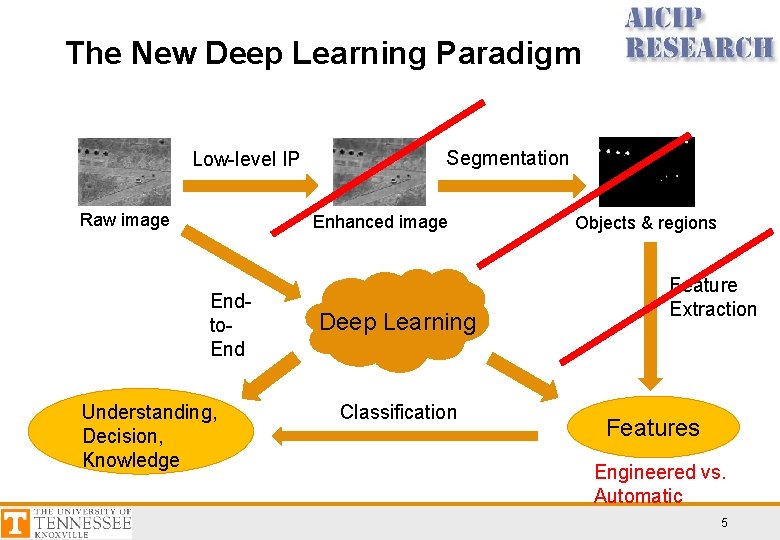
The New Deep Learning Paradigm Low-level IP Raw image Segmentation Enhanced image Endto. End Understanding, Decision, Knowledge Deep Learning Classification Objects & regions Feature Extraction Features Engineered vs. Automatic 5
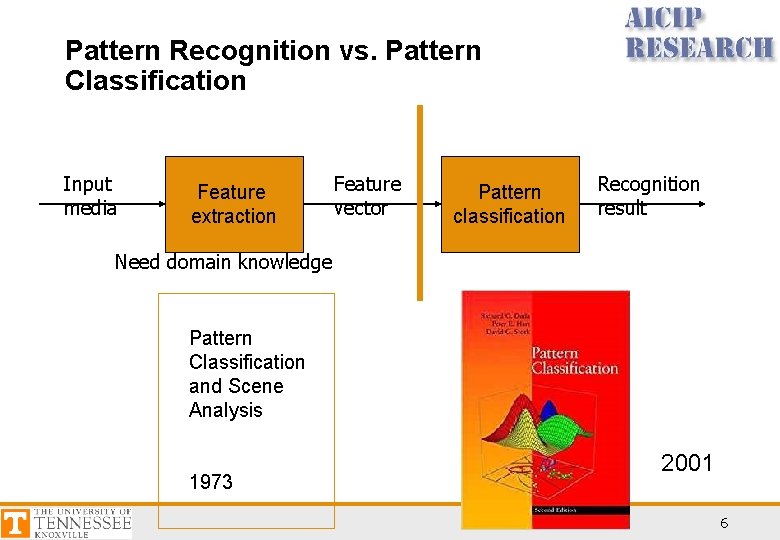
Pattern Recognition vs. Pattern Classification Input media Feature extraction Feature vector Pattern classification Recognition result Need domain knowledge Pattern Classification and Scene Analysis 1973 2001 6
AI vs. ML or PR PR + Reasoning (RNN) AI PR + Planning & RL AI 7
CS 425/528 Content • • • • Introduction (ch. 1) Supervised Learning (ch. 2) Bayesian Decision Theory (ch. 3) Parametric Methods (chs. 4– 5) Dimensionality Reduction (ch. 6) Clustering (ch. 7) Non-Parametric Methods (ch. 8) Decision Trees (ch. 9) Neural Networks (chs. 10– 11) Local Models (ch. 12) Kernel Machines (ch. 13) Reinforcement Learning (ch. 18) Machine Learning Experiments (ch. 19) 8
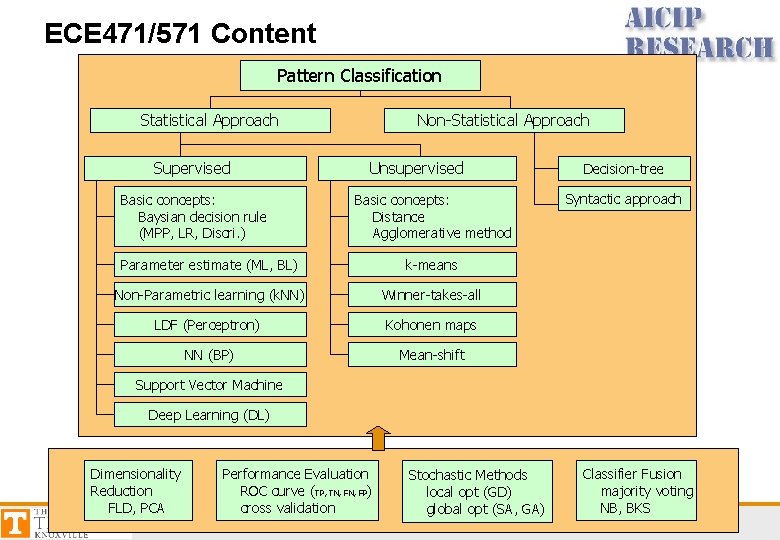
ECE 471/571 Content Pattern Classification Statistical Approach Supervised Basic concepts: Baysian decision rule (MPP, LR, Discri. ) Non-Statistical Approach Unsupervised Basic concepts: Distance Agglomerative method Parameter estimate (ML, BL) k-means Non-Parametric learning (k. NN) Winner-takes-all LDF (Perceptron) Kohonen maps NN (BP) Mean-shift Decision-tree Syntactic approach Support Vector Machine Deep Learning (DL) Dimensionality Reduction FLD, PCA Performance Evaluation ROC curve (TP, TN, FP) cross validation Stochastic Methods local opt (GD) global opt (SA, GA) Classifier Fusion majority voting NB, BKS
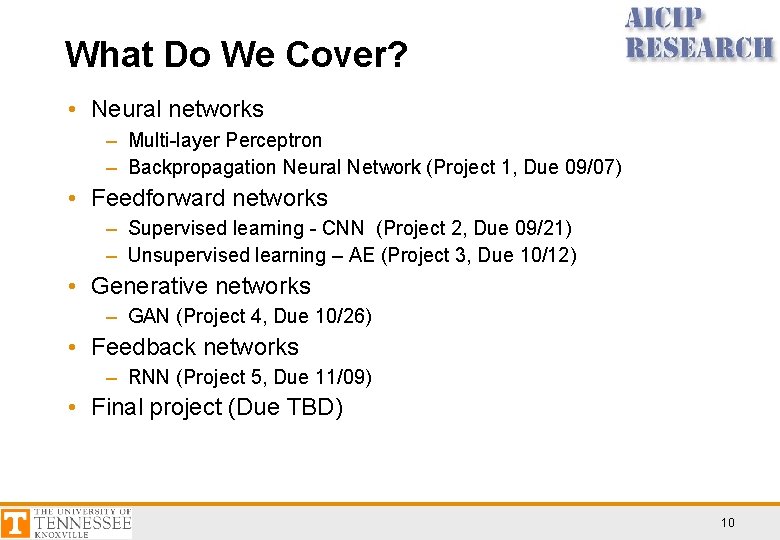
What Do We Cover? • Neural networks – Multi-layer Perceptron – Backpropagation Neural Network (Project 1, Due 09/07) • Feedforward networks – Supervised learning - CNN (Project 2, Due 09/21) – Unsupervised learning – AE (Project 3, Due 10/12) • Generative networks – GAN (Project 4, Due 10/26) • Feedback networks – RNN (Project 5, Due 11/09) • Final project (Due TBD) 10
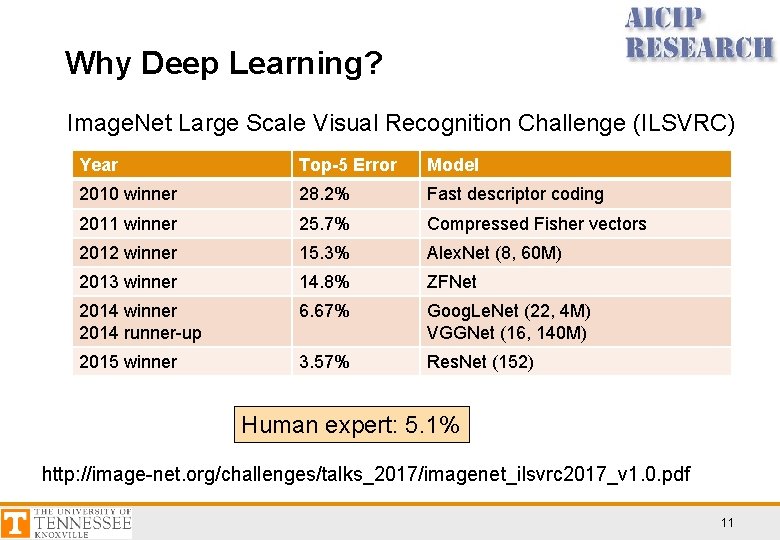
Why Deep Learning? Image. Net Large Scale Visual Recognition Challenge (ILSVRC) Year Top-5 Error Model 2010 winner 28. 2% Fast descriptor coding 2011 winner 25. 7% Compressed Fisher vectors 2012 winner 15. 3% Alex. Net (8, 60 M) 2013 winner 14. 8% ZFNet 2014 winner 2014 runner-up 6. 67% Goog. Le. Net (22, 4 M) VGGNet (16, 140 M) 2015 winner 3. 57% Res. Net (152) Human expert: 5. 1% http: //image-net. org/challenges/talks_2017/imagenet_ilsvrc 2017_v 1. 0. pdf 11
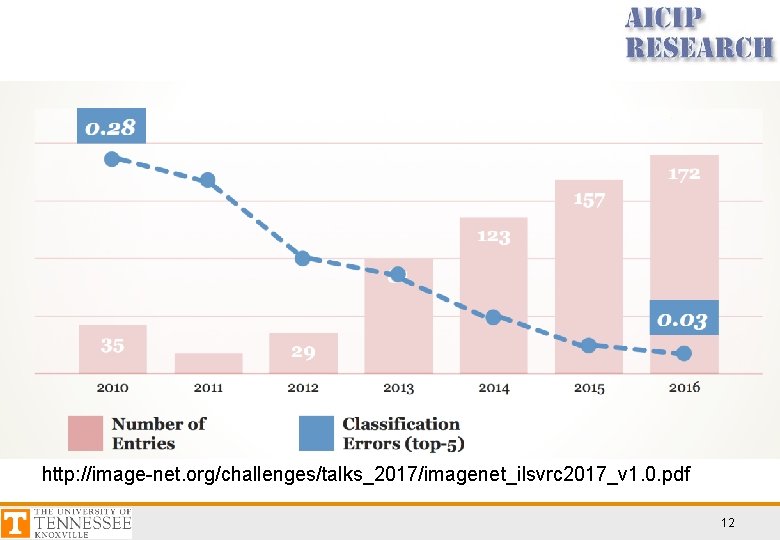
http: //image-net. org/challenges/talks_2017/imagenet_ilsvrc 2017_v 1. 0. pdf 12

To be continued … 13
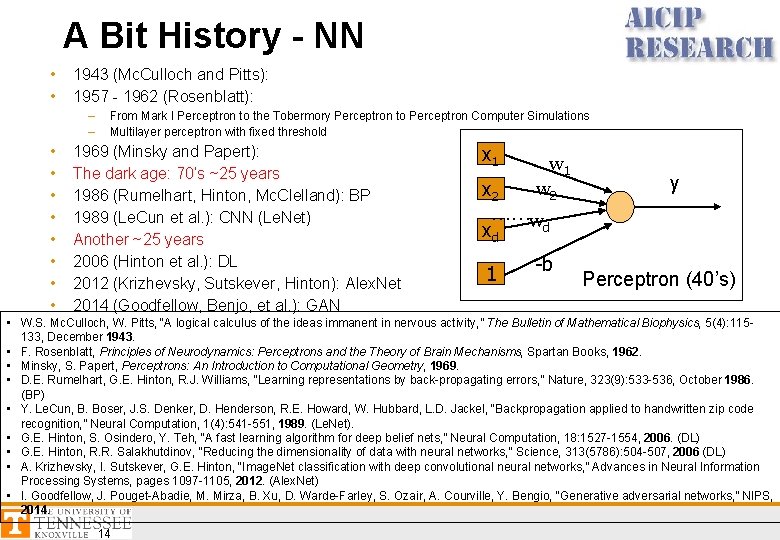
A Bit History - NN • • 1943 (Mc. Culloch and Pitts): 1957 - 1962 (Rosenblatt): – – • • From Mark I Perceptron to the Tobermory Perceptron to Perceptron Computer Simulations Multilayer perceptron with fixed threshold 1969 (Minsky and Papert): The dark age: 70’s ~25 years 1986 (Rumelhart, Hinton, Mc. Clelland): BP 1989 (Le. Cun et al. ): CNN (Le. Net) Another ~25 years 2006 (Hinton et al. ): DL 2012 (Krizhevsky, Sutskever, Hinton): Alex. Net 2014 (Goodfellow, Benjo, et al. ): GAN x 1 x 2 w 1 w 2 y ……wd xd 1 -b Perceptron (40’s) • W. S. Mc. Culloch, W. Pitts, “A logical calculus of the ideas immanent in nervous activity, ” The Bulletin of Mathematical Biophysics, 5(4): 115133, December 1943. • F. Rosenblatt, Principles of Neurodynamics: Perceptrons and the Theory of Brain Mechanisms, Spartan Books, 1962. • Minsky, S. Papert, Perceptrons: An Introduction to Computational Geometry, 1969. • D. E. Rumelhart, G. E. Hinton, R. J. Williams, “Learning representations by back-propagating errors, ” Nature, 323(9): 533 -536, October 1986. (BP) • Y. Le. Cun, B. Boser, J. S. Denker, D. Henderson, R. E. Howard, W. Hubbard, L. D. Jackel, “Backpropagation applied to handwritten zip code recognition, ” Neural Computation, 1(4): 541 -551, 1989. (Le. Net). • G. E. Hinton, S. Osindero, Y. Teh, “A fast learning algorithm for deep belief nets, ” Neural Computation, 18: 1527 -1554, 2006. (DL) • G. E. Hinton, R. R. Salakhutdinov, “Reducing the dimensionality of data with neural networks, ” Science, 313(5786): 504 -507, 2006 (DL) • A. Krizhevsky, I. Sutskever, G. E. Hinton, “Image. Net classification with deep convolutional neural networks, ” Advances in Neural Information Processing Systems, pages 1097 -1105, 2012. (Alex. Net) • I. Goodfellow, J. Pouget-Abadie, M. Mirza, B. Xu, D. Warde-Farley, S. Ozair, A. Courville, Y. Bengio, “Generative adversarial networks, ” NIPS, 2014. 14
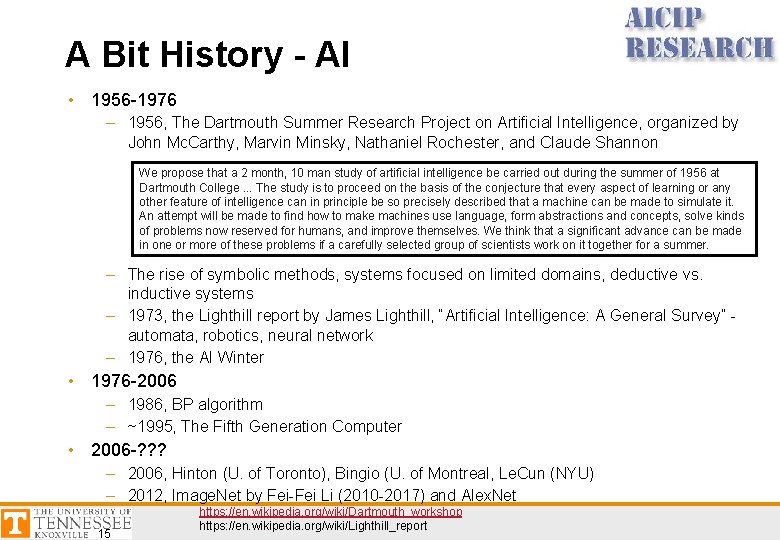
A Bit History - AI • 1956 -1976 – 1956, The Dartmouth Summer Research Project on Artificial Intelligence, organized by John Mc. Carthy, Marvin Minsky, Nathaniel Rochester, and Claude Shannon We propose that a 2 month, 10 man study of artificial intelligence be carried out during the summer of 1956 at Dartmouth College. . . The study is to proceed on the basis of the conjecture that every aspect of learning or any other feature of intelligence can in principle be so precisely described that a machine can be made to simulate it. An attempt will be made to find how to make machines use language, form abstractions and concepts, solve kinds of problems now reserved for humans, and improve themselves. We think that a significant advance can be made in one or more of these problems if a carefully selected group of scientists work on it together for a summer. – The rise of symbolic methods, systems focused on limited domains, deductive vs. inductive systems – 1973, the Lighthill report by James Lighthill, “Artificial Intelligence: A General Survey” - automata, robotics, neural network – 1976, the AI Winter • 1976 -2006 – 1986, BP algorithm – ~1995, The Fifth Generation Computer • 2006 -? ? ? – 2006, Hinton (U. of Toronto), Bingio (U. of Montreal, Le. Cun (NYU) – 2012, Image. Net by Fei-Fei Li (2010 -2017) and Alex. Net 15 https: //en. wikipedia. org/wiki/Dartmouth_workshop https: //en. wikipedia. org/wiki/Lighthill_report
Preliminaries • Math and Statistics – Linear algebra – Probability and Statistics – Numerical computation • Machine learning basics – Neural networks and backpropagation • Programming environment – Tensorflow – GCP 16
Linear Algebra • Scalars, vectors, matrices, tensors • Linear dependence and span • Norms – lp norms, l 0 norm – Frobenius norm - l 2 norm for matrices • Matrix decomposition – Eigendecomposition (for square matrices) – Singular value decomposition (SVD) (for any matrices) – [Snyder&Qi: 2017] 17
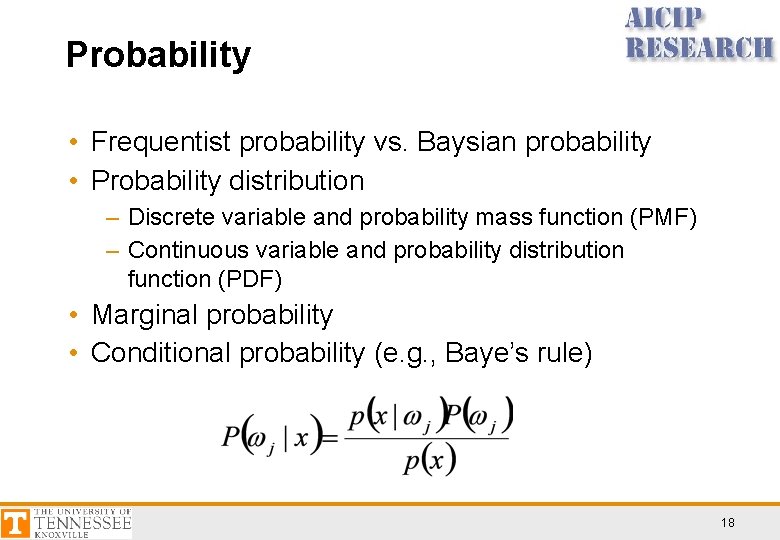
Probability • Frequentist probability vs. Baysian probability • Probability distribution – Discrete variable and probability mass function (PMF) – Continuous variable and probability distribution function (PDF) • Marginal probability • Conditional probability (e. g. , Baye’s rule) 18
Information Theory • Measuring information – Self-information of an event x=x, I(x) = -log. P(x) – Base e: unit (nats) information gained by observing an event of probability 1/e – Base 2: unit (bits or shannons) – Shannon entropy: H(x) = Ex~P[I(x)] = -Ex~P[log. P(x)] • Kullback-Leibler (KL) divergence – DKL(P||Q) = Ex~P[log. P(x)/Q(x)] = Ex~P[log. P(x) – log. Q(x)] • Cross-entropy – H(P, Q) = H(P) + DKL(P||Q) 19
Numerical Computation • Global vs. local optimization • Gradient descent • Constrained optimization – Langrange optimization – Karush-Kuhn-Tucker (KKT) approach 20
Pattern Classification Approaches • • • Supervised vs. unsupervised Parametric vs. non-parametric Classification vs. regression vs. generation Training set vs. test set vs. validation set Cross-validation 21
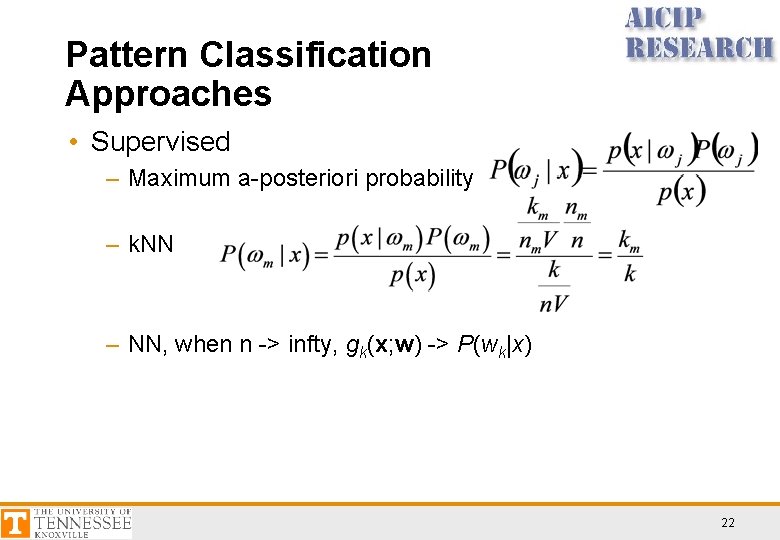
Pattern Classification Approaches • Supervised – Maximum a-posteriori probability – k. NN – NN, when n -> infty, gk(x; w) -> P(wk|x) 22
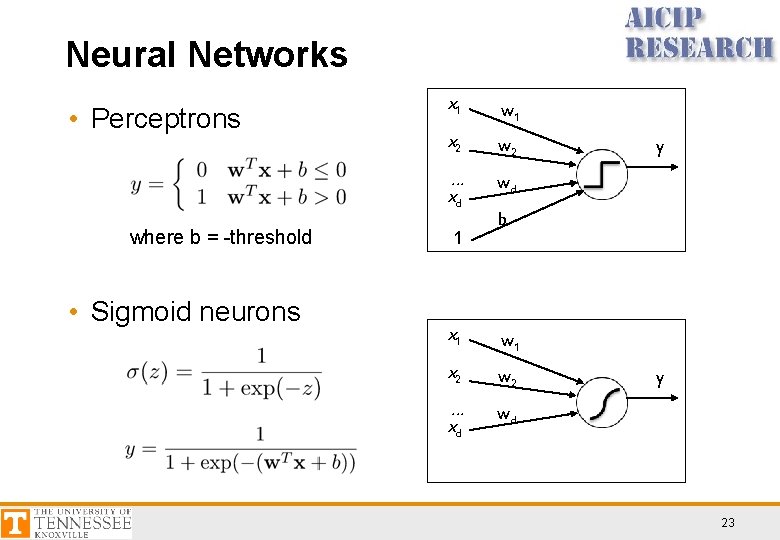
Neural Networks • Perceptrons where b = -threshold • Sigmoid neurons x 1 w 1 x 2 w 2 … xd wd 1 y b x 1 w 1 x 2 w 2 … xd wd y 23
![Network Example – MNIST Recognition Image from: [Nielson] 24](http://slidetodoc.com/presentation_image_h/75356bdbc96e5cc47afedcf917e104e3/image-24.jpg "Network Example – MNIST Recognition Image from: [Nielson] 24")
Network Example – MNIST Recognition Image from: [Nielson] 24
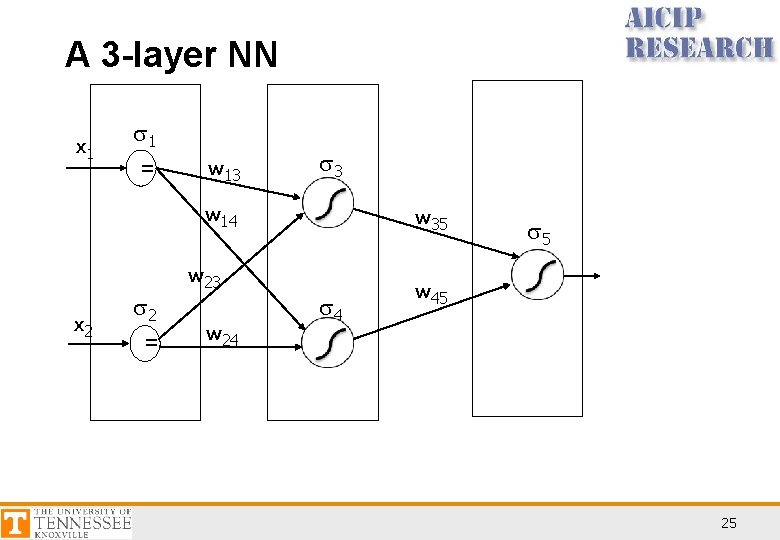
A 3 -layer NN x 1 s 1 = w 13 s 3 w 14 x 2 s 2 = w 23 w 24 w 35 s 4 s 5 w 45 25
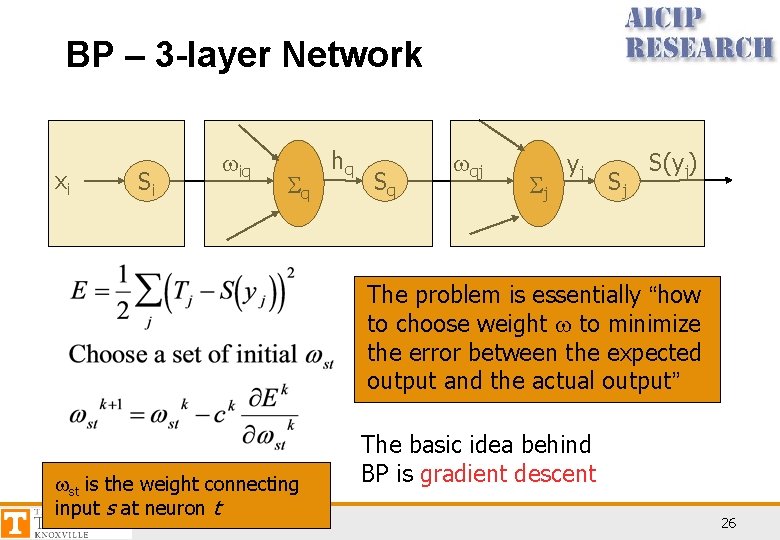
BP – 3 -layer Network xi Si wiq Sq hq Sq wqj Sj yj Sj S(yj) The problem is essentially “how to choose weight w to minimize the error between the expected output and the actual output” wst is the weight connecting input s at neuron t The basic idea behind BP is gradient descent 26
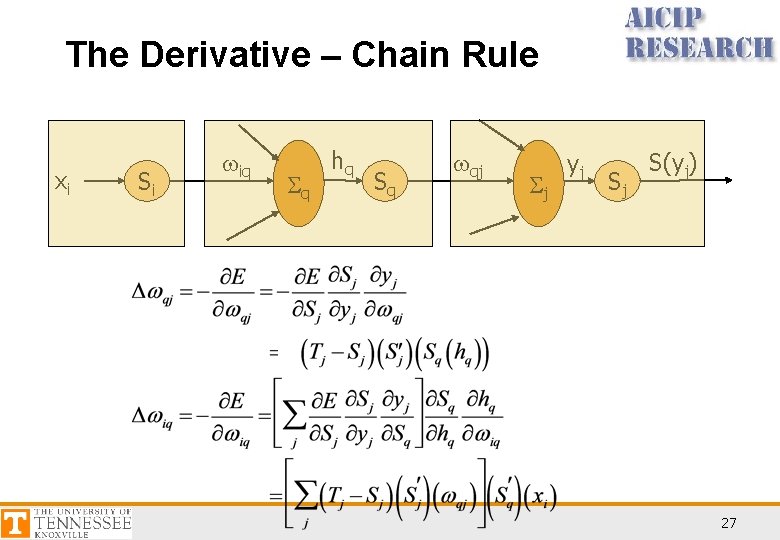
The Derivative – Chain Rule xi Si wiq Sq hq Sq wqj Sj yj Sj S(yj) 27
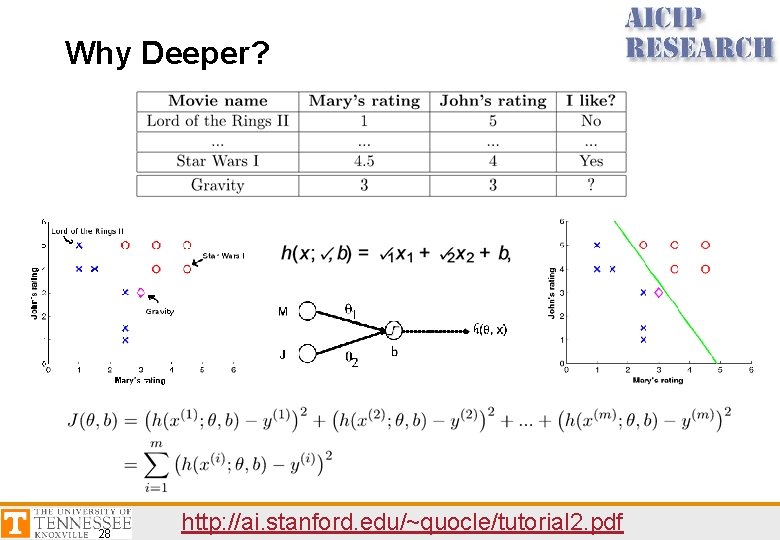
Why Deeper? 28 http: //ai. stanford. edu/~quocle/tutorial 2. pdf
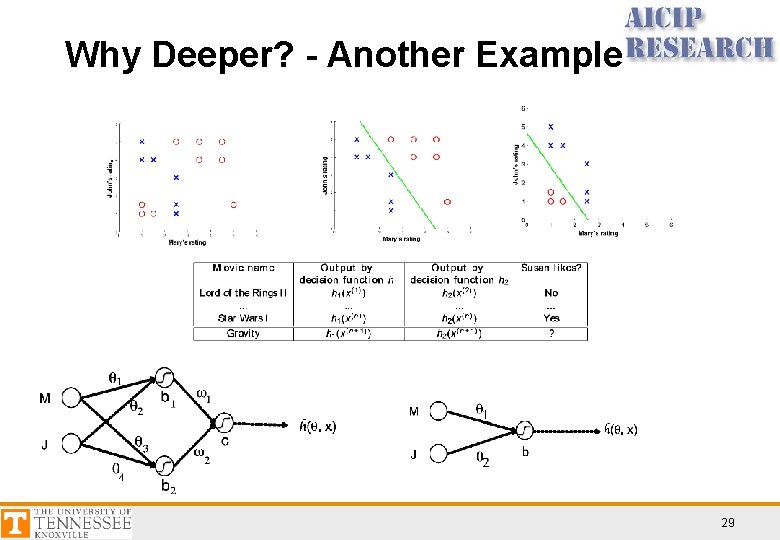
Why Deeper? - Another Example 29
- Slides: 29