
Spectral mapping with linearized Radiant Zhiming Kuang Basic
Spectral mapping with linearized Radiant Zhiming Kuang • Basic idea: Group wavelengths with similar optical properties into one “bin”, and approximate their RT solutions by that of this “bin”. • Spectral mapping with the discreteordinate approach (SMART by Crisp) requires the optical properties are similar at all levels
The linearized hybrid model Radiant offers important advantages for spectral mapping • No need to re-compute the GT and GR functions of individual layers when changes take place in other parts of the atmosphere. • The analytical Jacobians can be used to make first order corrections thus to achieve better accuracy

Basic independent variables: Restrict spectral mapping to within each layer Wavelength An empirical function scattering absorption • Using gas absorption and effects of cloud/aerosols/Rayleigh gives similar results
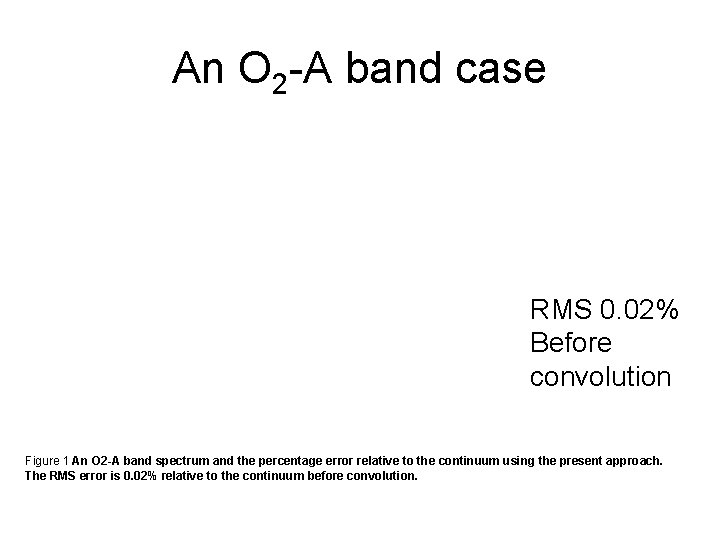
An O 2 -A band case RMS 0. 02% Before convolution Figure 1 An O 2 -A band spectrum and the percentage error relative to the continuum using the present approach. The RMS error is 0. 02% relative to the continuum before convolution.

A CO 2 2. 0 um band case RMS 0. 02%
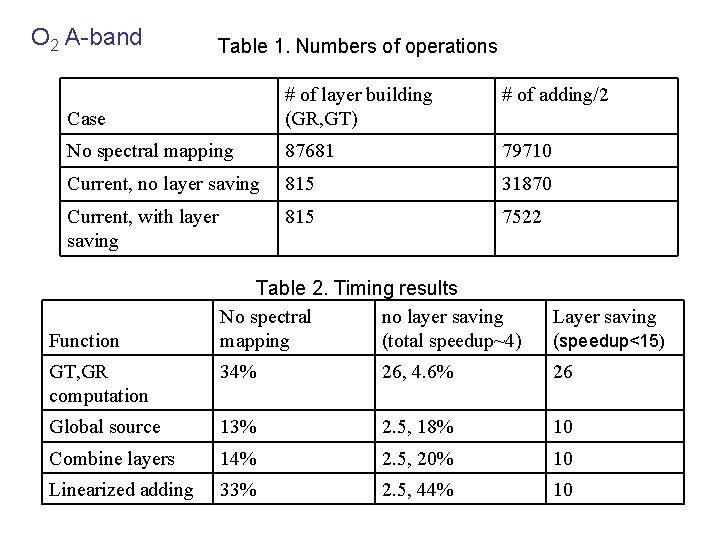
O 2 A-band Table 1. Numbers of operations # of adding/2 Case # of layer building (GR, GT) No spectral mapping 87681 79710 Current, no layer saving 815 31870 Current, with layer saving 815 7522 Table 2. Timing results No spectral no layer saving mapping (total speedup~4) Layer saving (speedup<15) GT, GR computation 34% 26, 4. 6% 26 Global source 13% 2. 5, 18% 10 Combine layers 14% 2. 5, 20% 10 Linearized adding 33% 2. 5, 44% 10 Function
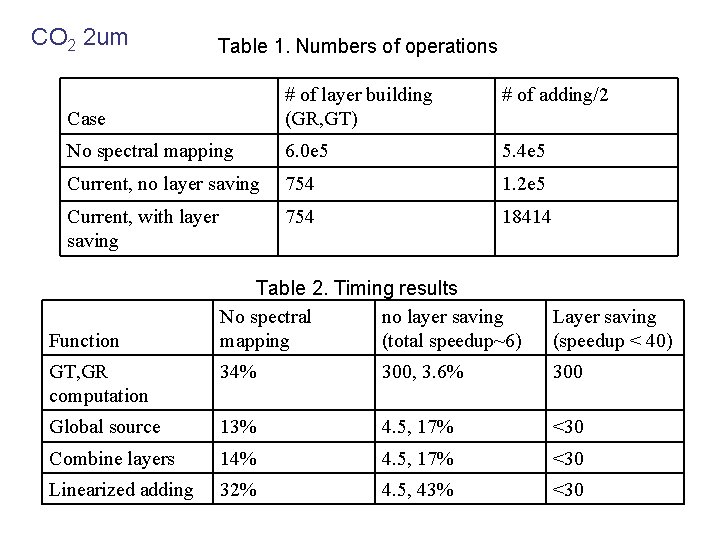
CO 2 2 um Table 1. Numbers of operations # of adding/2 Case # of layer building (GR, GT) No spectral mapping 6. 0 e 5 5. 4 e 5 Current, no layer saving 754 1. 2 e 5 Current, with layer saving 754 18414 Table 2. Timing results No spectral no layer saving mapping (total speedup~6) Layer saving (speedup < 40) GT, GR computation 34% 300, 3. 6% 300 Global source 13% 4. 5, 17% <30 Combine layers 14% 4. 5, 17% <30 Linearized adding 32% 4. 5, 43% <30 Function
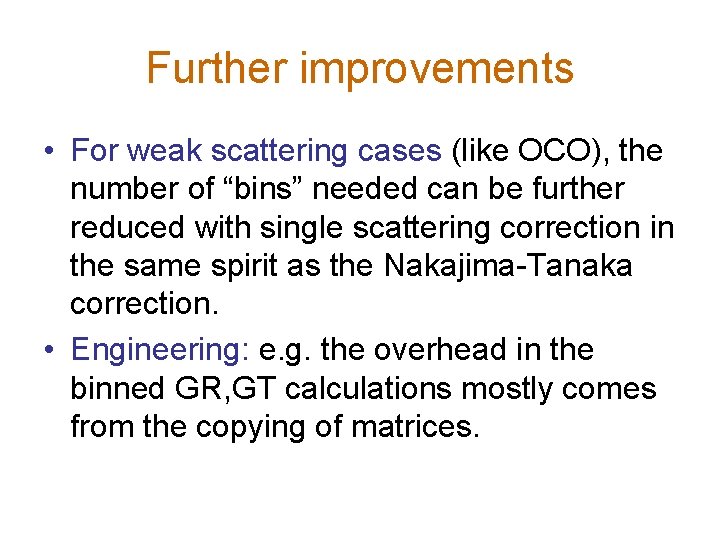
Further improvements • For weak scattering cases (like OCO), the number of “bins” needed can be further reduced with single scattering correction in the same spirit as the Nakajima-Tanaka correction. • Engineering: e. g. the overhead in the binned GR, GT calculations mostly comes from the copying of matrices.
- Slides: 8