Suvarna Arogya Suraksha Trust Department of Health and


- Slides: 44
Suvarna Arogya Suraksha Trust Department of Health and Family Welfare Government of Karnataka Welcome to the Orientation Programme of Integrated Ayushman Bharat-Arogya Karnataka Presentation
THE KARNATAKA INTEGRATED PUBLIC HEALTH POLICY 2017 • Envisages attainment of the highest possible level of good health and well-being of all with universal access to affordable and quality healthcare services. • All the fragmented social insurance schemes be merged into a single health assurance plan to improve efficiency and outreach • State Government to develop robust and sustainable financing mechanisms by strengthening the public sector and harnessing private services to ensure that public services of the highest quality.
The National Health Policy • Availability of primary healthcare services • Reproductive, maternal, child and adolescent health and for the treatment of the most prevalent communicable, non-communicable and occupational diseases • Ensuring improved access and affordability, of quality secondary and tertiary healthcare services through a combination of public hospitals and well measured strategic purchasing of services in healthcare deficit areas from private.
The National Health Policy • Achieving a significant reduction in out of pocket expenditure of healthcare costs • Reducing the proportion of households experiencing catastrophic health expenditures and consequent impoverishment.
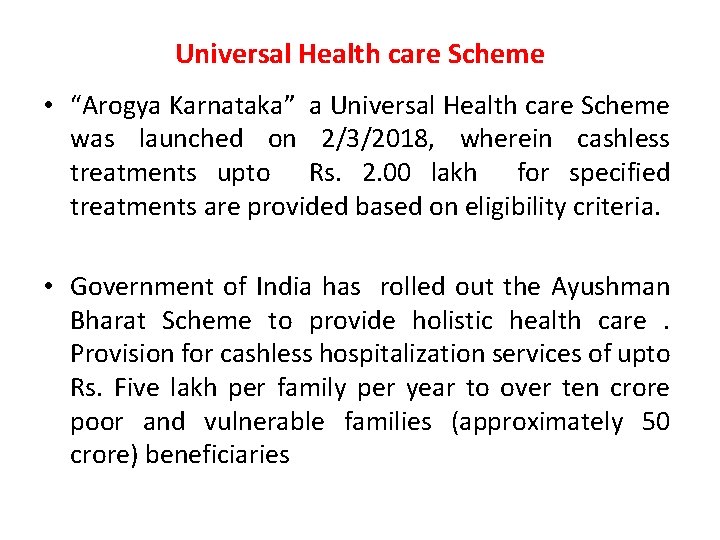
Universal Health care Scheme • “Arogya Karnataka” a Universal Health care Scheme was launched on 2/3/2018, wherein cashless treatments upto Rs. 2. 00 lakh for specified treatments are provided based on eligibility criteria. • Government of India has rolled out the Ayushman Bharat Scheme to provide holistic health care . Provision for cashless hospitalization services of upto Rs. Five lakh per family per year to over ten crore poor and vulnerable families (approximately 50 crore) beneficiaries
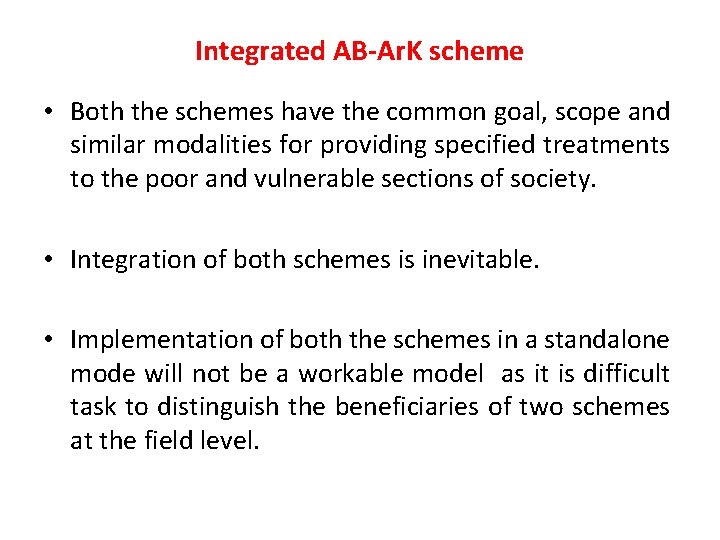
Integrated AB-Ar. K scheme • Both the schemes have the common goal, scope and similar modalities for providing specified treatments to the poor and vulnerable sections of society. • Integration of both schemes is inevitable. • Implementation of both the schemes in a standalone mode will not be a workable model as it is difficult task to distinguish the beneficiaries of two schemes at the field level.
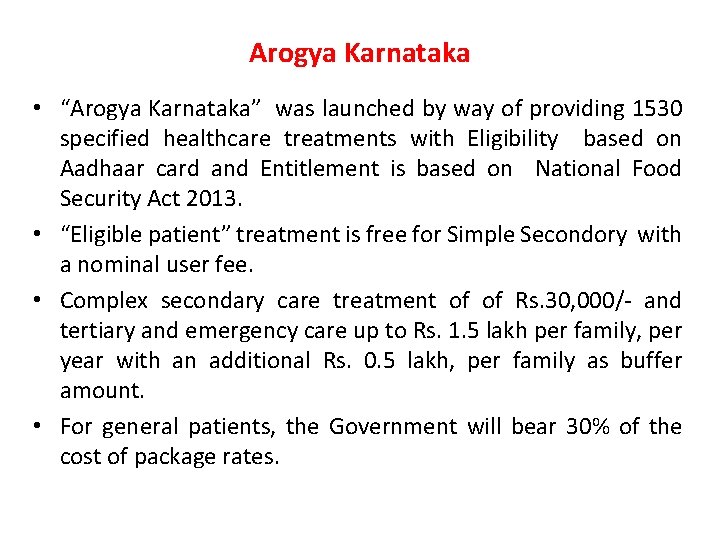
Arogya Karnataka • “Arogya Karnataka” was launched by way of providing 1530 specified healthcare treatments with Eligibility based on Aadhaar card and Entitlement is based on National Food Security Act 2013. • “Eligible patient” treatment is free for Simple Secondory with a nominal user fee. • Complex secondary care treatment of of Rs. 30, 000/- and tertiary and emergency care up to Rs. 1. 5 lakh per family, per year with an additional Rs. 0. 5 lakh, per family as buffer amount. • For general patients, the Government will bear 30% of the cost of package rates.
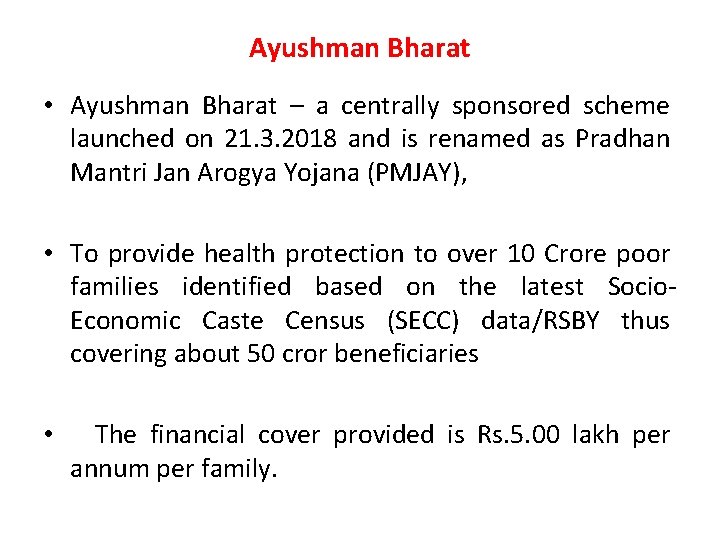
Ayushman Bharat • Ayushman Bharat – a centrally sponsored scheme launched on 21. 3. 2018 and is renamed as Pradhan Mantri Jan Arogya Yojana (PMJAY), • To provide health protection to over 10 Crore poor families identified based on the latest Socio. Economic Caste Census (SECC) data/RSBY thus covering about 50 cror beneficiaries • The financial cover provided is Rs. 5. 00 lakh per annum per family.
Rashtriya Swasthya Bhima Yojane • The centrally sponsored Rashtriya Swasthya Bhima Yojane that was implemented in an insurance mode and was servicing about 62 lakh families who come under the 8 deprivation criteria has come to a close on 31/8/2018 • It is this category of population, including those who are in the SECC data, that will now be the beneficiaries under the Ayushman Bharat-PMJAY scheme.
“Ayushman Bharat-Arogya Karnataka” • State already has a Universal Health Coverage scheme “Arogya Karnataka” and Ayushman Bharat is a similar scheme of the Government of India with a smaller coverage but higher financial assistance. • Integration of both the schemes “Ayushman Bharat” and “Arogya Karnataka” is done to achieve operational efficiency. Common coverage, scope and implementation modalities under co-branded integrated scheme “Ayushman Bharat-Arogya Karnataka”
Ayushman Bharat-Arogya Karnataka • Integrated scheme implemented in an “Assurance Mode” • Scheme operates a revised list of proced 1628, combining and rationalizing 1530 in Ar. K and 1349 procedures in Ayushman Bharat of Primary health care, simple secondary health care, complex secondary health care, tertiary health care and emergency health care in Annexures-1, 2 A, 2 B, 3 and 4
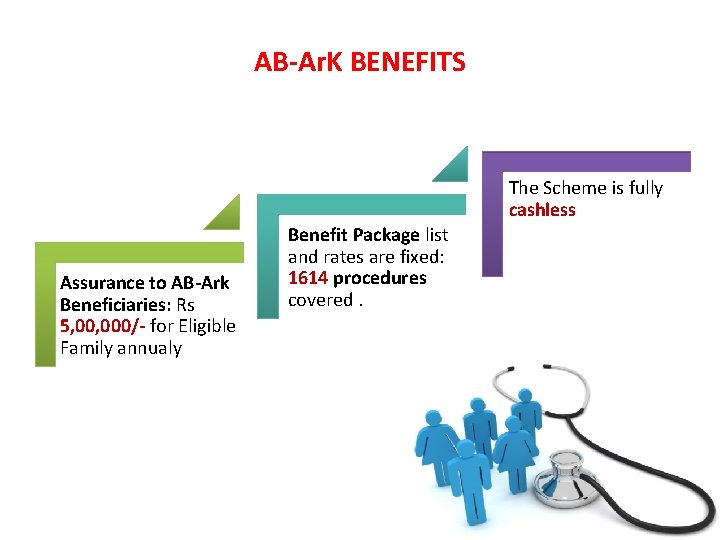
AB-Ar. K BENEFITS The Scheme is fully cashless Assurance to AB-Ark Beneficiaries: Rs 5, 000/- for Eligible Family annualy Benefit Package list and rates are fixed: 1614 procedures covered.
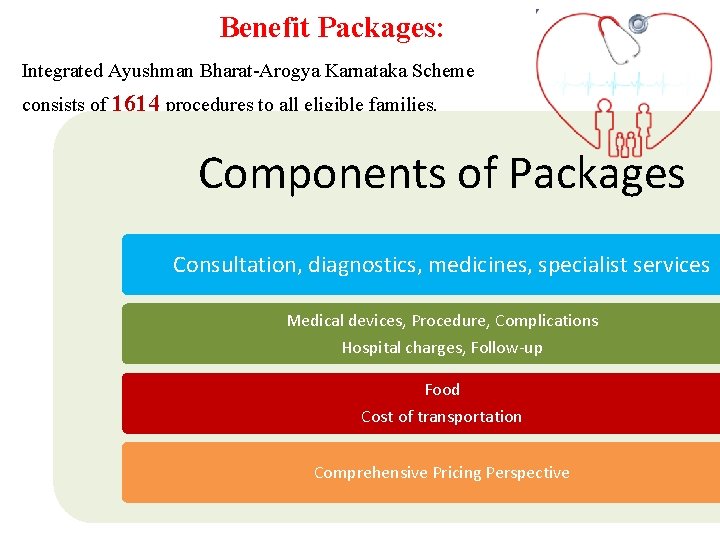
Benefit Packages: Integrated Ayushman Bharat-Arogya Karnataka Scheme consists of 1614 procedures to all eligible families. Components of Packages Consultation, diagnostics, medicines, specialist services Medical devices, Procedure, Complications Hospital charges, Follow-up Food Cost of transportation Comprehensive Pricing Perspective
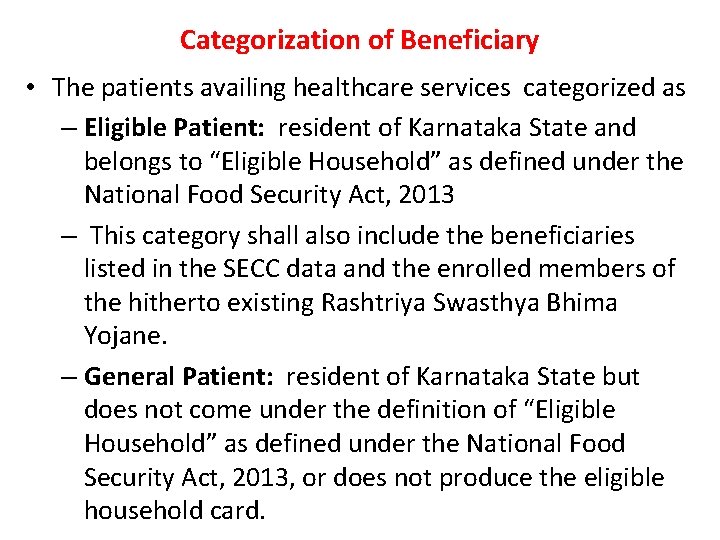
Categorization of Beneficiary • The patients availing healthcare services categorized as – Eligible Patient: resident of Karnataka State and belongs to “Eligible Household” as defined under the National Food Security Act, 2013 – This category shall also include the beneficiaries listed in the SECC data and the enrolled members of the hitherto existing Rashtriya Swasthya Bhima Yojane. – General Patient: resident of Karnataka State but does not come under the definition of “Eligible Household” as defined under the National Food Security Act, 2013, or does not produce the eligible household card.
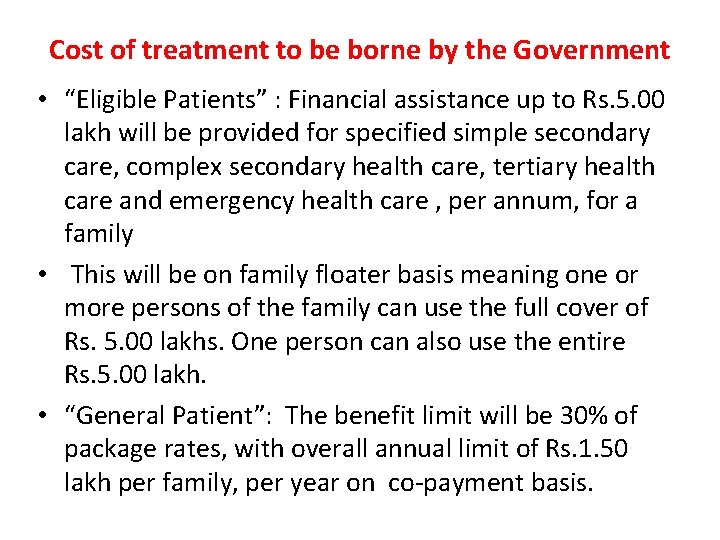
Cost of treatment to be borne by the Government • “Eligible Patients” : Financial assistance up to Rs. 5. 00 lakh will be provided for specified simple secondary care, complex secondary health care, tertiary health care and emergency health care , per annum, for a family • This will be on family floater basis meaning one or more persons of the family can use the full cover of Rs. 5. 00 lakhs. One person can also use the entire Rs. 5. 00 lakh. • “General Patient”: The benefit limit will be 30% of package rates, with overall annual limit of Rs. 1. 50 lakh per family, per year on co-payment basis.
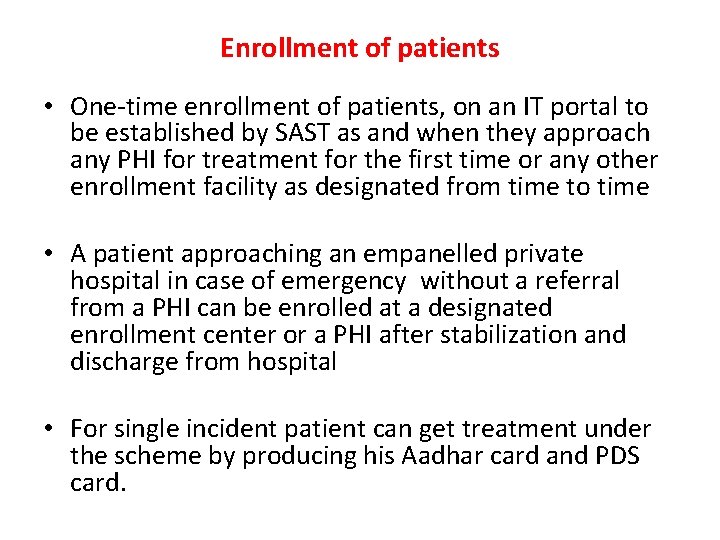
Enrollment of patients • One-time enrollment of patients, on an IT portal to be established by SAST as and when they approach any PHI for treatment for the first time or any other enrollment facility as designated from time to time • A patient approaching an empanelled private hospital in case of emergency without a referral from a PHI can be enrolled at a designated enrollment center or a PHI after stabilization and discharge from hospital • For single incident patient can get treatment under the scheme by producing his Aadhar card and PDS card.
AB-Ar. K Card • Under the Ayushman Bharat- Arogya Karnataka scheme the enrolment card called AB-Ar. K Card and the unique AB-Ark ID is generated and provided to the patient at the enrolment center on payment of a fee of Rs. 10/-. • Enrollment cards that have already been issued under the “Arogya Karnataka” scheme is valid for the integrated “Ayushman Bharat- Arogya Karnataka” scheme
Responsibilities of PHIs • PHIs to set up the required number of enrollment counters and outpatient registration counters in the hospitals Designating • There should be directions and sagnages about Enrolment Kiosk and Arogya Mitra counter in PHIs. • Signage saying Enrolment Kiosk or Counter should be prominently displayed at the spot of enrolment • Display boards of district hospital addresses should be placed in Taluk Hospitals at prominent place • Display boards of the list of Private Network hospitals of the concerned district should be placed in the district Hospitals at prominent place
Enrolment through Health & Wellness Centers • Pregnant women and children requiring reproductive and child health services, persons requiring preventive healthcare for non-communicable diseases, and persons requiring curative health care for communicable diseases shall also be enrolled through Health & Wellness Centers
Designating CSC, B 1 and K 1 Centers • Enrollment cards are to be issued Common service centers, B 1 and K 1 centers, or any other place convenient to the public for obtaining a health card expeditiously the cost of the health card in these center other than PHI’s will be fixed by competent authority.
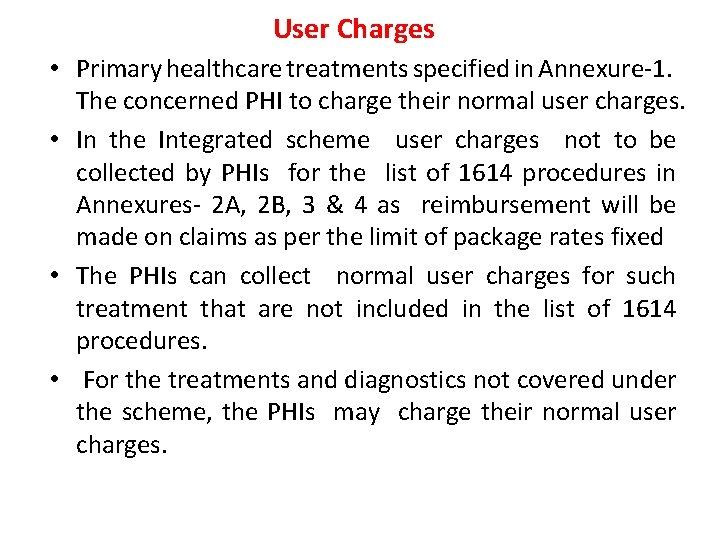
User Charges • Primary healthcare treatments specified in Annexure-1. The concerned PHI to charge their normal user charges. • In the Integrated scheme user charges not to be collected by PHIs for the list of 1614 procedures in Annexures- 2 A, 2 B, 3 & 4 as reimbursement will be made on claims as per the limit of package rates fixed • The PHIs can collect normal user charges for such treatment that are not included in the list of 1614 procedures. • For the treatments and diagnostics not covered under the scheme, the PHIs may charge their normal user charges.
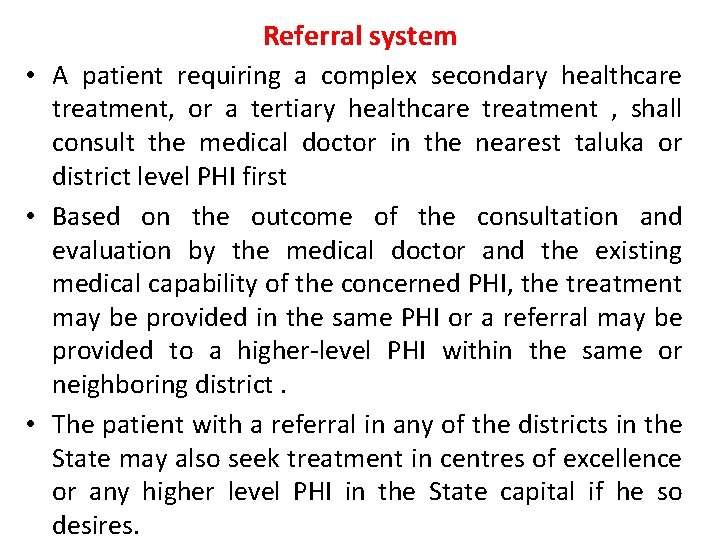
Referral system • A patient requiring a complex secondary healthcare treatment, or a tertiary healthcare treatment , shall consult the medical doctor in the nearest taluka or district level PHI first • Based on the outcome of the consultation and evaluation by the medical doctor and the existing medical capability of the concerned PHI, the treatment may be provided in the same PHI or a referral may be provided to a higher-level PHI within the same or neighboring district. • The patient with a referral in any of the districts in the State may also seek treatment in centres of excellence or any higher level PHI in the State capital if he so desires.
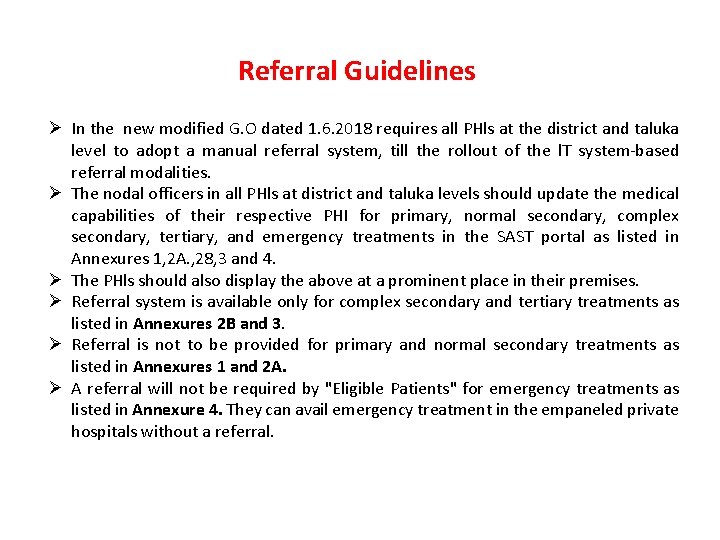
Referral Guidelines Ø In the new modified G. O dated 1. 6. 2018 requires all PHls at the district and taluka level to adopt a manual referral system, till the rollout of the l. T system-based referral modalities. Ø The nodal officers in all PHls at district and taluka levels should update the medical capabilities of their respective PHI for primary, normal secondary, complex secondary, tertiary, and emergency treatments in the SAST portal as listed in Annexures 1, 2 A. , 28, 3 and 4. Ø The PHls should also display the above at a prominent place in their premises. Ø Referral system is available only for complex secondary and tertiary treatments as listed in Annexures 2 B and 3. Ø Referral is not to be provided for primary and normal secondary treatments as listed in Annexures 1 and 2 A. Ø A referral will not be required by "Eligible Patients" for emergency treatments as listed in Annexure 4. They can avail emergency treatment in the empaneled private hospitals without a referral.
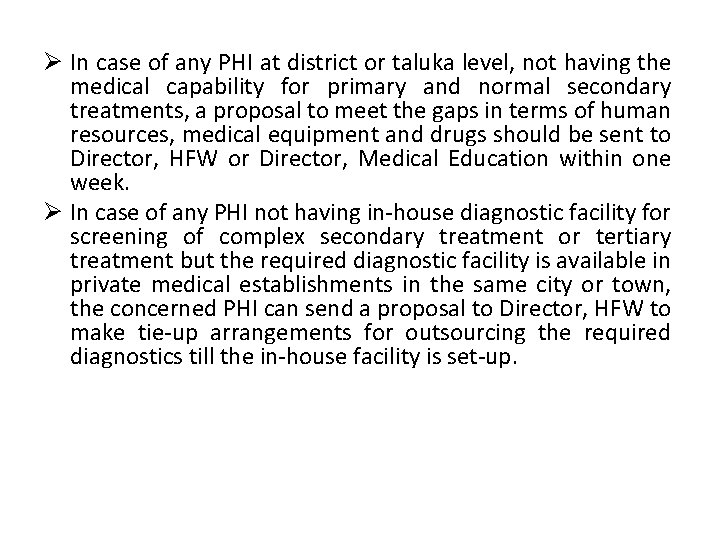
Ø In case of any PHI at district or taluka level, not having the medical capability for primary and normal secondary treatments, a proposal to meet the gaps in terms of human resources, medical equipment and drugs should be sent to Director, HFW or Director, Medical Education within one week. Ø In case of any PHI not having in-house diagnostic facility for screening of complex secondary treatment or tertiary treatment but the required diagnostic facility is available in private medical establishments in the same city or town, the concerned PHI can send a proposal to Director, HFW to make tie-up arrangements for outsourcing the required diagnostics till the in-house facility is set-up.
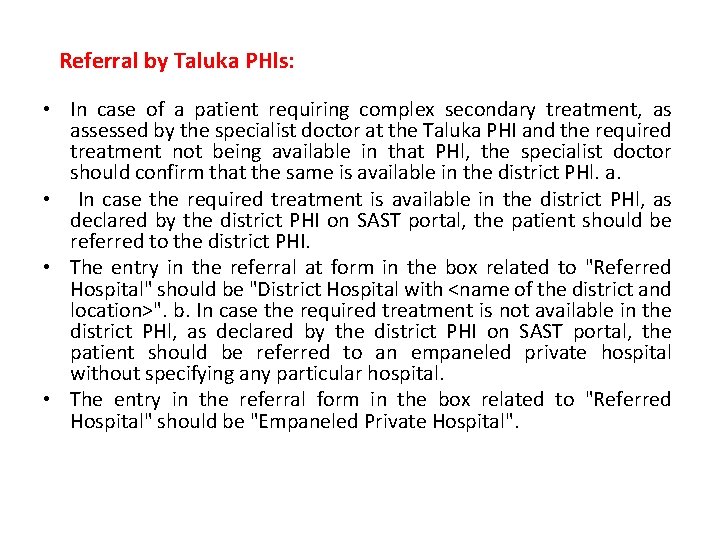
Referral by Taluka PHls: • In case of a patient requiring complex secondary treatment, as assessed by the specialist doctor at the Taluka PHI and the required treatment not being available in that PHl, the specialist doctor should confirm that the same is available in the district PHl. a. • In case the required treatment is available in the district PHl, as declared by the district PHI on SAST portal, the patient should be referred to the district PHI. • The entry in the referral at form in the box related to "Referred Hospital" should be "District Hospital with <name of the district and location>". b. In case the required treatment is not available in the district PHl, as declared by the district PHI on SAST portal, the patient should be referred to an empaneled private hospital without specifying any particular hospital. • The entry in the referral form in the box related to "Referred Hospital" should be "Empaneled Private Hospital".
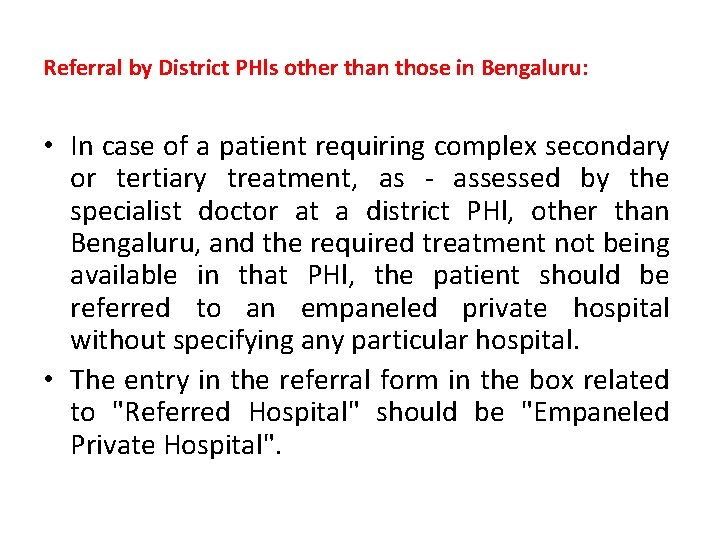
Referral by District PHls other than those in Bengaluru: • In case of a patient requiring complex secondary or tertiary treatment, as - assessed by the specialist doctor at a district PHl, other than Bengaluru, and the required treatment not being available in that PHl, the patient should be referred to an empaneled private hospital without specifying any particular hospital. • The entry in the referral form in the box related to "Referred Hospital" should be "Empaneled Private Hospital".
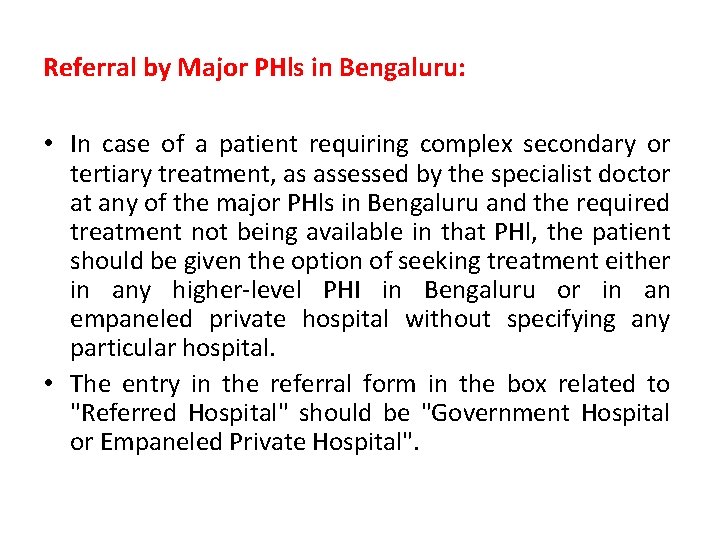
Referral by Major PHls in Bengaluru: • In case of a patient requiring complex secondary or tertiary treatment, as assessed by the specialist doctor at any of the major PHls in Bengaluru and the required treatment not being available in that PHl, the patient should be given the option of seeking treatment either in any higher-level PHI in Bengaluru or in an empaneled private hospital without specifying any particular hospital. • The entry in the referral form in the box related to "Referred Hospital" should be "Government Hospital or Empaneled Private Hospital".
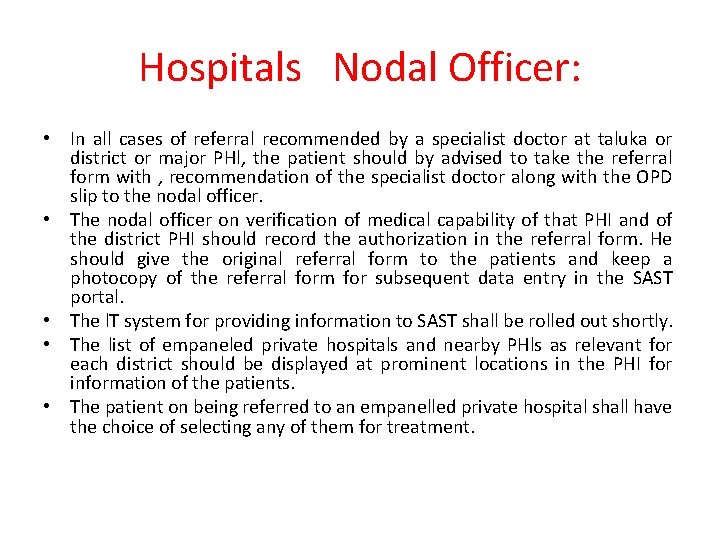
Hospitals Nodal Officer: • In all cases of referral recommended by a specialist doctor at taluka or district or major PHl, the patient should by advised to take the referral form with , recommendation of the specialist doctor along with the OPD slip to the nodal officer. • The nodal officer on verification of medical capability of that PHI and of the district PHI should record the authorization in the referral form. He should give the original referral form to the patients and keep a photocopy of the referral form for subsequent data entry in the SAST portal. • The l. T system for providing information to SAST shall be rolled out shortly. • The list of empaneled private hospitals and nearby PHls as relevant for each district should be displayed at prominent locations in the PHI for information of the patients. • The patient on being referred to an empanelled private hospital shall have the choice of selecting any of them for treatment.
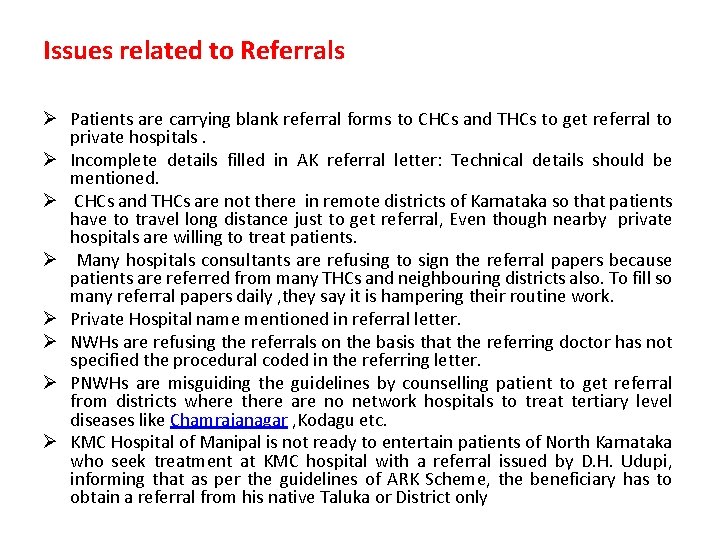
Issues related to Referrals Ø Patients are carrying blank referral forms to CHCs and THCs to get referral to private hospitals. Ø Incomplete details filled in AK referral letter: Technical details should be mentioned. Ø CHCs and THCs are not there in remote districts of Karnataka so that patients have to travel long distance just to get referral, Even though nearby private hospitals are willing to treat patients. Ø Many hospitals consultants are refusing to sign the referral papers because patients are referred from many THCs and neighbouring districts also. To fill so many referral papers daily , they say it is hampering their routine work. Ø Private Hospital name mentioned in referral letter. Ø NWHs are refusing the referrals on the basis that the referring doctor has not specified the procedural coded in the referring letter. Ø PNWHs are misguiding the guidelines by counselling patient to get referral from districts where there are no network hospitals to treat tertiary level diseases like Chamrajanagar , Kodagu etc. Ø KMC Hospital of Manipal is not ready to entertain patients of North Karnataka who seek treatment at KMC hospital with a referral issued by D. H. Udupi, informing that as per the guidelines of ARK Scheme, the beneficiary has to obtain a referral from his native Taluka or District only
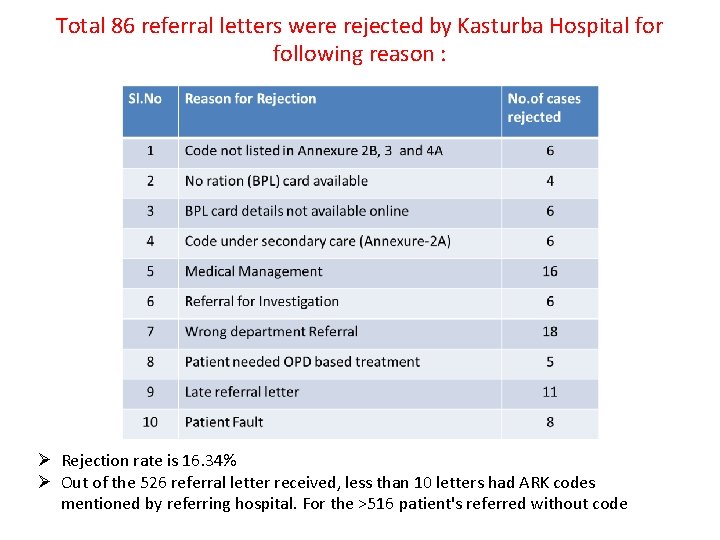
Total 86 referral letters were rejected by Kasturba Hospital for following reason : Ø Rejection rate is 16. 34% Ø Out of the 526 referral letter received, less than 10 letters had ARK codes mentioned by referring hospital. For the >516 patient's referred without code
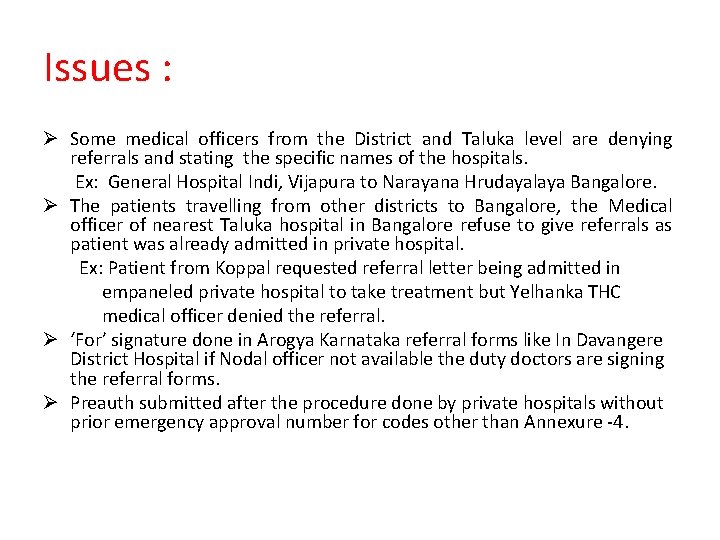
Issues : Ø Some medical officers from the District and Taluka level are denying referrals and stating the specific names of the hospitals. Ex: General Hospital Indi, Vijapura to Narayana Hrudayalaya Bangalore. Ø The patients travelling from other districts to Bangalore, the Medical officer of nearest Taluka hospital in Bangalore refuse to give referrals as patient was already admitted in private hospital. Ex: Patient from Koppal requested referral letter being admitted in empaneled private hospital to take treatment but Yelhanka THC medical officer denied the referral. Ø ‘For’ signature done in Arogya Karnataka referral forms like In Davangere District Hospital if Nodal officer not available the duty doctors are signing the referral forms. Ø Preauth submitted after the procedure done by private hospitals without prior emergency approval number for codes other than Annexure -4.
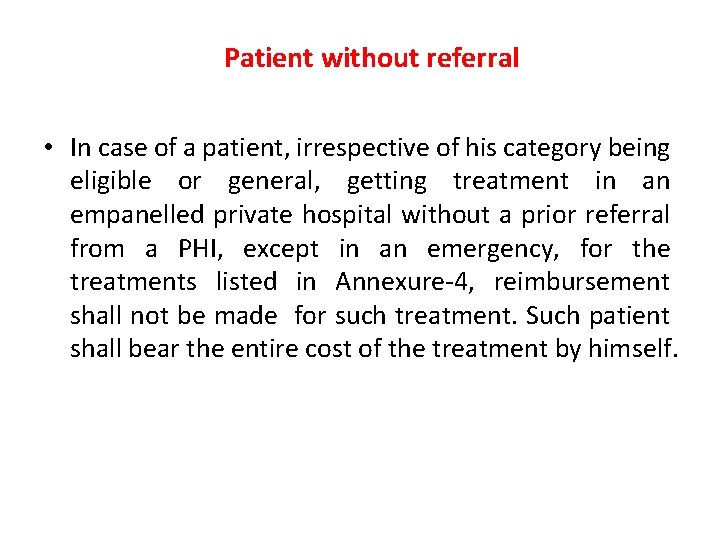
Patient without referral • In case of a patient, irrespective of his category being eligible or general, getting treatment in an empanelled private hospital without a prior referral from a PHI, except in an emergency, for the treatments listed in Annexure-4, reimbursement shall not be made for such treatment. Such patient shall bear the entire cost of the treatment by himself.
Patient without referral • In case of non-availability of the required diagnostic facilities in the PHIs to decide the nature of treatment, a referral may be provided to empanelled diagnostic laboratories for investigations. • In case the required complex secondary healthcare treatment or tertiary healthcare treatment is not available in the PHIs, a referral shall be provided for availing the treatment in any of the empanelled private hospitals. • 30. The referral protocol as prescribed in the circular at Ref. (4) and (5) above for complex secondary healthcare treatments and tertiary healthcare treatments specified in Annexures-2 B and 3 respectively shall prevail with respect to the integrated scheme. • Add border districts empanelment under Ark and under AB
Patient without referral • In case of non-availability of the required diagnostic facilities in the PHIs to decide the nature of treatment, a referral may be provided to empanelled diagnostic laboratories for investigations. • In case the required complex secondary healthcare treatment or tertiary healthcare treatment is not available in the PHIs, a referral shall be provided for availing the treatment in any of the empanelled private hospitals. • The referral protocol as prescribed will prevail with respect to the integrated scheme
Patient without referral • In case a higher-level PHI in the same district has the medical capability for the required specified complex secondary healthcare treatment or tertiary healthcare treatment of a patient, referral to be provided for such higher-level PHI only. Only in case of an emergency, referral can be made by the referring PHI to any of the empanelled private hospitals. • The referring PHI not to refer a patient to any particular empanelled hospital by name. The referral shall be open for all empanelled private hospitals having the capability and “Ayushman Bharat-Arogya Karnataka” readiness on the day. • The patient on being referred shall have the liberty to select any of the empanelled hospitals of his choice. The patient should carry the AB-Ar. K Card for acceptance in the hospital for the treatment.
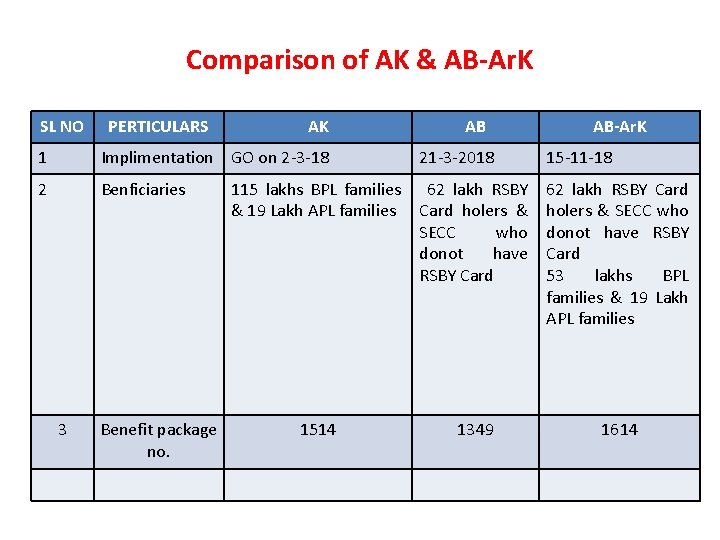
Comparison of AK & AB-Ar. K SL NO PERTICULARS AK 1 Implimentation GO on 2 -3 -18 2 Benficiaries 3 Benefit package no. AB 21 -3 -2018 115 lakhs BPL families 62 lakh RSBY & 19 Lakh APL families Card holers & SECC who donot have RSBY Card 1514 1349 AB-Ar. K 15 -11 -18 62 lakh RSBY Card holers & SECC who donot have RSBY Card 53 lakhs BPL families & 19 Lakh APL families 1614
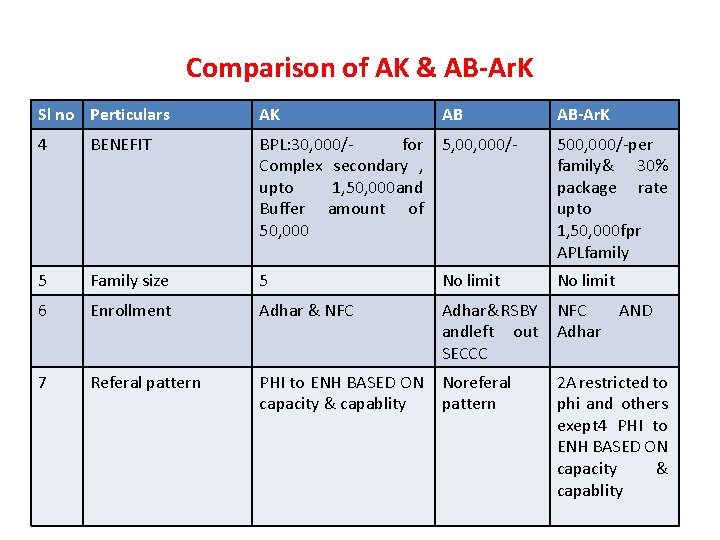
Comparison of AK & AB-Ar. K Sl no Perticulars AK AB AB-Ar. K 4 BENEFIT BPL: 30, 000/- for 5, 000/Complex secondary , upto 1, 50, 000 and Buffer amount of 50, 000 500, 000/-per family& 30% package rate upto 1, 50, 000 fpr APLfamily 5 Family size 5 No limit 6 Enrollment Adhar & NFC Adhar & RSBY NFC AND andleft out Adhar SECCC 7 Referal pattern PHI to ENH BASED ON Noreferal capacity & capablity pattern 2 A restricted to phi and others exept 4 PHI to ENH BASED ON capacity & capablity
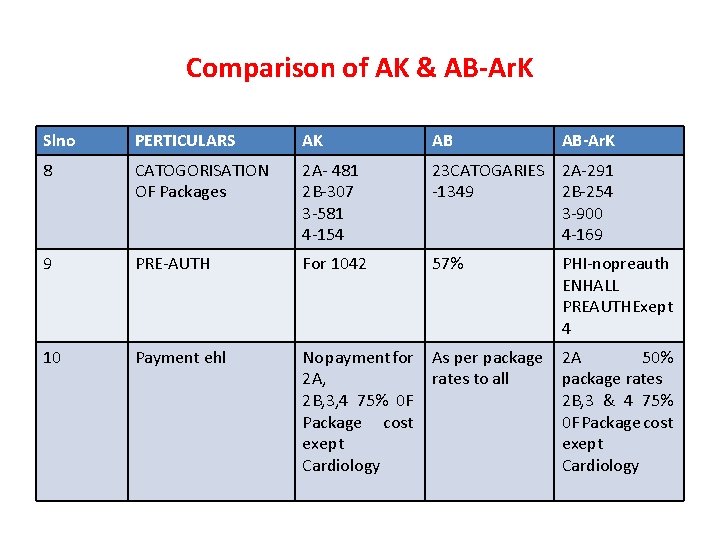
Comparison of AK & AB-Ar. K Slno PERTICULARS AK AB AB-Ar. K 8 CATOGORISATION OF Packages 2 A- 481 2 B-307 3 -581 4 -154 23 CATOGARIES 2 A-291 -1349 2 B-254 3 -900 4 -169 9 PRE-AUTH For 1042 57% 10 Payment ehl No payment for As per package 2 A 50% 2 A, rates to all package rates 2 B, 3, 4 75% 0 F 2 B, 3 & 4 75% Package cost 0 F Package cost exept Cardiology PHI-nopreauth ENHALL PREAUTH Exept 4
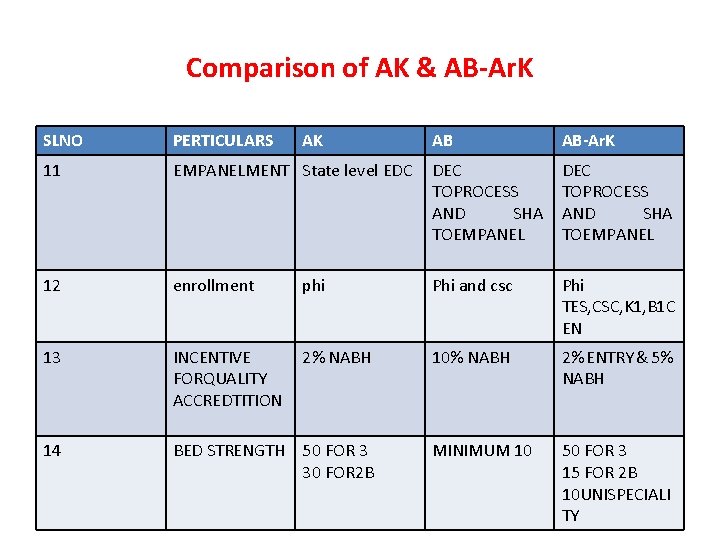
Comparison of AK & AB-Ar. K SLNO PERTICULARS 11 AK AB AB-Ar. K EMPANELMENT State level EDC DEC TOPROCESS AND SHA TOEMPANEL 12 enrollment phi Phi and csc Phi TES, CSC, K 1, B 1 C EN 13 INCENTIVE FORQUALITY ACCREDTITION 2% NABH 10% NABH 2% ENTRY & 5% NABH 14 BED STRENGTH 50 FOR 3 30 FOR 2 B MINIMUM 10 50 FOR 3 15 FOR 2 B 10 UNISPECIALI TY
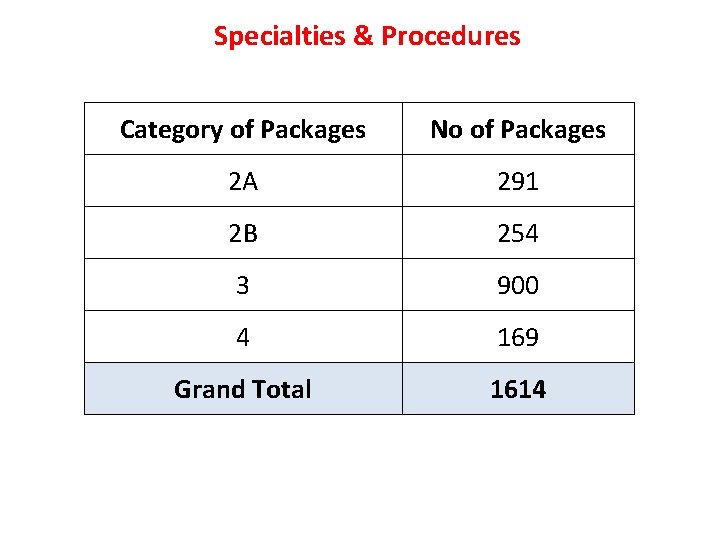
Specialties & Procedures Category of Packages No of Packages 2 A 291 2 B 254 3 900 4 169 Grand Total 1614
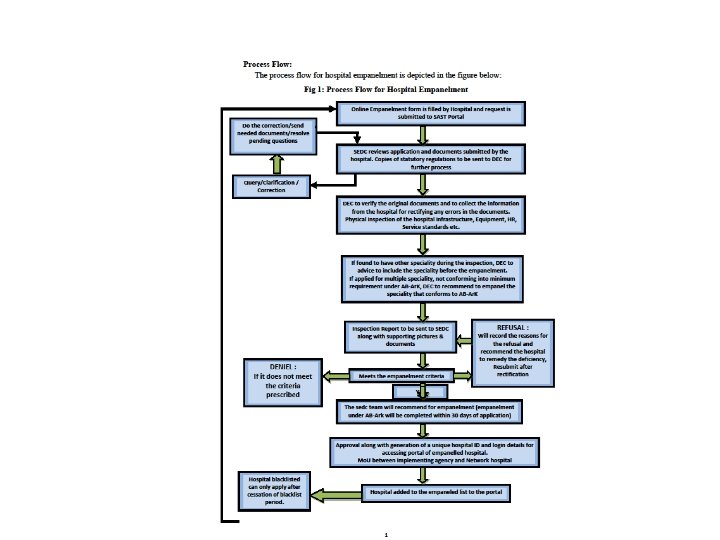
Empanelment of Hospitals : To empanel under the scheme, the hospitals are required to meet minimum qualification criteria prescribed and agree to provide services to beneficiaries as per GO. The Hospitals will be empanelled through SAST online empanelment portal. All existing hospitals empanelled under Arogya Karnataka will be given an option to continue for a period of 3 months. Empanelment procedure will be completed within this period and MOU to be signed.
Any Questions. . ?
Thank You