Surveys of Enacted Curriculum for English Language Learner
- Slides: 44
Surveys of Enacted Curriculum for English Language Learner Instruction, Standards, and Assessments: Evaluating Language Demands and Language Complexity Edynn Sato, West. Ed John Smithson, WCER Jaime Usma, WCER Peter Worth, West. Ed Enhanced Assessment Grant: SEC-ELL Coding Washington, DC May 5 -7, 2008
Training Goals • Introduce ELL components of study – Language demands – Language complexity • Training and calibration in SEC-ELL coding protocol 2
Agenda • Introducing the linguistic analysis aspect of the study • Components of linguistic analysis • Coding procedures • Coding practice • Questions 3
Study Goals • Improve methods of aligning instruction to standards and assessments for English language learners. • Analyze relationship of alignment to student achievement. 4
What is the nature of the language that students need to meaningfully engage with and achieve academic content? 5
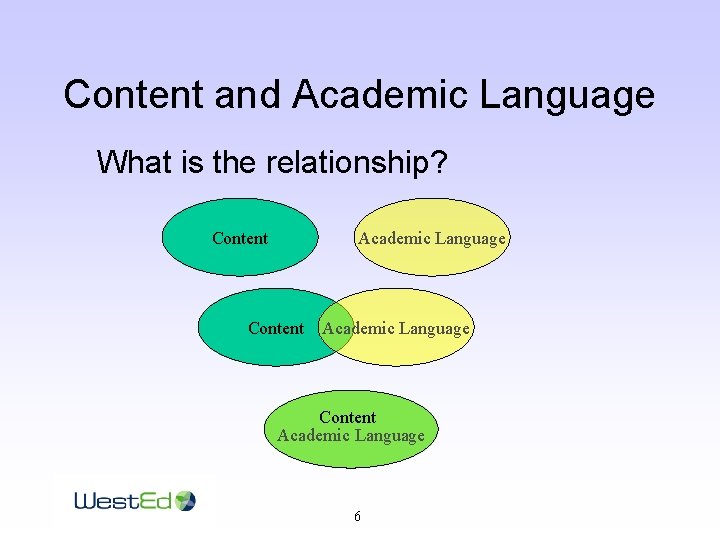
Content and Academic Language What is the relationship? Content Academic Language 6
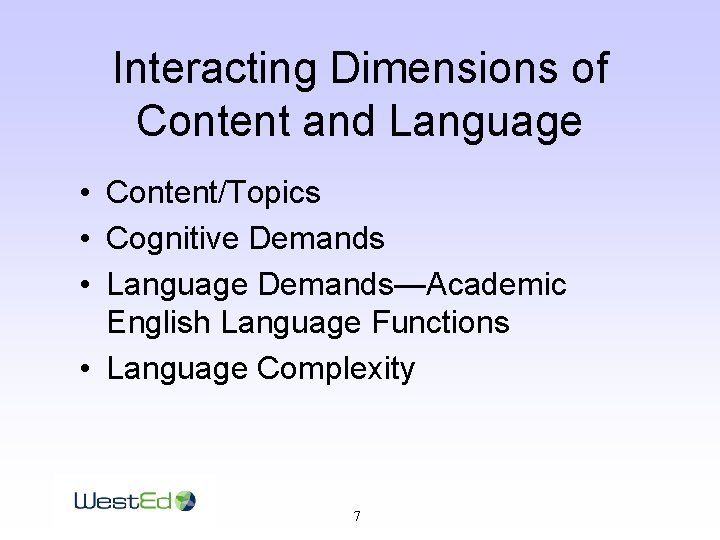
Interacting Dimensions of Content and Language • Content/Topics • Cognitive Demands • Language Demands—Academic English Language Functions • Language Complexity 7
Given the expected student outcome (content, learning), how do we expect students to use (receive, produce) language to acquire/demonstrate understanding of the content? 8
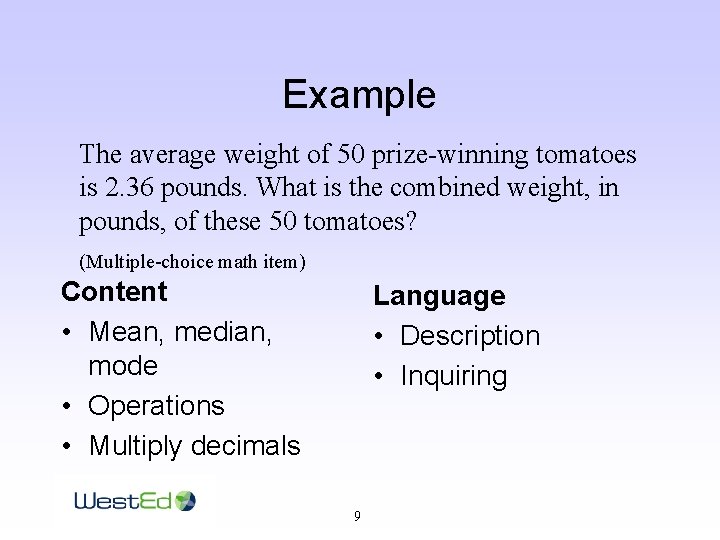
Example The average weight of 50 prize-winning tomatoes is 2. 36 pounds. What is the combined weight, in pounds, of these 50 tomatoes? (Multiple-choice math item) Content • Mean, median, mode • Operations • Multiply decimals Language • Description • Inquiring 9
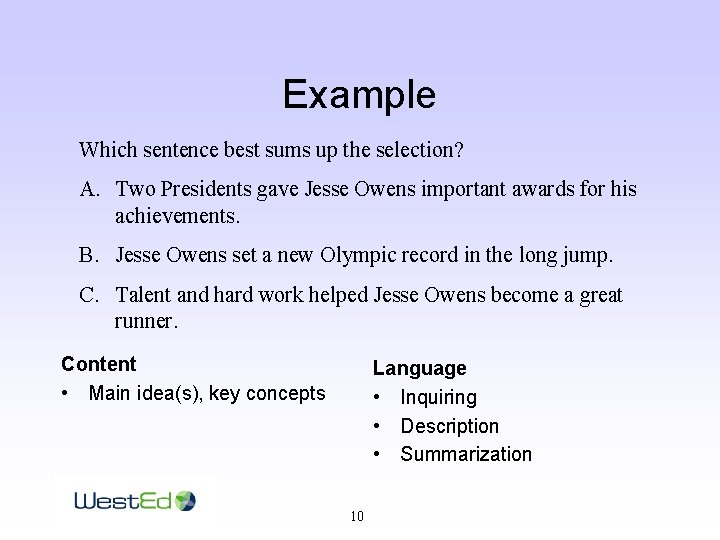
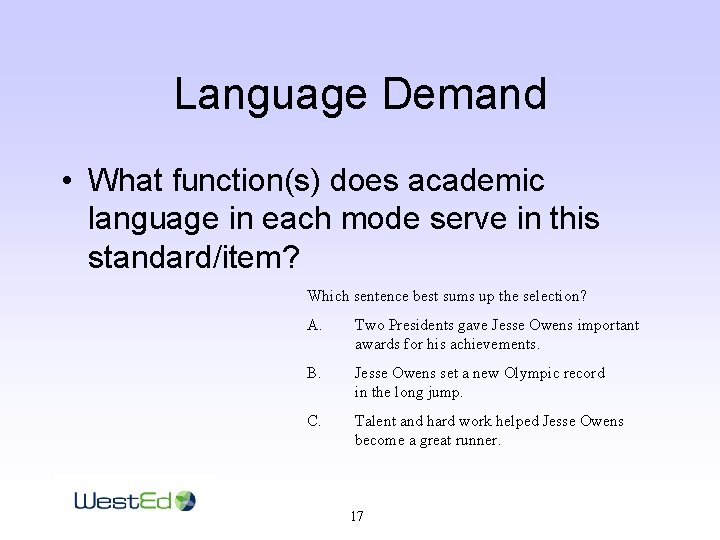
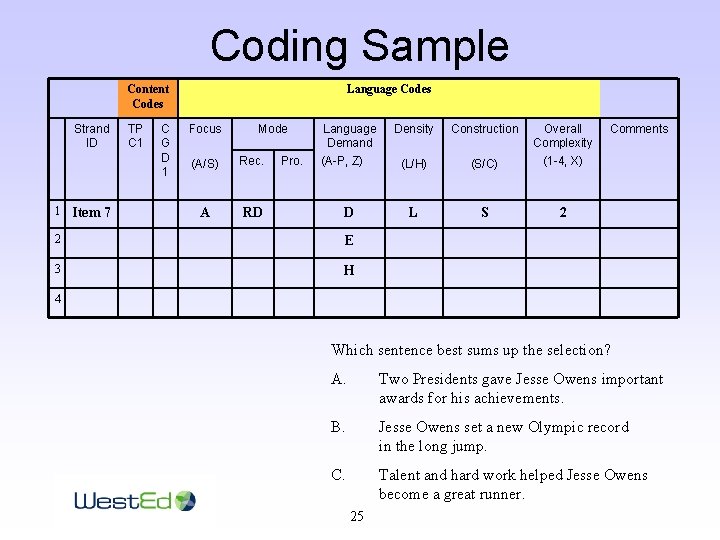
Example Which sentence best sums up the selection? A. Two Presidents gave Jesse Owens important awards for his achievements. B. Jesse Owens set a new Olympic record in the long jump. C. Talent and hard work helped Jesse Owens become a great runner. Content • Main idea(s), key concepts Language • Inquiring • Description • Summarization 10
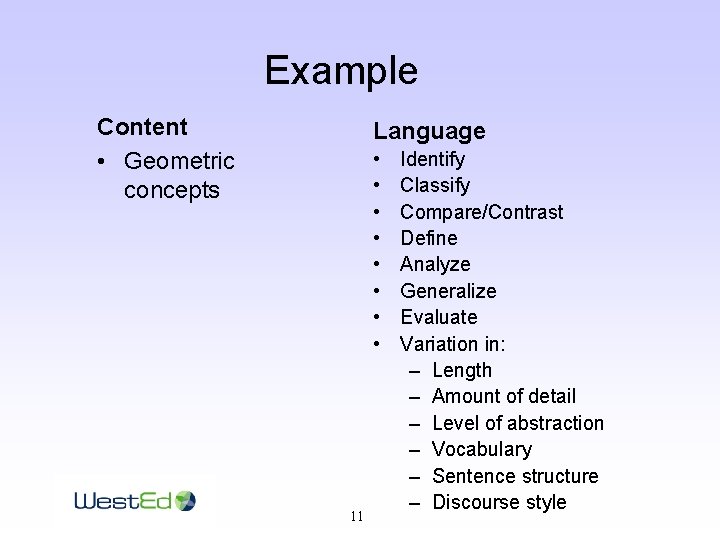
Example Content • Geometric concepts Language • • 11 Identify Classify Compare/Contrast Define Analyze Generalize Evaluate Variation in: – Length – Amount of detail – Level of abstraction – Vocabulary – Sentence structure – Discourse style
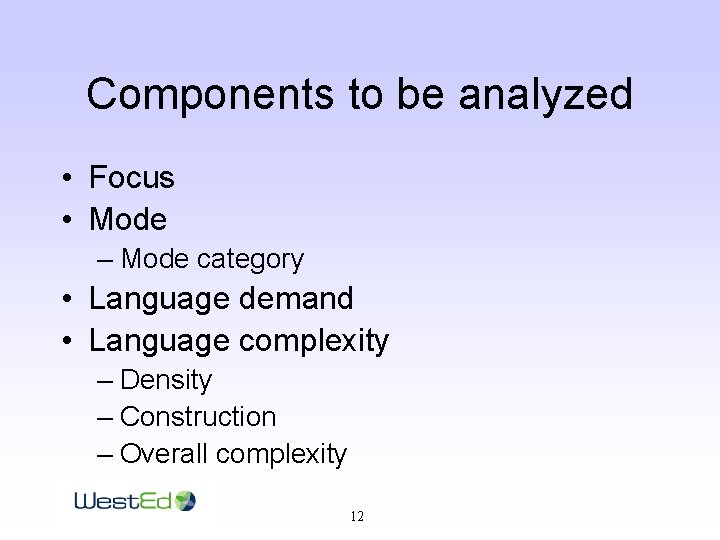
Components to be analyzed • Focus • Mode – Mode category • Language demand • Language complexity – Density – Construction – Overall complexity 12
Example Which sentence best sums up the selection? A. Two Presidents gave Jesse Owens important awards for his achievements. B. Jesse Owens set a new Olympic record in the long jump. C. Talent and hard work helped Jesse Owens become a great runner. 13
Focus • Is the language in this standard/item academic or social/functional? Which sentence best sums up the selection? A. Two Presidents gave Jesse Owens important awards for his achievements. B. Jesse Owens set a new Olympic record in the long jump. C. Talent and hard work helped Jesse Owens become a great runner. 14
Mode • Is the language required of the student in this standard/item receptive or productive? Or both? Which sentence best sums up the selection? A. Two Presidents gave Jesse Owens important awards for his achievements. B. Jesse Owens set a new Olympic record in the long jump. C. Talent and hard work helped Jesse Owens become a great runner. 15
Mode Category • Specifically, does the standard/item require the student to listen or read? Speak or write? Which sentence best sums up the selection? A. Two Presidents gave Jesse Owens important awards for his achievements. B. Jesse Owens set a new Olympic record in the long jump. C. Talent and hard work helped Jesse Owens become a great runner. 16
Language Demand • What function(s) does academic language in each mode serve in this standard/item? Which sentence best sums up the selection? A. Two Presidents gave Jesse Owens important awards for his achievements. B. Jesse Owens set a new Olympic record in the long jump. C. Talent and hard work helped Jesse Owens become a great runner. 17
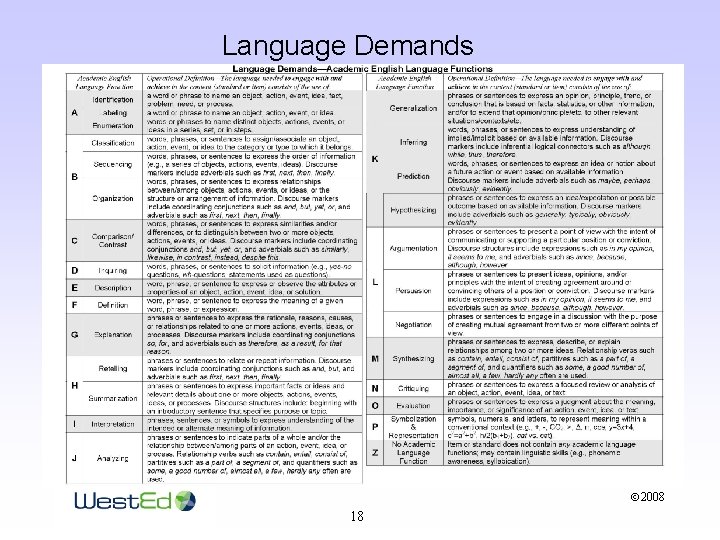
Language Demands 2008 18
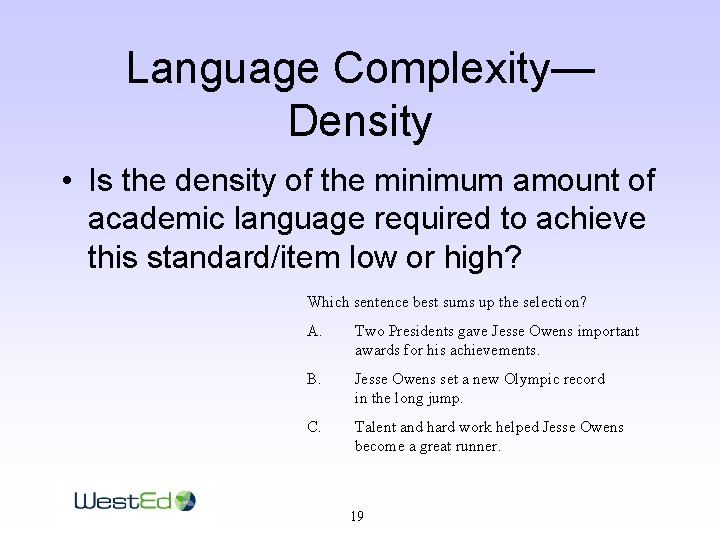
Language Complexity— Density • Is the density of the minimum amount of academic language required to achieve this standard/item low or high? Which sentence best sums up the selection? A. Two Presidents gave Jesse Owens important awards for his achievements. B. Jesse Owens set a new Olympic record in the long jump. C. Talent and hard work helped Jesse Owens become a great runner. 19
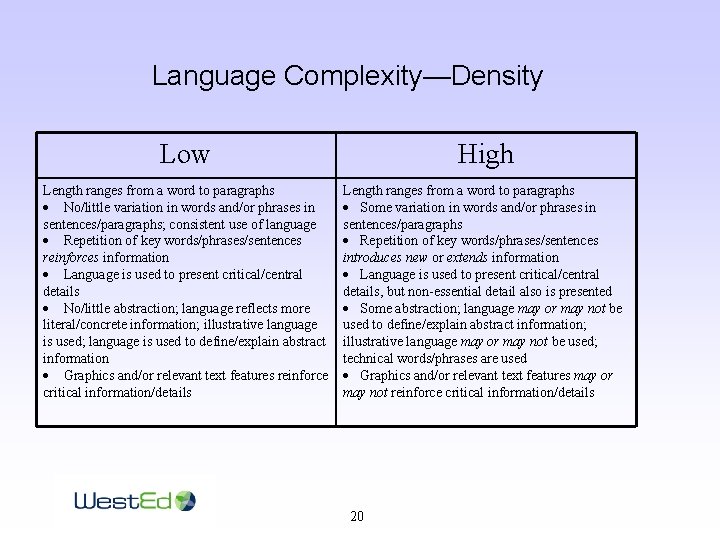
Language Complexity—Density Low High Length ranges from a word to paragraphs · No/little variation in words and/or phrases in sentences/paragraphs; consistent use of language · Repetition of key words/phrases/sentences reinforces information · Language is used to present critical/central details · No/little abstraction; language reflects more literal/concrete information; illustrative language is used; language is used to define/explain abstract information · Graphics and/or relevant text features reinforce critical information/details Length ranges from a word to paragraphs · Some variation in words and/or phrases in sentences/paragraphs · Repetition of key words/phrases/sentences introduces new or extends information · Language is used to present critical/central details, but non-essential detail also is presented · Some abstraction; language may or may not be used to define/explain abstract information; illustrative language may or may not be used; technical words/phrases are used · Graphics and/or relevant text features may or may not reinforce critical information/details 20
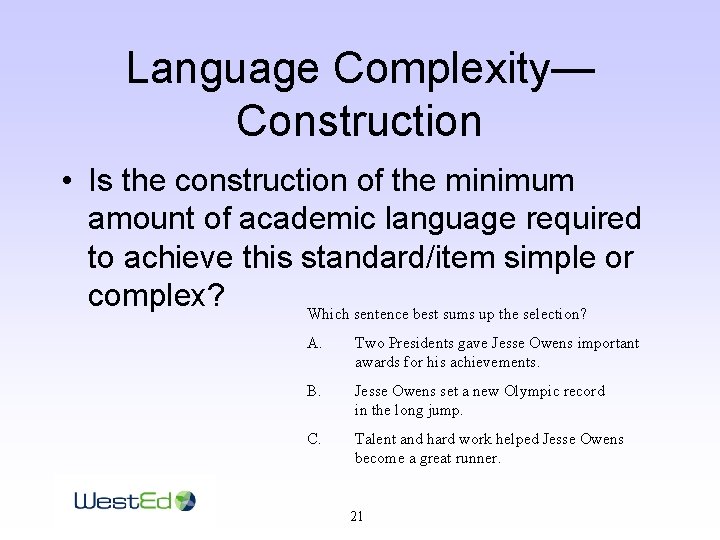
Language Complexity— Construction • Is the construction of the minimum amount of academic language required to achieve this standard/item simple or complex? Which sentence best sums up the selection? A. Two Presidents gave Jesse Owens important awards for his achievements. B. Jesse Owens set a new Olympic record in the long jump. C. Talent and hard work helped Jesse Owens become a great runner. 21
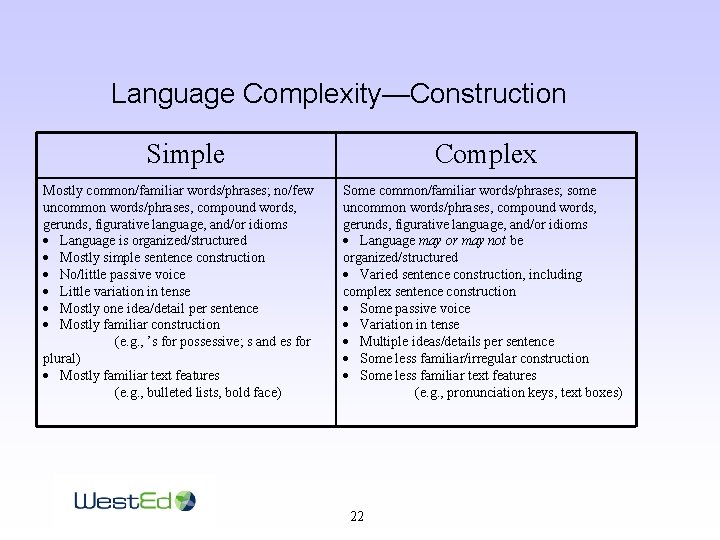
Language Complexity—Construction Simple Mostly common/familiar words/phrases; no/few uncommon words/phrases, compound words, gerunds, figurative language, and/or idioms · Language is organized/structured · Mostly simple sentence construction · No/little passive voice · Little variation in tense · Mostly one idea/detail per sentence · Mostly familiar construction (e. g. , ’s for possessive; s and es for plural) · Mostly familiar text features (e. g. , bulleted lists, bold face) Complex Some common/familiar words/phrases; some uncommon words/phrases, compound words, gerunds, figurative language, and/or idioms · Language may or may not be organized/structured · Varied sentence construction, including complex sentence construction · Some passive voice · Variation in tense · Multiple ideas/details per sentence · Some less familiar/irregular construction · Some less familiar text features (e. g. , pronunciation keys, text boxes) 22
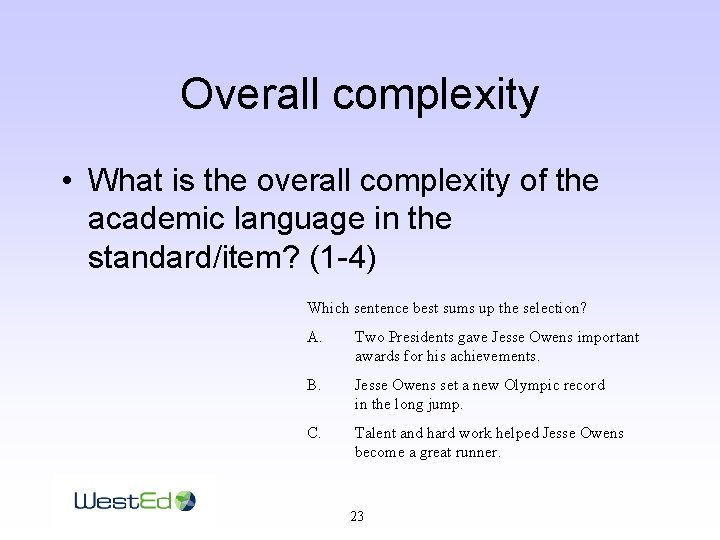
Overall complexity • What is the overall complexity of the academic language in the standard/item? (1 -4) Which sentence best sums up the selection? A. Two Presidents gave Jesse Owens important awards for his achievements. B. Jesse Owens set a new Olympic record in the long jump. C. Talent and hard work helped Jesse Owens become a great runner. 23
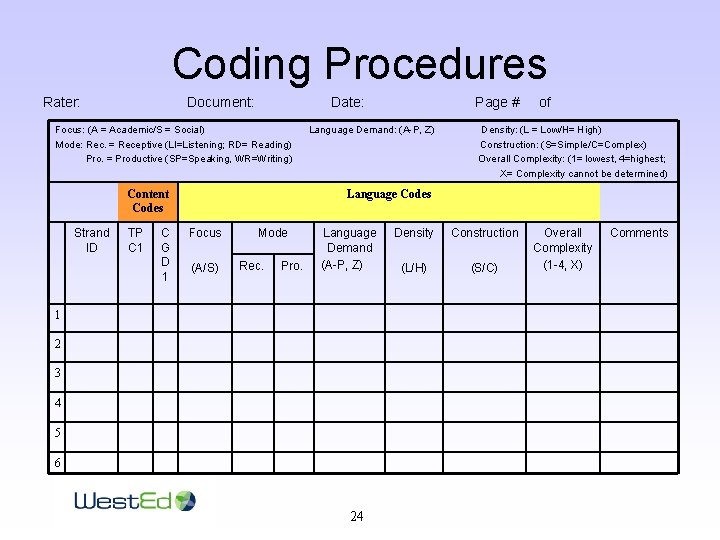
Coding Procedures Rater: Document: Date: Focus: (A = Academic/S = Social) Mode: Rec. = Receptive (LI=Listening; RD= Reading) Pro. = Productive (SP=Speaking, WR=Writing) Content Codes Strand ID TP C 1 C G D 1 Page # Language Demand: (A-P, Z) of Density: (L = Low/H= High) Construction: (S=Simple/C=Complex) Overall Complexity: (1= lowest, 4=highest; X= Complexity cannot be determined) Language Codes Focus (A/S) Mode Rec. Pro. Language Demand (A-P, Z) 1 2 3 4 5 6 24 Density Construction (L/H) (S/C) Overall Complexity (1 -4, X) Comments
Coding Sample Content Codes Strand ID 1 Item 7 TP C 1 C G D 1 Language Codes Focus Mode (A/S) Rec. A RD Pro. Language Demand (A-P, Z) Density Construction (L/H) (S/C) Overall Complexity (1 -4, X) D L S 2 2 E 3 H Comments 4 Which sentence best sums up the selection? A. Two Presidents gave Jesse Owens important awards for his achievements. B. Jesse Owens set a new Olympic record in the long jump. C. Talent and hard work helped Jesse Owens become a great runner. 25
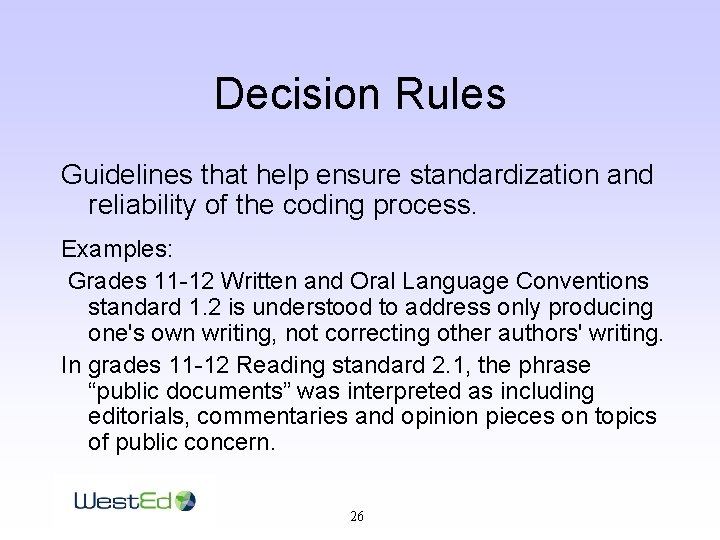
Decision Rules Guidelines that help ensure standardization and reliability of the coding process. Examples: Grades 11 -12 Written and Oral Language Conventions standard 1. 2 is understood to address only producing one's own writing, not correcting other authors' writing. In grades 11 -12 Reading standard 2. 1, the phrase “public documents” was interpreted as including editorials, commentaries and opinion pieces on topics of public concern. 26
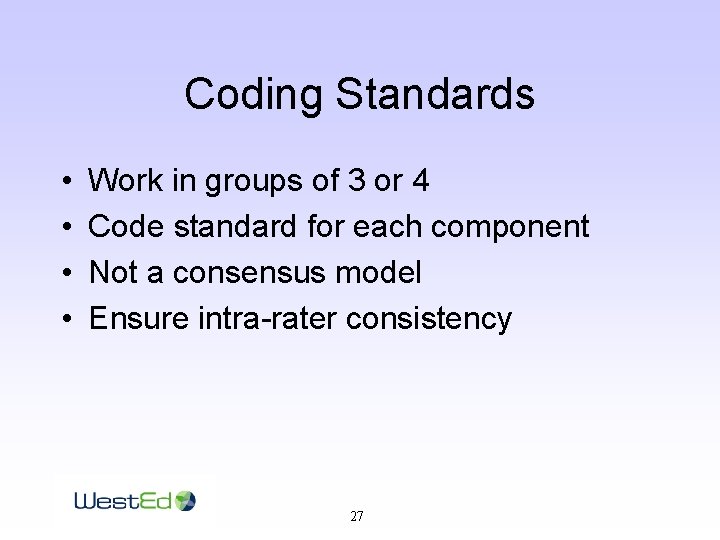
Coding Standards • • Work in groups of 3 or 4 Code standard for each component Not a consensus model Ensure intra-rater consistency 27
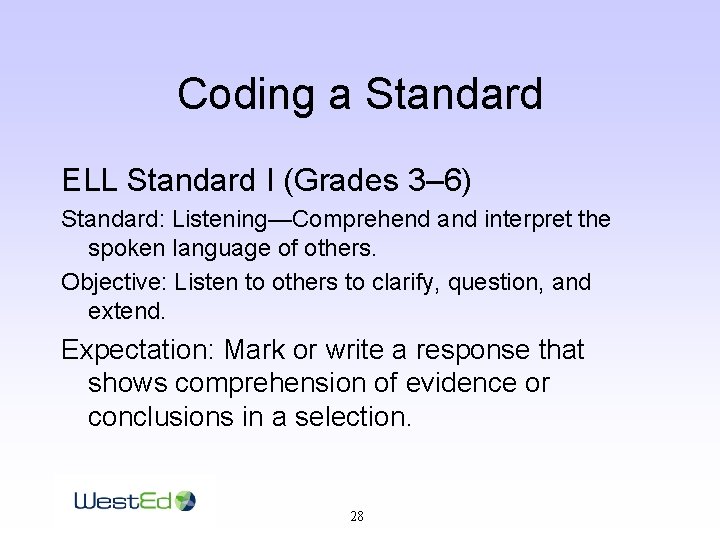
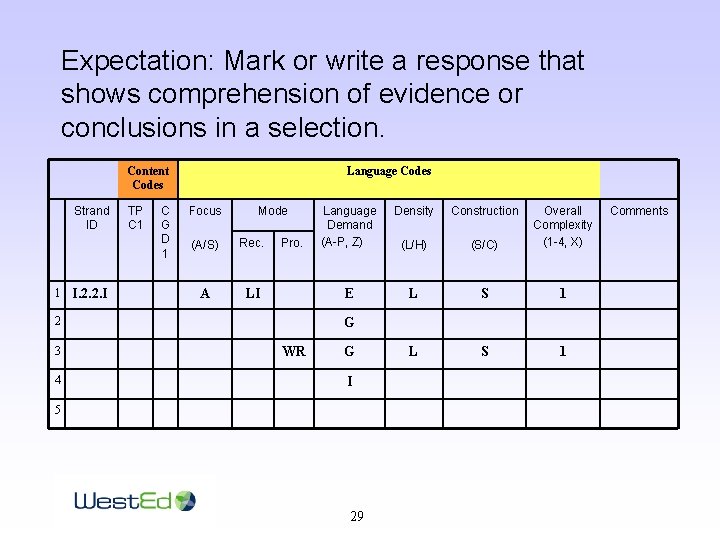
Coding a Standard ELL Standard I (Grades 3– 6) Standard: Listening—Comprehend and interpret the spoken language of others. Objective: Listen to others to clarify, question, and extend. Expectation: Mark or write a response that shows comprehension of evidence or conclusions in a selection. 28
Expectation: Mark or write a response that shows comprehension of evidence or conclusions in a selection. Content Codes Strand ID 1 I. 2. 2. I TP C 1 C G D 1 Language Codes Focus Mode (A/S) Rec. A LI Pro. 2 3 4 Language Demand (A-P, Z) Density Construction (L/H) (S/C) Overall Complexity (1 -4, X) E L S 1 G WR G I 5 29 Comments
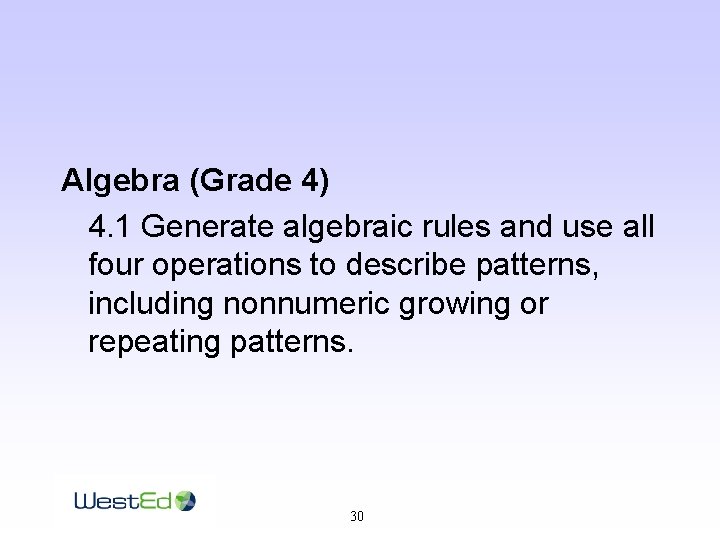
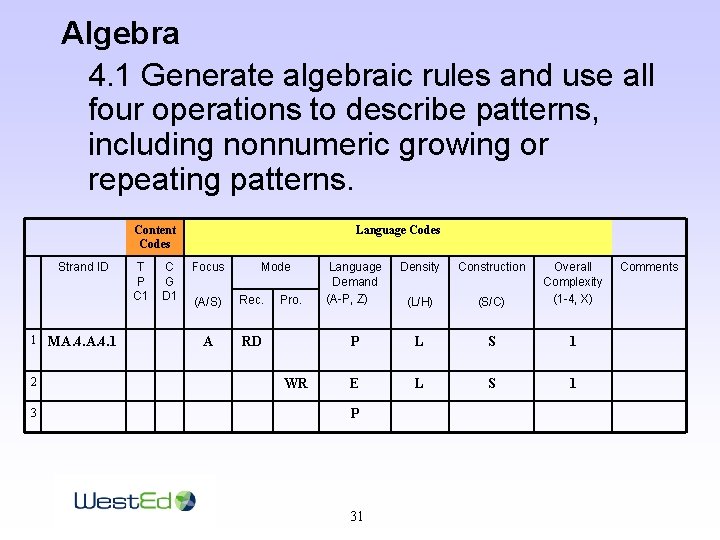
Algebra (Grade 4) 4. 1 Generate algebraic rules and use all four operations to describe patterns, including nonnumeric growing or repeating patterns. 30
Algebra 4. 1 Generate algebraic rules and use all four operations to describe patterns, including nonnumeric growing or repeating patterns. Content Codes Strand ID 1 MA. 4. 1 2 3 T P C 1 C G D 1 Language Codes Focus Mode (A/S) Rec. A RD Pro. WR Language Demand (A-P, Z) Density Construction (L/H) (S/C) Overall Complexity (1 -4, X) P L S 1 E L S 1 P 31 Comments
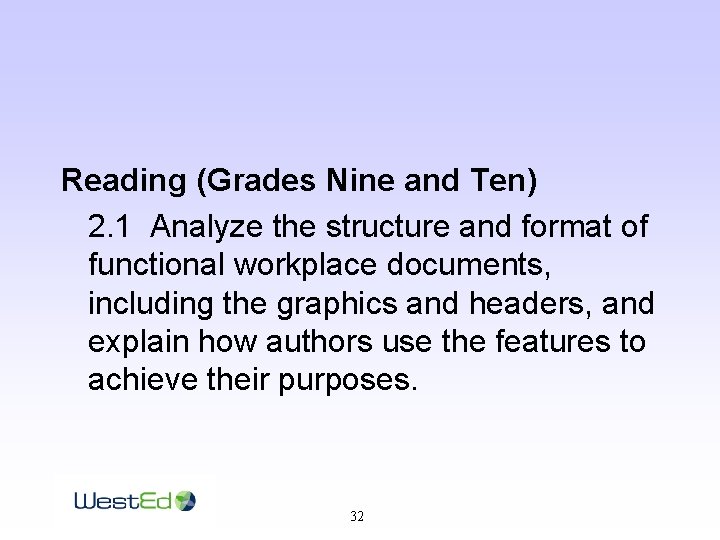
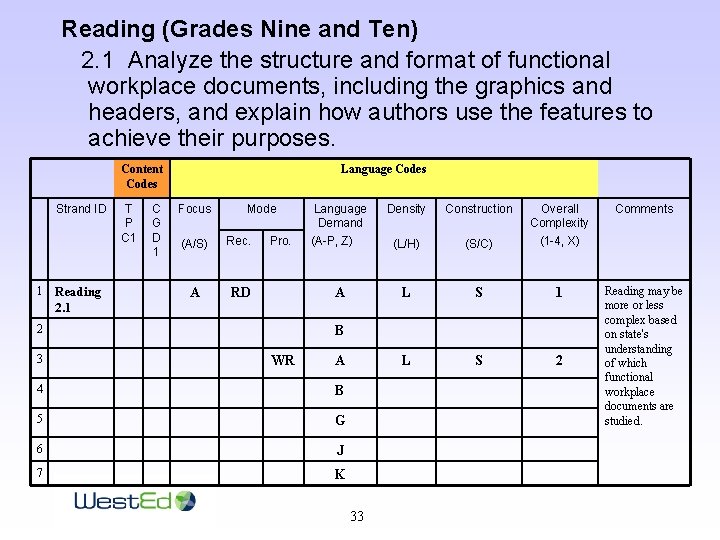
Reading (Grades Nine and Ten) 2. 1 Analyze the structure and format of functional workplace documents, including the graphics and headers, and explain how authors use the features to achieve their purposes. 32
Reading (Grades Nine and Ten) 2. 1 Analyze the structure and format of functional workplace documents, including the graphics and headers, and explain how authors use the features to achieve their purposes. Content Codes Strand ID 1 Reading 2. 1 T P C 1 C G D 1 Language Codes Focus Mode (A/S) Rec. A RD Pro. 2 3 Language Demand (A-P, Z) Density Construction Comments (S/C) Overall Complexity (1 -4, X) (L/H) A L S 1 L S 2 Reading may be more or less complex based on state's understanding of which functional workplace documents are studied. B WR A 4 B 5 G 6 J 7 K 33
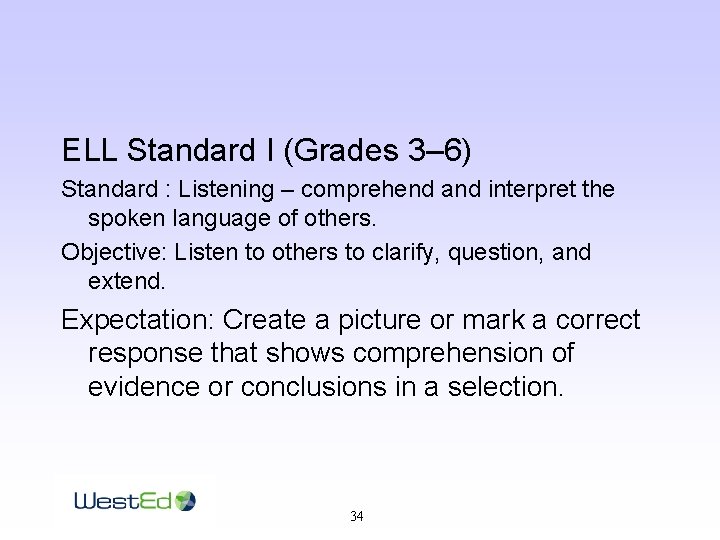
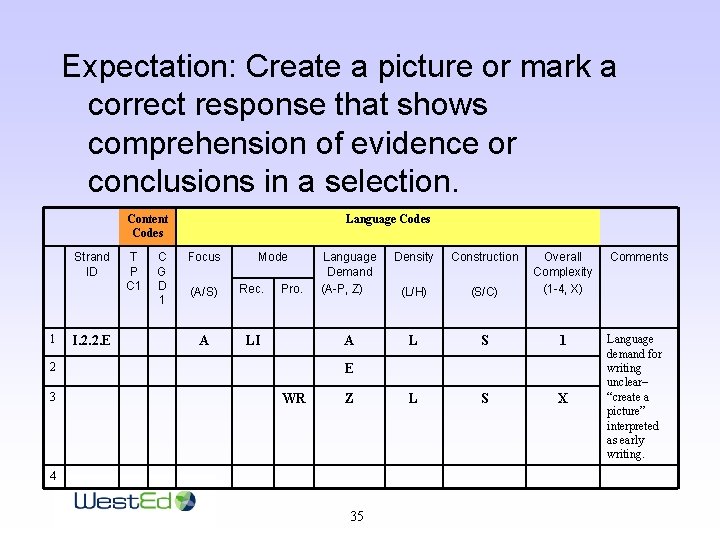
ELL Standard I (Grades 3– 6) Standard : Listening – comprehend and interpret the spoken language of others. Objective: Listen to others to clarify, question, and extend. Expectation: Create a picture or mark a correct response that shows comprehension of evidence or conclusions in a selection. 34
Expectation: Create a picture or mark a correct response that shows comprehension of evidence or conclusions in a selection. Content Codes Strand ID 1 I. 2. 2. E T P C 1 C G D 1 Language Codes Focus Mode (A/S) Rec. A LI Pro. 2 3 Language Demand (A-P, Z) Density Construction Comments (S/C) Overall Complexity (1 -4, X) (L/H) A L S 1 L S X Language demand for writing unclear– “create a picture” interpreted as early writing. E WR Z 4 35
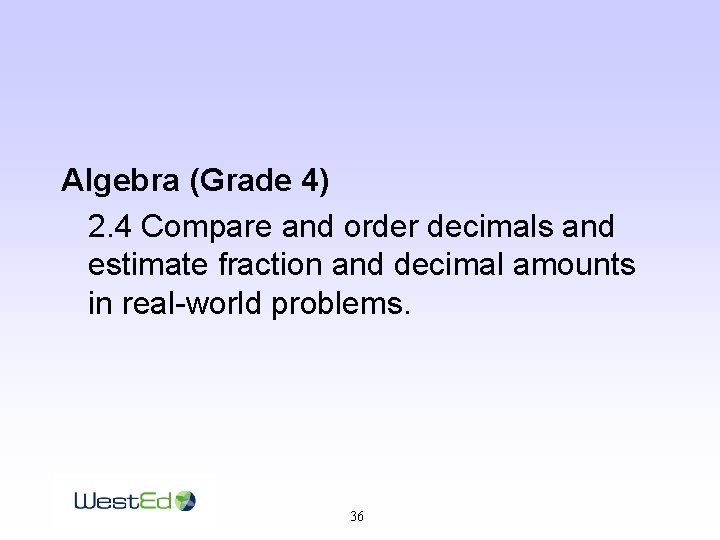
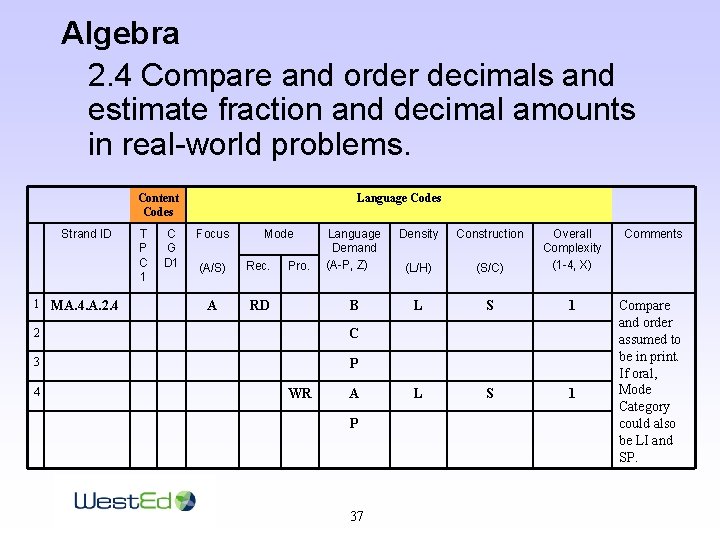
Algebra (Grade 4) 2. 4 Compare and order decimals and estimate fraction and decimal amounts in real-world problems. 36
Algebra 2. 4 Compare and order decimals and estimate fraction and decimal amounts in real-world problems. Content Codes Strand ID 1 MA. 4. A. 2. 4 T P C 1 C G D 1 Language Codes Focus Mode (A/S) Rec. A RD Pro. Language Demand (A-P, Z) Density Construction (L/H) B 2 C 3 P 4 WR A P 37 Comments (S/C) Overall Complexity (1 -4, X) L S 1 Compare and order assumed to be in print. If oral, Mode Category could also be LI and SP.
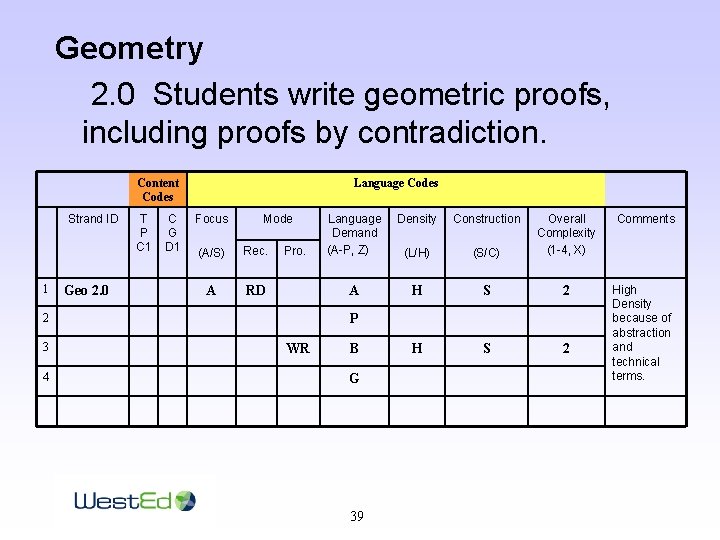
Geometry (High School) 2. 0 Students write geometric proofs, including proofs by contradiction. 38
Geometry 2. 0 Students write geometric proofs, including proofs by contradiction. Content Codes Strand ID 1 Geo 2. 0 T P C 1 C G D 1 Language Codes Focus Mode (A/S) Rec. A RD Pro. 2 3 4 Language Demand (A-P, Z) Density Construction (L/H) (S/C) Overall Complexity (1 -4, X) A H S 2 P WR B G 39 Comments High Density because of abstraction and technical terms.
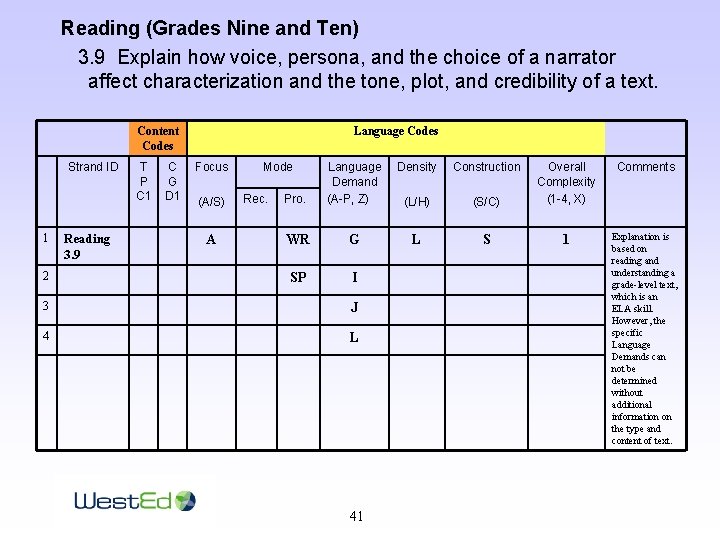
Reading (Grades Nine and Ten) 3. 9 Explain how voice, persona, and the choice of a narrator affect characterization and the tone, plot, and credibility of a text. 40
Reading (Grades Nine and Ten) 3. 9 Explain how voice, persona, and the choice of a narrator affect characterization and the tone, plot, and credibility of a text. Content Codes Strand ID 1 2 Reading 3. 9 T P C 1 C G D 1 Language Codes Focus (A/S) A Mode Rec. Density Construction Pro. Language Demand (A-P, Z) (L/H) WR G L SP I 3 J 4 L 41 Comments (S/C) Overall Complexity (1 -4, X) S 1 Explanation is based on reading and understanding a grade-level text, which is an ELA skill. However, the specific Language Demands can not be determined without additional information on the type and content of text.
Reminders • Code up to six language demands for each mode • Consider complexity of the minimum language required to achieve the standard • Use decision rules to record interpretations 42
Questions 43
If you have questions or would like additional information, please contact Edynn Sato, Ph. D. esato@wested. org 44