Sun Mountain International Disaster Risk Reduction in Latin









- Slides: 33
Sun Mountain International Disaster Risk Reduction in Latin America and the Caribbean Through Several Contributions for Environmental Management and the Use of Economic Instruments Interamerican Development Bank
Issues that will be addressed: First presentation 1. Hazard location maps 2. Framework for the application of disaster risk reduction proposals 3. Disaster risk reduction by means of environmental and natural resource management 4. Economic instruments for environmental and disaster risk reduction 5. Conclusions and recommendations
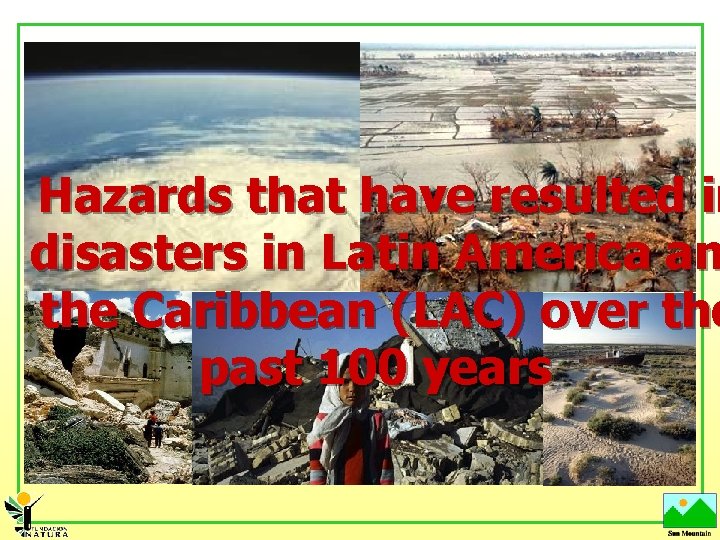
Hazards that have resulted in disasters in Latin America an the Caribbean (LAC) over the past 100 years
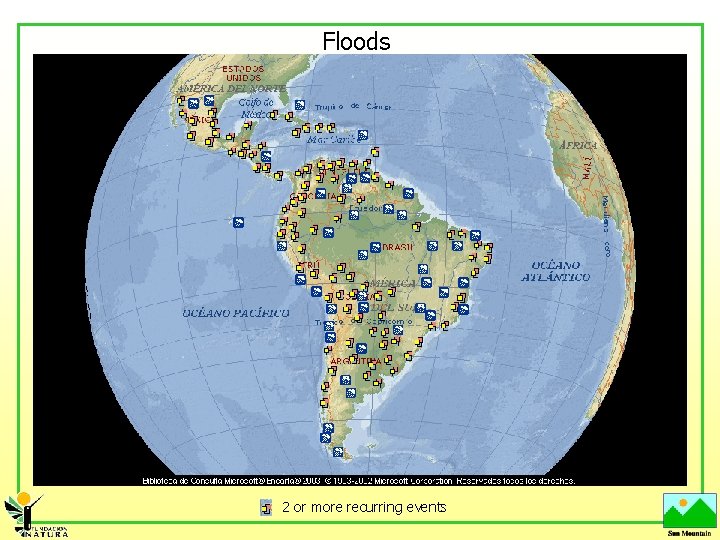
Floods 2 or more recurring events
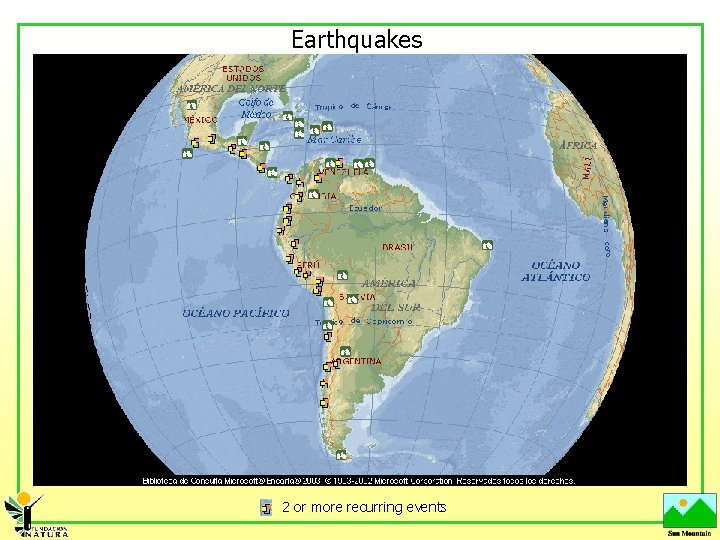
Earthquakes 2 or more recurring events
Hurricanes 2 or more recurring events
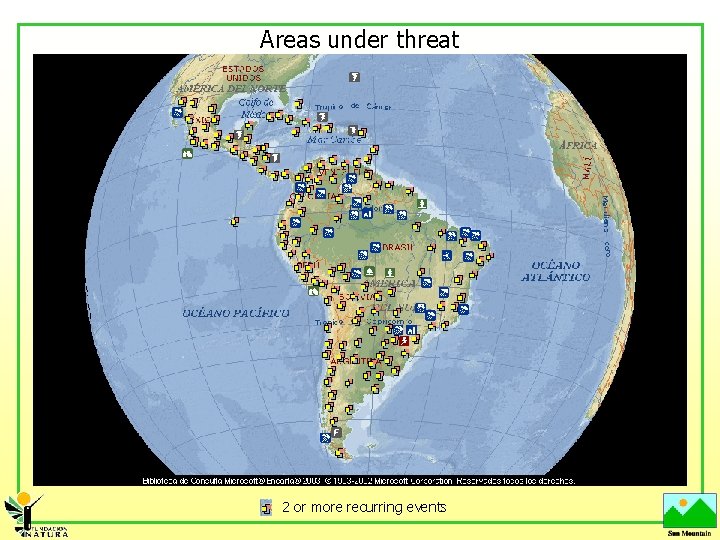
Areas under threat 2 or more recurring events
Conclusions from the maps ü Floods are the more frequent hazards in the region. ü Other significant hazards more prevalent in certain subregions: § Earthquakes: on the western flank of all countries on the Pacific coast, the Andean-Coastal Arch in Venezuela and a section of the Caribbean. § Hurricanes: in the Caribbean and Mexico § Volcanic eruptions: in the Andean sub-region near the Pacific ocean in Peru, Ecuador and Colombia, and in Central America and Mexico § Landslides: in the Andean countries and on the Atlantic coast of Brazil ü There are up to 9 different hazards per country
Recommendations regarding floods üComprehensive water resource management üFight against deforestation üReforestation üSound environmental management of soils and slopes üComprehensive waste management
Recommendations for countries withseveralhazards ü Land use planning ü Frequency, impact and vulnerability assessment ü Prioritize actions depending on the levels of risk assessed
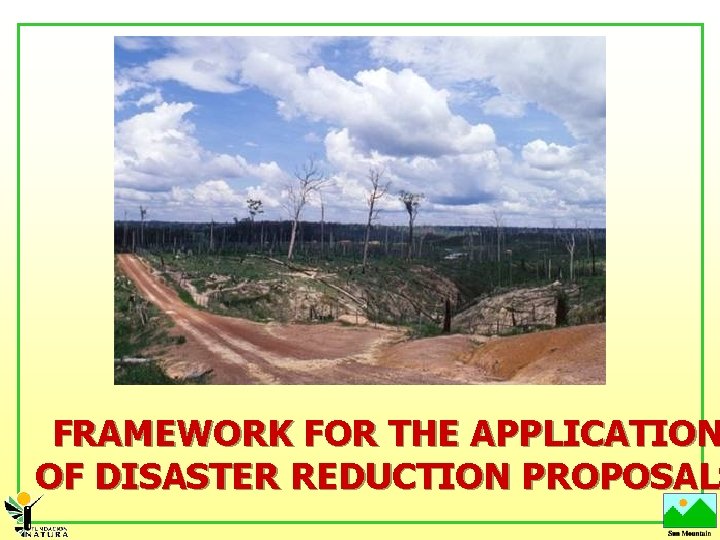
FRAMEWORK FOR THE APPLICATION OF DISASTER REDUCTION PROPOSALS
FRAMEWORK FOR THE APPLICATION OF DISASTER REDUCTION PROPOSALS ü Exposure of the population ü Assessment of socioeconomic vulnerability in LAC ü Important aspects for environmental management ü Important aspects for disaster risk management
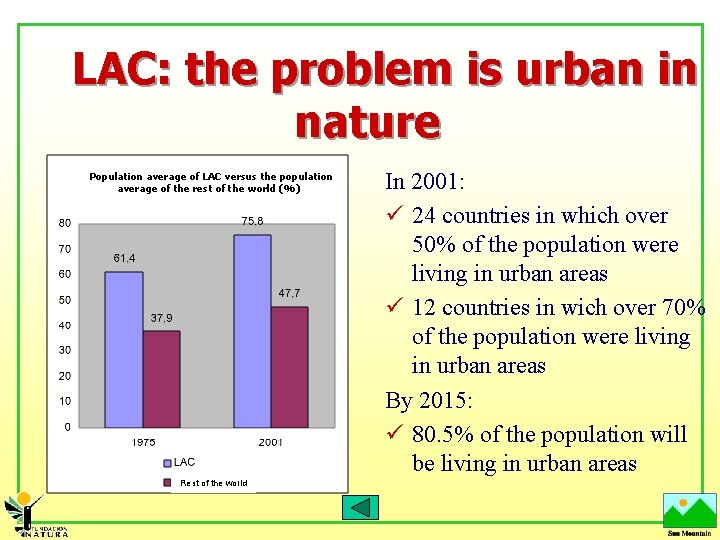
LAC: the problem is urban in nature Population average of LAC versus the population average of the rest of the world (%) Rest of the world In 2001: ü 24 countries in which over 50% of the population were living in urban areas ü 12 countries in wich over 70% of the population were living in urban areas By 2015: ü 80. 5% of the population will be living in urban areas
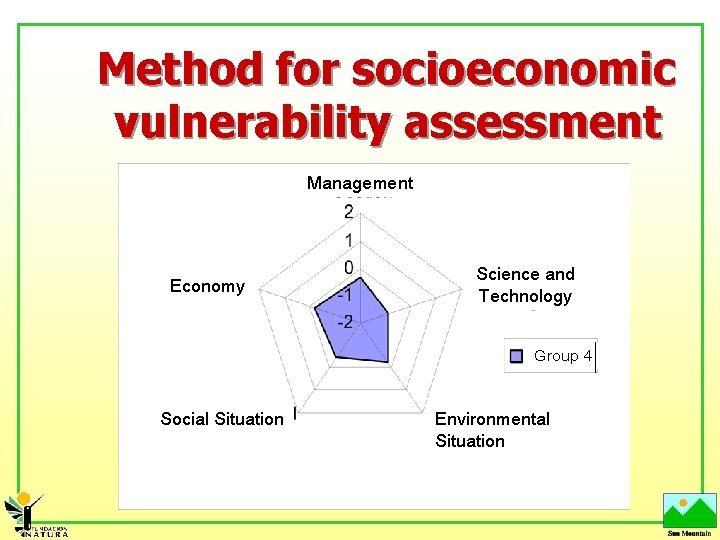
Socioeconomic vulnerability in LAC Assessment factors: ü Social condition ü Economic performance and condition ü Scientific and technological capabilities ü Quality of environmental management ü Situation of the environment
Method for socioeconomic vulnerability assessment Management Economy Science and Technology Group 4 Social Situation Environmental Situation
Vulnerability in LAC Very slightly vulnerable Slightly vulnerable Vulnerable Highly vulnerable Extremely vulnerable
Important aspects for environmental management ü Remarkable progress regarding the conceptual, legal and institutional basis ü Worrying environmental situation in most LAC countries ü The increase of poverty and poor distribution of income phenomena lower the priorities for environmental management ü Reduction of programs and projects guided to strengthening environmental management
Classification according to environmental management capacitie Group 1 Group 2 Group 3 Group 4 Group 5
Group 1 üCountries with good conceptual, legal and institutional basis and an environmental management performance better than the regional average
Group 2 üCountries with good conceptual, legal and institutional basis and an environmental management performance within the regional average
Group 3 üCountries with good conceptual, legal and institutional basis and an environmental management performance under the regional average
Group 4 üCountries with an incomplete conceptual, legal and institutional basis and an environmental management performance within the regional average
Group 5 üCountries with an incomplete conceptual, legal and institutional basis and an environmental management performance under the regional average
Important aspects for disaster risk management ü Wide variety of hazards ü The origin of hazards is natural or socionatural ü Increase of vulnerability as an unsolved aspect of development ü High impact and great amount of disasters ü Common features to manage risk in the region
Important aspects for disaster risk management ü The efforts of the governments (at national and local levels) concentrate on the response ü Gradual adoption of global and sectorial policies ü Existing regulations are guided towards the management of disasters. They are weak in relation to prevention and mitigation. ü Only a few countries have regulations enforcing that “who causes hazards is accountable for them. ”
Important aspects for disaster risk management ü Recent inclusion of hazard assessment in environmental impact evaluation ü Hazards and disasters are managed in a centralized manner ü In a great number of countries multiinstitutional and multi-sector work is very weak regarding the stages of prevention and mitigation
Important aspects for disaster risk management üGradual incorporation of hazard-related issues into development and government plans üThere is a trend to incorporate nongovernmental agents into the management of hazards üOnly a few countries arrange their territories according to existing hazards
Disaster risk reduction by k s i means of environmental and R natural resource management
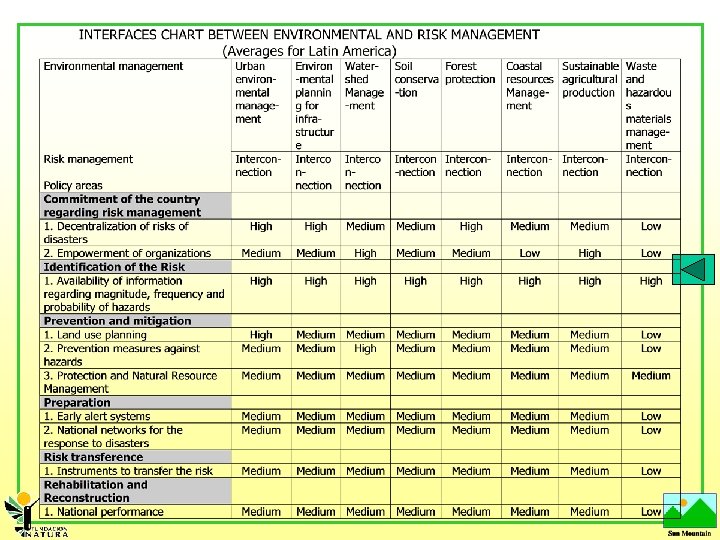
Disaster risk reduction by means of environmental management ü Management policies and actions of national governments to face natural disasters related with environmental and natural resource deterioration ü Chart of interrelationships between environmental management and risk management ü Application of the chart of interrelationships in three recent cases of disasters in the region
Management policies and actions o central governments ü Environmental and disaster risks ü Land planning of territories ü Management plans of areas under special administration systems ü Impact analysis and environmental instructions ü Environmental adaptation and supervision plans for industries ü Regulations for sectors ü Information and communication ü Cooperation networks for assistance and environmental surveillance and control ü Institutional issues
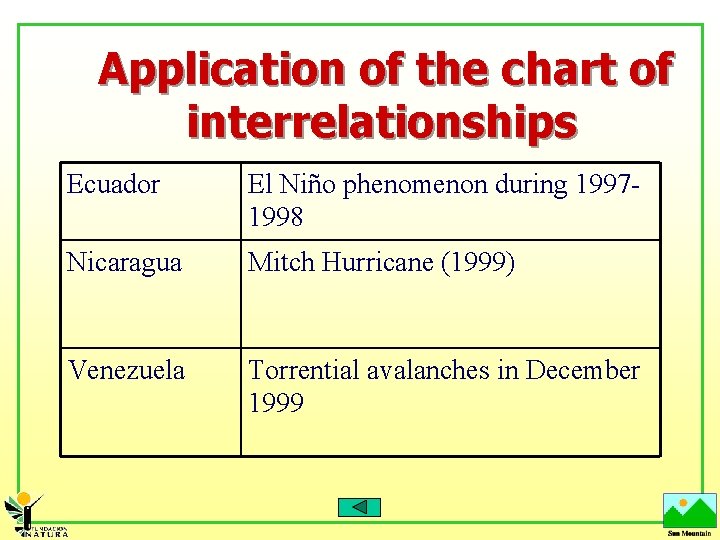
Application of the chart of interrelationships Ecuador El Niño phenomenon during 19971998 Nicaragua Mitch Hurricane (1999) Venezuela Torrential avalanches in December 1999
Thank you