
Diversification and Risk Reduction BY Shweta Acme Diversification
Diversification and Risk Reduction BY Shweta Acme

Diversification - Meaning Diversification is a risk management strategy that mixes a wide variety of investments within a portfolio. A diversified portfolio contains a mix of distinct asset types and investment vehicles in anattempt at limiting exposure to any single asset or risk. Diversification simply means not to put all your Eggs in one basket.
REASON OF DIVERSIFICATION • For growth in business operations • As not all investment perform well at same time. • Diversification enable you to have securities whose risk is smaller than individual securities. • Different type of investment affected differently through different economic factors.
IMPORTANCE OF DIVERSIFICATION • Diversification reduces risk by investing in investments that span different financial instruments, industries, and other categories. • Risk can be both undiversifiable or systemic, and diversifiable or unsystemic. • Investors may find balancing a diversified portfolio complicated and expensive, and it may come with lower rewards because the risk is mitigated
Pros of Diversification ● -Diversification in no of indstries or companies create a balance as investing in different industries may save us from market risk born by a specific company or industry. ● Help to prevent from unsystematic risk ● Better returns or increase in return rate
Cons of Diversification ● ● Require new skill or expertise knowledge More transaction cost involved More brokerage commission Time consuming affair
Forms of Diversification ● Into different Asset (gold, real estate govt. securities) ● Into different Instrument (bond, stock, debenture) ● Into different companies (new companies, growing companies) ● Into different industry lines (plastic, chemical, cement steel)
METHODS OF DIVERSIFICATION
Random Diversification There should be some sought of randomness during selection of companies and industries to invest as randomness is a statistical technique in which by placing companies in a specific order one can pick them in a random manner It may led to reduction of risk as an statistical error of choosing a wrong company may reduce.
Markowitz diversification Markowitz emphasised on right amount of securities neither too high nor too low just in an appropriate amount. securities those are negatively correlated Markowitz want to reduce unsystematic risk arising out of companies policies or performance so many risk can be reduced by optimum selection of companies and industries.
Adequate Diversification Adequate diversification is traditional approach as it involves as many industries or companies as acc to this it give us good results principle of adequate diversification is to brinkg the risk to zero by having more no of securities. Later this can be changed by Markowitz
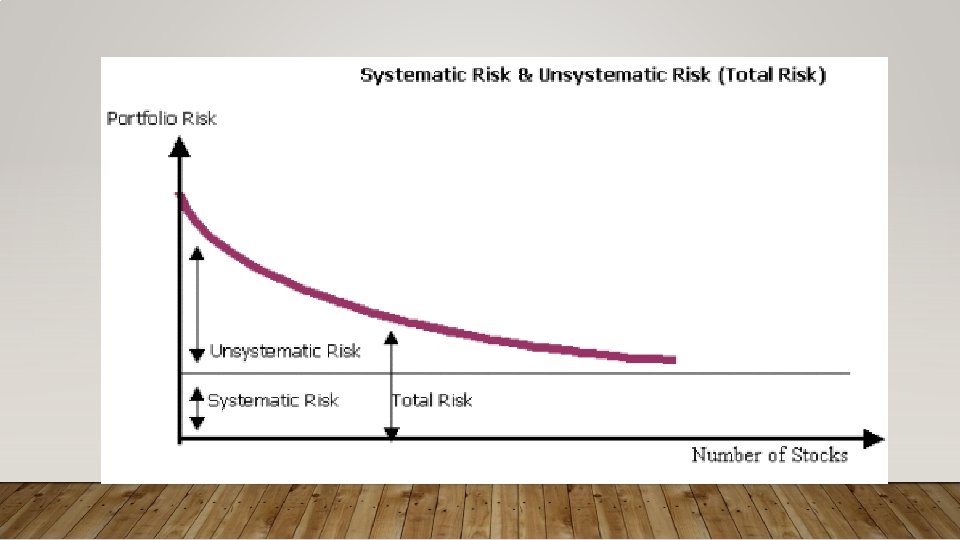
Naive Diversification It refers to diversification by simply picking stocks at random. this may or may not led to reduction in risk to optimal level. As no of stocks in a portfolio may increase randomly , it is possible to reduce risk upto a point. Diversification only reduce unsystematic risk but naive diversification does not even led to proper diversification of portfolio.
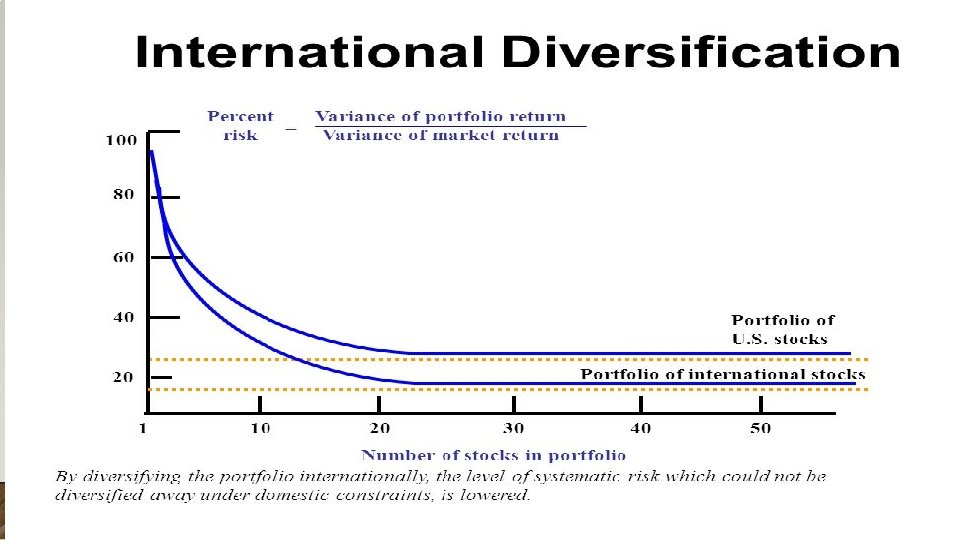
INTERNATIONAL DIVERSIFICATION • International diversification. The attempt to reduce risk by investing in more than one nation. By diversifying across nations whose economic cycles are not perfectly correlated, investors can typically reduce the variability of their returns. The easiest and most common way to invest in foreign markets is by purchasing exchange-traded funds (ETFs) or mutual funds that hold a basket of international stocks and bonds.
Usefulness of International Diversification ● size may widely vary for securities. ● scope for larger investment larger diversification. ● Return in foreign currency are more profitable then domestic currency. ● Eps of developing country may provide chances of upliftment ● chances of risk may reduce and returns may increase
Risk related to international investment ● Political factor of different economy or Social development may cause problem. ● Economy and Monetary policies of different nation are along a risk factor. ● Unforseen development such as wars, conflicts. ● Risk of currency fluctuation may also create major risk.
RISK Risk is defined in financial terms as the chance that an otcome or investment actual gains will differ from an expected outcome or returns. Risk includes the possibilities of losing some or all of an original investment. Standard Deviation is a common metric to measure the total amount of Risk one have to faced. It provides a measure of the volatality of asset prices in comparison to the historical averages in a given time frame. .
DIFFERENT TYPES OF RISK • Investors have to face two main types of risk when investing. The first is undiversifiable, which is also known as systematic or market risk. Systematic risk occurs due to macroeconomic factors. It is beyond the control of a specific company or individual, and hence, can’t be diversified. All investments and securities suffer from such type of risk. One can’t eliminate such a risk by holding more number of shares. • This risk includes all the unforeseen events that happen in everyday life, thus, making it beyond the control of the investors. Systematic risk impacts the entire industry rather than a single company or security. Common rates, political instability, war, and interest rates. causes include inflation rates, exchange
TYPE OF SYSTEMATIC RISK • INTEREST RATE RISK Such kind of risk is the result of a change in the market interest rate. It mainly impacts the fixed income securities as bond prices are inversely related to the interest rate. • MARKET RISK It is the result of the general tendency of the investors to move with the market. So, it is basically the tendency of security prices to move collectively. For instance, in the falling market, the stock price of even the best performing company’s drop. Usually, market risk accounts for about two-thirds of total systematic risk.
• PURCHASING POWER RISK / Inflation Risk occurs due to the erosion in the purchasing power of money. Inflation is the rise in the general price level, meaning the same amount of money buys fewer goods and services. So, if the income of the investor fails to keep pace with the rising inflation, then in the real term, he is earning less than before. Similar to the interest rate risk, purchasing power risk also mainly affects the fixed income securities because the income from such securities is fixed. • EXCHANGE RATE RISK This risk stems from the uncertainty in the changes in the value of the currencies. So, it affects only the companies doing foreign exchange transactions, like export and import companies.
Unsystematic Risk/ Diversifiable Risk • The second type of risk is diversifiable. This risk is also known as unsystematic risk and is specific to a company, industry, market, economy, or country. It can be reduced through diversification. common sources of unsystematic risk are business risk and financial risk. Thus, the aim is to invest in various assets so they will not all be affected the same way by market events. This vary risk canbe avoidable by various companies or indutry by opting for a suitable diversified portfolio.

Thank you
- Slides: 23