Summer 2017 Prototyping Your Idea and Opportunity Recognition
- Slides: 36
Summer 2017 Prototyping Your Idea and Opportunity Recognition Session 2 06/14/2017
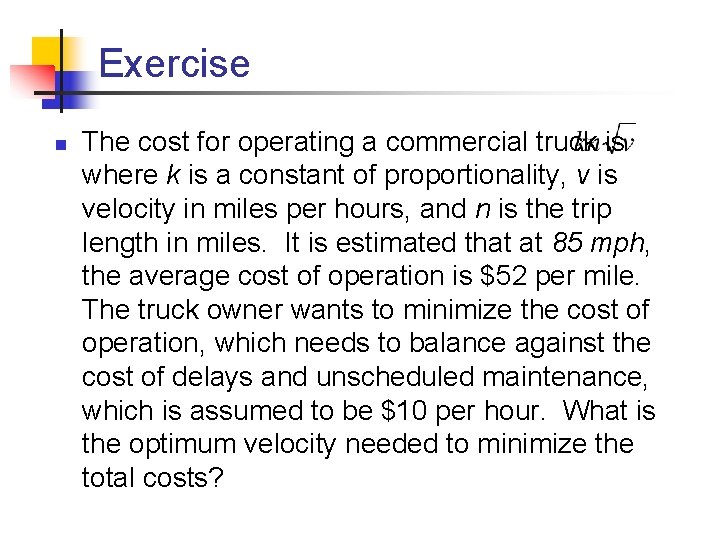
Exercise n The cost for operating a commercial truck is where k is a constant of proportionality, v is velocity in miles per hours, and n is the trip length in miles. It is estimated that at 85 mph, the average cost of operation is $52 per mile. The truck owner wants to minimize the cost of operation, which needs to balance against the cost of delays and unscheduled maintenance, which is assumed to be $10 per hour. What is the optimum velocity needed to minimize the total costs?
Objective • The objectives of today’s class are: – What is prototyping and why do it? – Determining your type of prototypes • Minimum Viable Product (MVP) – Identifying an opportunity – The ideation to opportunity transition – What is the opportunity space? – Knowing you customer
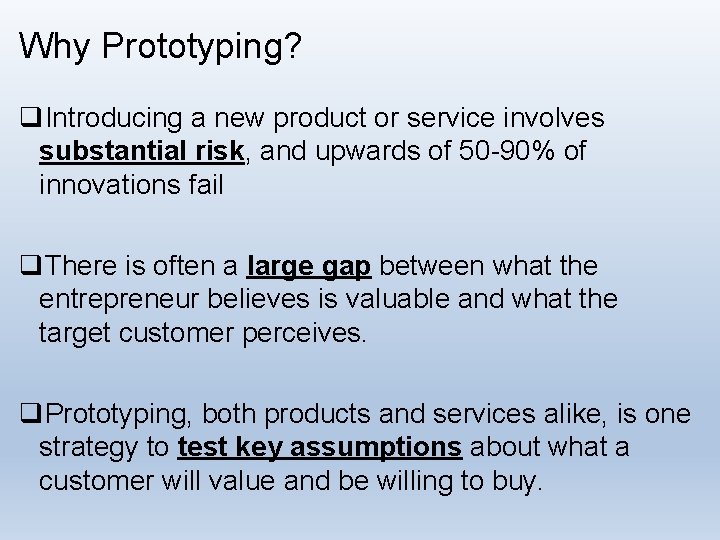
Why Prototyping? q. Introducing a new product or service involves substantial risk, and upwards of 50 -90% of innovations fail q. There is often a large gap between what the entrepreneur believes is valuable and what the target customer perceives. q. Prototyping, both products and services alike, is one strategy to test key assumptions about what a customer will value and be willing to buy.
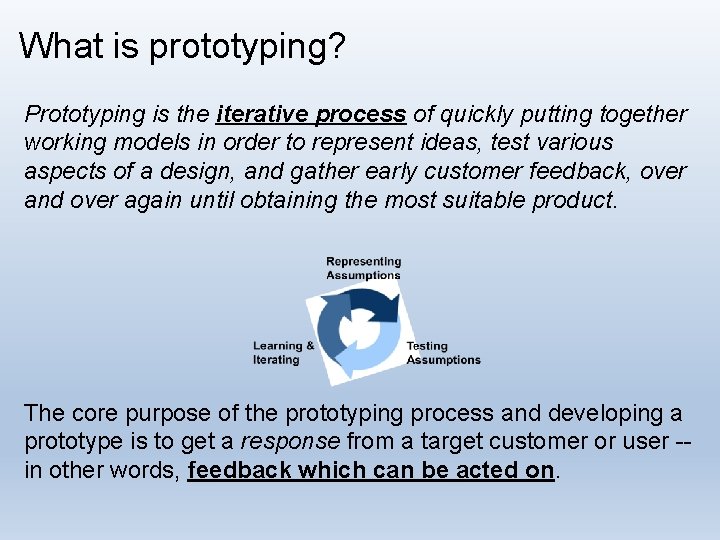
What is prototyping? Prototyping is the iterative process of quickly putting together working models in order to represent ideas, test various aspects of a design, and gather early customer feedback, over and over again until obtaining the most suitable product. The core purpose of the prototyping process and developing a prototype is to get a response from a target customer or user -- in other words, feedback which can be acted on.
Why Prototyping? q. Introducing a new product or service involves substantial risk, and upwards of 50 -90% of innovations fail q. There is often a large gap between what the entrepreneur believes is valuable and what the target customer perceives. q. Prototyping, both products and services alike, is one strategy to test key assumptions about what a customer will value and be willing to buy.
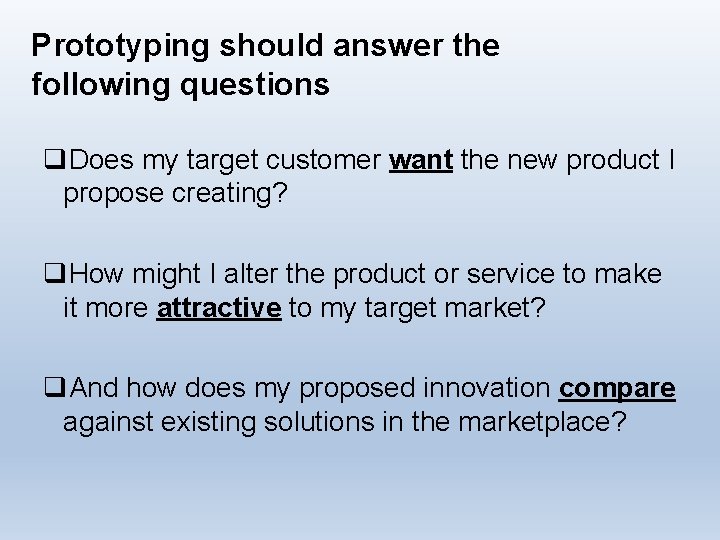
Prototyping should answer the following questions q. Does my target customer want the new product I propose creating? q. How might I alter the product or service to make it more attractive to my target market? q. And how does my proposed innovation compare against existing solutions in the marketplace?
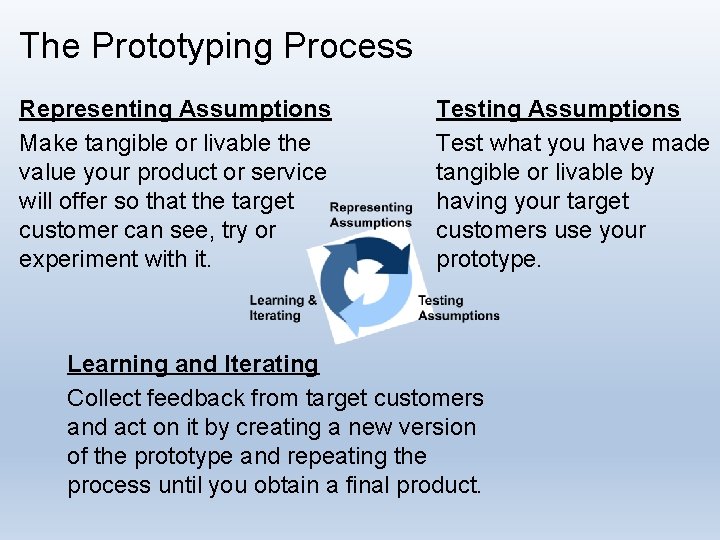
The Prototyping Process Representing Assumptions Make tangible or livable the value your product or service will offer so that the target customer can see, try or experiment with it. Testing Assumptions Test what you have made tangible or livable by having your target customers use your prototype. Learning and Iterating Collect feedback from target customers and act on it by creating a new version of the prototype and repeating the process until you obtain a final product.
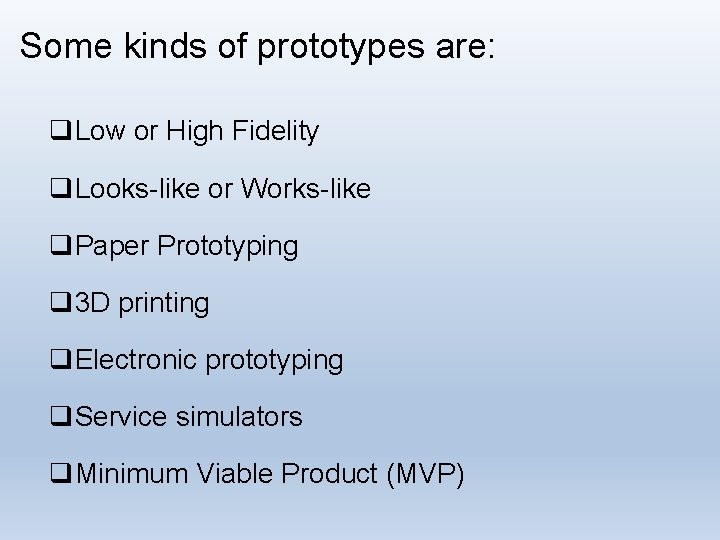
Some kinds of prototypes are: q. Low or High Fidelity q. Looks-like or Works-like q. Paper Prototyping q 3 D printing q. Electronic prototyping q. Service simulators q. Minimum Viable Product (MVP)
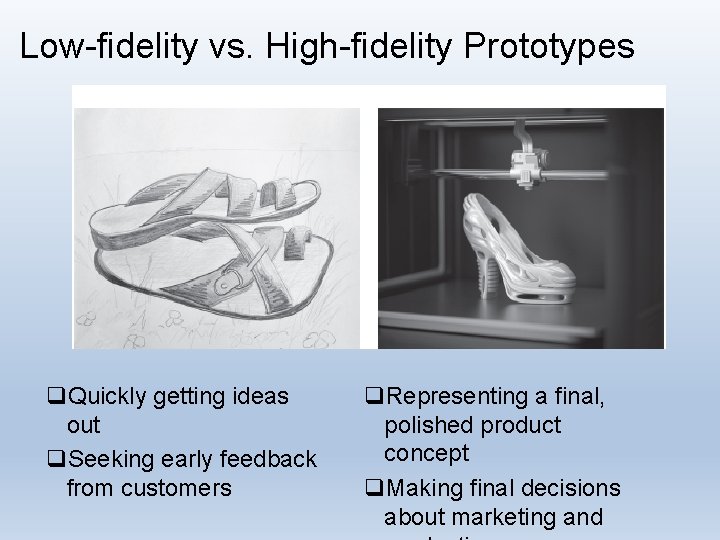
Low-fidelity vs. High-fidelity Prototypes q. Quickly getting ideas out q. Seeking early feedback from customers q. Representing a final, polished product concept q. Making final decisions about marketing and
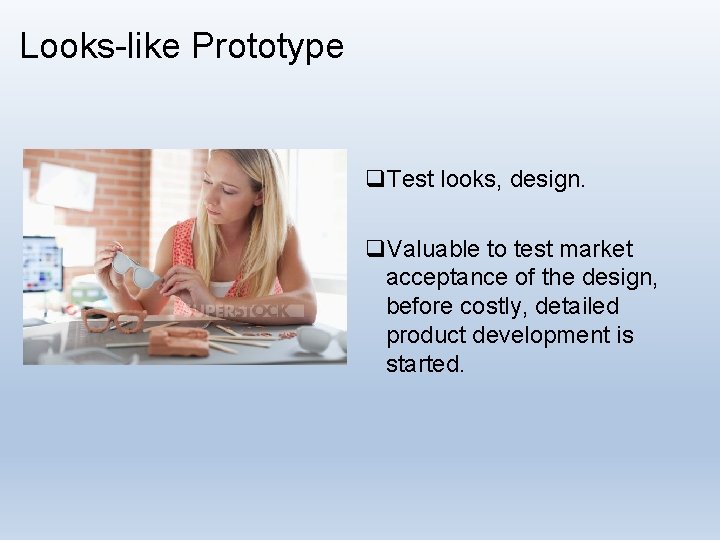
Looks-like Prototype q. Test looks, design. q. Valuable to test market acceptance of the design, before costly, detailed product development is started.
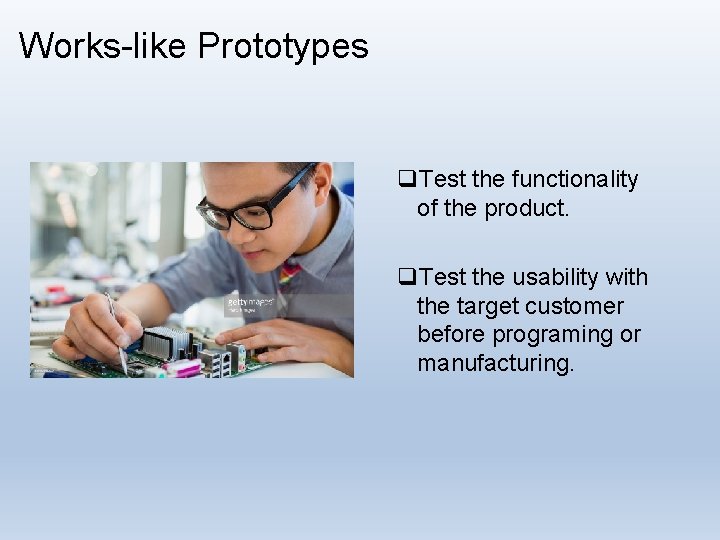
Works-like Prototypes q. Test the functionality of the product. q. Test the usability with the target customer before programing or manufacturing.
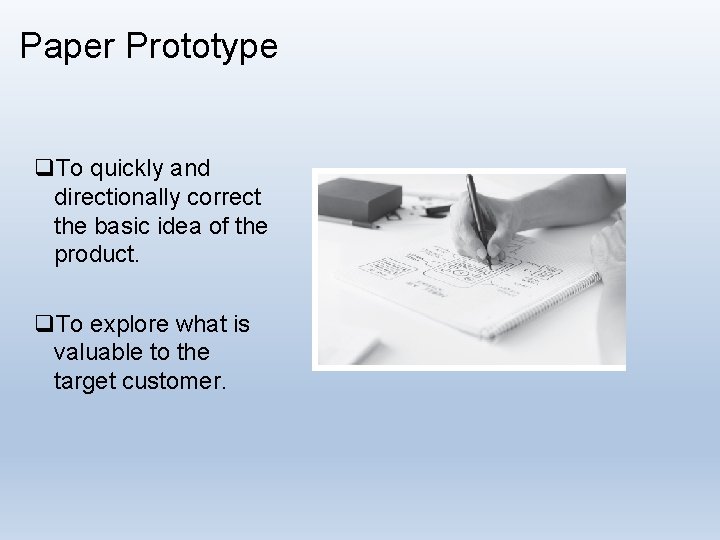
Paper Prototype q. To quickly and directionally correct the basic idea of the product. q. To explore what is valuable to the target customer.
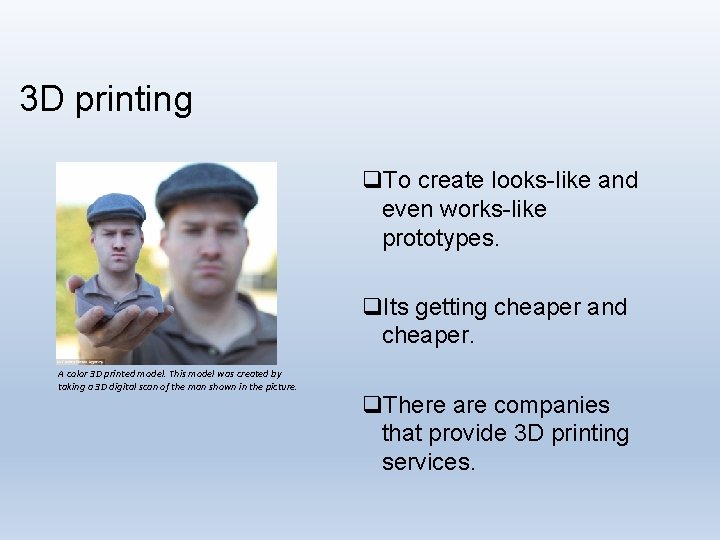
3 D printing q. To create looks-like and even works-like prototypes. q. Its getting cheaper and cheaper. A color 3 D printed model. This model was created by taking a 3 D digital scan of the man shown in the picture. q. There are companies that provide 3 D printing services.
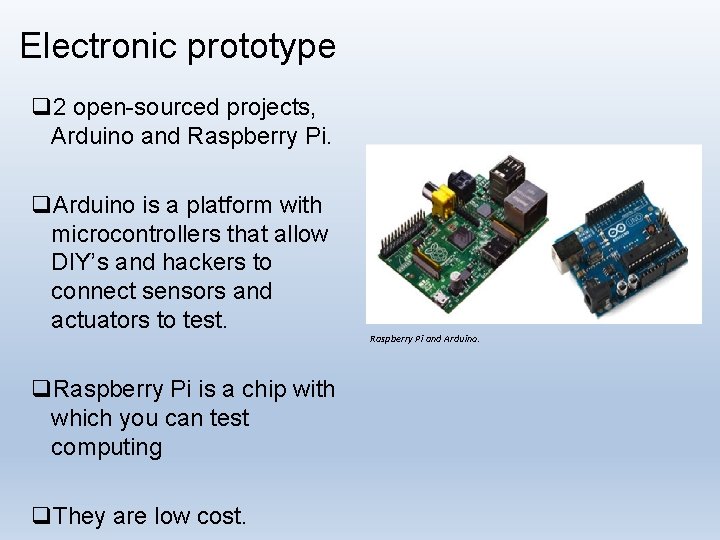
Electronic prototype q 2 open-sourced projects, Arduino and Raspberry Pi. q. Arduino is a platform with microcontrollers that allow DIY’s and hackers to connect sensors and actuators to test. q. Raspberry Pi is a chip with which you can test computing q. They are low cost. Raspberry Pi and Arduino.
Prototyping and Crowdfunding q. Kickstarter and Indiegogo highlight the value of prototypes in securing funding. q. Entrepreneur must develop and feature looks-like to convey to their creative vision, and more importantly, to signal their professionalism and dedication to their project.
Prototyping = Co-creating q. The most valuable step of prototyping is to design with, meaning alongside, your target audience to not only validate their needs but also to discover unexpected entrepreneurial opportunities. q. Customer engagement is at the center of the product design process q. Target customers must be engaged early and continuously in the process of idea generation and product development.
Service Simulator q. Major elements of services can be prototyped as well. For example: q. A plumbing company wishing to experiment with a new 30 -minute ‘arrival guarantee’ for plumbing emergencies can set aside a plumber for rapid response to test the desirability of this new service. q. An entrepreneur with a new pickup-and-delivery concept for a dry cleaner can first experiment with just the pickup-and-delivery aspect of the service without building and operating an entire cleaning operation. For example, an existing dry cleaner/cleaning operation can be used to do the cleaning itself.
Minimum Viable Product (MVP) q. Eric Reis defines a minimum viable product as that version of a new product concept which allows a team to collect the maximum amount of validated learning about customers with the least effort 1. q. Others view a minimum viable product as a more evolved prototype that can be used by the customer and actually deliver value to a customer, even in a rough form. 1. Ries, Eric. Minimum Viable Product: A Guide, http: //www. startuplessonslearned. com/2009/08/minimum-viable-product-guide. html, August 3, 2009.
Summary q. In sum, prototyping is a process and prototypes can be thought of in many ways: q. As market research and exploration tools q. As physical embodiments of a set of assumptions q. As fundraising tools for Crowdfunding efforts q. As coordination device within an entrepreneurial team to identify research and development priorities
Reflection points q. How might you leverage prototyping to explore your idea for an entrepreneurial venture? q. What simple prototype could you develop today, or this week, to test some core aspect of your concept? q. How might you develop multiple prototypes to seek a wide range of feedback from your target customer? q. How do you think 3 D printing might change how entrepreneurs develop prototypes as well as final products? q. How might you co-create opportunities with your target customer, i. e. , involve them early on in your idea generation? q. How might you develop and test a minimum viable product (MVP) for your product or service concept?
Web Exercises q. Watch this 2 -minute video on how to get started with simple paper prototyping: https: //www. youtube. com/watch? v=k_9 Q-KDSb 9 o. Remember, simple, low fidelity prototyping is always the place to start. q. Look at Fiverr. com to discover a wide range of affordable design services including graphic design, industrial/product design, 3 D design and web development. q. If you did not already, look at 3 Dhubs. com and Shapeways. com to learn more about 3 D printing services, some which are likely available in your city.
OPPORTUNITY RECOGNITION, SHAPING, & RESHAPING
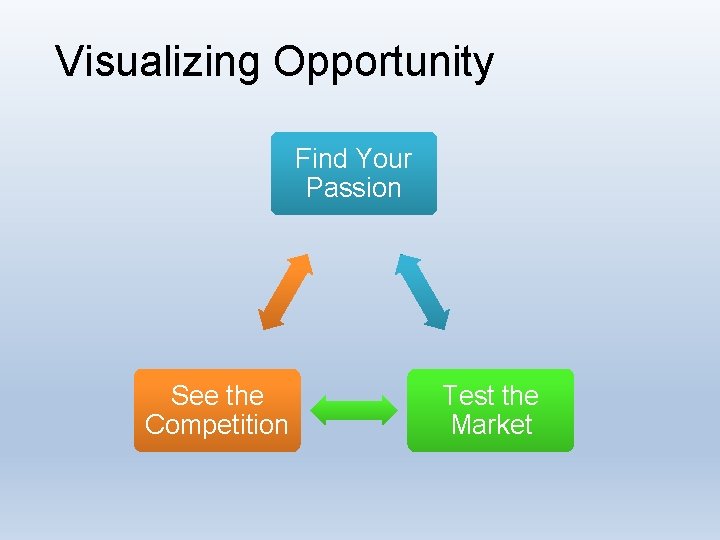
Visualizing Opportunity Find Your Passion See the Competition Test the Market
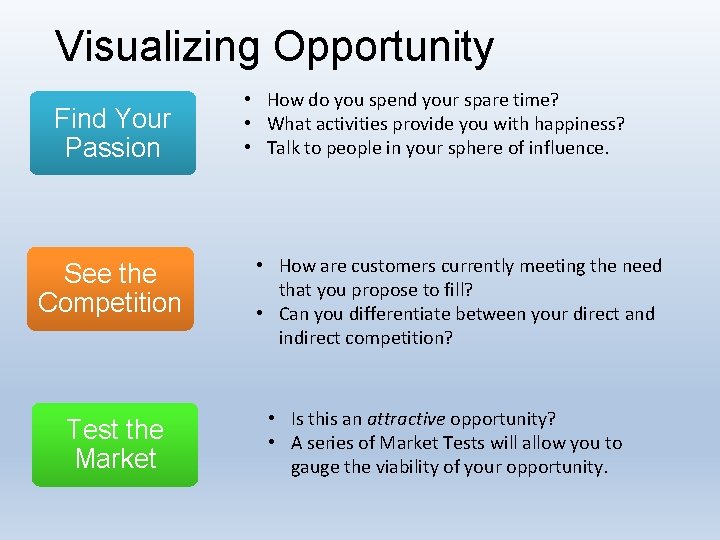
Visualizing Opportunity Find Your Passion See the Competition Test the Market • How do you spend your spare time? • What activities provide you with happiness? • Talk to people in your sphere of influence. • How are customers currently meeting the need that you propose to fill? • Can you differentiate between your direct and indirect competition? • Is this an attractive opportunity? • A series of Market Tests will allow you to gauge the viability of your opportunity.
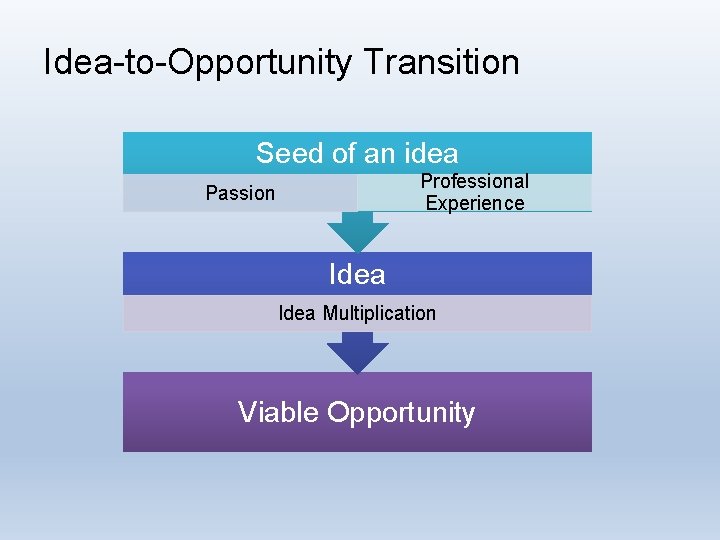
Idea-to-Opportunity Transition Seed of an idea Professional Experience Passion Idea Multiplication Viable Opportunity
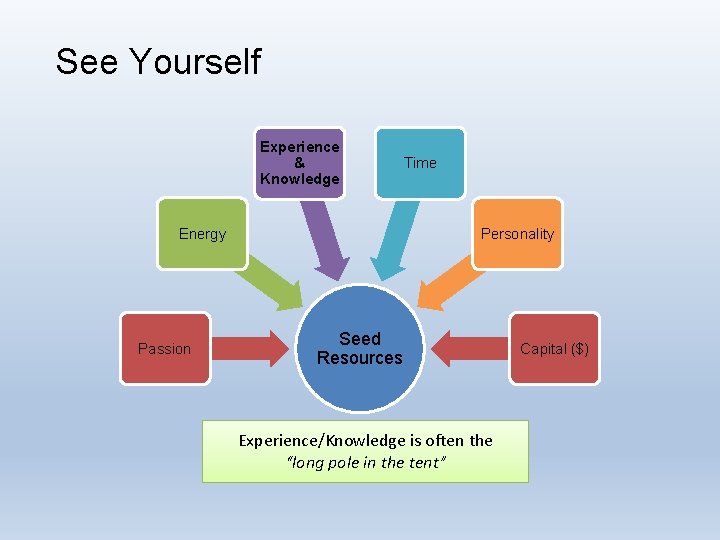
See Yourself Experience & Knowledge Energy Passion Time Personality Seed Resources Experience/Knowledge is often the “long pole in the tent” Capital ($)
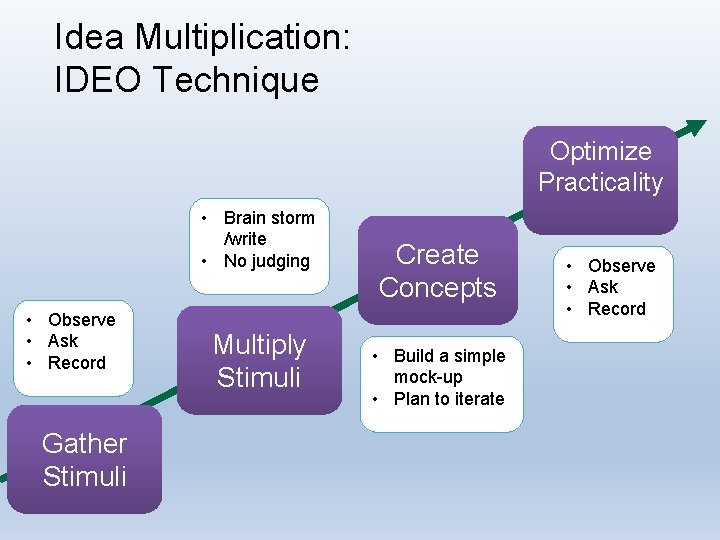
Idea Multiplication: IDEO Technique Optimize Practicality • Brain storm /write • No judging • Observe • Ask • Record Gather Stimuli Multiply Stimuli Create Concepts • Build a simple mock-up • Plan to iterate • Observe • Ask • Record
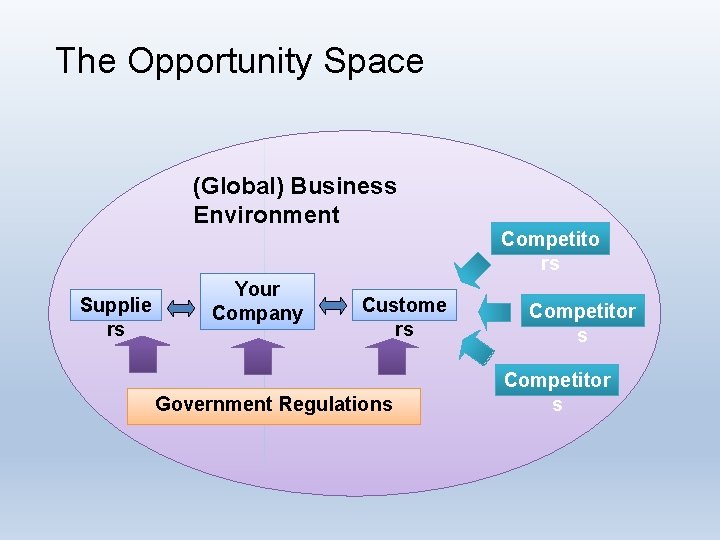
The Opportunity Space (Global) Business Environment Supplie rs Your Company Custome rs Government Regulations Competito rs Competitor s
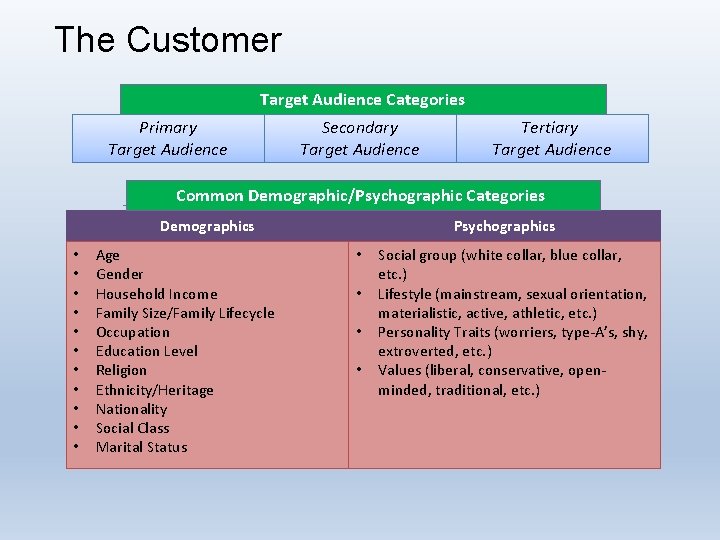
The Customer Target Audience Categories Primary Target Audience Secondary Target Audience Tertiary Target Audience Common Demographic/Psychographic Categories Demographics • • • Age Gender Household Income Family Size/Family Lifecycle Occupation Education Level Religion Ethnicity/Heritage Nationality Social Class Marital Status Psychographics • • Social group (white collar, blue collar, etc. ) Lifestyle (mainstream, sexual orientation, materialistic, active, athletic, etc. ) Personality Traits (worriers, type-A’s, shy, extroverted, etc. ) Values (liberal, conservative, openminded, traditional, etc. )
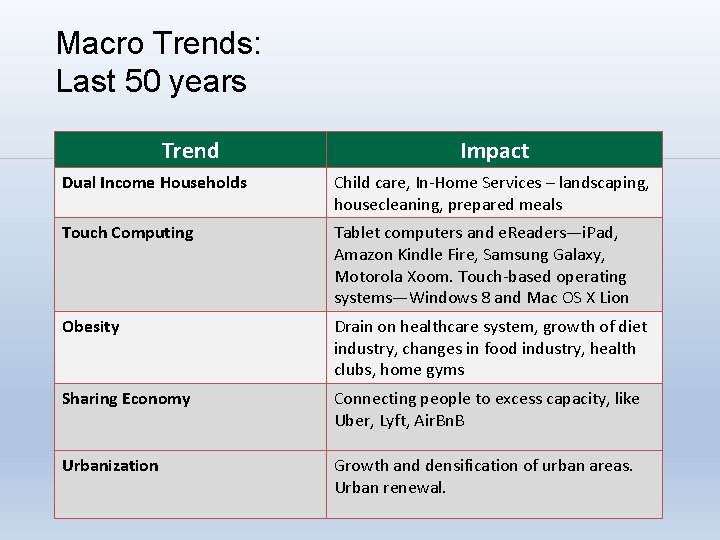
Macro Trends: Last 50 years Trend Impact Dual Income Households Child care, In-Home Services – landscaping, housecleaning, prepared meals Touch Computing Tablet computers and e. Readers—i. Pad, Amazon Kindle Fire, Samsung Galaxy, Motorola Xoom. Touch-based operating systems—Windows 8 and Mac OS X Lion Obesity Drain on healthcare system, growth of diet industry, changes in food industry, health clubs, home gyms Sharing Economy Connecting people to excess capacity, like Uber, Lyft, Air. Bn. B Urbanization Growth and densification of urban areas. Urban renewal.
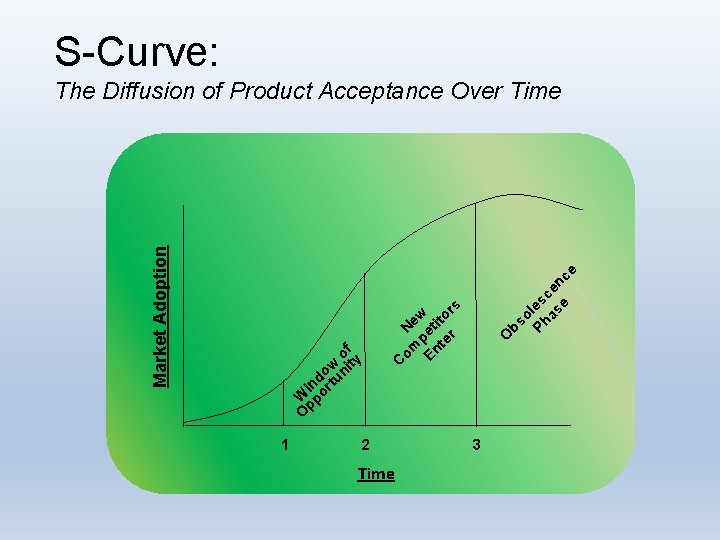
1 2 Time 3 ce o Ph les as cen e bs O om N ew p En et te ito r rs C O W pp in or do tu w ni of ty Market Adoption S-Curve: The Diffusion of Product Acceptance Over Time
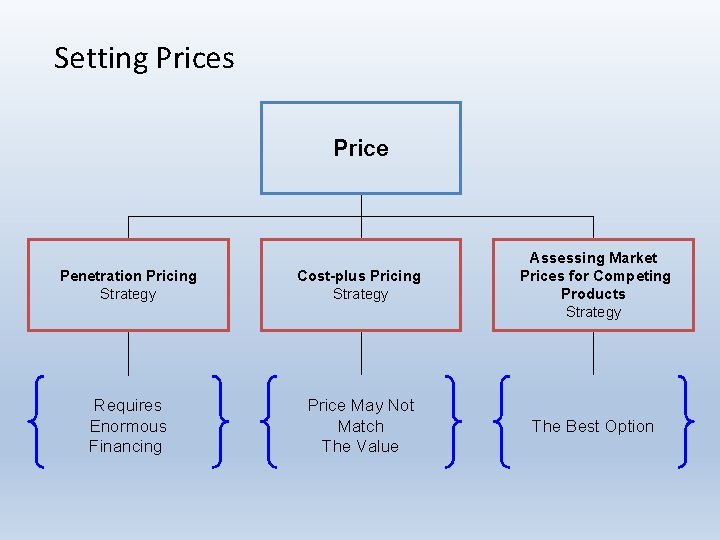
Setting Prices Price Penetration Pricing Strategy Cost-plus Pricing Strategy Assessing Market Prices for Competing Products Strategy Requires Enormous Financing Price May Not Match The Value The Best Option
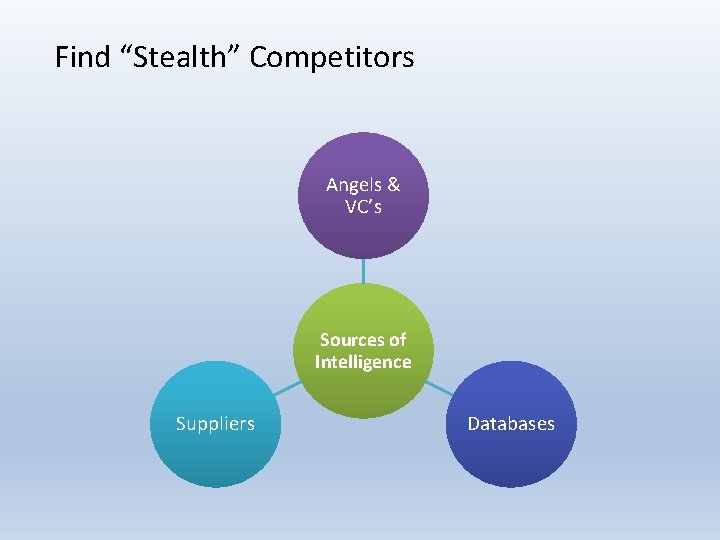
Find “Stealth” Competitors Angels & VC’s Sources of Intelligence Suppliers Databases
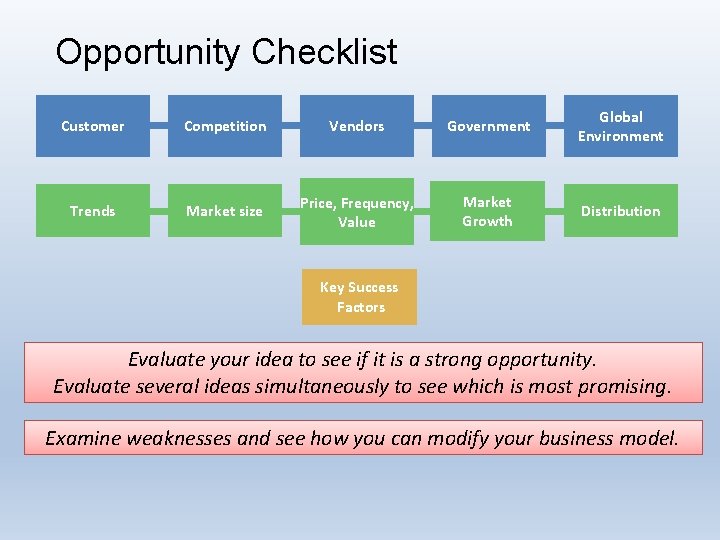
Opportunity Checklist Customer Competition Vendors Government Global Environment Trends Market size Price, Frequency, Value Market Growth Distribution Key Success Factors Evaluate your idea to see if it is a strong opportunity. Evaluate several ideas simultaneously to see which is most promising. Examine weaknesses and see how you can modify your business model.
Recap q. All opportunities start with an idea q. There should be an established and growing market q. Entrepreneur should have passion for the idea and know the customer q. Reach customer better than the competition can q. Four favorable elements: customer, competitors, suppliers and government