Study on Underground Gas Storage in Europe and

- Slides: 35
Study on Underground Gas Storage in Europe and Central Asia Working Party on Gas Geneva, January 19, 2010 United Nations Economic Commission for Europe Committee on Sustainable Energy 1
Study on Underground Gas Storage in Europe and Central Asia Summary : • • General consideration about Underground Gas Storage (UGS) Overview of UGS business from IGU The study on UGS in Europe and Central Asia carried out in the 90’s Opportunity for updating the UGS study Structure of the new UGS study Organization of the UNECE Working Group Current status of the UNECE UGS study Conclusion Economic Commission for Europe / Committee on Sustainable Energy 2
UNDERGROUND GAS STORAGE (UGS) TECHNOLOGIES 3
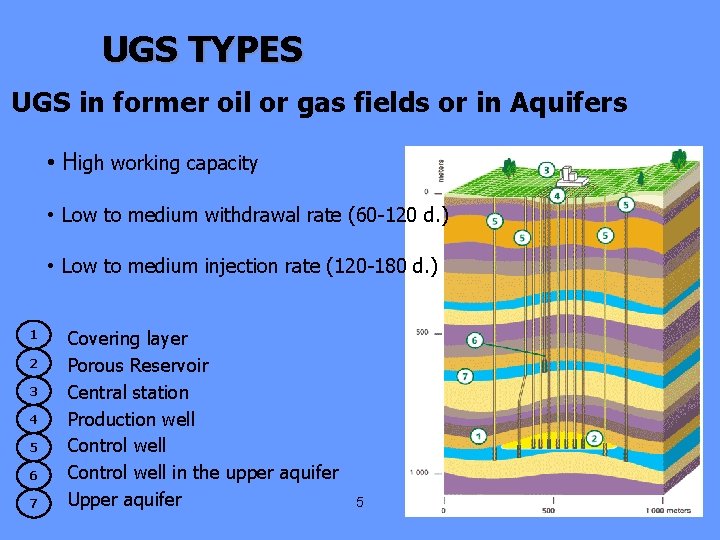
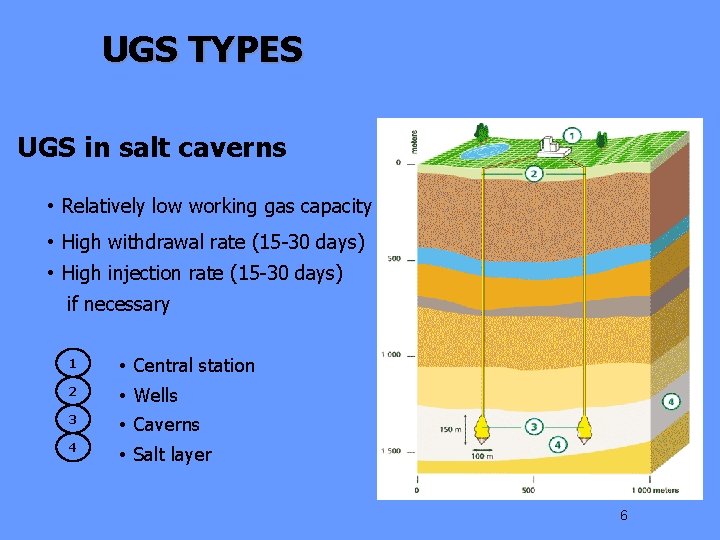
UGS TYPES • UGS types • Porous rock (depleted fields / aquifers) • Salt cavern • Mined caverns • Subsurface facilities • Wells • Surface facilities • compressors • gas treatment 4
UGS TYPES UGS in former oil or gas fields or in Aquifers • High working capacity • Low to medium withdrawal rate (60 -120 d. ) • Low to medium injection rate (120 -180 d. ) 1 2 3 4 5 6 7 Covering layer Porous Reservoir Central station Production well Control well in the upper aquifer Upper aquifer 5
UGS TYPES UGS in salt caverns • Relatively low working gas capacity • High withdrawal rate (15 -30 days) • High injection rate (15 -30 days) if necessary 1 • Central station 2 • Wells 3 • Caverns 4 • Salt layer 6
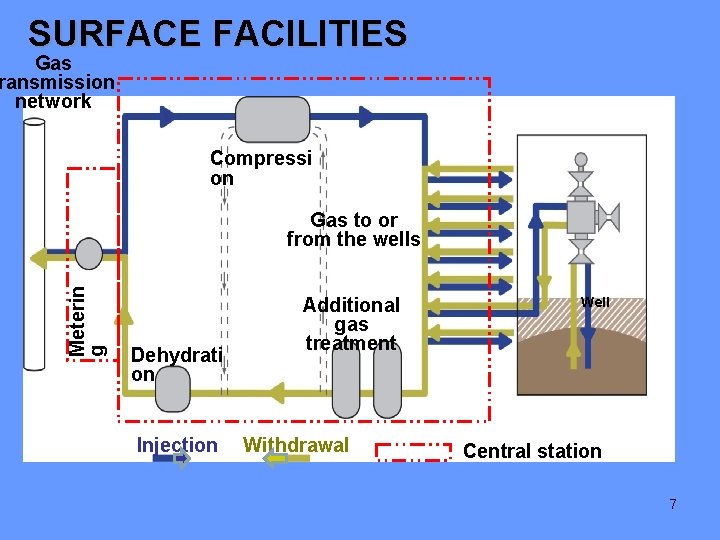
SURFACE FACILITIES Gas ransmission network Compressi on Meterin g Gas to or from the wells Dehydrati on Injection Additional gas treatment Withdrawal Well Central station 7
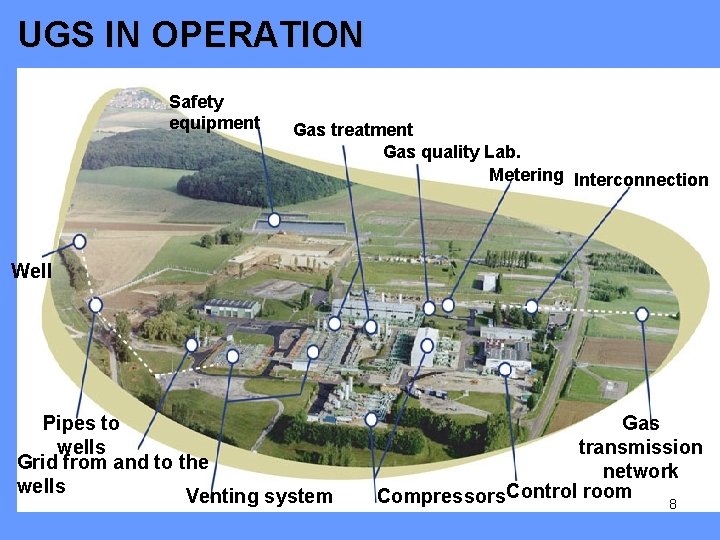
UGS IN OPERATION Safety equipment Gas treatment Gas quality Lab. Metering Interconnection Well Pipes to wells Grid from and to the wells Venting system Gas transmission network Compressors. Control room 8
NEED FOR UNDERGROUND GAS STORAGE 9
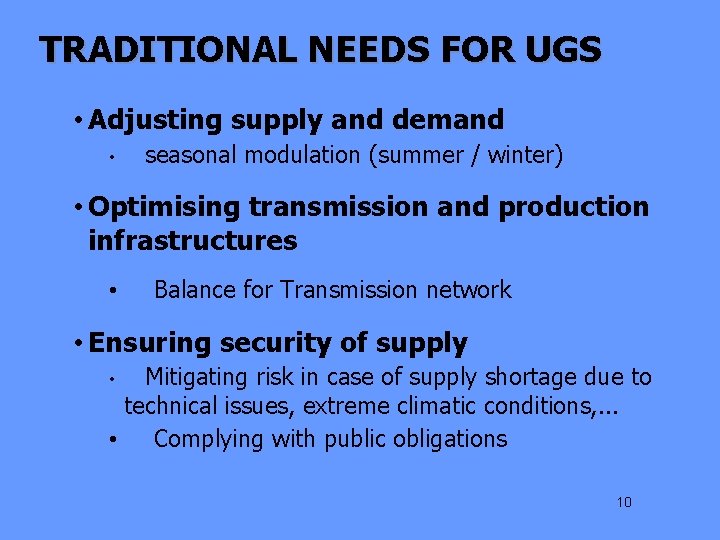
TRADITIONAL NEEDS FOR UGS • Adjusting supply and demand • seasonal modulation (summer / winter) • Optimising transmission and production infrastructures • Balance for Transmission network • Ensuring security of supply Mitigating risk in case of supply shortage due to technical issues, extreme climatic conditions, . . . • Complying with public obligations • 10
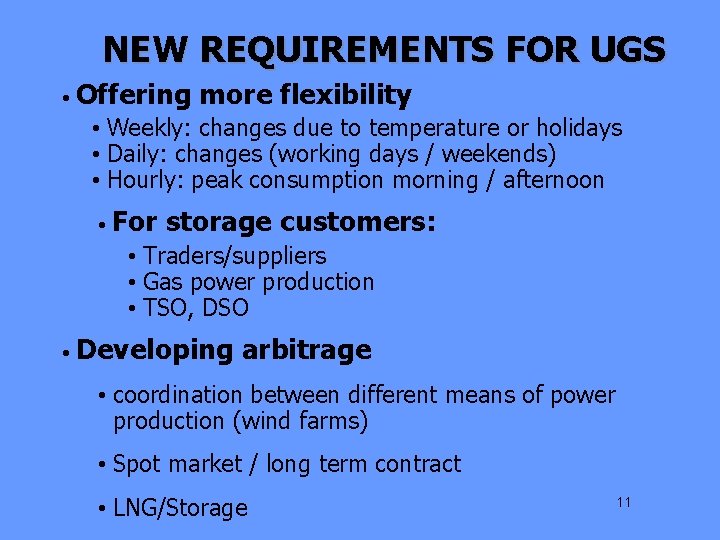
NEW REQUIREMENTS FOR UGS • Offering more flexibility • Weekly: changes due to temperature or holidays • Daily: changes (working days / weekends) • Hourly: peak consumption morning / afternoon • For storage customers: • Traders/suppliers • Gas power production • TSO, DSO • Developing arbitrage • coordination between different means of power production (wind farms) • Spot market / long term contract • LNG/Storage 11
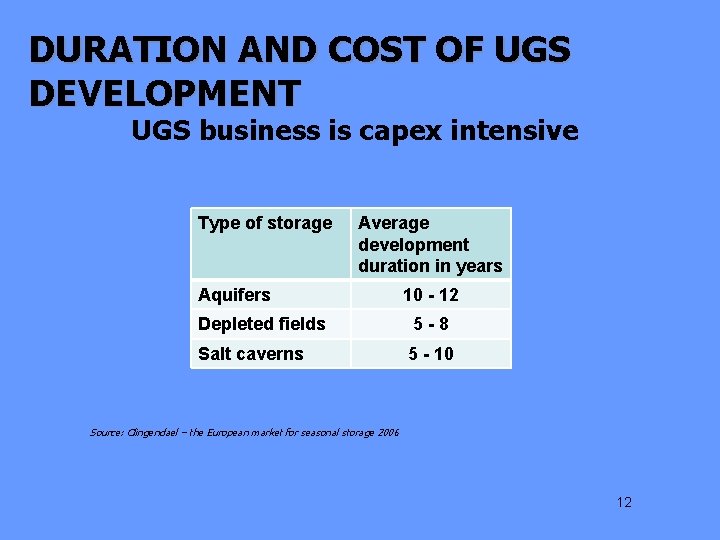
DURATION AND COST OF UGS DEVELOPMENT UGS business is capex intensive Type of storage Average development duration in years Aquifers 10 - 12 Depleted fields 5 - 8 Salt caverns 5 - 10 Source: Clingendael – the European market for seasonal storage 2006 12
EUROPEAN REGULATORY FRAMEWORK Current Regulation of Storage within Directive 2003/55/EC, Article 19(1) • TPA access to UGS facilities when technically and/or economically necessary • Member States can choose between negotiated TPA or regulated TPA for UGS or both procedures • access on transparent and non discriminatory basis • exemptions from TPA under art 22 • regulators generally monitor the access conditions to UGS GGPSSO (Guidelines for Good TPA Practice for Storage System Operators) • In March 2005, a minimum set of rules required for the organization of the storage market were agreed, after a consultation of European Regulators (ERGEG) with SSOs 13
EUROPEAN REGULATORY FRAMEWORK Future Regulation of storage within the third Energy Package • Member States can choose either or both negotiated/regulated access (regulated access implying conditions set by an independent regulator) • legally binding guidelines (GGPSSO)gives details for management of services and capacity allocation • legal and functional unbundling • regulatory oversight • transparency on and pre-definition of criteria adopted for the definition of capacity for TPA (MS or Regulators define these criteria) • the 3 rd Energy Package (July 2009) will be implemented in 2011 • New Security of Supply Regulation (repealing 2004 So. S Directive) Gas Storage Europe is the interface with the EC. 14
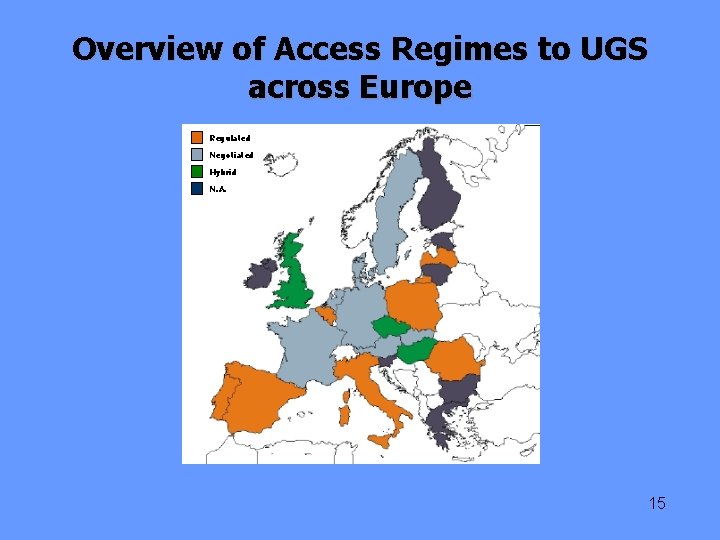
Overview of Access Regimes to UGS across Europe Regulated Negotiated Hybrid N. A. 15
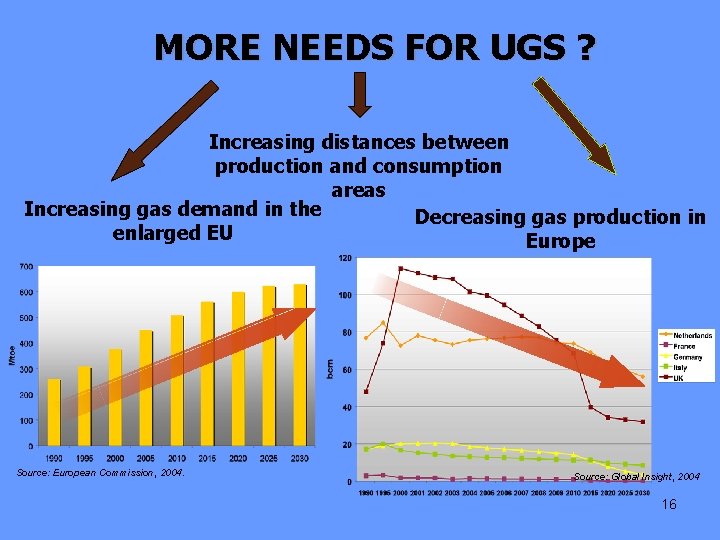
MORE NEEDS FOR UGS ? Increasing distances between production and consumption areas Increasing gas demand in the Decreasing gas production in enlarged EU Europe Source: European Commission, 2004. Source: Global Insight, 2004 16
OVERVIEW ABOUT UGS BUSINESS FROM IGU 17
THE UNECE STUDY ON UGS IN EUROPE AND CENTRAL ASIA 18
Study on Underground Gas Storage in Europe and Central Asia The First Study carried out in the 90’s: • • The first study on UGS in Europe and Central Asia started in 1996 and was finalized in 1999. It was composed of 6 chapters which dealt with new technologies, current status, new projects, regulation frameworks, costs of storage and trends of market. Approx. 75 experts from 35 countries (from UNECE region and USA) participated in this study. This study was unique for its multidisciplinary approach and the geographic areas concerned. Economic Commission for Europe / Committee on Sustainable Energy 19
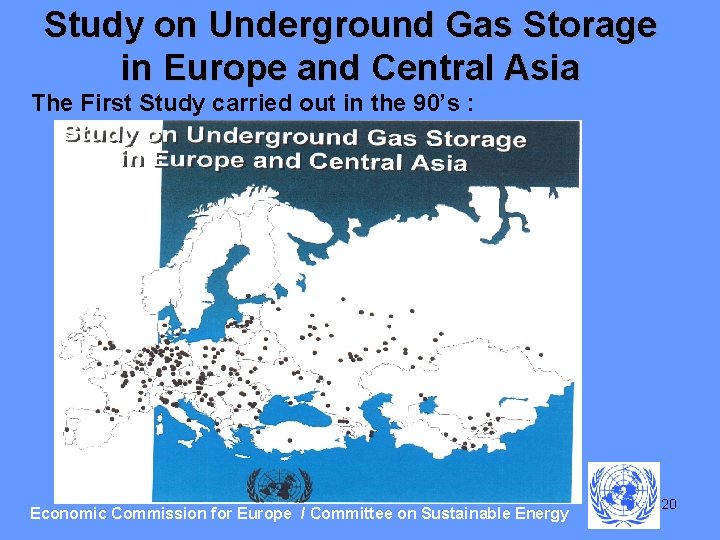
Study on Underground Gas Storage in Europe and Central Asia The First Study carried out in the 90’s : Economic Commission for Europe / Committee on Sustainable Energy 20
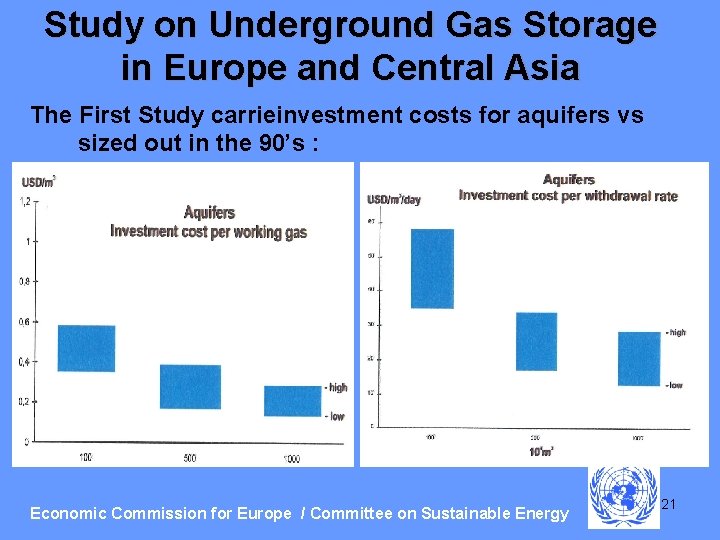
Study on Underground Gas Storage in Europe and Central Asia The First Study carrieinvestment costs for aquifers vs sized out in the 90’s : - Economic Commission for Europe / Committee on Sustainable Energy 21
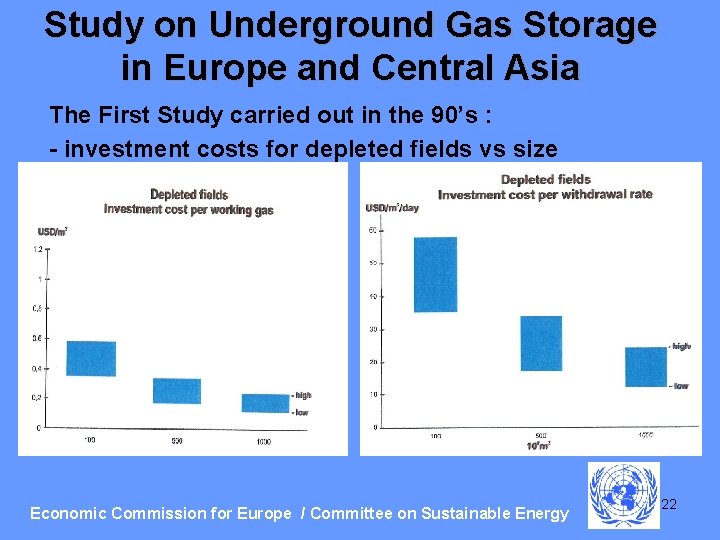
Study on Underground Gas Storage in Europe and Central Asia The First Study carried out in the 90’s : - investment costs for depleted fields vs size Economic Commission for Europe / Committee on Sustainable Energy 22
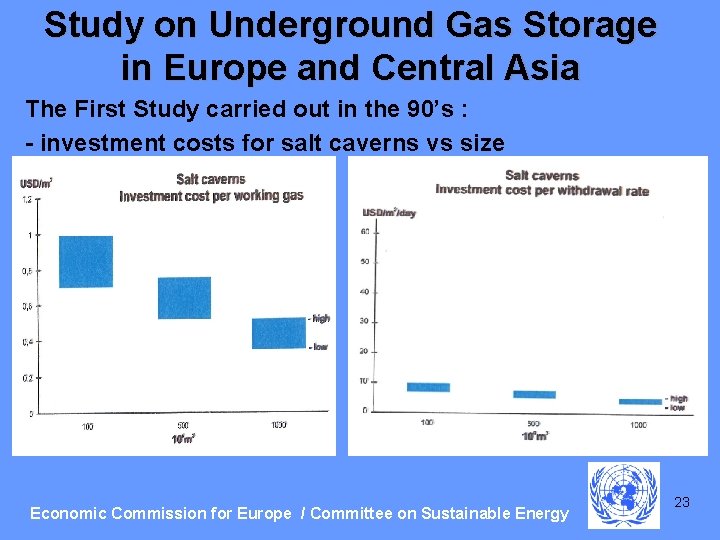
Study on Underground Gas Storage in Europe and Central Asia The First Study carried out in the 90’s : - investment costs for salt caverns vs size Economic Commission for Europe / Committee on Sustainable Energy 23
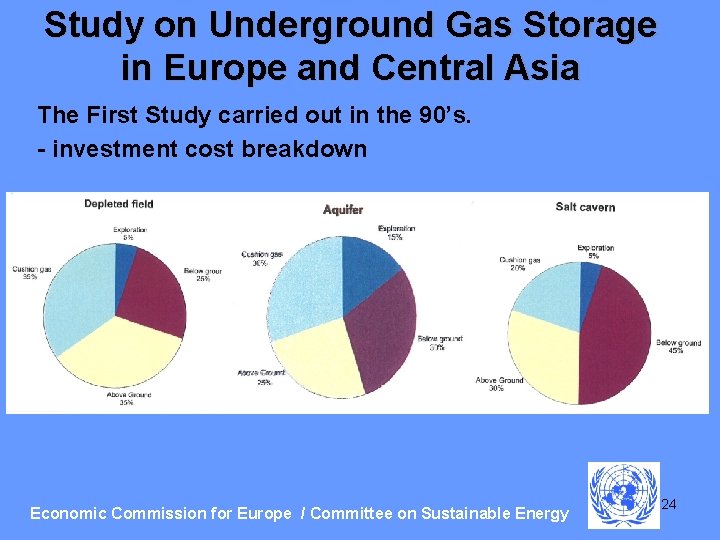
Study on Underground Gas Storage in Europe and Central Asia The First Study carried out in the 90’s. - investment cost breakdown Economic Commission for Europe / Committee on Sustainable Energy 24
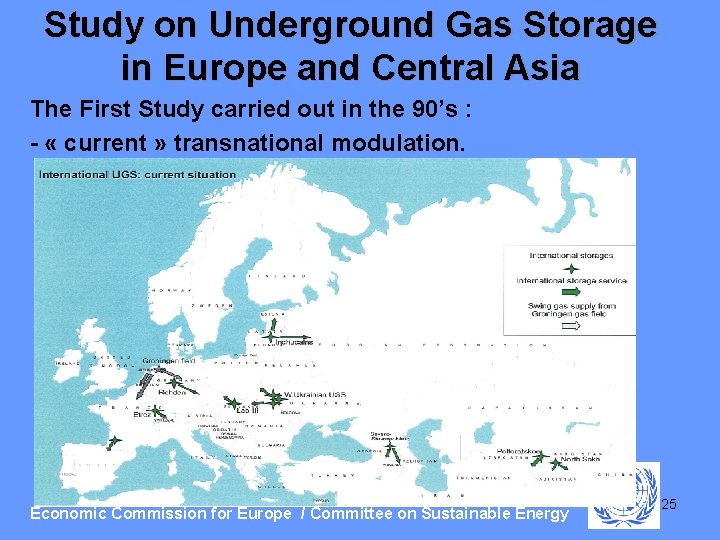
Study on Underground Gas Storage in Europe and Central Asia The First Study carried out in the 90’s : - « current » transnational modulation. Economic Commission for Europe / Committee on Sustainable Energy 25
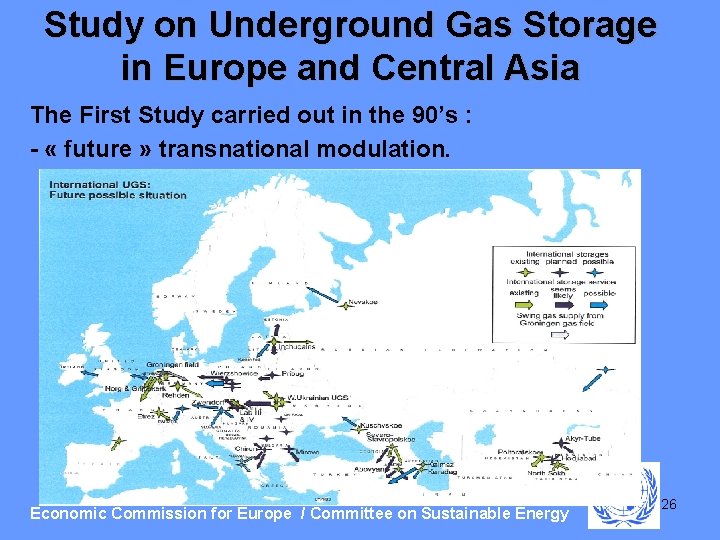
Study on Underground Gas Storage in Europe and Central Asia The First Study carried out in the 90’s : - « future » transnational modulation. Economic Commission for Europe / Committee on Sustainable Energy 26
Study on Underground Gas Storage in Europe and Central Asia Why updating the Study ? • • The market became more complex and changed significantly, particularly after the EU Directives for liberalization of gas market (TPA concept) : investment decision making then became more difficult, Many newcomers entered the market as operators (SSOs) or as customers (TSOs, shippers, DSOs and power producers), Due to the further decline of EU gas production, UGS becomes and will become more and more important, Investors and developers of Gas Industry need to have benchmark for investment decisions. Economic Commission for Europe / Committee on Sustainable Energy 27
Study on Underground Gas Storage in Europe and Central Asia Structure of the new study (1 st part) : • Chapter 1 : New and emerging technologies : identify the main technological improvements in UGS business that may lead to a better cost efficiency, (Heads : Mr A. Iskhakov (Gazprom), Mr H. Spreckels – E-On Gas Storage and Mr C. Gomez-Montalvo - Geostock) • Chapter 2 : Current UGS status : set up an updated data base for all existing UGS plants in each country, (Head : Mr M. Sandu – Romgaz with support of Mr J. Wallbrecht – BEB / IGU and Mr A. Iskhakov ( Gazprom) Economic Commission for Europe / Committee on Sustainable Energy 28
Study on Underground Gas Storage in Europe and Central Asia Structure of the new study (2 nd part) : • Chapter 3 : Market structure and legal framework : describe the legislation and guidelines for UGS market organization (incl. TPA rules) and UGS services, (Head : G. -H. Joffre – Storengy with support of Ms A. Brandenburger– RWE Gasspeicher and Mr U. Duda – E. On Gas Storage) • Chapter 4 : UGS projects : set up a data base for planned projects in each country including criteria for selecting projects, (Head : Mr F. Favret (EDF) with support of Mr J. Wallbrecht – BEB / IGU, Ms A. Brandenburger– RWE Gasspeicher and Mr U. Duda – E. On Gas Storage) Economic Commission for Europe / Committee on Sustainable Energy 29
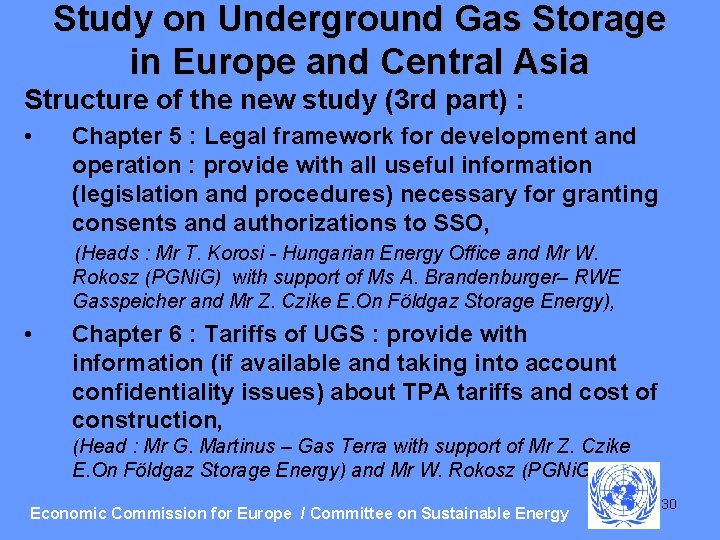
Study on Underground Gas Storage in Europe and Central Asia Structure of the new study (3 rd part) : • Chapter 5 : Legal framework for development and operation : provide with all useful information (legislation and procedures) necessary for granting consents and authorizations to SSO, (Heads : Mr T. Korosi - Hungarian Energy Office and Mr W. Rokosz (PGNi. G) with support of Ms A. Brandenburger– RWE Gasspeicher and Mr Z. Czike E. On Földgaz Storage Energy), • Chapter 6 : Tariffs of UGS : provide with information (if available and taking into account confidentiality issues) about TPA tariffs and cost of construction, (Head : Mr G. Martinus – Gas Terra with support of Mr Z. Czike E. On Földgaz Storage Energy) and Mr W. Rokosz (PGNi. G) Economic Commission for Europe / Committee on Sustainable Energy 30
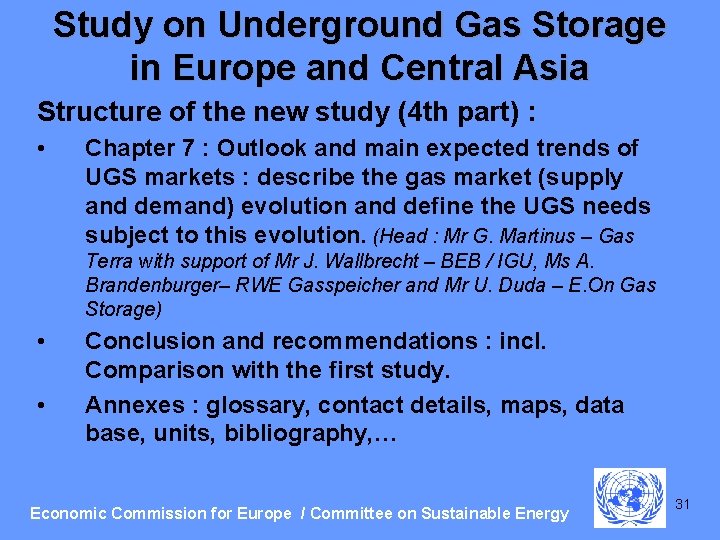
Study on Underground Gas Storage in Europe and Central Asia Structure of the new study (4 th part) : • Chapter 7 : Outlook and main expected trends of UGS markets : describe the gas market (supply and demand) evolution and define the UGS needs subject to this evolution. (Head : Mr G. Martinus – Gas Terra with support of Mr J. Wallbrecht – BEB / IGU, Ms A. Brandenburger– RWE Gasspeicher and Mr U. Duda – E. On Gas Storage) • • Conclusion and recommendations : incl. Comparison with the first study. Annexes : glossary, contact details, maps, data base, units, bibliography, … Economic Commission for Europe / Committee on Sustainable Energy 31
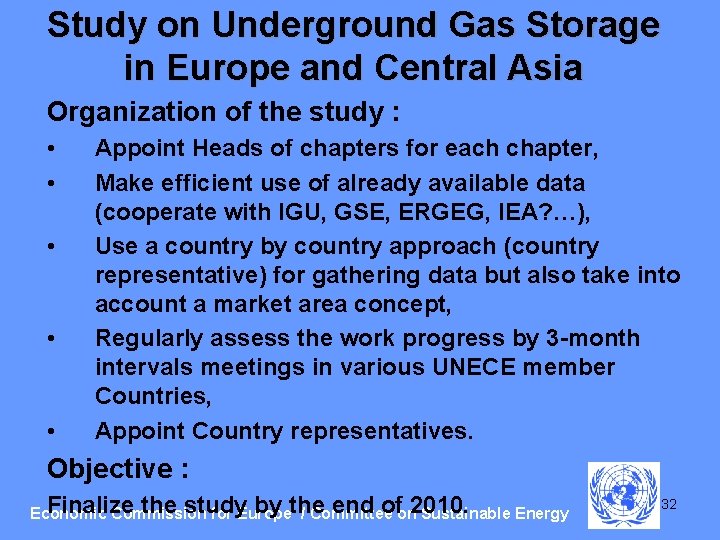
Study on Underground Gas Storage in Europe and Central Asia Organization of the study : • • • Appoint Heads of chapters for each chapter, Make efficient use of already available data (cooperate with IGU, GSE, ERGEG, IEA? …), Use a country by country approach (country representative) for gathering data but also take into account a market area concept, Regularly assess the work progress by 3 -month intervals meetings in various UNECE member Countries, Appoint Country representatives. Objective : Finalize the study by the end of 2010. Economic Commission for Europe / Committee on Sustainable Energy 32
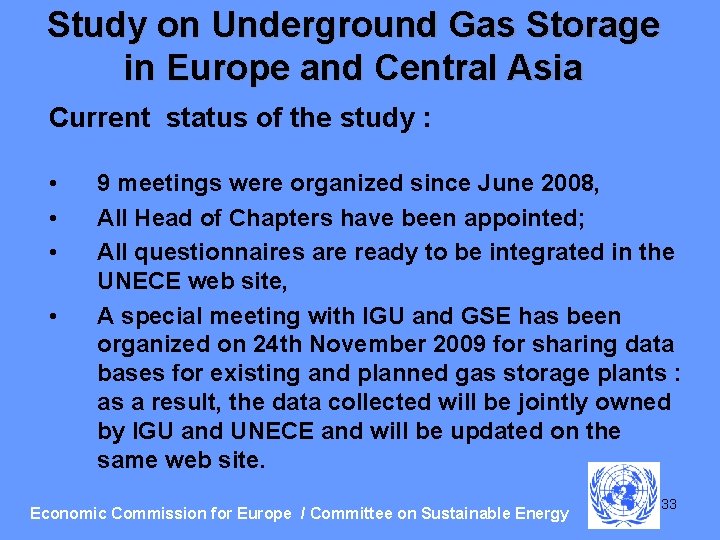
Study on Underground Gas Storage in Europe and Central Asia Current status of the study : • • 9 meetings were organized since June 2008, All Head of Chapters have been appointed; All questionnaires are ready to be integrated in the UNECE web site, A special meeting with IGU and GSE has been organized on 24 th November 2009 for sharing data bases for existing and planned gas storage plants : as a result, the data collected will be jointly owned by IGU and UNECE and will be updated on the same web site. Economic Commission for Europe / Committee on Sustainable Energy 33
Study on Underground Gas Storage in Europe and Central Asia Conclusion • • Since the study was presented to the UNECE / Working Party on Gas on 20 th January 2009, significant progress have been made, particulary by finalizing questionnaires and by strenghtening the cooperation with IGU and GSE, The first results of the study could be available at the end of the year 2010 and a first be presented to the next WP on Gas session (and a final report at mid 2011) But, for proceeding, • we need manpower for supporting the Heads of chapters, • we need representatives in each UNECE member country (in public bodies or companies). Economic Commission for Europe / Committee on Sustainable Energy 34
Study on Underground Gas Storage in Europe and Central Asia Thanks for your attention Economic Commission for Europe / Committee on Sustainable Energy 35