State of Art of LaserPlasma Accelerators Victor Malka
- Slides: 37
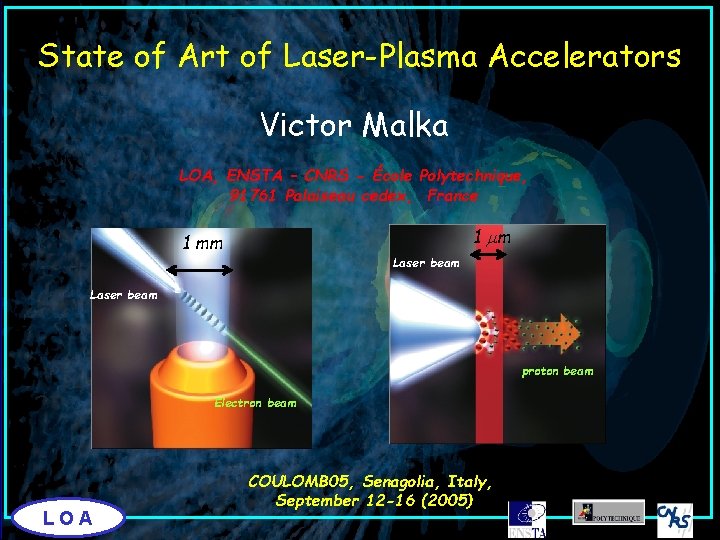
State of Art of Laser-Plasma Accelerators Victor Malka LOA, ENSTA – CNRS - École Polytechnique, 91761 Palaiseau cedex, France 1 mm Laser beam proton beam Electron beam LOA COULOMB 05, Senagolia, Italy, September 12 -16 (2005)
SPL ELF Particle group Laser group F. Ewald J. Faure Y. Glinec A. Lifschitz J. J. Santos F. Burgy B. Mercier J. Ph. Rousseau Collaborators A. Pukhov, University of Dusseldorf, Germany E. Lefebvre, CEA/DAM Ile-de-France, France LOA Supported by EEC under FP 6 : CARE
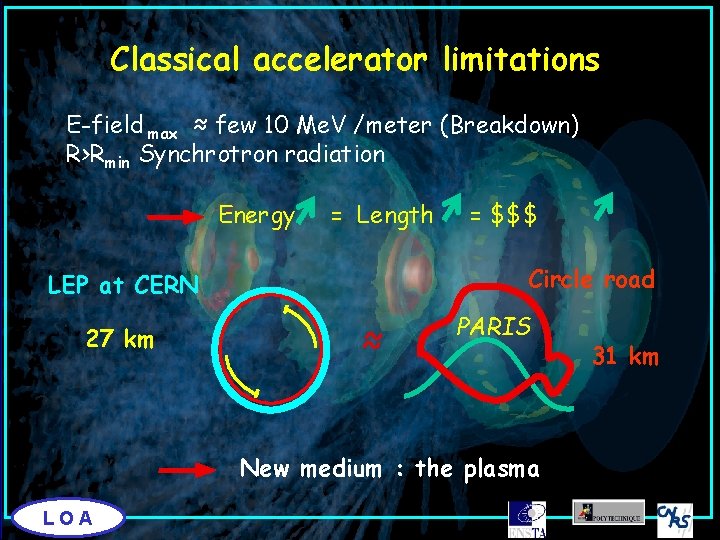
Classical accelerator limitations E-field max ≈ few 10 Me. V /meter (Breakdown) R>Rmin Synchrotron radiation Energy = Length Circle road LEP at CERN 27 km = $$$ ≈ PARIS New medium : the plasma LOA 31 km
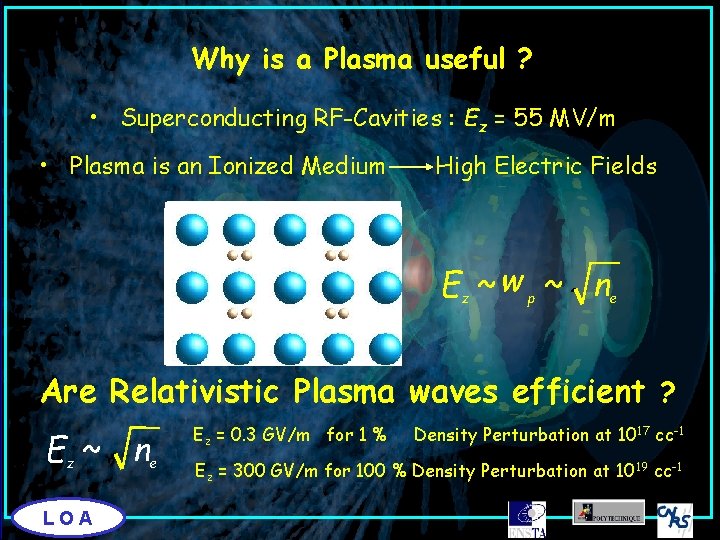
Why is a Plasma useful ? • Superconducting RF-Cavities : Ez = 55 MV/m • Plasma is an Ionized Medium High Electric Fields Ez ~ w p ~ ne Are Relativistic Plasma waves efficient ? Ez ~ ne LOA Ez = 0. 3 GV/m for 1 % Density Perturbation at 1017 cc-1 Ez = 300 GV/m for 100 % Density Perturbation at 1019 cc-1
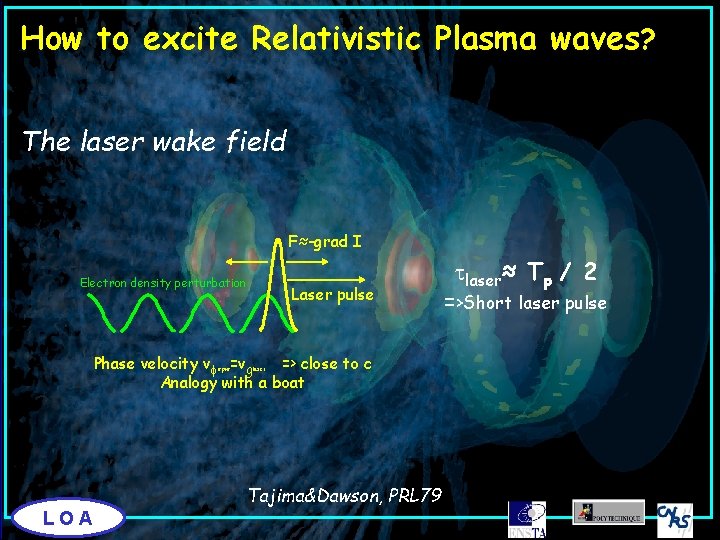
How to excite Relativistic Plasma waves? The laser wake field F≈-grad I Electron density perturbation Laser pulse Phase velocity vfepw=vg => close to c Analogy with a boat laser Tajima&Dawson, PRL 79 LOA tlaser≈ Tp / 2 =>Short laser pulse
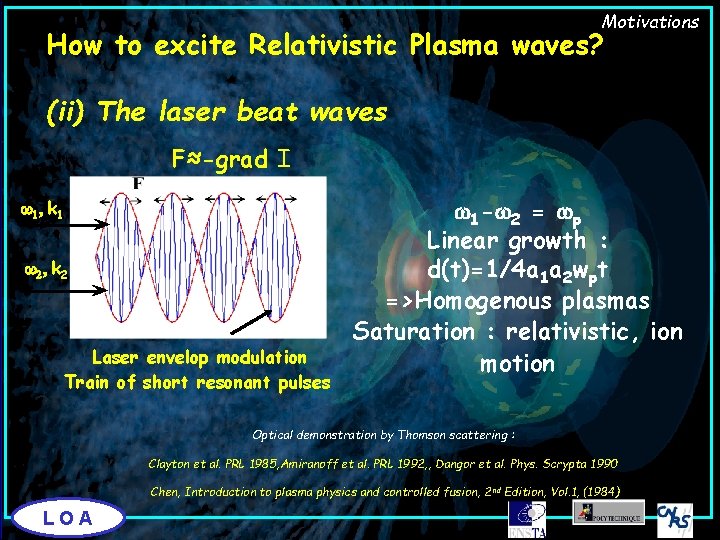
Motivations How to excite Relativistic Plasma waves? (ii) The laser beat waves F≈-grad I k k 2 Laser envelop modulation Train of short resonant pulses 1 - 2 = p Linear growth : d(t)=1/4 a 1 a 2 wpt =>Homogenous plasmas Saturation : relativistic, ion motion Optical demonstration by Thomson scattering : Clayton et al. PRL 1985, Amiranoff et al. PRL 1992, , Dangor et al. Phys. Scrypta 1990 Chen, Introduction to plasma physics and controlled fusion, 2 nd Edition, Vol. 1, (1984) LOA
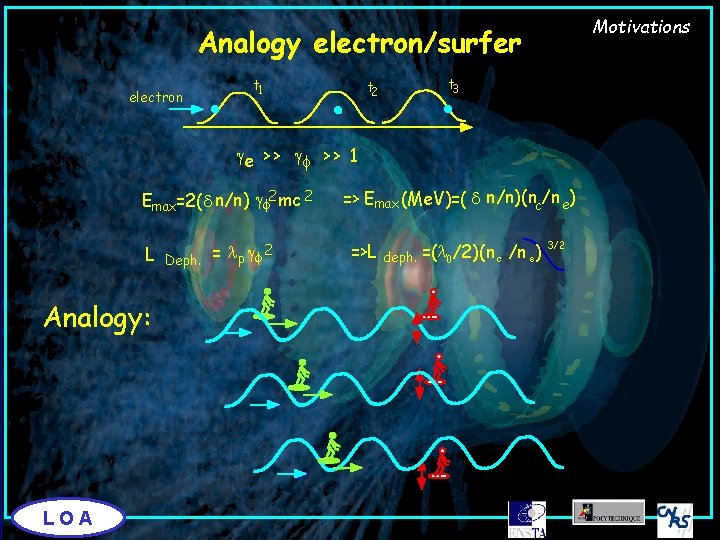
Motivations Analogy electron/surfer electron t 1 t 3 t 2 ge > > gf > > 1 Emax=2(d n/n) gf 2 mc 2 L Analogy: LOA Deph. = l p gf 2 => Emax (Me. V)=( d n/n)(nc/n e) =>L deph. =(l 0/2)(n c /n e) 3/2
Motivations LOA
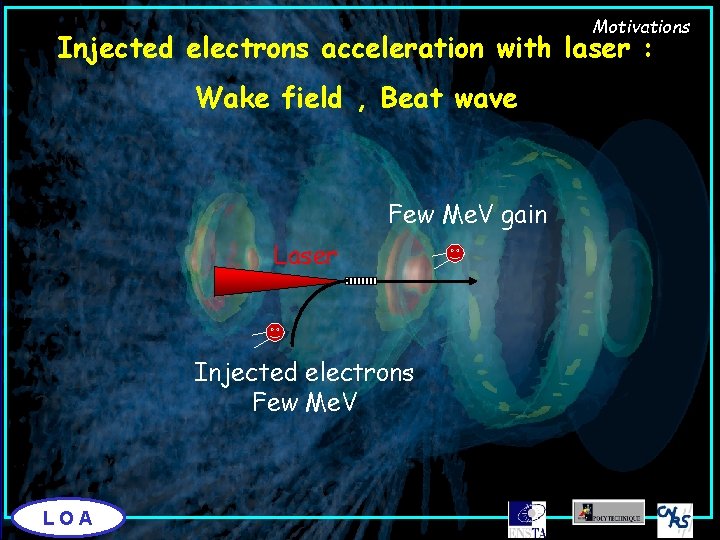
Motivations Injected electrons acceleration with laser : Wake field , Beat wave Few Me. V gain Laser Injected electrons Few Me. V LOA
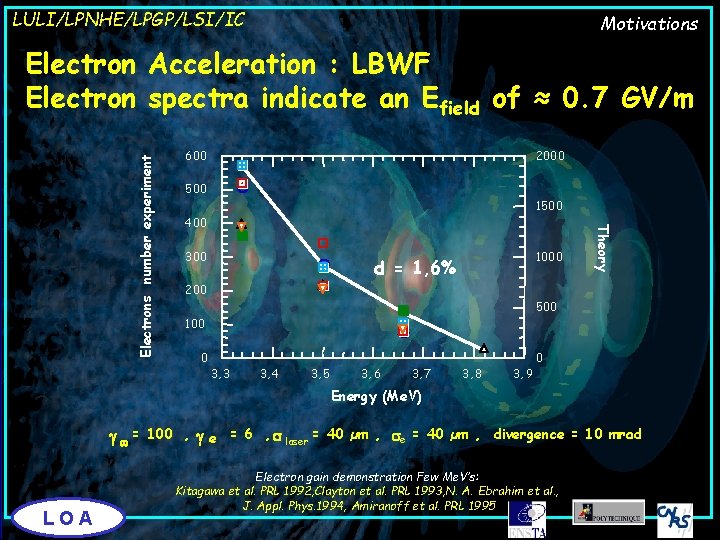
LULI/LPNHE/LPGP/LSI/IC Motivations 600 2000 500 1500 400 300 1000 d = 1, 6% Theory Electrons number experiment Electron Acceleration : LBWF Electron spectra indicate an Efield of ≈ 0. 7 GV/m 200 500 100 0 3, 3 3, 4 3, 5 3, 6 3, 7 3, 8 3, 9 0 Energy (Me. V) g = LOA 100 , ge = 6 , s laser = 40 µm , se = 40 µm , divergence = 10 mrad Electron gain demonstration Few Me. V’s: Kitagawa et al. PRL 1992, Clayton et al. PRL 1993, N. A. Ebrahim et al. , J. Appl. Phys. 1994, Amiranoff et al. PRL 1995
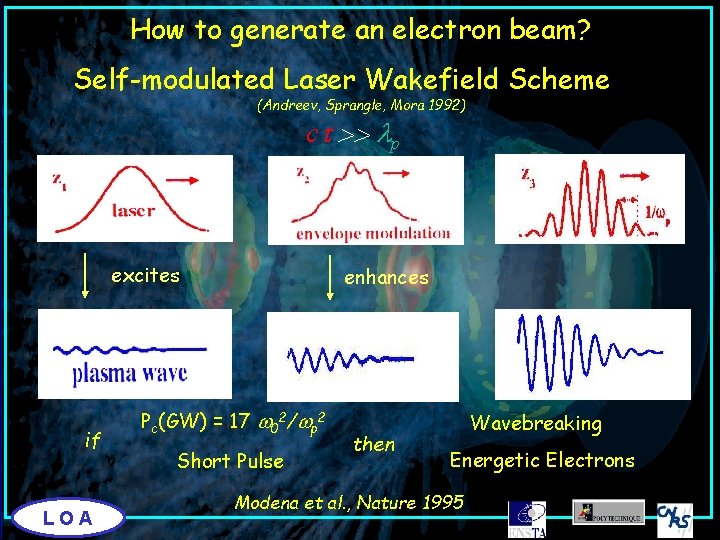
How to generate an electron beam? Self-modulated Laser Wakefield Scheme (Andreev, Sprangle, Mora 1992) ct >> lp excites if LOA enhances Pc(GW) = 17 w 02/wp 2 Short Pulse then Wavebreaking Energetic Electrons Modena et al. , Nature 1995
Wave breaking : from waves to particles LOA
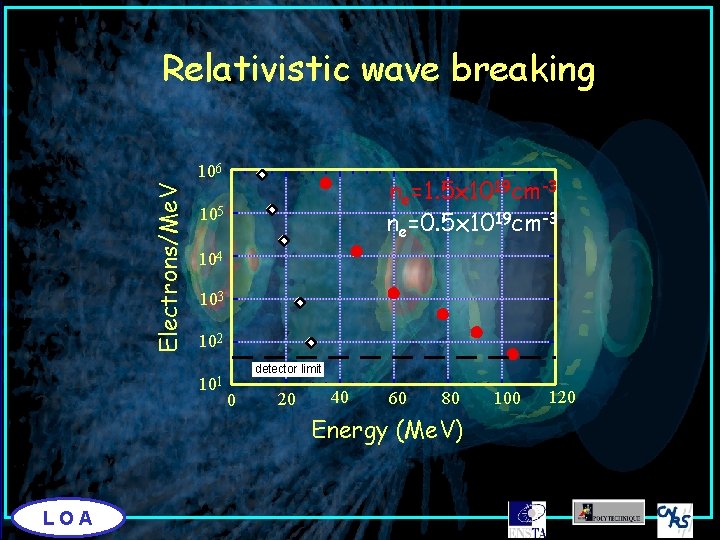
Relativistic wave breaking Electrons/Me. V 106 ne=1. 5 x 1019 cm-3 ne=0. 5 x 1019 cm-3 105 104 103 102 101 detector limit 0 20 40 60 80 Energy (Me. V) LOA 100 120
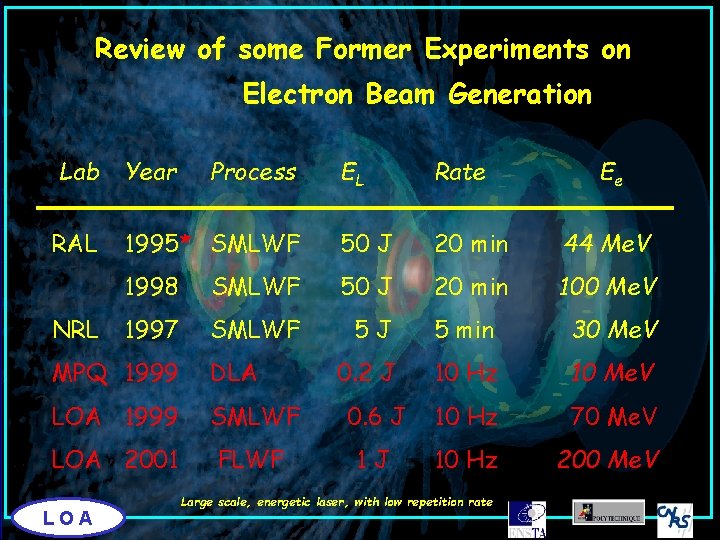
Review of some Former Experiments on Electron Beam Generation Lab Year RAL NRL Process EL Rate Ee 1995* SMLWF 50 J 20 min 44 Me. V 1998 SMLWF 50 J 20 min 100 Me. V 1997 SMLWF 5 J 5 min 30 Me. V 0. 2 J 10 Hz 10 Me. V MPQ 1999 DLA LOA 1999 SMLWF 0. 6 J 10 Hz 70 Me. V LOA 2001 FLWF 1 J 10 Hz 200 Me. V LOA Large scale, energetic laser, with low repetition rate
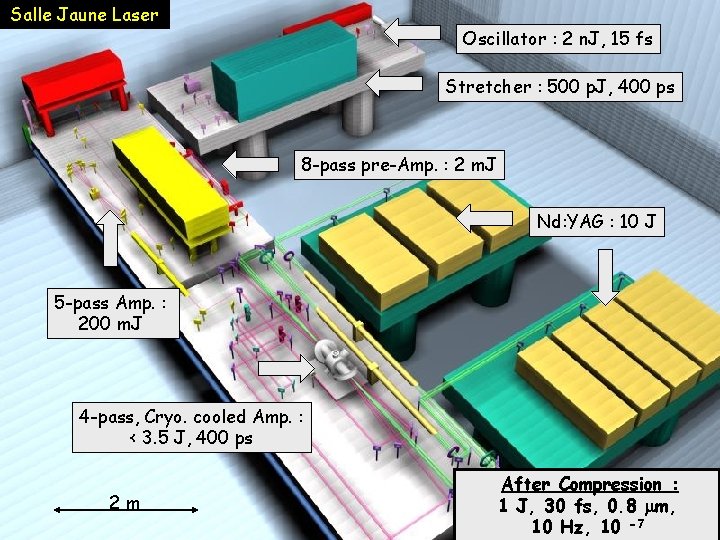
Salle Jaune Laser Oscillator : 2 n. J, 15 fs Stretcher : 500 p. J, 400 ps 8 -pass pre-Amp. : 2 m. J Nd: YAG : 10 J 5 -pass Amp. : 200 m. J 4 -pass, Cryo. cooled Amp. : < 3. 5 J, 400 ps LOA 2 m After Compression : 1 J, 30 fs, 0. 8 mm, 10 Hz, 10 -7
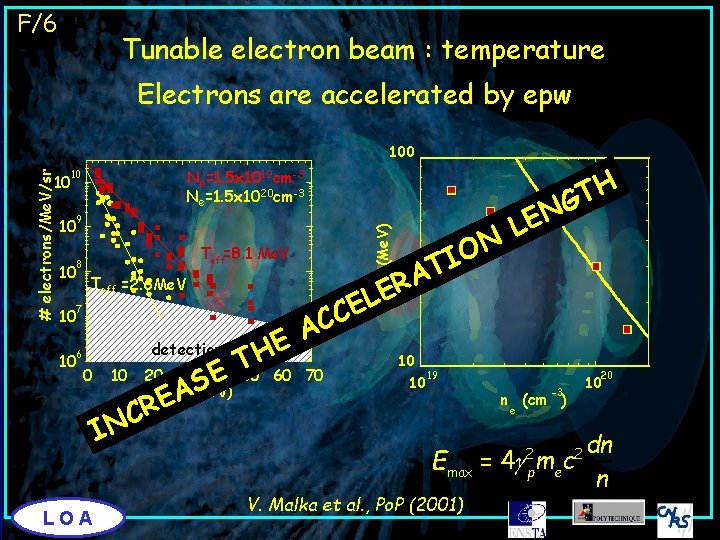
F/6 Tunable electron beam : temperature Electrons are accelerated by epw Teff =2. 6 Me. V C A E detection threshold H 10 T 0 10 20 30 40 50 60 70 E S WA(Me. V) E R C IN 7 10 6 LOA N O I N E L T A R E L CE max 8 Teff=8. 1 Me. V (Me. V) 9 10 10 H T G Ne=1. 5 x 1019 cm-3 Ne=1. 5 x 1020 cm-3 10 10 E # electrons/Me. V/sr 100 10 19 10 20 10 -3 n (cm ) e dn E max = 4 g mec n V. Malka et al. , Po. P (2001) 2 p 2
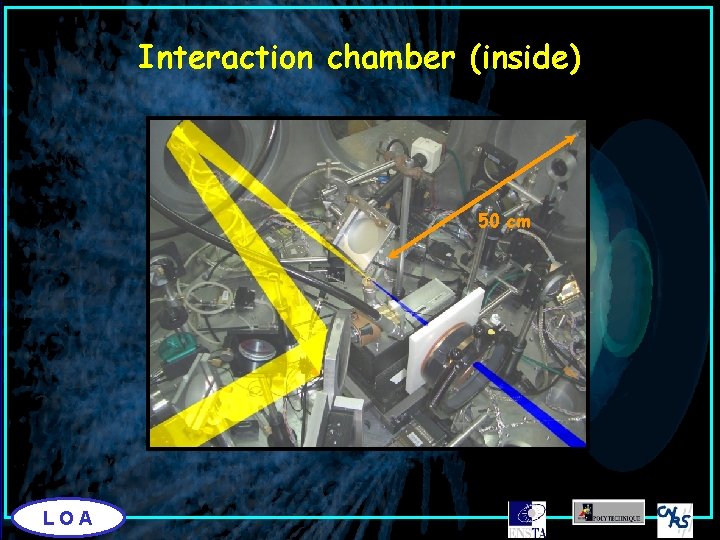
Interaction chamber (inside) 50 cm Laser beam electron beam LOA
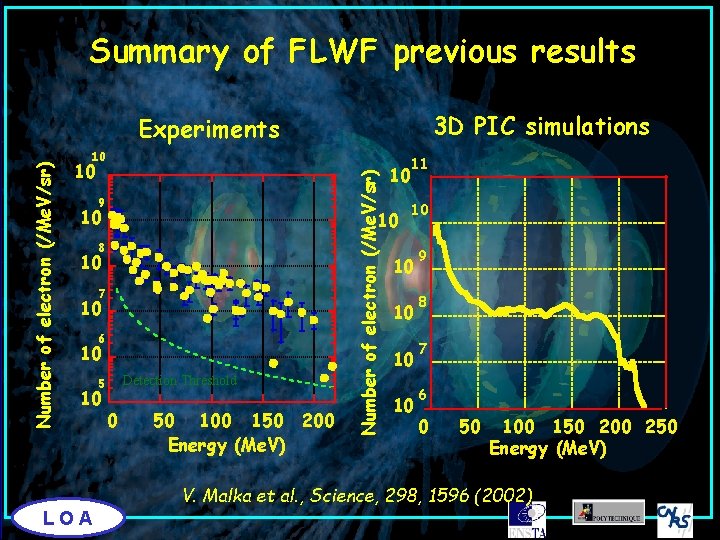
Summary of FLWF previous results 3 D PIC simulations 10 10 9 10 10 10 8 10 7 10 6 10 Detection Threshold 5 10 Number of electron (/Me. V/sr) Experiments 0 50 100 150 200 Energy (Me. V) 11 10 10 10 9 8 7 6 0 50 100 150 200 250 Energy (Me. V) V. Malka et al. , Science, 298, 1596 (2002) LOA
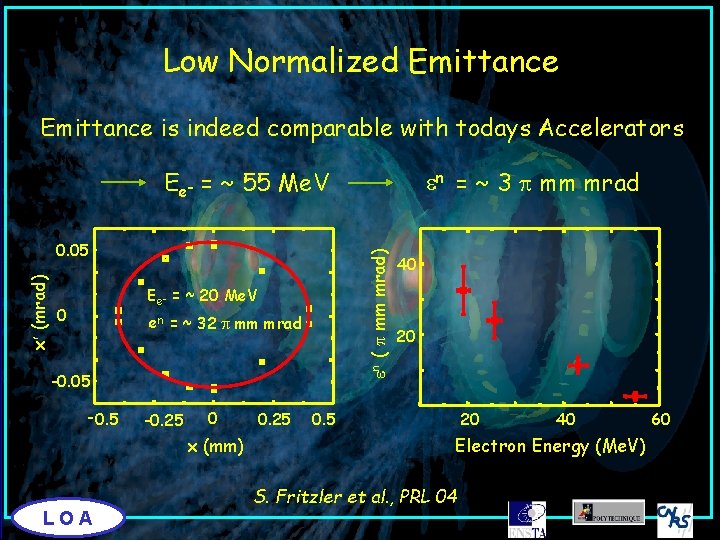
Low Normalized Emittance is indeed comparable with todays Accelerators n = ~ 3 mm mrad Ee- = ~ 55 Me. V n ( mm mrad) x (mrad) 0. 05 Ee- = ~ 20 Me. V 0 en = ~ 32 mm mrad -0. 05 - 0. 5 -0. 25 0 x (mm) LOA 0. 25 40 20 0. 5 20 40 Electron Energy (Me. V) S. Fritzler et al. , PRL 04 60
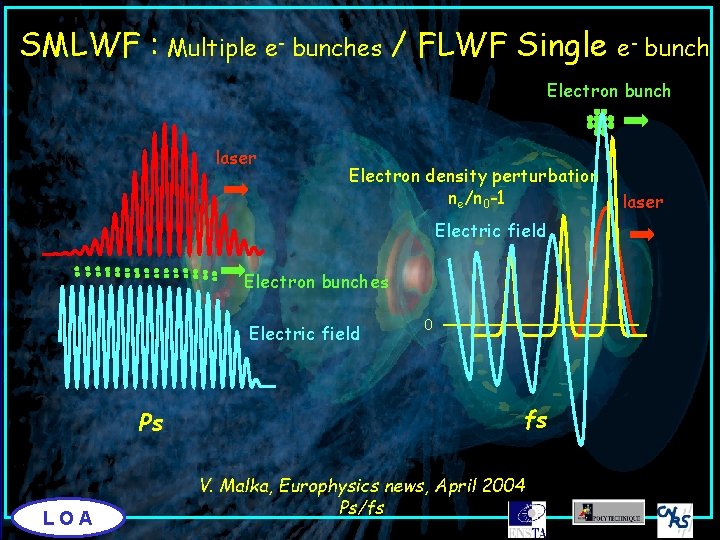
SMLWF : Multiple e- bunches / FLWF Single e- bunch Electron bunch laser Electron density perturbation ne/n 0 -1 Electric field Electron bunches Electric field Ps LOA 0 fs V. Malka, Europhysics news, April 2004 Ps/fs laser
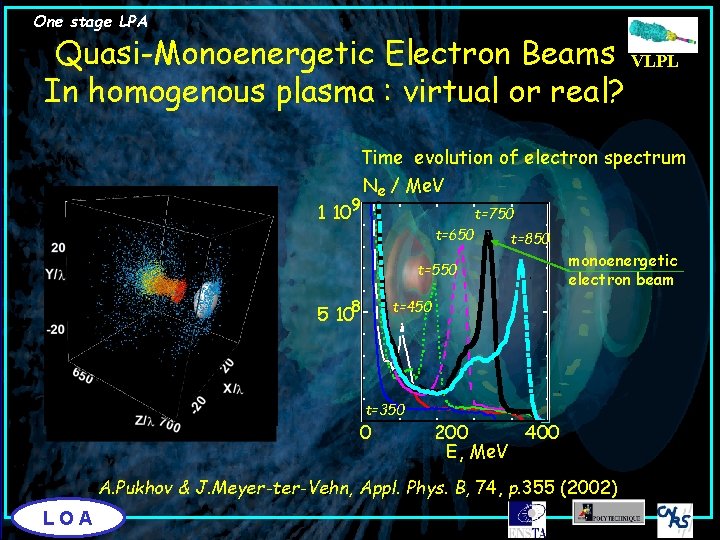
One stage LPA Quasi-Monoenergetic Electron Beams VLPL In homogenous plasma : virtual or real? Time evolution of electron spectrum Ne / Me. V 1 109 t=750 t=650 t=850 t=550 5 108 monoenergetic electron beam t=450 t=350 0 200 400 E, Me. V A. Pukhov & J. Meyer-ter-Vehn, Appl. Phys. B, 74, p. 355 (2002) LOA
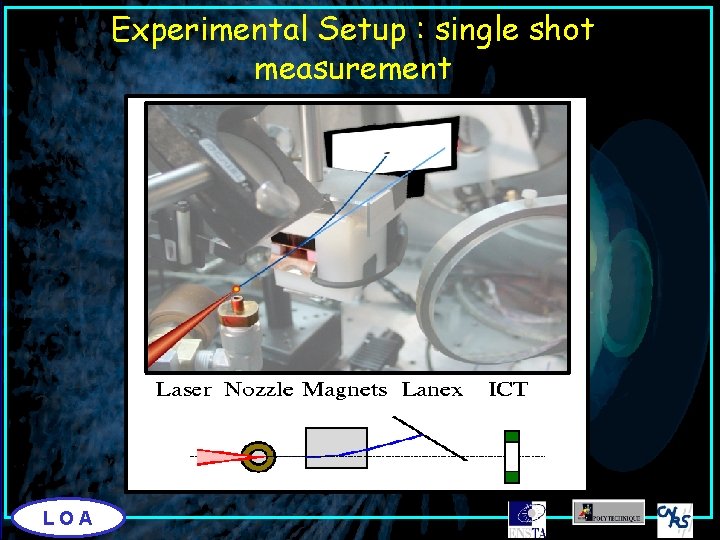
Experimental Setup : single shot measurement LOA
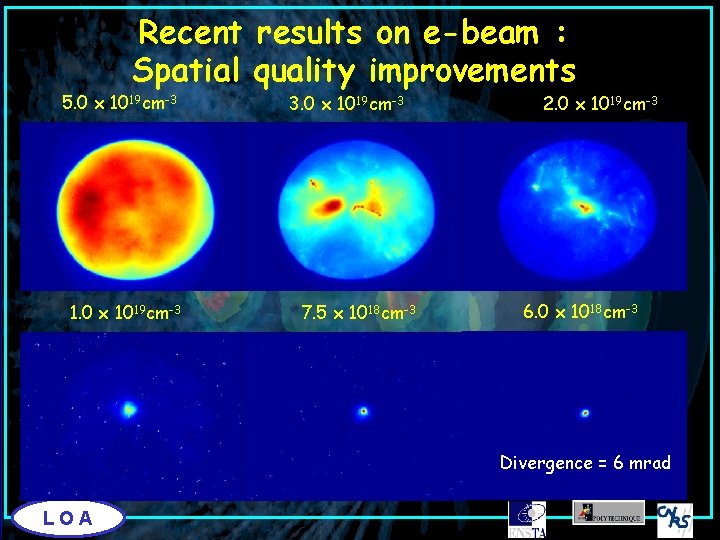
Recent results on e-beam : Spatial quality improvements 5. 0 x 1019 cm-3 1. 0 x 1019 cm-3 3. 0 x 1019 cm-3 7. 5 x 1018 cm-3 2. 0 x 1019 cm-3 6. 0 x 1018 cm-3 Divergence = 6 mrad LOA
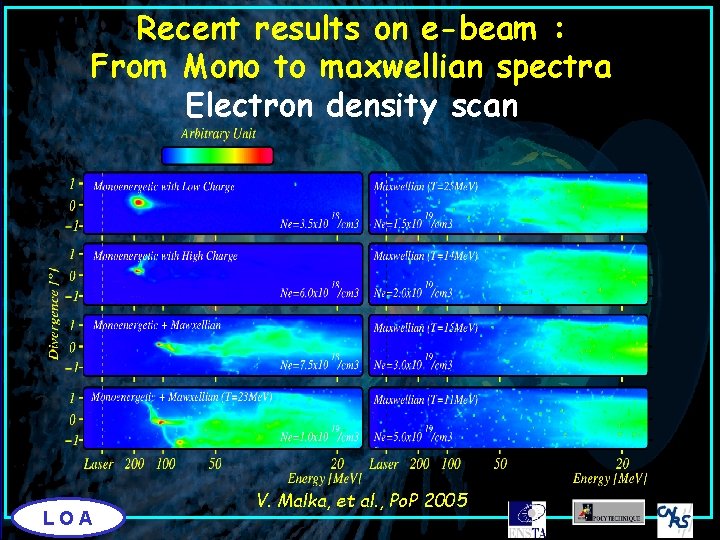
Recent results on e-beam : From Mono to maxwellian spectra Electron density scan LOA V. Malka, et al. , Po. P 2005
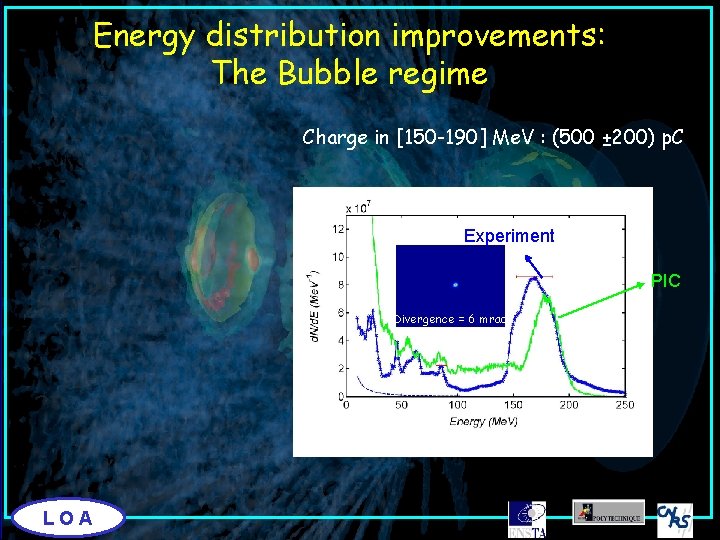
Energy distribution improvements: The Bubble regime Charge in [150 -190] Me. V : (500 ± 200) p. C Experiment PIC Divergence = 6 mrad LOA
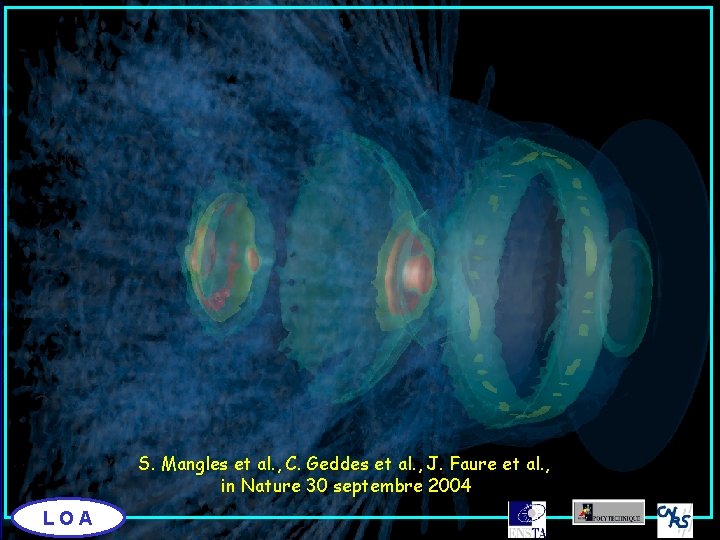
S. Mangles et al. , C. Geddes et al. , J. Faure et al. , in Nature 30 septembre 2004 LOA
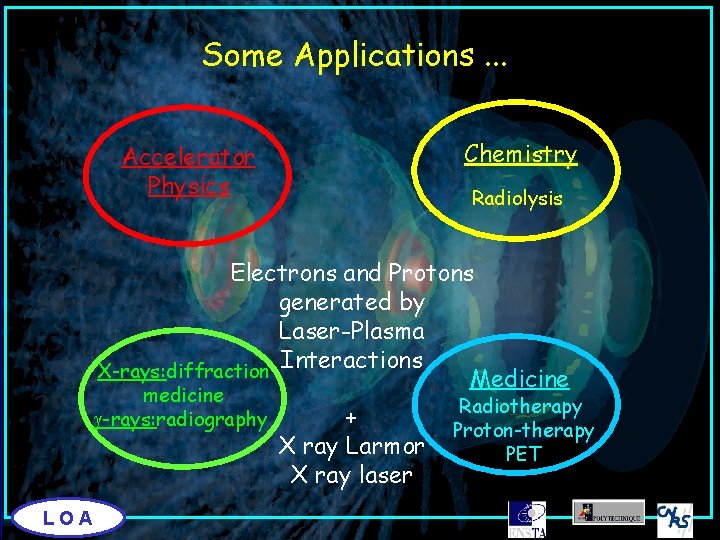
Some Applications. . . Chemistry Accelerator Physics Radiolysis Electrons and Protons generated by Laser-Plasma Interactions X-rays: diffraction Medicine medicine g-rays: radiography LOA + X ray Larmor X ray laser Radiotherapy Proton-therapy PET
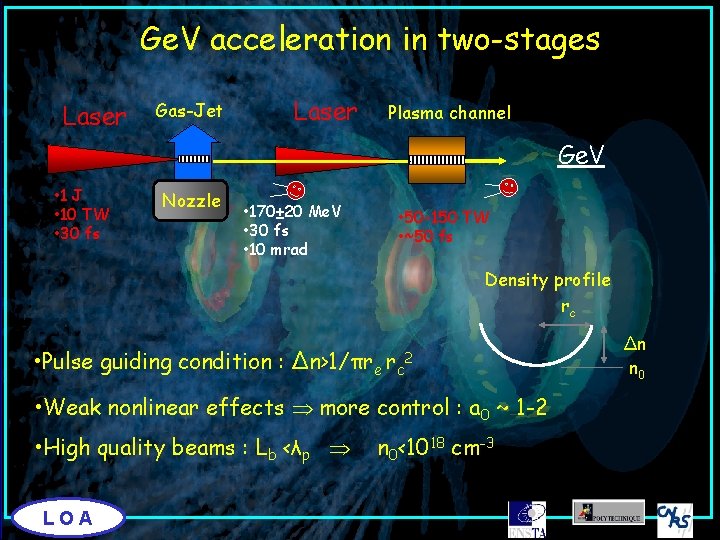
Ge. V acceleration in two-stages Laser Gas-Jet Laser Plasma channel Ge. V • 1 J • 10 TW • 30 fs Nozzle • 170± 20 Me. V • 30 fs • 10 mrad • 50 -150 TW • ~50 fs Density profile rc • Pulse guiding condition : Δn>1/πre rc 2 • Weak nonlinear effects more control : a 0 ~ 1 -2 • High quality beams : Lb <λp LOA n 0<1018 cm-3 Δn n 0
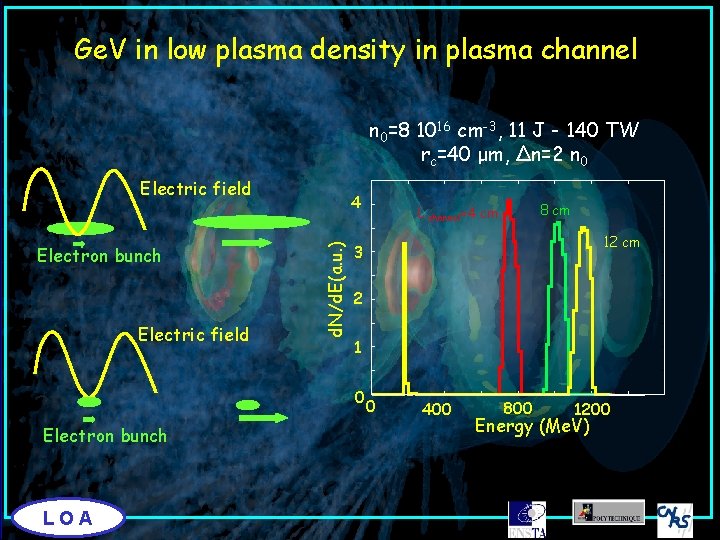
Ge. V in low plasma density in plasma channel n 0=8 1016 cm-3, 11 J - 140 TW rc=40 μm, Δn=2 n 0 Electric field d. N/d. E(a. u. ) Electron bunch 4 LOA 12 cm 3 2 1 0 Electron bunch 8 cm L channel=4 cm 0 400 800 1200 Energy (Me. V)
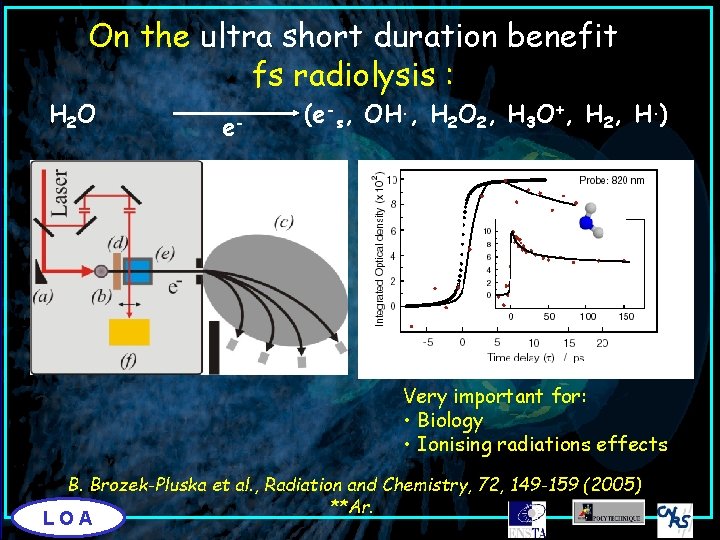
On the ultra short duration benefit fs radiolysis : H 2 O e- (e-s, OH. , H 2 O 2, H 3 O+, H 2, H. ) Very important for: • Biology • Ionising radiations effects B. Brozek-Pluska et al. , Radiation and Chemistry, 72, 149 -159 (2005) **Ar. LOA
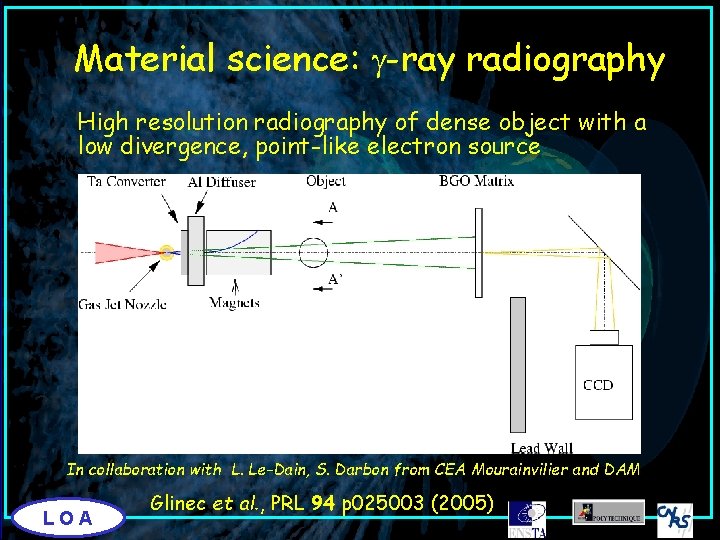
Material science: g-ray radiography High resolution radiography of dense object with a low divergence, point-like electron source In collaboration with L. Le-Dain, S. Darbon from CEA Mourainvilier and DAM LOA Glinec et al. , PRL 94 p 025003 (2005)
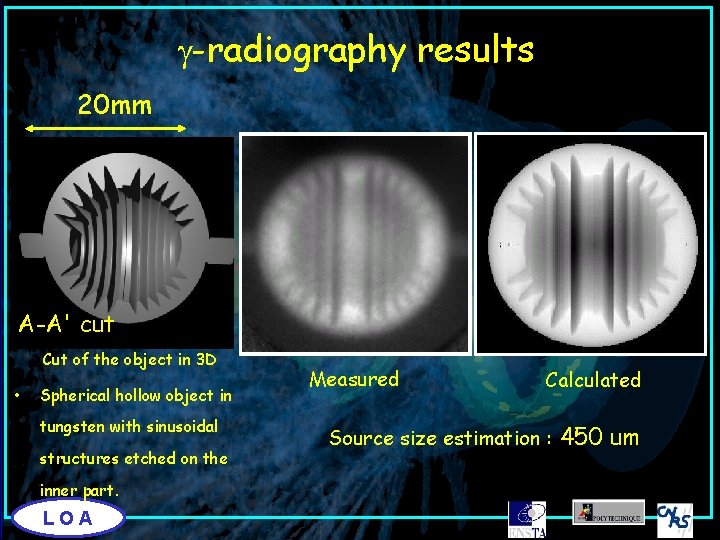
g-radiography results 20 mm A-A' cut Cut of the object in 3 D • Spherical hollow object in tungsten with sinusoidal structures etched on the inner part. LOA Measured Calculated Source size estimation : 450 um
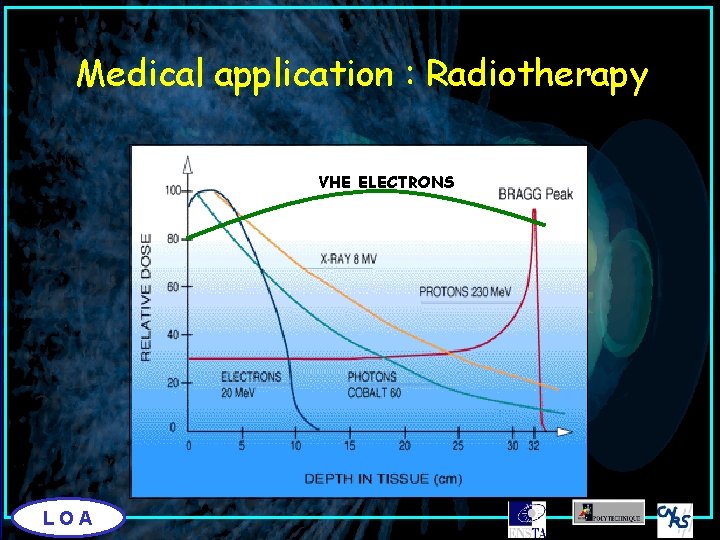
Medical application : Radiotherapy VHE ELECTRONS LOA
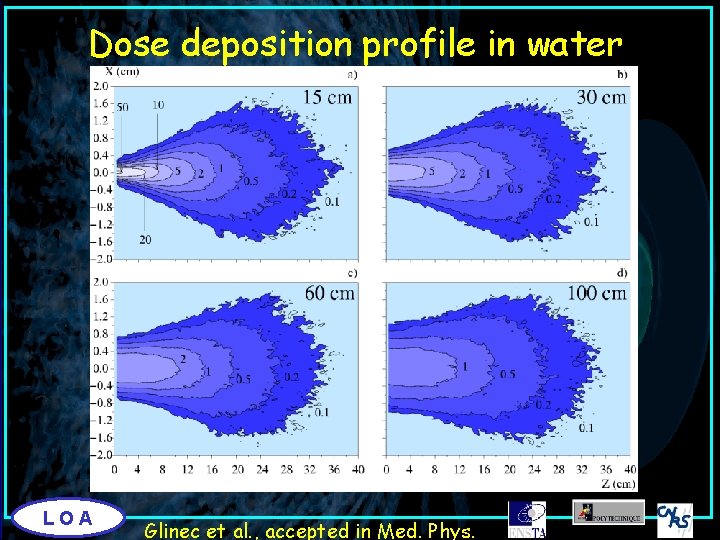
Dose deposition profile in water LOA Glinec et al. , accepted in Med. Phys.
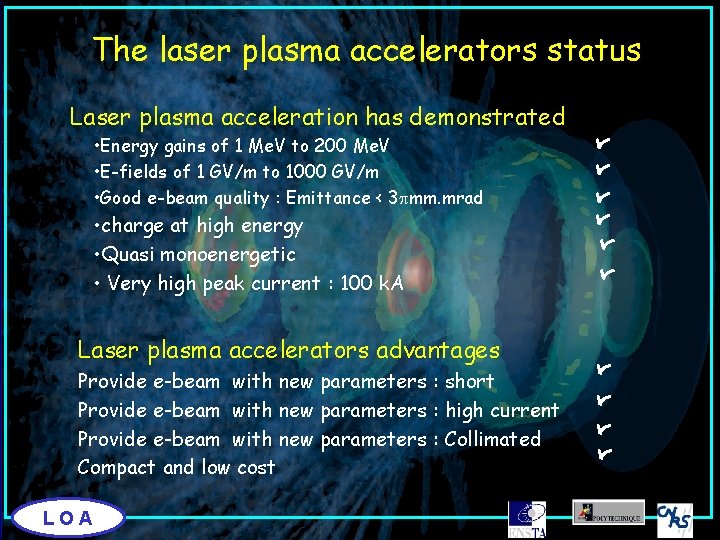
The laser plasma accelerators status Laser plasma acceleration has demonstrated • charge at high energy • Quasi monoenergetic • Very high peak current : 100 k. A Provide e-beam with new parameters : short Provide e-beam with new parameters : high current Provide e-beam with new parameters : Collimated Compact and low cost LOA ゝ ゝ Laser plasma accelerators advantages ゝ ゝ ゝ • Energy gains of 1 Me. V to 200 Me. V • E-fields of 1 GV/m to 1000 GV/m • Good e-beam quality : Emittance < 3 mm. mrad
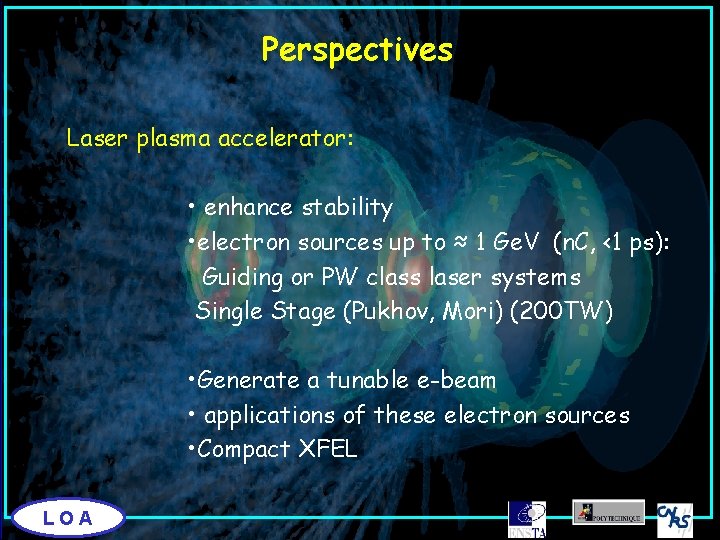
Perspectives Laser plasma accelerator: • enhance stability • electron sources up to ≈ 1 Ge. V (n. C, <1 ps): Guiding or PW class laser systems Single Stage (Pukhov, Mori) (200 TW) • Generate a tunable e-beam • applications of these electron sources • Compact XFEL LOA
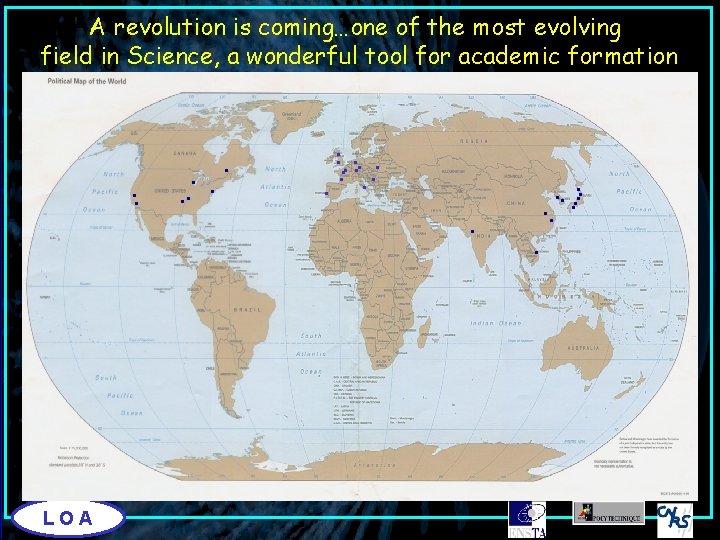
A revolution is coming…one of the most evolving field in Science, a wonderful tool for academic formation . . LOA . . . .