
STATE OF THE ART SOTA CONFERENCE ON ARABIC
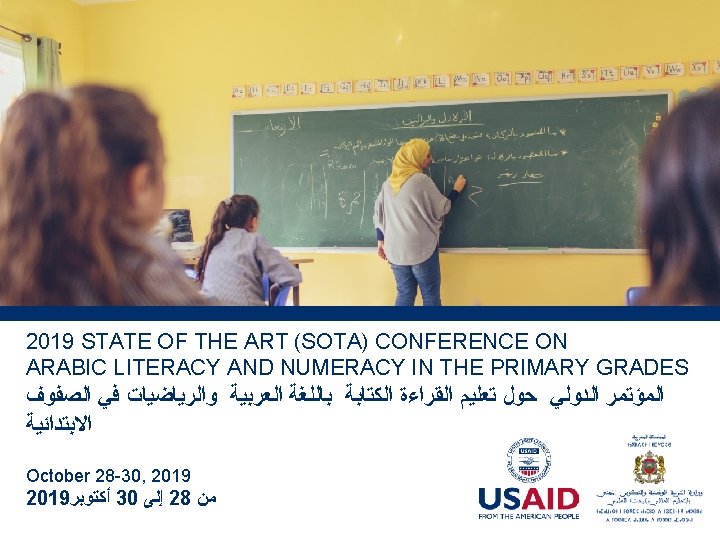
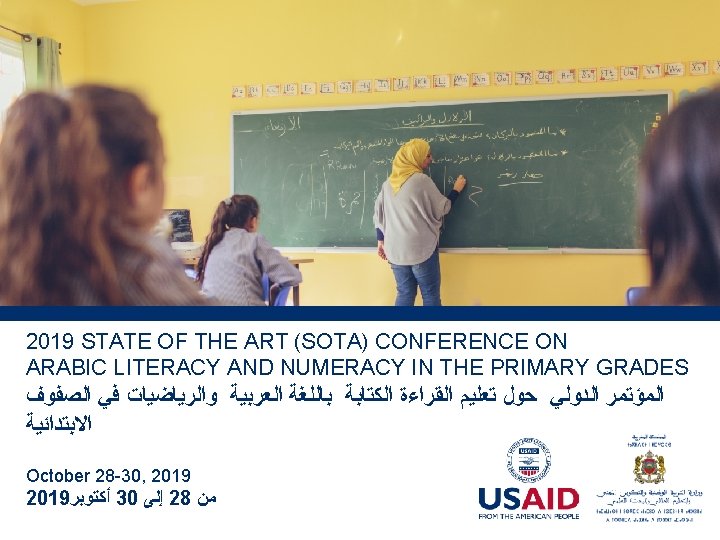
STATE OF THE ART (SOTA) CONFERENCE ON ARABIC LITERACY AND NUMERACY IN THE PRIMARY GRADES October 28 30, 2019 2

BACKGROUND & TIMELINE 9/29/2020 3
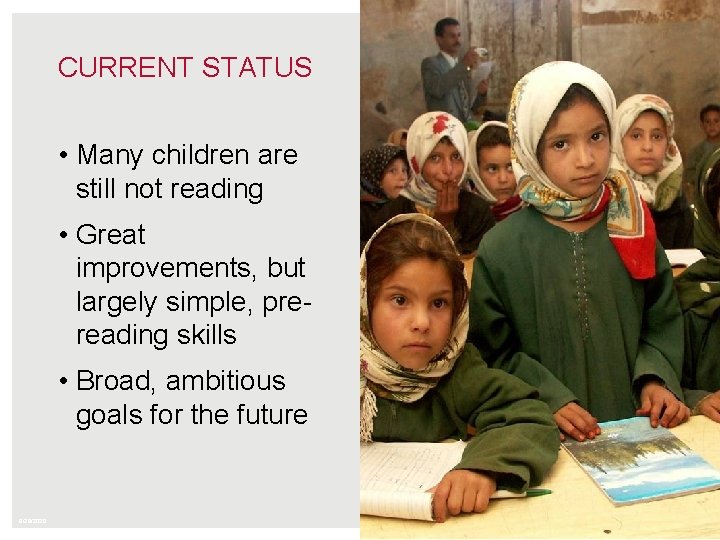
CURRENT STATUS • Many children are still not reading • Great improvements, but largely simple, pre reading skills • Broad, ambitious goals for the future 9/29/2020 4
CONFERENCE OBJECTIVES DAY 1 LEARNING OBJECTIVES: • Review recent progress in Arabic literacy and numeracy and opportunities for further progress. • Identify categories of marginalization and their barriers to learning. • Understand the application of the Universal Design for Learning framework in country contexts. • Begin charting next steps on literacy and numeracy reform within Country Teams. DAY 2 LEARNING OBJECTIVES: • Identify best practices in teacher professional development for pedagogy and instruction. • Use the Reading MATTERS framework to consider how country systems can continue to strengthen progress in primary grade literacy and numeracy. DAY 3 LEARNING OBJECTIVES: 9/29/2020 • Understand data and benchmarks in education reform and to scale and sustain successful programs. • Identify key takeaways from the SOTA and determine next steps as Country 5
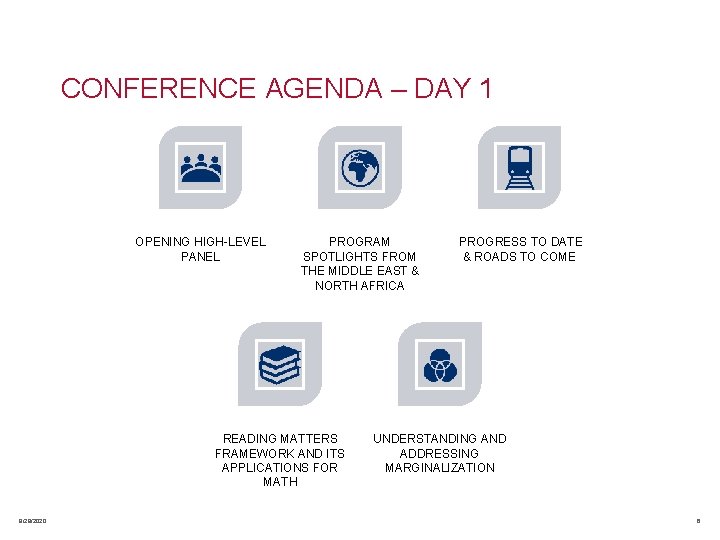
CONFERENCE AGENDA – DAY 1 OPENING HIGH LEVEL PANEL PROGRAM SPOTLIGHTS FROM THE MIDDLE EAST & NORTH AFRICA READING MATTERS FRAMEWORK AND ITS APPLICATIONS FOR MATH 9/29/2020 PROGRESS TO DATE & ROADS TO COME UNDERSTANDING AND ADDRESSING MARGINALIZATION 6
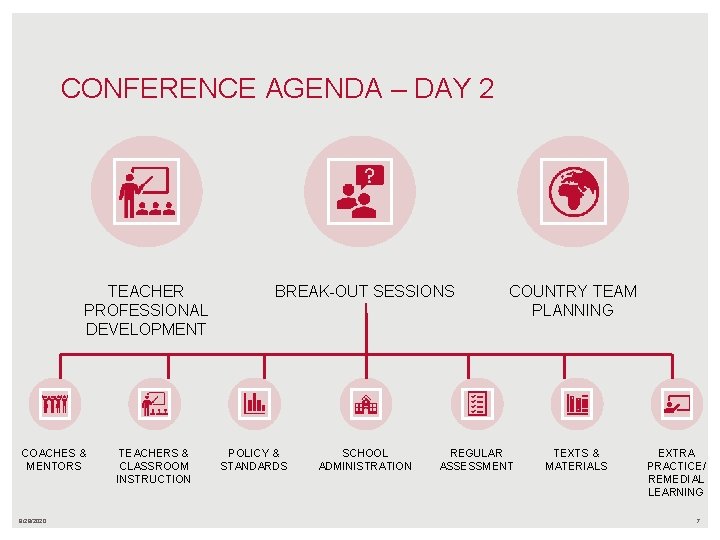
CONFERENCE AGENDA – DAY 2 TEACHER PROFESSIONAL DEVELOPMENT COACHES & MENTORS 9/29/2020 TEACHERS & CLASSROOM INSTRUCTION BREAK OUT SESSIONS POLICY & STANDARDS SCHOOL ADMINISTRATION COUNTRY TEAM PLANNING REGULAR ASSESSMENT TEXTS & MATERIALS EXTRA PRACTICE/ REMEDIAL LEARNING 7
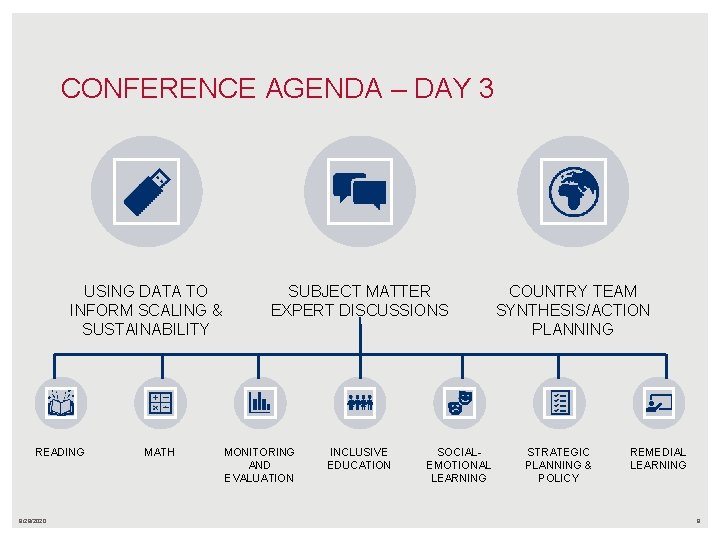
CONFERENCE AGENDA – DAY 3 USING DATA TO INFORM SCALING & SUSTAINABILITY READING 9/29/2020 MATH SUBJECT MATTER EXPERT DISCUSSIONS MONITORING AND EVALUATION INCLUSIVE EDUCATION SOCIAL EMOTIONAL LEARNING COUNTRY TEAM SYNTHESIS/ACTION PLANNING STRATEGIC PLANNING & POLICY REMEDIAL LEARNING 8
KEYNOTE PRESENTATION PROGRESS TO DATE & ROADS TO COME 2019 State of the Art (SOTA) Conference on Arabic Literacy and Numeracy in the Primary Grades Helen N. Boyle, Ph. D. October 28, 2019 9/29/2020`1 FOOTER GOES HERE 10
RESEARCH QUESTIONS Research Question 1 (RQ 1): What do the research based literature and existing assessment data say about teaching and learning literacy and numeracy with a variety of learning groups across the Arabic speaking countries in the Middle East and North Africa (MENA) region today? Research Question 2 (RQ 2): What is the current level of early grade reading (EGR) and early grade math (EGM) performance in Arabic speaking MENA countries according to targets (boys, girls, students in or out of school, marginalized, etc. )? 9/29/2020 11
EARLY GRADE LITERACY RQ 1: What do the research based literature and existing assessment data say about teaching and learning literacy with a variety of learning groups across the Arabic speaking countries in the MENA region today? 9/29/2020 12
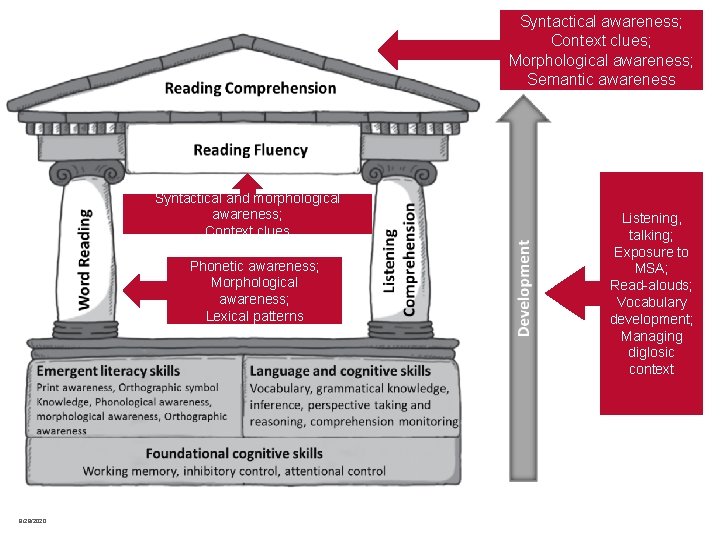
Syntactical awareness; Context clues; Morphological awareness; Semantic awareness Syntactical and morphological awareness; Context clues Phonetic awareness; Morphological awareness; Lexical patterns 9/29/2020 Listening, talking; Exposure to MSA; Read alouds; Vocabulary development; Managing diglosic context 13
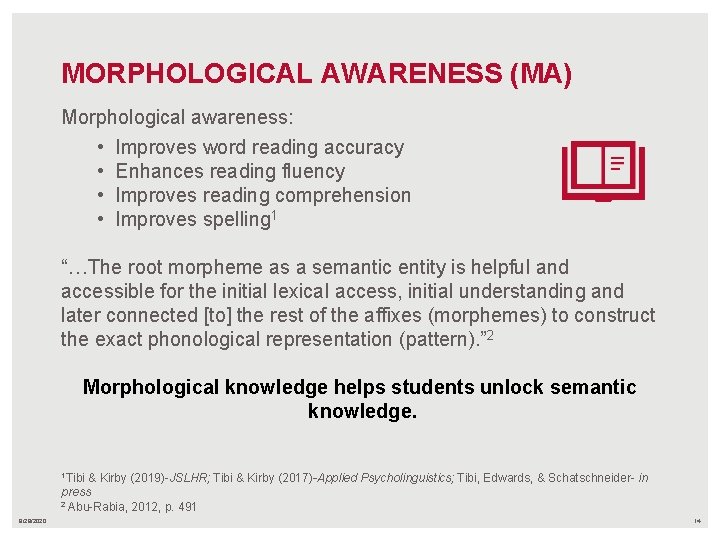
MORPHOLOGICAL AWARENESS (MA) Morphological awareness: • Improves word reading accuracy • Enhances reading fluency • Improves reading comprehension • Improves spelling 1 “…The root morpheme as a semantic entity is helpful and accessible for the initial lexical access, initial understanding and later connected [to] the rest of the affixes (morphemes) to construct the exact phonological representation (pattern). ” 2 Morphological knowledge helps students unlock semantic knowledge. 1 Tibi & Kirby (2019) JSLHR; Tibi & Kirby (2017)-Applied Psycholinguistics; Tibi, Edwards, & Schatschneider in press 2 Abu Rabia, 2012, p. 491 9/29/2020 14
INSTRUCTIONAL IMPLICATIONS Shalhoub Awwad and Leikin assert: “It is likely that the novice Arabic reader needs an additional reading strategy, the root morpheme, due to the lexical/phonological distance between the spoken and written Arabic” (2016, p. 306). Tibi & Kirby (2018) recommend the following: • Teach morphology explicitly and systematically • Teach oral and written morphology • Reading textbooks should include more words from the same root 9/29/2020 • Use words that belong to productive roots • Focus on high frequency root type • Embed morphology it in literacy activities • Teach teachers about morphology and the roots of words 15
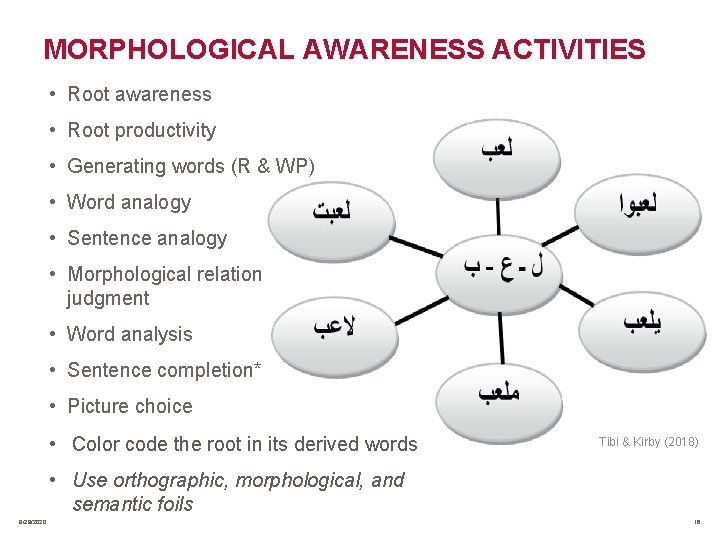
MORPHOLOGICAL AWARENESS ACTIVITIES • Root awareness • Root productivity • Generating words (R & WP) • Word analogy • Sentence analogy • Morphological relation judgment • Word analysis • Sentence completion* • Picture choice • Color code the root in its derived words Tibi & Kirby (2018) • Use orthographic, morphological, and semantic foils 9/29/2020 16
EARLY GRADE NUMERACY RQ 1: What do the research based literature and existing assessment data say about teaching and learning numeracy with a variety of learning groups across the Arabic speaking countries in the MENA region today? 9/29/2020 17
CONTENT STANDARDS: what is taught “Almost all early grade math curricula in the region share the same content domains including numbers, geometry, algebra, measurement, and probability and statistics, although with different levels of emphasis, ” (Matar, 2013, p. 11). The National Council of Mathematics likewise lists the key content areas as: number & operations, algebra, geometry, measurement, data analysis and probability. 9/29/2020 18
PROCESS STANDARDS: How Content Is Taught The backbone of sound pedagogical practices in mathematics: 1 1. Understanding 2. Computing 3. Applying 4. Reasoning 5. En gaging The National Council of Mathematics articulates similar process standards: problem solving, reasoning & proof, communication, connections, and representation. 1 Matar, 9/29/2020 2013, p. 15 19
EARLY GRADEs LITERACY AND NUMERACY RQ 2: What is the current level of EGR and EGM performance in Arabic speaking MENA countries according to targets (boys, girls, students in or out of school, marginalized, etc. )? 9/29/2020 20
CURRENT FINDINGS: MENA Region Most Progress • • • letter sound identification simple word reading number identification quantity discrimination simple addition and subtraction • greater availability of literacy resources • more attention to literacy and numeracy instruction for children with special needs 9/29/2020 Least Progress • • • oral reading fluency reading comprehension listening comprehension number pattern identification more complex addition and subtraction operations • word problems • providing opportunities for high quality early grade reading and numeracy education for children both in conflict and crisis contexts and with disabilities. 21
CROSS CUTTING CHALLENGES • Teacher preparation/classroom instruction • Teacher confidence to teach harder skills like comprehension or word problems • Lack of supplemental reading books and math manipulables • Lack of policies defining special needs and how to address them; lack of clarity on inclusion • Lack of diagnostic tools regarding students with mild sensory disabilities • Translating evidence from research into policies and practices 9/29/2020 22
RECOMMENDATIONS: EGR 9/29/2020 1. Expose children to MSA consistently, both inside and outside of the classroom. 2. Reading takes practice: Ensure that children have time to read aloud and silently. 3. Continue to focus on phonological and phonemic awareness and phonics…But, phonics is not enough: develop lessons and train teachers to focus on morphological awareness, syntactical awareness, etc. 4. Develop instructional strategies and materials to more directly develop and reinforce syntactical and morphological awareness. 5. Ensure an expanding supply of engaging, grade and age appropriate reading materials for students to access. 6. Engage supervisors in mentoring teachers and helping to keep them on track in terms of using best practices in EGR instruction. 7. Continue to train EGR teachers in best practices, including how to better teach some of the higher order or more complex skills of reading, such as comprehension, and monitor student performance in reading. 8. Consider curriculum revision to ensure that reading is taught coherently and comprehensively within the larger Arabic language curriculum. 23
RECOMMENDATIONS: EGM 9/29/2020 1. Focus on more conceptual, higher order skills such as number patterns, Level 2 (i. e. more complex operations) in addition, subtraction, and word problems. 2. Focus on applying skills and reasoning and less on memorizing facts and procedural aspects. 3. Ensure a greater supply of hands on mathematics teaching aids, ideally that students can use themselves in the classroom. 4. Engage supervisors in mentoring teachers and helping to keep them on track in terms of using best practices in EGM instruction. 5. Continue to train EGM teachers in best practices, including how to monitor student performance in math. 24
INTRODUCTION TO THE READING/MATH MATTERS FRAMEWORK State of the Art Conference on Arabic Literacy and Numeracy in the Primary Grades October 28 30, 2019 Photo credit: USAID Liberia Credit: USAID West Bank 26
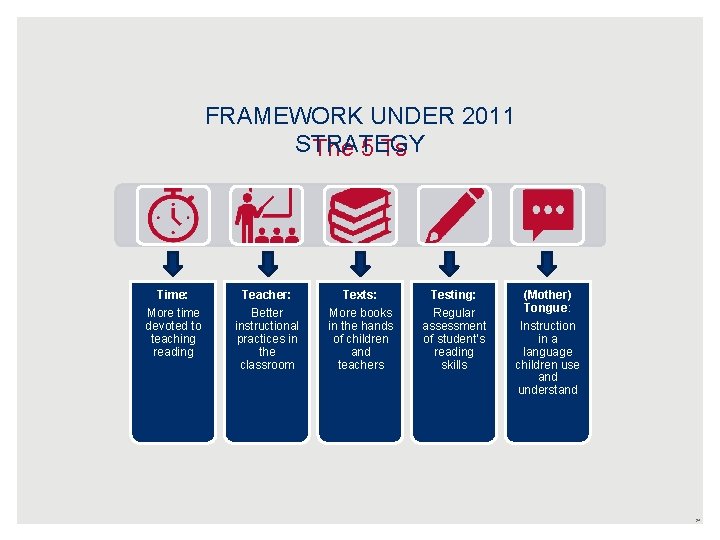
FRAMEWORK UNDER 2011 STRATEGY The 5 Ts Time: Teacher: Texts: Testing: More time devoted to teaching reading Better instructional practices in the classroom More books in the hands of children and teachers Regular assessment of student’s reading skills (Mother) Tongue: Instruction in a language children use and understand 27
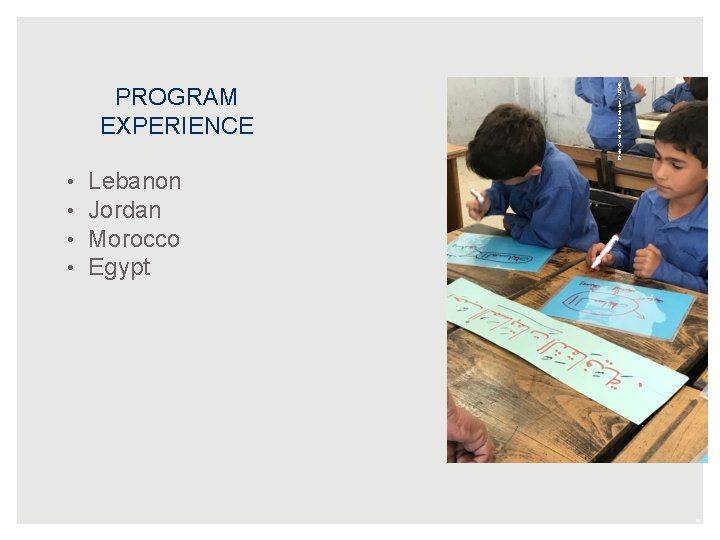
• • Photo Credit: Rebeca Martinez, USAID PROGRAM EXPERIENCE Lebanon Jordan Morocco Egypt 28
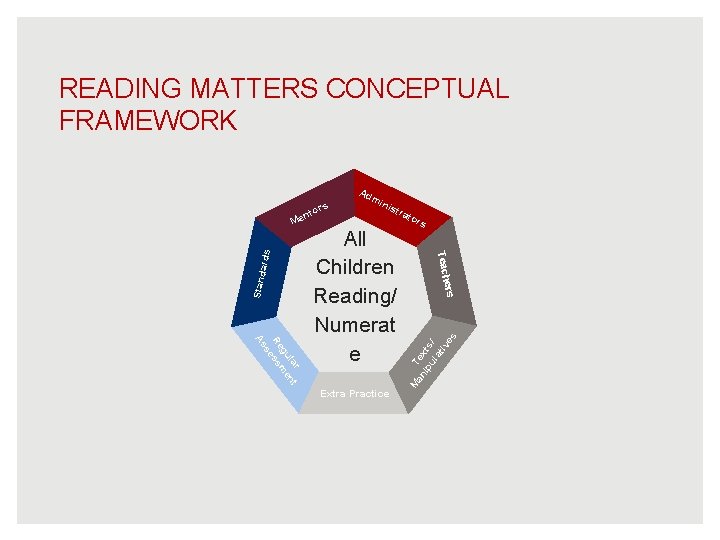
READING MATTERS CONCEPTUAL FRAMEWORK nis tra Extra Practice s ers r la nt gu me Re ess s As All Children Reading/ Numerat e tor an Tex ip ts ul / at iv es mi M s Teach Stand ards Me r nto Ad
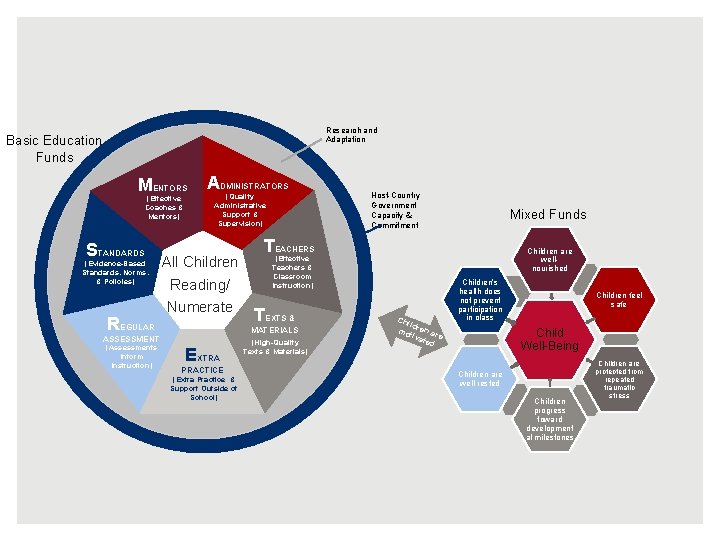
Research and Adaptation Basic Education Funds MENTORS (Effective Coaches & Mentors) STANDARDS (Evidence-Based Standards, Norms, & Policies) REGULAR ADMINISTRATORS (Quality Administrative Support & Supervision) All Children Reading/ Numerate ASSESSMENT (Assessments Inform Instruction) E XTRA PRACTICE (Extra Practice & Support Outside of School) Host Country Government Capacity & Commitment Mixed Funds TEACHERS Children are well nourished (Effective Teachers & Classroom Instruction) T EXTS & MATERIALS (High-Quality Texts & Materials) Chi ld mo ren ar tiva e ted Children’s health does not prevent participation in class Children feel safe Child Well Being Children are well rested Children progress toward development al milestones Children are protected from repeated traumatic stress
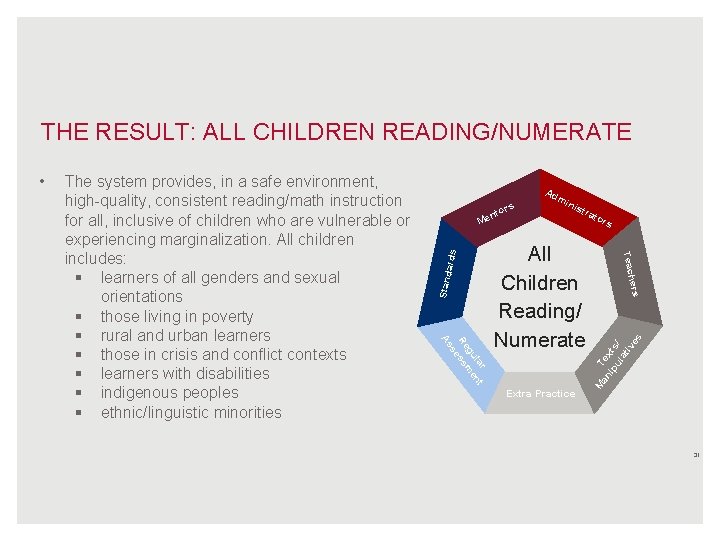
THE RESULT: ALL CHILDREN READING/NUMERATE mi nis tra tor s Extra Practice an Tex ip ts ul / at iv es ers r la nt gu me Re ess s All Children Reading/ Numerate Teach ards Me Ad M rs nto As The system provides, in a safe environment, high quality, consistent reading/math instruction for all, inclusive of children who are vulnerable or experiencing marginalization. All children includes: § learners of all genders and sexual orientations § those living in poverty § rural and urban learners § those in crisis and conflict contexts § learners with disabilities § indigenous peoples § ethnic/linguistic minorities Stand • 31
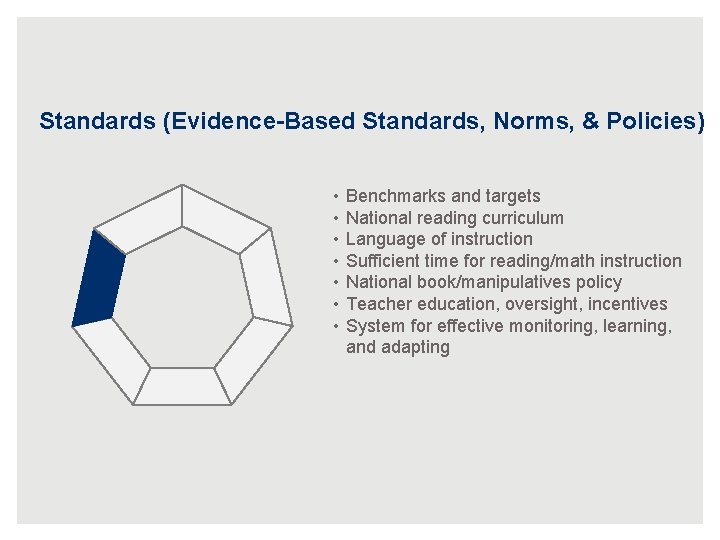
Standards (Evidence-Based Standards, Norms, & Policies) • • Benchmarks and targets National reading curriculum Language of instruction Sufficient time for reading/math instruction National book/manipulatives policy Teacher education, oversight, incentives System for effective monitoring, learning, and adapting
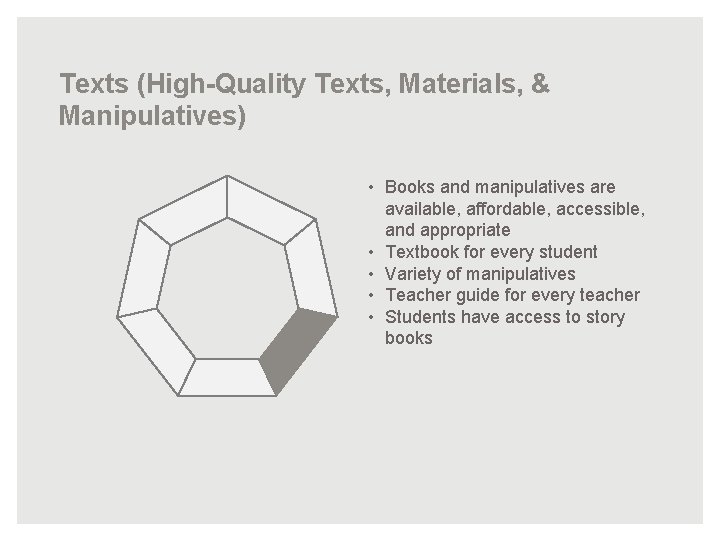
Texts (High-Quality Texts, Materials, & Manipulatives) • Books and manipulatives are available, affordable, accessible, and appropriate • Textbook for every student • Variety of manipulatives • Teacher guide for every teacher • Students have access to story books
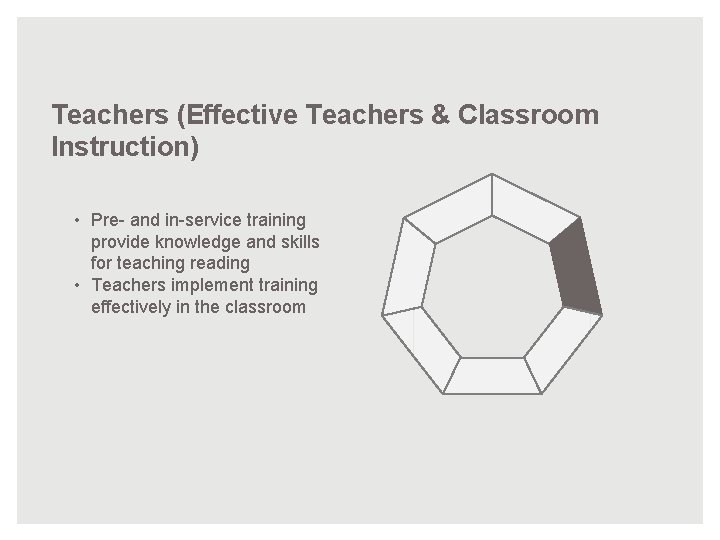
Teachers (Effective Teachers & Classroom Instruction) • Pre and in service training provide knowledge and skills for teaching reading • Teachers implement training effectively in the classroom
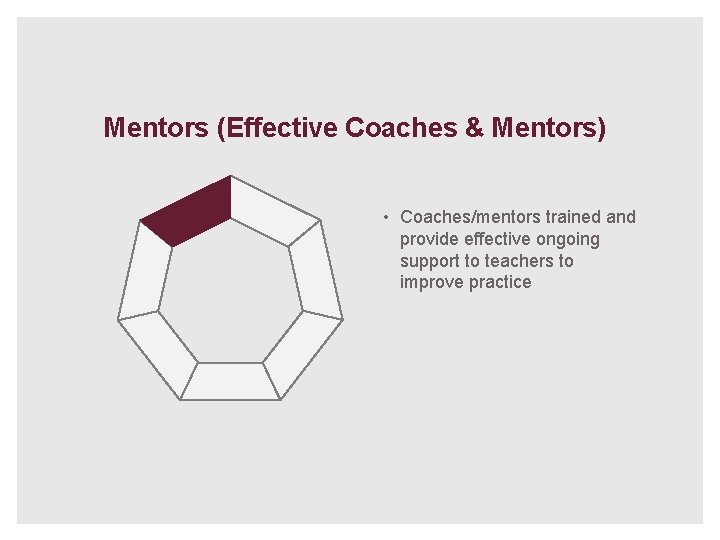
Mentors (Effective Coaches & Mentors) • Coaches/mentors trained and provide effective ongoing support to teachers to improve practice
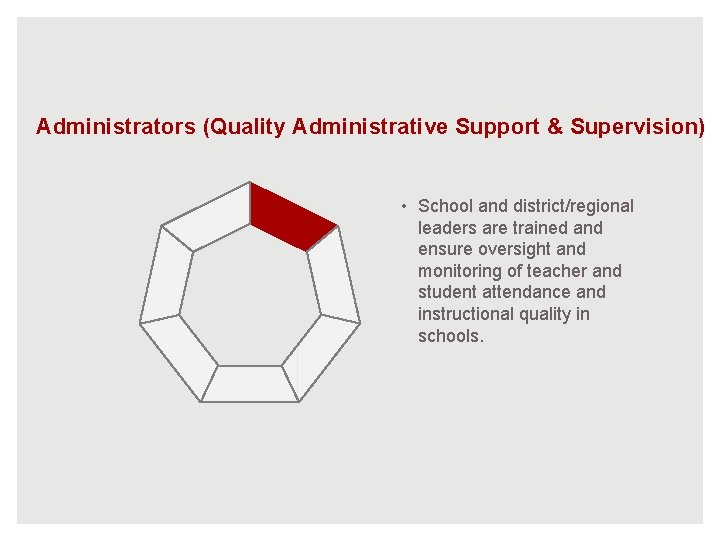
Administrators (Quality Administrative Support & Supervision) • School and district/regional leaders are trained and ensure oversight and monitoring of teacher and student attendance and instructional quality in schools.
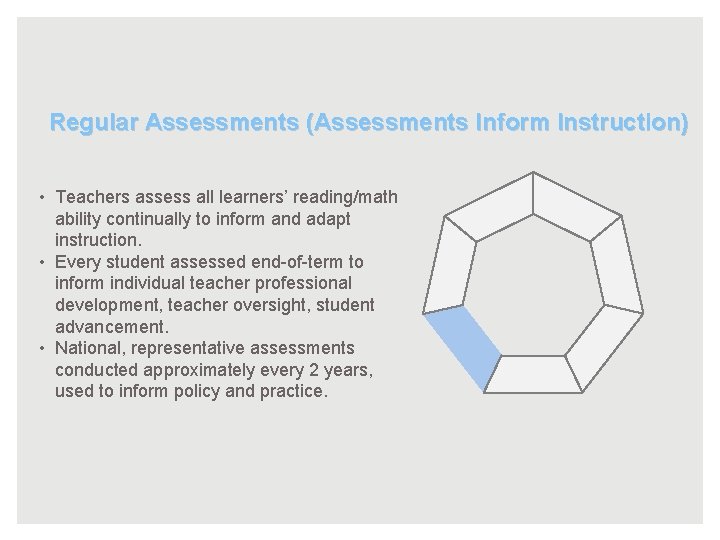
Regular Assessments (Assessments Inform Instruction) • Teachers assess all learners’ reading/math ability continually to inform and adapt instruction. • Every student assessed end of term to inform individual teacher professional development, teacher oversight, student advancement. • National, representative assessments conducted approximately every 2 years, used to inform policy and practice.
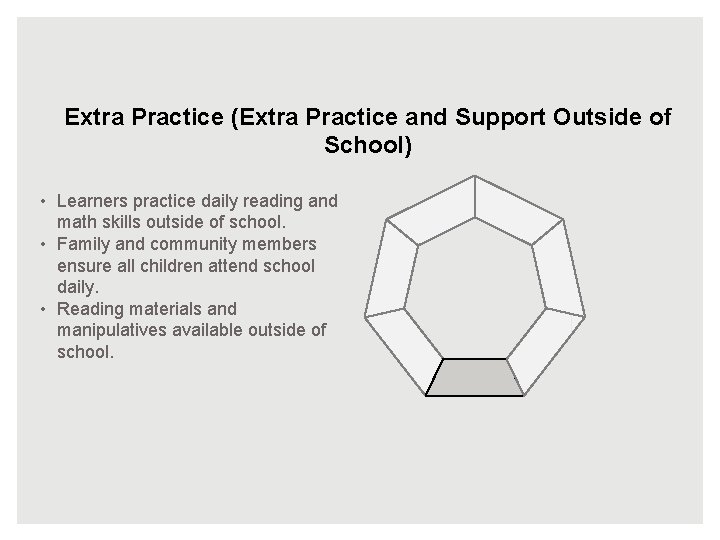
Extra Practice (Extra Practice and Support Outside of School) • Learners practice daily reading and math skills outside of school. • Family and community members ensure all children attend school daily. • Reading materials and manipulatives available outside of school.
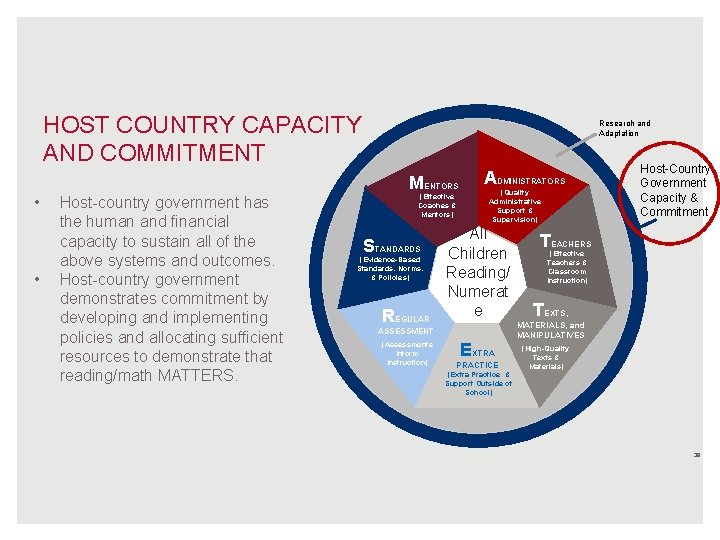
HOST COUNTRY CAPACITY AND COMMITMENT Research and Adaptation MENTORS • • Host country government has the human and financial capacity to sustain all of the above systems and outcomes. Host country government demonstrates commitment by developing and implementing policies and allocating sufficient resources to demonstrate that reading/math MATTERS. (Effective Coaches & Mentors) STANDARDS (Evidence-Based Standards, Norms, & Policies) REGULAR ADMINISTRATORS (Quality Administrative Support & Supervision) All Children Reading/ Numerat e TEACHERS (Effective Teachers & Classroom Instruction) TEXTS, MATERIALS, and MANIPULATIVES ASSESSMENT (Assessments Inform Instruction) Host Country Government Capacity & Commitment EXTRA PRACTICE (High-Quality Texts & Materials) (Extra Practice & Support Outside of School) 39
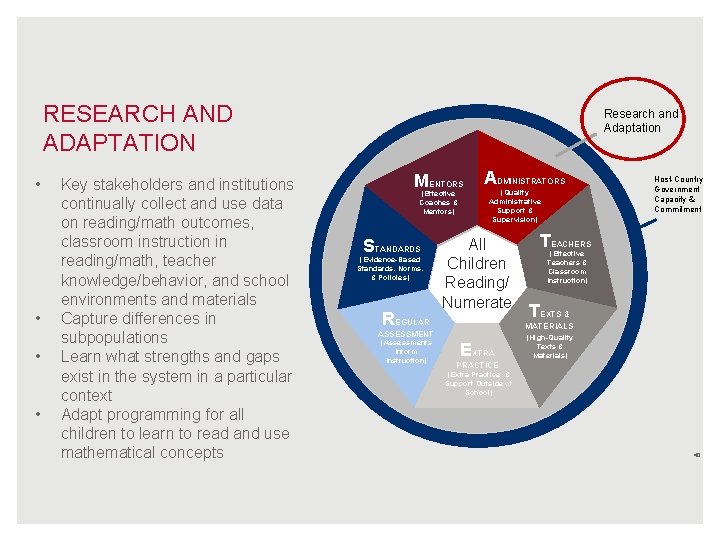
RESEARCH AND ADAPTATION • • Key stakeholders and institutions continually collect and use data on reading/math outcomes, classroom instruction in reading/math, teacher knowledge/behavior, and school environments and materials Capture differences in subpopulations Learn what strengths and gaps exist in the system in a particular context Adapt programming for all children to learn to read and use mathematical concepts Research and Adaptation MENTORS (Effective Coaches & Mentors) STANDARDS (Evidence-Based Standards, Norms, & Policies) REGULAR ADMINISTRATORS (Quality Administrative Support & Supervision) All Children Reading/ Numerate ASSESSMENT (Assessments Inform Instruction) E XTRA PRACTICE Host Country Government Capacity & Commitment TEACHERS (Effective Teachers & Classroom Instruction) T EXTS & MATERIALS (High-Quality Texts & Materials) (Extra Practice & Support Outside of School) 40
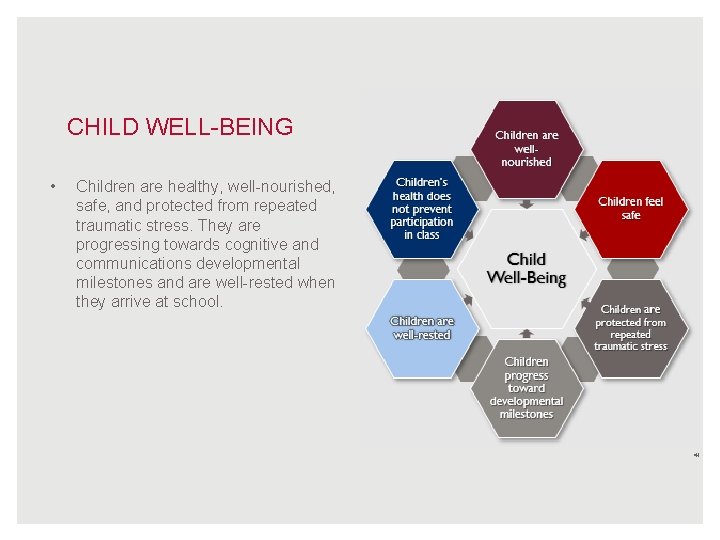
CHILD WELL BEING • Children are healthy, well nourished, safe, and protected from repeated traumatic stress. They are progressing towards cognitive and communications developmental milestones and are well rested when they arrive at school. 41
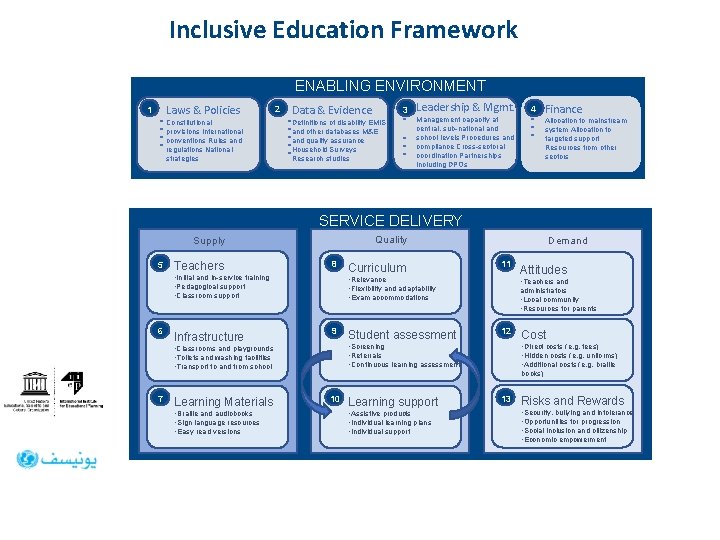
Inclusive Education Framework ENABLING ENVIRONMENT Laws & Policies 1 · Constitutional · provisions International · conventions Rules and · regulations National strategies 2 Data & Evidence 3 · Definitions of disability EMIS · and other databases M&E · and quality assurance · Household Surveys · Research studies · · Leadership & Mgmt. Management capacity at central, sub national and school levels Procedures and compliance Cross sectoral coordination Partnerships including DPOs 4 · · · Finance Allocation to mainstream system Allocation to targeted support Resources from other sectors SERVICE DELIVERY Quality Supply 5 Teachers 8 • Initial and in service training • Pedagogical support • Classroom support 6 Infrastructure Learning Materials • Braille and audiobooks • Sign language resources • Easy read versions 11 • Relevance • Flexibility and adaptability • Exam accommodations 9 Student assessment Attitudes • Teachers and administrators • Local community • Resources for parents 12 • Screening • Referrals • Continuous learning assessment • Classrooms and playgrounds • Toilets and washing facilities • Transport to and from school 7 Curriculum Demand Cost • Direct costs (e. g. fees) • Hidden costs (e. g. uniforms) • Additional costs (e. g. braille books) 10 Learning support • Assistive products • Individual learning plans • Individual support 13 Risks and Rewards • Security, bullying and intolerance • Opportunities for progression • Social inclusion and citizenship • Economic empowerment
- Slides: 44