Sociology Chapter 3 Socialization Miss Hickey Hilliard Davidson
- Slides: 37
Sociology – Chapter 3 Socialization Miss Hickey Hilliard Davidson High School Sociology
What is Human Nature? • social environment: entire human environment, including direct contact with others • socialization: process by which people learn the characteristics of their croup • self: unique human capacity of being able to se ourselves “from the outside” • significant other: an individual who influences someone else’s life • generalized other: norms, values, attitudes, and expectations of people in general
What is Human Nature? • People have always wondered how much of peoples characteristics come for “nature” (heredity) and “nurture” (contact with others). – Best way to find out is to examine those who have had not social contact: feral children
Feral Children • Feral children: raised by animals; can’t speak or do any normal human behavior; raised in the wilderness (language and human bonding = needed) – Isolated children: have no natural language no shared way of life no connection to others: culture is key to what people become • without language there is no culture • without interaction/shared ideas… no image of self
Feral Children: Textbook Example • In 1798 in France in a forest, they found a boy that walked on all fours and pounced on animals devouring them uncooked. – Most social scientists have take the position that children can not be raised by animals, and that the reason they were abandoned was because of mental disability
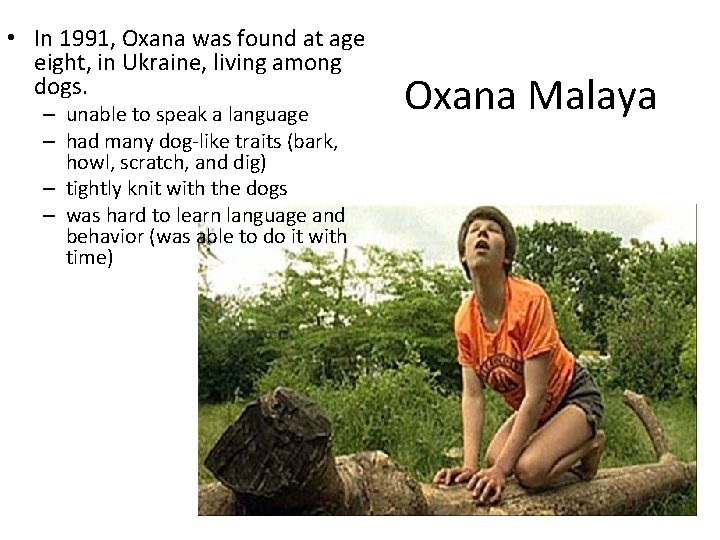
• In 1991, Oxana was found at age eight, in Ukraine, living among dogs. – unable to speak a language – had many dog-like traits (bark, howl, scratch, and dig) – tightly knit with the dogs – was hard to learn language and behavior (was able to do it with time) Oxana Malaya
Institutionalized Children • Institutionalized children: intelligence and ability to establish close bonds with others depends on early interaction; period of time where intelligence and bonds must occur in order for humans to develop – 1930 s – shorter lifespan, children that lived in orphanages had less than a third grade education • difficulty establishing relationships • lower IQs
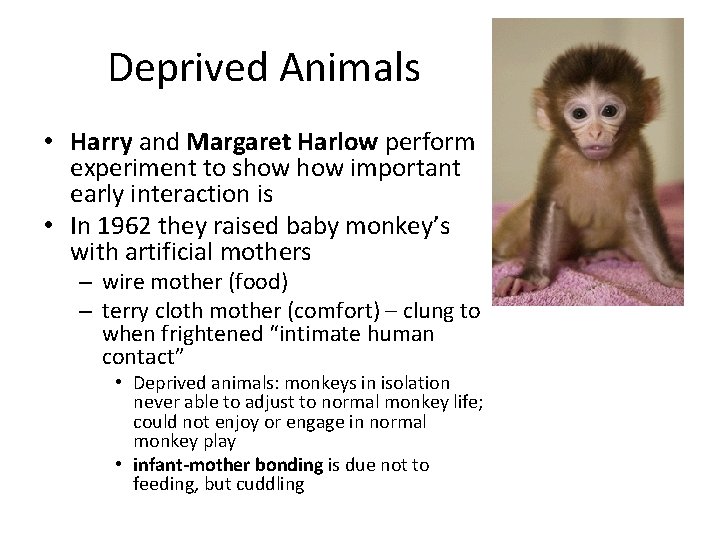
Deprived Animals • Harry and Margaret Harlow perform experiment to show important early interaction is • In 1962 they raised baby monkey’s with artificial mothers – wire mother (food) – terry cloth mother (comfort) – clung to when frightened “intimate human contact” • Deprived animals: monkeys in isolation never able to adjust to normal monkey life; could not enjoy or engage in normal monkey play • infant-mother bonding is due not to feeding, but cuddling
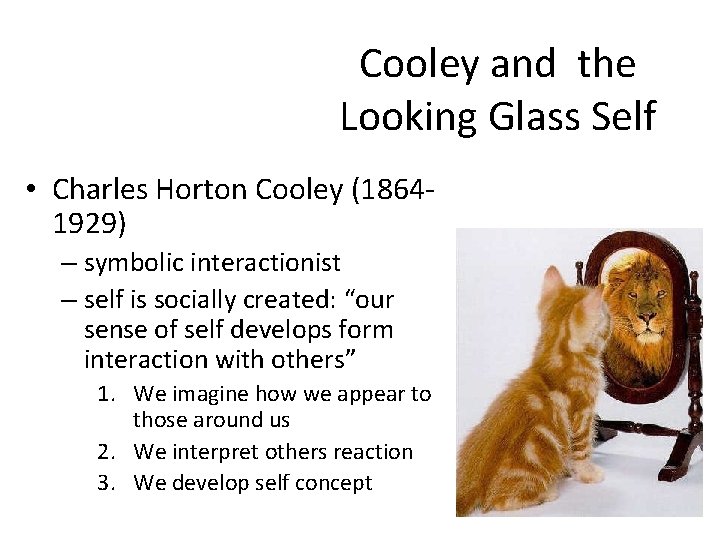
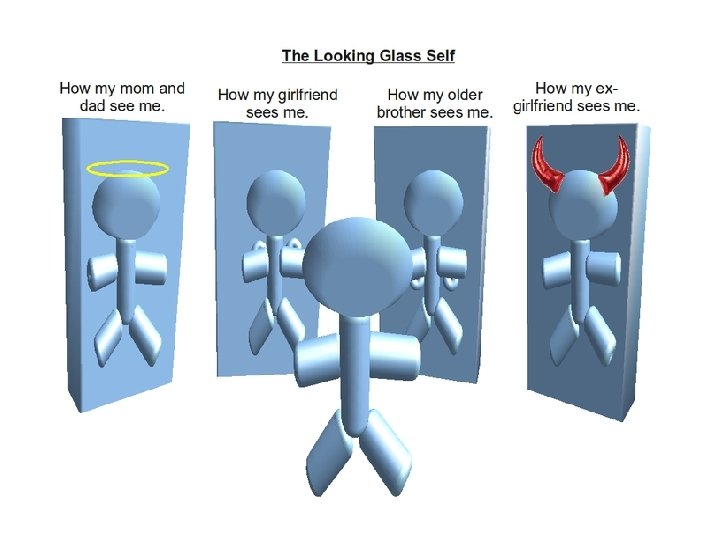
Cooley and the Looking Glass Self • Charles Horton Cooley (18641929) – symbolic interactionist – self is socially created: “our sense of self develops form interaction with others” 1. We imagine how we appear to those around us 2. We interpret others reaction 3. We develop self concept
Looking-Glass Self
George Herbert Mead (1863 -1931) • George Mead: thought that play was crucial to the development of self – Take the role of other: putting self in other person's shoes 1. imitation – acting like someone else/significant others with gestures 2. play – pretend to take roles of specific peple 3. games – learn to take multiple roles – Initially significant others (parents, police officers) eventually “generalized other” (role of a whole group)
Piaget and the Development of Reasoning • How do we come to answers? How do we reason? • Believed the mind was a social product • Piaget and the States of Reasoning: 1. The sensorimotor stage (infants; understanding is limited) 2. The preoperational stage (develop the ability to use symbols) 3. Concrete operational stage (remain concrete 4. Formal operational stage (capable of abstract thinking) • • reasoning moves from concrete and moves to more abstract can talk about concepts and come to conclusions
A SHORT Time to Ponder • How do you think you appear to those who are around you? • Which stage in “taking the role” do you think is the most important? Why?
Learning Personality, Morality and Emotions • Sigmund Freud: physician who founded psychoanalysis – believed that your personality consists of three elements: • id: term for inborn basic drives • ego: term for balancing force between the id and the demands of society • superego: term of the conscience, the internalized norms and values of our societal groups
Lawrence Kohlberg’s Theory • Lawrence Kohlberg: concluded that we go through a sequence of stages as we develop morality 1. amoral stage: no right or wrong, personal needs need to be satisfied 2. preconventional stage: learned rules and follow them to stay out of trouble 3. conventional stage: morality means to follow norms and values they have learned 4. postconventional stage: most people don’t reach, people reflect on abstract principles of right and wrong and judge a behavior according to these principles
Carol Gilligan • Didn’t agree with Kohlbergs conclusions because he only used males in his studies • Interviewed 200 men and women to conduct her own research • Conclusions: – women evaluate morality of personal relationships and want to know how and action affects others – Men evaluate morality of abstract principles and see whether an act matches or violets a code of ethics
Paul Ekman • everyone experiences six basic emotions: 1. 2. 3. 4. 5. 6. anger disgust fear happiness sadness surprise • expressing emotions is different between genders, cultures, social class and relationships • what people feel also changes between different cultures
Socializing Emotions • global emotions – existence of universal facial expressions for 6 basic emotions does NOT mean socialization has no effect on how express them • people in one culture may learn to experience feelings that are unknown in another culture
Gender Messages • gender role: behaviors and attitudes considered appropriate because one if female or male – Social inequality – a social condition in which privileges and obligations are given to some but denied to others • gender = primary basis • gender socialization: the ways in which society sets children into different courses of life because they are male or female – family: unconsciously send gender messages through toys and color choices for various things • Goldberg and Lewis introduced the idea that mothers subconsciously reward daughters for being passive and dependent and sons for being active and independent
Gender Messages, cont. – peers: teen girls talk to their girlfriends different than they talk to their guy friends and vice versa • girls: shopping, boys, clothing • boys: sex and violence • peer group: group of individuals of roughly the same age who are linked by common interests – mass media: forms of communication such as radio, newspapers, television that are directed at a mass audience • advertising, television, movies and video games are all directed to a certain gender (and reinforce stereotypes of sexes) • advertising: bombards people with things a certain gender would want • TV/movies: boys and girls watch certain shows and movies • videogames: directed at boys – use action and violence – reflect cutting edge changes in sex roles
A SHORT Time to Ponder • How does mass media impact your life indirectly? • How have your parents or guardians socialized you towards characteristics associated with one gender or another?
Agents of Socialization • • family neighborhood religion day care school peer groups sports and competitive success workplace
Agent of Socialization: Family • lay down our basic sense of self • establish our initial motivations values and beliefs • subtle socialization (study families in public) – The stroller effect (gender roles/gender messages) – Social Class (diff. classes raise children differently) • ways of discipline – middle class: instill values – working class: keep out of trouble • curiosity • self-control
Agent of Socialization: Neighborhood • poor neighborhoods vs. wealthy neighborhoods – poor neighborhoods: crime, less opportunity • more likely to be around negative influences – wealthy neighborhoods: more opportunity • neighbors more likely to keep an eye on children (children more likely to develop sense of community) • children socialize with immediate peers • disadvantage vs. advantages to both
Agent of Socialization: Religion • • ideas of right and wrong dress, speech, manners, etc. morals of religious people effect everyone influences extend to many areas of our lives
Agent of Socialization: Day Care • Pro: language skills, low income families • Con: increased hours in day care make children more likely to be mean and cruel, bad relationship with mother
Agent of Socialization: School • Manifest and latent functions – manifest functions (intended): transmit skills such as reading, writing, arithmetic – latent functions (unintended): social system, hidden and corridor curriculum • hidden curriculum: teach patriotism, democracy, justice, honesty – dysfunction: racism, sexism, coolness, reinforce social and economic and political standing • Kids born in higher class families attend better schools and therefore end up better off in life. The opposite holds true for the poor.
Agent of Socialization: Peer Groups • friends become more influential than family • conformity or rejection • influential (dominate one’s actions and thoughts) – male traits: athletic ability, coolness and toughness – female traits: family background, personal appearance and ability to attract boys
Agent of Socialization: Sport and Competitive Success • • physical skills team players self image gender roles – boys (what they get from sports): sports lead to a positive “masculine” identity for boys and facilitates their self-esteem – girls (relationships): sports construct meaningful relationships and positive identity
Agent of Socialization: Workplace • anticipatory socialization – Anticipating future role and learning parts of it now • helps self-concept – more you work in a certain line of work, the more it becomes a part of your self-concept • new perspective on world
A SHORT Time to Ponder • Which of these groups do you think have the greatest effect on people? You? • Do you think there is really a hidden curriculum in schools? • How do peer groups change allegiance from family to friends? • Do you think that there are other agents of socialization that should be added?
Resocialization • resocialization – the process of learning new norms, values, attitudes and behaviors – most resocialization is mild • total institutions – people are cut off from the rest of society – degradation ceremony – an attempt to remake the self by stripping away in individuals selfidentity
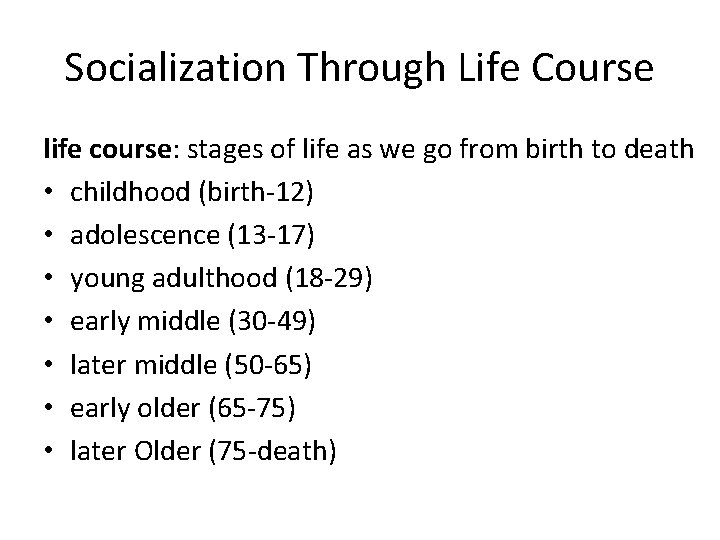
Socialization Through Life Course life course: stages of life as we go from birth to death • childhood (birth-12) • adolescence (13 -17) • young adulthood (18 -29) • early middle (30 -49) • later middle (50 -65) • early older (65 -75) • later Older (75 -death)
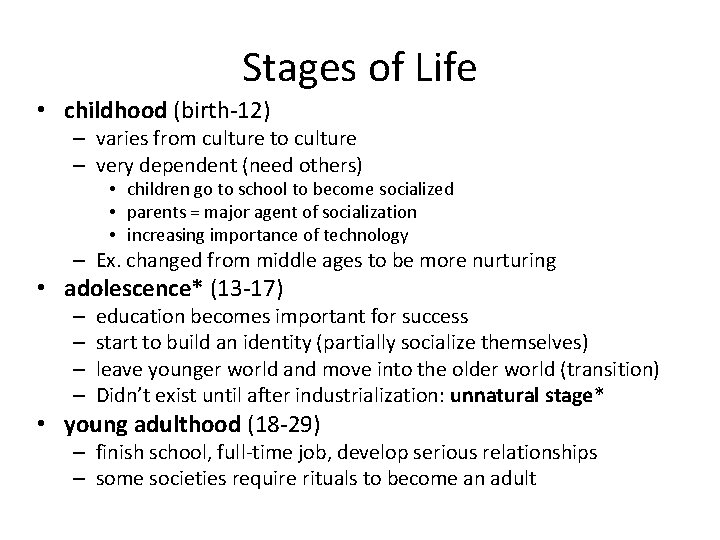
Stages of Life • childhood (birth-12) – varies from culture to culture – very dependent (need others) • children go to school to become socialized • parents = major agent of socialization • increasing importance of technology – Ex. changed from middle ages to be more nurturing • adolescence* (13 -17) – – education becomes important for success start to build an identity (partially socialize themselves) leave younger world and move into the older world (transition) Didn’t exist until after industrialization: unnatural stage* • young adulthood (18 -29) – finish school, full-time job, develop serious relationships – some societies require rituals to become an adult
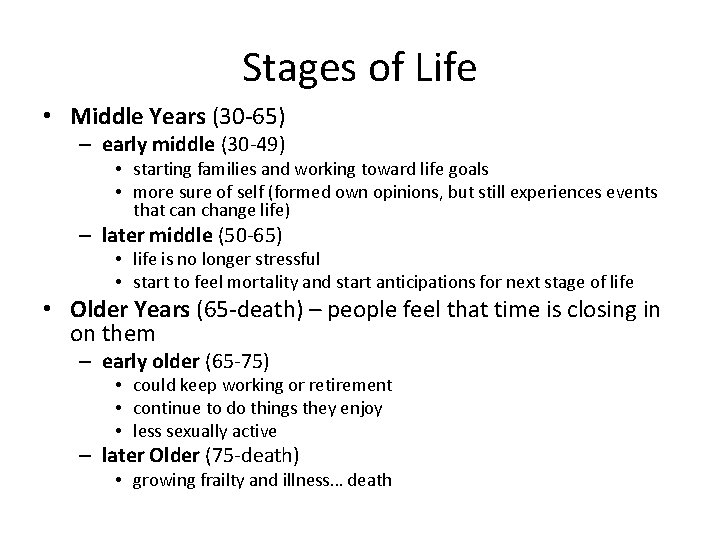
Stages of Life • Middle Years (30 -65) – early middle (30 -49) • starting families and working toward life goals • more sure of self (formed own opinions, but still experiences events that can change life) – later middle (50 -65) • life is no longer stressful • start to feel mortality and start anticipations for next stage of life • Older Years (65 -death) – people feel that time is closing in on them – early older (65 -75) • could keep working or retirement • continue to do things they enjoy • less sexually active – later Older (75 -death) • growing frailty and illness… death
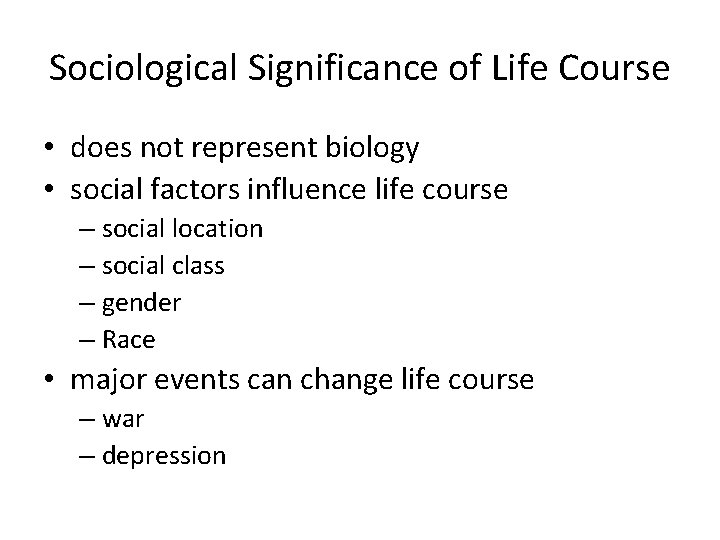
Sociological Significance of Life Course • does not represent biology • social factors influence life course – social location – social class – gender – Race • major events can change life course – war – depression
A SHORT Time to Ponder • Which life stage do you find most desirable? Why? • Do you think that we are prisoners of socialization? Why? • Do you think degradation ceremonies are affective? Why?