
A regulatory perspective Raquel Duarte Davidson WHO Collaborating
A regulatory perspective Raquel Duarte Davidson WHO Collaborating Centre, Cardiff University Chemical Hazards and Poisons Division (CHa. PD), HQ, Chilton SHE Net workshop 2 nd and 3 rd of July 2008, Nottingham University
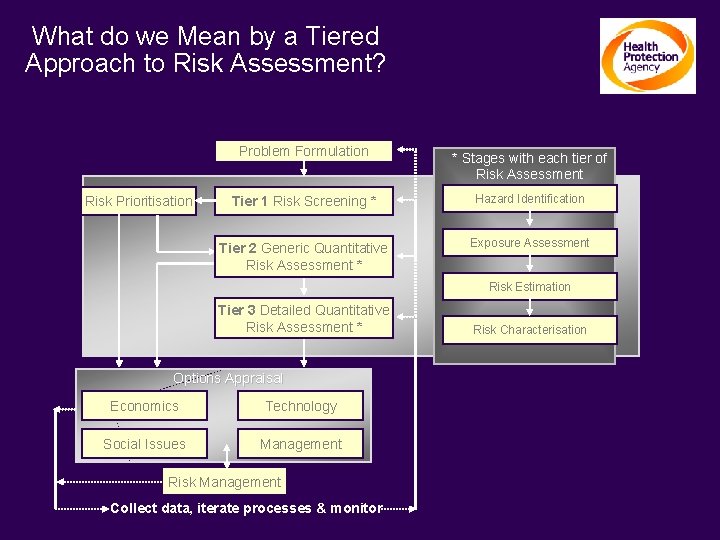
What do we Mean by a Tiered Approach to Risk Assessment? Problem Formulation Risk Prioritisation * Stages with each tier of Risk Assessment Tier 1 Risk Screening * Hazard Identification Tier 2 Generic Quantitative Risk Assessment * Exposure Assessment Risk Estimation Tier 3 Detailed Quantitative Risk Assessment * Options Appraisal Economics Technology Social Issues Management Risk Management Collect data, iterate processes & monitor Risk Characterisation
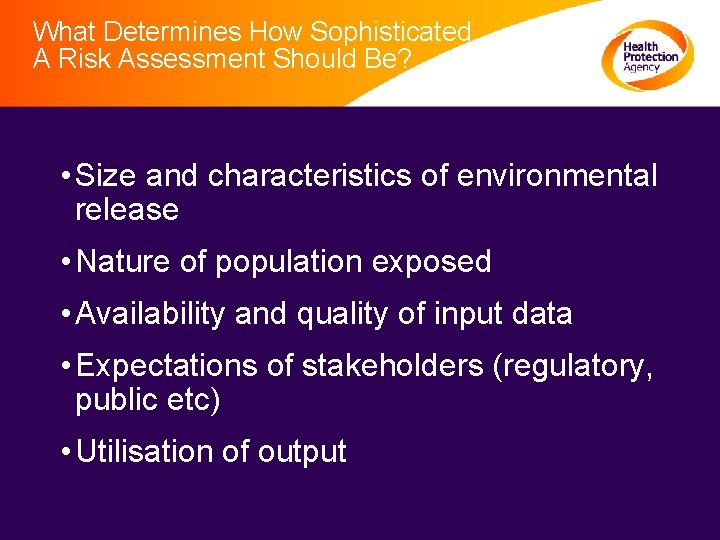
What Determines How Sophisticated A Risk Assessment Should Be? • Size and characteristics of environmental release • Nature of population exposed • Availability and quality of input data • Expectations of stakeholders (regulatory, public etc) • Utilisation of output

Appropriate Selection of Risk Assessment Methodologies Increasing Resolution, Sophistication and Cost A, B and C represent hazards requiring assessment Line of Acceptability of risk Quantitative B Generic-Quantitative B C Qualitative A Increasing Risk (log scale)
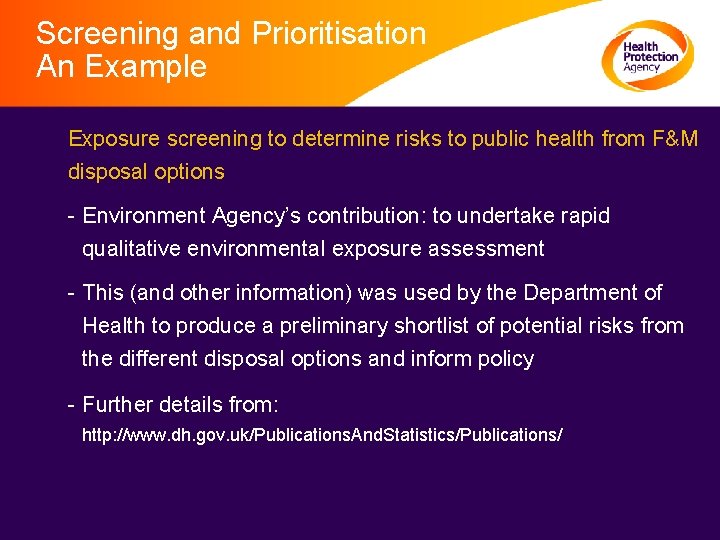
Screening and Prioritisation An Example Exposure screening to determine risks to public health from F&M disposal options Environment Agency’s contribution: to undertake rapid qualitative environmental exposure assessment This (and other information) was used by the Department of Health to produce a preliminary shortlist of potential risks from the different disposal options and inform policy Further details from: http: //www. dh. gov. uk/Publications. And. Statistics/Publications/
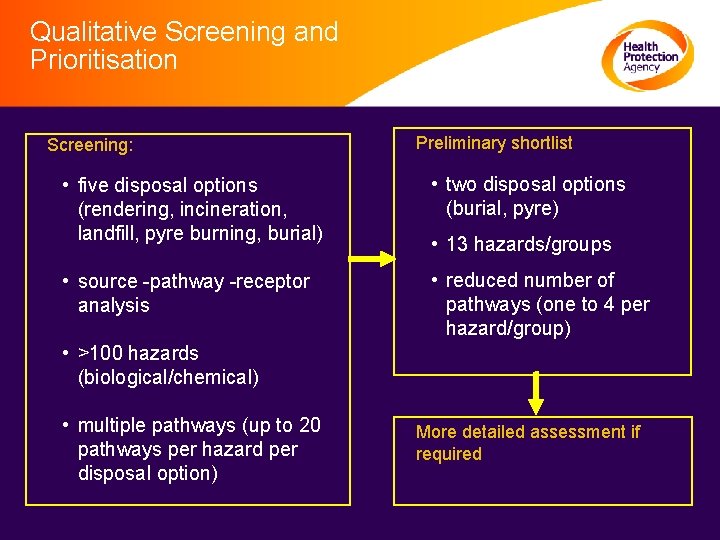
Qualitative Screening and Prioritisation Screening: Preliminary shortlist • five disposal options (rendering, incineration, landfill, pyre burning, burial) • two disposal options (burial, pyre) • source pathway receptor analysis • reduced number of pathways (one to 4 per hazard/group) • 13 hazards/groups • >100 hazards (biological/chemical) • multiple pathways (up to 20 pathways per hazard per disposal option) More detailed assessment if required
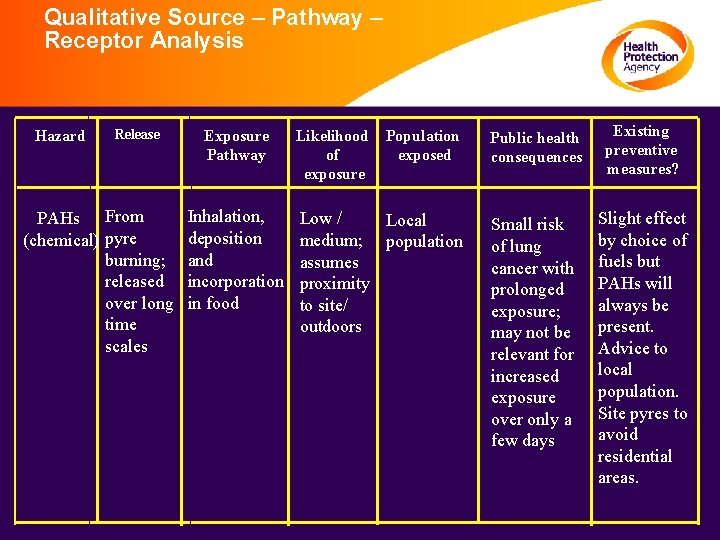
Qualitative Source – Pathway – Receptor Analysis Hazard Release PAHs From (chemical) pyre burning; released over long time scales Exposure Pathway Inhalation, deposition and incorporation in food Likelihood of exposure Population exposed Low / Local medium; population assumes proximity to site/ outdoors Public health consequences Existing preventive measures? Small risk of lung cancer with prolonged exposure; may not be relevant for increased exposure over only a few days Slight effect by choice of fuels but PAHs will always be present. Advice to local population. Site pyres to avoid residential areas.
Summary of results from the Screening Exercise: Potential Health risks, Disposal Methods and Pathways Disposal option with greatest human exposure to hazards Disposal options entailing some human exposure to hazards R = Rendering; I = Incineration; L= Landfill; P = Pyre; B = Burial
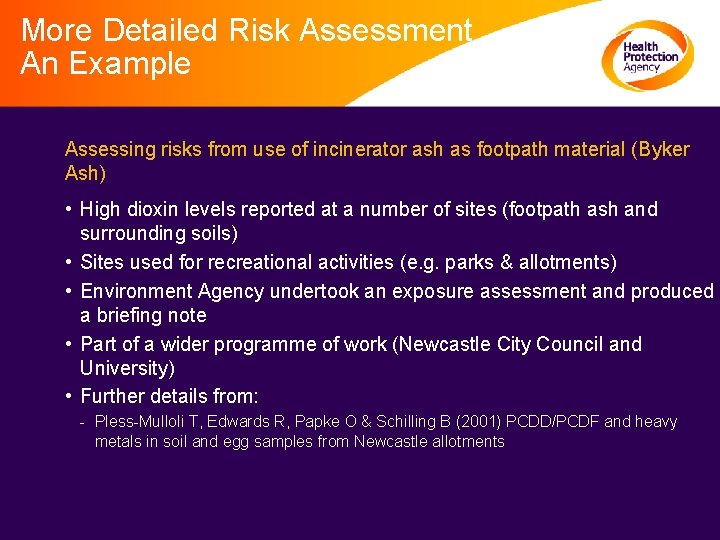
More Detailed Risk Assessment An Example Assessing risks from use of incinerator ash as footpath material (Byker Ash) • High dioxin levels reported at a number of sites (footpath ash and surrounding soils) • Sites used for recreational activities (e. g. parks & allotments) • Environment Agency undertook an exposure assessment and produced a briefing note • Part of a wider programme of work (Newcastle City Council and University) • Further details from: Pless Mulloli T, Edwards R, Papke O & Schilling B (2001) PCDD/PCDF and heavy metals in soil and egg samples from Newcastle allotments
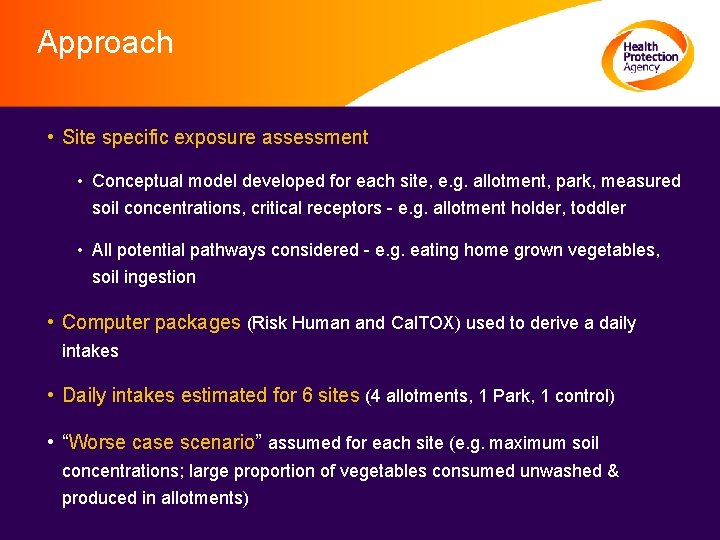
Approach • Site specific exposure assessment • Conceptual model developed for each site, e. g. allotment, park, measured soil concentrations, critical receptors e. g. allotment holder, toddler • All potential pathways considered e. g. eating home grown vegetables, soil ingestion • Computer packages (Risk Human and Cal. TOX) used to derive a daily intakes • Daily intakes estimated for 6 sites (4 allotments, 1 Park, 1 control) • “Worse case scenario” assumed for each site (e. g. maximum soil concentrations; large proportion of vegetables consumed unwashed & produced in allotments)
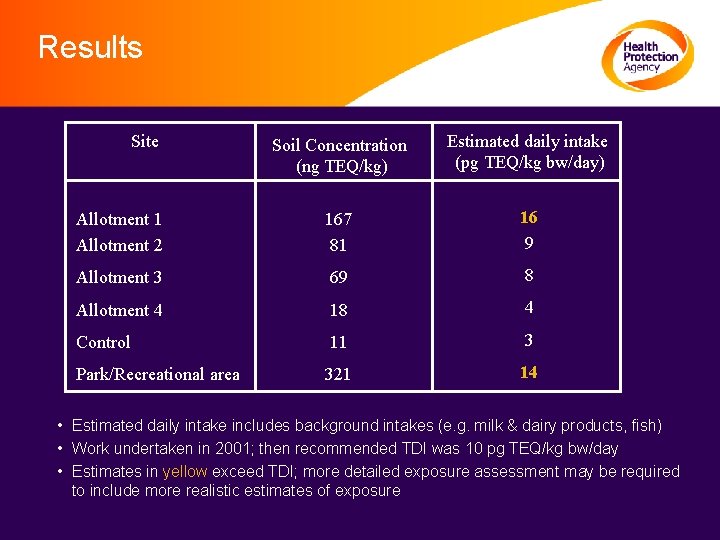
Results Soil Concentration (ng TEQ/kg) Estimated daily intake (pg TEQ/kg bw/day) Allotment 1 Allotment 2 167 81 16 9 Allotment 3 69 8 Allotment 4 18 4 Control 11 3 Park/Recreational area 321 14 Site • Estimated daily intake includes background intakes (e. g. milk & dairy products, fish) • Work undertaken in 2001; then recommended TDI was 10 pg TEQ/kg bw/day • Estimates in yellow exceed TDI; more detailed exposure assessment may be required to include more realistic estimates of exposure
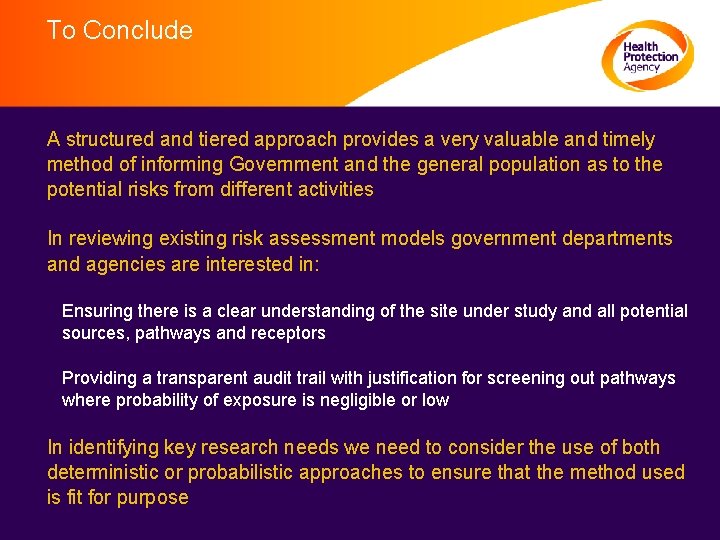
To Conclude A structured and tiered approach provides a very valuable and timely method of informing Government and the general population as to the potential risks from different activities In reviewing existing risk assessment models government departments and agencies are interested in: Ensuring there is a clear understanding of the site under study and all potential sources, pathways and receptors Providing a transparent audit trail with justification for screening out pathways where probability of exposure is negligible or low In identifying key research needs we need to consider the use of both deterministic or probabilistic approaches to ensure that the method used is fit for purpose
- Slides: 12