Sociocultural issues and sports psychology 2 3 Health

- Slides: 42
Socio-cultural issues and sports psychology
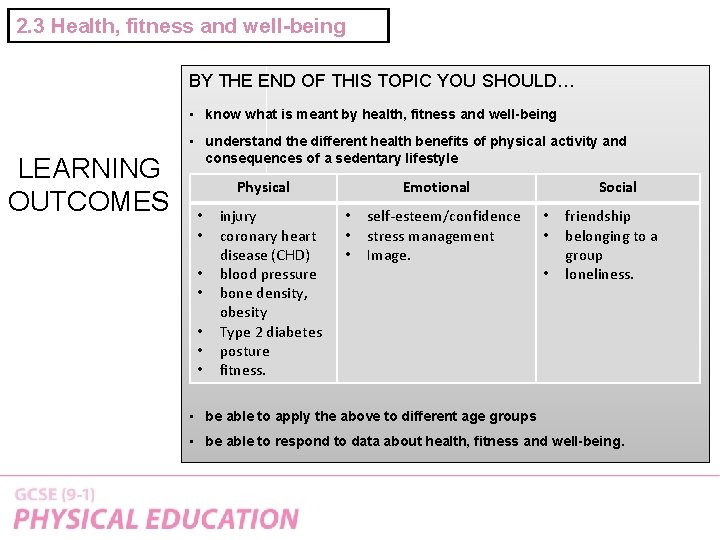
2. 3 Health, fitness and well-being BY THE END OF THIS TOPIC YOU SHOULD… • know what is meant by health, fitness and well-being LEARNING OUTCOMES • understand the different health benefits of physical activity and consequences of a sedentary lifestyle Physical • • injury coronary heart disease (CHD) blood pressure bone density, obesity Type 2 diabetes posture fitness. Emotional • • • self-esteem/confidence stress management Image. Social • • • friendship belonging to a group loneliness. • be able to apply the above to different age groups • be able to respond to data about health, fitness and well-being.
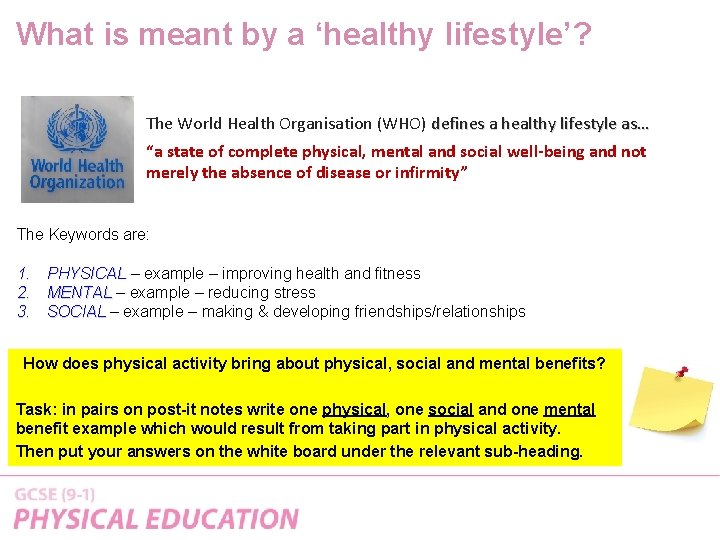
What is meant by a ‘healthy lifestyle’? The World Health Organisation (WHO) defines a healthy lifestyle as… “a state of complete physical, mental and social well-being and not merely the absence of disease or infirmity” The Keywords are: 1. PHYSICAL – example – improving health and fitness 2. MENTAL – example – reducing stress 3. SOCIAL – example – making & developing friendships/relationships How does physical activity bring about physical, social and mental benefits? Task: in pairs on post-it notes write one physical, one social and one mental benefit example which would result from taking part in physical activity. Then put your answers on the white board under the relevant sub-heading.
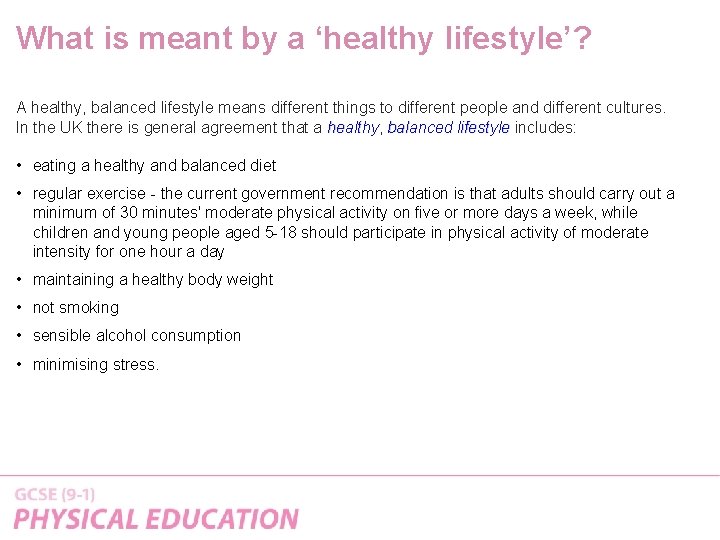
What is meant by a ‘healthy lifestyle’? A healthy, balanced lifestyle means different things to different people and different cultures. In the UK there is general agreement that a healthy, healthy balanced lifestyle includes: • eating a healthy and balanced diet • regular exercise - the current government recommendation is that adults should carry out a minimum of 30 minutes' moderate physical activity on five or more days a week, while children and young people aged 5 -18 should participate in physical activity of moderate intensity for one hour a day • maintaining a healthy body weight • not smoking • sensible alcohol consumption • minimising stress.
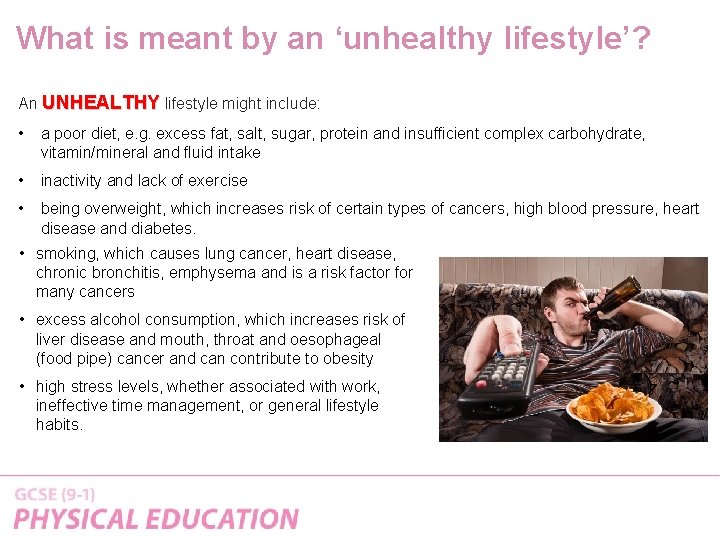
What is meant by an ‘unhealthy lifestyle’? An UNHEALTHY lifestyle might include: • a poor diet, e. g. excess fat, salt, sugar, protein and insufficient complex carbohydrate, vitamin/mineral and fluid intake • inactivity and lack of exercise • being overweight, which increases risk of certain types of cancers, high blood pressure, heart disease and diabetes. • smoking, which causes lung cancer, heart disease, chronic bronchitis, emphysema and is a risk factor for many cancers • excess alcohol consumption, which increases risk of liver disease and mouth, throat and oesophageal (food pipe) cancer and can contribute to obesity • high stress levels, whether associated with work, ineffective time management, or general lifestyle habits.
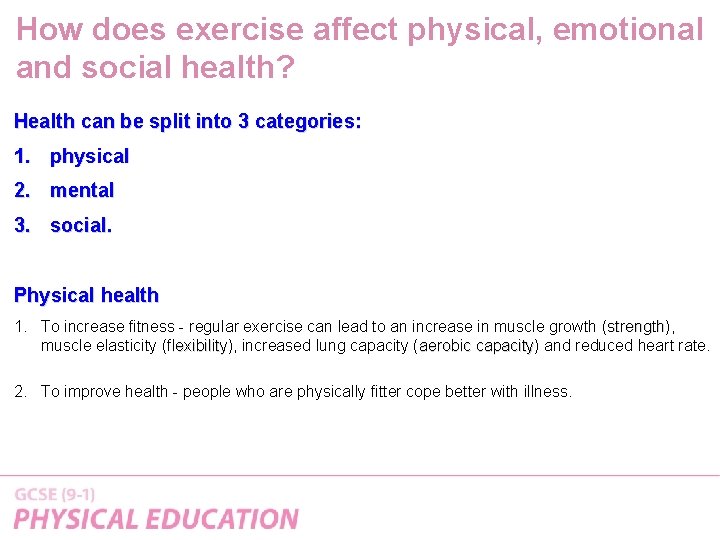
How does exercise affect physical, emotional and social health? Health can be split into 3 categories: 1. physical 2. mental 3. social. Physical health 1. To increase fitness - regular exercise can lead to an increase in muscle growth (strength), strength muscle elasticity (flexibility), increased lung capacity ( aerobic capacity) and reduced heart rate. lexibility aerobic capacity 2. To improve health - people who are physically fitter cope better with illness.
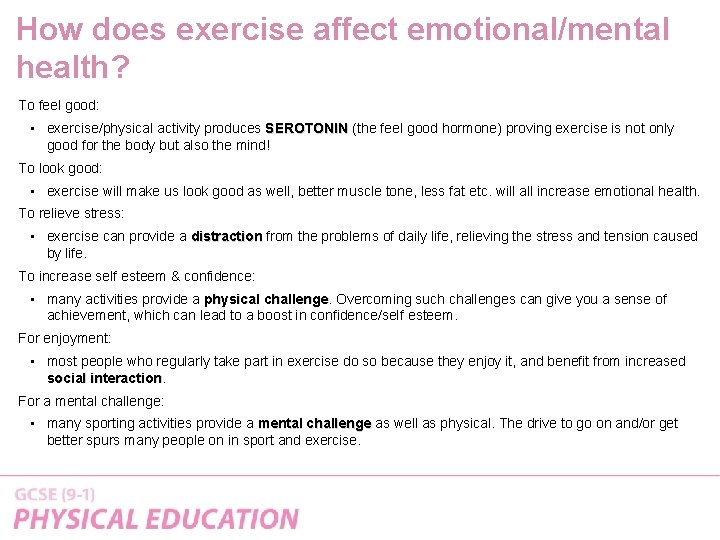
How does exercise affect emotional/mental health? To feel good: • exercise/physical activity produces SEROTONIN (the feel good hormone) proving exercise is not only good for the body but also the mind! To look good: • exercise will make us look good as well, better muscle tone, less fat etc. will all increase emotional health. To relieve stress: • exercise can provide a distraction from the problems of daily life, relieving the stress and tension caused distraction by life. To increase self esteem & confidence: • many activities provide a physical challenge. Overcoming such challenges can give you a sense of challenge achievement, which can lead to a boost in confidence/self esteem. For enjoyment: • most people who regularly take part in exercise do so because they enjoy it, and benefit from increased social interaction For a mental challenge: • many sporting activities provide a mental challenge as well as physical. The drive to go on and/or get better spurs many people on in sport and exercise.
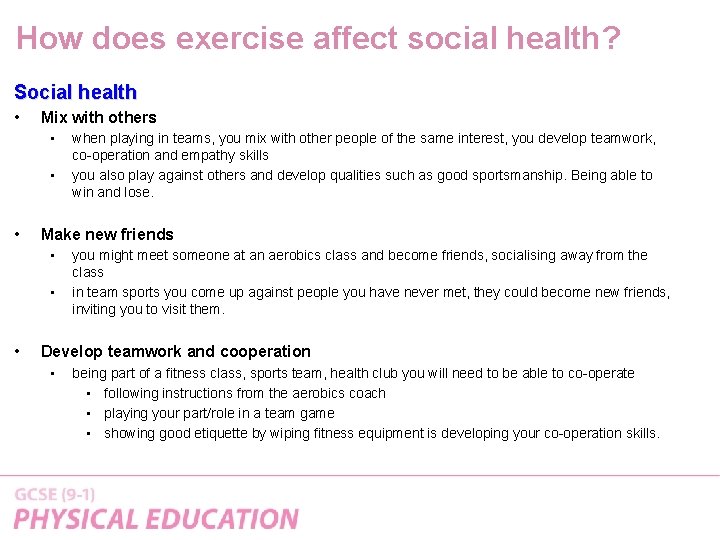
How does exercise affect social health? Social health • Mix with others • • • Make new friends • • • when playing in teams, you mix with other people of the same interest, you develop teamwork, co-operation and empathy skills you also play against others and develop qualities such as good sportsmanship. Being able to win and lose. you might meet someone at an aerobics class and become friends, socialising away from the class in team sports you come up against people you have never met, they could become new friends, inviting you to visit them. Develop teamwork and cooperation • being part of a fitness class, sports team, health club you will need to be able to co-operate • following instructions from the aerobics coach • playing your part/role in a team game • showing good etiquette by wiping fitness equipment is developing your co-operation skills.
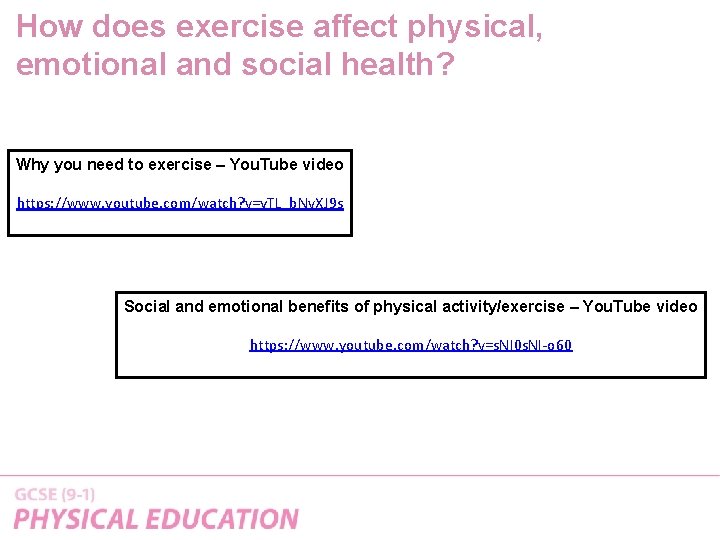
How does exercise affect physical, emotional and social health? Why you need to exercise – You. Tube video https: //www. youtube. com/watch? v=y. TL_b. Nv. XJ 9 s Social and emotional benefits of physical activity/exercise – You. Tube video https: //www. youtube. com/watch? v=s. NI 0 s. NI-o 60
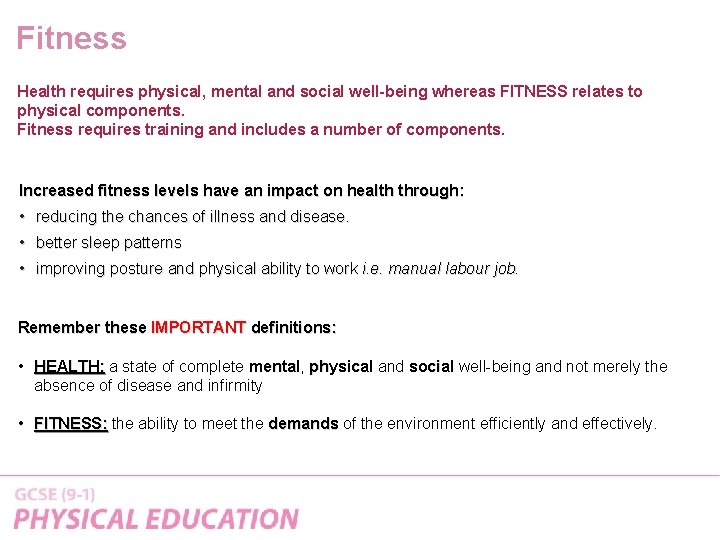
Fitness Health requires physical, mental and social well-being whereas FITNESS relates to physical components. Fitness requires training and includes a number of components. Increased fitness levels have an impact on health through: • reducing the chances of illness and disease. • better sleep patterns • improving posture and physical ability to work i. e. manual labour job. Remember these IMPORTANT definitions: • HEALTH: a state of complete mental, social well-being and not merely the mental physical and physical social absence of disease and infirmity • FITNESS: the ability to meet the demands of the environment efficiently and effectively. demands
Is it possible to be fit but not healthy? Watch this You. Tube video: https: //www. youtube. com/watch? v=r. Os. Xuu-Cexw This is Sir Steven Redgrave (5 time Olympic gold medallist in rowing). Would you consider him fit? (aka, able to meet the demands of the environment). Would you consider him healthy? (he currently suffers from diabetes) so NO! So a clear example that you can be fit but not healthy!!
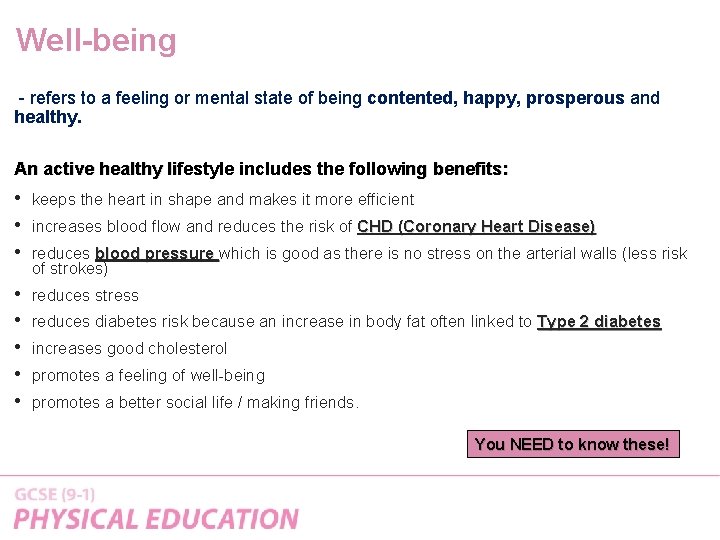
Well-being - refers to a feeling or mental state of being contented, happy, prosperous and healthy. An active healthy lifestyle includes the following benefits: • • • keeps the heart in shape and makes it more efficient • • • reduces stress increases blood flow and reduces the risk of CHD (Coronary Heart Disease) reduces blood pressure which is good as there is no stress on the arterial walls (less risk of strokes) reduces diabetes risk because an increase in body fat often linked to Type 2 diabetes increases good cholesterol promotes a feeling of well-being promotes a better social life / making friends. You NEED to know these!
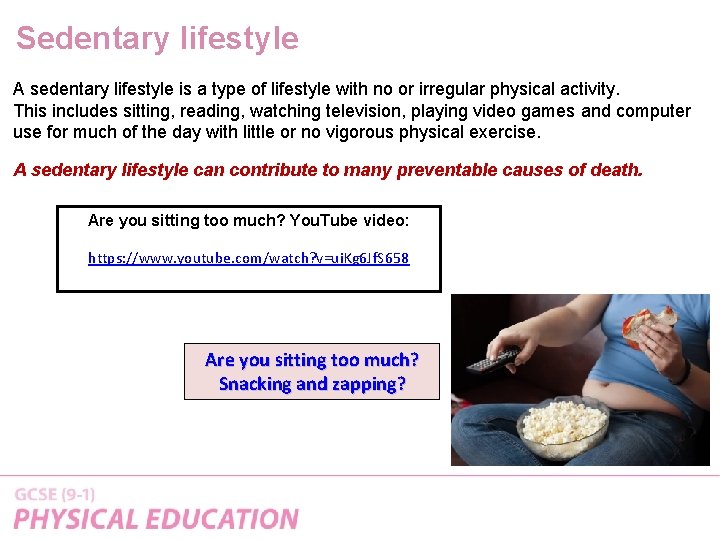
Sedentary lifestyle A sedentary lifestyle is a type of lifestyle with no or irregular physical activity. This includes sitting, reading, watching television, playing video games and computer use for much of the day with little or no vigorous physical exercise. A sedentary lifestyle can contribute to many preventable causes of death. Are you sitting too much? You. Tube video: https: //www. youtube. com/watch? v=ui. Kg 6 Jf. S 658 Are you sitting too much? Snacking and zapping?
Sedentary lifestyle There are numerous long term health/physical consequences of a sedentary lifestyle including: • • increased risk of high blood pressure increased risk of strokes increased risk of heart attacks increased likelihood of injury more likely to suffer from respiratory/lung disease obesity poor posture. Obesity is very damaging to health and the risk of Type 2 diabetes and coronary heart disease (CHD) is much greater
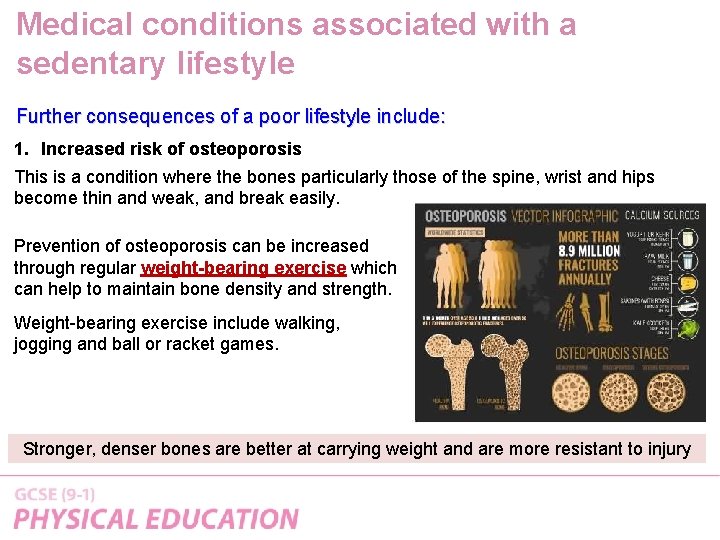
Medical conditions associated with a sedentary lifestyle Further consequences of a poor lifestyle include: 1. Increased risk of osteoporosis This is a condition where the bones particularly those of the spine, wrist and hips become thin and weak, and break easily. Prevention of osteoporosis can be increased through regular weight-bearing exercise which can help to maintain bone density and strength. Weight-bearing exercise include walking, jogging and ball or racket games. Stronger, denser bones are better at carrying weight and are more resistant to injury
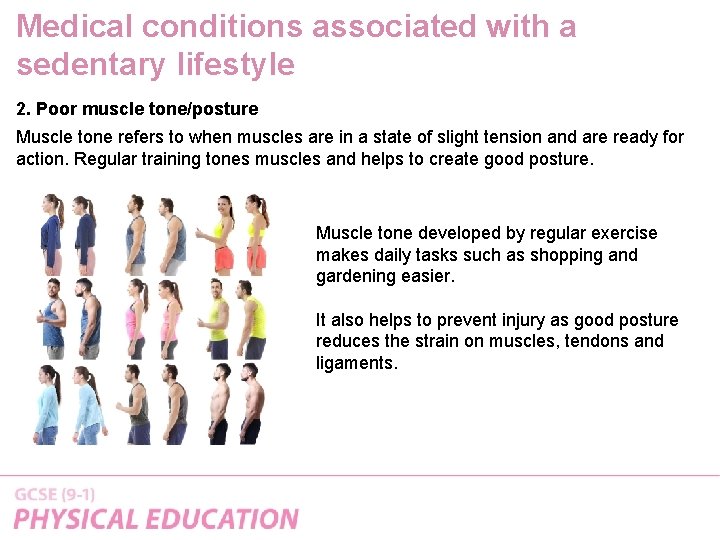
Medical conditions associated with a sedentary lifestyle 2. Poor muscle tone/posture Muscle tone refers to when muscles are in a state of slight tension and are ready for action. Regular training tones muscles and helps to create good posture. Muscle tone developed by regular exercise makes daily tasks such as shopping and gardening easier. It also helps to prevent injury as good posture reduces the strain on muscles, tendons and ligaments.
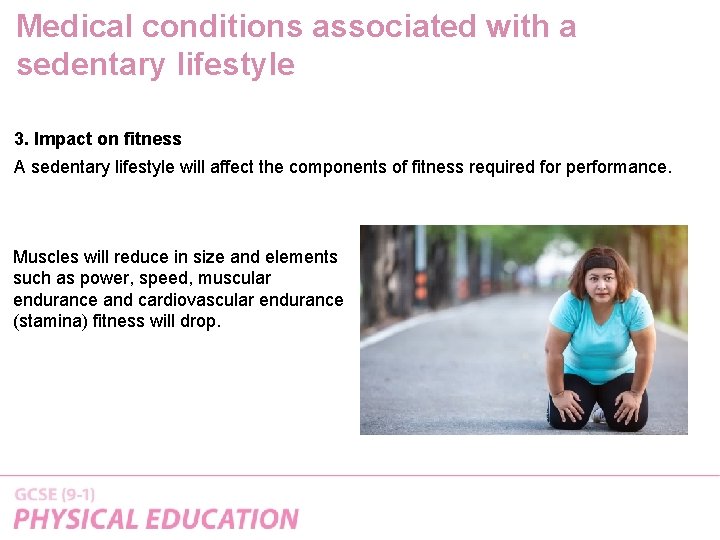
Medical conditions associated with a sedentary lifestyle 3. Impact on fitness A sedentary lifestyle will affect the components of fitness required for performance. Muscles will reduce in size and elements such as power, speed, muscular endurance and cardiovascular endurance (stamina) fitness will drop.
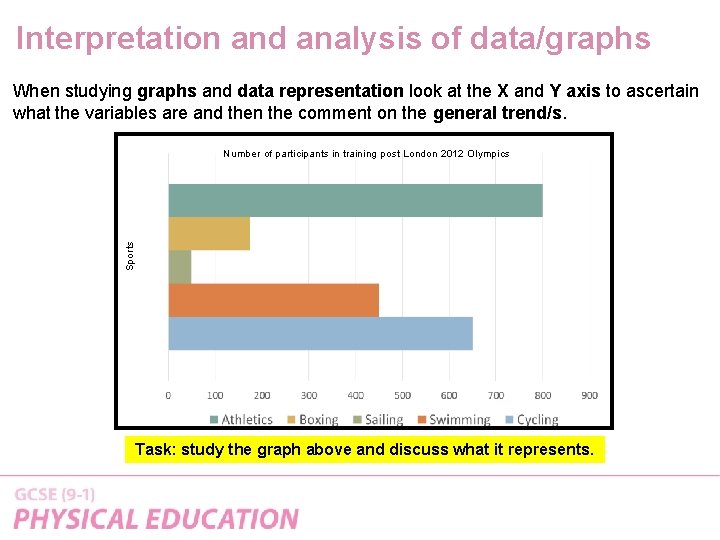
Interpretation and analysis of data/graphs When studying graphs and data representation look at the X and Y axis to ascertain what the variables are and then the comment on the general trend/s. Sports Number of participants in training post London 2012 Olympics Task: study the graph above and discuss what it represents.
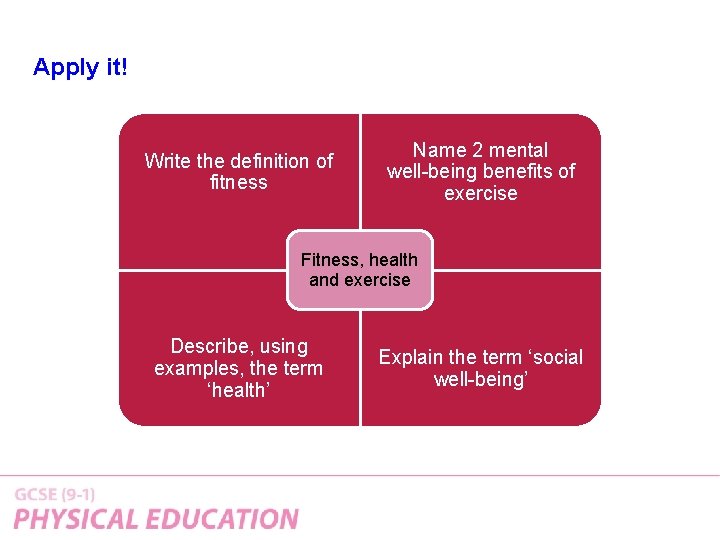
Apply it! Write the definition of fitness Name 2 mental well-being benefits of exercise Fitness, health and exercise Describe, using examples, the term ‘health’ Explain the term ‘social well-being’
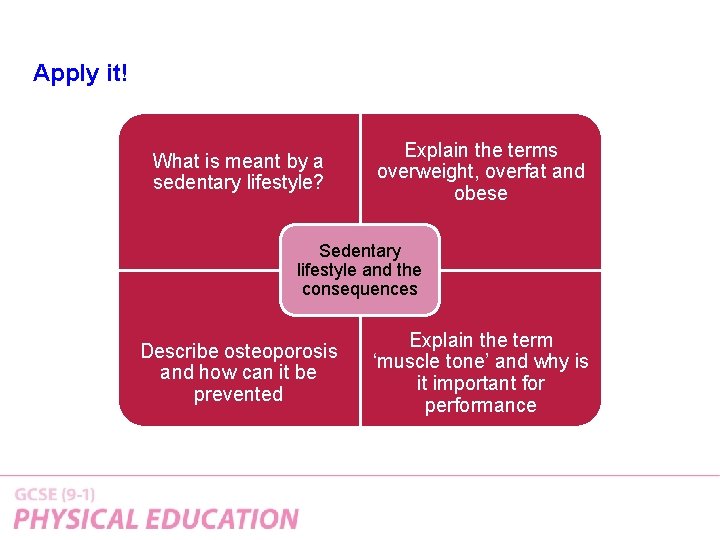
Apply it! What is meant by a sedentary lifestyle? Explain the terms overweight, overfat and obese Sedentary lifestyle and the consequences Describe osteoporosis and how can it be prevented Explain the term ‘muscle tone’ and why is it important for performance
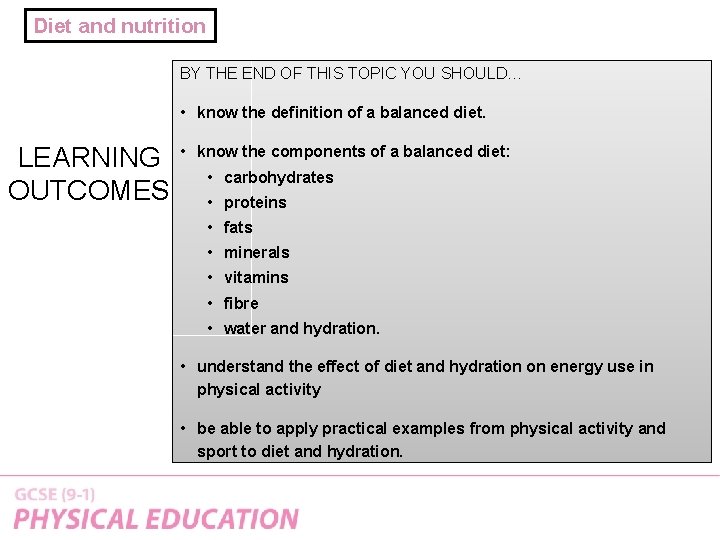
Diet and nutrition BY THE END OF THIS TOPIC YOU SHOULD… • know the definition of a balanced diet. LEARNING OUTCOMES • know the components of a balanced diet: • carbohydrates • proteins • fats • minerals • vitamins • fibre • water and hydration. • understand the effect of diet and hydration on energy use in physical activity • be able to apply practical examples from physical activity and sport to diet and hydration.
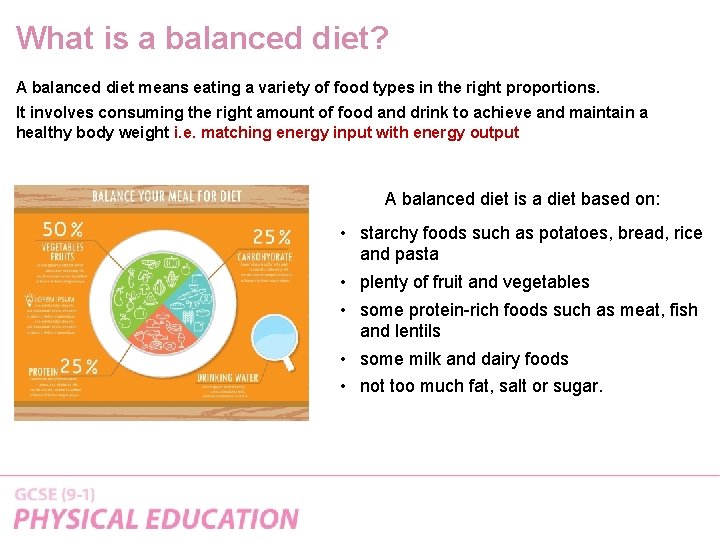
What is a balanced diet? A balanced diet means eating a variety of food types in the right proportions. It involves consuming the right amount of food and drink to achieve and maintain a healthy body weight i. e. matching energy input with energy output A balanced diet is a diet based on: • starchy foods such as potatoes, bread, rice and pasta • plenty of fruit and vegetables • some protein-rich foods such as meat, fish and lentils • some milk and dairy foods • not too much fat, salt or sugar.
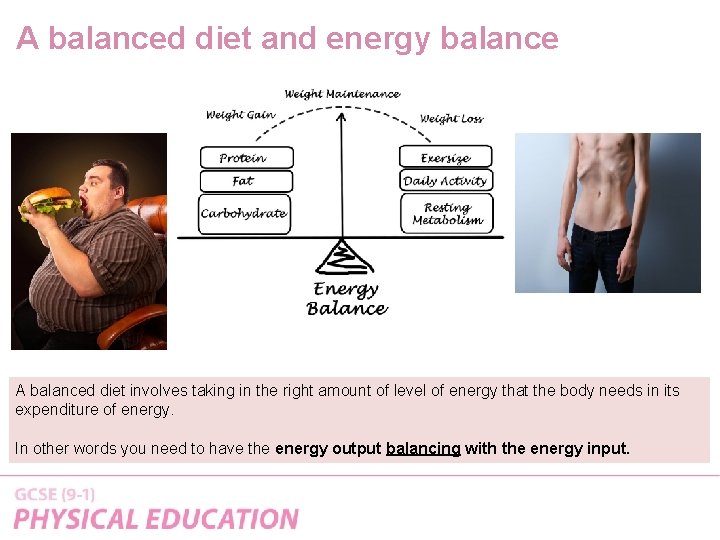
A balanced diet and energy balance A balanced diet involves taking in the right amount of level of energy that the body needs in its expenditure of energy. In other words you need to have the energy output balancing with the energy input.
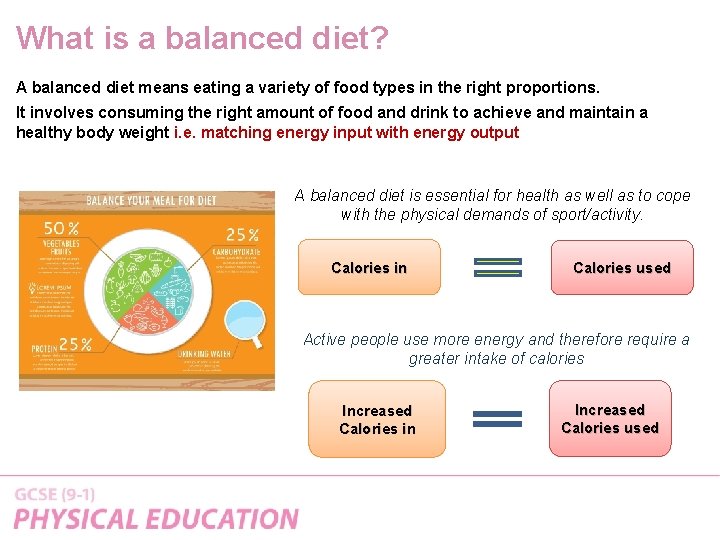
What is a balanced diet? A balanced diet means eating a variety of food types in the right proportions. It involves consuming the right amount of food and drink to achieve and maintain a healthy body weight i. e. matching energy input with energy output A balanced diet is essential for health as well as to cope with the physical demands of sport/activity. Calories in Calories used Active people use more energy and therefore require a greater intake of calories Increased Calories in Increased Calories used
Diet and Nutrition ✓Diet is what we eat on a day-to-day basis and should not be confused with being on a ‘diet to lose weight’. ✓Diet is an essential part of providing energy needed to work, exercise and also to rest and repair muscles tissues. ✓Balanced diet = the right foods in the right amounts. Task: what should be included in a balanced diet?
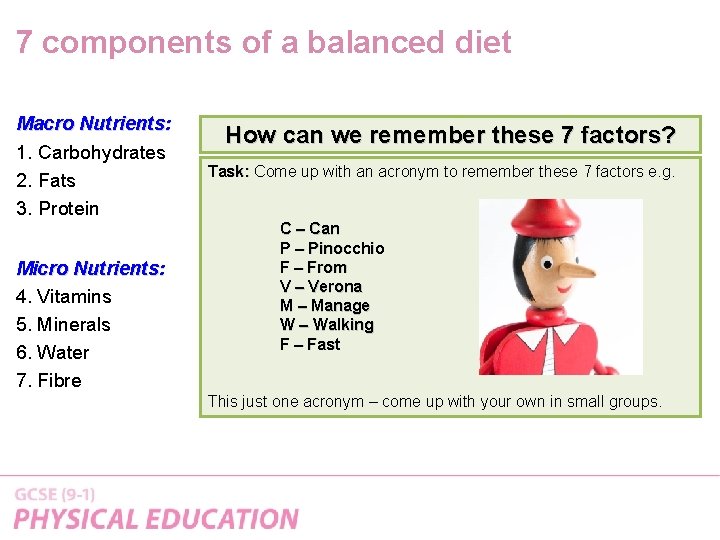
7 components of a balanced diet Macro Nutrients: 1. Carbohydrates 2. Fats 3. Protein Micro Nutrients: 4. Vitamins 5. Minerals 6. Water 7. Fibre How can we remember these 7 factors? Task: Come up with an acronym to remember these 7 factors e. g. C – Can P – Pinocchio F – From V – Verona M – Manage W – Walking F – Fast This just one acronym – come up with your own in small groups.
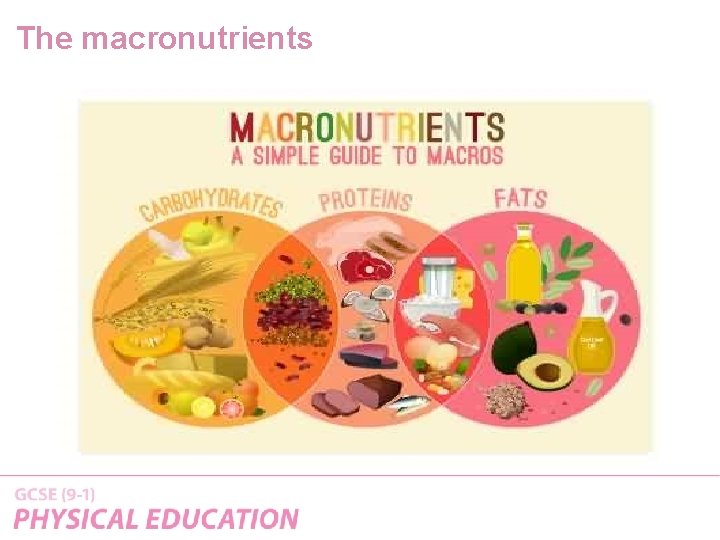
The macronutrients
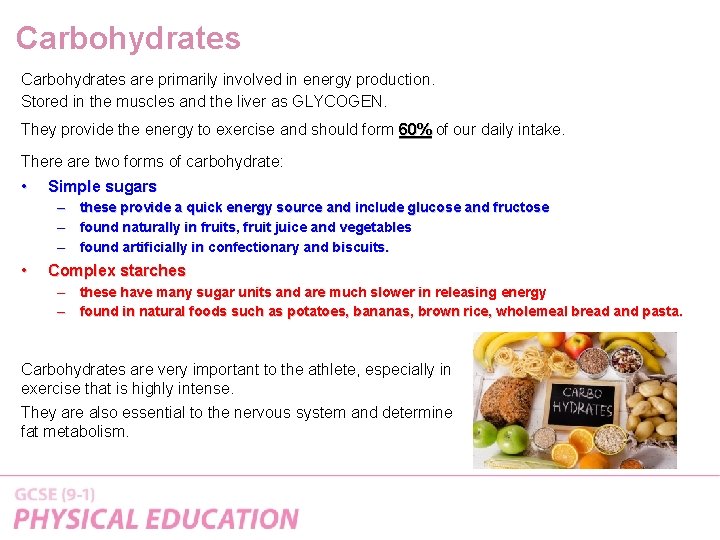
Carbohydrates are primarily involved in energy production. Stored in the muscles and the liver as GLYCOGEN. They provide the energy to exercise and should form 60% of our daily intake. 60% There are two forms of carbohydrate: • Simple sugars – – – • these provide a quick energy source and include glucose and fructose found naturally in fruits, fruit juice and vegetables found artificially in confectionary and biscuits. Complex starches – these have many sugar units and are much slower in releasing energy – found in natural foods such as potatoes, bananas, brown rice, wholemeal bread and pasta. Carbohydrates are very important to the athlete, especially in exercise that is highly intense. They are also essential to the nervous system and determine fat metabolism.
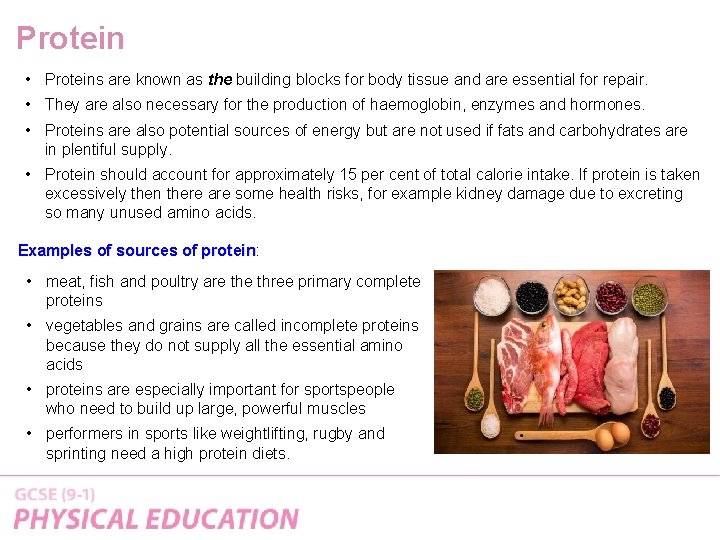
Protein • Proteins are known as the building blocks for body tissue and are essential for repair. • They are also necessary for the production of haemoglobin, enzymes and hormones. • Proteins are also potential sources of energy but are not used if fats and carbohydrates are in plentiful supply. • Protein should account for approximately 15 per cent of total calorie intake. If protein is taken excessively then there are some health risks, for example kidney damage due to excreting so many unused amino acids. Examples of sources of protein: protein • meat, fish and poultry are three primary complete proteins • vegetables and grains are called incomplete proteins because they do not supply all the essential amino acids • proteins are especially important for sportspeople who need to build up large, powerful muscles • performers in sports like weightlifting, rugby and sprinting need a high protein diets.
Fats • Fats are a major source of energy for athletes performing low-intensity endurance exercise. • They also play an important role in insulating the body. • There are two types: – triglycerides, which are stored in the form of body fat – fatty acids, which are used mainly as fuel for energy production • these are either saturated fats or unsaturated fats • When muscles' cells are readily supplied with oxygen, fat is the usual fuel for energy production. This is because the body is trying to save the limited stores of glycogen for high-intensity exercise and therefore delay the onset of fatigue. The body cannot solely use fat for energy and so the muscle is fuelled by a combination of fat and glycogen. • It is generally accepted that a maximum of 30% of total calories consumed should be from fatty foods. • Examples of sources of fats: – saturated fats - meat products, dairy products, cakes, confectionery – unsaturated fats - oily fish, nuts, margarine, olive oil. • The fitter you are the more easily your body uses up stores of fat.
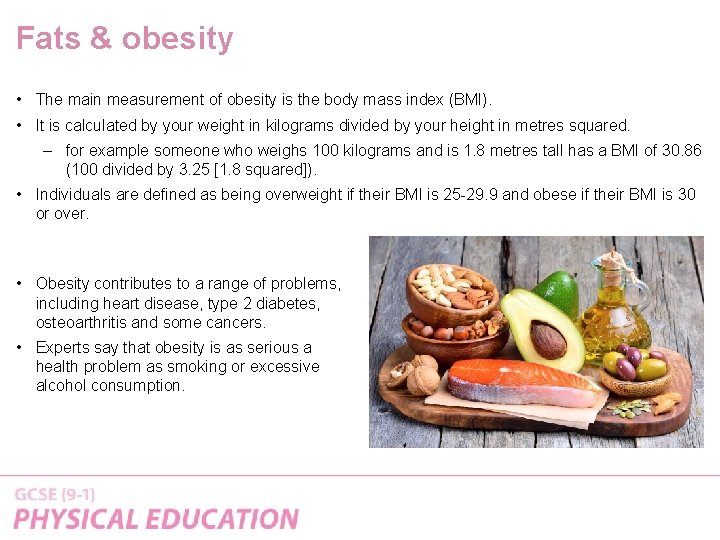
Fats & obesity • The main measurement of obesity is the body mass index (BMI). • It is calculated by your weight in kilograms divided by your height in metres squared. – for example someone who weighs 100 kilograms and is 1. 8 metres tall has a BMI of 30. 86 (100 divided by 3. 25 [1. 8 squared]). • Individuals are defined as being overweight if their BMI is 25 -29. 9 and obese if their BMI is 30 or over. • Obesity contributes to a range of problems, including heart disease, type 2 diabetes, osteoarthritis and some cancers. • Experts say that obesity is as serious a health problem as smoking or excessive alcohol consumption.
Vitamins, minerals, fibre and water (Micronutrients) Micronutrients Key Definitions: • • micro nutrients: nutrients needed in small quantities minerals and vitamins (we need them to maintain good health) people involved in physical activity will need more our body can store some micro nutrients for future use but some cannot be stored and so we need to eat a fresh supply every day.
Vitamins • Vitamins are non-caloric chemical compounds that are needed by the body in small quantities. • Vital in the production of energy, the functioning of our metabolism and the prevention of disease. • With the exception of vitamin D the body cannot produce vitamins. • Vitamins A, D, E and K are fat-soluble. • Vitamins B and C are water-soluble. • A well-balanced diet will ensure sufficient vitamin intake. • Vitamins can be found in fresh fruit and vegetables. • Extremely large doses of vitamins can be dangerous. • An overdose of vitamin A can cause hair loss and enlargement of the liver. • There is little evidence to suggest that supplementary vitamin pills can enhance performance • Most excess vitamins are simply excreted via urine
Vitamins SOURCES Of VITAMINS
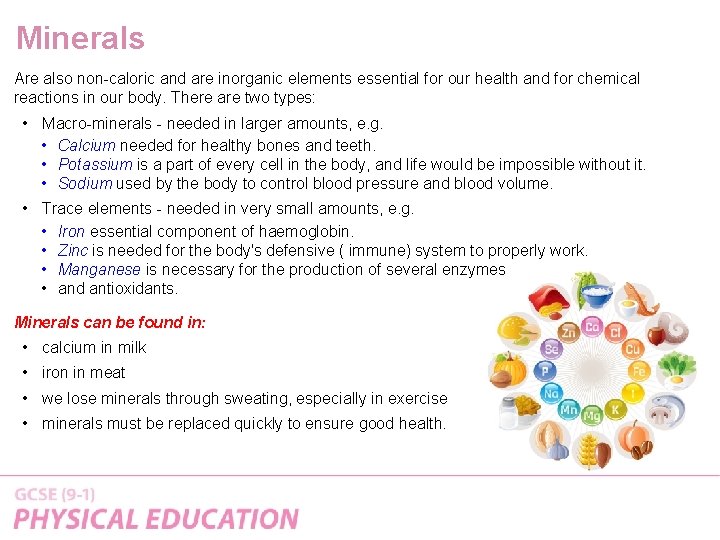
Minerals Are also non-caloric and are inorganic elements essential for our health and for chemical reactions in our body. There are two types: • Macro-minerals - needed in larger amounts, e. g. • Calcium needed for healthy bones and teeth. • Potassium is a part of every cell in the body, and life would be impossible without it. • Sodium used by the body to control blood pressure and blood volume. • Trace elements - needed in very small amounts, e. g. • Iron essential component of haemoglobin. • Zinc is needed for the body's defensive ( immune) system to properly work. • Manganese is necessary for the production of several enzymes • and antioxidants. Minerals can be found in: • calcium in milk • iron in meat • we lose minerals through sweating, especially in exercise • minerals must be replaced quickly to ensure good health.
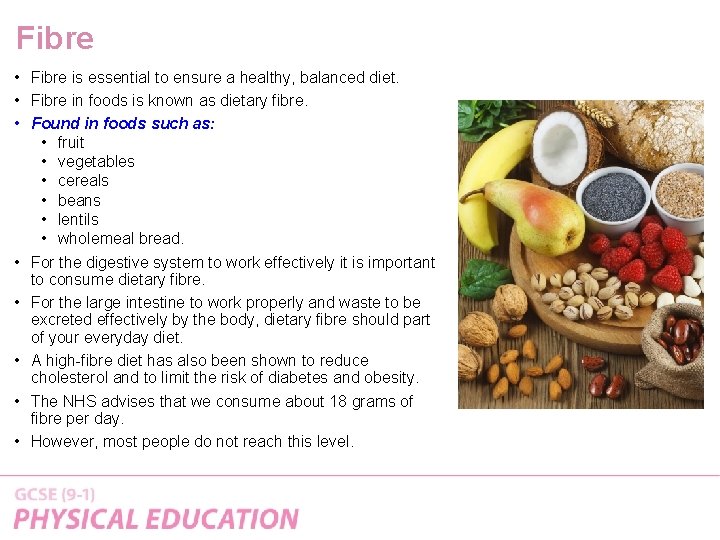
Fibre • Fibre is essential to ensure a healthy, balanced diet. • Fibre in foods is known as dietary fibre. • Found in foods such as: • fruit • vegetables • cereals • beans • lentils • wholemeal bread. • For the digestive system to work effectively it is important to consume dietary fibre. • For the large intestine to work properly and waste to be excreted effectively by the body, dietary fibre should part of your everyday diet. • A high-fibre diet has also been shown to reduce cholesterol and to limit the risk of diabetes and obesity. • The NHS advises that we consume about 18 grams of fibre per day. • However, most people do not reach this level.
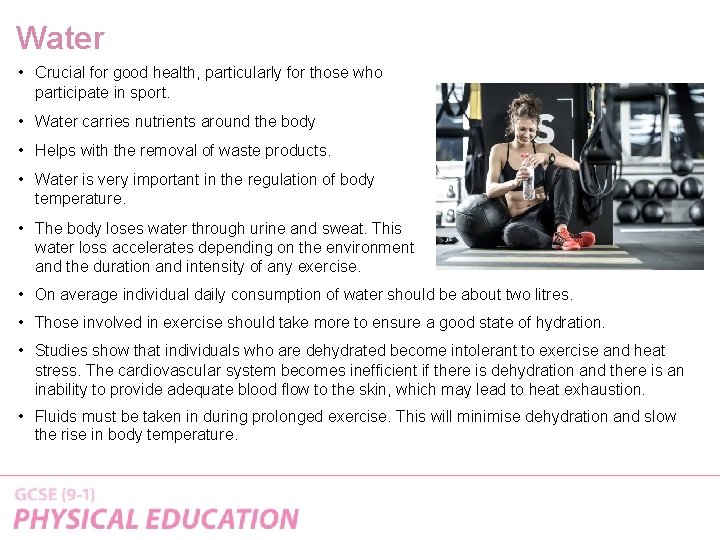
Water • Crucial for good health, particularly for those who participate in sport. • Water carries nutrients around the body • Helps with the removal of waste products. • Water is very important in the regulation of body temperature. • The body loses water through urine and sweat. This water loss accelerates depending on the environment and the duration and intensity of any exercise. • On average individual daily consumption of water should be about two litres. • Those involved in exercise should take more to ensure a good state of hydration. • Studies show that individuals who are dehydrated become intolerant to exercise and heat stress. The cardiovascular system becomes inefficient if there is dehydration and there is an inability to provide adequate blood flow to the skin, which may lead to heat exhaustion. • Fluids must be taken in during prolonged exercise. This will minimise dehydration and slow the rise in body temperature.
Hydration during exercise What are the effects of dehydration on athletes? Stay hydrated for health and peak performance watch this You. Tube video: https: //www. youtube. com/watch? v=b 6_b 84 MAmo 0 Nutrition and hydration for exercise - watch this You. Tube video: https: //www. youtube. com/watch? v=vah. Oi. Jst. G-s
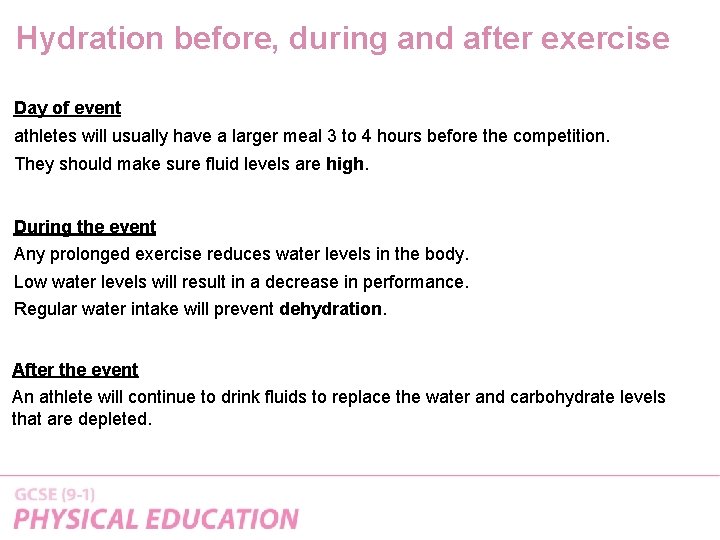
Hydration before, during and after exercise Day of event athletes will usually have a larger meal 3 to 4 hours before the competition. They should make sure fluid levels are high. During the event Any prolonged exercise reduces water levels in the body. Low water levels will result in a decrease in performance. Regular water intake will prevent dehydration. After the event An athlete will continue to drink fluids to replace the water and carbohydrate levels that are depleted.
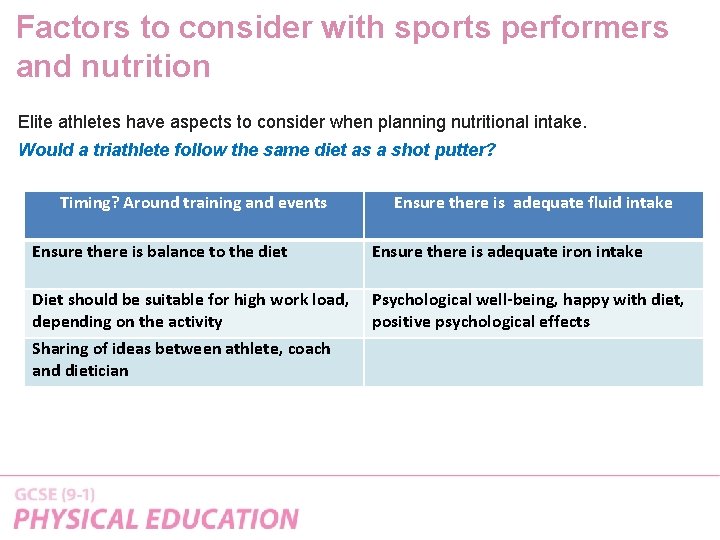
Factors to consider with sports performers and nutrition Elite athletes have aspects to consider when planning nutritional intake. Would a triathlete follow the same diet as a shot putter? Timing? Around training and events Ensure there is adequate fluid intake Ensure there is balance to the diet Ensure there is adequate iron intake Diet should be suitable for high work load, depending on the activity Psychological well-being, happy with diet, positive psychological effects Sharing of ideas between athlete, coach and dietician
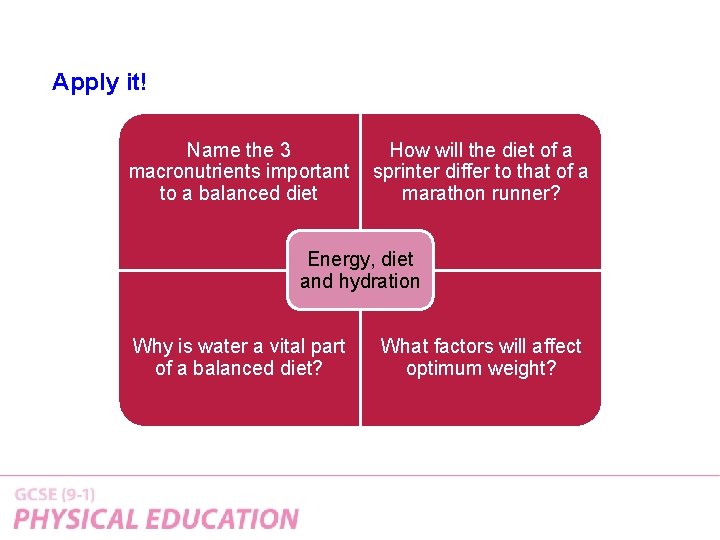
Apply it! How will the diet of a Name the 3 macronutrients important sprinter differ to that of a marathon runner? to a balanced diet Energy, diet and hydration Why is water a vital part of a balanced diet? What factors will affect optimum weight?
OCR Resources: the small print OCR’s resources are provided to support the delivery of OCR qualifications, but in no way constitute an endorsed teaching method that is required by the Board, and the decision to use them lies with the individual teacher. Whilst every effort is made to ensure the accuracy of the content, OCR cannot be held responsible for any errors or omissions within these resources. Our documents are updated over time. Whilst every effort is made to check all documents, there may be contradictions between published support and the specification, therefore please use the information on the latest specification at all times. Where changes are made to specifications these will be indicated within the document, there will be a new version number indicated, and a summary of the changes. If you do notice a discrepancy between the specification and a resource please contact us at: resources. feedback@ocr. org. uk. © OCR 2018 - This resource may be freely copied and distributed, as long as the OCR logo and this message remain intact and OCR is acknowledged as the originator of this work. OCR acknowledges the use of the following content: • • • 3 > World Health Organization sign / By Michel Passet / Shutterstock. com / ED 3 > Sticky_note / Lyudmyla Kharlamova / Shutterstock. com 5 > Man with beer and chips watching TV at home / Nomad_Soul / Shutterstock. com 14 > Woman snacking and zapping / saltodemata / Shutterstock. com 16 > Osteoporosis in the world_Medical infographic poster / Double Brain / Shutterstock. com 17 > Rehabilitation concept / Africa Studio / Shutterstock. com 18 > Exercise and healthy concept / i. Moved Studio / Shutterstock. com 23, 25 > Healthy foods infographics elements and background / nnnnae / Shutterstock. com 24 > Diet failure of fat man eating fast food / Poznyakov / Shutterstock. com 24 > Skinny young man with anorexia on grey background / Africa Studio / Shutterstock. com 27 > Liar concept Wooden Pinocchio doll with long nose / Ingkarat Bunnag / Shutterstock. com 28 > Main food groups macronutrients / Double Brain / Shutterstock. com • • • 29 > Foods Highest in Carbohydrates / bitt 24 / Shutterstock. com 30 > Different types of healthy uncooked proteins / nehophoto / Shutterstock. com 31, 32 > Selection of healthy fat sources on wooden background / Craevschii Family / Shutterstock. com 35 > Vitamin A in food / Evan Lorne / Shutterstock. com 35 > Foods rich in B 7 / Evan Lorne / Shutterstock. com 35 > Vitamin C in fruits and vegetables / Evan Lorne / Shutterstock. com 35 > Foods rich in vitamin D / Evan Lorne / Shutterstock. com 35 > Foods rich in vitamin E / Evan Lorne / Shutterstock. com 36 > Mineral Vitamin supplement / Olga. Chernyak / Shutterstock. com 37 > Foods rich in fiber / Evan Lorne / Shutterstock. com 38 > Laughing woman with curly hair sits on the floor in the gym / bezikus / Shutterstock. com Please get in touch if you want to discuss the accessibility of resources we offer to support delivery of our qualifications: resources. feedback@ocr. org. uk