SocioCultural Analysis Understanding HOW and WHY certain methodology


- Slides: 12
Socio-Cultural Analysis Understanding HOW and WHY certain methodology is use
What is Socio-Cultural Analysis? • Principles that define the sociocultural level of analysis – Humans are social animals with a basic need to belong – Culture influences human behavior – Humans have a social self which reflects their group membership • In and out groups • How do these research methods help us study the principles
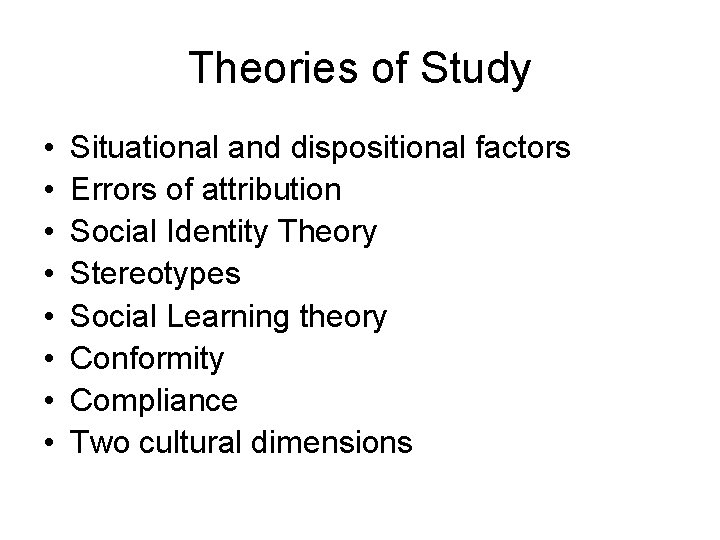
Theories of Study • • Situational and dispositional factors Errors of attribution Social Identity Theory Stereotypes Social Learning theory Conformity Compliance Two cultural dimensions
Learning Outcomes • Discuss how and why particular research methods are used at the sociocultural level of analysis – How • Structure of research Why • What do we learn about behavior? • Why is this method the best for the aim/hypothesis? • Why is this method better than other methods to study the same behavior/theory
Challenges to studying culture 1. The problem of methods and samples 2. Problem of interpreting results • Language and custom barriers 3. Problem of stereotyping • • How do you describe differences with out stereotyping? We say “the Asians” or “the Latinos”…are they all the same? 4. Reification of culture • • Make abstract concrete (simplify) Example: emotion (complex cluster of physical and mental reactions) as a literal object
Common methods Used • Experiments – Laboratory Experiments – Field experiments – Natural experiments • Correlational Studies • Case Studies – Based on: Interviews & Archival evidence • Participant Observation
Methodology Challenges • Internal validity – Sampling (randomization) • External validity – Replication – Meta-analysis – Cross-cultural studies • Emic/Etic distinction – Emic: specific or local – Etic: universal characteristics of society
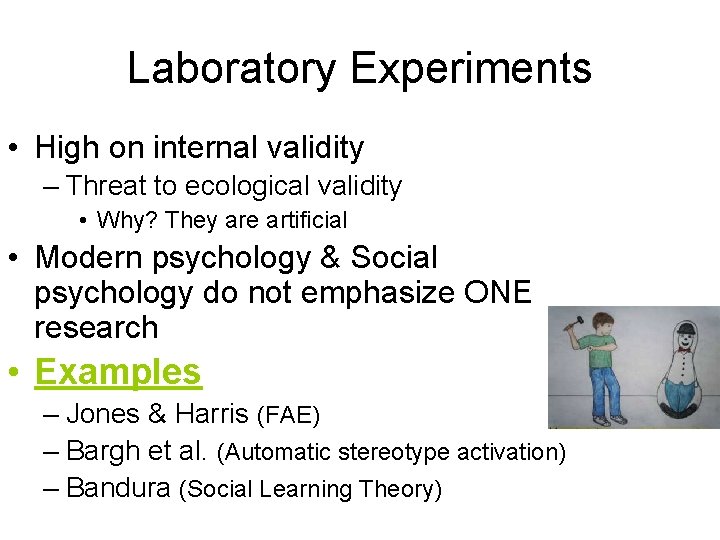
Laboratory Experiments • High on internal validity – Threat to ecological validity • Why? They are artificial • Modern psychology & Social psychology do not emphasize ONE research • Examples – Jones & Harris (FAE) – Bargh et al. (Automatic stereotype activation) – Bandura (Social Learning Theory)
Field Experiments • Field experiments often follow lab experiments – Minimizes weaknesses in lab experiments • Triangulation • Cross-cultural studies using experiments are not possible – Why? • Examples – Palak et al (Compliance) • Attempts natural experiments to study culture – NO clear causal statements
Correlational Studies • Use large-scale surveys • Suspicious – Why? • Complex mathematical models for factor analysis – Do not study individual behavior – Impact? • Results are used as general guides for explaining behavior • Example – Hofstede (cultural dimensions)
Case Studies • Are you really studying what you say you are studying – Asch social Was it social? They were strangers • Limitations – Can’t be generalized – Method of data collection raises doubts about objectivity • Examples – Janis (Group Think) – Esser and Lindoerfer (Group Think)
Participant Observation • Research infiltrates the setting to be studied and observes its workings from within. – Internal spy