Singleview geometry Odilon Redon Cyclops 1914 Geometric vision



- Slides: 32
Single-view geometry Odilon Redon, Cyclops, 1914
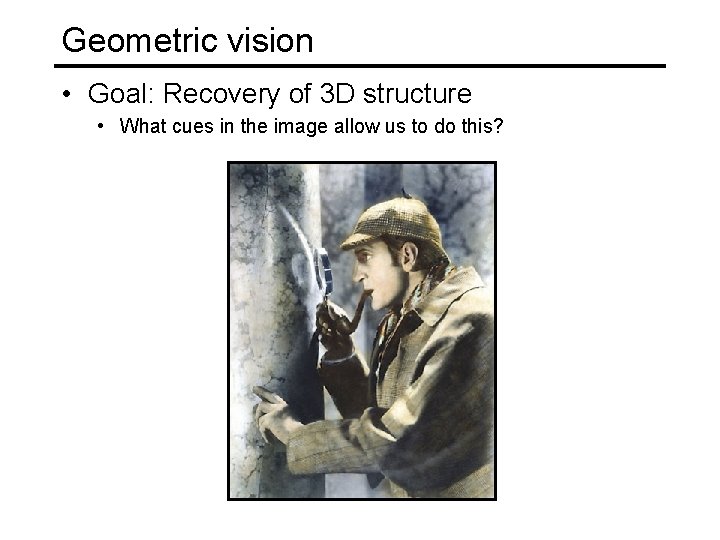
Geometric vision • Goal: Recovery of 3 D structure • What cues in the image allow us to do this?
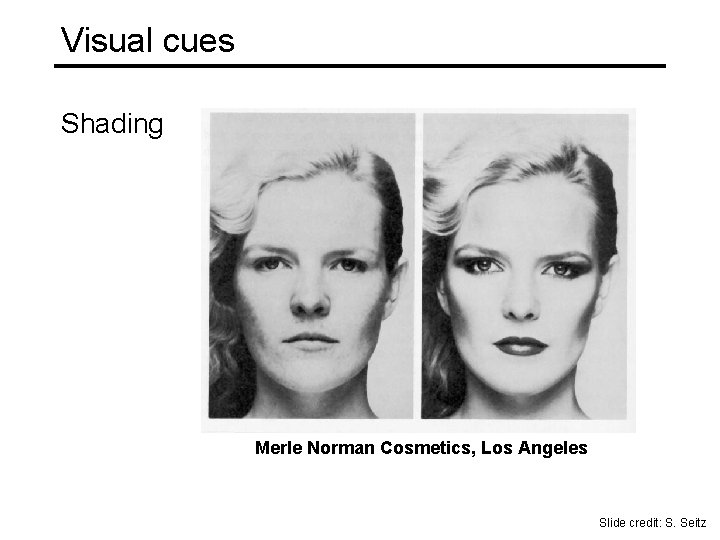
Visual cues Shading Merle Norman Cosmetics, Los Angeles Slide credit: S. Seitz
Visual cues Focus From The Art of Photography, Canon Slide credit: S. Seitz
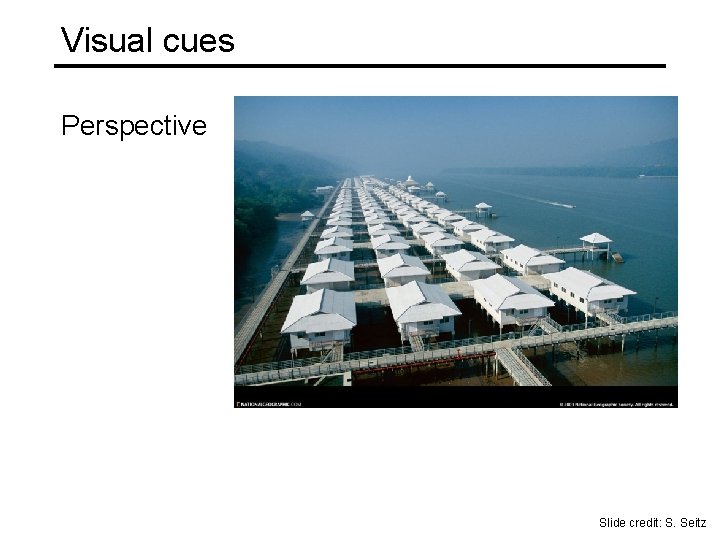
Visual cues Perspective Slide credit: S. Seitz
Visual cues Motion Slide credit: S. Seitz
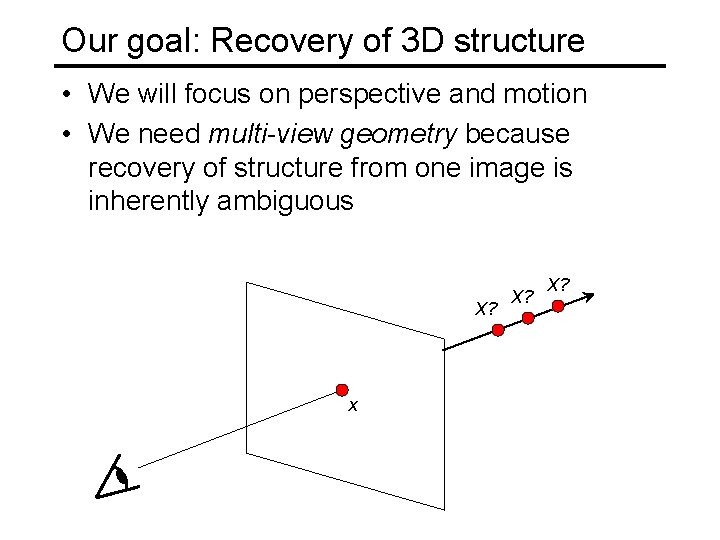
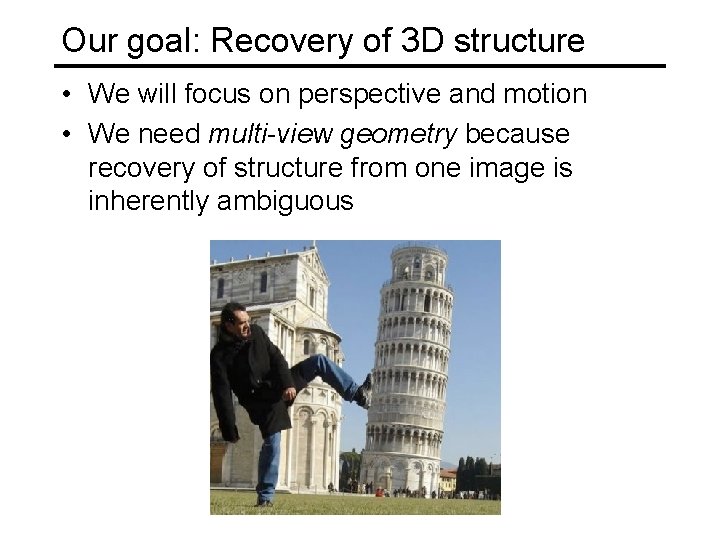
Our goal: Recovery of 3 D structure • We will focus on perspective and motion • We need multi-view geometry because recovery of structure from one image is inherently ambiguous X? x X?
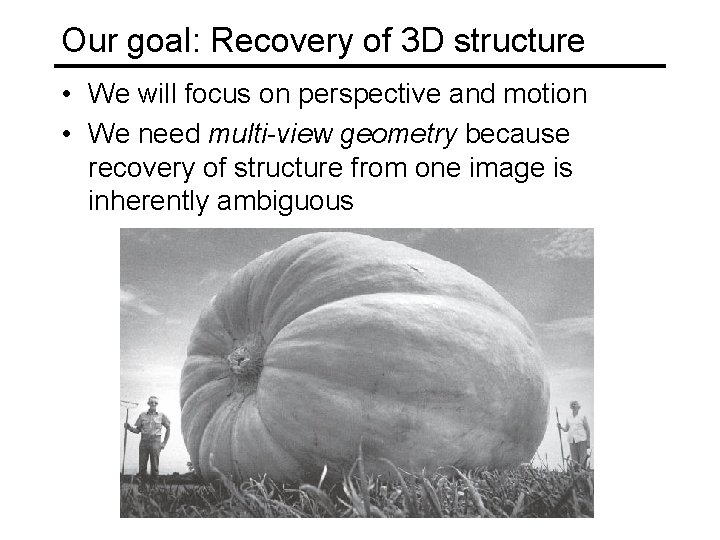
Our goal: Recovery of 3 D structure • We will focus on perspective and motion • We need multi-view geometry because recovery of structure from one image is inherently ambiguous
Our goal: Recovery of 3 D structure • We will focus on perspective and motion • We need multi-view geometry because recovery of structure from one image is inherently ambiguous
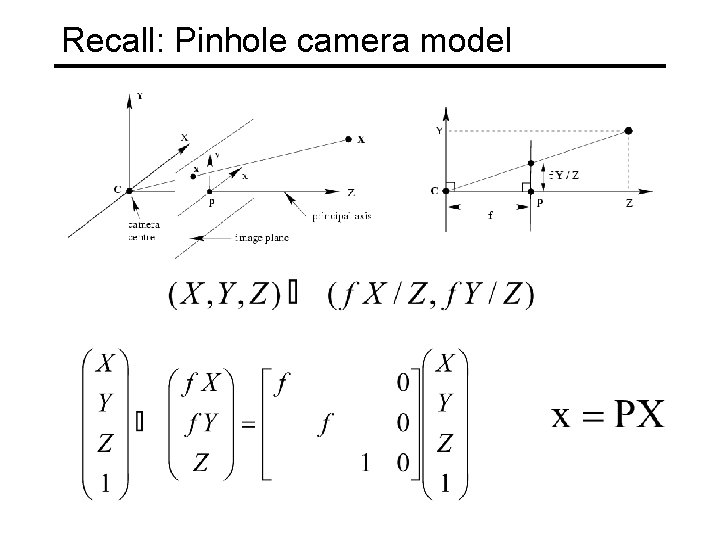
Recall: Pinhole camera model
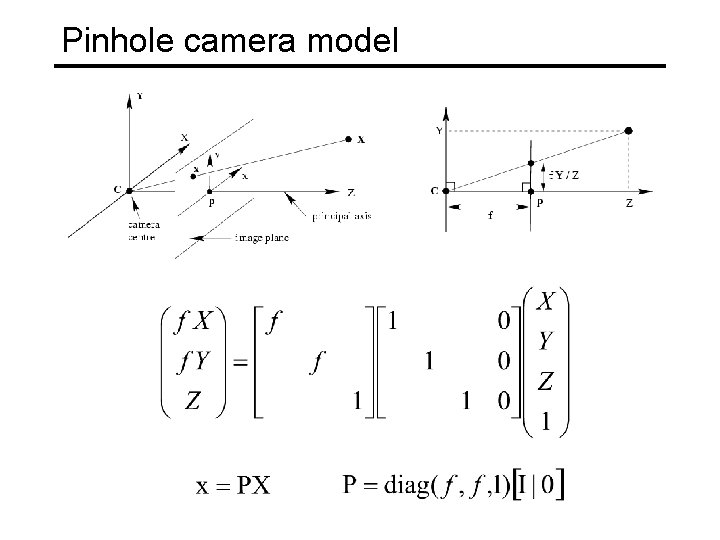
Pinhole camera model
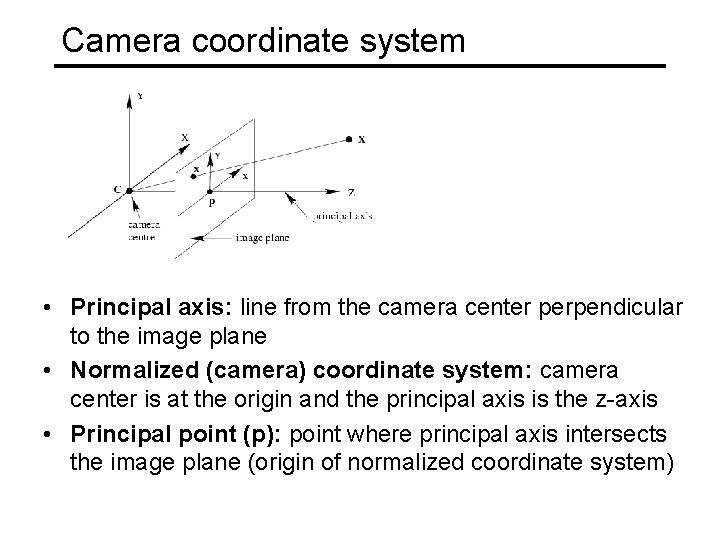
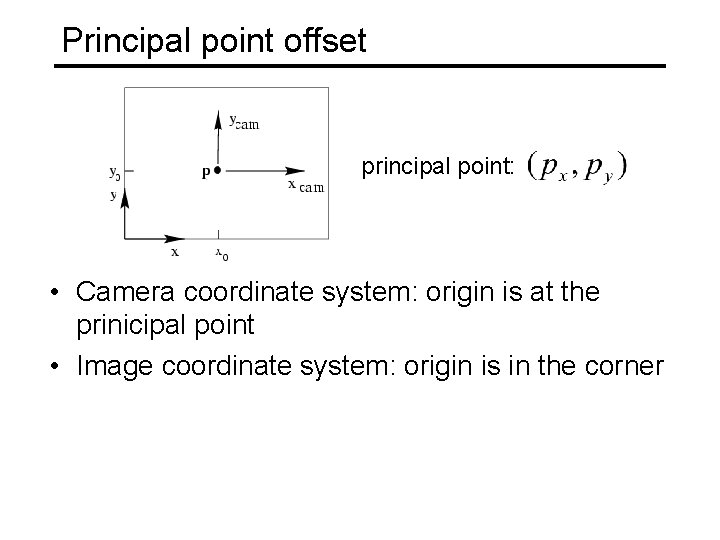
Camera coordinate system • Principal axis: line from the camera center perpendicular to the image plane • Normalized (camera) coordinate system: camera center is at the origin and the principal axis is the z-axis • Principal point (p): point where principal axis intersects the image plane (origin of normalized coordinate system)
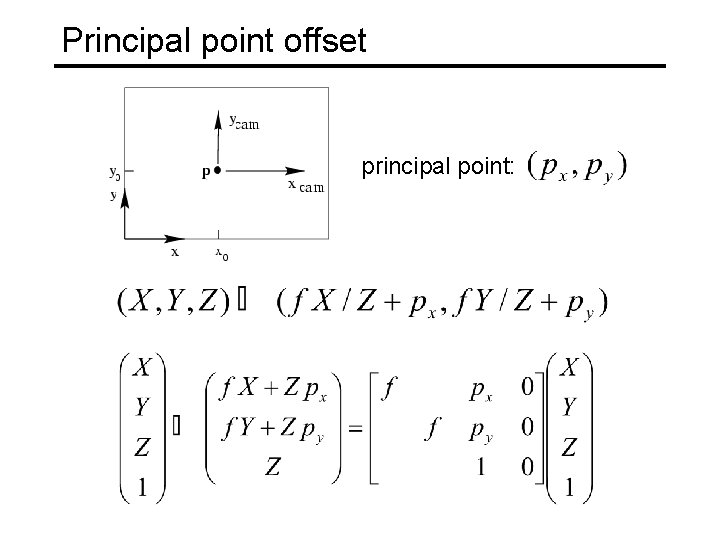
Principal point offset principal point: • Camera coordinate system: origin is at the prinicipal point • Image coordinate system: origin is in the corner
Principal point offset principal point:
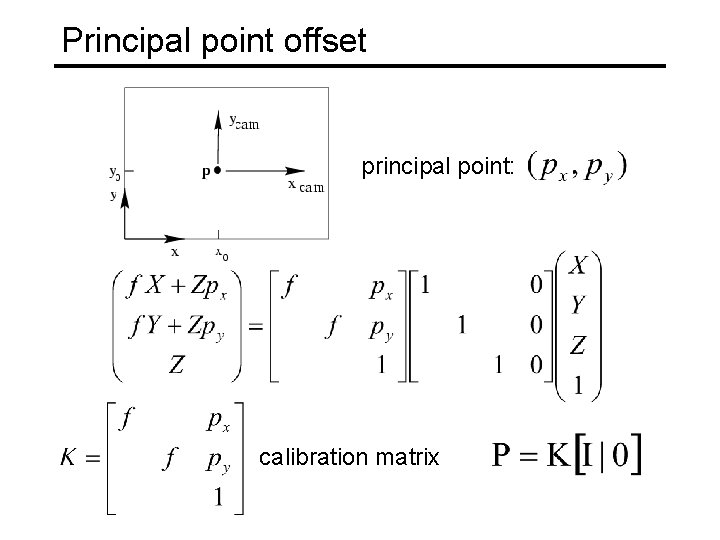
Principal point offset principal point: calibration matrix
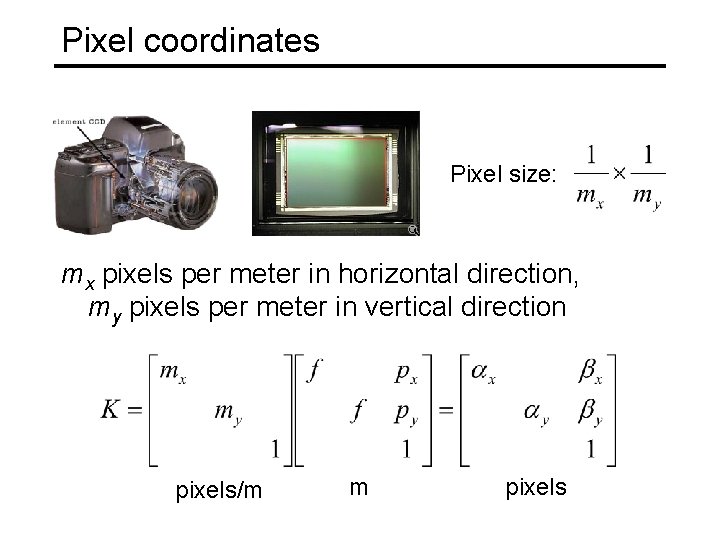
Pixel coordinates Pixel size: mx pixels per meter in horizontal direction, my pixels per meter in vertical direction pixels/m m pixels
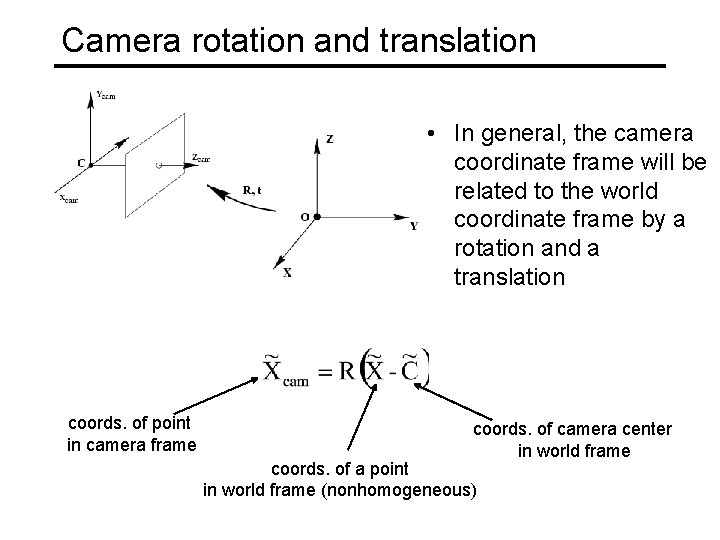
Camera rotation and translation • In general, the camera coordinate frame will be related to the world coordinate frame by a rotation and a translation coords. of point in camera frame coords. of camera center in world frame coords. of a point in world frame (nonhomogeneous)
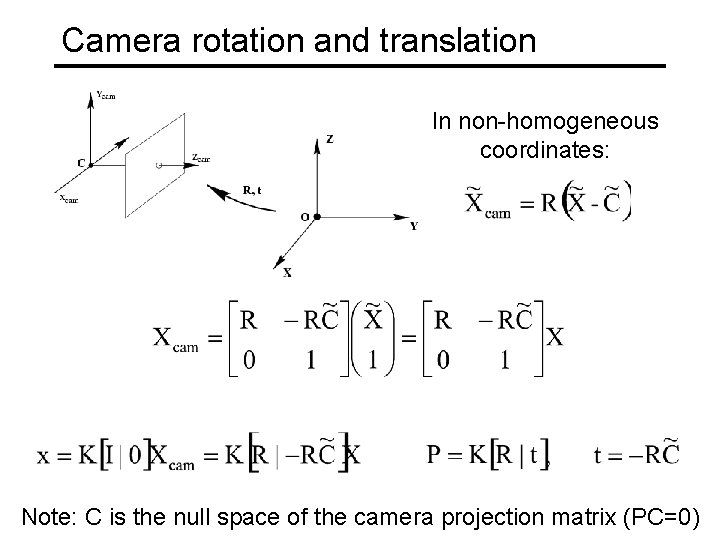
Camera rotation and translation In non-homogeneous coordinates: Note: C is the null space of the camera projection matrix (PC=0)
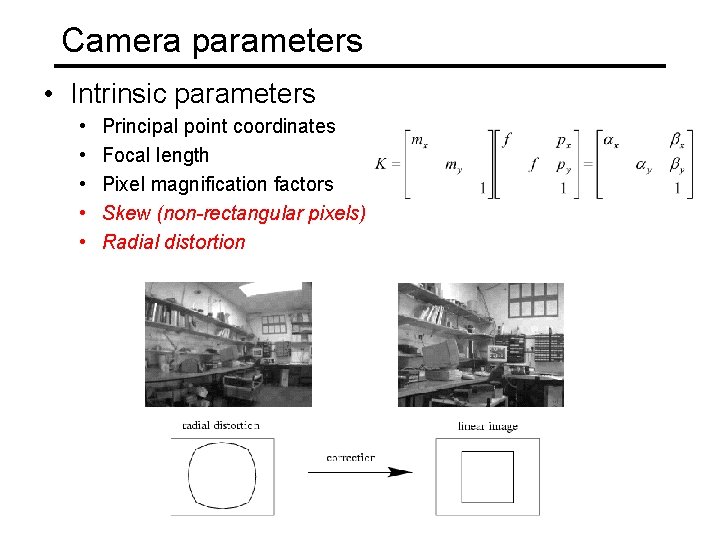
Camera parameters • Intrinsic parameters • • • Principal point coordinates Focal length Pixel magnification factors Skew (non-rectangular pixels) Radial distortion
Camera parameters • Intrinsic parameters • • • Principal point coordinates Focal length Pixel magnification factors Skew (non-rectangular pixels) Radial distortion • Extrinsic parameters • Rotation and translation relative to world coordinate system
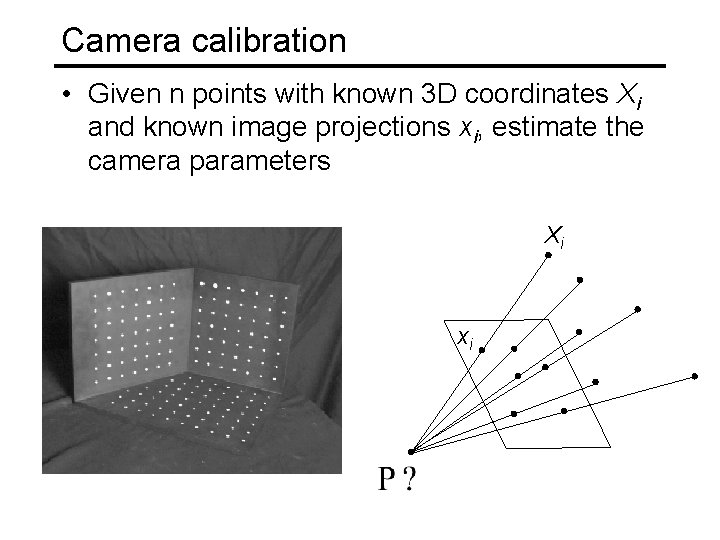
Camera calibration • Given n points with known 3 D coordinates Xi and known image projections xi, estimate the camera parameters Xi xi
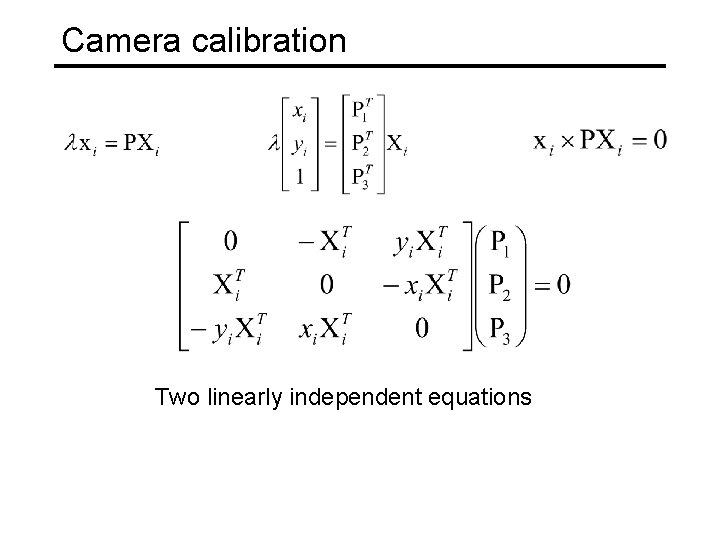
Camera calibration Two linearly independent equations
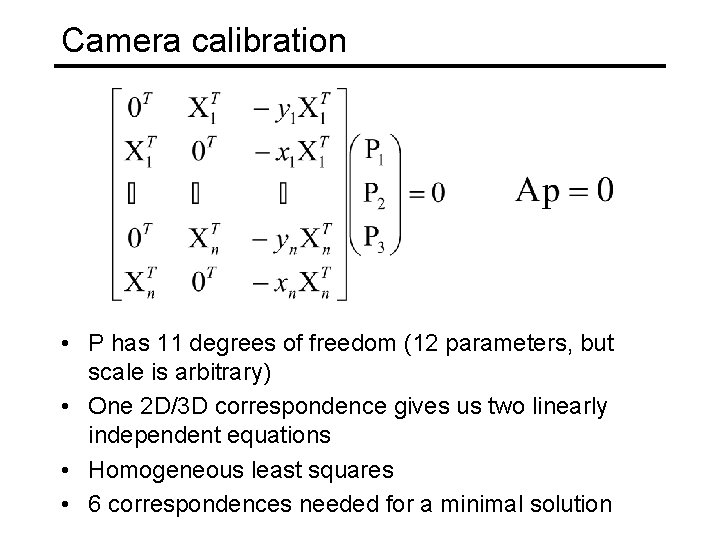
Camera calibration • P has 11 degrees of freedom (12 parameters, but scale is arbitrary) • One 2 D/3 D correspondence gives us two linearly independent equations • Homogeneous least squares • 6 correspondences needed for a minimal solution
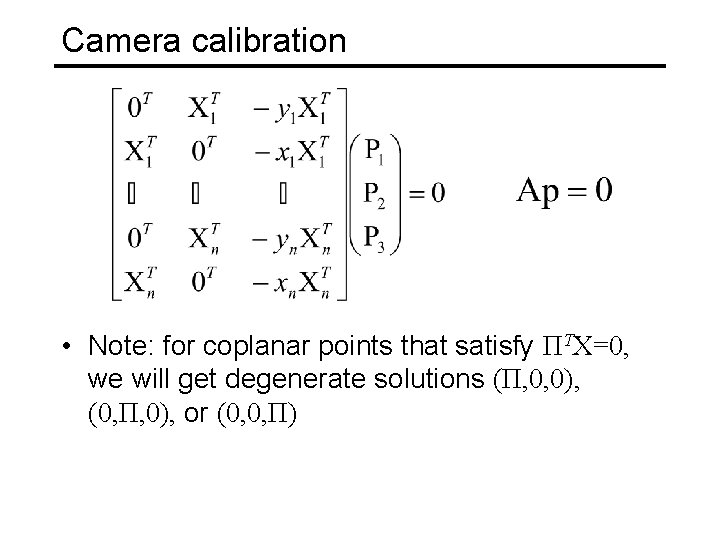
Camera calibration • Note: for coplanar points that satisfy ΠTX=0, we will get degenerate solutions (Π, 0, 0), (0, Π, 0), or (0, 0, Π)
Camera calibration • Once we’ve recovered the numerical form of the camera matrix, we still have to figure out the intrinsic and extrinsic parameters • This is a matrix decomposition problem, not an estimation problem (see F&P sec. 3. 2, 3. 3)
Two-view geometry • Scene geometry (structure): Given projections of the same 3 D point in two or more images, how do we compute the 3 D coordinates of that point? • Correspondence (stereo matching): Given a point in just one image, how does it constrain the position of the corresponding point in a second image? • Camera geometry (motion): Given a set of corresponding points in two images, what are the cameras for the two views?
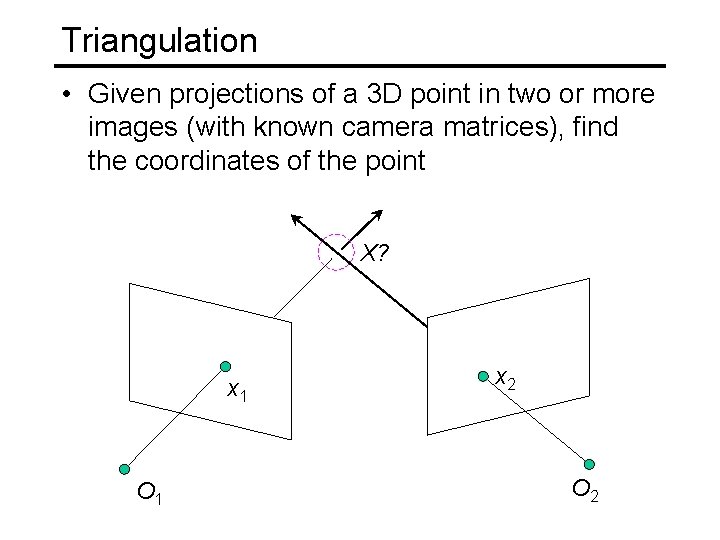
Triangulation • Given projections of a 3 D point in two or more images (with known camera matrices), find the coordinates of the point X? x 1 O 1 x 2 O 2
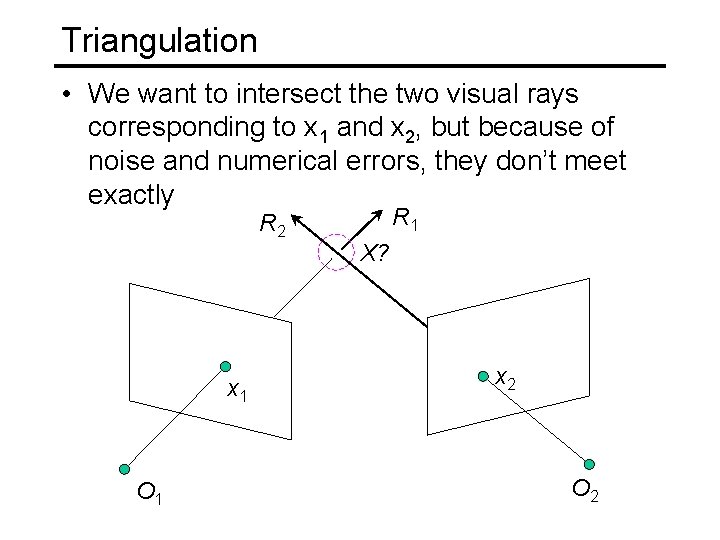
Triangulation • We want to intersect the two visual rays corresponding to x 1 and x 2, but because of noise and numerical errors, they don’t meet exactly R 2 x 1 O 1 R 1 X? x 2 O 2
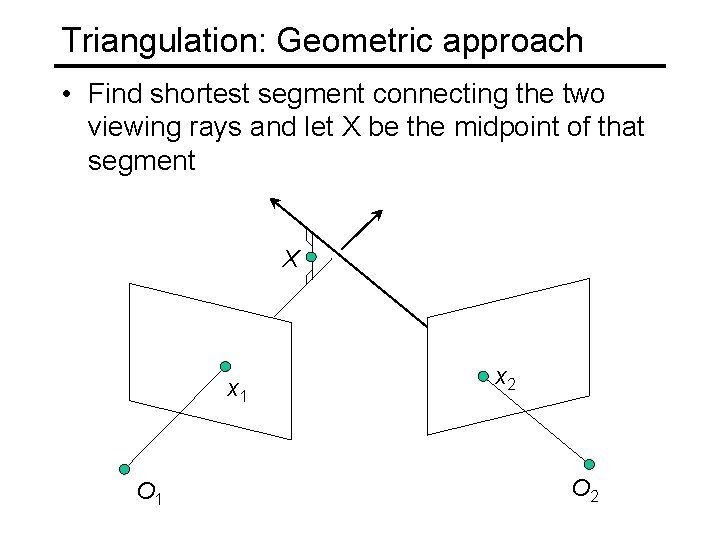
Triangulation: Geometric approach • Find shortest segment connecting the two viewing rays and let X be the midpoint of that segment X x 1 O 1 x 2 O 2
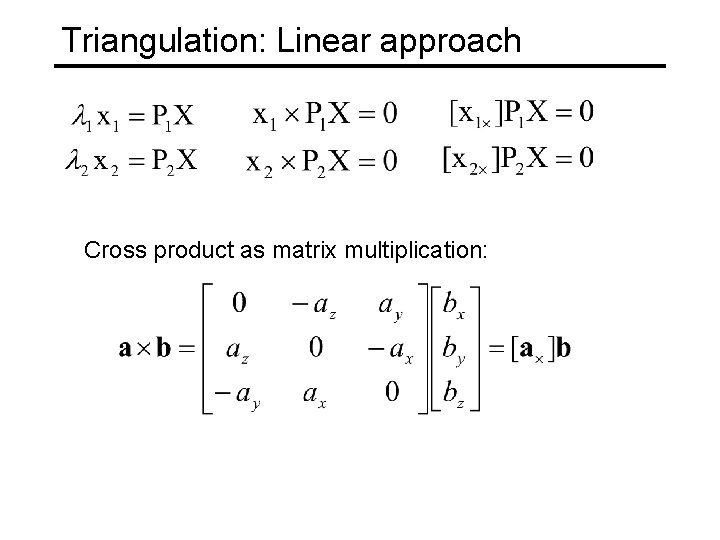
Triangulation: Linear approach Cross product as matrix multiplication:
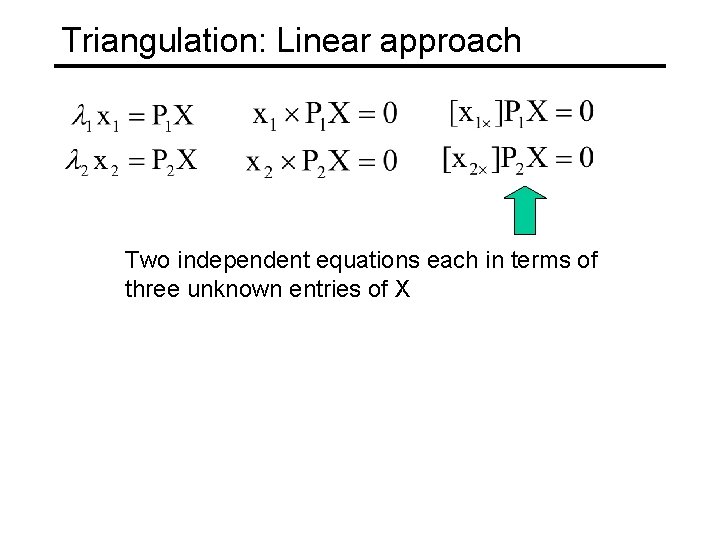
Triangulation: Linear approach Two independent equations each in terms of three unknown entries of X
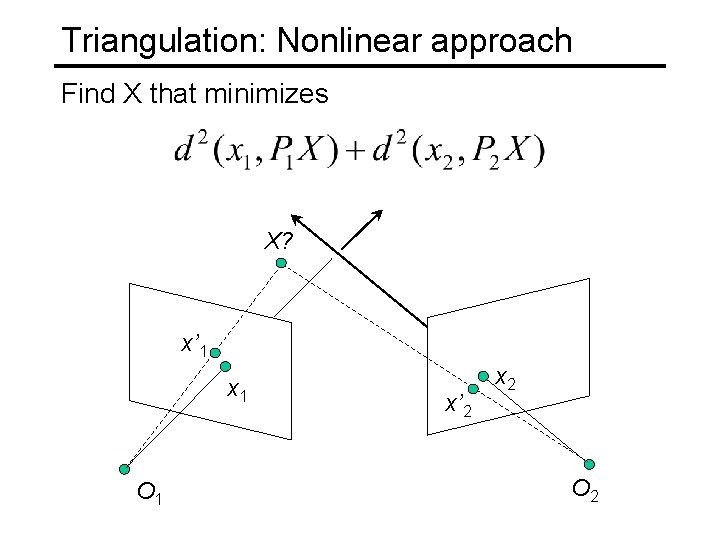
Triangulation: Nonlinear approach Find X that minimizes X? x’ 1 x 1 O 1 x’ 2 x 2 O 2