
Introduction to Epic and Myth The Cyclops Big
Introduction to Epic and Myth “The Cyclops” Big Idea: “Patterns allow us to make sense of our world. ” Essential Question: “How do myths reflect cultural beliefs and values? ”

Greek Beliefs and Values • The Greeks often told stories about the gods to teach their children how to behave. • Stories warned against hubris (thinking you were better than the gods). • Stories also warned children against greed and cheating. Q: How do we warn our children today?

Greek Cultural Beliefs and Values • • The Greeks valued: Intelligence Hospitality Homeland Youth and beauty Rhetorical abilities (the ability to speak well) Respect for the gods Q: “How are their values different from your culture or experience? ”
Patterns in Myths, Culture, Values Review: • Criteria of a Myth – • Characteristics of Patterns - • Patterns of Archetypes – Old patterns or images that recur over and over again in literature (H, R &W 2003) • In this introduction to Epic we will look at a Monster and a Hero pattern from The Cyclops.
Vocabulary • • Epic – A long narrative poem that tells a story Epic Hero – A “larger than life” main character Cyclops – a one-eyed giant Adversary- Someone you are competing with or fighting against In media res- A story that begins in the middle Odyssey – A long voyage or wandering Cordial – sincere, warm and friendly Ravage – destroy violently; ruin
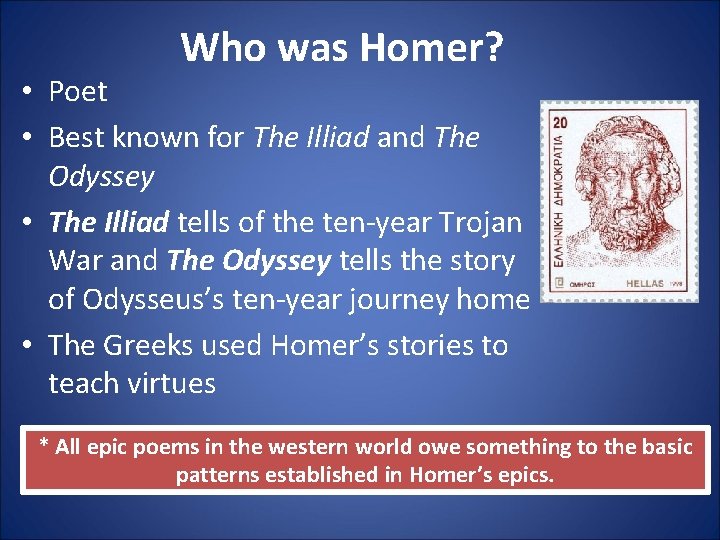
Who was Homer? • Poet • Best known for The Illiad and The Odyssey • The Illiad tells of the ten-year Trojan War and The Odyssey tells the story of Odysseus’s ten-year journey home • The Greeks used Homer’s stories to teach virtues * All epic poems in the western world owe something to the basic patterns established in Homer’s epics.
Patterns of Archetypes in Myths • In this Introduction to the Epic, we will examine the archetypes of good and evil. • Hero = “good” embodied in the character of Odysseus. • Evil = “Bad” embodied in the character of Polyphemus. Q: What modern archetype patterns of “good and evil” can you name from your culture?
Archetype Patterns Monsters and Heroes (7 basic traits) Monsters 1. Superhuman 2. On a quest, journey 3. Fight monsters 4. Are of divine and human birth mixed origins • 5. Interference from divine world • 6. Undergo a transformation • 7. Visit the Underworld • • • Strange mythical beasts Unnatural Not human Hostile to people Inspire dread and embody evil • Represent impossible barriers/challenges

An Overview of The Cyclops • The story begins with Odysseus and his crew waiting in a cave. • When Polyphemus arrives, the men are afraid and scatter to safety. • Odysseus suggests hospitality from the Cyclops to keep from offending the gods. Q: Looking at these two paintings, what can you infer about the Cyclops’s characteristics? • The Cyclops laughs at the suggestion. • Odysseus introduces himself as “no body. ” • The men brainstorm an escape. • They sharpen a stick, introduce the Cyclops to wine, and as he sleeps, they stab him in the eye. • Odysseus and his men escape by tying themselves to the sheep’s underbellies.
Works Cited • Carr, Karen. www. historyforkids. org 2012. accessed on August 16, 2013. • Greychuk, Bishop. www. bishopgreschuk. ecsd. net accessed on August 16 2013. • Issacs, Katie. http: //grovesite. com/page. asp? o=vchs&s • Lahanas, Micheal. www. mlahanas. de/Greeks/Live • Tischbein, Johann. Polyphemus, 1802 Landesmuseum Oldenburg • www. wtps. org/wths/imc/pathfinders/archetypes. pdf
- Slides: 10