SEG 3101 Fall 2015 Introduction to Requirements Elicitation

- Slides: 27
SEG 3101 (Fall 2015) Introduction to Requirements Elicitation Miguel Garzón, University of Ottawa Based on Powerpoint slides by Gunter Mussbacher with material from: Jo Atlee, Nancy Day, Dan Berry (all University of Waterloo); Amyot 2008 -2009, Somé 2008
Table of Contents • Goals, Risks, and Challenges • Sources of Requirements • Requirements Elicitation Tasks • Elicitation Problems • I know that you believe that you understood what you think I said, but I am not sure you realize that what you heard is not what I meant. 1 [1] Robert Mc. Closkey, State Department spokesman SEG 3101 (Fall 2014). Introduction to Requirements Elicitation 2
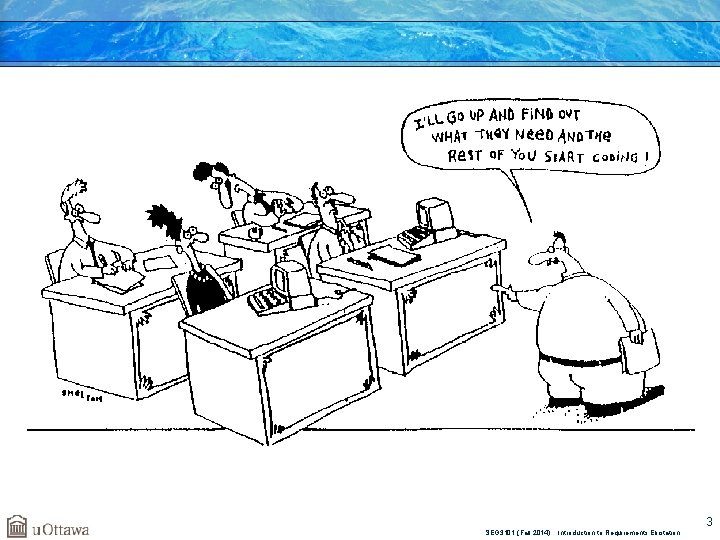
SEG 3101 (Fall 2014). Introduction to Requirements Elicitation 3
Goals, Risks, and Challenges
Goals, Risks, and Challenges Sources of Requirements Elicitation Tasks Elicitation Problems What is Requirements Elicitation? • Requirements elicitation is “the process of discovering the requirements for a system by communicating with customers, system users and others who have a stake in the system development” 1 • Elicitation means “to bring out, to evoke, to call forth” • Elicitation might even require one to provoke! • Human activity involving interaction between a diverse array of human beings [1] Ian Sommerville and Pete Sawyer SEG 3101 (Fall 2014). Introduction to Requirements Elicitation 5
Goals, Risks, and Challenges Sources of Requirements Elicitation Tasks Elicitation Problems Elicitation Goals • Determine sources of information & appropriate techniques • Get information on domain, problem, constraints • Produce a first document • Mainly user requirements and elicitation notes • Potentially incomplete, disorganized, inconsistent • But we must start somewhere! SEG 3101 (Fall 2014). Introduction to Requirements Elicitation 6
Goals, Risks, and Challenges Sources of Requirements Elicitation Tasks Elicitation Problems Elicitation Risks and Challenges (1) • Problems of scope • System boundaries inadequately defined or defined too soon • Unnecessary technical details • Problems of understanding • Stakeholder not sure of what is needed • Stakeholder has trouble communicating needs • Stakeholder does not understand capabilities and limitation of computing environment • Requirements limited by what stakeholders think is possible • Stakeholder does not have full understanding of domain • Stakeholders state conflicting requirements • Hard to detect, negotiate, and prioritize • Problems of volatility • Stakeholders will not commit to a set of written requirements SEG 3101 (Fall 2014). Introduction to Requirements Elicitation 7
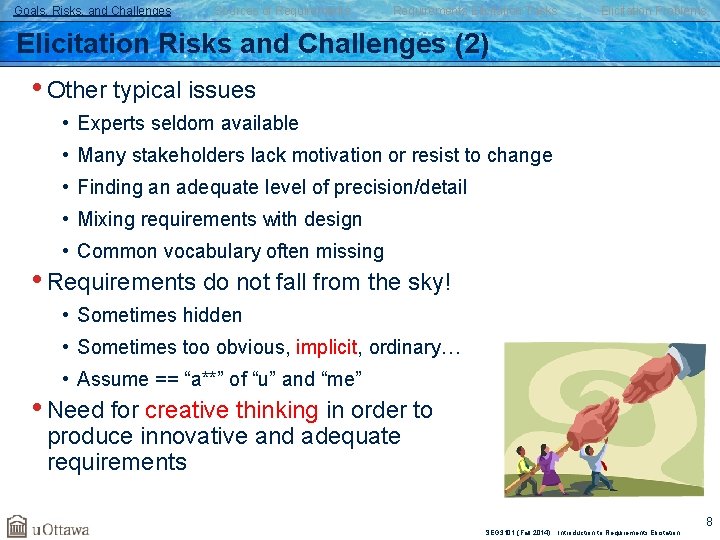
Goals, Risks, and Challenges Sources of Requirements Elicitation Tasks Elicitation Problems Elicitation Risks and Challenges (2) • Other typical issues • Experts seldom available • Many stakeholders lack motivation or resist to change • Finding an adequate level of precision/detail • Mixing requirements with design • Common vocabulary often missing • Requirements do not fall from the sky! • Sometimes hidden • Sometimes too obvious, implicit, ordinary… • Assume == “a**” of “u” and “me” • Need for creative thinking in order to produce innovative and adequate requirements SEG 3101 (Fall 2014). Introduction to Requirements Elicitation 8
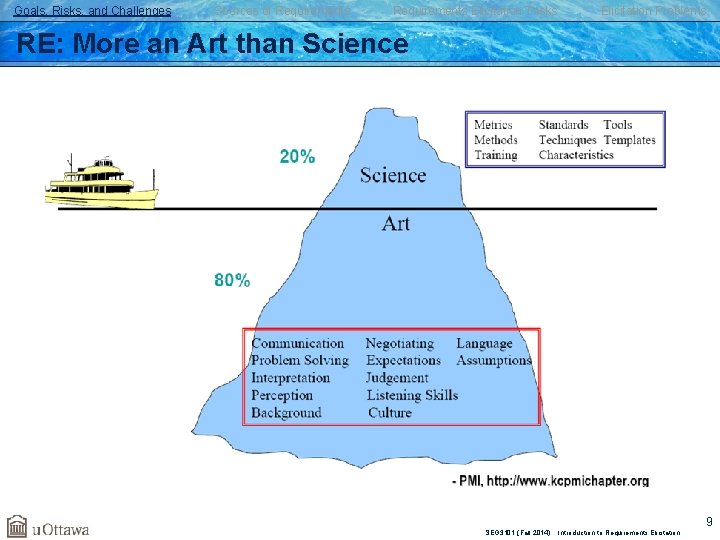
Goals, Risks, and Challenges Sources of Requirements Elicitation Tasks Elicitation Problems RE: More an Art than Science SEG 3101 (Fall 2014). Introduction to Requirements Elicitation 9
Sources of Requirements
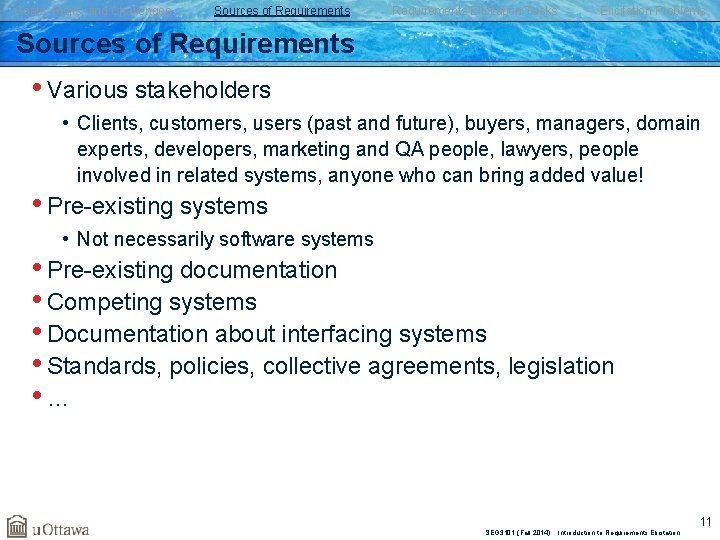
Goals, Risks, and Challenges Sources of Requirements Elicitation Tasks Elicitation Problems Sources of Requirements • Various stakeholders • Clients, customers, users (past and future), buyers, managers, domain experts, developers, marketing and QA people, lawyers, people involved in related systems, anyone who can bring added value! • Pre-existing systems • Not necessarily software systems • Pre-existing documentation • Competing systems • Documentation about interfacing systems • Standards, policies, collective agreements, legislation • … SEG 3101 (Fall 2014). Introduction to Requirements Elicitation 11
Goals, Risks, and Challenges Sources of Requirements Elicitation Tasks Elicitation Problems Stakeholder – Customer/Client • Person who pays for the software development • Ultimately, has the final word on what will be the product • For an internal product, the client is probably a product manager • For the consumer market, the customer may be the marketing department SEG 3101 (Fall 2014). Introduction to Requirements Elicitation 12
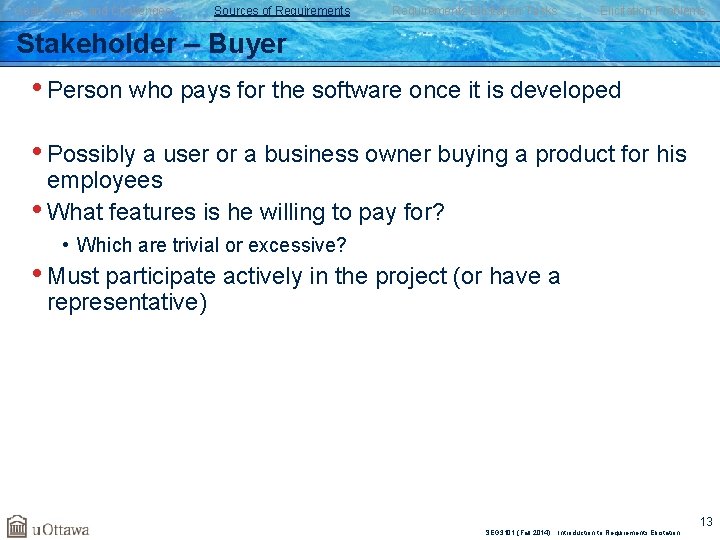
Goals, Risks, and Challenges Sources of Requirements Elicitation Tasks Elicitation Problems Stakeholder – Buyer • Person who pays for the software once it is developed • Possibly a user or a business owner buying a product for his employees • What features is he willing to pay for? • Which are trivial or excessive? • Must participate actively in the project (or have a representative) SEG 3101 (Fall 2014). Introduction to Requirements Elicitation 13
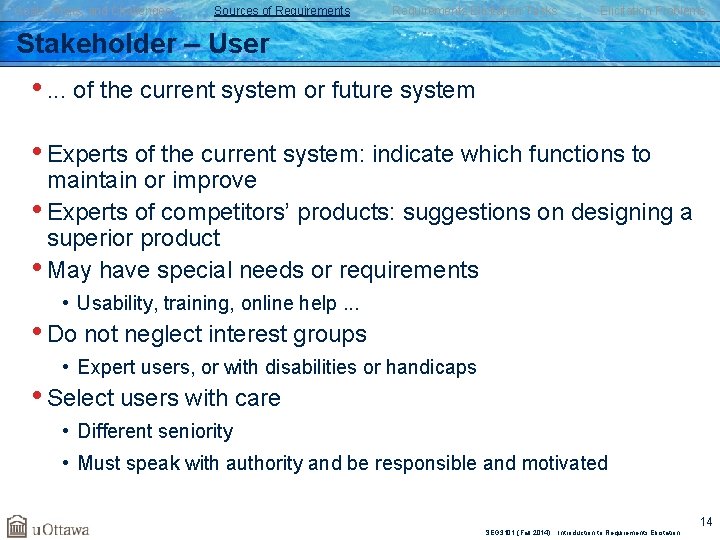
Goals, Risks, and Challenges Sources of Requirements Elicitation Tasks Elicitation Problems Stakeholder – User • . . . of the current system or future system • Experts of the current system: indicate which functions to maintain or improve • Experts of competitors’ products: suggestions on designing a superior product • May have special needs or requirements • Usability, training, online help. . . • Do not neglect interest groups • Expert users, or with disabilities or handicaps • Select users with care • Different seniority • Must speak with authority and be responsible and motivated SEG 3101 (Fall 2014). Introduction to Requirements Elicitation 14
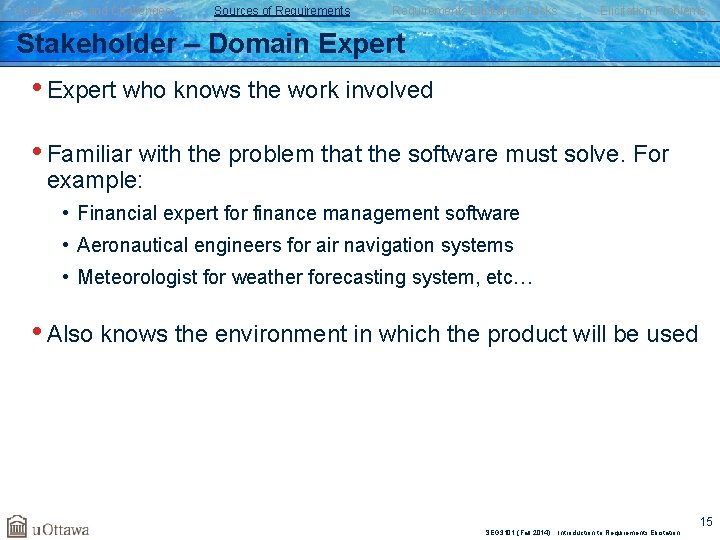
Goals, Risks, and Challenges Sources of Requirements Elicitation Tasks Elicitation Problems Stakeholder – Domain Expert • Expert who knows the work involved • Familiar with the problem that the software must solve. For example: • Financial expert for finance management software • Aeronautical engineers for air navigation systems • Meteorologist for weather forecasting system, etc… • Also knows the environment in which the product will be used SEG 3101 (Fall 2014). Introduction to Requirements Elicitation 15
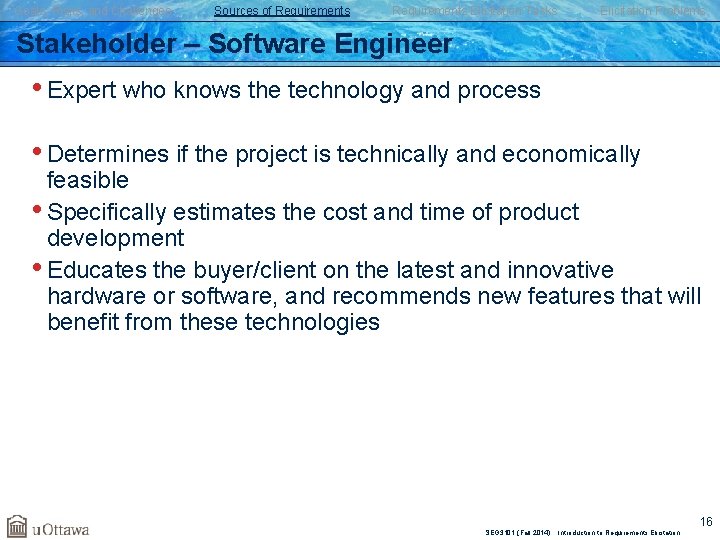
Goals, Risks, and Challenges Sources of Requirements Elicitation Tasks Elicitation Problems Stakeholder – Software Engineer • Expert who knows the technology and process • Determines if the project is technically and economically feasible • Specifically estimates the cost and time of product development • Educates the buyer/client on the latest and innovative hardware or software, and recommends new features that will benefit from these technologies SEG 3101 (Fall 2014). Introduction to Requirements Elicitation 16
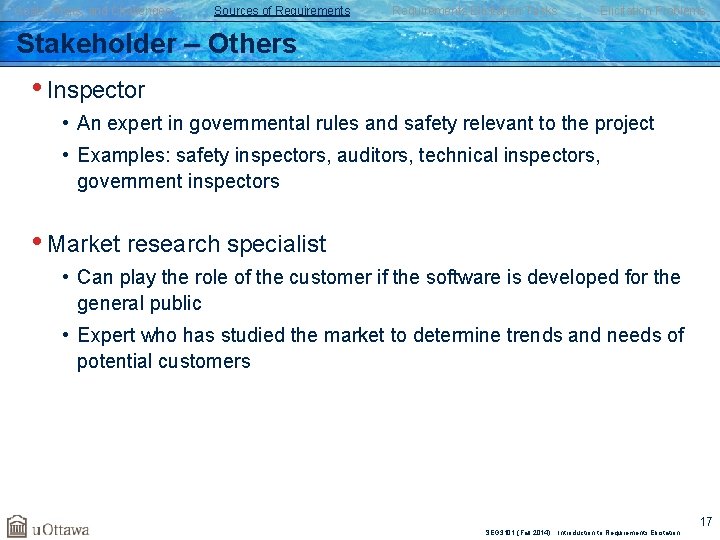
Goals, Risks, and Challenges Sources of Requirements Elicitation Tasks Elicitation Problems Stakeholder – Others • Inspector • An expert in governmental rules and safety relevant to the project • Examples: safety inspectors, auditors, technical inspectors, government inspectors • Market research specialist • Can play the role of the customer if the software is developed for the general public • Expert who has studied the market to determine trends and needs of potential customers SEG 3101 (Fall 2014). Introduction to Requirements Elicitation 17
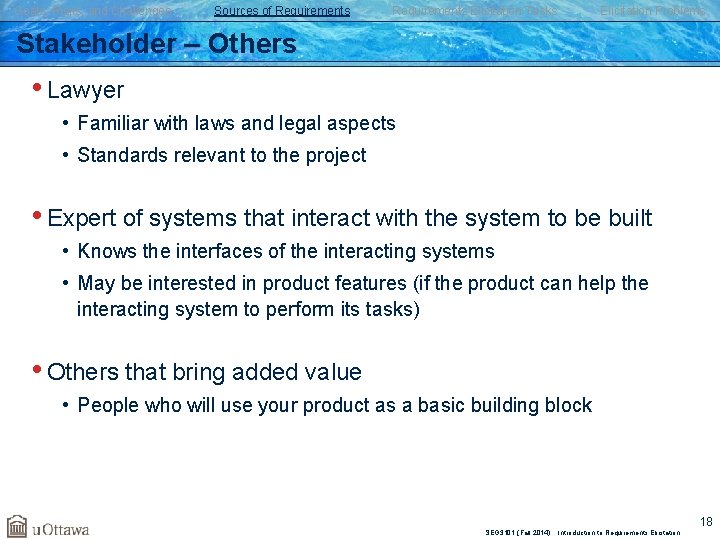
Goals, Risks, and Challenges Sources of Requirements Elicitation Tasks Elicitation Problems Stakeholder – Others • Lawyer • Familiar with laws and legal aspects • Standards relevant to the project • Expert of systems that interact with the system to be built • Knows the interfaces of the interacting systems • May be interested in product features (if the product can help the interacting system to perform its tasks) • Others that bring added value • People who will use your product as a basic building block SEG 3101 (Fall 2014). Introduction to Requirements Elicitation 18
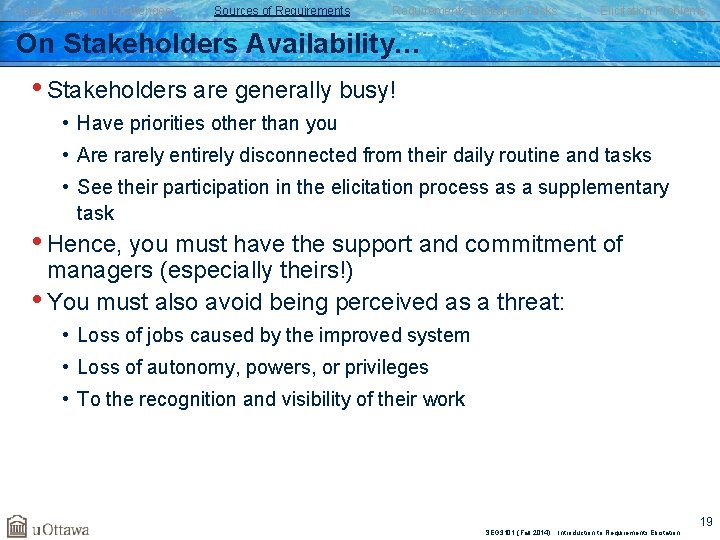
Goals, Risks, and Challenges Sources of Requirements Elicitation Tasks Elicitation Problems On Stakeholders Availability… • Stakeholders are generally busy! • Have priorities other than you • Are rarely entirely disconnected from their daily routine and tasks • See their participation in the elicitation process as a supplementary task • Hence, you must have the support and commitment of managers (especially theirs!) • You must also avoid being perceived as a threat: • Loss of jobs caused by the improved system • Loss of autonomy, powers, or privileges • To the recognition and visibility of their work SEG 3101 (Fall 2014). Introduction to Requirements Elicitation 19
Requirements Elicitation Tasks
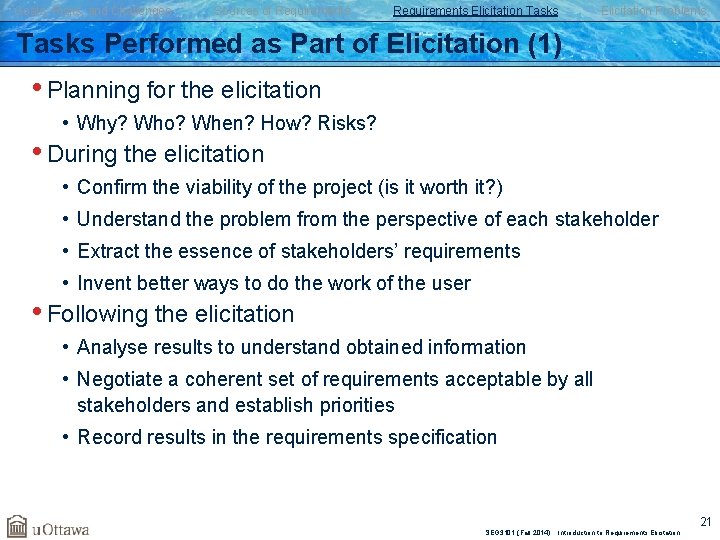
Goals, Risks, and Challenges Sources of Requirements Elicitation Tasks Elicitation Problems Tasks Performed as Part of Elicitation (1) • Planning for the elicitation • Why? Who? When? How? Risks? • During the elicitation • Confirm the viability of the project (is it worth it? ) • Understand the problem from the perspective of each stakeholder • Extract the essence of stakeholders’ requirements • Invent better ways to do the work of the user • Following the elicitation • Analyse results to understand obtained information • Negotiate a coherent set of requirements acceptable by all stakeholders and establish priorities • Record results in the requirements specification SEG 3101 (Fall 2014). Introduction to Requirements Elicitation 21
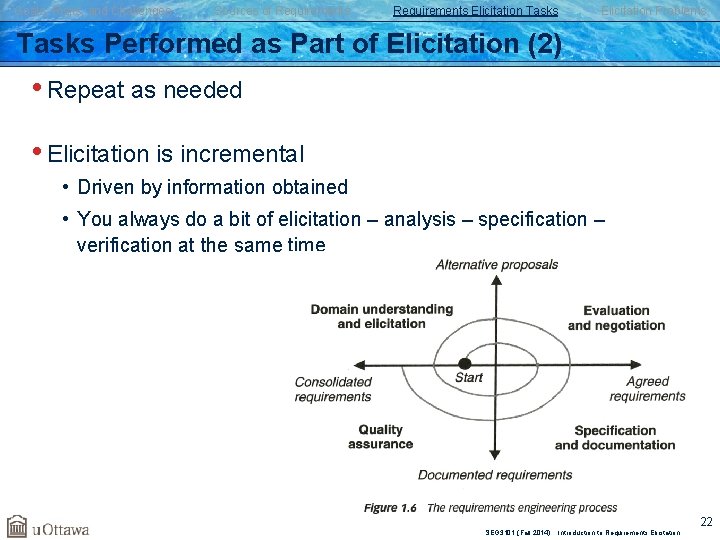
Goals, Risks, and Challenges Sources of Requirements Elicitation Tasks Elicitation Problems Tasks Performed as Part of Elicitation (2) • Repeat as needed • Elicitation is incremental • Driven by information obtained • You always do a bit of elicitation – analysis – specification – verification at the same time SEG 3101 (Fall 2014). Introduction to Requirements Elicitation 22
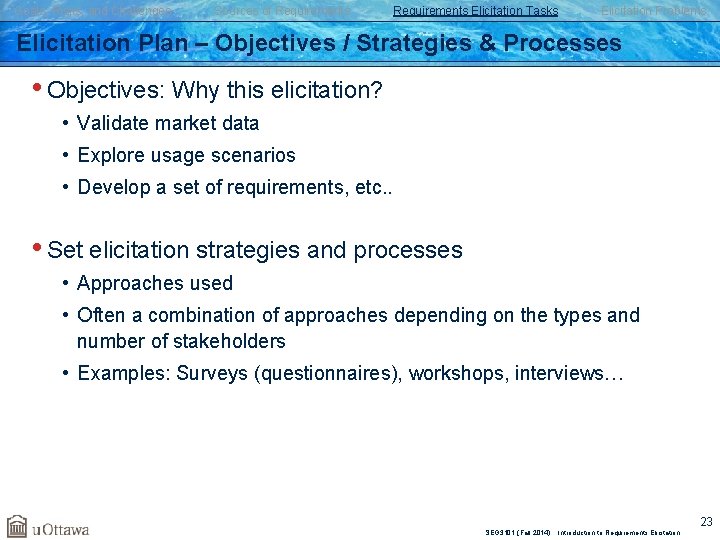
Goals, Risks, and Challenges Sources of Requirements Elicitation Tasks Elicitation Problems Elicitation Plan – Objectives / Strategies & Processes • Objectives: Why this elicitation? • Validate market data • Explore usage scenarios • Develop a set of requirements, etc. . • Set elicitation strategies and processes • Approaches used • Often a combination of approaches depending on the types and number of stakeholders • Examples: Surveys (questionnaires), workshops, interviews… SEG 3101 (Fall 2014). Introduction to Requirements Elicitation 23
Goals, Risks, and Challenges Sources of Requirements Elicitation Tasks Elicitation Problems Elicitation Plan – Products • Usually set of rough requirements • Written, audio, video notes • Documentation • Deliverables depend on objective and technique • Generally: un-organized, redundant, incomplete SEG 3101 (Fall 2014). Introduction to Requirements Elicitation 24
Goals, Risks, and Challenges Sources of Requirements Elicitation Tasks Elicitation Problems Extract Essence • Extract the essence of the stakeholders' requirements • Interpret stakeholders' descriptions of requirements • Possibly build models (may be part of your documentation!) • Gaps in the model behavior may indicate unknown or ambiguous situations • Models help focus our efforts • Should be resolved by asking the stakeholders (especially users) SEG 3101 (Fall 2014). Introduction to Requirements Elicitation 25
Goals, Risks, and Challenges Sources of Requirements Elicitation Tasks Elicitation Problems Invent Better Ways • Invent better ways to do the user's work • Ask why documented requirements so far are desired • The client/user’s view can be limited by past experiences. . . • Brainstorm to invent requirements the stakeholders have not yet thought of SEG 3101 (Fall 2014). Introduction to Requirements Elicitation 26
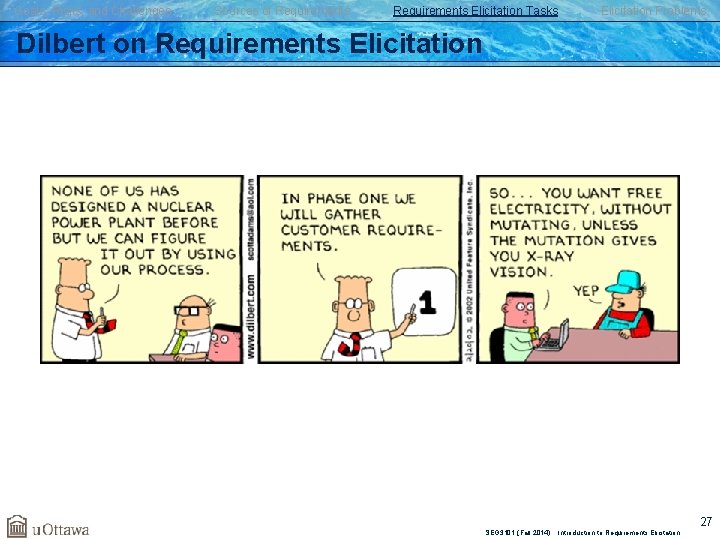
Goals, Risks, and Challenges Sources of Requirements Elicitation Tasks Elicitation Problems Dilbert on Requirements Elicitation SEG 3101 (Fall 2014). Introduction to Requirements Elicitation 27