
CS 499 Chapter 4 Capturing the Requirements Shari
- Slides: 18
CS 499 Chapter 4 Capturing the Requirements Shari L. Pfleeger Joanne M. Atlee 4 th Edition Pfleeger and Atlee, Software Engineering: Theory and Practice
CS 499 Contents 4. 1 4. 2 The Requirements Process Requirements Elicitation 4. 4 Types of Requirements 4. 4 Characteristic of Requirements Use Cases and Behavioral Requirements 4. 5 Modeling Notations 4. 6 Requirements and Specification Languages 4. 7 Prototyping Requirements 4. 8 Requirements Documentation 4. 9 Validation and Verification 4. 10 Measuring Requirements 4. 11 Choosing a Specification Technique 4. 12 Information System Example 4. 13 Real Time Example Pfleeger and Atlee, Software Engineering: Theory and Practice
CS 499 Chapter 4 Objectives • • Eliciting requirements from the customers Modeling requirements Reviewing requirements to ensure their quality Documenting requirements for use by the design and test teams Pfleeger and Atlee, Software Engineering: Theory and Practice
CS 499 4. 1 The Requirements Process • A requirement is an expression of desired behavior • A requirement deals with – objects or entities – the state they can be in – functions that are performed to change states or object characteristics • Requirements focus on the customer needs, not on the solution or implementation – designate what behavior, without saying how that behavior will be realized Pfleeger and Atlee, Software Engineering: Theory and Practice
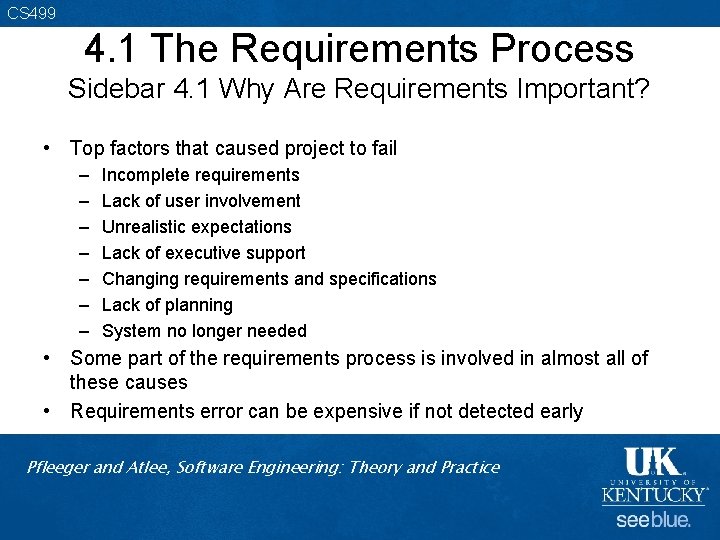
CS 499 4. 1 The Requirements Process Sidebar 4. 1 Why Are Requirements Important? • Top factors that caused project to fail – – – – Incomplete requirements Lack of user involvement Unrealistic expectations Lack of executive support Changing requirements and specifications Lack of planning System no longer needed • Some part of the requirements process is involved in almost all of these causes • Requirements error can be expensive if not detected early Pfleeger and Atlee, Software Engineering: Theory and Practice
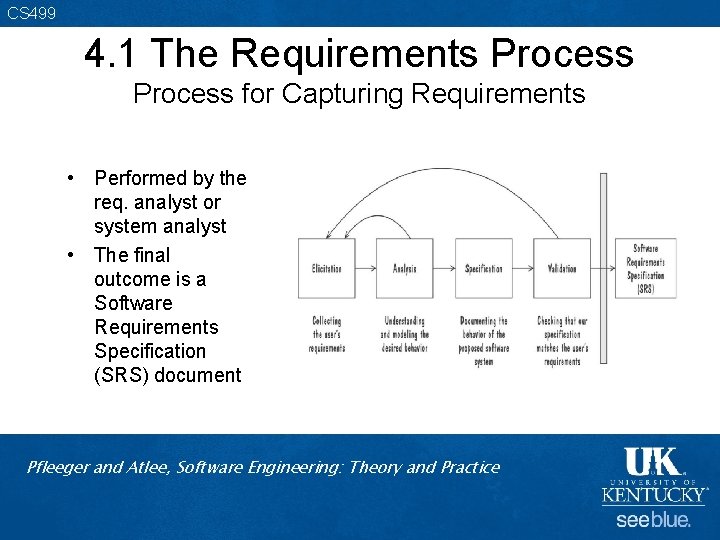
CS 499 4. 1 The Requirements Process for Capturing Requirements • Performed by the req. analyst or system analyst • The final outcome is a Software Requirements Specification (SRS) document Pfleeger and Atlee, Software Engineering: Theory and Practice
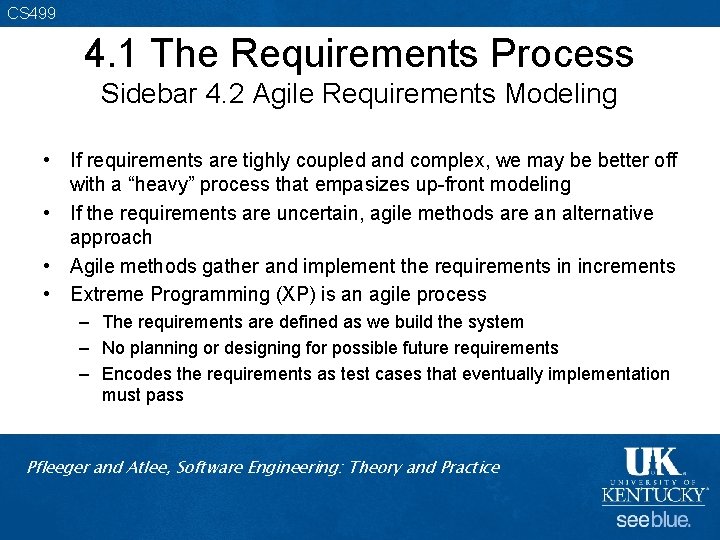
CS 499 4. 1 The Requirements Process Sidebar 4. 2 Agile Requirements Modeling • If requirements are tighly coupled and complex, we may be better off with a “heavy” process that empasizes up-front modeling • If the requirements are uncertain, agile methods are an alternative approach • Agile methods gather and implement the requirements in increments • Extreme Programming (XP) is an agile process – The requirements are defined as we build the system – No planning or designing for possible future requirements – Encodes the requirements as test cases that eventually implementation must pass Pfleeger and Atlee, Software Engineering: Theory and Practice
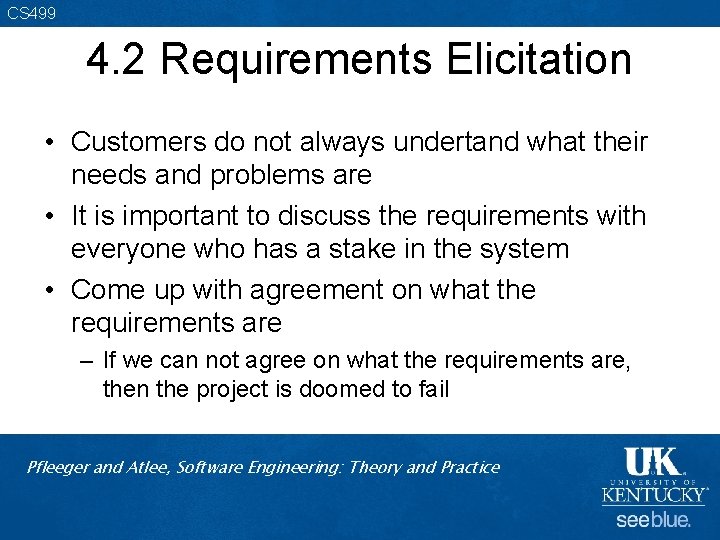
CS 499 4. 2 Requirements Elicitation • Customers do not always undertand what their needs and problems are • It is important to discuss the requirements with everyone who has a stake in the system • Come up with agreement on what the requirements are – If we can not agree on what the requirements are, then the project is doomed to fail Pfleeger and Atlee, Software Engineering: Theory and Practice
CS 499 4. 2 Requirements Elicitation Stakeholders • • Clients: pay for the software to be developed Customers: buy the software after it is developed Users: use the system Domain experts: familiar with the problem that the software must automate • Market Researchers: conduct surveys to determine future trends and potential customers • Lawyers or auditors: familiar with government, safety, or legal requirements • Software engineers or other technology experts Pfleeger and Atlee, Software Engineering: Theory and Practice
CS 499 4. 2 Requirements Elicitation Sidebar 4. 3 Using Viewpoints to Manage Inconsistency • No need to resolve inconsitencies early in the requirements process (Easterbrook and Nuseibah, 1996) • Stakeholders' views documented and maintained as separate Viewpoints through the software development process – The requirements analyst defines consistency rules that should apply between Viewpoints – The Viewpoints are analyzed to see if they conform to the consistency requirements • Inconsistencies are highlighted but not adressed until there is sufficient information to make informed decision Pfleeger and Atlee, Software Engineering: Theory and Practice
CS 499 4. 2 Requirements Elicitation Means of Eliciting Requirements • • Interviewing stake holders Reviewing available documentations Observing the current system (if one exists) Apprenticing with users to learn about user's task in more details • Interviewing user or stakeholders in groups • Using domain specific strategies, such as Joint Application Design, or PIECES • Brainstorming with current and potential users Pfleeger and Atlee, Software Engineering: Theory and Practice
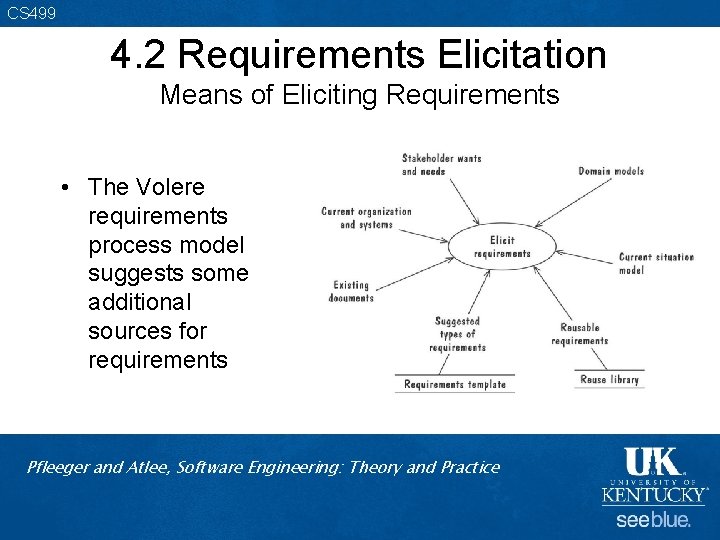
CS 499 4. 2 Requirements Elicitation Means of Eliciting Requirements • The Volere requirements process model suggests some additional sources for requirements Pfleeger and Atlee, Software Engineering: Theory and Practice
CS 499 4. 3 Types of Requirements • Functional requirement: describes required behavior in terms of required activities • Quality requirement or nonfunctional requirement: describes some quality characteristic that the software must posses • Design constraint: a design decision such as choice of platform or interface components • Process constraint: a restriction on the techniques or resources that can be used to build the system Pfleeger and Atlee, Software Engineering: Theory and Practice
CS 499 4. 3 Types of Requirements Sidebar 4. 4 Making Requirements Testable • Fit criteria form objective standards for judging whether a proposed solution satisfies the requirements – It is easy to set fit criteria for quantifyable requirements – It is hard for subjective quality requirements • Three ways to help make requirements testable – Specify a quantitave description for each adverb and adjective – Replace pronouns with specific names of entities – Make sure that every noun is defined in exaclty one place in the requirements documents Pfleeger and Atlee, Software Engineering: Theory and Practice
CS 499 4. 3 Types of Requirements Resolving Conflicts • Different stakeholder has different set of requirements – potential conflicting ideas • Need to prioritize requirements • Prioritization might separate requirements into three categories – essential: absolutely must be met – desirable: highly desirable but not necessary – optional: possible but could be eliminated Pfleeger and Atlee, Software Engineering: Theory and Practice
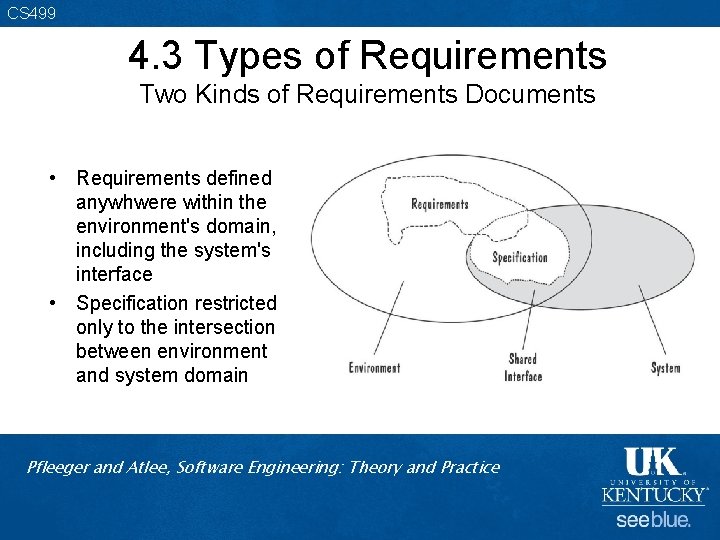
CS 499 4. 3 Types of Requirements Two Kinds of Requirements Documents • Requirements definition: a complete listing of everything the customer wants to achieve – Describing the entities in the environment where the system will be installed • Requirements specification: restates the requirements as a specification of how the proposed system shall behave Pfleeger and Atlee, Software Engineering: Theory and Practice
CS 499 4. 3 Types of Requirements Two Kinds of Requirements Documents • Requirements defined anywhwere within the environment's domain, including the system's interface • Specification restricted only to the intersection between environment and system domain Pfleeger and Atlee, Software Engineering: Theory and Practice
CS 499 4. 4 Characteristics of Requirements • • Correct Consistent Unambigious Complete • • Feasible Relevant Testable Traceable Pfleeger and Atlee, Software Engineering: Theory and Practice