
SEG 3101 Fall 2015 Requirements Engineering Basics Miguel
SEG 3101 (Fall 2015) Requirements Engineering Basics Miguel Garzón, University of Ottawa Based on Powerpoint slides prepared by G. Mussbacher with material from: Sommerville & Kotonya 1998, Lethbridge & Laganière 2001 -2005, Hooks & Farry 2001, Bray 2002, Pressman 2005, Amyot 2005 -2009, Somé 2008, Bochmann 2010
Table of Contents • Definition and Importance of Requirements • Types of Requirements • The Requirements Engineering Process • Requirements Engineering: Main Activities • The beginning is the most important part of the work. 1 [1] Plato, 4 B. C. 2 SEG 3101 (Fall 2014). Basics – nature and purpose of requirements
3 SEG 3101 (Fall 2014). Basics – nature and purpose of requirements
Failures Requirements Definition/Importance Requirements Types Development Process Requirements Activities Mars Climate Orbiter • In 1999, the Mars Climate Orbiter disappears around Mars • Cost: about $125 M US • Problem caused by a misunderstanding between a team in Colorado and one in California • One team used the metric system while the other used the English system for a key function… 4 SEG 3101 (Fall 2014). Basics – nature and purpose of requirements
Failures Requirements Definition/Importance Requirements Types Development Process Requirements Activities GIRES • GIRES 1 (Gestion intégrée des ressources) • Integrated management of resources • To replace >1000 existing systems • In 140 organisations / departments • Affecting 68000 employees! • 8 -year project of the Quebec government, started 1998 • $80 million budget • Could not cope with changes to the requirements… • Cost of $400 millions after 5 years, and very late • Project cancelled in 2003 [1] http: //radio-canada. ca/nouvelles/Index/nouvelles/200303/04/012 -GIRES. shtml 5 SEG 3101 (Fall 2014). Basics – nature and purpose of requirements
Failures Requirements Definition/Importance Requirements Types Development Process Requirements Activities Canadian Gun Registry 1, 2 • Law adopted in 1995 • Was supposed to cost $119 M, with revenues of $117 M (net cost of $2 M) • 30 types of permits, long questionnaires, 90% of errors in requests • Rising costs ($327 M in 2000, $688 M in 2002, plus others…) • Many political and legal issues, and a few scandals… • Customer asked for over 2000 changes in the computer system! • ~$1 B in 2004, probably ~$2 B by the time the system is fully functional • Tons of unhappy customers and taxpayers… • Not required to register as of May 17, 2006! • Bill C-391 passed in April 2013… [1] http: //en. wikipedia. org/wiki/Canadian_gun_registry [2] http: //radio-canada. ca/actualite/zonelibre/04 -02/registre_armes. asp 6 SEG 3101 (Fall 2014). Basics – nature and purpose of requirements
Definition and Importance of Requirements
Failures Requirements Definition/Importance Requirements Types Development Process Requirements Activities You said “Requirements”? • A requirement is: • Capturing the purpose of a system • An expression of the ideas to be embodied in the system or application under development • A statement about the proposed system that all stakeholders agree must be made true in order for the customer’s problem to be adequately solved • Short and concise piece of information • Says something about the system • All the stakeholders have agreed that it is valid • It helps solve the customer’s problem • In French: exigence, requis, besoin 8 SEG 3101 (Fall 2014). Basics – nature and purpose of requirements
Failures Requirements Definition/Importance Requirements Types Development Process Requirements Activities According to Standards • [IEEE 830 -1998] A requirement is defined as: • A condition or capability needed by a user to solve a problem or achieve an objective • A condition or a capability that must be met or possessed by a system … to satisfy a contract, standard, specification, or other formally imposed document … • [IEEE 29148 -2011] A requirement is a statement which translates or expresses a need and its associated constraints and conditions. 9 SEG 3101 (Fall 2014). Basics – nature and purpose of requirements
Failures Requirements Definition/Importance Requirements Types Development Process Requirements Activities You said “Requirements Engineering”? • Requirements Engineering (RE) is: • The activity of development, elicitation, specification, analysis, and management of the stakeholder requirements, which are to be met by a new or evolving system • Requirements Engineering encompasses all the interdisciplinary activities involved in determining, documenting, and maintaining an agreed set of requirements for a system, and for tracing these through to implementation • Standard definition: RE is the interdisciplinary function that mediates between the domains of the acquirer and supplier to establish and maintain the requirements to be met by the system, software or service of interest. RE is concerned with discovering, eliciting, developing, analyzing, determining verification methods, validating, communicating, documenting, and managing requirements [IEEE 29148]. 10 SEG 3101 (Fall 2014). Basics – nature and purpose of requirements
Failures Requirements Definition/Importance Requirements Types Development Process Requirements Activities You said “Requirements Engineering”? • RE is concerned with identifying the purpose of a software system… and the contexts in which it will be used • How/where the system will be used • Big picture is important • Captures real world needs of stakeholders affected by a software system and expresses them as artifacts that can be implemented by a computing system • Bridge to design and construction • How to communicate and negotiate? • Is anything lost in the translation between different worlds? 11 SEG 3101 (Fall 2014). Basics – nature and purpose of requirements
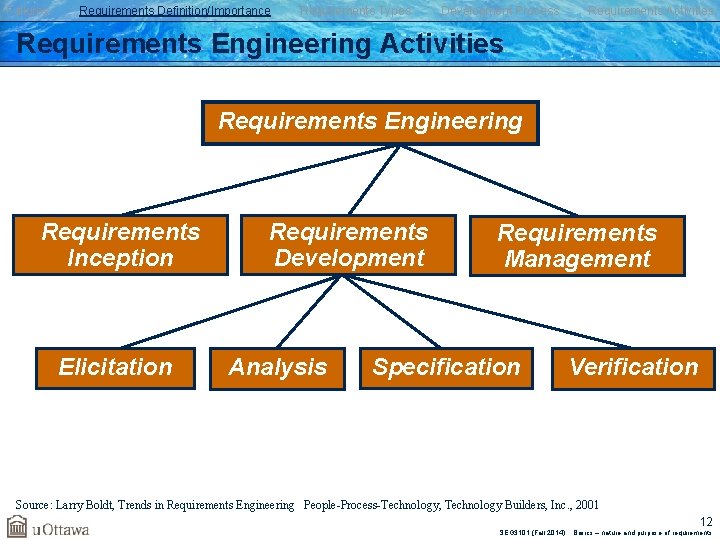
Failures Requirements Definition/Importance Requirements Types Development Process Requirements Activities Requirements Engineering Requirements Inception Elicitation Requirements Development Analysis Requirements Management Specification Verification Source: Larry Boldt, Trends in Requirements Engineering People-Process-Technology, Technology Builders, Inc. , 2001 12 SEG 3101 (Fall 2014). Basics – nature and purpose of requirements
Failures Requirements Definition/Importance Requirements Types Development Process Requirements Activities About these RE Activities… • Inception • Start the process (business need, market opportunity, great idea, . . . ), business case, feasibility study, system scope, risks, etc. • Requirements elicitation • Requirements discovered through consultation with stakeholders • Requirements analysis and negotiation • Requirements are analyzed and conflicts resolved through negotiation • Requirements specification • A precise requirements document is produced • Requirements validation • The requirements document is checked for consistency and completeness • Requirements management • Needs and contexts evolve, and so do requirements! 13 SEG 3101 (Fall 2014). Basics – nature and purpose of requirements
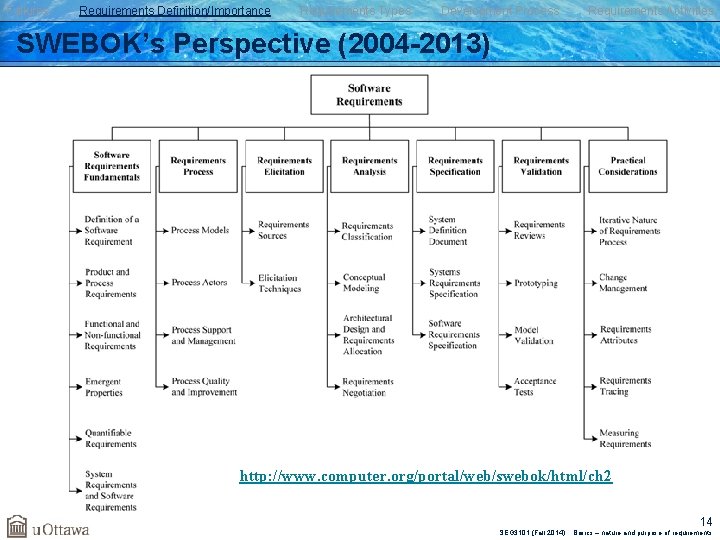
Failures Requirements Definition/Importance Requirements Types Development Process Requirements Activities SWEBOK’s Perspective (2004 -2013) http: //www. computer. org/portal/web/swebok/html/ch 2 14 SEG 3101 (Fall 2014). Basics – nature and purpose of requirements
Failures Requirements Definition/Importance Requirements Types Development Process Requirements Activities General Problems with the Requirements Process • Lack of the right expertise (software engineers, domain experts, etc. ) • Initial ideas are often incomplete, wildly optimistic, and firmly entrenched in the minds of the people leading the acquisition process • Difficulty of using complex tools and diverse methods associated with requirements gathering may negate the anticipated benefits of a complete and detailed approach 15 SEG 3101 (Fall 2014). Basics – nature and purpose of requirements
Failures Requirements Definition/Importance Requirements Types Development Process Requirements Activities Statistics from NIST Report • NIST (National Institute of Standards and Technology) has published a comprehensive (309 pages) and very interesting report on project statistics and experiences based on data from a large number of software projects 1 • 70% of the defects are introduced in the specification phase • 30% are introduced later in the technical solution process • Only 5% of the specification inadequacies are corrected in the specification phase • 95% are detected later in the project or after delivery where the cost for correction on average is 22 times higher compared to a correction directly during the specification effort • The NIST report concludes that extensive testing is essential, however testing detects the dominating specification errors late in the process [1] http: //www. nist. gov/public_affairs/releases/n 02 -10. htm (May 2002) 16 SEG 3101 (Fall 2014). Basics – nature and purpose of requirements
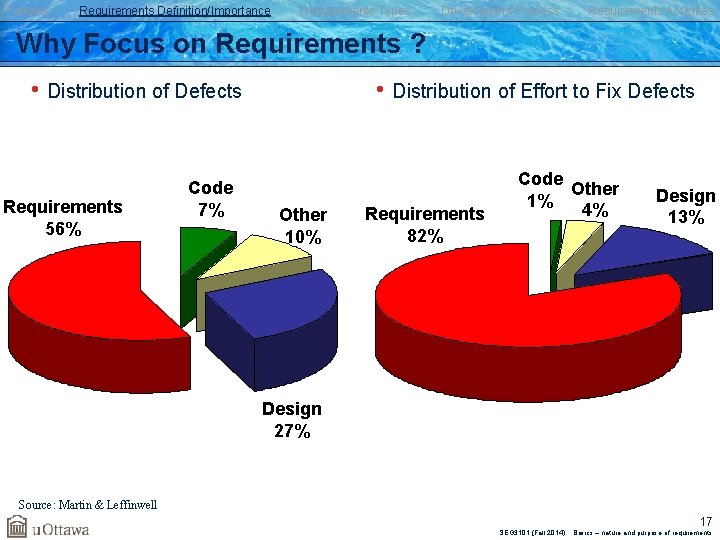
Failures Requirements Definition/Importance Requirements Types Development Process Requirements Activities Why Focus on Requirements ? • Distribution of Defects Requirements 56% Code 7% • Distribution of Effort to Fix Defects Other 10% Requirements 82% Code Other 1% 4% Design 13% Design 27% Source: Martin & Leffinwell 17 SEG 3101 (Fall 2014). Basics – nature and purpose of requirements
Failures Requirements Definition/Importance Requirements Types Development Process Requirements Activities View of the Software Engineering Institute (SEI) • Improve software development with the CMM/CMMI model for software development • Capability Maturity Model (CMM) • For software development, superseded by Capability Maturity Model Integration (CMMI) • SEI’s vision is: • The right software, delivered defect free, on time & on cost, every time • “Right software” implies software that satisfies requirements for functionality and qualities (e. g. , performance, cost…) throughout its lifetime • “Defect free” software is achieved either through exhaustive testing after coding or by developing the code right the first time 18 SEG 3101 (Fall 2014). Basics – nature and purpose of requirements
![Failures Requirements Definition/Importance Requirements Types Development Process Requirements Activities CHAOS Report (2004)1 [1] Standish](http://slidetodoc.com/presentation_image_h/b89d33e99512568848953de443f97097/image-19.jpg "Failures Requirements Definition/Importance Requirements Types Development Process Requirements Activities CHAOS Report (2004)1 [1] Standish")
Failures Requirements Definition/Importance Requirements Types Development Process Requirements Activities CHAOS Report (2004)1 [1] Standish Group Inc. , 2004 19 SEG 3101 (Fall 2014). Basics – nature and purpose of requirements
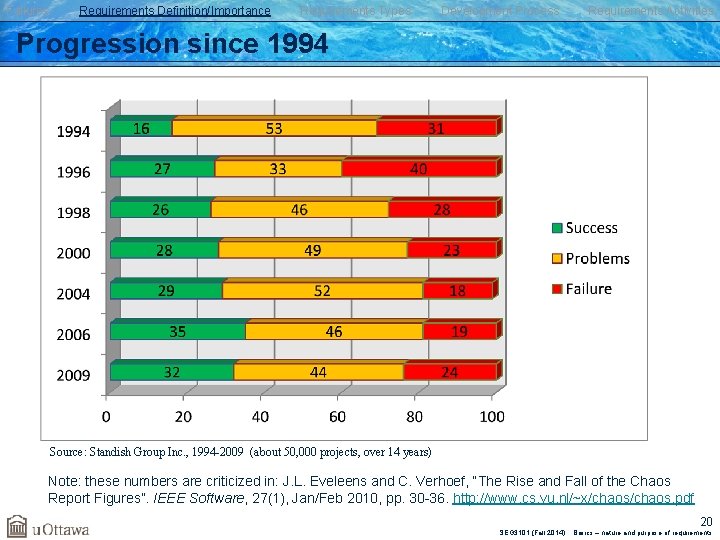
Failures Requirements Definition/Importance Requirements Types Development Process Requirements Activities Progression since 1994 Source: Standish Group Inc. , 1994 -2009 (about 50, 000 projects, over 14 years) Note: these numbers are criticized in: J. L. Eveleens and C. Verhoef, “The Rise and Fall of the Chaos Report Figures”. IEEE Software, 27(1), Jan/Feb 2010, pp. 30 -36. http: //www. cs. vu. nl/~x/chaos. pdf 20 SEG 3101 (Fall 2014). Basics – nature and purpose of requirements
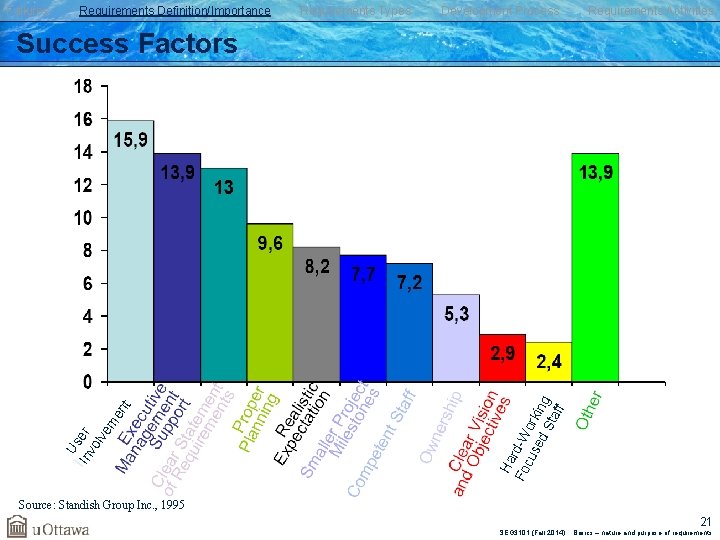
Failures Requirements Definition/Importance Requirements Types Development Process Requirements Activities Ha Fo rd-W cu se orkin d S g taf f Us Inv er olv e me nt Success Factors Source: Standish Group Inc. , 1995 21 SEG 3101 (Fall 2014). Basics – nature and purpose of requirements
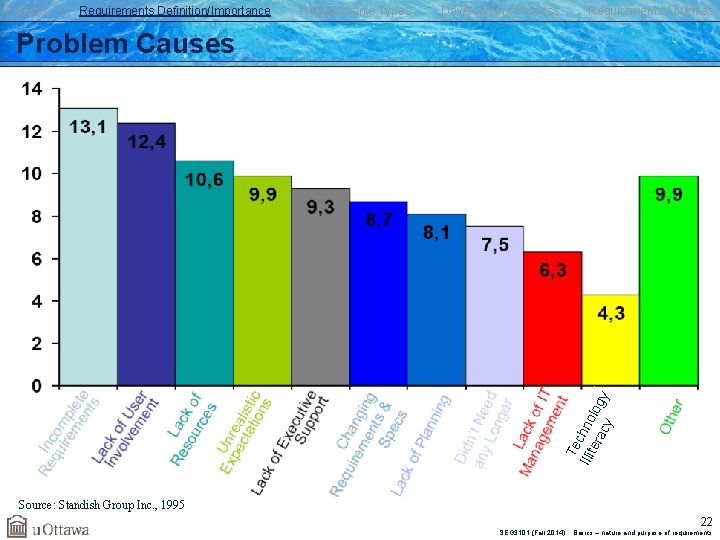
Failures Requirements Definition/Importance Requirements Types Development Process Requirements Activities Te Illit chno era log cy y Problem Causes Source: Standish Group Inc. , 1995 22 SEG 3101 (Fall 2014). Basics – nature and purpose of requirements
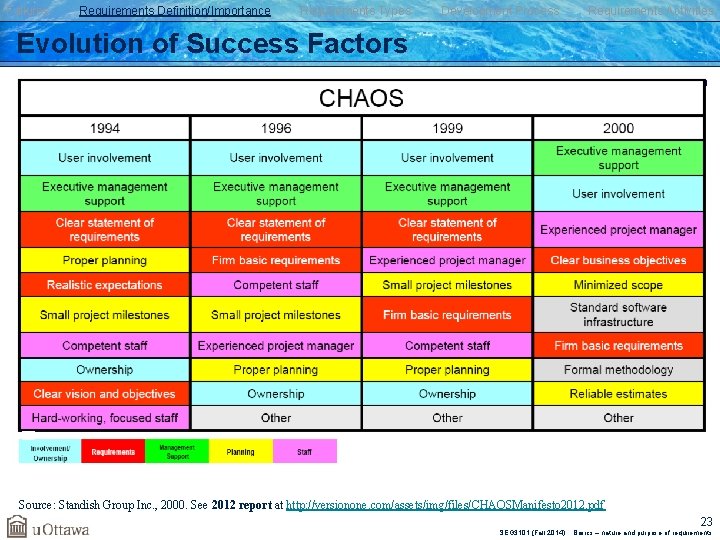
Failures Requirements Definition/Importance Requirements Types Development Process Requirements Activities Evolution of Success Factors Source: Standish Group Inc. , 2000. See 2012 report at http: //versionone. com/assets/img/files/CHAOSManifesto 2012. pdf 23 SEG 3101 (Fall 2014). Basics – nature and purpose of requirements
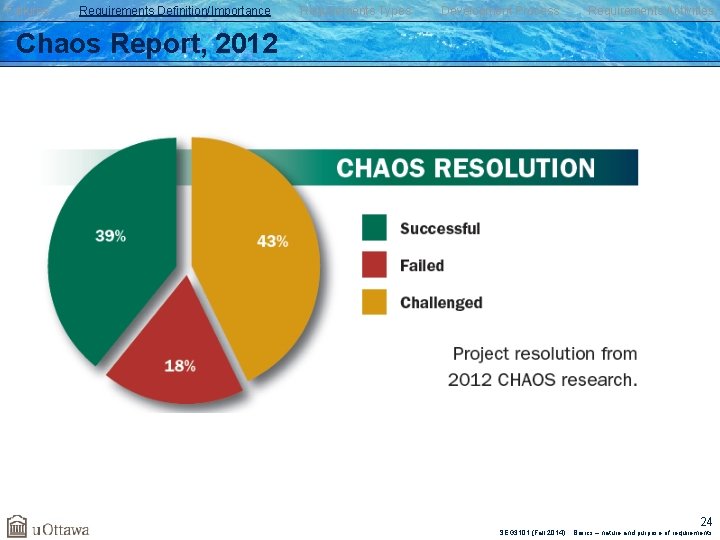
Failures Requirements Definition/Importance Requirements Types Development Process Requirements Activities Chaos Report, 2012 24 SEG 3101 (Fall 2014). Basics – nature and purpose of requirements
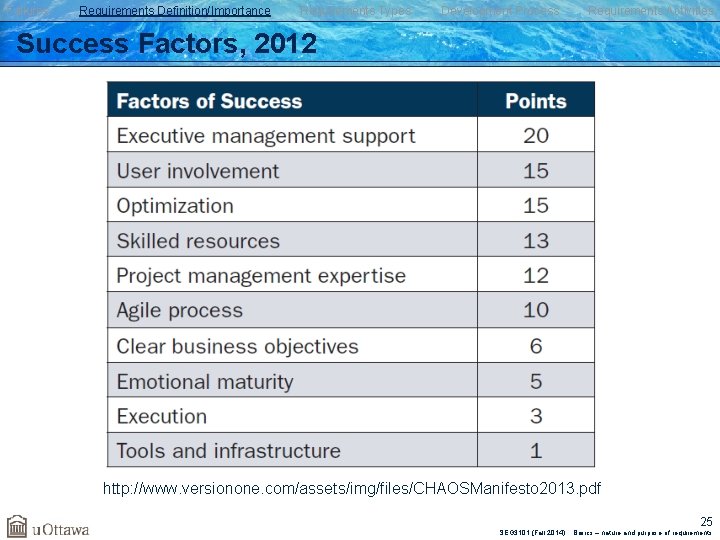
Failures Requirements Definition/Importance Requirements Types Development Process Requirements Activities Success Factors, 2012 http: //www. versionone. com/assets/img/files/CHAOSManifesto 2013. pdf 25 SEG 3101 (Fall 2014). Basics – nature and purpose of requirements
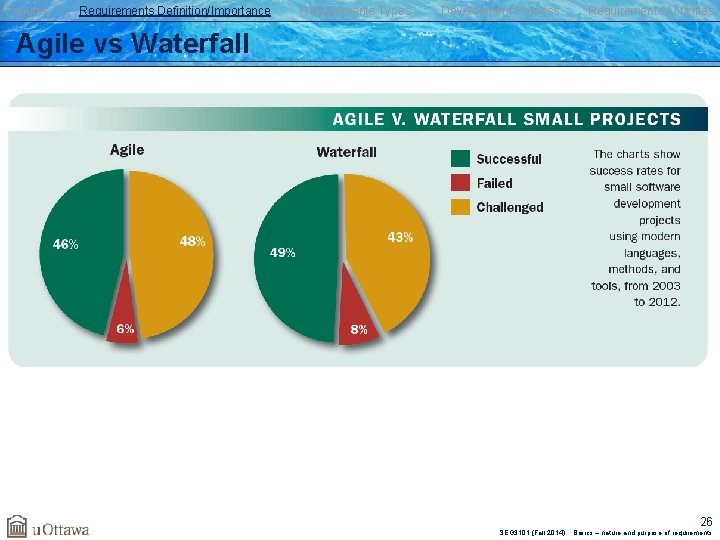
Failures Requirements Definition/Importance Requirements Types Development Process Requirements Activities Agile vs Waterfall 26 SEG 3101 (Fall 2014). Basics – nature and purpose of requirements
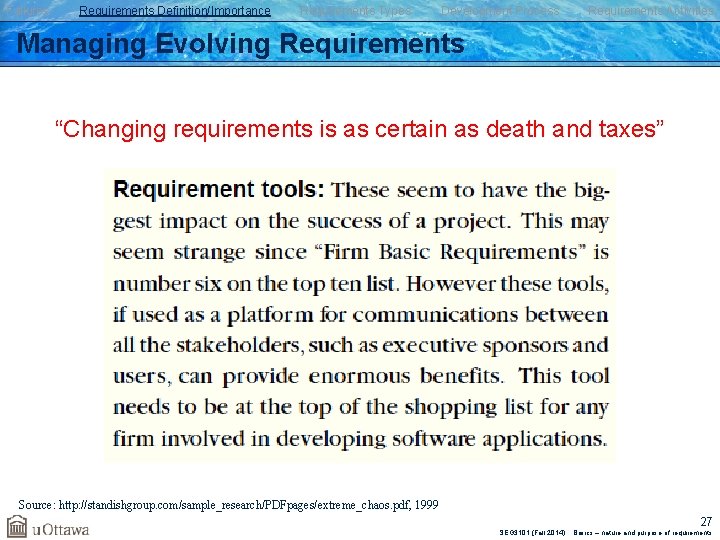
Failures Requirements Definition/Importance Requirements Types Development Process Requirements Activities Managing Evolving Requirements “Changing requirements is as certain as death and taxes” Source: http: //standishgroup. com/sample_research/PDFpages/extreme_chaos. pdf, 1999 27 SEG 3101 (Fall 2014). Basics – nature and purpose of requirements
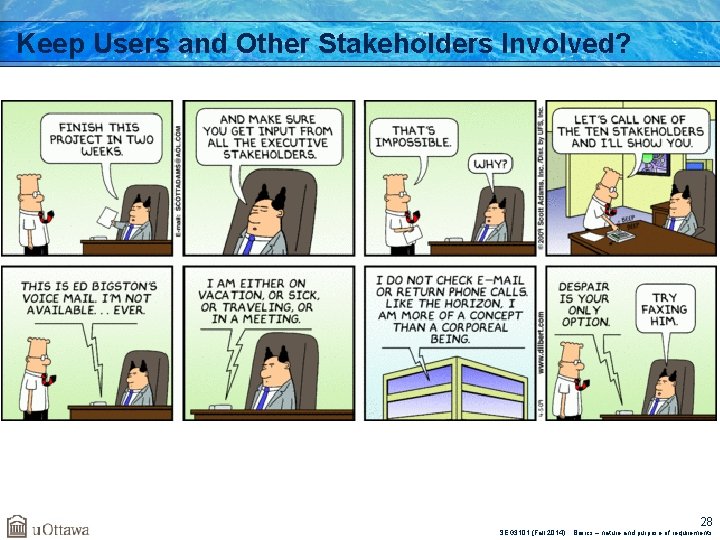
Keep Users and Other Stakeholders Involved? 28 SEG 3101 (Fall 2014). Basics – nature and purpose of requirements
Types of Requirements
Failures Requirements Definition/Importance Requirements Types Development Process Requirements Activities So Many “Requirements”… (1) • A goal is an objective or concern that guides the RE process. It can be used to discover and evaluate functional and nonfunctional requirements • A goal is not yet a requirement… • Note: All requirements must be verifiable (by some test, inspection, audit etc. ) • A functional requirement is a requirement defining functions of the system under development • Describes what the system should do • A non-functional requirement is a requirement that is not functional. This includes many different kinds of requirements. – Therefore one often considers the following sub-categories: 30 SEG 3101 (Fall 2014). Basics – nature and purpose of requirements
Failures Requirements Definition/Importance Requirements Types Development Process Requirements Activities So Many “Requirements”… (2) • A user requirement is a desired goal or function that a user and other stakeholders expect the system to achieve • Does not necessarily become a system requirement • Application domain requirement (sometimes called business rules) are requirements derived from business practices within a given industrial sector, or in a given company, or defined by government regulations or standards. • May lead to system requirements. Can be functional or non-functional • System requirements are the requirements for the system to be built, as a whole • A system is a collection of interrelated components working together towards some common objective (may be software, mechanical, electrical and electronic hardware and be operated by people) • Systems Engineering is a multidisciplinary approach to systems development – software is only a part (but often the problematic part) 31 SEG 3101 (Fall 2014). Basics – nature and purpose of requirements
Failures Requirements Definition/Importance Requirements Types Development Process Requirements Activities So Many “Requirements”… (3) • Important note: Software Requirements Engineering is a special case of Requirements Engineering. Many topics discussed in this course are quite general and apply to requirements engineering, in general. • In a system containing software, software requirements are derived from the system requirements. The system then consists of hardware and software, and the hardware (and often the operating system and other existing software modules) are part of the environment in which the software is used. 32 SEG 3101 (Fall 2014). Basics – nature and purpose of requirements
Failures Requirements Definition/Importance Requirements Types Development Process Requirements Activities Functional Requirements • What inputs the system should accept • What outputs the system should produce • What data the system should store other systems might use • What computations the system should perform • The timing and synchronization of the above • Depend on the type of software, expected users, and the type of system where the software is used • Functional user requirements may be high-level statements of what the system should do, but functional system requirements should describe the system services in detail 33 SEG 3101 (Fall 2014). Basics – nature and purpose of requirements
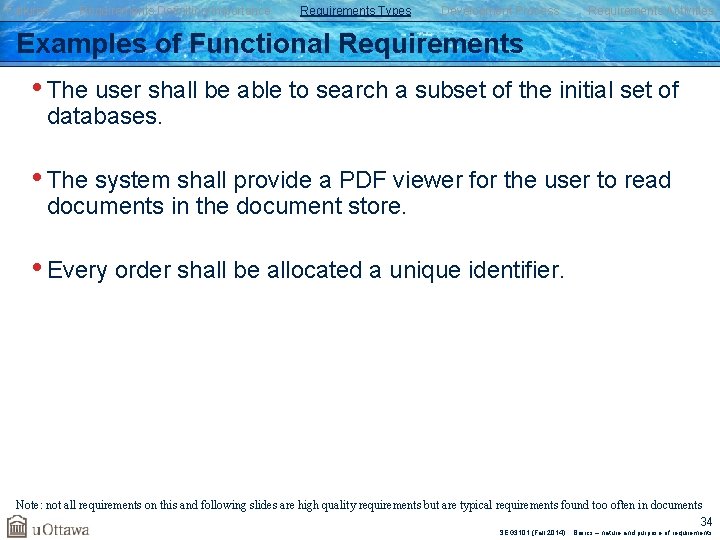
Failures Requirements Definition/Importance Requirements Types Development Process Requirements Activities Examples of Functional Requirements • The user shall be able to search a subset of the initial set of databases. • The system shall provide a PDF viewer for the user to read documents in the document store. • Every order shall be allocated a unique identifier. Note: not all requirements on this and following slides are high quality requirements but are typical requirements found too often in documents 34 SEG 3101 (Fall 2014). Basics – nature and purpose of requirements
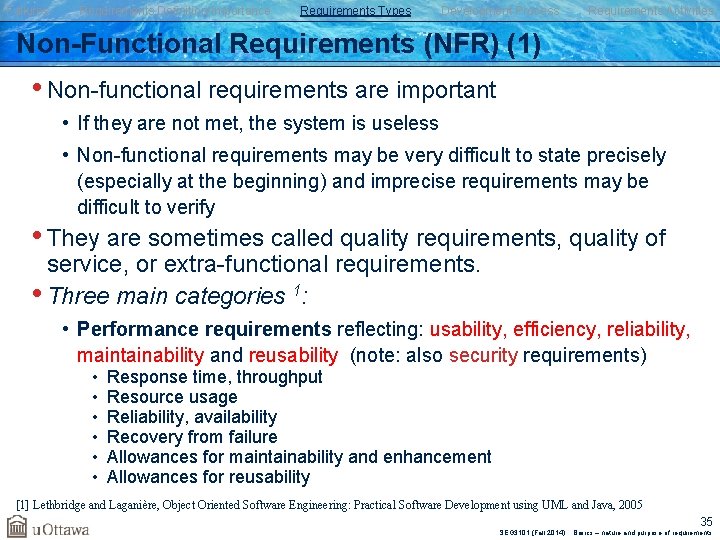
Failures Requirements Definition/Importance Requirements Types Development Process Requirements Activities Non-Functional Requirements (NFR) (1) • Non-functional requirements are important • If they are not met, the system is useless • Non-functional requirements may be very difficult to state precisely (especially at the beginning) and imprecise requirements may be difficult to verify • They are sometimes called quality requirements, quality of service, or extra-functional requirements. • Three main categories 1: • Performance requirements reflecting: usability, efficiency, reliability, maintainability and reusability (note: also security requirements) • • • Response time, throughput Resource usage Reliability, availability Recovery from failure Allowances for maintainability and enhancement Allowances for reusability [1] Lethbridge and Laganière, Object Oriented Software Engineering: Practical Software Development using UML and Java, 2005 35 SEG 3101 (Fall 2014). Basics – nature and purpose of requirements
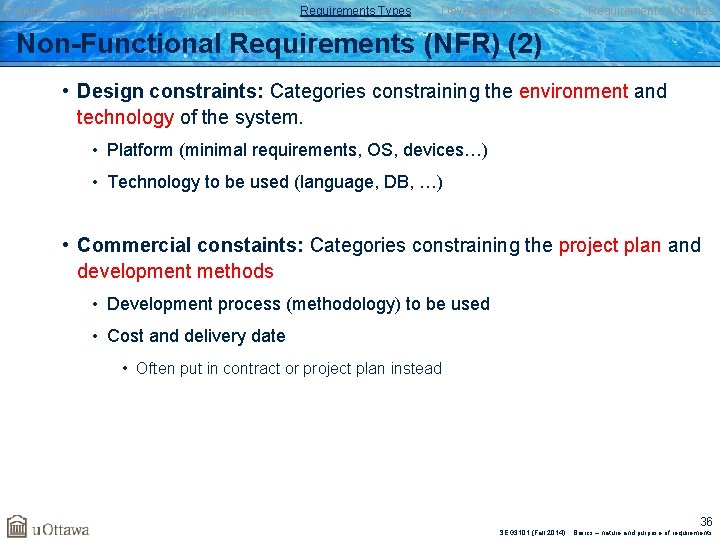
Failures Requirements Definition/Importance Requirements Types Development Process Requirements Activities Non-Functional Requirements (NFR) (2) • Design constraints: Categories constraining the environment and technology of the system. • Platform (minimal requirements, OS, devices…) • Technology to be used (language, DB, …) • Commercial constaints: Categories constraining the project plan and development methods • Development process (methodology) to be used • Cost and delivery date • Often put in contract or project plan instead 36 SEG 3101 (Fall 2014). Basics – nature and purpose of requirements
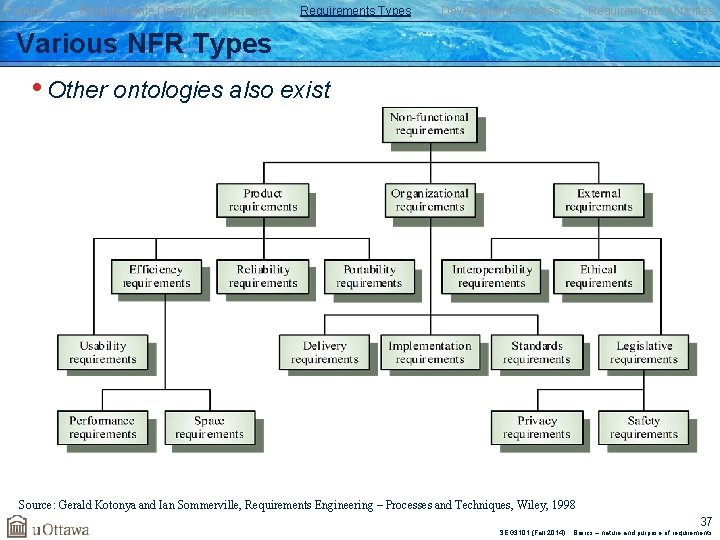
Failures Requirements Definition/Importance Requirements Types Development Process Requirements Activities Various NFR Types • Other ontologies also exist Source: Gerald Kotonya and Ian Sommerville, Requirements Engineering – Processes and Techniques, Wiley, 1998 37 SEG 3101 (Fall 2014). Basics – nature and purpose of requirements
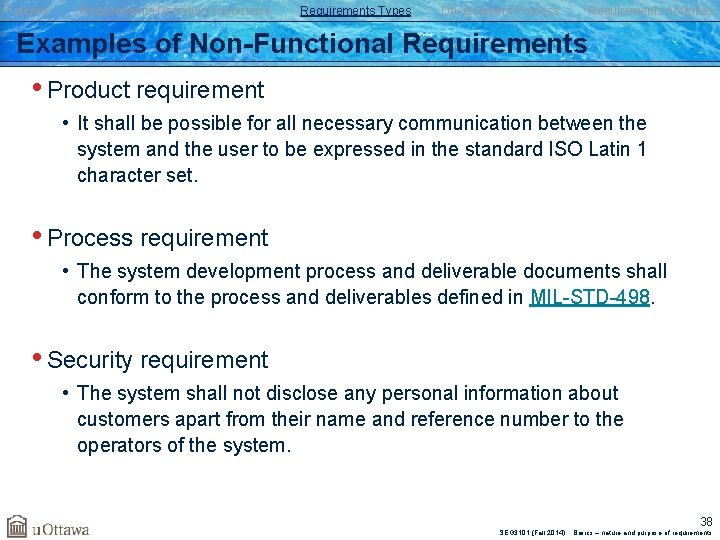
Failures Requirements Definition/Importance Requirements Types Development Process Requirements Activities Examples of Non-Functional Requirements • Product requirement • It shall be possible for all necessary communication between the system and the user to be expressed in the standard ISO Latin 1 character set. • Process requirement • The system development process and deliverable documents shall conform to the process and deliverables defined in MIL-STD-498. • Security requirement • The system shall not disclose any personal information about customers apart from their name and reference number to the operators of the system. 38 SEG 3101 (Fall 2014). Basics – nature and purpose of requirements
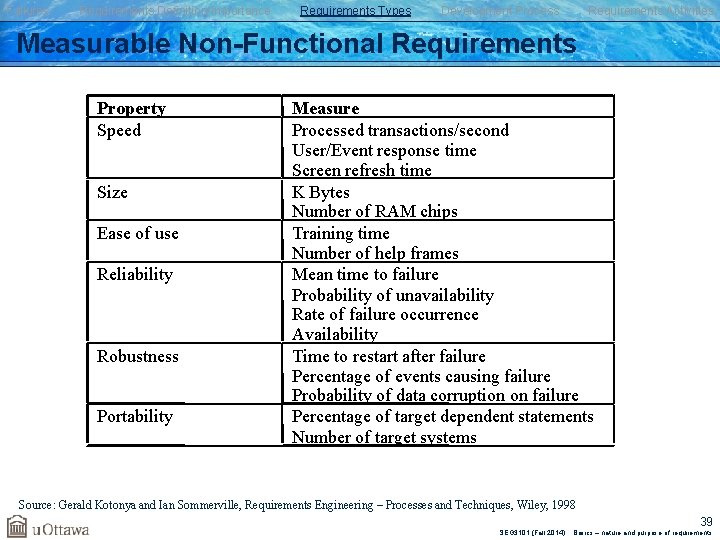
Failures Requirements Definition/Importance Requirements Types Development Process Requirements Activities Measurable Non-Functional Requirements Property Speed Size Ease of use Reliability Robustness Portability Measure Processed transactions/second User/Event response time Screen refresh time K Bytes Number of RAM chips Training time Number of help frames Mean time to failure Probability of unavailability Rate of failure occurrence Availability Time to restart after failure Percentage of events causing failure Probability of data corruption on failure Percentage of target dependent statements Number of target systems Source: Gerald Kotonya and Ian Sommerville, Requirements Engineering – Processes and Techniques, Wiley, 1998 39 SEG 3101 (Fall 2014). Basics – nature and purpose of requirements
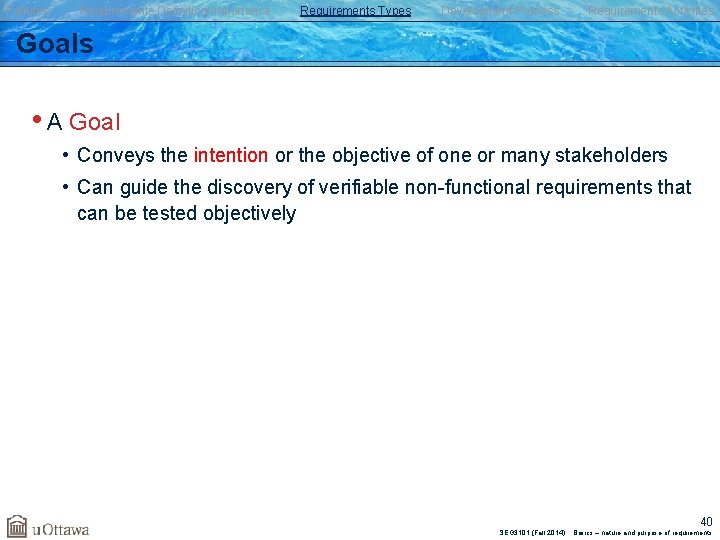
Failures Requirements Definition/Importance Requirements Types Development Process Requirements Activities Goals • A Goal • Conveys the intention or the objective of one or many stakeholders • Can guide the discovery of verifiable non-functional requirements that can be tested objectively 40 SEG 3101 (Fall 2014). Basics – nature and purpose of requirements
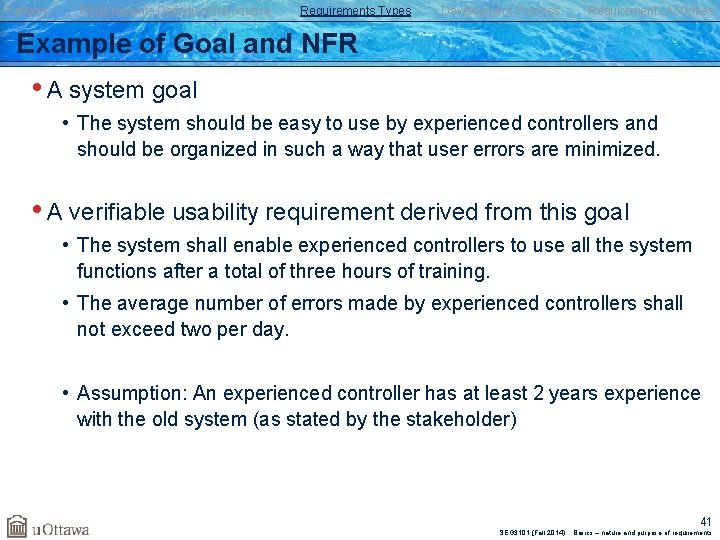
Failures Requirements Definition/Importance Requirements Types Development Process Requirements Activities Example of Goal and NFR • A system goal • The system should be easy to use by experienced controllers and should be organized in such a way that user errors are minimized. • A verifiable usability requirement derived from this goal • The system shall enable experienced controllers to use all the system functions after a total of three hours of training. • The average number of errors made by experienced controllers shall not exceed two per day. • Assumption: An experienced controller has at least 2 years experience with the old system (as stated by the stakeholder) 41 SEG 3101 (Fall 2014). Basics – nature and purpose of requirements
Failures Requirements Definition/Importance Requirements Types Development Process Requirements Activities Application-Domain Requirements • Derived from the application domain • Describe system characteristics and features that reflect the domain • May be new functional requirements, constraints on existing requirements, or define specific computations • If domain requirements are not satisfied, the system may be unworkable 42 SEG 3101 (Fall 2014). Basics – nature and purpose of requirements
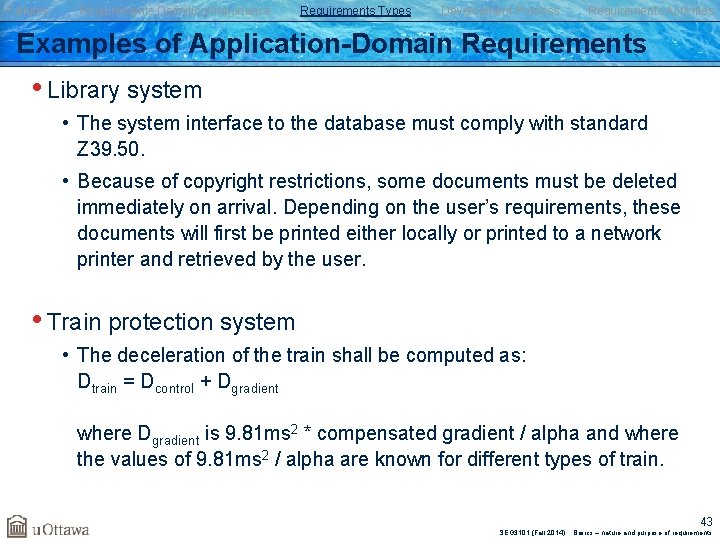
Failures Requirements Definition/Importance Requirements Types Development Process Requirements Activities Examples of Application-Domain Requirements • Library system • The system interface to the database must comply with standard Z 39. 50. • Because of copyright restrictions, some documents must be deleted immediately on arrival. Depending on the user’s requirements, these documents will first be printed either locally or printed to a network printer and retrieved by the user. • Train protection system • The deceleration of the train shall be computed as: Dtrain = Dcontrol + Dgradient where Dgradient is 9. 81 ms 2 * compensated gradient / alpha and where the values of 9. 81 ms 2 / alpha are known for different types of train. 43 SEG 3101 (Fall 2014). Basics – nature and purpose of requirements
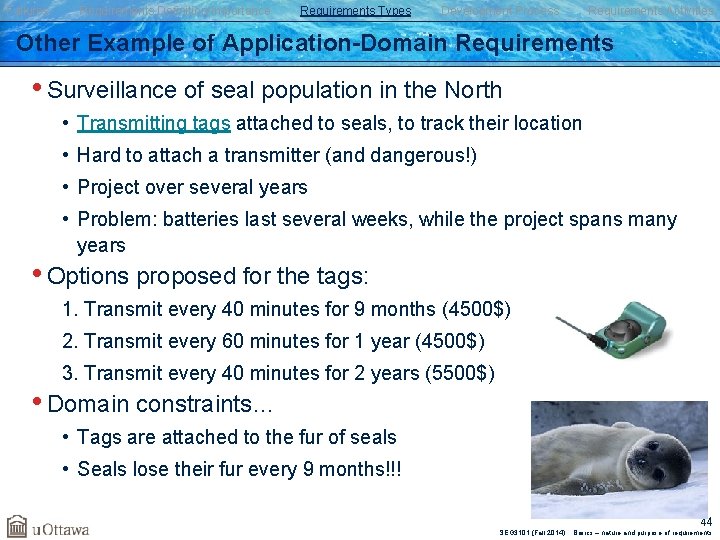
Failures Requirements Definition/Importance Requirements Types Development Process Requirements Activities Other Example of Application-Domain Requirements • Surveillance of seal population in the North • Transmitting tags attached to seals, to track their location • Hard to attach a transmitter (and dangerous!) • Project over several years • Problem: batteries last several weeks, while the project spans many years • Options proposed for the tags: 1. Transmit every 40 minutes for 9 months (4500$) 2. Transmit every 60 minutes for 1 year (4500$) 3. Transmit every 40 minutes for 2 years (5500$) • Domain constraints… • Tags are attached to the fur of seals • Seals lose their fur every 9 months!!! 44 SEG 3101 (Fall 2014). Basics – nature and purpose of requirements
Failures Requirements Definition/Importance Requirements Types Development Process Requirements Activities Problems Concerning Application-Domain Requirements • Understandability • Requirements are expressed in the language of the application domain • This is often not understood by software engineers developing the system • Implicitness / Tacit Knowledge • Domain specialists understand the area so well that they do not think of making the domain requirements explicit • People are often unaware of the tacit knowledge they possess and therefore cannot express it to others • “It’s obvious” • “Assume” 45 SEG 3101 (Fall 2014). Basics – nature and purpose of requirements
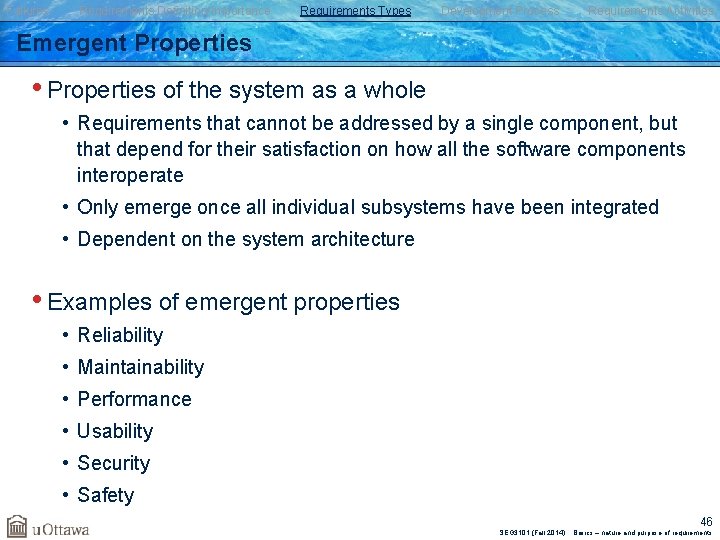
Failures Requirements Definition/Importance Requirements Types Development Process Requirements Activities Emergent Properties • Properties of the system as a whole • Requirements that cannot be addressed by a single component, but that depend for their satisfaction on how all the software components interoperate • Only emerge once all individual subsystems have been integrated • Dependent on the system architecture • Examples of emergent properties • Reliability • Maintainability • Performance • Usability • Security • Safety 46 SEG 3101 (Fall 2014). Basics – nature and purpose of requirements
The Requirements Engineering Process
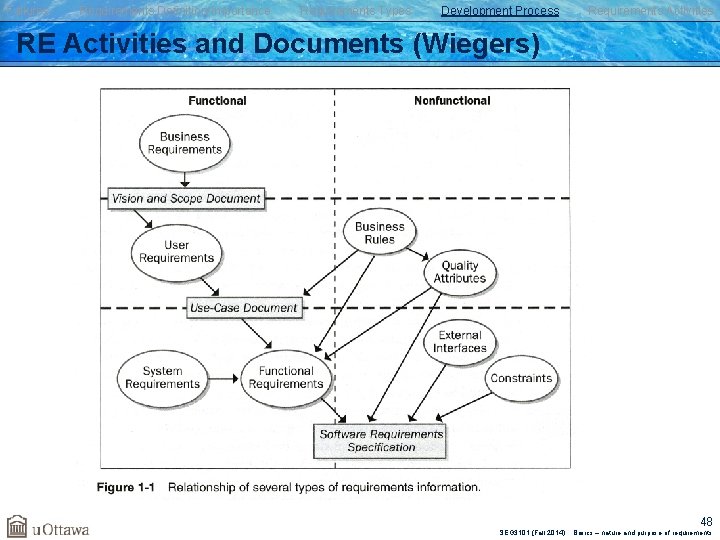
Failures Requirements Definition/Importance Requirements Types Development Process Requirements Activities RE Activities and Documents (Wiegers) 48 SEG 3101 (Fall 2014). Basics – nature and purpose of requirements
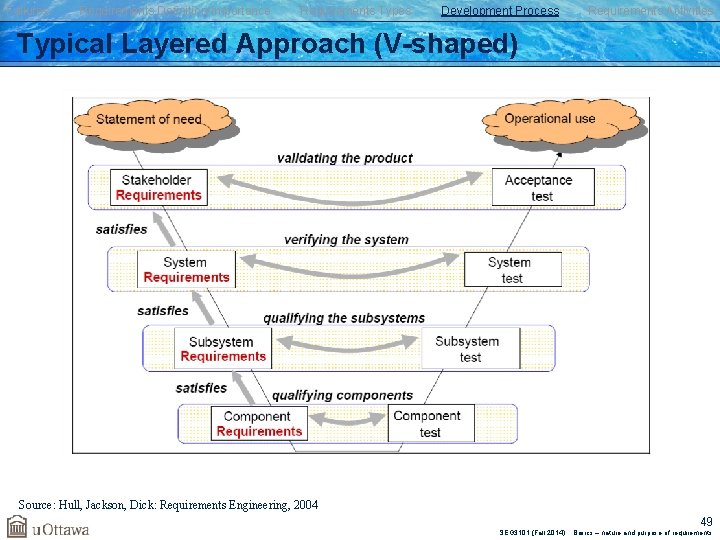
Failures Requirements Definition/Importance Requirements Types Development Process Requirements Activities Typical Layered Approach (V-shaped) Source: Hull, Jackson, Dick: Requirements Engineering, 2004 49 SEG 3101 (Fall 2014). Basics – nature and purpose of requirements
Failures Requirements Definition/Importance Requirements Types Development Process Requirements Activities Requirements and Modeling go together • The systems engineering sandwich! Source: http: //www. telelogic. com/download/paper/Systems. Engineering. Sandwich. pdf 50 SEG 3101 (Fall 2014). Basics – nature and purpose of requirements
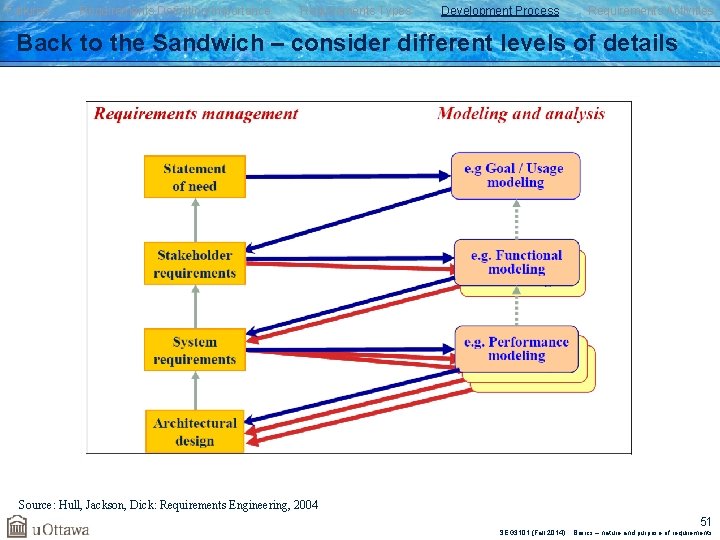
Failures Requirements Definition/Importance Requirements Types Development Process Requirements Activities Back to the Sandwich – consider different levels of details Source: Hull, Jackson, Dick: Requirements Engineering, 2004 51 SEG 3101 (Fall 2014). Basics – nature and purpose of requirements
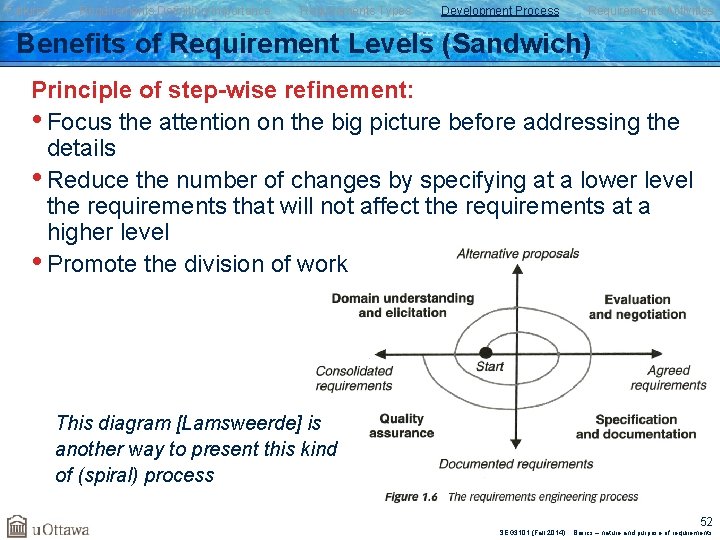
Failures Requirements Definition/Importance Requirements Types Development Process Requirements Activities Benefits of Requirement Levels (Sandwich) Principle of step-wise refinement: • Focus the attention on the big picture before addressing the details • Reduce the number of changes by specifying at a lower level the requirements that will not affect the requirements at a higher level • Promote the division of work This diagram [Lamsweerde] is another way to present this kind of (spiral) process 52 SEG 3101 (Fall 2014). Basics – nature and purpose of requirements
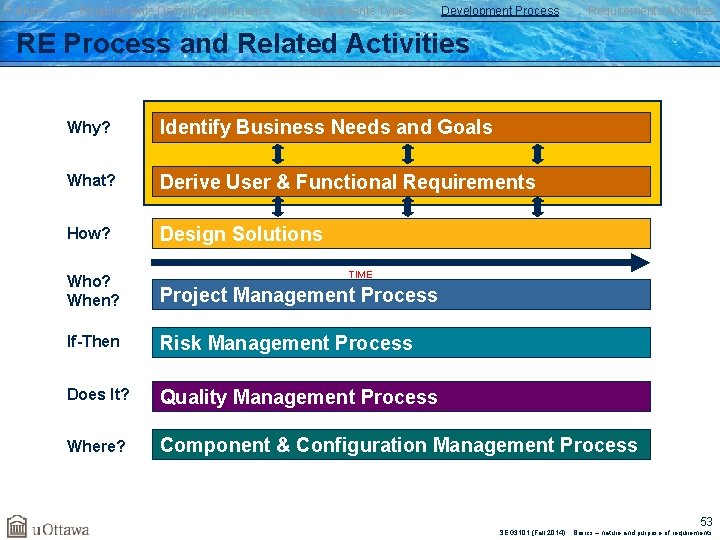
Failures Requirements Definition/Importance Requirements Types Development Process Requirements Activities RE Process and Related Activities Why? Identify Business Needs and Goals What? Derive User & Functional Requirements How? Time Design Solutions TIME Who? When? Project Management Process If-Then Risk Management Process Does It? Quality Management Process Where? Component & Configuration Management Process 53 SEG 3101 (Fall 2014). Basics – nature and purpose of requirements
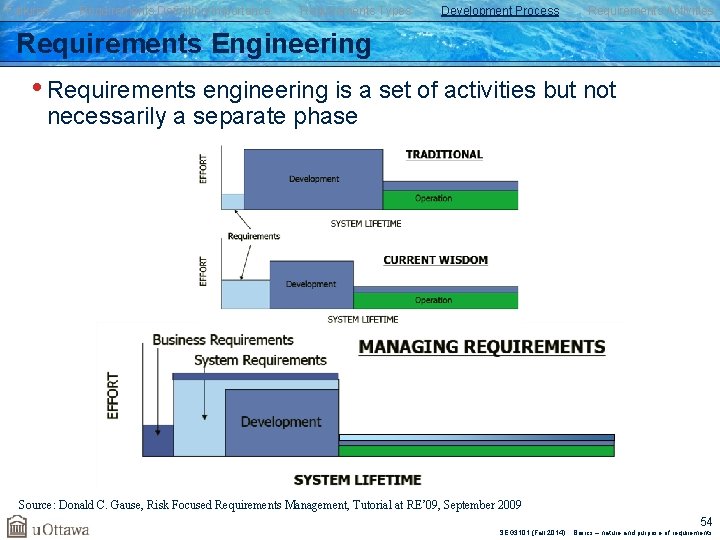
Failures Requirements Definition/Importance Requirements Types Development Process Requirements Activities Requirements Engineering • Requirements engineering is a set of activities but not necessarily a separate phase Source: Donald C. Gause, Risk Focused Requirements Management, Tutorial at RE’ 09, September 2009 54 SEG 3101 (Fall 2014). Basics – nature and purpose of requirements
Main Requirements Activities
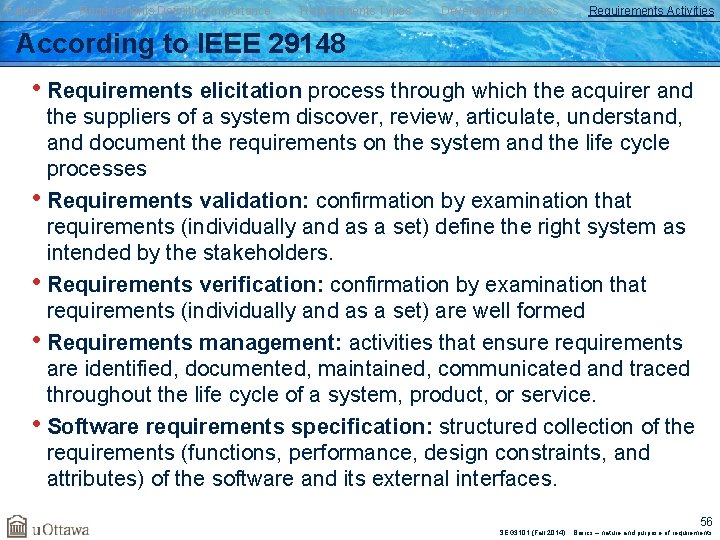
Failures Requirements Definition/Importance Requirements Types Development Process Requirements Activities According to IEEE 29148 • Requirements elicitation process through which the acquirer and the suppliers of a system discover, review, articulate, understand, and document the requirements on the system and the life cycle processes • Requirements validation: confirmation by examination that requirements (individually and as a set) define the right system as intended by the stakeholders. • Requirements verification: confirmation by examination that requirements (individually and as a set) are well formed • Requirements management: activities that ensure requirements are identified, documented, maintained, communicated and traced throughout the life cycle of a system, product, or service. • Software requirements specification: structured collection of the requirements (functions, performance, design constraints, and attributes) of the software and its external interfaces. 56 SEG 3101 (Fall 2014). Basics – nature and purpose of requirements
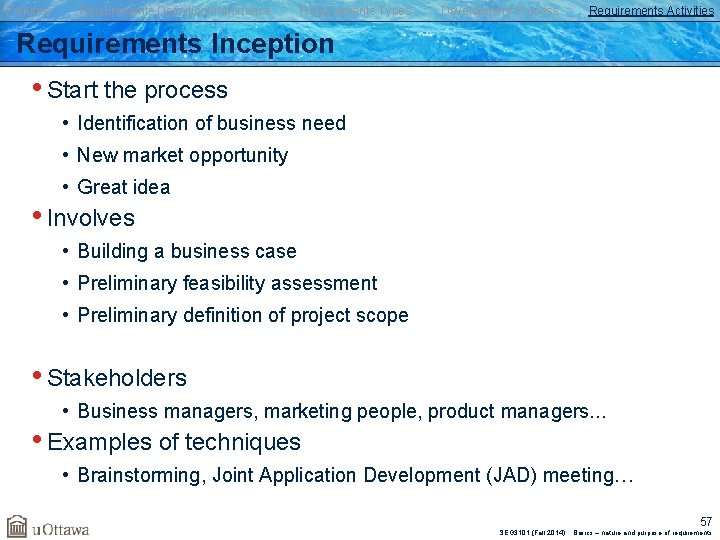
Failures Requirements Definition/Importance Requirements Types Development Process Requirements Activities Requirements Inception • Start the process • Identification of business need • New market opportunity • Great idea • Involves • Building a business case • Preliminary feasibility assessment • Preliminary definition of project scope • Stakeholders • Business managers, marketing people, product managers. . . • Examples of techniques • Brainstorming, Joint Application Development (JAD) meeting… 57 SEG 3101 (Fall 2014). Basics – nature and purpose of requirements
Failures Requirements Definition/Importance Requirements Types Development Process Requirements Activities Requirements Elicitation (1) • Gathering of information • About problem domain • About problems requiring a solution • About constraints related to the problem or solution • More than just collecting… Need to evoke and provoke! • Questions that need to be answered • What is the system? • What are the goals of the system? • How is the work done now? • What are the problems? • How will the system solve these problems? • How will the system be used on a day-to-day basis? • Will performance issues, legal issues, or other constraints affect the way the solution is approached? 58 SEG 3101 (Fall 2014). Basics – nature and purpose of requirements
Failures Requirements Definition/Importance Requirements Types Development Process Requirements Activities Requirements Elicitation (2) • Overview of different sources • Customers and other stakeholders • Existing systems • Documentation • Domain experts • More. . . • Overview of different techniques • Brainstorming • Interviews • Task observations • Use cases / scenarios • Prototyping • More. . . 59 SEG 3101 (Fall 2014). Basics – nature and purpose of requirements
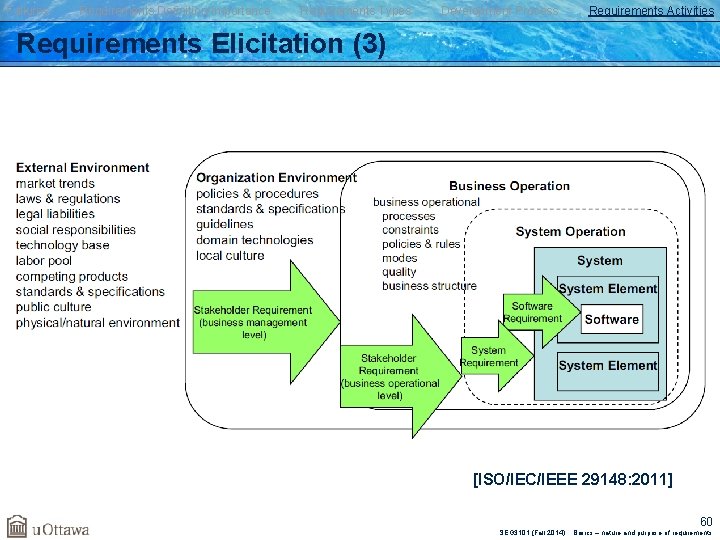
Failures Requirements Definition/Importance Requirements Types Development Process Requirements Activities Requirements Elicitation (3) [ISO/IEC/IEEE 29148: 2011] 60 SEG 3101 (Fall 2014). Basics – nature and purpose of requirements
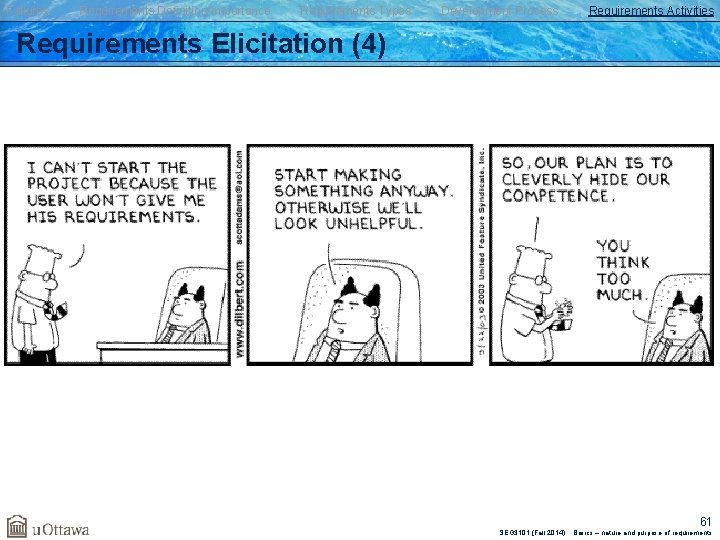
Failures Requirements Definition/Importance Requirements Types Development Process Requirements Activities Requirements Elicitation (4) 61 SEG 3101 (Fall 2014). Basics – nature and purpose of requirements
Failures Requirements Definition/Importance Requirements Types Development Process Requirements Activities Requirements Analysis • The process of studying and analyzing the needs of stakeholders (e. g. , customer, user) in view of coming up with a “solution”. Such a solution may involve: • A new organization of the workflow in the company. • A new system (system-to-be, also called solution domain) which will be used in the existing or modified workflow. • A new software to be developed which is to run within the existing computer system or involving modified and/or additional hardware. • Objectives • Detect and resolve conflicts between requirements (e. g. , through negotiation) • Discover the boundaries of the system / software and how it must interact with its environment • Elaborate system requirements to derive software requirements • Requirements analysis is often linked to modeling 62 SEG 3101 (Fall 2014). Basics – nature and purpose of requirements
Failures Requirements Definition/Importance Requirements Types Development Process Requirements Activities Requirements Specification • The invention and definition of the behavior of a new system (solution domain) such that it will produce the required effects in the problem domain • Requirements Analysis has defined the problem domain and the required effects • Specification Document • A document that clearly and precisely describes, each of the essential requirements (functions, performance, design constraints, and quality attributes) of the software and the external interfaces • Each requirement being defined in such a way that its achievement is capable of being objectively verified by a prescribed method (e. g. , inspection, demonstration, analysis, or test) • Different guidelines and templates exist for requirements specification 63 SEG 3101 (Fall 2014). Basics – nature and purpose of requirements
Failures Requirements Definition/Importance Requirements Types Development Process Requirements Activities Requirements Verification and Validation • Validation and verification • Both help ensure delivery of what the client wants • • • Need to be performed at every stage during the process Validation: checks that the right product is being built (refers back to stakeholders – main concern during RE) Verification: checks that the product is being built right • During design phase: refers back to the specification of the system or software requirements • • During RE: mainly checking consistency between different requirements, detecting conflicts Techniques used during RE • • • Simple checks Formal reviews Logical analysis Prototypes and enactments Design of functional tests Development of user manual 64 SEG 3101 (Fall 2014). Basics – nature and purpose of requirements
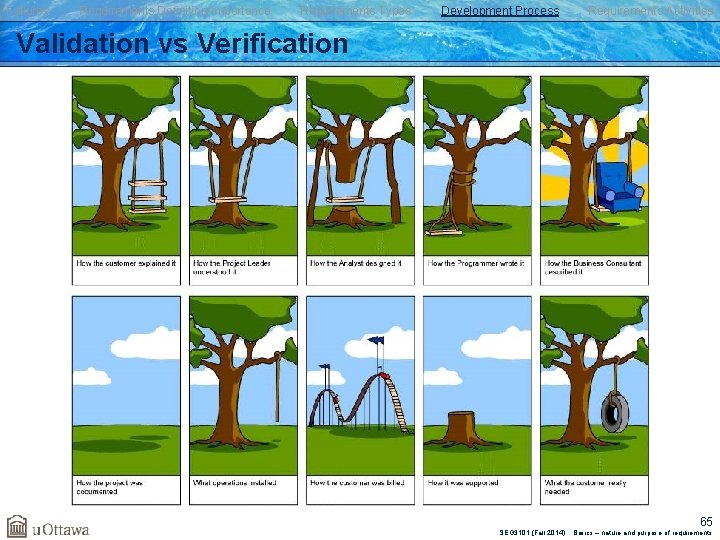
Failures Requirements Definition/Importance Requirements Types Development Process Requirements Activities Validation vs Verification 65 SEG 3101 (Fall 2014). Basics – nature and purpose of requirements
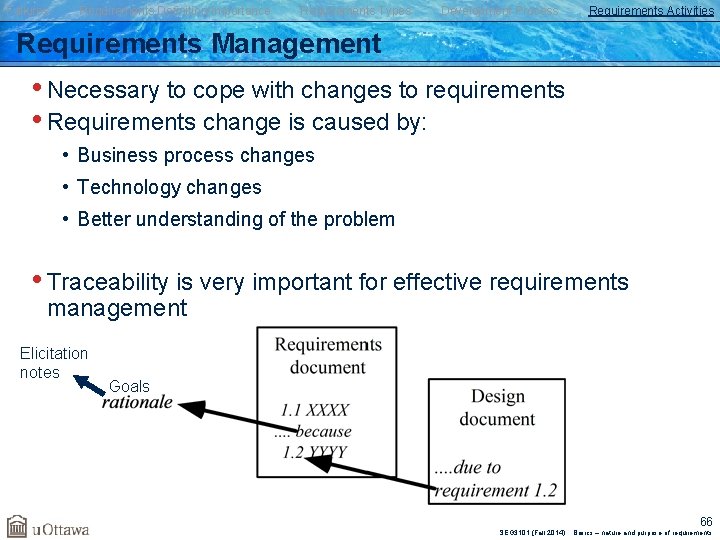
Failures Requirements Definition/Importance Requirements Types Development Process Requirements Activities Requirements Management • Necessary to cope with changes to requirements • Requirements change is caused by: • Business process changes • Technology changes • Better understanding of the problem • Traceability is very important for effective requirements management Elicitation notes Goals 66 SEG 3101 (Fall 2014). Basics – nature and purpose of requirements
Failures Requirements Definition/Importance Requirements Types Development Process Requirements Activities Requirements Documents • • Vision and Scope Document Elicitation notes • • (Raw) user requirements obtained through elicitation; often unstructured, incomplete, and inconsistent Requirements document System requirements document Software requirements document • The software is normally part of a system that includes hardware and software. Therefore the software requirements are normally part of the system requirements. 67 SEG 3101 (Fall 2014). Basics – nature and purpose of requirements
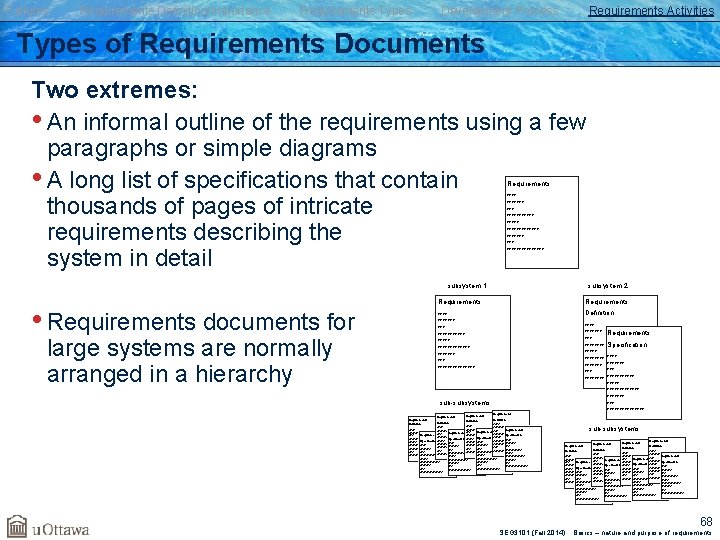
Failures Requirements Definition/Importance Requirements Types Development Process Requirements Activities Types of Requirements Documents Two extremes: • An informal outline of the requirements using a few paragraphs or simple diagrams • A long list of specifications that contain thousands of pages of intricate requirements describing the system in detail Requirements xxxxxxx xxxxxxxxx xxxxxxxx subsystem 1 • Requirements documents for large systems are normally arranged in a hierarchy subsystem 2 Requirements xxxxxxx xxxxxxxxx xxxxxxxx Definition xxxxxxx Requirements xxxxxxx Specification xxxxxxx xxxxxxx xxx xxxxxxxxxxxxxxx xxxxxxxx sub-subsystems Requirements Definition xxxxxxx xxxxxxx Requirementsxxx xxx xxxxxxxxxxx Requirements Specification xxxxxxxxxxx Specificationxxxxx xxxxxxxxxxxxx xxxxxxx xxxxxxx xxx xxxxxxx xxxxxx xxxxxxxxxxx xxxxxxxxxxxxxxx xxxxxxxx xxxxxxxxxxxxx xxxxxxx xxxxxxx xxx xxxxxxxxxxxxxxx Requirements Definition Requirements sub-subsystems Requirements Definition xxxxxxx xxxxxxx Requirements xxxxxxxxxxx xxx xxxxxx Requirements Specification xxxxxx Specificationxxxxxxxxxxx Specificationxxxxxxx xxxxxxxxxxxxx xxxxxxx xxx xxxxxxx xxx xxxxxxxxxxx xxxxxxxxxxxxxxx xxxxxxxxxxxxxxxxxx xxxxxxx xxxxxxx xxx xxxxxxxxxxxxxxx Requirements Definition Requirements 68 SEG 3101 (Fall 2014). Basics – nature and purpose of requirements
Failures Requirements Definition/Importance Requirements Types Development Process Requirements Activities The Requirements Analyst 1 • Plays an essential communication role • Talks to users: application domain • Talks to developers: technical domain • Translates user requirements into functional requirements and quality goals • Needs many capabilities • Interviewing and listening skills • Facilitation and interpersonal skills • Writing and modeling skills • Organizational ability • RE is more than just modeling… This is a social activity! [1] Karl Wiegers, In Search of Excellent Requirements 69 SEG 3101 (Fall 2014). Basics – nature and purpose of requirements
For More Information a. B. A. Nuseibeh and S. M. Easterbrook, Requirements Engineering: A Roadmap. In A. C. W. Finkelstein (ed) The Future of Software Engineering, ACM Press, 2000 http: //www. cs. toronto. edu/~sme/papers/2000/ICSE 2000. pdf b. Simson Garfinkel, History's Worst Software Bugs, Wired News, 2005 http: //www. wired. com/news/technology/bugs/0, 2924, 69355, 00. html c. INCOSE Requirements Working Group http: //www. incose. org/practice/techactivities/wg/rqmts/ d. Tools Survey: Requirements Management (RM) Tools http: //www. incose. org/productspubs/products/rmsurvey. aspx http: //www. volere. co. uk/tools. htm e. IEEE (1993) Recommended Practice for Software Requirements Specifications. IEEE Std 830 -1993, NY, USA. f. IEEE (1995) Guide for Developing System Requirements Specifications. IEEE Std P 1233/D 3, NY, USA. g. SWEBOK 2013 70 SEG 3101 (Fall 2014). Basics – nature and purpose of requirements
Main References a. Jeremy Dick, Elizabeth Hull, Ken Jackson: Requirements Engineering, Springer-Verlag, 2004 b. c. Soren Lauesen: Software Requirements - Styles and Techniques, Addison Wesley, 2002 d. Karl E. Wiegers: Software Requirements, Microsoft Press, 2003 e. Gerald Kotonya, Ian Sommerville: Requirements Engineering – Processes and Techniques, Wiley, 1998 f. Roger S. Pressman: Software Engineering – A Practitioner's Approach, Mc. Graw-Hill, 2005 g. Tim Lethbridge, Robert Laganière: Object Oriented Software Engineering: Practical Software Developement using UML and Java, 2 nd edition, Mc. Graw-Hill, 2005 h. Ivy F. Hooks, Kristin A. Farry: Customer-Centered Products – Creating Successful Products Through Smart Requirements Management, Amacom, 2001 i. CHAOS Report, Standish Group, 1994 -2012 Ian K. Bray: An Introduction to Requirements Engineering, Addison Wesley, 2002 71 SEG 3101 (Fall 2014). Basics – nature and purpose of requirements
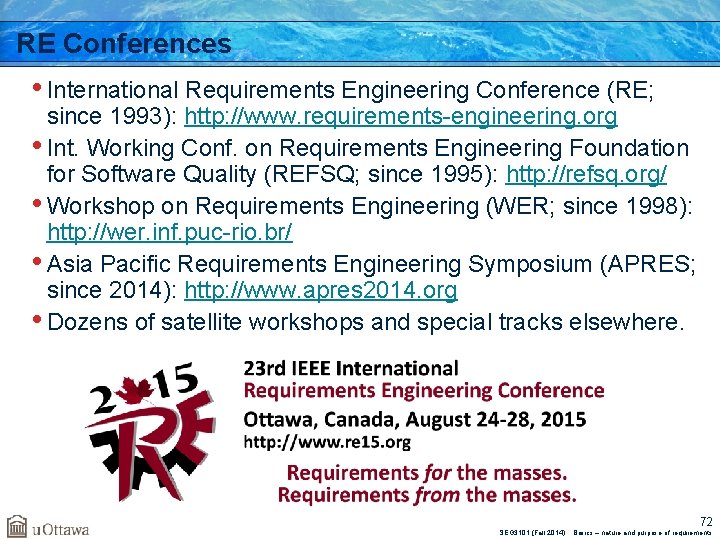
RE Conferences • International Requirements Engineering Conference (RE; since 1993): http: //www. requirements-engineering. org • Int. Working Conf. on Requirements Engineering Foundation for Software Quality (REFSQ; since 1995): http: //refsq. org/ • Workshop on Requirements Engineering (WER; since 1998): http: //wer. inf. puc-rio. br/ • Asia Pacific Requirements Engineering Symposium (APRES; since 2014): http: //www. apres 2014. org • Dozens of satellite workshops and special tracks elsewhere. 72 SEG 3101 (Fall 2014). Basics – nature and purpose of requirements
- Slides: 72