Satellites Settler What is this picture of Learning
- Slides: 18
Satellites
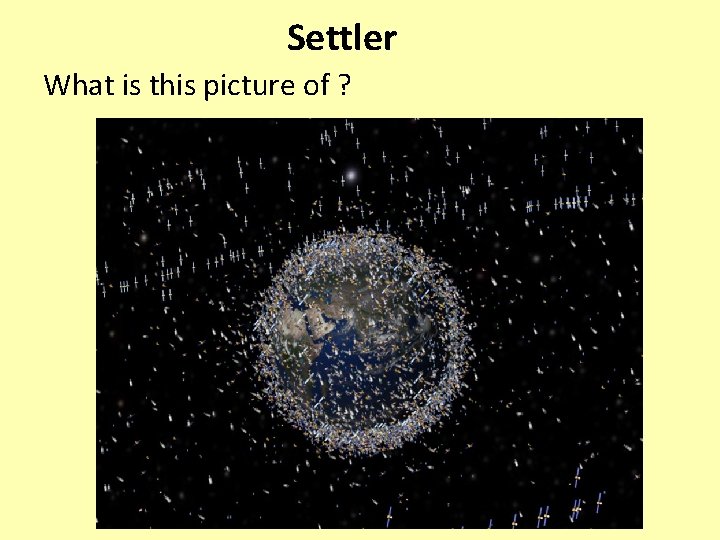
Settler What is this picture of ?
Learning Objectives • To know what a satellite is • To know some uses of artificial satellites • To understand the differences between polar and geostationary orbits and where they are used
Success criteria • Produce a list of uses of satellites, and correctly identify the type of orbit. (Grade C) • Calculate orbit time and speed for satellites and explain differences. (Grade A) • Draw a scale diagram to determine the number of satellites needed to provide coverage for the entire earth.
Starter - Satellites On one post it note write down a definition for a satellite On the second post it note write down as many uses of satellites as you can
Satellites A satellite is: Uses of satellites
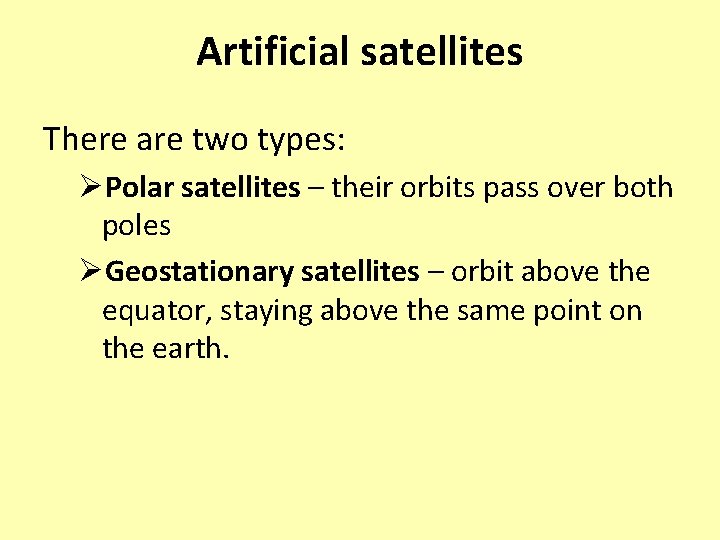
Artificial satellites There are two types: ØPolar satellites – their orbits pass over both poles ØGeostationary satellites – orbit above the equator, staying above the same point on the earth.
Uses of satellites 1. Make a table with 2 columns labelled “Polar satellites” and “Geostationary satellites”. 2. Put each of the uses of satellites produced in the starter into the appropriate column.
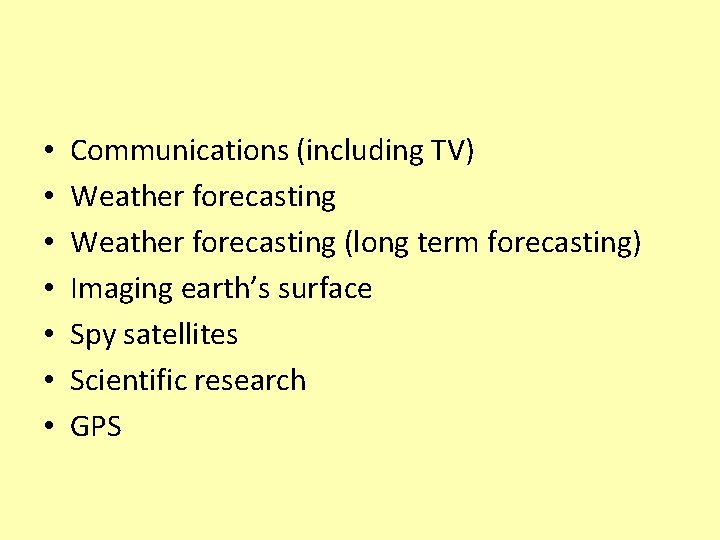
• • Communications (including TV) Weather forecasting (long term forecasting) Imaging earth’s surface Spy satellites Scientific research GPS
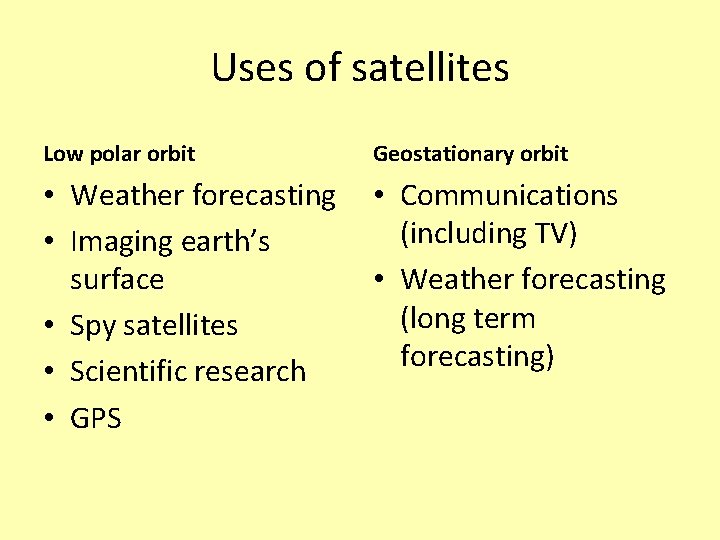
Uses of satellites Low polar orbit Geostationary orbit • Weather forecasting • Imaging earth’s surface • Spy satellites • Scientific research • GPS • Communications (including TV) • Weather forecasting (long term forecasting)
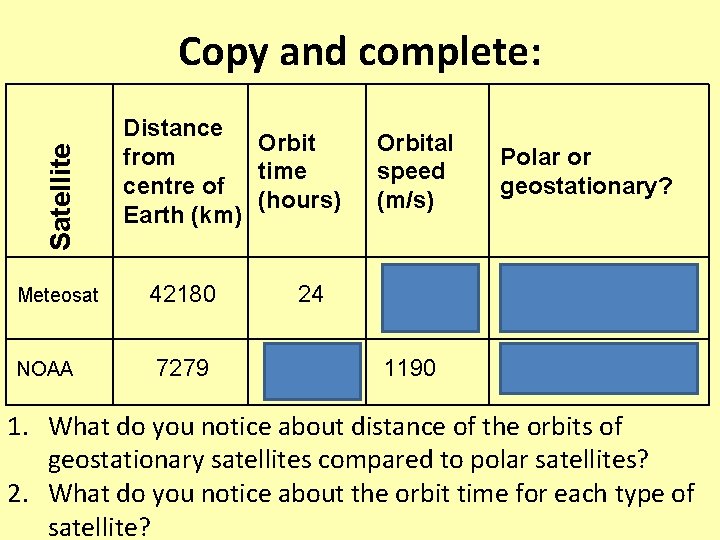
Satellite Copy and complete: Meteosat NOAA Distance Orbit from time centre of (hours) Earth (km) 42180 24 7279 10. 7 Orbital speed (m/s) 3067. 4 1190 Polar or geostationary? Geostationary Polar 1. What do you notice about distance of the orbits of geostationary satellites compared to polar satellites? 2. What do you notice about the orbit time for each type of satellite?
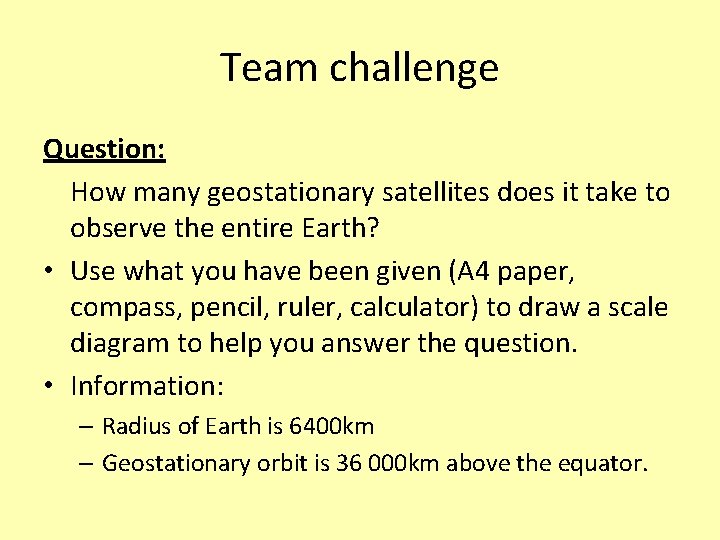
Team challenge Question: How many geostationary satellites does it take to observe the entire Earth? • Use what you have been given (A 4 paper, compass, pencil, ruler, calculator) to draw a scale diagram to help you answer the question. • Information: – Radius of Earth is 6400 km – Geostationary orbit is 36 000 km above the equator.
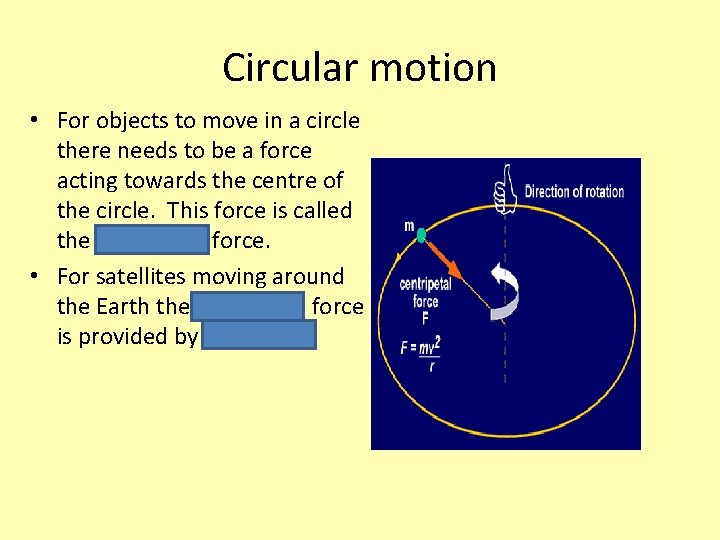
Circular motion • For objects to move in a circle there needs to be a force acting towards the centre of the circle. This force is called the centripetal force. • For satellites moving around the Earth the centripetal force is provided by gravity
Why will a satellite closer to earth have a shorter orbit time? 1. Close to earth so strong gravitational attraction (large centripetal acceleration). 2. Shorter orbit.
Homework • Homework 1 on Space exploration and satellites
Learning Objectives • To know what a satellite is • To know some uses of artificial satellites • To understand the differences between polar and geostationary orbits and where they are used
Success criteria • Produce a list of uses of satellites, and correctly identify the type of orbit. (Grade C) • Calculate orbit time and speed for satellites and explain differences. (Grade A) • Draw a scale diagram to determine the number of satellites needed to provide coverage for the entire earth.
Plenary - Key learning • Satellites are. . . . • The main differences between polar orbits and geostationary orbits are. . . • Two uses of a polar orbit satellite are. . . . • Two uses of a geostationary orbit satellite are. . . • The further a satellite is from the earth the. . . it moves