Sacred Power Vision and Liturgy in John of
- Slides: 27
Sacred Power: Vision and Liturgy in John of Morigny's Book of Flowers (1301 -1315)
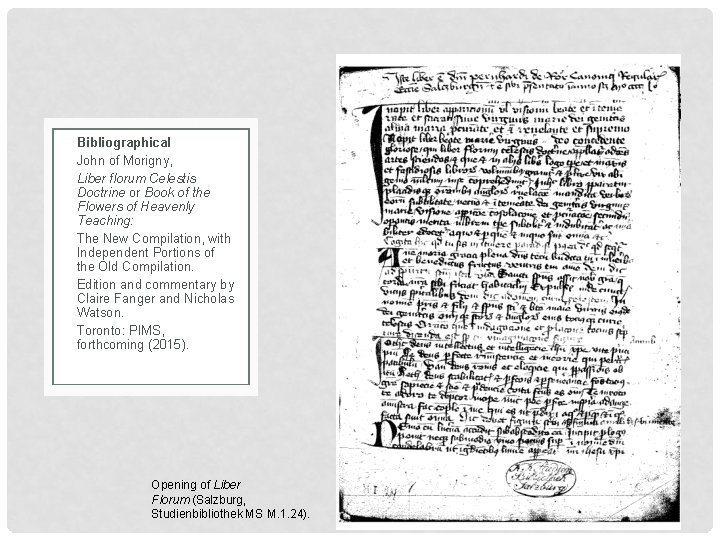
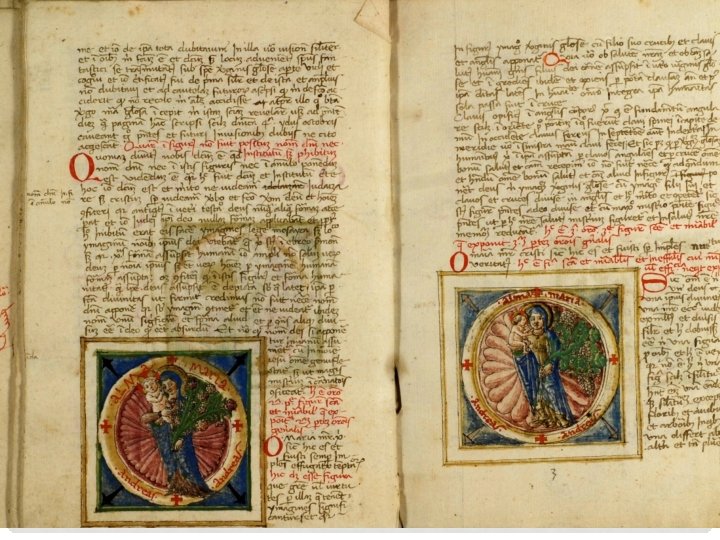
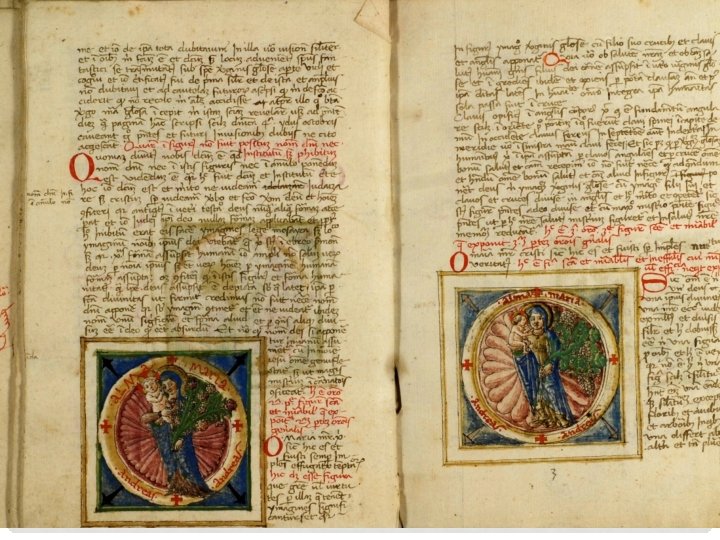
Bibliographical John of Morigny, Liber florum Celestis Doctrine or Book of the Flowers of Heavenly Teaching: The New Compilation, with Independent Portions of the Old Compilation. Edition and commentary by Claire Fanger and Nicholas Watson. Toronto: PIMS, forthcoming (2015). Opening of Liber Florum (Salzburg, Studienbibliothek MS M. 1. 24).
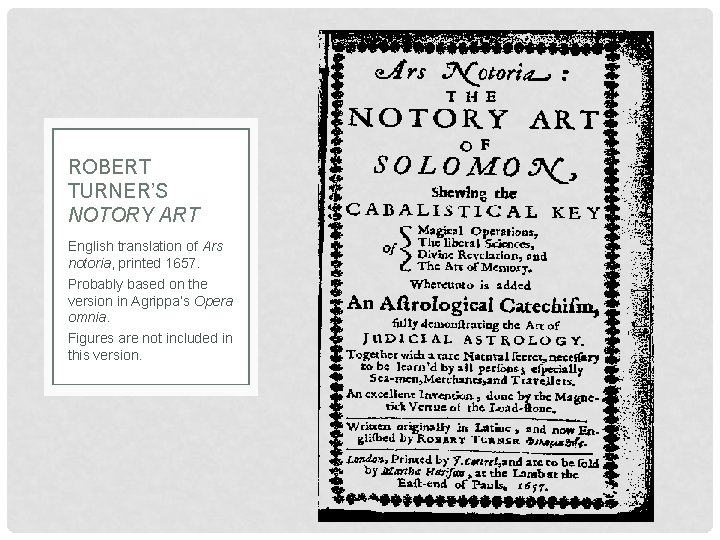
ROBERT TURNER’S NOTORY ART English translation of Ars notoria, printed 1657. Probably based on the version in Agrippa’s Opera omnia. Figures are not included in this version.
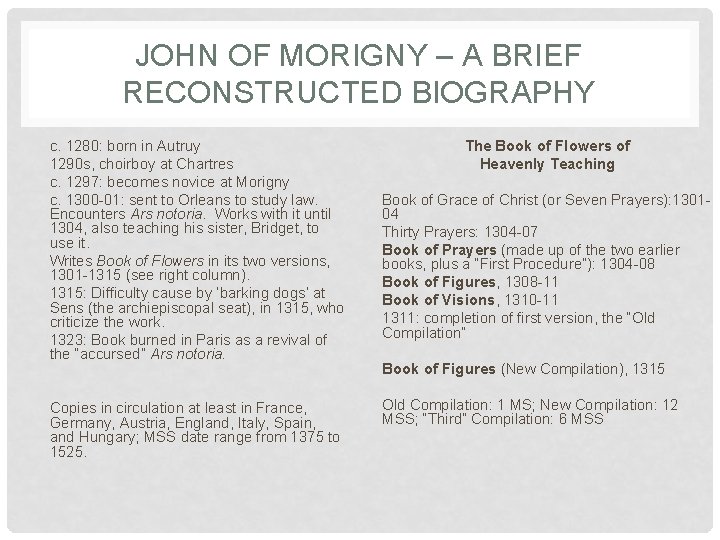
JOHN OF MORIGNY – A BRIEF RECONSTRUCTED BIOGRAPHY c. 1280: born in Autruy 1290 s, choirboy at Chartres c. 1297: becomes novice at Morigny c. 1300 -01: sent to Orleans to study law. Encounters Ars notoria. Works with it until 1304, also teaching his sister, Bridget, to use it. Writes Book of Flowers in its two versions, 1301 -1315 (see right column). 1315: Difficulty cause by ‘barking dogs’ at Sens (the archiepiscopal seat), in 1315, who criticize the work. 1323: Book burned in Paris as a revival of the “accursed” Ars notoria. Copies in circulation at least in France, Germany, Austria, England, Italy, Spain, and Hungary; MSS date range from 1375 to 1525. The Book of Flowers of Heavenly Teaching Book of Grace of Christ (or Seven Prayers): 130104 Thirty Prayers: 1304 -07 Book of Prayers (made up of the two earlier books, plus a “First Procedure”): 1304 -08 Book of Figures, 1308 -11 Book of Visions, 1310 -11 1311: completion of first version, the “Old Compilation” Book of Figures (New Compilation), 1315 Old Compilation: 1 MS; New Compilation: 12 MSS; “Third” Compilation: 6 MSS
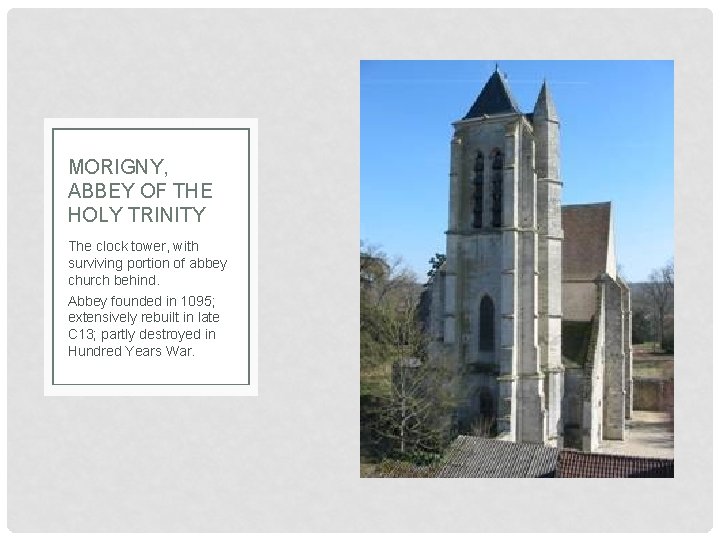
MORIGNY, ABBEY OF THE HOLY TRINITY The clock tower, with surviving portion of abbey church behind. Abbey founded in 1095; extensively rebuilt in late C 13; partly destroyed in Hundred Years War.
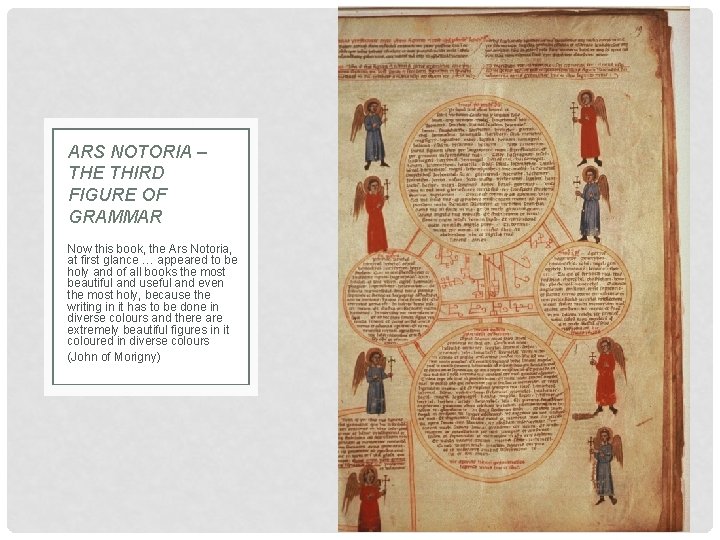
ARS NOTORIA – THE THIRD FIGURE OF GRAMMAR Now this book, the Ars Notoria, at first glance … appeared to be holy and of all books the most beautiful and useful and even the most holy, because the writing in it has to be done in diverse colours and there are extremely beautiful figures in it coloured in diverse colours (John of Morigny)
JOHN OF MORIGNY – A BRIEF RECONSTRUCTED BIOGRAPHY c. 1280: born in Autruy 1290 s, choirboy at Chartres c. 1297: becomes novice at Morigny c. 1300 -01: sent to Orleans to study law. Encounters Ars notoria. Works with it until 1304, also teaching his sister, Bridget, to use it. Writes Book of Flowers in its two versions, 1301 -1315 (see right column). 1315: Difficulty cause by ‘barking dogs’ at Sens (the archiepiscopal seat), in 1315, who criticize the work. 1323: Book burned in Paris as a revival of the “accursed” Ars notoria. Copies in circulation at least in France, Germany, Austria, England, Italy, Spain, and Hungary; MSS date range from 1375 to 1525. The Book of Flowers of Heavenly Teaching Book of Grace of Christ (or Seven Prayers): 130104 Thirty Prayers: 1304 -07 Book of Prayers (made up of the two earlier books, plus a “First Procedure”): 1304 -08 Book of Figures, 1308 -11 Book of Visions, 1310 -11 1311: completion of first version, the “Old Compilation” Book of Figures (New Compilation), 1315 Old Compilation: 1 MS; New Compilation: 12 MSS; “Third” Compilation: 6 MSS
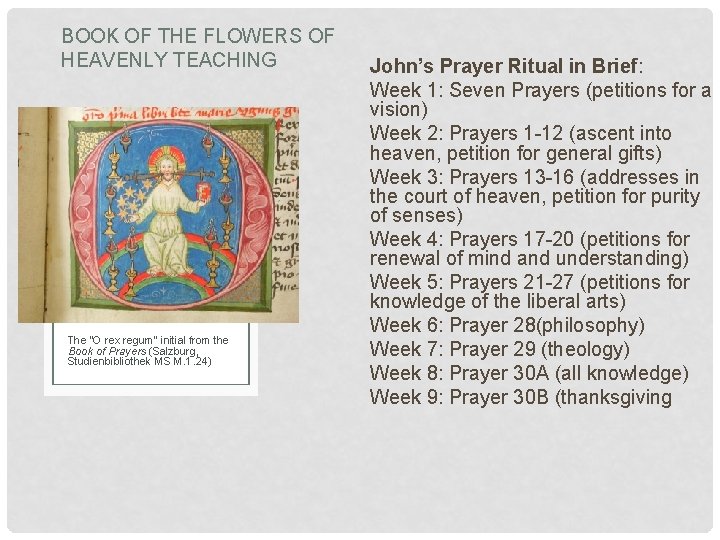
BOOK OF THE FLOWERS OF HEAVENLY TEACHING The “O rex regum” initial from the Book of Prayers (Salzburg, Studienbibliothek MS M. 1. 24) John’s Prayer Ritual in Brief: Week 1: Seven Prayers (petitions for a vision) Week 2: Prayers 1 -12 (ascent into heaven, petition for general gifts) Week 3: Prayers 13 -16 (addresses in the court of heaven, petition for purity of senses) Week 4: Prayers 17 -20 (petitions for renewal of mind and understanding) Week 5: Prayers 21 -27 (petitions for knowledge of the liberal arts) Week 6: Prayer 28(philosophy) Week 7: Prayer 29 (theology) Week 8: Prayer 30 A (all knowledge) Week 9: Prayer 30 B (thanksgiving
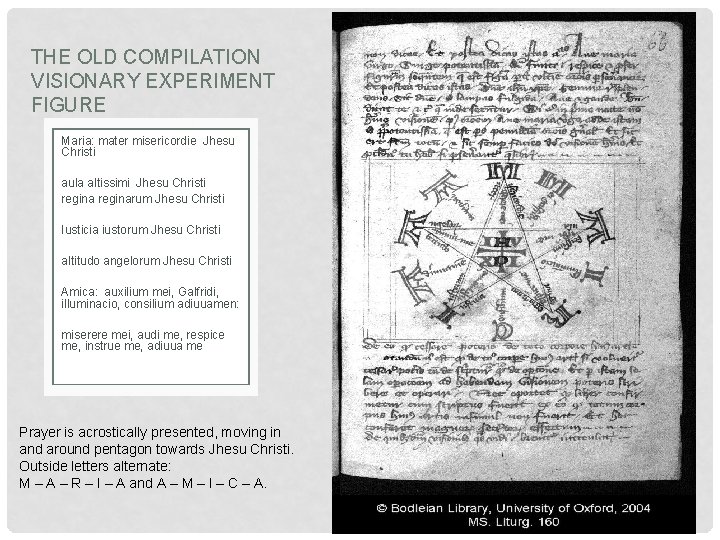
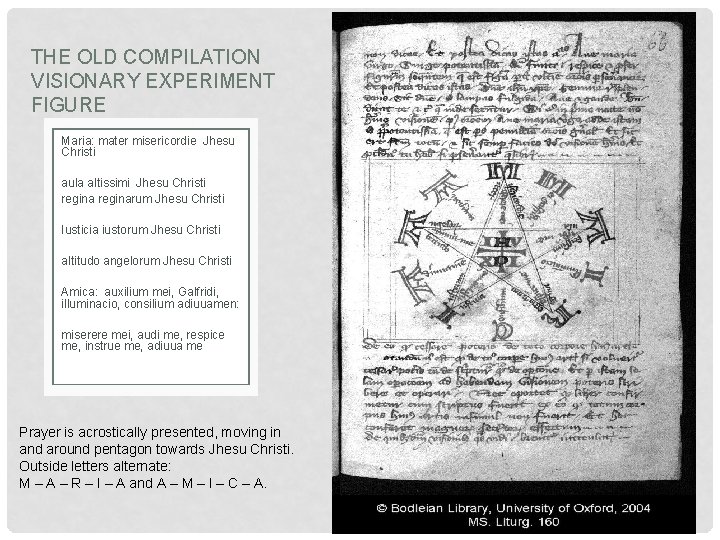
THE OLD COMPILATION VISIONARY EXPERIMENT FIGURE Maria: mater misericordie Jhesu Christi aula altissimi Jhesu Christi reginarum Jhesu Christi Iusticia iustorum Jhesu Christi altitudo angelorum Jhesu Christi Amica: auxilium mei, Galfridi, illuminacio, consilium adiuuamen: miserere mei, audi me, respice me, instrue me, adiuua me Prayer is acrostically presented, moving in and around pentagon towards Jhesu Christi. Outside letters alternate: M – A – R – I – A and A – M – I – C – A.
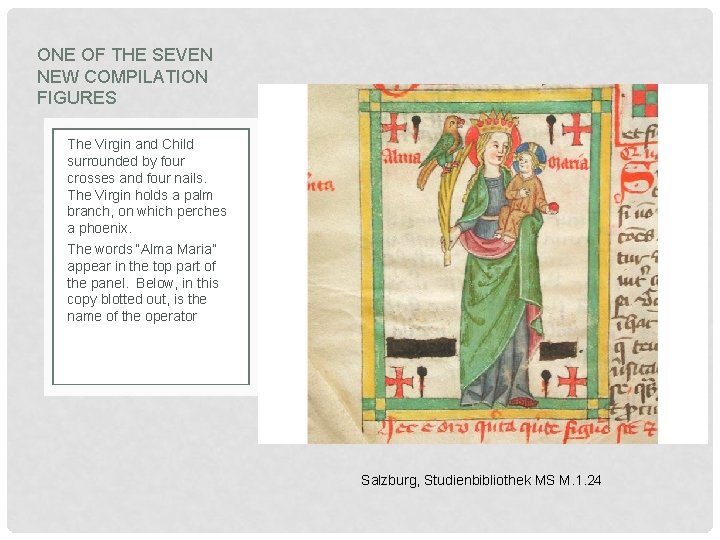
ONE OF THE SEVEN NEW COMPILATION FIGURES The Virgin and Child surrounded by four crosses and four nails. The Virgin holds a palm branch, on which perches a phoenix. The words “Alma Maria” appear in the top part of the panel. Below, in this copy blotted out, is the name of the operator Salzburg, Studienbibliothek MS M. 1. 24
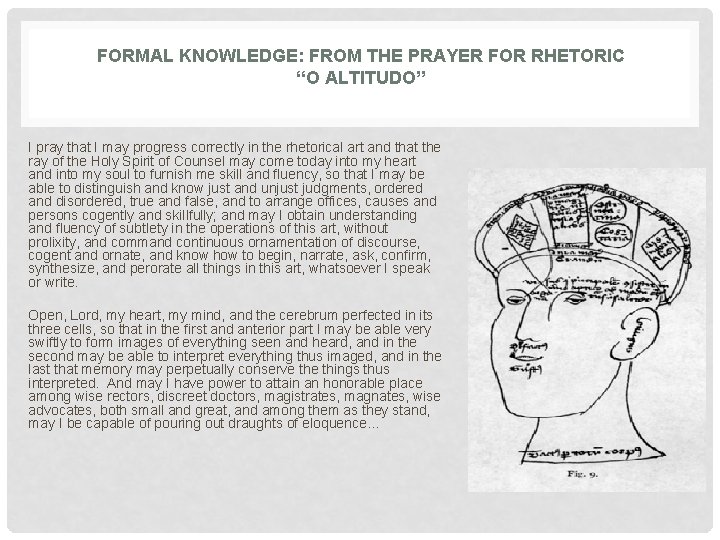
FORMAL KNOWLEDGE: FROM THE PRAYER FOR RHETORIC “O ALTITUDO” I pray that I may progress correctly in the rhetorical art and that the ray of the Holy Spirit of Counsel may come today into my heart and into my soul to furnish me skill and fluency, so that I may be able to distinguish and know just and unjust judgments, ordered and disordered, true and false, and to arrange offices, causes and persons cogently and skillfully; and may I obtain understanding and fluency of subtlety in the operations of this art, without prolixity, and command continuous ornamentation of discourse, cogent and ornate, and know how to begin, narrate, ask, confirm, synthesize, and perorate all things in this art, whatsoever I speak or write. Open, Lord, my heart, my mind, and the cerebrum perfected in its three cells, so that in the first and anterior part I may be able very swiftly to form images of everything seen and heard, and in the second may be able to interpret everything thus imaged, and in the last that memory may perpetually conserve things thus interpreted. And may I have power to attain an honorable place among wise rectors, discreet doctors, magistrates, magnates, wise advocates, both small and great, and among them as they stand, may I be capable of pouring out draughts of eloquence…
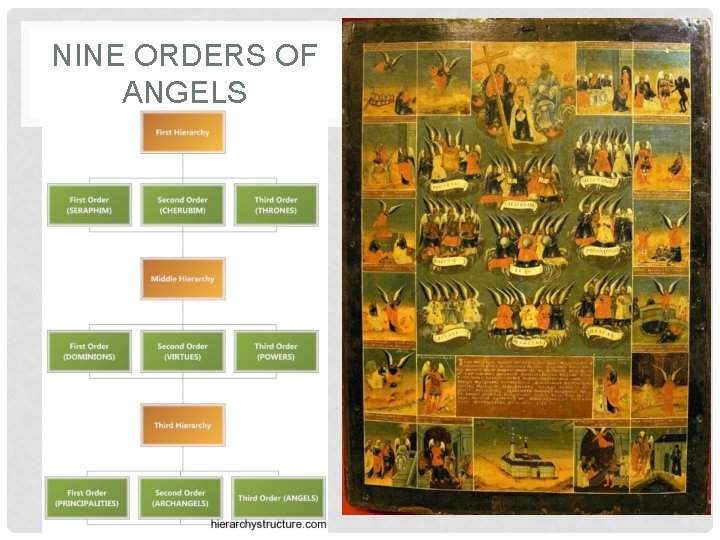
NINE ORDERS OF ANGELS
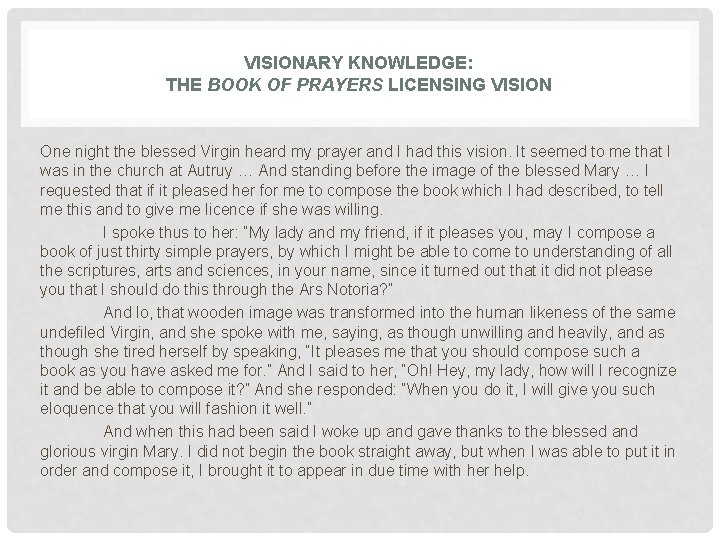
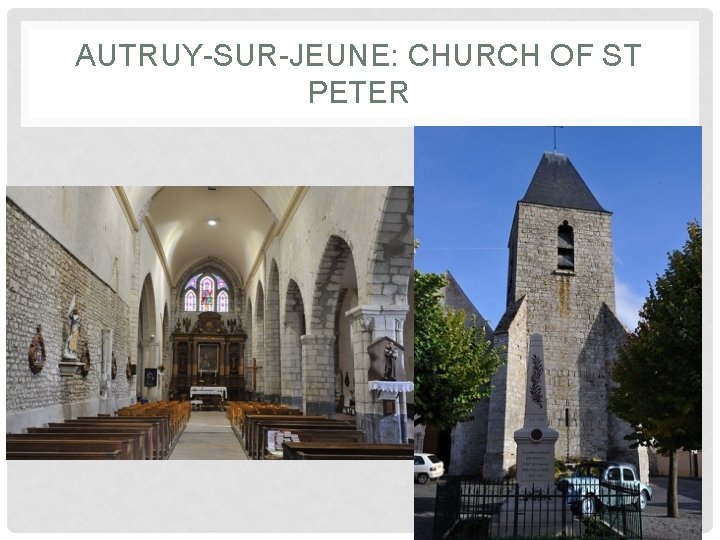
VISIONARY KNOWLEDGE: THE BOOK OF PRAYERS LICENSING VISION One night the blessed Virgin heard my prayer and I had this vision. It seemed to me that I was in the church at Autruy … And standing before the image of the blessed Mary … I requested that if it pleased her for me to compose the book which I had described, to tell me this and to give me licence if she was willing. I spoke thus to her: “My lady and my friend, if it pleases you, may I compose a book of just thirty simple prayers, by which I might be able to come to understanding of all the scriptures, arts and sciences, in your name, since it turned out that it did not please you that I should do this through the Ars Notoria? ” And lo, that wooden image was transformed into the human likeness of the same undefiled Virgin, and she spoke with me, saying, as though unwilling and heavily, and as though she tired herself by speaking, “It pleases me that you should compose such a book as you have asked me for. ” And I said to her, “Oh! Hey, my lady, how will I recognize it and be able to compose it? ” And she responded: “When you do it, I will give you such eloquence that you will fashion it well. ” And when this had been said I woke up and gave thanks to the blessed and glorious virgin Mary. I did not begin the book straight away, but when I was able to put it in order and compose it, I brought it to appear in due time with her help.
AUTRUY-SUR-JEUNE: CHURCH OF ST PETER
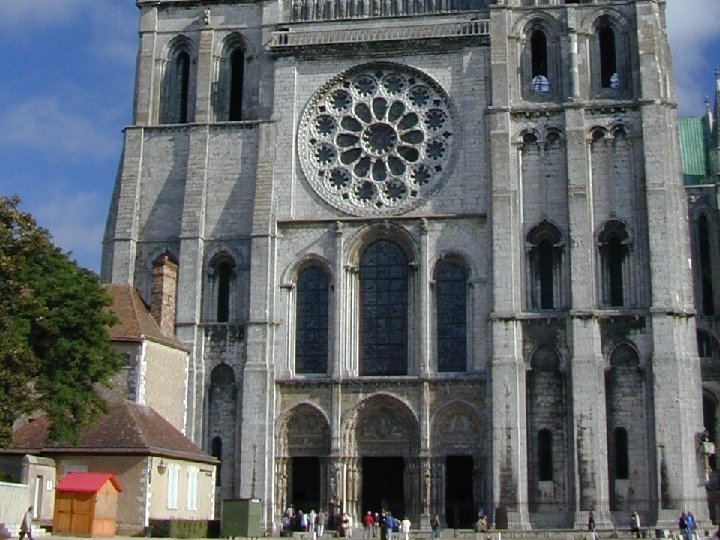
THE THEMA VISION FROM THE BOOK OF VISIONS – AN ALLEGORY OF JOHN’S FLIGHT FROM ARS NOTORIA INTO NEW KNOWLEDGE When I, John, was about fourteen years old and lived in the city of Chartres in the close of the blessed Mary, very near to the church, about a stone’s throw away, this vision was shown to me as to one born out of due time. On a certain night I was placed as though in ecstasy, whether in the body or out of the body I know not, God knows. And lo, I saw a certain horrible figure, and it seemed to me absolutely certain that it was the enemy of the human race. And that figure rose up against me, wishing and craving to suffocate me. When I saw it I fled aghast in great fear from its terrible face, and it pursued me hither and thither, and could not catch me, and yet pressed upon me as it followed, so that I left the house I was in, fleeing from the face of my persecutor. And when I went outside it did not cease to follow; and retreating in great fear, with altered course I ran towards the church of the blessed Mary. I entered it through the right hand door of the main entrance on the west front, and when I was in the church, I immediately lifted my eyes--I was next to the door at some distance from it --towards the image of the blessed virgin Mary. And lo, suddenly the devoted virgin Mary counseled me sweetly with a sign of her arm that I should come to her. After seeing this I ran to her quickly and fled as though to the true comfort and refuge of sinners, guarding myself under her protection and under hand. And I did not see my persecutor the devil any more after that; I had completely evaded his hand by the invocation, help and protection of the blessed Mary, the glorious undefiled mother of God.
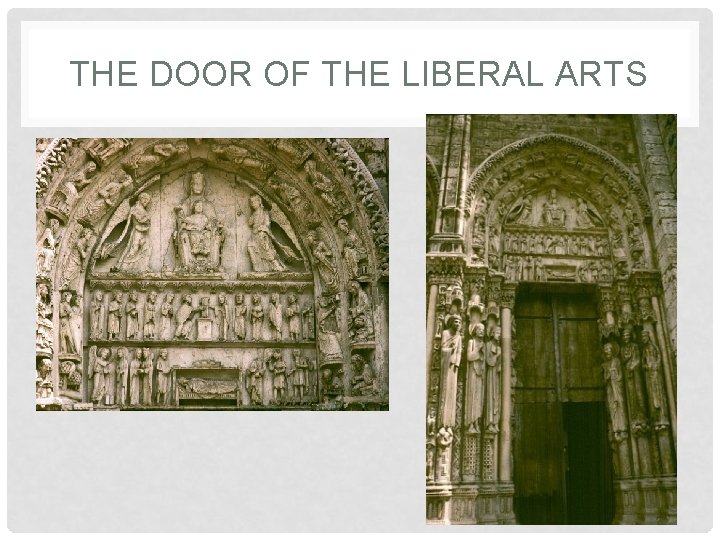
THE DOOR OF THE LIBERAL ARTS
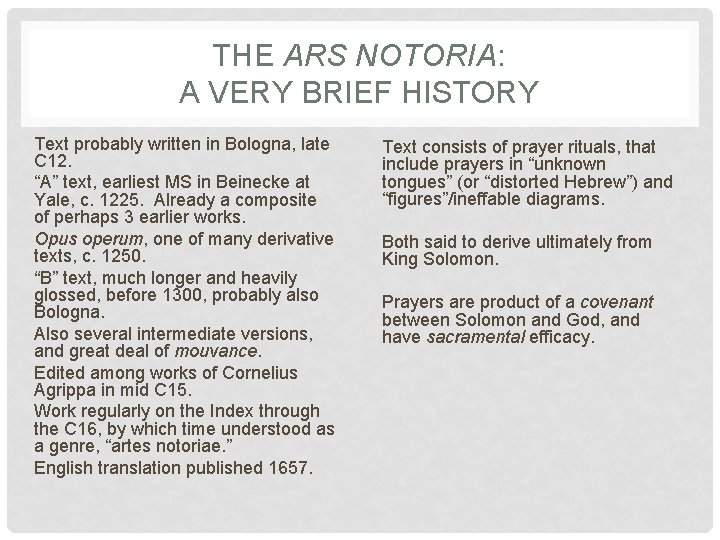
THE ARS NOTORIA: A VERY BRIEF HISTORY Text probably written in Bologna, late C 12. “A” text, earliest MS in Beinecke at Yale, c. 1225. Already a composite of perhaps 3 earlier works. Opus operum, one of many derivative texts, c. 1250. “B” text, much longer and heavily glossed, before 1300, probably also Bologna. Also several intermediate versions, and great deal of mouvance. Edited among works of Cornelius Agrippa in mid C 15. Work regularly on the Index through the C 16, by which time understood as a genre, “artes notoriae. ” English translation published 1657. Text consists of prayer rituals, that include prayers in “unknown tongues” (or “distorted Hebrew”) and “figures”/ineffable diagrams. Both said to derive ultimately from King Solomon. Prayers are product of a covenant between Solomon and God, and have sacramental efficacy.
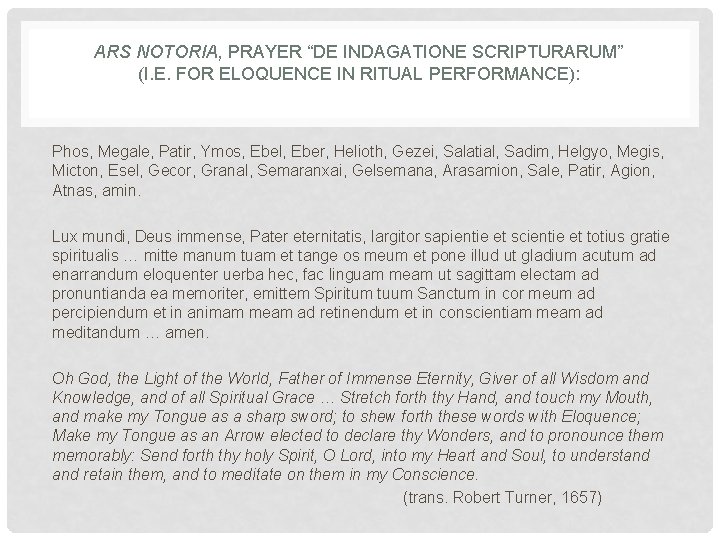
ARS NOTORIA, PRAYER “DE INDAGATIONE SCRIPTURARUM” (I. E. FOR ELOQUENCE IN RITUAL PERFORMANCE): Phos, Megale, Patir, Ymos, Ebel, Eber, Helioth, Gezei, Salatial, Sadim, Helgyo, Megis, Micton, Esel, Gecor, Granal, Semaranxai, Gelsemana, Arasamion, Sale, Patir, Agion, Atnas, amin. Lux mundi, Deus immense, Pater eternitatis, largitor sapientie et scientie et totius gratie spiritualis … mitte manum tuam et tange os meum et pone illud ut gladium acutum ad enarrandum eloquenter uerba hec, fac linguam meam ut sagittam electam ad pronuntianda ea memoriter, emittem Spiritum tuum Sanctum in cor meum ad percipiendum et in animam meam ad retinendum et in conscientiam meam ad meditandum … amen. Oh God, the Light of the World, Father of Immense Eternity, Giver of all Wisdom and Knowledge, and of all Spiritual Grace … Stretch forth thy Hand, and touch my Mouth, and make my Tongue as a sharp sword; to shew forth these words with Eloquence; Make my Tongue as an Arrow elected to declare thy Wonders, and to pronounce them memorably: Send forth thy holy Spirit, O Lord, into my Heart and Soul, to understand retain them, and to meditate on them in my Conscience. (trans. Robert Turner, 1657)
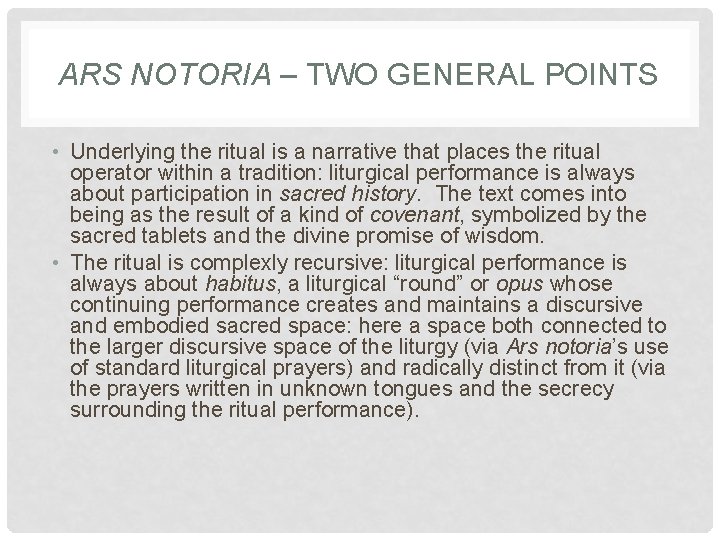
ARS NOTORIA – TWO GENERAL POINTS • Underlying the ritual is a narrative that places the ritual operator within a tradition: liturgical performance is always about participation in sacred history. The text comes into being as the result of a kind of covenant, symbolized by the sacred tablets and the divine promise of wisdom. • The ritual is complexly recursive: liturgical performance is always about habitus, a liturgical “round” or opus whose continuing performance creates and maintains a discursive and embodied sacred space: here a space both connected to the larger discursive space of the liturgy (via Ars notoria’s use of standard liturgical prayers) and radically distinct from it (via the prayers written in unknown tongues and the secrecy surrounding the ritual performance).
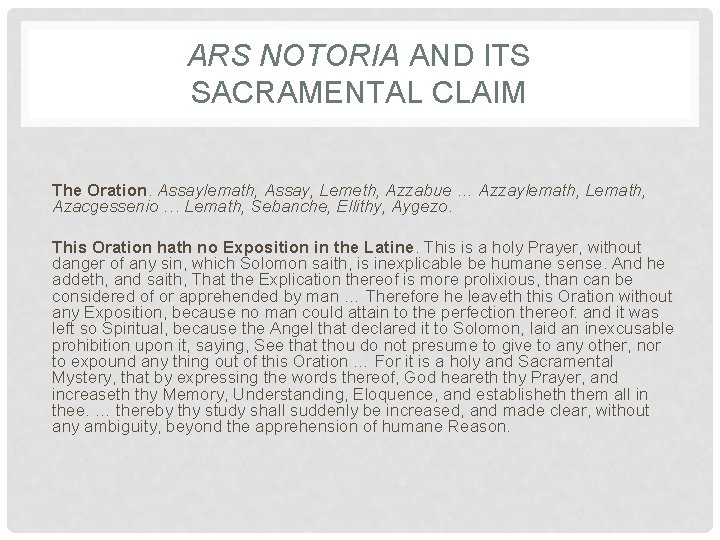
ARS NOTORIA AND ITS SACRAMENTAL CLAIM The Oration. Assaylemath, Assay, Lemeth, Azzabue … Azzaylemath, Lemath, Azacgessenio … Lemath, Sebanche, Ellithy, Aygezo. This Oration hath no Exposition in the Latine. This is a holy Prayer, without danger of any sin, which Solomon saith, is inexplicable be humane sense. And he addeth, and saith, That the Explication thereof is more prolixious, than can be considered of or apprehended by man … Therefore he leaveth this Oration without any Exposition, because no man could attain to the perfection thereof: and it was left so Spiritual, because the Angel that declared it to Solomon, laid an inexcusable prohibition upon it, saying, See that thou do not presume to give to any other, nor to expound any thing out of this Oration … For it is a holy and Sacramental Mystery, that by expressing the words thereof, God heareth thy Prayer, and increaseth thy Memory, Understanding, Eloquence, and establisheth them all in thee. … thereby thy study shall suddenly be increased, and made clear, without any ambiguity, beyond the apprehension of humane Reason.
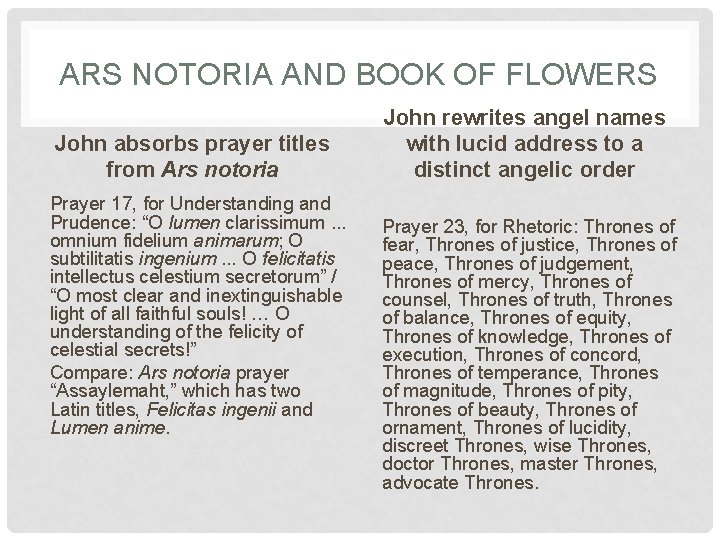
ARS NOTORIA AND BOOK OF FLOWERS John absorbs prayer titles from Ars notoria Prayer 17, for Understanding and Prudence: “O lumen clarissimum. . . omnium fidelium animarum; O subtilitatis ingenium. . . O felicitatis intellectus celestium secretorum” / “O most clear and inextinguishable light of all faithful souls! … O understanding of the felicity of celestial secrets!” Compare: Ars notoria prayer “Assaylemaht, ” which has two Latin titles, Felicitas ingenii and Lumen anime. John rewrites angel names with lucid address to a distinct angelic order Prayer 23, for Rhetoric: Thrones of fear, Thrones of justice, Thrones of peace, Thrones of judgement, Thrones of mercy, Thrones of counsel, Thrones of truth, Thrones of balance, Thrones of equity, Thrones of knowledge, Thrones of execution, Thrones of concord, Thrones of temperance, Thrones of magnitude, Thrones of pity, Thrones of beauty, Thrones of ornament, Thrones of lucidity, discreet Thrones, wise Thrones, doctor Thrones, master Thrones, advocate Thrones.
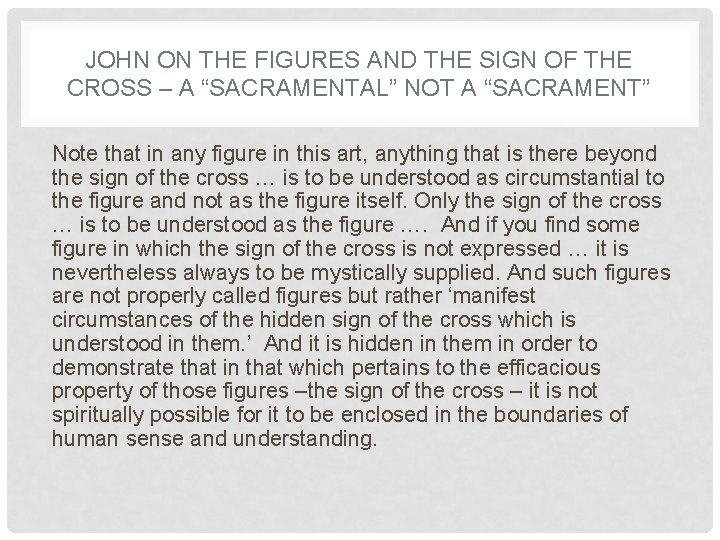
JOHN ON THE FIGURES AND THE SIGN OF THE CROSS – A “SACRAMENTAL” NOT A “SACRAMENT” Note that in any figure in this art, anything that is there beyond the sign of the cross … is to be understood as circumstantial to the figure and not as the figure itself. Only the sign of the cross … is to be understood as the figure …. And if you find some figure in which the sign of the cross is not expressed … it is nevertheless always to be mystically supplied. And such figures are not properly called figures but rather ‘manifest circumstances of the hidden sign of the cross which is understood in them. ’ And it is hidden in them in order to demonstrate that in that which pertains to the efficacious property of those figures –the sign of the cross – it is not spiritually possible for it to be enclosed in the boundaries of human sense and understanding.
THE OLD COMPILATION VISIONARY EXPERIMENT FIGURE Maria: mater misericordie Jhesu Christi aula altissimi Jhesu Christi reginarum Jhesu Christi Iusticia iustorum Jhesu Christi altitudo angelorum Jhesu Christi Amica: auxilium mei, Galfridi, illuminacio, consilium adiuuamen: miserere mei, audi me, respice me, instrue me, adiuua me Prayer is acrostically presented, moving in and around pentagon towards Jhesu Christi. Outside letters alternate: M – A – R – I – A and A – M – I – C – A.
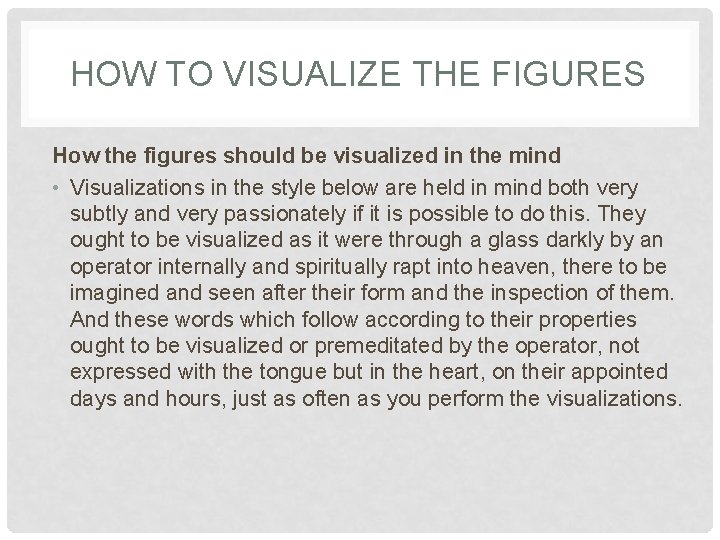
HOW TO VISUALIZE THE FIGURES How the figures should be visualized in the mind • Visualizations in the style below are held in mind both very subtly and very passionately if it is possible to do this. They ought to be visualized as it were through a glass darkly by an operator internally and spiritually rapt into heaven, there to be imagined and seen after their form and the inspection of them. And these words which follow according to their properties ought to be visualized or premeditated by the operator, not expressed with the tongue but in the heart, on their appointed days and hours, just as often as you perform the visualizations.