RightSizing Your Request Handling System Juli Haugen Jason








- Slides: 21
Right-Sizing Your Request Handling System Juli Haugen, Jason Pelletier (Bowdoin College) Anne Pinkowski, Chris Lundin (Stanford University) October 2008
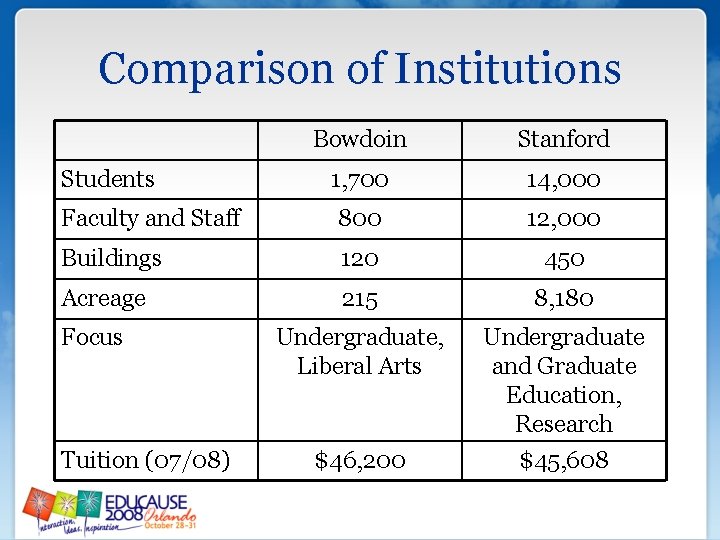
Comparison of Institutions Bowdoin Stanford 1, 700 14, 000 Faculty and Staff 800 12, 000 Buildings 120 450 Acreage 215 8, 180 Undergraduate, Liberal Arts Undergraduate and Graduate Education, Research $46, 200 $45, 608 Students Focus Tuition (07/08)
Request Tracking at Bowdoin: Prior to 2001 - Homegrown Filemaker Database 2001 to 2004 – Switch to Remedy version 5 installed on a Linux server. 2004 – Upgrade to Remedy version 6, move to Windows 2003 server, reassignment of Remedy support person. March 2008 – The big move to Altiris Help Desk!
Request Tracking at Stanford: • 1988: Mainframe-based in-house developed system • 1997: Remedy Action Request System: built custom “Help. SU” ticketing application • 2000: CIO declared Remedy required for all IT Services groups • 2004: Replaced custom “Help. SU” with BMC Remedy Help Desk 5. 5 (retaining Help. SU brand name) • 2008: Replaced Help Desk 5. 5 with Remedy Service Desk 7. 01 • 2008 and beyond: Moving forward with BMC Remedy IT Service Management suite • 2009: Upgrade to ARS 7. 1 CMDB 2. 1 and propagate with core infrastructure equipment. • 2010: BMC Change Management: Change is good!
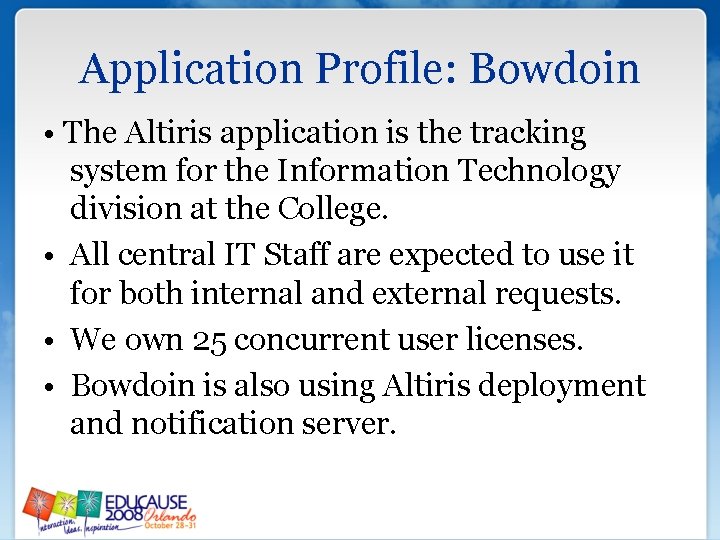
Application Profile: Bowdoin • The Altiris application is the tracking system for the Information Technology division at the College. • All central IT Staff are expected to use it for both internal and external requests. • We own 25 concurrent user licenses. • Bowdoin is also using Altiris deployment and notification server.
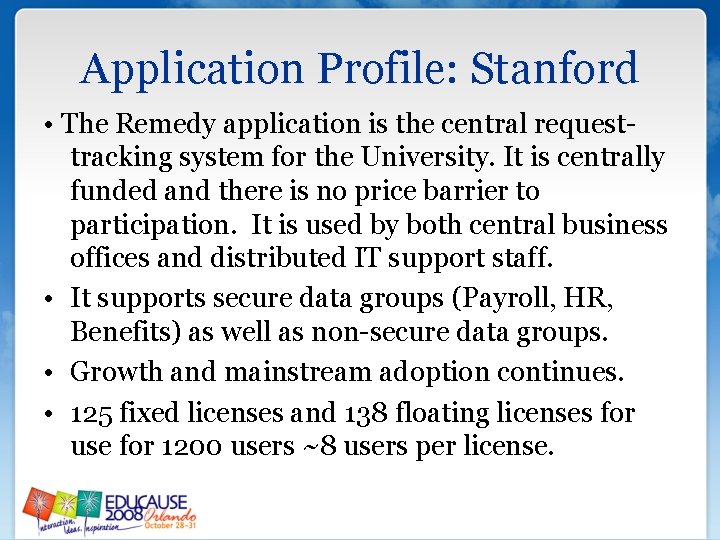
Application Profile: Stanford • The Remedy application is the central requesttracking system for the University. It is centrally funded and there is no price barrier to participation. It is used by both central business offices and distributed IT support staff. • It supports secure data groups (Payroll, HR, Benefits) as well as non-secure data groups. • Growth and mainstream adoption continues. • 125 fixed licenses and 138 floating licenses for use for 1200 users ~8 users per license.
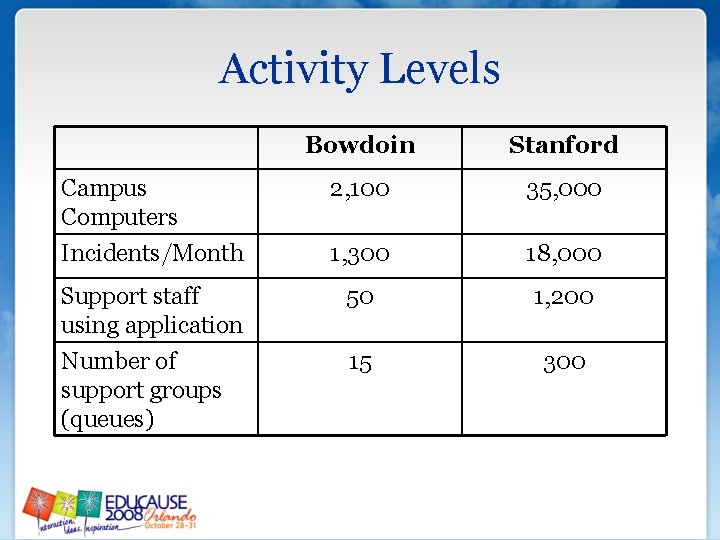
Activity Levels Bowdoin Stanford Campus Computers 2, 100 35, 000 Incidents/Month 1, 300 18, 000 Support staff using application 50 1, 200 Number of support groups (queues) 15 300
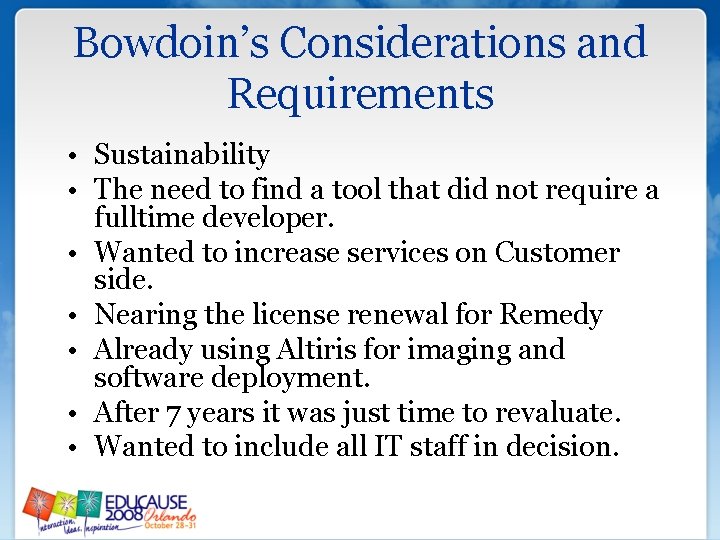
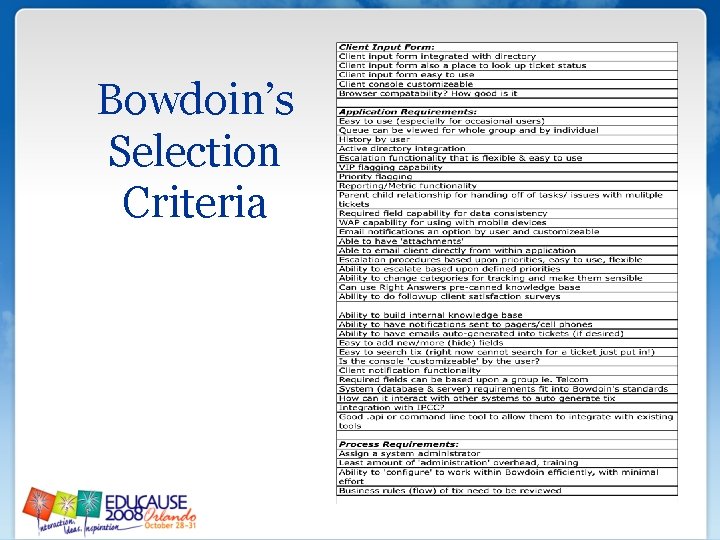
Bowdoin’s Considerations and Requirements • Sustainability • The need to find a tool that did not require a fulltime developer. • Wanted to increase services on Customer side. • Nearing the license renewal for Remedy • Already using Altiris for imaging and software deployment. • After 7 years it was just time to revaluate. • Wanted to include all IT staff in decision.
Bowdoin’s Selection Criteria
Stanford’s Considerations and Requirements • Desired Integrated IT Service Management Suite – Best-of-breed nixed because of complexity of integration and interoperability – Move to ITIL-based processes – Applications and processes are optimized for usability, extensibility, and maintainability – Non-IT usage would piggy-back on top of ITSM functionality, as it had been. • Staff technical knowledge and experience – Stanford has a Remedy-knowledgeable development staff – 10 years experience with Remedy on campus – One platform decreases overall administrative overhead • Scalability – System able to handle Stanford’s volume of help requests, system change requests and CMDB updates.
And your selection, please! Bowdoin Stanford Application Altiris Help Desk 6. 06 Remedy Service Desk 7. 01 Clients Browser (Windows IE only) Remedy User client and Web for Windows, Web access for IE/Firefox on Mac and Linux Authentication NTLM or Windows login Single-sign-on, Kerberos Back-end Database Microsoft SQL server version 5 Oracle 10 g. R 2 Front-end Windows Server 2003 Red. Hat Linux on all three tiers: application, web and DB
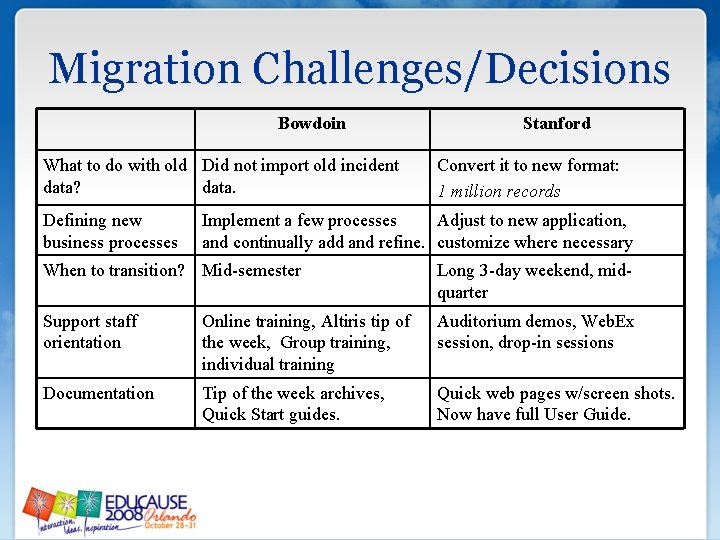
Migration Challenges/Decisions Bowdoin What to do with old Did not import old incident data? data. Defining new business processes Stanford Convert it to new format: 1 million records Implement a few processes Adjust to new application, and continually add and refine. customize where necessary When to transition? Mid-semester Long 3 -day weekend, midquarter Support staff orientation Online training, Altiris tip of the week, Group training, individual training Auditorium demos, Web. Ex session, drop-in sessions Documentation Tip of the week archives, Quick Start guides. Quick web pages w/screen shots. Now have full User Guide.
Architecting for Growth: Bowdoin
Architecting for Growth: Stanford
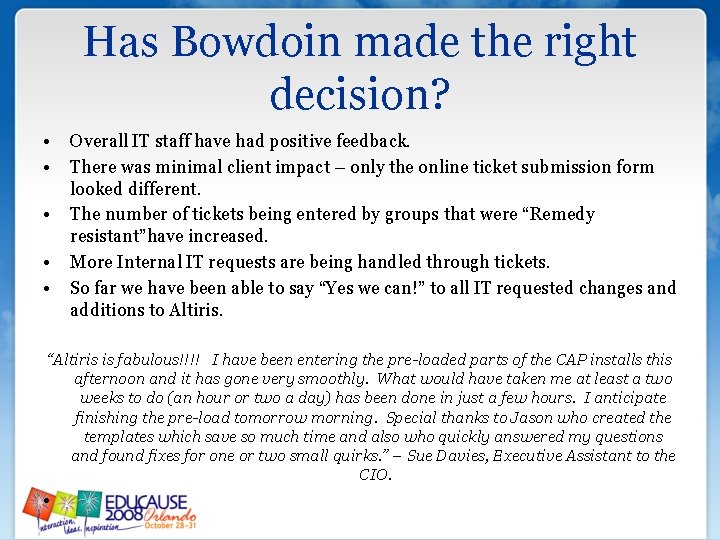
Has Bowdoin made the right decision? • • • Overall IT staff have had positive feedback. There was minimal client impact – only the online ticket submission form looked different. The number of tickets being entered by groups that were “Remedy resistant”have increased. More Internal IT requests are being handled through tickets. So far we have been able to say “Yes we can!” to all IT requested changes and additions to Altiris. “Altiris is fabulous!!!! I have been entering the pre-loaded parts of the CAP installs this afternoon and it has gone very smoothly. What would have taken me at least a two weeks to do (an hour or two a day) has been done in just a few hours. I anticipate finishing the pre-load tomorrow morning. Special thanks to Jason who created the templates which save so much time and also who quickly answered my questions and found fixes for one or two small quirks. ” – Sue Davies, Executive Assistant to the CIO. •
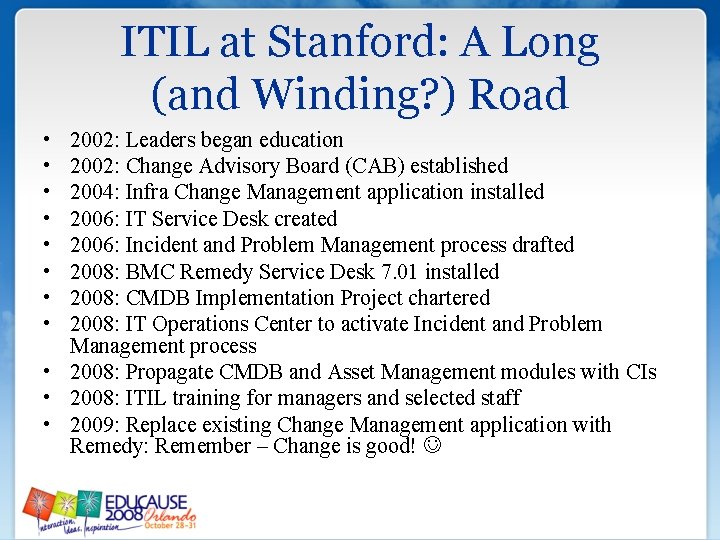
ITIL at Stanford: A Long (and Winding? ) Road • • 2002: Leaders began education 2002: Change Advisory Board (CAB) established 2004: Infra Change Management application installed 2006: IT Service Desk created 2006: Incident and Problem Management process drafted 2008: BMC Remedy Service Desk 7. 01 installed 2008: CMDB Implementation Project chartered 2008: IT Operations Center to activate Incident and Problem Management process • 2008: Propagate CMDB and Asset Management modules with CIs • 2008: ITIL training for managers and selected staff • 2009: Replace existing Change Management application with Remedy: Remember – Change is good!
Using a Single Enterprise-Wide Application • Pros: – Single interface for all support staff – Single client-facing interface (acknowledgements, notifications) – ITIL processes can be taught relative to a single application – Easy transfer of requests (change, incident, problem) from support group to support group – Unified reporting across all support groups using a single classification hierarchy. – It’s easier to hire and retain knowledgeable Application Administration/Development staff being on a single platform. – As a suite, application upgrades don’t impact the complexity of integrations with other applications.
Using A Single Enterprise-Wide Application • Cons – Non-IT groups see/hear language which is more IT related (“incidents”, “impact”) – Single interface means we have to say “no” to some niche requests, e. g. Student ID Numbers – Single classification hierarchy takes work to maintain and “keep the lid on”.
Future Plans: Bowdoin • Appoint Altiris administrator for each IT group. • With new version reported additional campus groups could have access (payroll, HR, One. Card, library) • Browser independency • Increased implementation of ITIL standards.
Future Plans: Stanford • 2008 and beyond: Moving forward with BMC Remedy IT Service Management suite • 2009: Upgrade to ARS 7. 1 CMDB 2. 1 and propagate CMDB with core infrastructure equipment. • 2010: Implement BMC Change Management: Change is good!
Questions About Right-Sizing Your Request Handling System? Bowdoin College Juli Haugen, Jason Pelletier jhaugen@bowdoin. edu, jpellet 2@bowdoin. edu Stanford University Anne Pinkowski, Chris Lundin apink@stanford. edu, clundin@stanford. edu October 2008