Review Multiple Steady States in CSTR 1 EXA

- Slides: 25
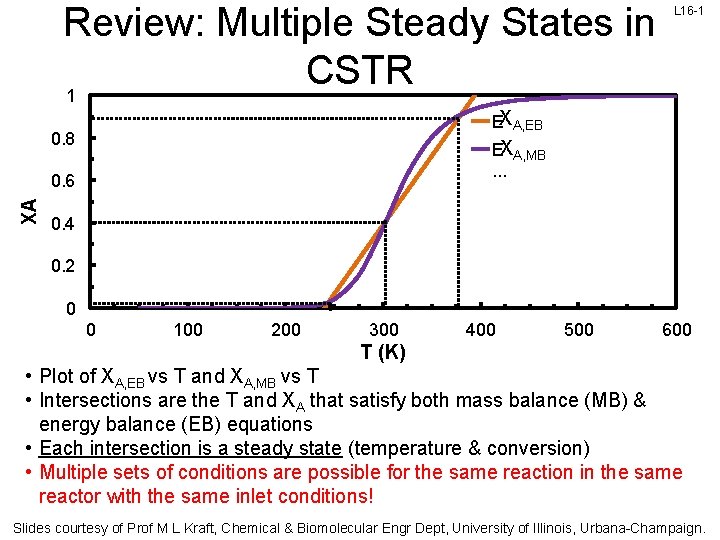
Review: Multiple Steady States in CSTR 1 EXA, EB. . . EX 0. 8 . . . 0. 6 XA L 16 -1 A, MB 0. 4 0. 2 0 0 100 200 300 400 500 600 T (K) • Plot of XA, EB vs T and XA, MB vs T • Intersections are the T and XA that satisfy both mass balance (MB) & energy balance (EB) equations • Each intersection is a steady state (temperature & conversion) • Multiple sets of conditions are possible for the same reaction in the same reactor with the same inlet conditions! Slides courtesy of Prof M L Kraft, Chemical & Biomolecular Engr Dept, University of Illinois, Urbana-Champaign.
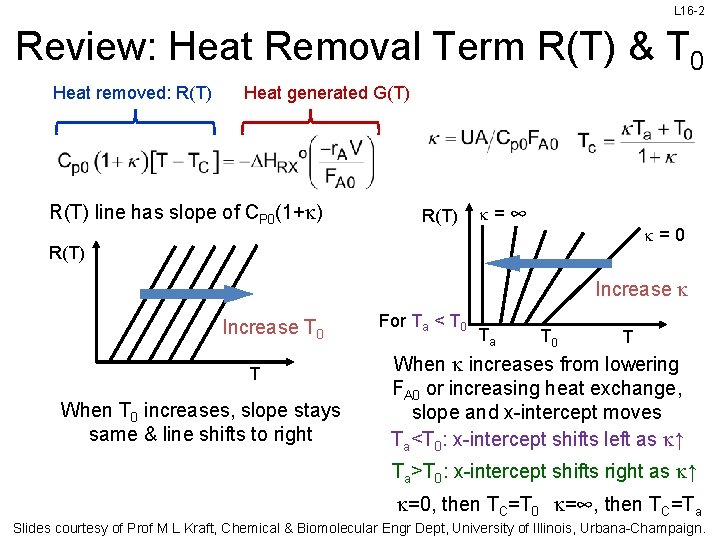
L 16 -2 Review: Heat Removal Term R(T) & T 0 Heat removed: R(T) Heat generated G(T) R(T) line has slope of CP 0(1+ ) R(T) =∞ =0 R(T) Increase T 0 T When T 0 increases, slope stays same & line shifts to right For Ta < T 0 Ta T 0 T When increases from lowering FA 0 or increasing heat exchange, slope and x-intercept moves Ta<T 0: x-intercept shifts left as ↑ Ta>T 0: x-intercept shifts right as ↑ =0, then TC=T 0 =∞, then TC=Ta Slides courtesy of Prof M L Kraft, Chemical & Biomolecular Engr Dept, University of Illinois, Urbana-Champaign.
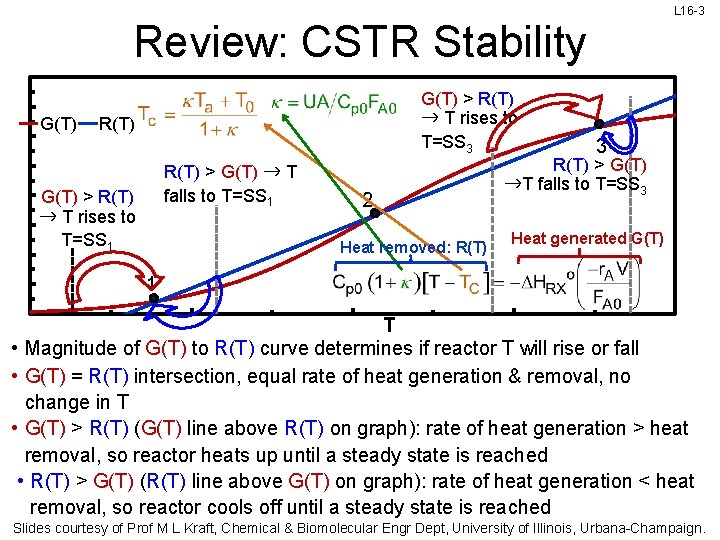
L 16 -3 Review: CSTR Stability G(T) > R(T) → T rises to T=SS 3 R(T) > G(T) → T falls to T=SS 1 G(T) > R(T) → T rises to T=SS 1 2 Heat removed: R(T) 3 R(T) > G(T) →T falls to T=SS 3 Heat generated G(T) 1 T • Magnitude of G(T) to R(T) curve determines if reactor T will rise or fall • G(T) = R(T) intersection, equal rate of heat generation & removal, no change in T • G(T) > R(T) (G(T) line above R(T) on graph): rate of heat generation > heat removal, so reactor heats up until a steady state is reached • R(T) > G(T) (R(T) line above G(T) on graph): rate of heat generation < heat removal, so reactor cools off until a steady state is reached Slides courtesy of Prof M L Kraft, Chemical & Biomolecular Engr Dept, University of Illinois, Urbana-Champaign.
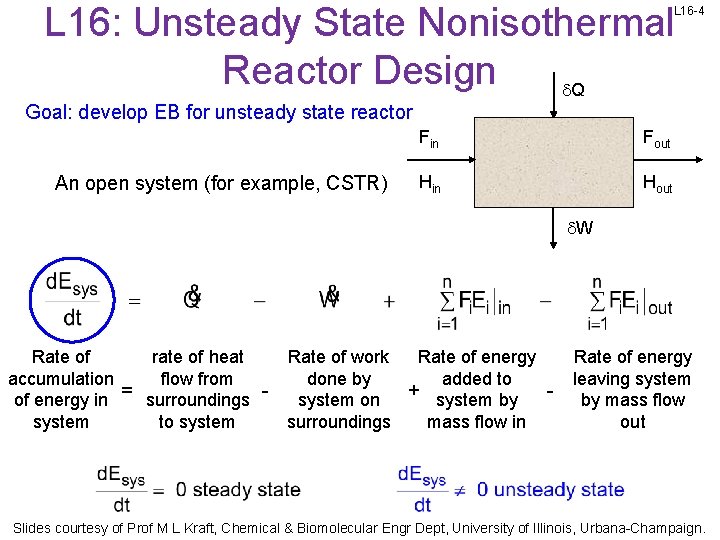
L 16: Unsteady State Nonisothermal Reactor Design Q L 16 -4 Goal: develop EB for unsteady state reactor An open system (for example, CSTR) Fin Fout Hin Hout W Rate of rate of heat accumulation flow from = of energy in surroundings system to system Rate of work Rate of energy done by added to + system on system by surroundings mass flow in Rate of energy leaving system by mass flow out Slides courtesy of Prof M L Kraft, Chemical & Biomolecular Engr Dept, University of Illinois, Urbana-Champaign.
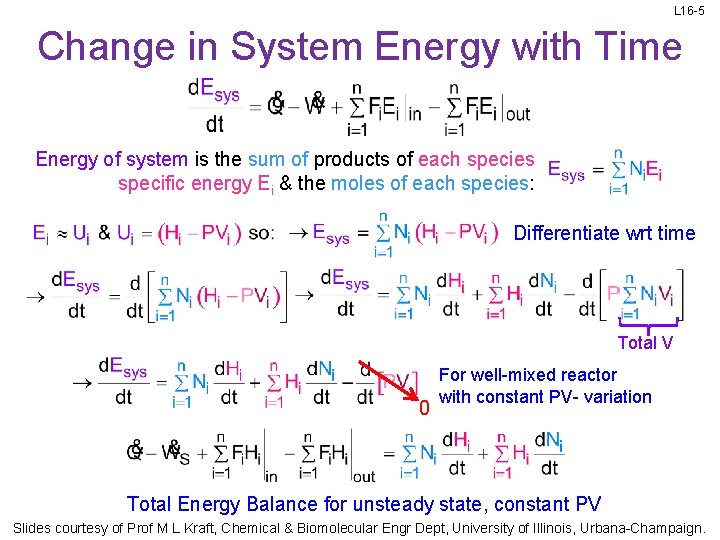
L 16 -5 Change in System Energy with Time Energy of system is the sum of products of each species specific energy Ei & the moles of each species: Differentiate wrt time Total V 0 For well-mixed reactor with constant PV- variation Total Energy Balance for unsteady state, constant PV Slides courtesy of Prof M L Kraft, Chemical & Biomolecular Engr Dept, University of Illinois, Urbana-Champaign.
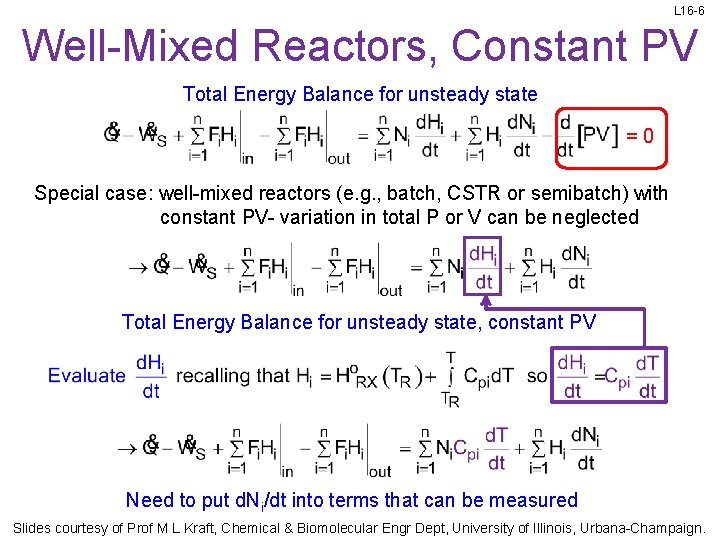
L 16 -6 Well-Mixed Reactors, Constant PV Total Energy Balance for unsteady state =0 Special case: well-mixed reactors (e. g. , batch, CSTR or semibatch) with constant PV- variation in total P or V can be neglected Total Energy Balance for unsteady state, constant PV Need to put d. Ni/dt into terms that can be measured Slides courtesy of Prof M L Kraft, Chemical & Biomolecular Engr Dept, University of Illinois, Urbana-Champaign.
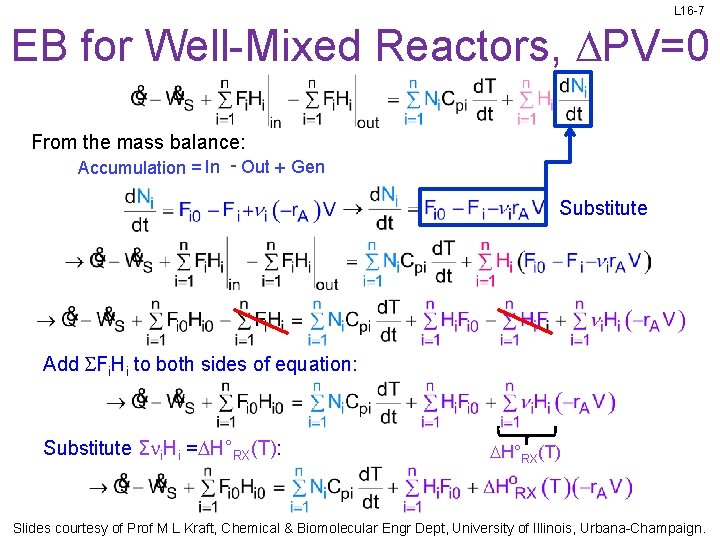
L 16 -7 EB for Well-Mixed Reactors, DPV=0 From the mass balance: Accumulation = In - Out + Gen Substitute Add SFi. Hi to both sides of equation: Substitute Σni. Hi =DH°RX(T): DH°RX(T) Slides courtesy of Prof M L Kraft, Chemical & Biomolecular Engr Dept, University of Illinois, Urbana-Champaign.
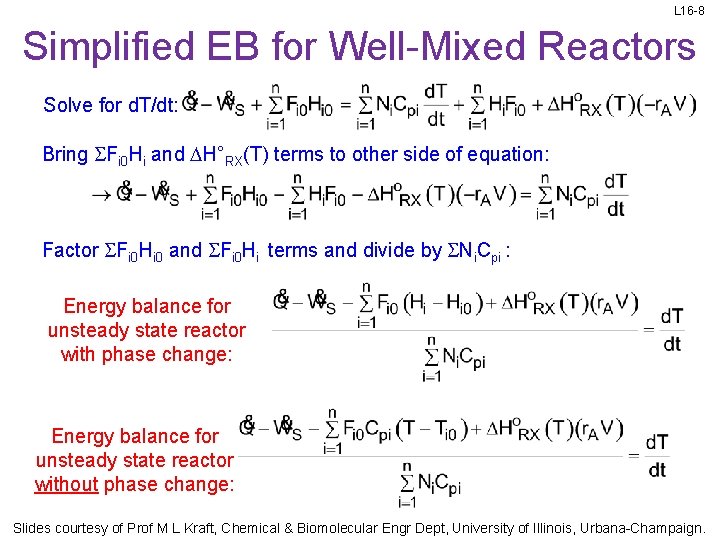
L 16 -8 Simplified EB for Well-Mixed Reactors Solve for d. T/dt: Bring SFi 0 Hi and DH°RX(T) terms to other side of equation: Factor SFi 0 Hi 0 and SFi 0 Hi terms and divide by SNi. Cpi : Energy balance for unsteady state reactor with phase change: Energy balance for unsteady state reactor without phase change: Slides courtesy of Prof M L Kraft, Chemical & Biomolecular Engr Dept, University of Illinois, Urbana-Champaign.
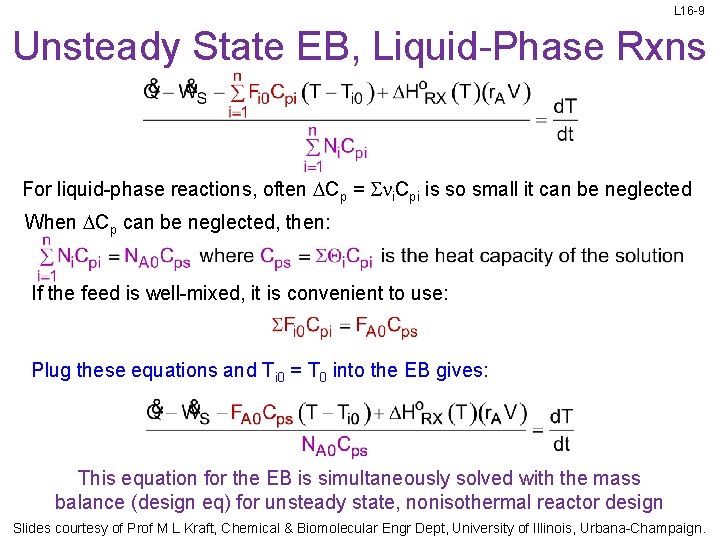
L 16 -9 Unsteady State EB, Liquid-Phase Rxns For liquid-phase reactions, often DCp = Sni. Cpi is so small it can be neglected When DCp can be neglected, then: If the feed is well-mixed, it is convenient to use: Plug these equations and Ti 0 = T 0 into the EB gives: This equation for the EB is simultaneously solved with the mass balance (design eq) for unsteady state, nonisothermal reactor design Slides courtesy of Prof M L Kraft, Chemical & Biomolecular Engr Dept, University of Illinois, Urbana-Champaign.
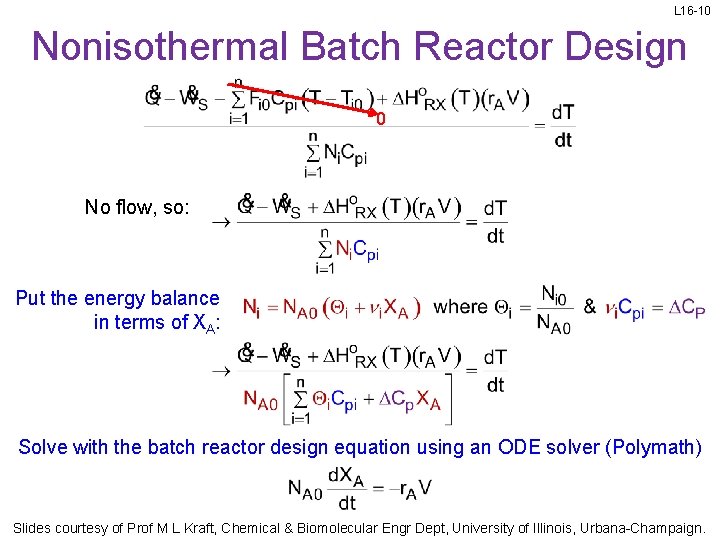
L 16 -10 Nonisothermal Batch Reactor Design 0 No flow, so: Put the energy balance in terms of XA: Solve with the batch reactor design equation using an ODE solver (Polymath) Slides courtesy of Prof M L Kraft, Chemical & Biomolecular Engr Dept, University of Illinois, Urbana-Champaign.
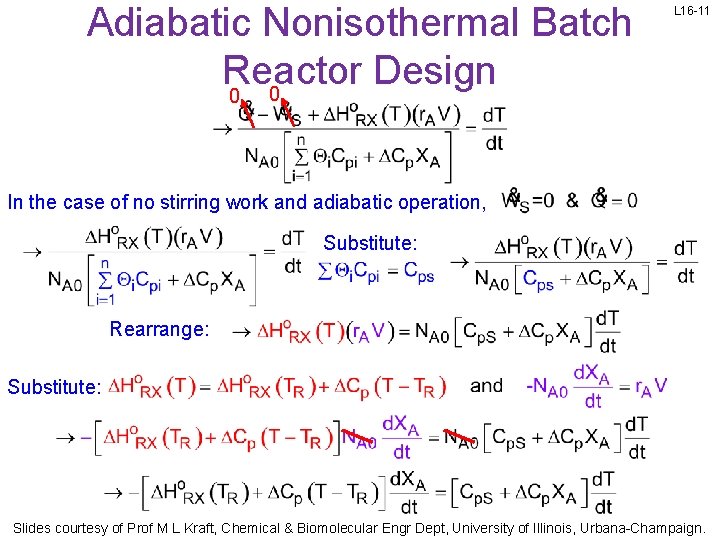
Adiabatic Nonisothermal Batch Reactor Design 0 0 L 16 -11 In the case of no stirring work and adiabatic operation, Substitute: Rearrange: Substitute: Slides courtesy of Prof M L Kraft, Chemical & Biomolecular Engr Dept, University of Illinois, Urbana-Champaign.
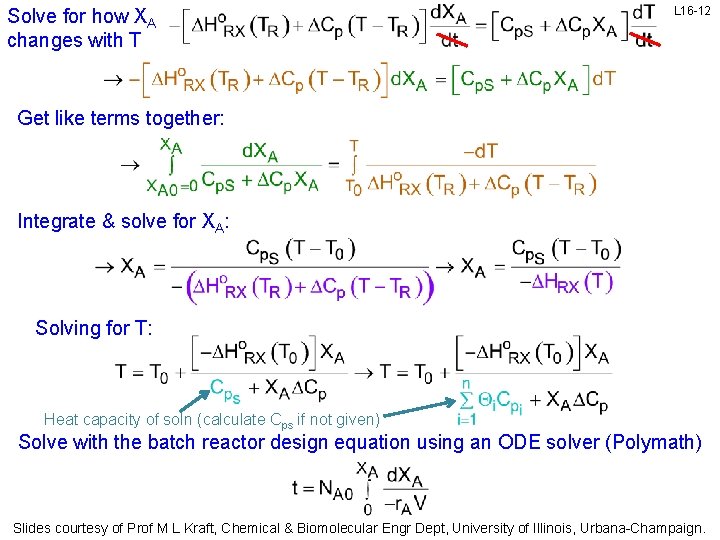
Solve for how XA changes with T L 16 -12 Get like terms together: Integrate & solve for XA: Solving for T: Heat capacity of soln (calculate Cps if not given) Solve with the batch reactor design equation using an ODE solver (Polymath) Slides courtesy of Prof M L Kraft, Chemical & Biomolecular Engr Dept, University of Illinois, Urbana-Champaign.
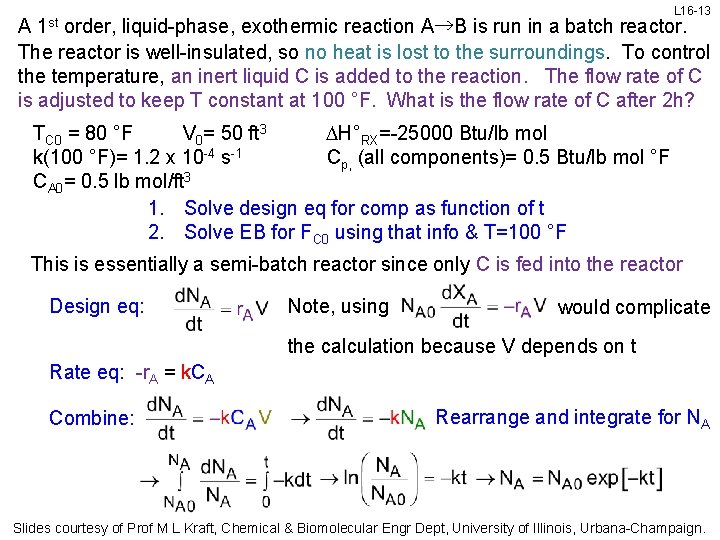
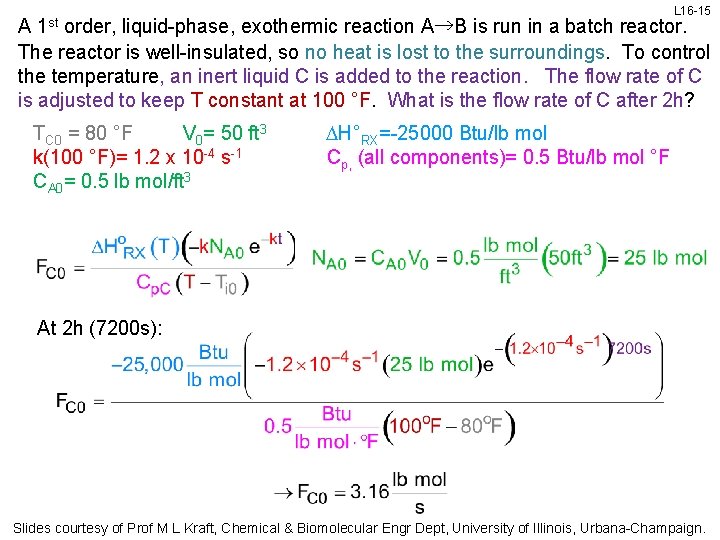
L 16 -13 1 st A order, liquid-phase, exothermic reaction A→B is run in a batch reactor. The reactor is well-insulated, so no heat is lost to the surroundings. To control the temperature, an inert liquid C is added to the reaction. The flow rate of C is adjusted to keep T constant at 100 °F. What is the flow rate of C after 2 h? TC 0 = 80 °F V 0= 50 ft 3 DH°RX=-25000 Btu/lb mol k(100 °F)= 1. 2 x 10 -4 s-1 Cp, (all components)= 0. 5 Btu/lb mol °F CA 0= 0. 5 lb mol/ft 3 1. Solve design eq for comp as function of t 2. Solve EB for FC 0 using that info & T=100 °F This is essentially a semi-batch reactor since only C is fed into the reactor Design eq: Note, using would complicate the calculation because V depends on t Rate eq: -r. A = k. CA Combine: Rearrange and integrate for NA Slides courtesy of Prof M L Kraft, Chemical & Biomolecular Engr Dept, University of Illinois, Urbana-Champaign.
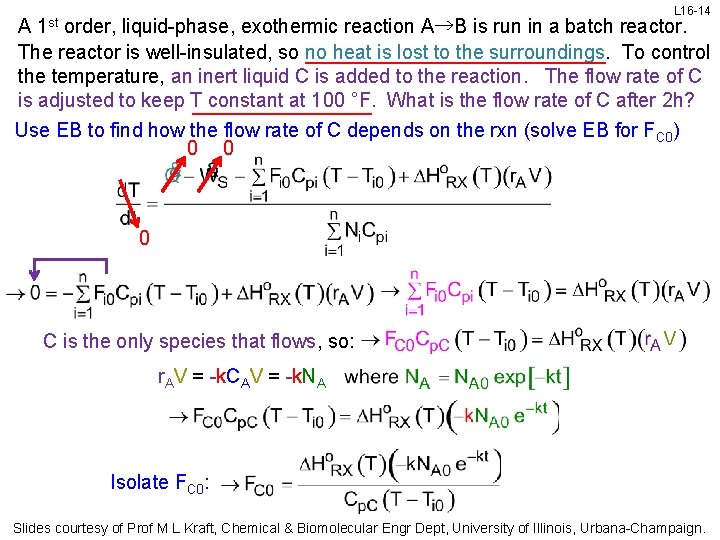
L 16 -14 1 st A order, liquid-phase, exothermic reaction A→B is run in a batch reactor. The reactor is well-insulated, so no heat is lost to the surroundings. To control the temperature, an inert liquid C is added to the reaction. The flow rate of C is adjusted to keep T constant at 100 °F. What is the flow rate of C after 2 h? Use EB to find how the flow rate of C depends on the rxn (solve EB for F C 0) 0 0 0 C is the only species that flows, so: r. AV = -k. CAV = -k. NA Isolate FC 0: Slides courtesy of Prof M L Kraft, Chemical & Biomolecular Engr Dept, University of Illinois, Urbana-Champaign.
L 16 -15 1 st A order, liquid-phase, exothermic reaction A→B is run in a batch reactor. The reactor is well-insulated, so no heat is lost to the surroundings. To control the temperature, an inert liquid C is added to the reaction. The flow rate of C is adjusted to keep T constant at 100 °F. What is the flow rate of C after 2 h? TC 0 = 80 °F V 0= 50 ft 3 k(100 °F)= 1. 2 x 10 -4 s-1 CA 0= 0. 5 lb mol/ft 3 DH°RX=-25000 Btu/lb mol Cp, (all components)= 0. 5 Btu/lb mol °F At 2 h (7200 s): Slides courtesy of Prof M L Kraft, Chemical & Biomolecular Engr Dept, University of Illinois, Urbana-Champaign.
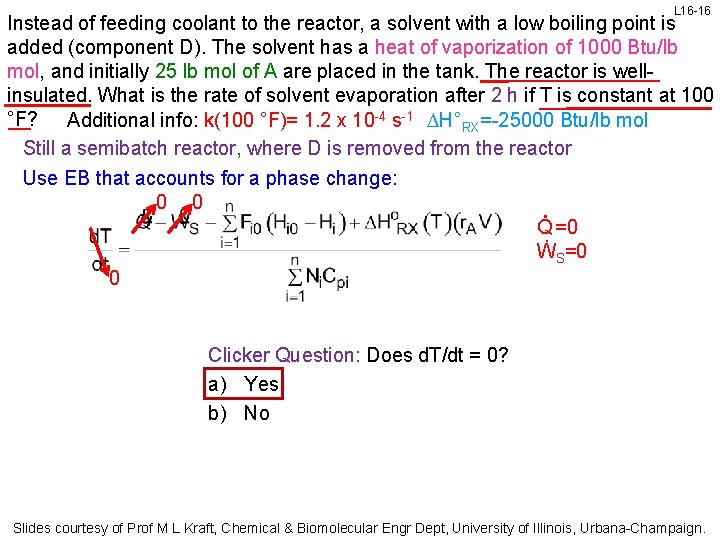
L 16 -16 Instead of feeding coolant to the reactor, a solvent with a low boiling point is added (component D). The solvent has a heat of vaporization of 1000 Btu/lb mol, and initially 25 lb mol of A are placed in the tank. The reactor is wellinsulated. What is the rate of solvent evaporation after 2 h if T is constant at 100 °F? Additional info: k(100 °F)= 1. 2 x 10 -4 s-1 DH°RX=-25000 Btu/lb mol Still a semibatch reactor, where D is removed from the reactor Use EB that accounts for a phase change: 0 0 Q ˙ =0 ẆS=0 0 Clicker Question: Does d. T/dt = 0? a) Yes b) No Slides courtesy of Prof M L Kraft, Chemical & Biomolecular Engr Dept, University of Illinois, Urbana-Champaign.
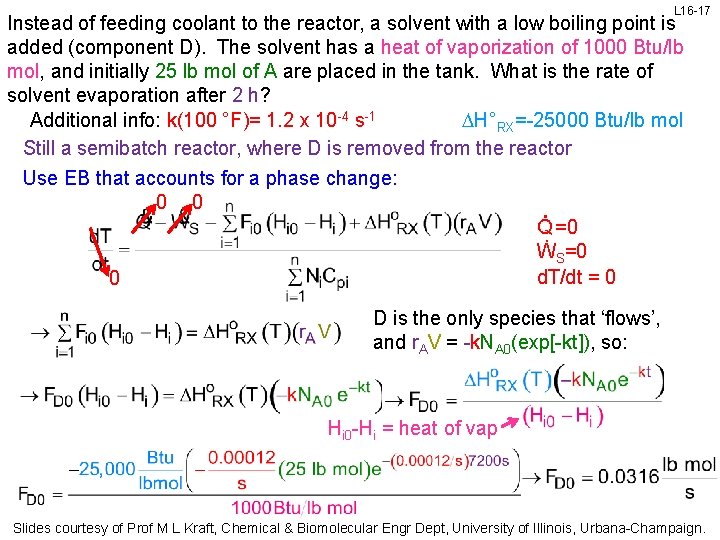
L 16 -17 Instead of feeding coolant to the reactor, a solvent with a low boiling point is added (component D). The solvent has a heat of vaporization of 1000 Btu/lb mol, and initially 25 lb mol of A are placed in the tank. What is the rate of solvent evaporation after 2 h? Additional info: k(100 °F)= 1. 2 x 10 -4 s-1 DH°RX=-25000 Btu/lb mol Still a semibatch reactor, where D is removed from the reactor Use EB that accounts for a phase change: 0 0 Q ˙ =0 ẆS=0 d. T/dt = 0 0 D is the only species that ‘flows’, and r. AV = -k. NA 0(exp[-kt]), so: Hi 0 -Hi = heat of vap Slides courtesy of Prof M L Kraft, Chemical & Biomolecular Engr Dept, University of Illinois, Urbana-Champaign.
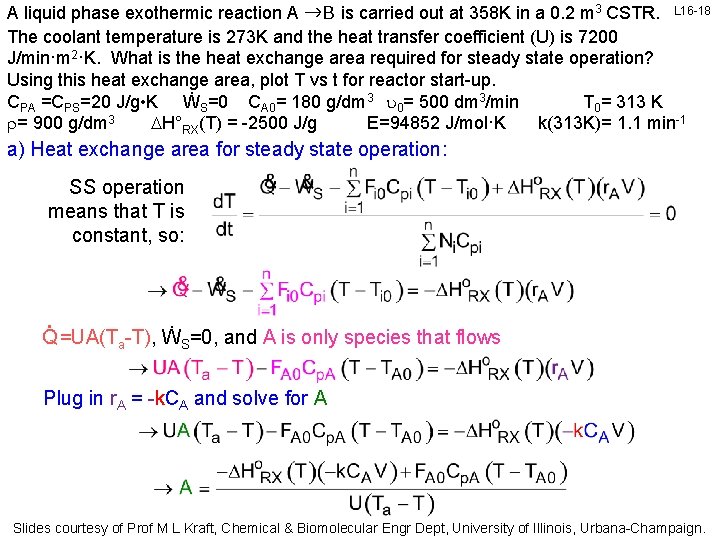
A liquid phase exothermic reaction A →B is carried out at 358 K in a 0. 2 m 3 CSTR. L 16 -18 The coolant temperature is 273 K and the heat transfer coefficient (U) is 7200 J/min·m 2·K. What is the heat exchange area required for steady state operation? Using this heat exchange area, plot T vs t for reactor start-up. CPA =CPS=20 J/g • K ẆS=0 CA 0= 180 g/dm 3 u 0= 500 dm 3/min T 0= 313 K r= 900 g/dm 3 DH°RX(T) = -2500 J/g E=94852 J/mol·K k(313 K)= 1. 1 min-1 a) Heat exchange area for steady state operation: SS operation means that T is constant, so: Q ˙ =UA(Ta-T), ẆS=0, and A is only species that flows Plug in r. A = -k. CA and solve for A Slides courtesy of Prof M L Kraft, Chemical & Biomolecular Engr Dept, University of Illinois, Urbana-Champaign.
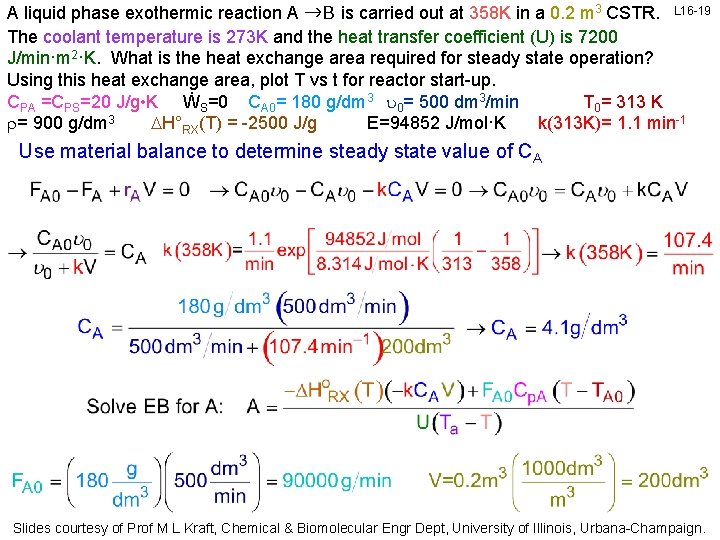
A liquid phase exothermic reaction A →B is carried out at 358 K in a 0. 2 m 3 CSTR. L 16 -19 The coolant temperature is 273 K and the heat transfer coefficient (U) is 7200 J/min·m 2·K. What is the heat exchange area required for steady state operation? Using this heat exchange area, plot T vs t for reactor start-up. CPA =CPS=20 J/g • K ẆS=0 CA 0= 180 g/dm 3 u 0= 500 dm 3/min T 0= 313 K r= 900 g/dm 3 DH°RX(T) = -2500 J/g E=94852 J/mol·K k(313 K)= 1. 1 min-1 Use material balance to determine steady state value of CA Slides courtesy of Prof M L Kraft, Chemical & Biomolecular Engr Dept, University of Illinois, Urbana-Champaign.
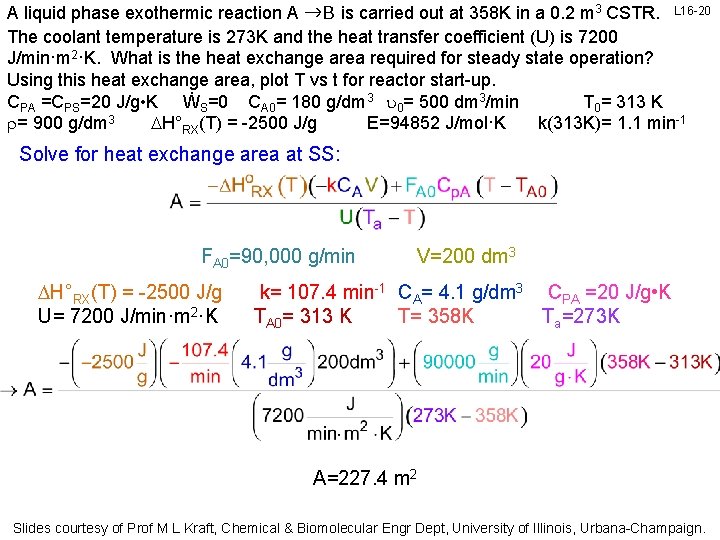
A liquid phase exothermic reaction A →B is carried out at 358 K in a 0. 2 m 3 CSTR. L 16 -20 The coolant temperature is 273 K and the heat transfer coefficient (U) is 7200 J/min·m 2·K. What is the heat exchange area required for steady state operation? Using this heat exchange area, plot T vs t for reactor start-up. CPA =CPS=20 J/g • K ẆS=0 CA 0= 180 g/dm 3 u 0= 500 dm 3/min T 0= 313 K r= 900 g/dm 3 DH°RX(T) = -2500 J/g E=94852 J/mol·K k(313 K)= 1. 1 min-1 Solve for heat exchange area at SS: FA 0=90, 000 g/min DH°RX(T) = -2500 J/g U= 7200 J/min·m 2·K V=200 dm 3 k= 107. 4 min-1 CA= 4. 1 g/dm 3 CPA =20 J/g • K TA 0= 313 K T= 358 K Ta=273 K A=227. 4 m 2 Slides courtesy of Prof M L Kraft, Chemical & Biomolecular Engr Dept, University of Illinois, Urbana-Champaign.
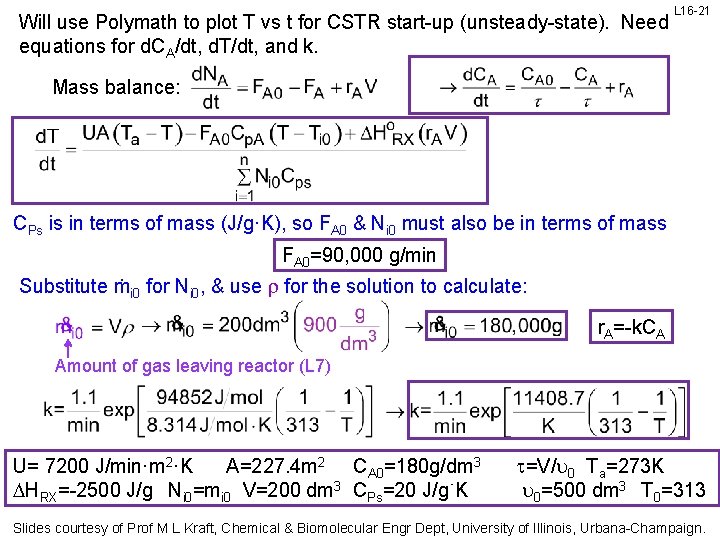
Will use Polymath to plot T vs t for CSTR start-up (unsteady-state). Need equations for d. CA/dt, d. T/dt, and k. L 16 -21 Mass balance: CPs is in terms of mass (J/g·K), so FA 0 & Ni 0 must also be in terms of mass FA 0=90, 000 g/min Substitute ṁi 0 for Ni 0, & use r for the solution to calculate: r. A=-k. CA Amount of gas leaving reactor (L 7) U= 7200 J/min·m 2·K A=227. 4 m 2 CA 0=180 g/dm 3 DHRX=-2500 J/g Ni 0=mi 0 V=200 dm 3 CPs=20 J/g˙K t=V/u 0 Ta=273 K u 0=500 dm 3 T 0=313 Slides courtesy of Prof M L Kraft, Chemical & Biomolecular Engr Dept, University of Illinois, Urbana-Champaign.
Will use Polymath to plot T vs t for CSTR start-up (unsteady-state). Need equations for d. CA/dt, d. T/dt, and k. L 16 -22 r. A=-k. CA FA 0=90, 000 g/min U= 7200 J/min·m 2·K A=227. 4 m 2 CA 0=180 g/dm 3 DHRX=-2500 J/g Ni 0=mi 0 V=200 dm 3 CPs=20 J/g˙K t=V/u 0 Ta=273 K u 0=500 dm 3 T 0=313 Slides courtesy of Prof M L Kraft, Chemical & Biomolecular Engr Dept, University of Illinois, Urbana-Champaign.
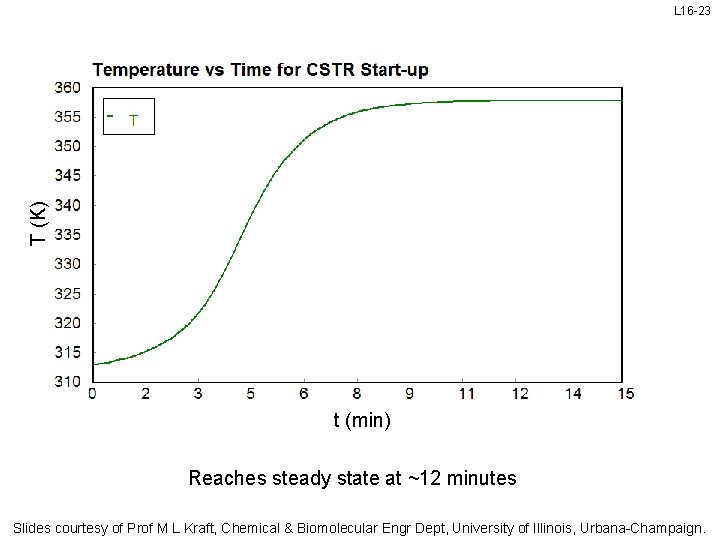
T (K) L 16 -23 t (min) Reaches steady state at ~12 minutes Slides courtesy of Prof M L Kraft, Chemical & Biomolecular Engr Dept, University of Illinois, Urbana-Champaign.
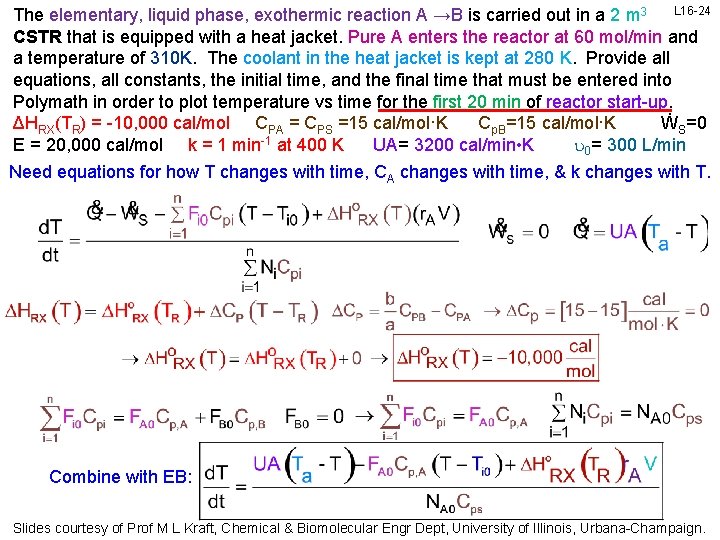
The elementary, liquid phase, exothermic reaction A →B is carried out in a 2 m 3 L 16 -24 CSTR that is equipped with a heat jacket. Pure A enters the reactor at 60 mol/min and a temperature of 310 K. The coolant in the heat jacket is kept at 280 K. Provide all equations, all constants, the initial time, and the final time that must be entered into Polymath in order to plot temperature vs time for the first 20 min of reactor start-up. ΔHRX(TR) = -10, 000 cal/mol CPA = CPS =15 cal/mol·K Cp. B=15 cal/mol·K ẆS=0 E = 20, 000 cal/mol k = 1 min-1 at 400 K UA= 3200 cal/min • K u 0= 300 L/min Need equations for how T changes with time, CA changes with time, & k changes with T. Combine with EB: Slides courtesy of Prof M L Kraft, Chemical & Biomolecular Engr Dept, University of Illinois, Urbana-Champaign.
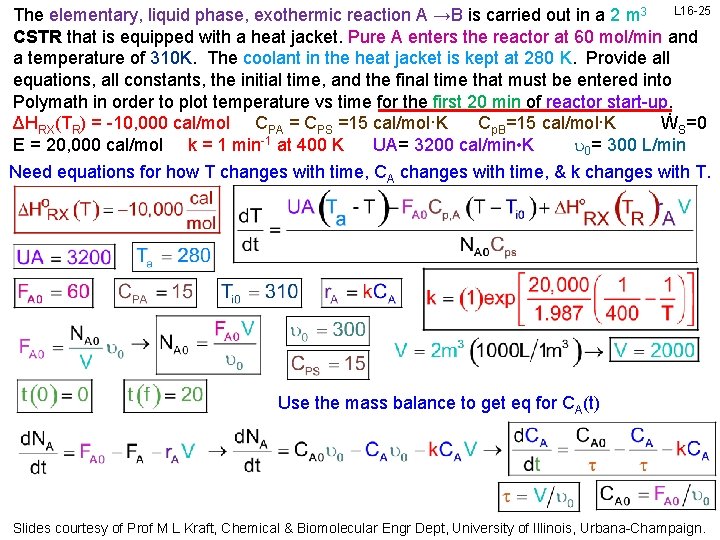
The elementary, liquid phase, exothermic reaction A →B is carried out in a 2 m 3 L 16 -25 CSTR that is equipped with a heat jacket. Pure A enters the reactor at 60 mol/min and a temperature of 310 K. The coolant in the heat jacket is kept at 280 K. Provide all equations, all constants, the initial time, and the final time that must be entered into Polymath in order to plot temperature vs time for the first 20 min of reactor start-up. ΔHRX(TR) = -10, 000 cal/mol CPA = CPS =15 cal/mol·K Cp. B=15 cal/mol·K ẆS=0 E = 20, 000 cal/mol k = 1 min-1 at 400 K UA= 3200 cal/min • K u 0= 300 L/min Need equations for how T changes with time, CA changes with time, & k changes with T. Use the mass balance to get eq for CA(t) Slides courtesy of Prof M L Kraft, Chemical & Biomolecular Engr Dept, University of Illinois, Urbana-Champaign.