
Cyberinfrastructure Framework for 21 st Century Science Engineering
Cyberinfrastructure Framework for 21 st Century Science & Engineering (CIF 21) NSF-wide Cyberinfrastructure Vision People, Sustainability, Innovation, Integration Alan Blatecky Acting Director OCI 1 1
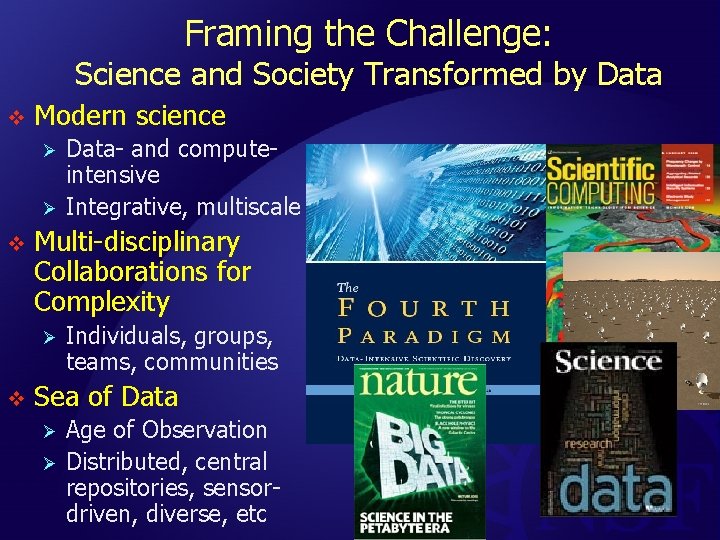
Framing the Challenge: Science and Society Transformed by Data v Modern science Ø Ø v Multi-disciplinary Collaborations for Complexity Ø v Data- and computeintensive Integrative, multiscale Individuals, groups, teams, communities Sea of Data Ø Ø Age of Observation Distributed, central repositories, sensordriven, diverse, etc 2
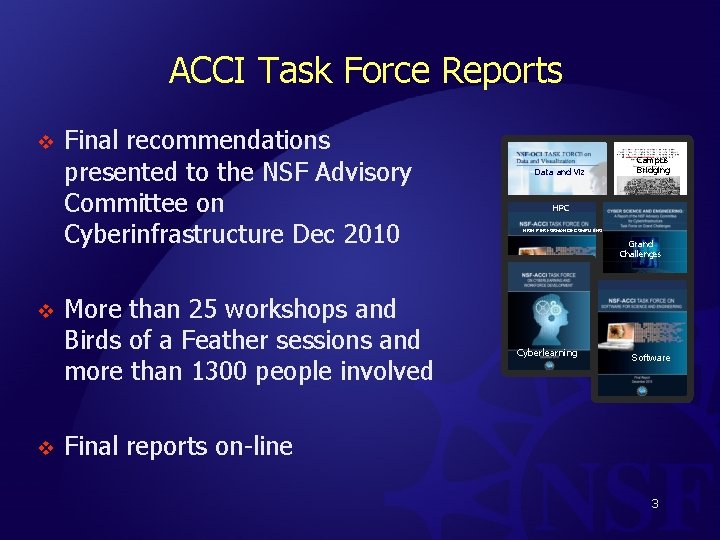
ACCI Task Force Reports v v v Final recommendations presented to the NSF Advisory Committee on Cyberinfrastructure Dec 2010 More than 25 workshops and Birds of a Feather sessions and more than 1300 people involved Data and Viz Campus Bridging HPC HIGH P ERFORMANCE COMPUTING Grand Challenges Cyberlearning Software Final reports on-line 3
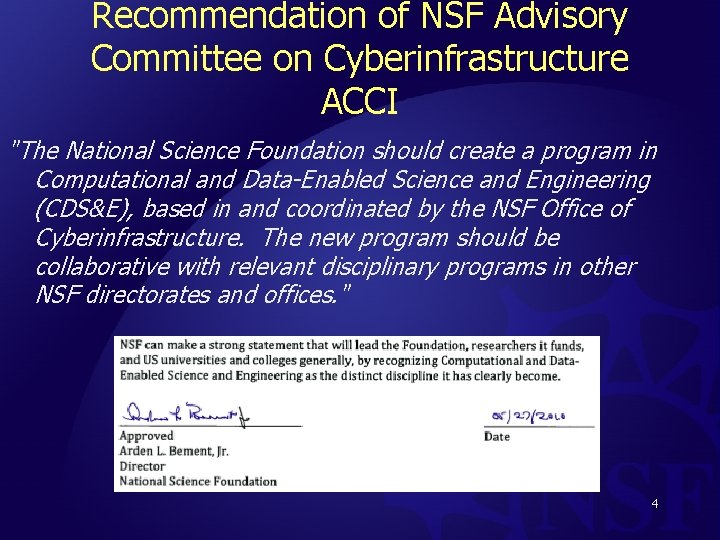
Recommendation of NSF Advisory Committee on Cyberinfrastructure ACCI "The National Science Foundation should create a program in Computational and Data-Enabled Science and Engineering (CDS&E), based in and coordinated by the NSF Office of Cyberinfrastructure. The new program should be collaborative with relevant disciplinary programs in other NSF directorates and offices. " 4
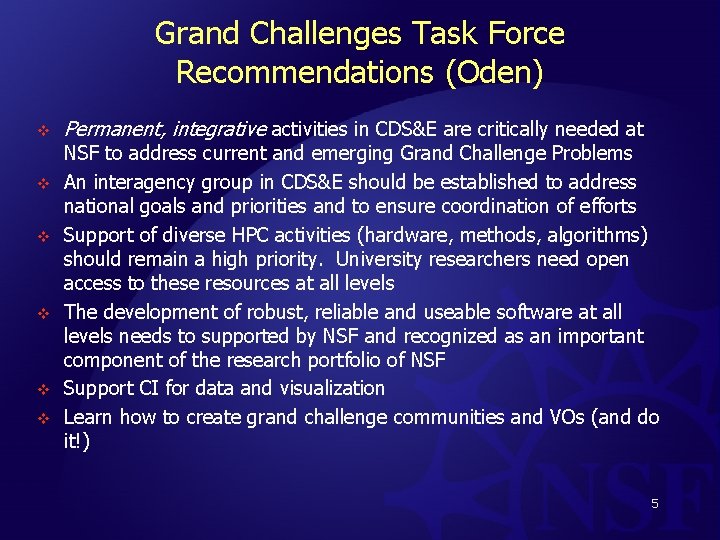
Grand Challenges Task Force Recommendations (Oden) v v v Permanent, integrative activities in CDS&E are critically needed at NSF to address current and emerging Grand Challenge Problems An interagency group in CDS&E should be established to address national goals and priorities and to ensure coordination of efforts Support of diverse HPC activities (hardware, methods, algorithms) should remain a high priority. University researchers need open access to these resources at all levels The development of robust, reliable and useable software at all levels needs to supported by NSF and recognized as an important component of the research portfolio of NSF Support CI for data and visualization Learn how to create grand challenge communities and VOs (and do it!) 5
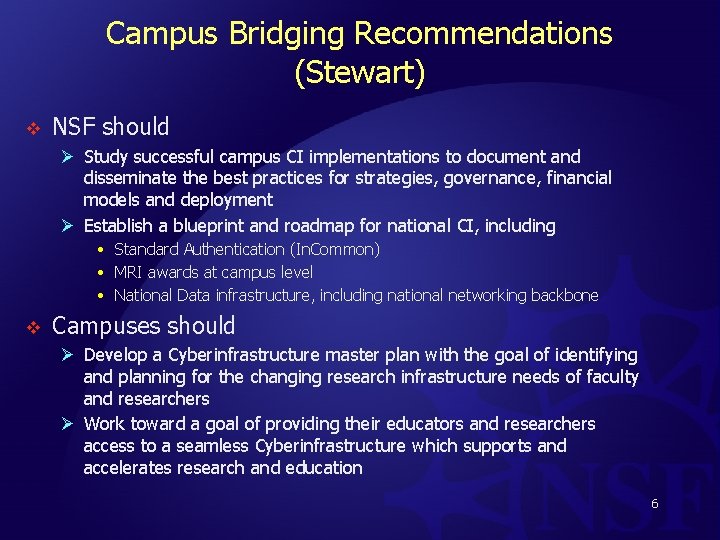
Campus Bridging Recommendations (Stewart) v NSF should Ø Study successful campus CI implementations to document and disseminate the best practices for strategies, governance, financial models and deployment Ø Establish a blueprint and roadmap for national CI, including • Standard Authentication (In. Common) • MRI awards at campus level • National Data infrastructure, including national networking backbone v Campuses should Ø Develop a Cyberinfrastructure master plan with the goal of identifying and planning for the changing research infrastructure needs of faculty and researchers Ø Work toward a goal of providing their educators and researchers access to a seamless Cyberinfrastructure which supports and accelerates research and education 6
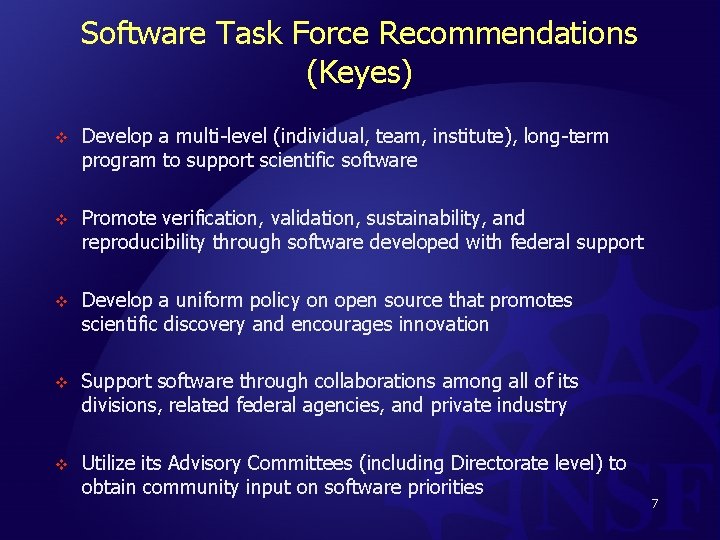
Software Task Force Recommendations (Keyes) v Develop a multi-level (individual, team, institute), long-term program to support scientific software v Promote verification, validation, sustainability, and reproducibility through software developed with federal support v Develop a uniform policy on open source that promotes scientific discovery and encourages innovation v Support software through collaborations among all of its divisions, related federal agencies, and private industry v Utilize its Advisory Committees (including Directorate level) to obtain community input on software priorities 7
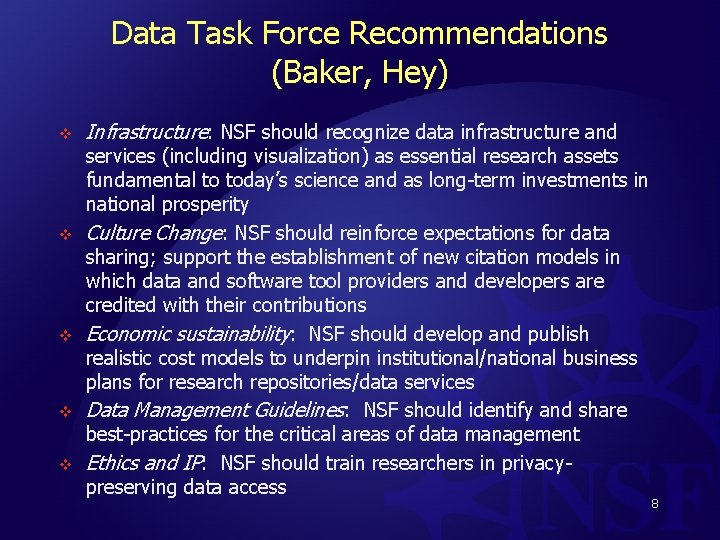
Data Task Force Recommendations (Baker, Hey) v v v Infrastructure: NSF should recognize data infrastructure and services (including visualization) as essential research assets fundamental to today’s science and as long-term investments in national prosperity Culture Change: NSF should reinforce expectations for data sharing; support the establishment of new citation models in which data and software tool providers and developers are credited with their contributions Economic sustainability: NSF should develop and publish realistic cost models to underpin institutional/national business plans for research repositories/data services Data Management Guidelines: NSF should identify and share best-practices for the critical areas of data management Ethics and IP: NSF should train researchers in privacypreserving data access 8
HPC Task Force Recommendations (Zacharia) v Develop a sustainable model to provide the academic research community with access to a rich mix of HPC systems Ø 20 -100 PF, integrated nationally, supported at campus levels Ø Invest now for exascale systems by 2018 -2020 v Continue and grow a variety of education, outreach, and training programs to expand awareness and encourage the use of high-end modeling and simulation v Broaden outreach to improve the preparation of researchers and to engage industry, decision-makers, and new user communities in the use of HPC as a valuable tool v Provide funding for digital data framework to address the issues of knowledge discovery including co-location of archives and data resources with compute and visualization resources as appropriate. 9
Cyberlearning and Workforce Development Task Force Recommendations (Ramirez) v Overall: Continuous, Collaborative, Computation Cloud (C 4) Ø Pervasive/ubiquitous Internet-based, interacting devices, data sources, users to dominate research, education & all areas of human endeavor v Promote cross-disciplinary, transformative research and education Ø Systemic change needed at all levels of education; university structures adjusted to train next generation scientists v Invest in efforts to understand learning and research mechanisms and organizations in the new world of CI Ø Exploit and transform CI-enabled, STEM research advancements, tools, and resources for cyberlearning and workforce development purposes v v Focus on lifelong learning and professional development Strengthen leadership, fund research in broadening participation: elimination of underrepresentation of women, 10 persons with disabilities, and minorities
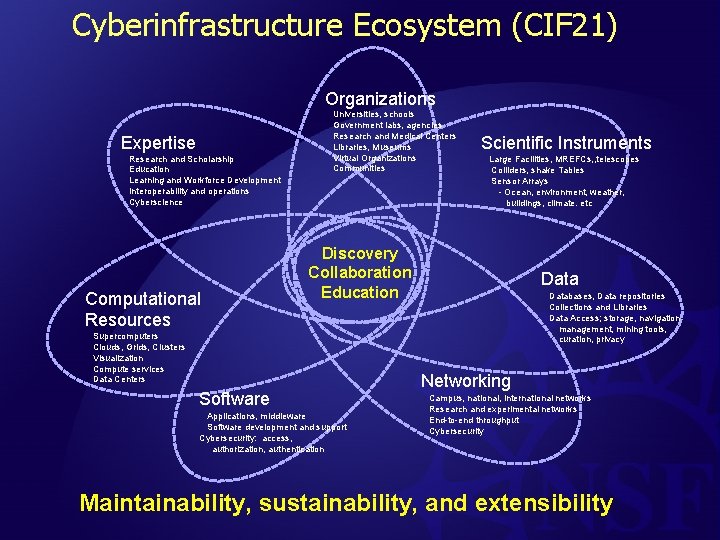
Cyberinfrastructure Ecosystem (CIF 21) Organizations Expertise Research and Scholarship Education Learning and Workforce Development Interoperability and operations Cyberscience Computational Resources Universities, schools Government labs, agencies Research and Medical Centers Libraries, Museums Virtual Organizations Communities Scientific Instruments Large Facilities, MREFCs, , telescopes Colliders, shake Tables Sensor Arrays - Ocean, environment, weather, buildings, climate. etc Discovery Collaboration Education Supercomputers Clouds, Grids, Clusters Visualization Compute services Data Centers Software Applications, middleware Software development and support Cybersecurity: access, authorization, authentication Databases, Data repositories Collections and Libraries Data Access; storage, navigation management, mining tools, curation, privacy Networking Campus, national, international networks Research and experimental networks End-to-end throughput Cybersecurity Maintainability, sustainability, and extensibility
CIF 21 – a metaphor v A goal of Virtual Proximity –-“ you are one with your resources” Ø Continue to collapse the barrier of distance and remove geographic location as an issue Ø ALL resources (including people) are virtually present, accessible and secure Ø End-to-end integrated resources Ø Science, discovery, innovation, education are the metrics An organizing fabric and foundation for science, engineering and education 12
Broad Principles to Lead CIF 21 Builds national infrastructure for S&E v Leverages common methods, approaches, and applications – focus on interoperability v Catalyzes other CI investments across NSF ØProvides focus and is a vehicle for coordinating efforts and programs ØIs a “force multiplier” across NSF v Shared governance; embedded into every directorate and office v Managed as a coherent program v 13
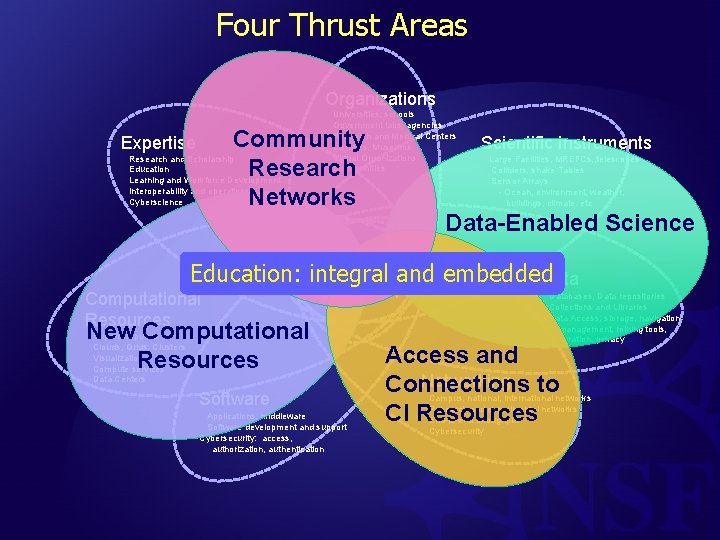
Four Thrust Areas Organizations Universities, schools Government labs, agencies Research and Medical Centers Libraries, Museums Virtual Organizations Communities Community Research Networks Expertise Research and Scholarship Education Learning and Workforce Development Interoperability and operations Cyberscience Education: Computational Resources Supercomputers Clouds, Grids, Clusters Visualization Compute services Data Centers Software Applications, middleware Software development and support Cybersecurity: access, authorization, authentication Large Facilities, MREFCs, , telescopes Colliders, shake Tables Sensor Arrays - Ocean, environment, weather, buildings, climate. etc Data-Enabled Science Discovery Collaboration integral and Education New Computational Resources Scientific Instruments embedded Databases, Data repositories Collections and Libraries Data Access; storage, navigation management, mining tools, curation, privacy Access and Networking to Connections CI Resources Campus, national, international networks Research and experimental networks End-to-end throughput Cybersecurity
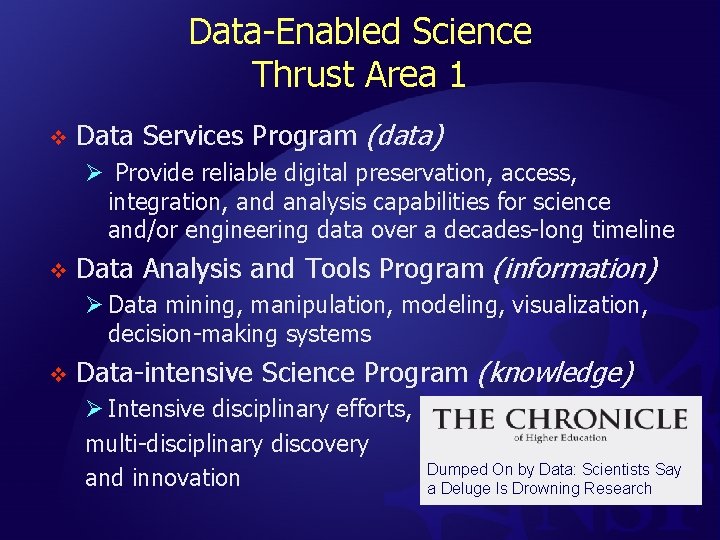
Data-Enabled Science Thrust Area 1 v Data Services Program (data) Ø Provide reliable digital preservation, access, integration, and analysis capabilities for science and/or engineering data over a decades-long timeline v Data Analysis and Tools Program (information) Ø Data mining, manipulation, modeling, visualization, decision-making systems v Data-intensive Science Program (knowledge) Ø Intensive disciplinary efforts, multi-disciplinary discovery and innovation Dumped On by Data: Scientists Say 15 a Deluge Is Drowning Research
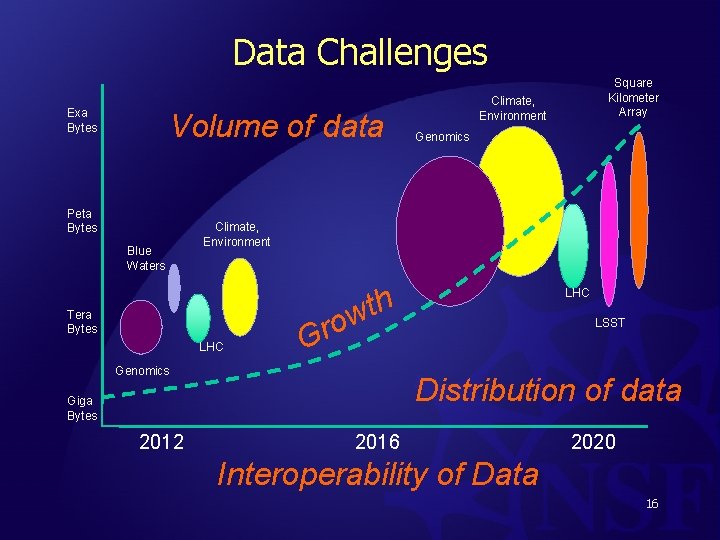
Data Challenges Exa Bytes Volume of data Peta Bytes Blue Waters Climate, Environment Genomics Climate, Environment Tera Bytes LHC th w ro LHC LSST G Genomics Distribution of data Giga Bytes 2012 Square Kilometer Array 2016 2020 Interoperability of Data 16
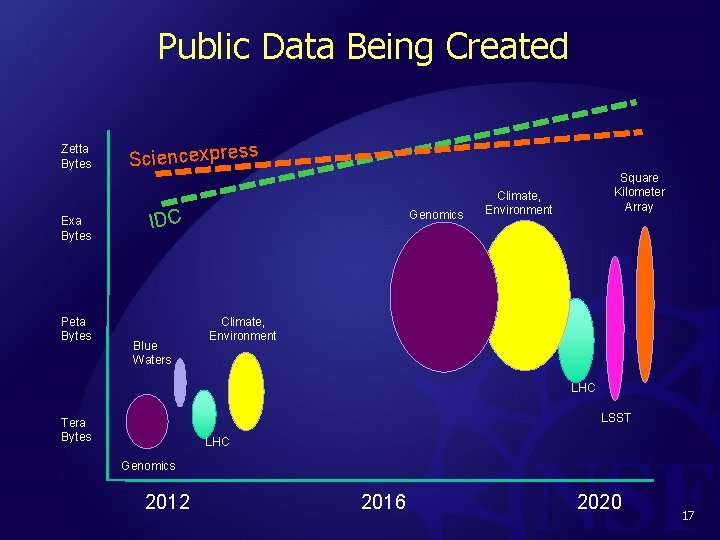
Public Data Being Created Zetta Bytes Exa Bytes Peta Bytes s Sciencexpres IDC Blue Waters Genomics Square Kilometer Array Climate, Environment LHC LSST Tera Bytes LHC Genomics 2012 2016 2020 17
New Computational Infrastructure Thrust Area 2 v Computational and Data-enabled resources Ø HPC, Clouds, Clusters, Data Centers v Long-term software for science and engineering Ø Sustained software development and support v Discipline-specific activities Ø Services, tools, compute environments that serve specific research efforts and communities 18
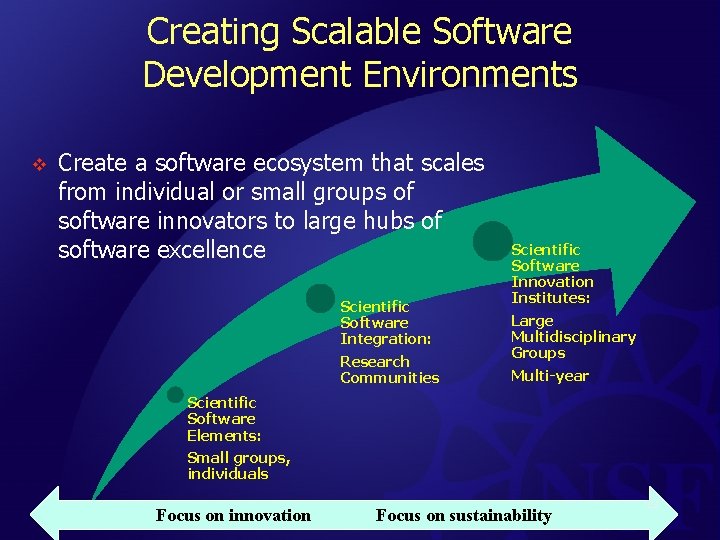
Creating Scalable Software Development Environments v Create a software ecosystem that scales from individual or small groups of software innovators to large hubs of software excellence Scientific Software Integration: Research Communities Scientific Software Innovation Institutes: Large Multidisciplinary Groups Multi-year Scientific Software Elements: Small groups, individuals Focus on innovation Focus on sustainability 19
Community Research Networks Thrust Area 3 v New multidisciplinary research communities Ø Address challenges beyond individuals and disciplinary research communities Ø Support and optimize collaboration across small, midlevel and large community networks Ø Support SEES and new research communities v Advanced research on community and social networks Ø Structures, leadership, fostering and sustainability Ø “virtuous cycle” providing feedback through formal evaluation and program iteration 20
Access and Connectivity Thrust Area 4 v Network connections and engineering program Ø Real-time access to facilities and instruments; Begins to tie in MREFC activities Ø Integration and end-to-end performance to provide seamless access from researcher to resource v Cybersecurity – from innovation to practice Ø Deployment of identity management systems Ø Development of cybersecurity prototypes 21
CIF 21 Strategic Plan Development of a detailed CIF 21 Roadmap for FY 12 and beyond; updated as needed v Developing a plan and guide for CI investments across NSF v Established internal NSF working group v Exploring and developing data policies on open access, publications, citation, etc v Multidirectorate/office “collective” programs designed to build critical infrastructure and capabilities v 22
CIF 21 Strategy Plan con’t Outcomes and metrics being identified for each Thrust Area v Spiral development model adopted for all components v Ø 3 -5 year overlapping spirals Ø Iteration and creation of new versions and capabilities with each spiral Ø Ever increasing improvements v NSF Advisory Committee on Cyberinfrastructure to review CIF 21 progress; individual directorate ACs as well 23
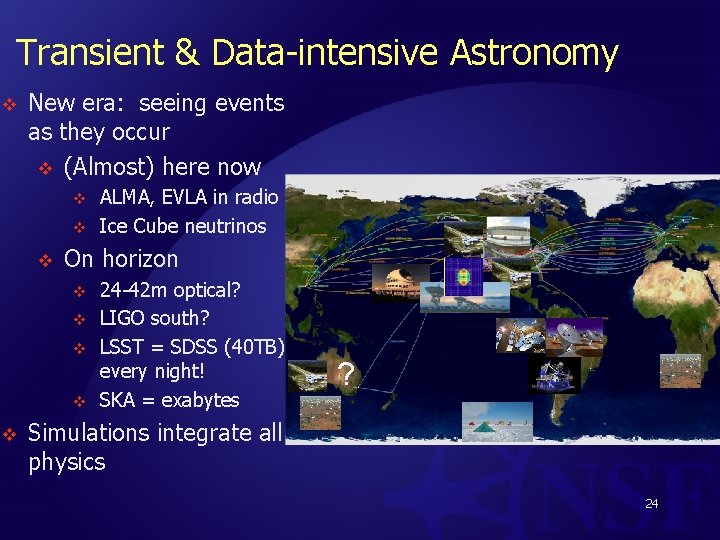
Transient & Data-intensive Astronomy v New era: seeing events as they occur v (Almost) here now v v v On horizon v v v ALMA, EVLA in radio Ice Cube neutrinos 24 -42 m optical? LIGO south? LSST = SDSS (40 TB) every night! SKA = exabytes ? Simulations integrate all physics 24
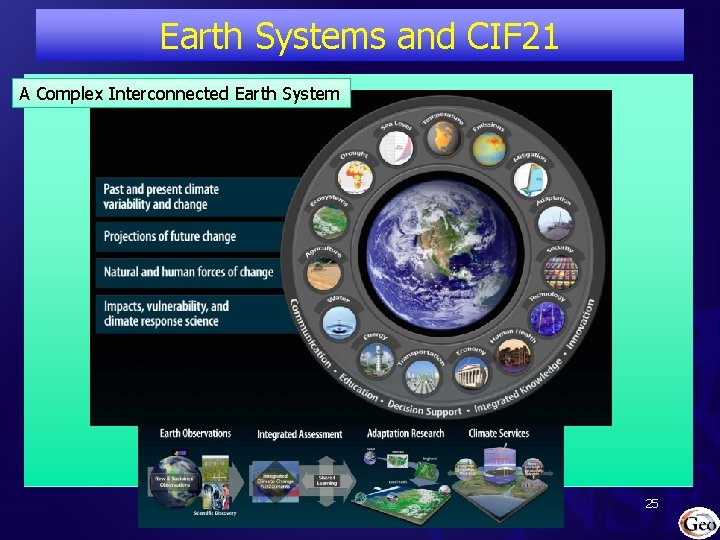
Earth Systems and CIF 21 A Complex Interconnected Earth System 25
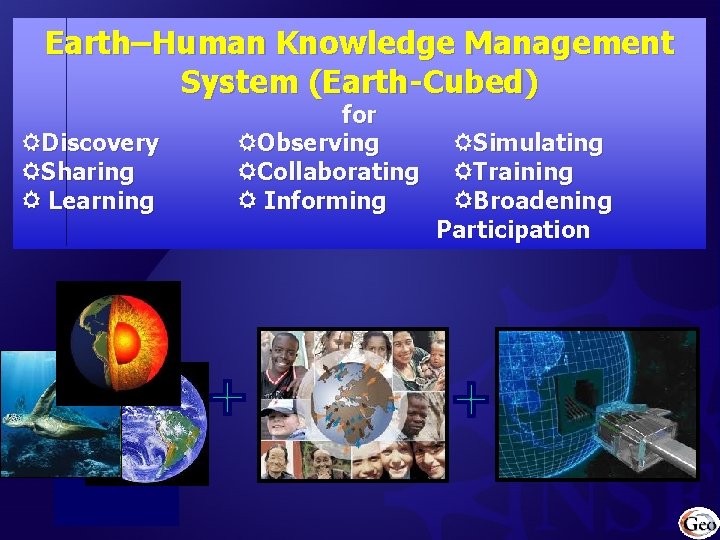
Earth–Human Knowledge Management System (Earth-Cubed) Discovery Sharing Learning for Observing Collaborating Informing Simulating Training Broadening Participation
Impacts on NSF v CI as enabling infrastructure for S&E Ø Sustainability and viability essential Ø NSF has a unique role in this strategy v New role for Data Ø data-enabled and data intensive science Ø management of data - compute, storage, use, access, etc Multi-disciplinary approaches essential v Education - embedded and integral v Ø methodologies (compute and data intensive) Ø culture/society (interdisciplinary approaches, collaborative) v More coordinated post-award management Ø ensure value across the entire research enterprise 27
Thank you 28
- Slides: 28