RESTRICTED ACCESS MRE PROGRAMMING OR MRE FOR HARDTOREACH
- Slides: 16
“RESTRICTED ACCESS MRE PROGRAMMING” - OR MRE FOR HARD-TO-REACH COMMUNITIES
DEFINITION… Remote management programming (or limited access programming): As an adaptation to insecurity, the practice of withdrawing international (or other at-risk staff) while transferring increased programming responsibilities to local staff or local partner organisations. (OCHA 2011)
RESTRICTED ACCESS PROGRAMMING Implementing activities in areas with restricted access entails risks with regard to Security of (partner) staff and beneficiaries Ensuring accountability Securing assets and resources monitoring and ensuring quality
RESTRICTED ACCESS MRE PROGRAMMING Implementing MRE activities in areas with restricted access entails the same risks: Security of (partner) staff and beneficiaries
RESTRICTED ACCESS MRE PROGRAMMING Implementing MRE activities in areas with restricted access entails the same risks: Security of (partner) staff and beneficiaries Ensuring accountability
RESTRICTED ACCESS MRE PROGRAMMING Implementing MRE activities in areas with restricted access entails the same risks: Security of (partner) staff and beneficiaries Ensuring accountability Securing assets and resources
RESTRICTED ACCESS MRE PROGRAMMING Implementing MRE activities in areas with restricted access entails the same risks: Security of (partner) staff and beneficiaries Ensuring accountability Securing assets and resources monitoring and ensuring quality MRE only represents a value if it is done – and if it is done properly!
RESTRICTED ACCESS MRE PROGRAMMING We can mitigate the risks to MRE programming through Revised training methodology Revised RE tools and materials Increased support to and capacity development of implementing teams Establish a culture of learning Improved M&E system Strategic Partnerships Revised delivery methodologies
REVISED TRAINING METHODOLOGY Reflect the reality of the team Have emphasis on practical exercises, thoroughly testing facilitation skills Prepare to be self-reliant and dynamic Web-based training
REVISED RE TOOLS AND MATERIALS Less people-dependent materials and tools A combination of tools (audio, visual) Web-based tools and materials
INCREASED SUPPORT & CAPACITY DEVELOPMENT Involve the team from the outset: (“how do you think we can satisfy donor’s need for documentation? ”) Give them ownership of implementation and monitoring plans Follow-up, pre-arrange regular meetings with fixed agendas (Whats. App, Adobe-connect, skype etc) Spot needs for support and capacity development along the way and follow up!
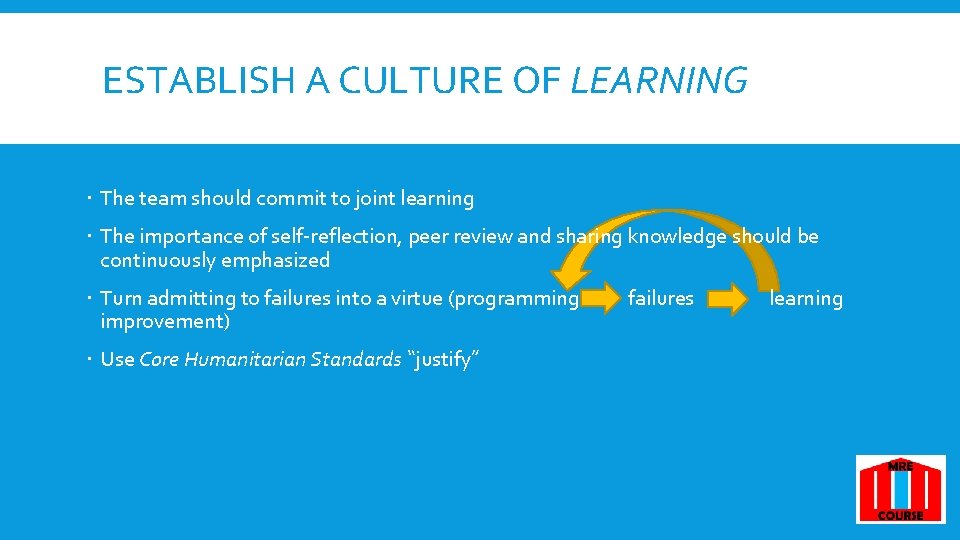
ESTABLISH A CULTURE OF LEARNING The team should commit to joint learning The importance of self-reflection, peer review and sharing knowledge should be continuously emphasized Turn admitting to failures into a virtue (programming improvement) Use Core Humanitarian Standards “justify” failures learning
IMPROVED M&E SYSTEM Monitoring and implementation plan should be devised and discussed with the team Make sure that it is clear and visible that performance is being monitored Use different kinds of documentation (geo-referencing monitoring tools, photos, beneficiary statements) Triangulate information from different sources Invest in teams dedicated to monitoring Link accountability and monitoring (make sure beneficiaries can reach us) Coordination with other agencies
PARTNERSHIPS Build long-term strategic partnerships Partners should not only be used as contractor, a means-to-an-end or a service provider Supporting and empowering progressive parts of civil society – a civil society aiming at transforming power structures to ensure development and eradication of poverty, injustice and insecurity – must be locally owned to be sustainable. Working in partnership is therefore our natural starting point. (DCA Partnership Policy)
DELIVERY METHODOLOGIES Spend 5 minutes at each table coming up with examples of effective ways to reach communities in hard-to-reach areas
DELIVERY METHODOLOGIES http: //www. local 2 global. info/