IEEE 802 11 201046 r 9 August 2020
- Slides: 17
IEEE 802. 11 -20/1046 r 9 August 2020 Protected TWT Enhancement for Latency Sensitive Traffic Date: 2020 -07 -29 Name Chunyu Hu Payam Torab George Cherian Duncan Ho Laurent Cariou Dave Cavalcanti Zhou Lan George Kondylis Yongho Seok Submission Affiliations Address Phone email Facebook Inc. 1 Hacker way Menlo Park, CA chunyuhu@fb. com Qualcomm Inc. 5665 Morehouse Dr, San Diego CA 92131 gcherian@qti. qualcomm. com Intel Corp. 2111 NE 25 th Ave, Hillsboro, OR 97124 laurent. cariou@intel. com Broadcom Inc. 250 Innovation Dr. , San Jose, CA 95034 Media. Tek Inc. 2840 Junction Ave, San Jose, CA 95134 Slide 1 torab@ieee. org dho@qti. qualcomm. com dave. cavalcanti@intel. com zhou. lan@broadcom. com george. kondylis@broadcom. com yongho. seok@mediatek. com Chunyu Hu et al.
IEEE 802. 11 -20/1046 r 9 August 2020 Abstract • Discuss a solution in R 1 timeline based on TWT to provide latency sensitive traffic more predictable latency performance Submission Slide 2 Chunyu Hu et al.
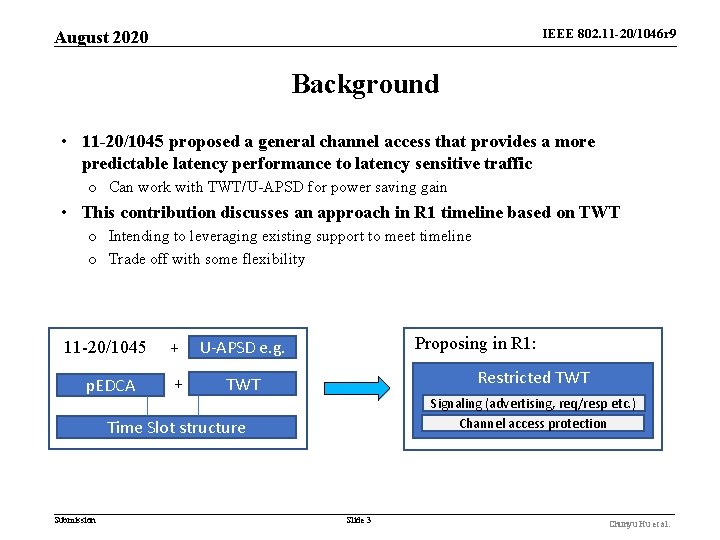
IEEE 802. 11 -20/1046 r 9 August 2020 Background • 11 -20/1045 proposed a general channel access that provides a more predictable latency performance to latency sensitive traffic o Can work with TWT/U-APSD for power saving gain • This contribution discusses an approach in R 1 timeline based on TWT o Intending to leveraging existing support to meet timeline o Trade off with some flexibility 11 -20/1045 + U-APSD e. g. p. EDCA + TWT Proposing in R 1: Restricted TWT Signaling (advertising, req/resp etc. ) Channel access protection Time Slot structure Submission Slide 3 Chunyu Hu et al.
IEEE 802. 11 -20/1046 r 9 August 2020 TWT Revisit • TWT is a mechanism where a set of Service Periods (SPs) are defined and shared between AP and non-AP STAs to reduce medium contention and improve the power efficiency of STAs. • TWT provides a periodic operation (implicit TWT) suiting periodic traffic • Broadcast TWT: AP can schedule TWT SP(s) with supporting STAs and shares schedule info in Beacon/Probe Response frames o Reduced negotiation overhead compared to individual TWT, but further reduction of signaling overhead can be considered o Information is shared on per TWT flow basis • Individual TWT: defined a protection mode using a NAV protection mechanism to protect medium access of TWT SP o The session info is not shared in the beacon • TWT is associated with a STA but not associated with a traffic class (TID or AC) • TWT is defined for AP/STA pairs or TDLS peers Submission Slide 4 Chunyu Hu et al.
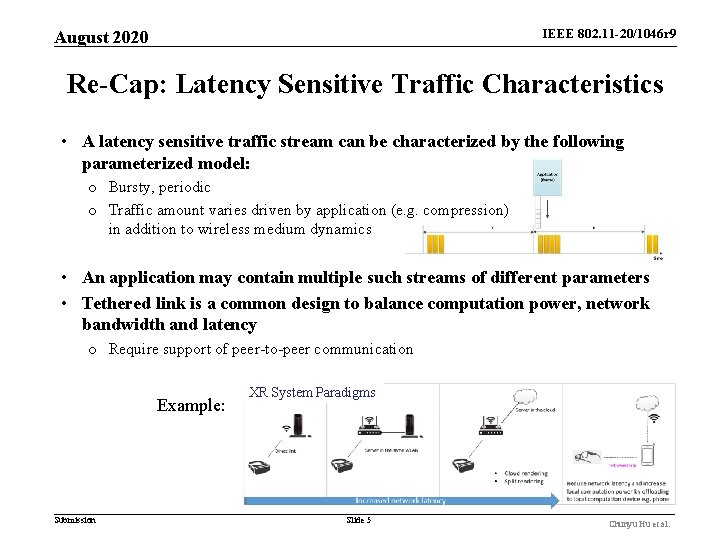
IEEE 802. 11 -20/1046 r 9 August 2020 Re-Cap: Latency Sensitive Traffic Characteristics • A latency sensitive traffic stream can be characterized by the following parameterized model: o Bursty, periodic o Traffic amount varies driven by application (e. g. compression) in addition to wireless medium dynamics • An application may contain multiple such streams of different parameters • Tethered link is a common design to balance computation power, network bandwidth and latency o Require support of peer-to-peer communication Example: Submission XR System Paradigms Slide 5 Chunyu Hu et al.
IEEE 802. 11 -20/1046 r 9 August 2020 Proposal Highlight • • • Enhance channel access protection for TWT SP Extend the concept of protected individual TWT to Broadcast TWT Extend the usage of Broadcast TWT signaling for protected SPs Extend the usage of TWT for low latency peer-to-peer communication Define support of limiting a protected TWT flow to TID(s) Submission Slide 6 Chunyu Hu et al.
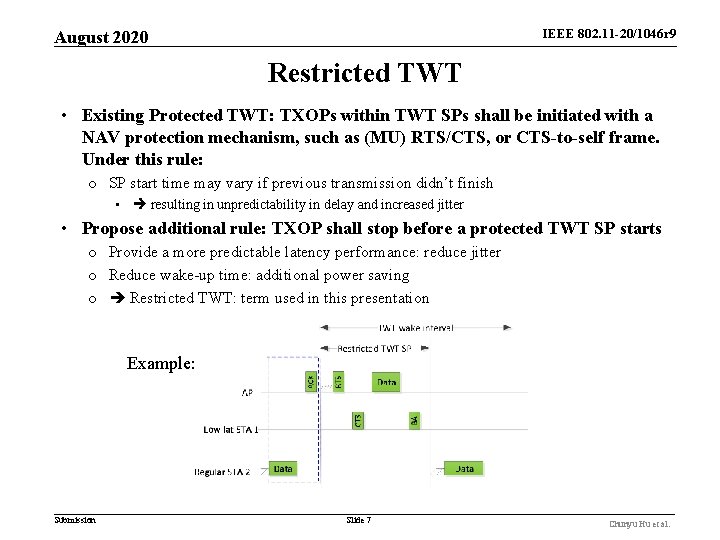
IEEE 802. 11 -20/1046 r 9 August 2020 Restricted TWT • Existing Protected TWT: TXOPs within TWT SPs shall be initiated with a NAV protection mechanism, such as (MU) RTS/CTS, or CTS-to-self frame. Under this rule: o SP start time may vary if previous transmission didn’t finish • resulting in unpredictability in delay and increased jitter • Propose additional rule: TXOP shall stop before a protected TWT SP starts o Provide a more predictable latency performance: reduce jitter o Reduce wake-up time: additional power saving o Restricted TWT: term used in this presentation Example: Submission Slide 7 Chunyu Hu et al.
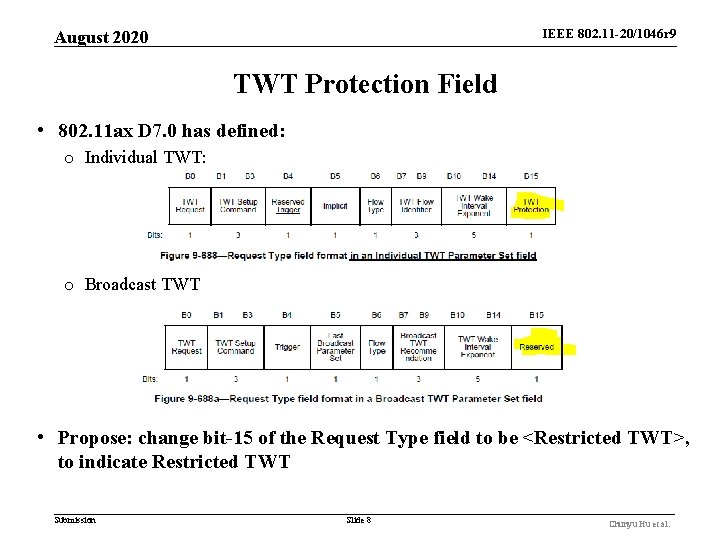
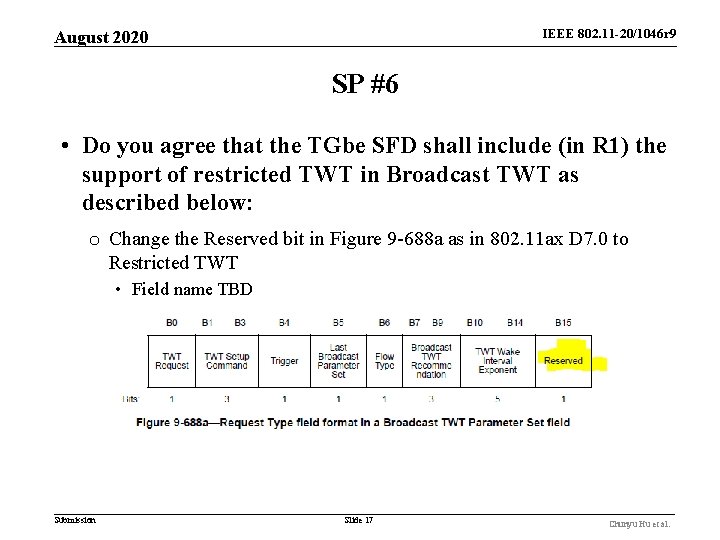
IEEE 802. 11 -20/1046 r 9 August 2020 TWT Protection Field • 802. 11 ax D 7. 0 has defined: o Individual TWT: o Broadcast TWT • Propose: change bit-15 of the Request Type field to be <Restricted TWT>, to indicate Restricted TWT Submission Slide 8 Chunyu Hu et al.
IEEE 802. 11 -20/1046 r 9 July 2020 Support of Peer-to-Peer Communication • Existing TWT sessions only allows AP/STA and TDLS pairs to participate • Some examples of peer-to-peer links: o TDLS: either non-AP STA can request TWT membership for their latency sensitive traffic, and follow corresponding channel access rules o Tethered link using P 2 P (GO/GC): GO as non-AP STA associated with the AP, and request TWT membership for the latency sensitive traffic carried over the p 2 p link o Tethered link using Soft. AP: similar to above • Propose: extend restricted TWT for peer-to-peer STAs to participate Submission Slide 9 Chunyu Hu
IEEE 802. 11 -20/1046 r 9 August 2020 What Else is Needed? • A STA needs to learn the restricted broadcast TWT sessions o => The AP shall include sufficient info of these TWT sessions in the Beacon/Probe Response • A STA provides its own traffic information and minimum Qo. S requirement for the TWT setup o => This allows the AP to perform resource allocation and admission control (accept/reject/suggest the request) and update its scheduling • To avoid abuse by the STAs, the AP can announce policies, which o Limits the type of traffic that it can accept for the restricted TWT sessions, and/or o Limits the amount of time allocated to each and total restricted TWT sessions. Submission Slide 10 Chunyu Hu et al.
IEEE 802. 11 -20/1046 r 9 August 2020 Summary • Introduced restricted TWT SPs with the following mechanisms where we: o o Enhance the channel access for restricted TWT SPs Extend the use of Broadcast TWT signaling Extend the usage of such TWT SPs for low latency peer-to-peer communications Introduce support of limiting a restricted TWT flow to TIDs • Discussed possible ways for AP to constrain the use of protected channel access Submission Slide 11 Chunyu Hu et al.
IEEE 802. 11 -20/1046 r 9 August 2020 SP #1 • Do you agree to add to the TGbe SFD (in R 1), a mode where an EHT AP may announce restricted service periods (SPs) such that: o Any EHT non-AP STA that supports following the announced restricted SPs, and associated to the AP, shall end its TXOP before the start of the restricted SP(s) o The support for the restricted SPs is optional for the EHT non-AP STA o The support for this mode is optional for the EHT AP o Note: such restricted SPs are intended to provide more predictable latency performance for latency sensitive traffic Submission Slide 12 Chunyu Hu et al.
IEEE 802. 11 -20/1046 r 9 August 2020 SP #2 • Do you agree to add to the TGbe SFD (in R 1): o An AP may announce restricted TWT session(s) that are for peer-topeer STAs. Submission Slide 13 Chunyu Hu et al.
IEEE 802. 11 -20/1046 r 9 August 2020 SP #3 • Do you agree that the TGbe SFD shall add (in R 1): o Extend the per STA TWT setup procedure to allow limiting the usage of a restricted TWT session to indicated TID(s) Submission Slide 14 Chunyu Hu et al.
IEEE 802. 11 -20/1046 r 9 August 2020 SP #4 • Do you agree to add to the TGbe SFD (in R 1): o Define a signaling mechanism for an AP to announce a Qo. S management policy for admitting a STA into a restricted TWT session Submission Slide 15 Chunyu Hu et al.
IEEE 802. 11 -20/1046 r 9 August 2020 SP #5 • Do you agree to add to the TGbe SFD (in R 1) the following: o Define a signaling mechanism for a STA to convey its traffic information and Qo. S requirements (e. g. , latency delay tolerance, throughput needs, periodicity, offset, etc. ) when or before requesting a restricted TWT session Submission Slide 16 Chunyu Hu et al.
IEEE 802. 11 -20/1046 r 9 August 2020 SP #6 • Do you agree that the TGbe SFD shall include (in R 1) the support of restricted TWT in Broadcast TWT as described below: o Change the Reserved bit in Figure 9 -688 a as in 802. 11 ax D 7. 0 to Restricted TWT • Field name TBD Submission Slide 17 Chunyu Hu et al.