
Unlocking airway management skills the key to patient







- Slides: 85
Unlocking airway management skills …. …the key to patient survival. Kansas Airway Supplement 1
Respiratory Anatomy ¨ Nose and mouth (warms, moistens, and filters air). ¨ Pharynx – Oropharynx – Nasopharynx ¨ Epiglottis ¨ Trachea (windpipe) Kansas Airway Supplement Kansas BEMS Educator Task Force 2
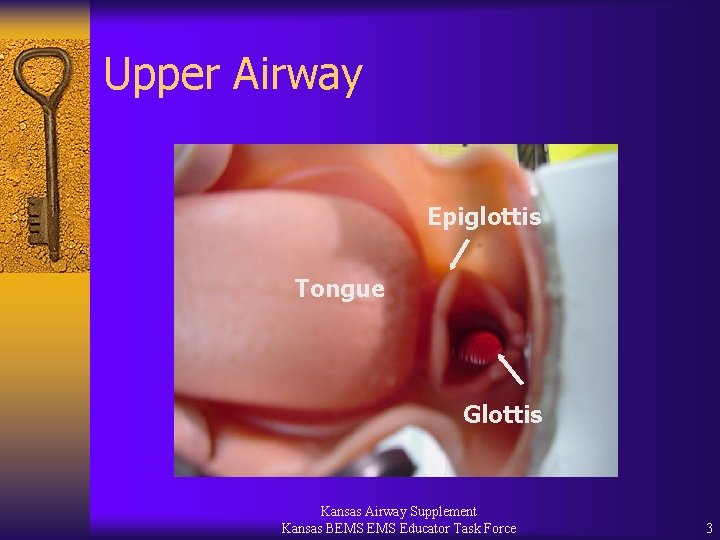
Upper Airway Epiglottis Tongue Glottis Kansas Airway Supplement Kansas BEMS Educator Task Force 3
Respiratory Anatomy ¨ Cricoid cartilage ¨ Larynx (voice box). ¨ Bronchi ¨ Lungs – Visceral pleura (surface of lungs) – Parietal pleura (internal chest wall) – Interpleural space (potential space) Kansas Airway Supplement Kansas BEMS Educator Task Force 4
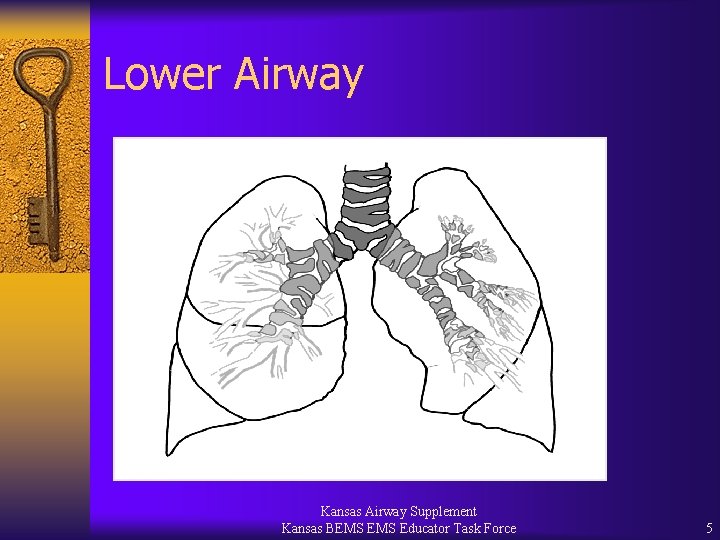
Lower Airway Kansas Airway Supplement Kansas BEMS Educator Task Force 5
Respiratory Anatomy ¨ Diaphragm ¨ Inhalation (active process) – Diaphragm and intercostal muscles contract, increasing the size of the thoracic cavity. – Diaphragm moves slightly downward, ribs move upward and outward. ¨ The negative pressure in the chest cavity causes air flow into the lungs. Kansas Airway Supplement Kansas BEMS Educator Task Force 6
Respiratory Anatomy ¨ Exhalation (passive process) ¨ Diaphragm and intercostal muscles relax decreasing the size of the thoracic cavity. – Diaphragm moves upward, ribs move downward and inward. ¨ The positive pressure inside the chest cavity causes air flow out of the lungs. Kansas Airway Supplement Kansas BEMS Educator Task Force 7
Anatomical sources of ventilation problems ¨ Upper airway ¨ Lower airway ¨ Head/neck-Brain ¨ Spinal cord ¨ Chest wall Kansas Airway Supplement Kansas BEMS Educator Task Force 8
Respiratory Physiology ¨ Oxygenation - blood and the cells become saturated with oxygen ¨ Hypoxia - inadequate oxygen levels in the blood ¨ Signs of Hypoxia – – – Increased or decreased heart rate Altered mental status (early sign) Agitation Initial elevation of B. P. followed by a decrease Cyanosis (often a late sign) Kansas Airway Supplement Kansas BEMS Educator Task Force 9
Alveolar Gas Exchange ¨ Oxygen-rich air enters the alveoli during each inspiration. ¨ Oxygen enters the blood in the capillaries as carbon dioxide enters the alveoli for exhalation. Kansas Airway Supplement Kansas BEMS Educator Task Force 10
Infant and Child Considerations ¨ Mouth and nose - generally all structures are smaller and more easily obstructed than in adults. ¨ Pharynx - infant’s and children’s tongues take up proportionally more space in the mouth than adults. ¨ Trachea - (windpipe) – Infants and children have narrower tracheas that are obstructed more easily by swelling. – Trachea is softer and more flexible in infants and children. Kansas Airway Supplement Kansas BEMS Educator Task Force 11
Infant and Child Considerations ¨ Cricoid cartilage - like other cartilage in the infant and child, the cricoid cartilage is less developed and less rigid. It is the narrowest part of the infant’s or child’s airway. ¨ Diaphragm - chest wall is softer, infants and children tend to depend more heavily on the diaphragm for breathing. Kansas Airway Supplement Kansas BEMS Educator Task Force 12
Opening the Mouth ¨ Crossed-finger technique ¨ Inspect the mouth – Vomit – Blood – Secretions – Foreign bodies ¨ Be extremely cautious – Fingers – Gag or vomit Kansas Airway Supplement Kansas BEMS Educator Task Force 13
Opening the Airway ¨ Head-tilt, chin lift maneuver – Adults vs. . Infants and Children ¨ Jaw thrust maneuver Kansas Airway Supplement Kansas BEMS Educator Task Force 14
Techniques of Suctioning ¨ BSI precautions ¨ Purpose – Remove blood, other liquids, and food particles from the airway – Some suction units are inadequate for removing solid objects like teeth, foreign bodies, and food – A patient needs to be suctioned immediately when a gurgling sound is heard with artificial ventilation Kansas Airway Supplement Kansas BEMS Educator Task Force 15
Types of Suction Units ¨ Mounted Suction Devices – Fixed on-board the ambulance – 300 mm. Hg pull on gauge when tubing is clamped – Should be adjustable for infants and children Kansas Airway Supplement Kansas BEMS Educator Task Force 16
Portable Suction Devices ¨ Electric - battery powered ¨ Oxygen - powered ¨ Hand - powered ¨ Each device must have – Wide-bore, thick walled, non-kink tubing – Plastic collection bottle, supply of water – Enough vacuum to clear the throat Kansas Airway Supplement Kansas BEMS Educator Task Force 17
Suction Catheters ¨ Hard or rigid catheter (Yankaeur) – Tonsil tip – Used to suction mouth and oropharynx – Inserted a limited depth – Use caution on infants and children • Soft tissue damage Kansas Airway Supplement Kansas BEMS Educator Task Force 18
Suction Catheters ¨ Soft catheter (French catheter) – Used to suction mouth or nose and nasopharynx – Measured from tip of the nose to the tip of the ear. – Not inserted beyond the base of the tongue Kansas Airway Supplement Kansas BEMS Educator Task Force 19
Techniques of Suctioning ¨ Best positioned at patient’s head ¨ Turn on the suction unit ¨ Select catheter ¨ Measure and insert without suction if possible ¨ Suction from side to side – Adults no more than 15 seconds – Infants & children - less than 15 seconds ¨ Rinse catheter with water if necessary Kansas Airway Supplement Kansas BEMS Educator Task Force 20
Special Considerations ¨ Secretions that cannot be removed log roll and finger sweep ¨ Patient producing frothy secretions as rapidly as suctioning can remove them – Suction 15 seconds – Positive pressure with supplemental oxygen for 2 minutes then suction again and repeat the process ¨ Residual air removed from lungs, monitor pulse and heart rate Kansas Airway Supplement Kansas BEMS Educator Task Force 21
Suction ¨ The importance of readiness can not be overstated. Kansas Airway Supplement Kansas BEMS Educator Task Force 22
Study of suction equipment utilization. Prehosp Emerg Care 1997 Apr-Jun; 1(2): 91 -5 Kozak RJ, Ginther BE, Bean WS. Kansas Airway Supplement Kansas BEMS Educator Task Force 23
Fifty-one paramedics serving a Level I urban trauma center were anonymously surveyed. Prehosp Emerg Care 1997 Apr-Jun; 1(2): 91 -5 Kozak RJ, Ginther BE, Bean WS. Kansas Airway Supplement Kansas BEMS Educator Task Force 24
Study of suction equipment utilization. The paramedics reported: • carrying suction equipment to the scene of medical aid calls less than 25% of the time. Prehosp Emerg Care 1997 Apr-Jun; 1(2): 91 -5 Kozak RJ, Ginther BE, Bean WS. Kansas Airway Supplement Kansas BEMS Educator Task Force 25
Study of suction equipment utilization. The paramedics reported: carrying suction equipment to the scene of medical aid calls less than 25% of the time. suction equipment is utilized during 50% of advanced airway procedures. Prehosp Emerg Care 1997 Apr-Jun; 1(2): 91 -5 Kozak RJ, Ginther BE, Bean WS. Kansas Airway Supplement Kansas BEMS Educator Task Force 26
Study of suction equipment utilization. The paramedics reported: carrying suction equipment to the scene of medical aid calls less than 25% of the time. suction equipment is utilized during 50% of advanced airway procedures. Half of the paramedics reported complications affecting patient care at least once during their careers due to equipment malfunction. Prehosp Emerg Care 1997 Apr-Jun; 1(2): 91 -5 Kozak RJ, Ginther BE, Bean WS. Kansas Airway Supplement Kansas BEMS Educator Task Force 27
Study of suction equipment utilization. The paramedics reported: carrying suction equipment to the scene of medical aid calls less than 25% of the time. suction equipment is utilized during 50% of advanced airway procedures. Half of the paramedics reported complications affecting patient care at least once during their careers due to equipment malfunction. Ninety-eight percent of the paramedics reported having some type of training with the suction equipment for prehospital advanced airway procedures. Prehosp Emerg Care 1997 Apr-Jun; 1(2): 91 -5 Kozak RJ, Ginther BE, Bean WS. Kansas Airway Supplement Kansas BEMS Educator Task Force 28
Suction - Key Points ¨ Reminder of BSI ¨ Suctions are limited in what they remove ¨ Immediate action is needed ¨ Have a secondary device Kansas Airway Supplement Kansas BEMS Educator Task Force 29
Oropharyngeal Airway (OPA) ¨ Used to maintain a patent airway only on deeply unresponsive patients ¨ No gag reflex ¨ Designed to allow suctioning while in place ¨ Must have the proper size ¨ If patient becomes responsive and starts to fight the OPA remove it. . . Kansas Airway Supplement Kansas BEMS Educator Task Force 30
Inserting the OPA ¨ Select the proper size (corner of the mouth to tip of the ear) ¨ Open the patient’s mouth ¨ Insert the OPA with the tip facing the roof of the mouth ¨ Advance while rotating 180° ¨ Continue until flange rests on the teeth ¨ Infants and children insertion Kansas Airway Supplement Kansas BEMS Educator Task Force 31
Nasopharyngeal Airway (NPA) ¨ Nose hose, nasal trumpet ¨ Used on patients who are unable to tolerate an OPA or is not fully responsive ¨ Do not use on suspected basilar skull fracture ¨ Still need to maintain head-tilt chin lift or jaw thrust when inserted ¨ Must select the proper size ¨ Made to go into right nare or nostril Kansas Airway Supplement Kansas BEMS Educator Task Force 32
Inserting the NPA ¨ Select the proper size in length and diameter ¨ Lubricate ¨ Insert into right nostril with bevel always toward the septum ¨ Continue inserting until flange rests against the nostril ¨ Insertion into left nostril Kansas Airway Supplement Kansas BEMS Educator Task Force 33
Assessment of Breathing ¨ After establishing an airway your next step should be to assess breathing ¨ Look – Breathing pattern regular or irregular – Nasal flaring – Adequate expansion, retractions Kansas Airway Supplement Kansas BEMS Educator Task Force 34
Assessment of Breathing ¨ Listen – Shortness of breath when speaking – Unresponsive place ear next to patients mouth – Is there any movement of air? Kansas Airway Supplement Kansas BEMS Educator Task Force 35
Assessment of Breathing ¨ Feel – Check the volume of breathing by placing you ear and cheek next to the patient’s mouth Kansas Airway Supplement Kansas BEMS Educator Task Force 36
Assessment of Breathing ¨ Auscultate – Stethoscope • Mid clavicular about the second intercostal space and the fourth or fifth anterior midaxillary line or next to sternum – Check both sides • Present and equal bilaterally • Diminished or absent Kansas Airway Supplement Kansas BEMS Educator Task Force 37
Adequate Breathing ¨ Normal rate – Adult 12 - 20/min – Child 15 - 30/min – Infant 25 - 50/min ¨ Rhythm – Regular – Irregular Kansas Airway Supplement Kansas BEMS Educator Task Force 38
Ventilation Volume ¨ Tidal volume-air inspired in each breath ¨ Minute volume-tidal volume multiplied by the respiratory rate Kansas Airway Supplement Kansas BEMS Educator Task Force 39
Adequate Breathing ¨ Quality – Breath sounds present and equal – Chest expansion adequate and equal – Effort of breathing • use of accessory muscles predominately in infants and children ¨ Depth (tidal volume) – Adequate chest rise and fall – Full breath sounds heard Kansas Airway Supplement Kansas BEMS Educator Task Force 40
Inadequate Breathing ¨ Rate – Outside the normal limits • Tachypnea (rapid breathing) >20 • Badypnea (slow breathing) <12 ¨ Rhythm – Irregular breathing pattern Kansas Airway Supplement Kansas BEMS Educator Task Force 41
Inadequate Breathing ¨ Quality – Breath sounds diminished, noisy or absent – Excessive use of accessory muscles, retractions – Reduced air flow at nose/mouth – Inadequate chest expansion – Nostril flaring (infants & children) ¨ Depth – Shallow (impaired depth) breathing – Agonal respirations - occasional gasping respirations Kansas Airway Supplement Kansas BEMS Educator Task Force 42
Inadequate Breathing ¨ Skin Color ¨ Retractions ¨ “Seesaw” breathing (abd & chest move in opposite directions) ¨ Any of these signs is by itself may be reason to ventilate a patient without delay Kansas Airway Supplement Kansas BEMS Educator Task Force 43
Positive Pressure ventilation ¨ The practice of artificially ventilating, or forcing air into a patient who is breathing inadequately or not breathing at all Kansas Airway Supplement Kansas BEMS Educator Task Force 44
Techniques of Artificial Ventilation ¨ In order of preference – Mouth to mask – Two-person bag-valve-mask – Flow-restricted oxygen-powered ventilation device – One-person bag-valve-mask Kansas Airway Supplement Kansas BEMS Educator Task Force 45
Considerations When Using Artificial Ventilation ¨ Maintain a good mask seal ¨ Device must deliver adequate volume of air to sufficiently inflate the lungs ¨ Supplemental oxygen must be used Kansas Airway Supplement Kansas BEMS Educator Task Force 46
Adequate Artificial Ventilations ¨ Chest rises and falls with each ventilation ¨ Rate of ventilations are sufficient ¨ Heart rate returns to normal ¨ Color improves Kansas Airway Supplement Kansas BEMS Educator Task Force 47
Inadequate Artificial Ventilations ¨ Chest does not rise and fall ¨ Ventilation rate is too fast or slow ¨ Heart rate does not return to normal ¨ Color is not improved Kansas Airway Supplement Kansas BEMS Educator Task Force 48
Mouth-to-Mouth Ventilation ¨ Air we breath contains 21% oxygen ¨ 5% used by the body ¨ 16% is exhaled ¨ Danger of infectious disease Kansas Airway Supplement Kansas BEMS Educator Task Force 49
Mouth-to-Mask ¨ Eliminates direct contact with patient ¨ One-way valve system ¨ Can provide adequate or greater volume than a BVM ¨ Oxygen port (should be connected to 15 lpm) Kansas Airway Supplement Kansas BEMS Educator Task Force 50
Bag-Valve-Mask (BVM) ¨ EMT-B can feel the lung compliance ¨ Consists of self-inflating bag, one-way valve, face mask, intake/oxygen reservoir valve, and an oxygen reservoir. ¨ By adding oxygen and a reservoir close to 100% oxygen can be delivered to the patient ¨ When using a BVM an OPA/NPA should be used if possible Kansas Airway Supplement Kansas BEMS Educator Task Force 51
Bag-Valve-Mask Cont. . . ¨ Volume of approximately 1, 600 milliliters ¨ Provides less volume than mouth-to-mask ¨ Single EMT may have trouble maintaining seal ¨ Two EMT’s more effective ¨ Pop-off valve must be disabled ¨ Available in infant, child, and adult sizes Kansas Airway Supplement Kansas BEMS Educator Task Force 52
Bag-Valve-Mask Cont. . . ¨ Breaths should be 1. 5 to 2 seconds ¨ Guard against overinflation ¨ Monitor the seal ¨ Bring the jaw to the mask Kansas Airway Supplement Kansas BEMS Educator Task Force 53
Bag-Valve-Mask Cont. . . ¨ Assisted ventilations for hyper or hypoventilating patients – Explain procedure – Place the mask – Squeeze bag on inhalation – Over next 5 to 10 breaths slowly adjust rate and tidal volume to desired rate and volume Kansas Airway Supplement Kansas BEMS Educator Task Force 54
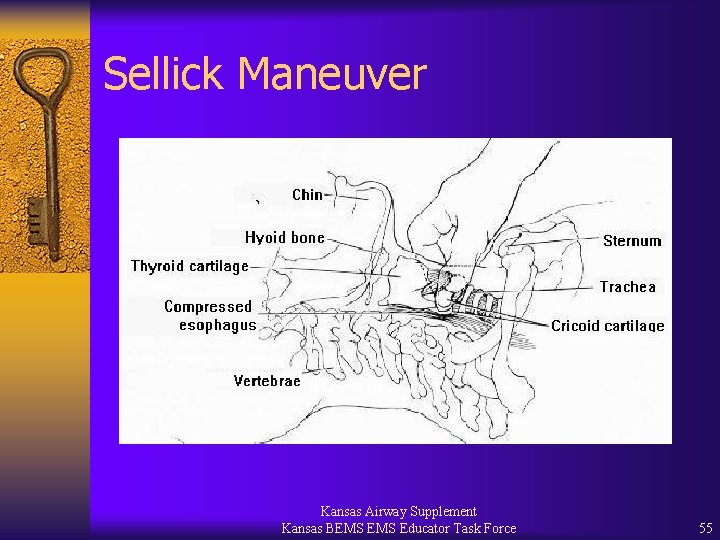
Sellick Maneuver Kansas Airway Supplement Kansas BEMS Educator Task Force 55
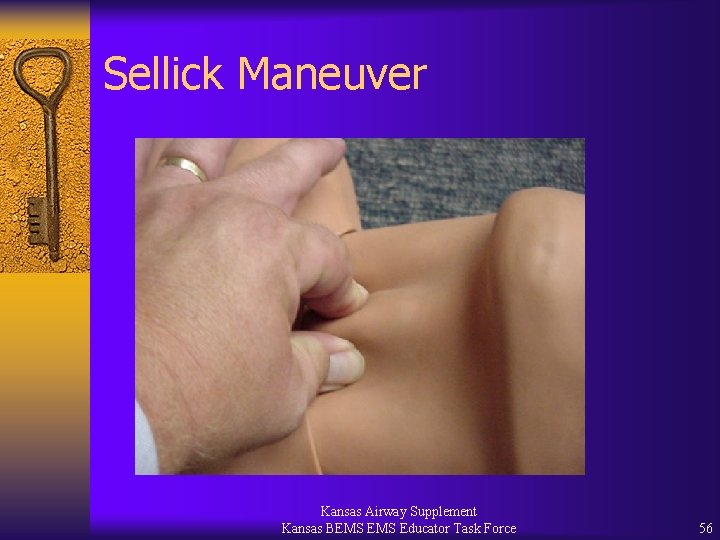
Sellick Maneuver Kansas Airway Supplement Kansas BEMS Educator Task Force 56
Mask ventilation will be made difficult by: ¨ poor mask seal -- beards ¨ facial burns ¨ facial scarring/cuts ¨ facial dressings ¨ edentulous patients ¨ any evidence of airway obstruction ¨ neck instability ¨ penetrating neck trauma ¨ repeated failed direct laryngoscopy ¨ obesity/bull neck Kansas Airway Supplement Kansas BEMS Educator Task Force 57
Other ventilation techniques will be made difficult by: • lack of knowledge and experience • lower airway obstruction • neck instability • penetrating neck injury Kansas Airway Supplement Kansas BEMS Educator Task Force 58
Flow-Restricted, Oxygen-Powered Ventilation Device ¨ Known as a demand-valve device ¨ Can be operated by patient or EMT ¨ Unable to feel lung compliance ¨ With proper seal will deliver 100% oxygen ¨ Designed for use on adult patients ¨ Gastric distension ¨ Rupture of the lungs ¨ A trigger positioned to allow EMT to keep both hands on the mask Kansas Airway Supplement Kansas BEMS Educator Task Force 59
Automatic Transport Ventilators ¨ Deliver 100% oxygen ¨ Provide and maintain a constant rate and tidal volume during ventilation ¨ Advantages – Frees both hands – Rate, & tidal volume can be set – Alarm for low oxygen tank ¨ Disadvantages – Oxygen powered – not used in children under 5 – Cannot feel increase in airway resistance Kansas Airway Supplement Kansas BEMS Educator Task Force 60
Oxygen Therapy ¨ Oxygen is a drug that can be given by the EMT-B ¨ “Generally speaking”, a patient who is breathing less than 12 and more than 24 times a minute needs oxygen Kansas Airway Supplement Kansas BEMS Educator Task Force 61
Oxygen Dangers ¨ Oxygen supports combustion, (it is not flammable) ¨ Avoid contact with petroleum products ¨ Smoking ¨ Handle carefully since contents are under pressure Kansas Airway Supplement Kansas BEMS Educator Task Force 62
Oxygen Cylinders ¨ All of the cylinders when full are the same pressure of 2, 000 psi. ¨ Usually green or aluminum grey ¨ D cylinder - 350 liters ¨ E cylinders - 625 liters ¨ M cylinders - 3, 000 liters ¨ G cylinders - 5, 300 liters ¨ H cylinders - 6, 900 liters Kansas Airway Supplement Kansas BEMS Educator Task Force 63
High-Pressure Regulator ¨ Provides 50 psi to an oxygen-powered, ventilation device. ¨ Flow rate cannot be controlled Kansas Airway Supplement Kansas BEMS Educator Task Force 64
Low Pressure/Therapy Regulator ¨ Permit oxygen delivery to the patient at a desired rate in liters per minute ¨ Flow rate can go from 1 to 25 liters/min. Kansas Airway Supplement Kansas BEMS Educator Task Force 65
Oxygen Humidifiers ¨ Dry oxygen is not harmful in the short term ¨ Generally not needed in prehospital care ¨ Transport time of an hour or more humidifier should be considered Kansas Airway Supplement Kansas BEMS Educator Task Force 66
Changing Oxygen Bottle ¨ Check cylinder for oxygen remove protective seal ¨ Quickly open and shut tank to remove debris ¨ Place regulator over yoke and align pins. ¨ Make sure new O ring is in place ¨ Hand tighten the T screw ¨ Open to check for leaks Kansas Airway Supplement Kansas BEMS Educator Task Force 67
Nonrebreather Mask ¨ Preferred method of giving oxygen to prehospital patients ¨ Up to 90% oxygen can be delivered ¨ Bag should be filled before placing on patient ¨ Flow rate should be adjusted to 15 liters/min. ¨ Patients who are cyanotic, cool, clammy or short of breath need oxygen ¨ Concerns of too much oxygen ¨ Different size masks Kansas Airway Supplement Kansas BEMS Educator Task Force 68
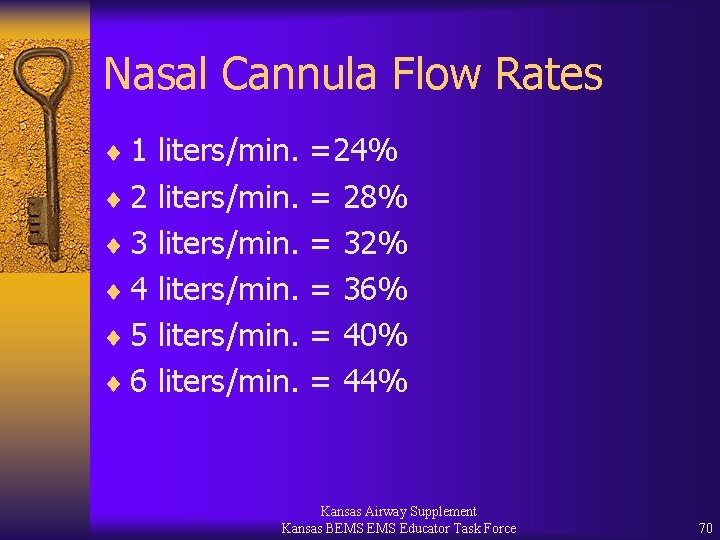
Nasal Cannula ¨ Provides limited oxygen concentration ¨ Used when patients cannot tolerate mask ¨ Prongs and other uses ¨ Concentration of 24 to 44% ¨ Flow rate set between 1 to 6 liters ¨ For every liter per minute of flow delivered, the oxygen concentration the patient inhales increases by 4% Kansas Airway Supplement Kansas BEMS Educator Task Force 69
Nasal Cannula Flow Rates ¨ 1 liters/min. =24% ¨ 2 liters/min. = 28% ¨ 3 liters/min. = 32% ¨ 4 liters/min. = 36% ¨ 5 liters/min. = 40% ¨ 6 liters/min. = 44% Kansas Airway Supplement Kansas BEMS Educator Task Force 70
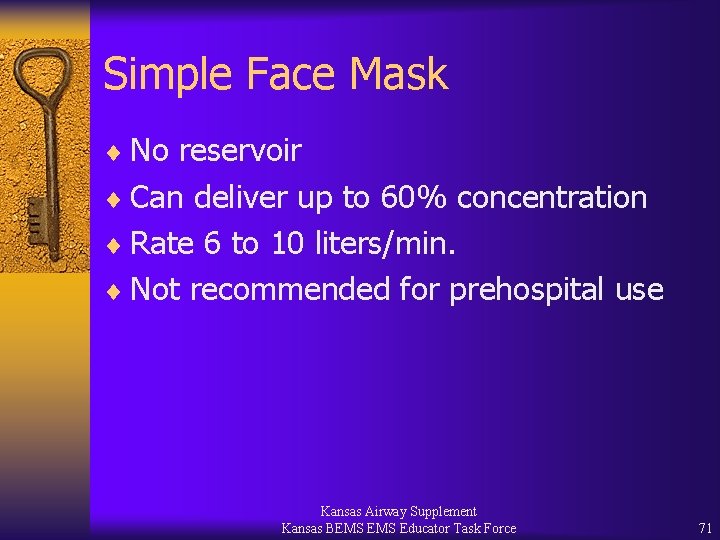
Simple Face Mask ¨ No reservoir ¨ Can deliver up to 60% concentration ¨ Rate 6 to 10 liters/min. ¨ Not recommended for prehospital use Kansas Airway Supplement Kansas BEMS Educator Task Force 71
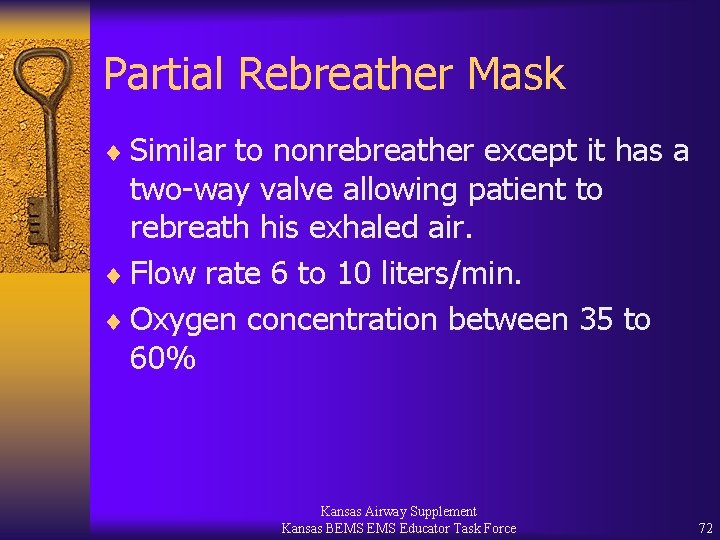
Partial Rebreather Mask ¨ Similar to nonrebreather except it has a two-way valve allowing patient to rebreath his exhaled air. ¨ Flow rate 6 to 10 liters/min. ¨ Oxygen concentration between 35 to 60% Kansas Airway Supplement Kansas BEMS Educator Task Force 72
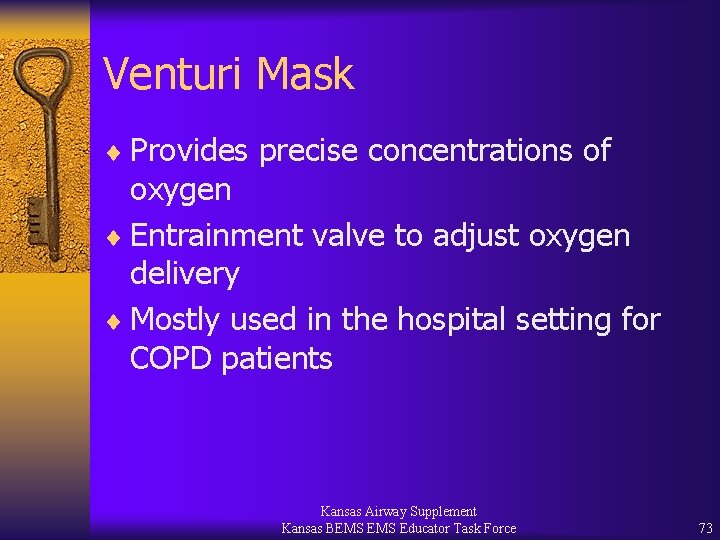
Venturi Mask ¨ Provides precise concentrations of oxygen ¨ Entrainment valve to adjust oxygen delivery ¨ Mostly used in the hospital setting for COPD patients Kansas Airway Supplement Kansas BEMS Educator Task Force 73
Special Situations Kansas Airway Supplement 74
Inhaler Therapy ¨ History ¨ Medical Direction ¨ Review of specific bronchodilator medication Kansas Airway Supplement Kansas BEMS Educator Task Force 75
Laryngectomies (Stomas) ¨ A breathing tube may be present ¨ If obstructed, suction it ¨ Some patients may have partial laryngectomies ¨ Be sure to close the mouth and nose to prevent air escaping Kansas Airway Supplement Kansas BEMS Educator Task Force 76
Infants and Child Patients ¨ Neutral position infant ¨ Just a little past neutral for child ¨ Avoid hyperextension of head ¨ Avoid excessive BVM pressure ¨ Gastric distension more common in children ¨ Oral or nasal airway may be considered when other procedures fail to clear the airway Kansas Airway Supplement Kansas BEMS Educator Task Force 77
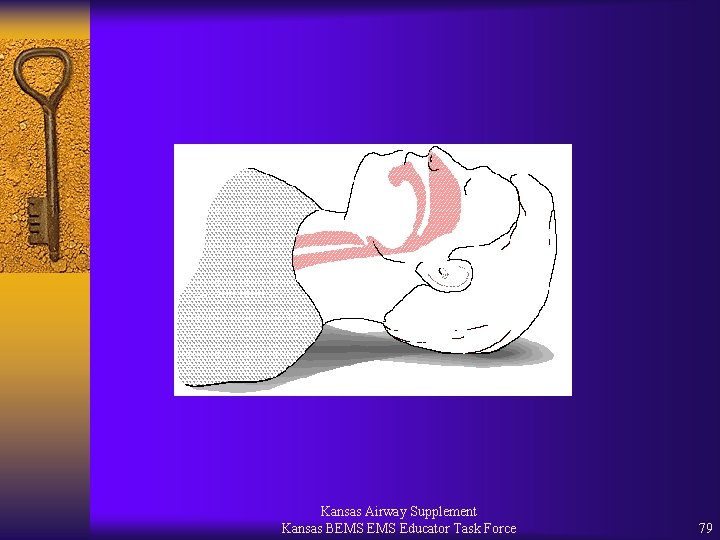
Obstruction Anything (food, blood, swollen tissue, vomit) that blocks the airway will cause some level of decrease of available oxygen to the body. Kansas Airway Supplement Kansas BEMS Educator Task Force 78
Kansas Airway Supplement Kansas BEMS Educator Task Force 79
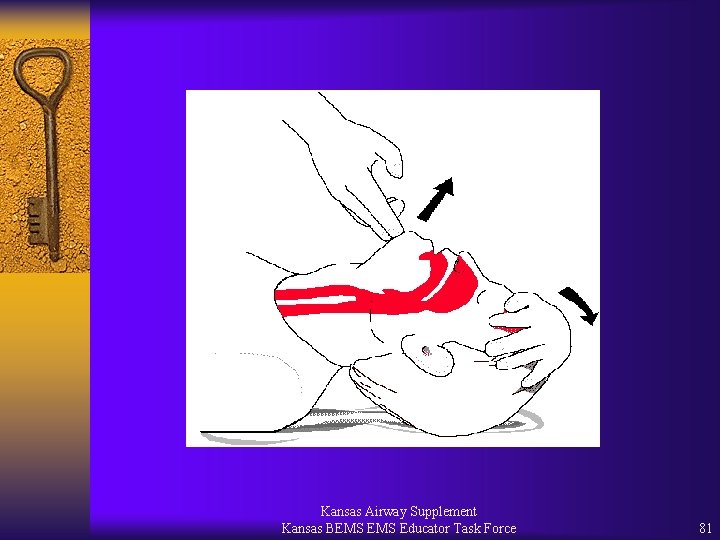
Obstruction The size of obstruction affects the available air exchange. For example, snoring will reduce air Exchange while a food bolus can actually stop air exchange. Kansas Airway Supplement Kansas BEMS Educator Task Force 80
Kansas Airway Supplement Kansas BEMS Educator Task Force 81
Obstruction ¨ When obstruction persists, repeat FBAO procedures three times and transport as soon as possible. Kansas Airway Supplement Kansas BEMS Educator Task Force 82
Facial Injuries ¨ Rich blood supply to the face ¨ Blunt injuries and burns to the face result in severe swelling ¨ Bleeding into the airway can be a challenge to manage Kansas Airway Supplement Kansas BEMS Educator Task Force 83
Jaw Thrust Kansas Airway Supplement Kansas BEMS Educator Task Force 84
Dental Appliances ¨ Dentures ordinarily should be left in place ¨ Partial dentures (plates) may become dislodged during an emergency ¨ Leave in place, but be prepared to remove it if it becomes dislodged Kansas Airway Supplement Kansas BEMS Educator Task Force 85