Research Outputs Management in a Nutshell Anna Maria
- Slides: 30
Research Outputs Management in a Nutshell Anna Maria Tammaro, University of Parma Joy Davidson, University of Glasgow Tomasz Miksa, Technical University of Vienna ROMOR Basic Training Workshop/ 06/09/2017 Project number: 573700 -EPP-1 -2016 -1 -PS-EPPKA 2 -CBHE-JP This project has been co-funded with support from the European Commission. The European Commission support for the production of this publication does not constitute endorsement of the contents which reflects the views only of the authors, and the Commission cannot be held responsible for any use which may be made of the information contained therein.
Research Output Management in PS Higher Education Learning objectives This introductory session will provide an overview of reference models that will help to refine the range of services and infrastructure required to effectively manage and preserve access to research outputs. Key terms will be explained and contextualised to provide a solid foundation for the remainder of the workshop. After this session participants will: • understand what digital curation is and how it relates to research outputs management • be familiar with the curation lifecycle model • be familiar with the OAIS reference model and how it can be applied to the design of open access information repositories and related services • be able to communicate more consistently by ensuring a shared understanding of key terms Project number: 573700 -EPP-1 -2016 -1 -PS-EPPKA 2 -CBHE-JP 2
Research Output Management in PS Higher Education Structure of session • Welcome, practical information, objectives for the workshop (Parma) • Overview of digital curation lifecycle model (Glasgow) • Overview of Open Archival Information System reference model (Parma) • Jargon busting session (Vienna) • Open to questions from participants (all) Project number: 573700 -EPP-1 -2016 -1 -PS-EPPKA 2 -CBHE-JP 3
Introduction to the Digital Curation Lifecycle Model Joy Davidson ROMOR Basic Training Workshop/ 06/09/2017 Project number: 573700 -EPP-1 -2016 -1 -PS-EPPKA 2 -CBHE-JP This project has been co-funded with support from the European Commission. The European Commission support for the production of this publication does not constitute endorsement of the contents which reflects the views only of the authors, and the Commission cannot be held responsible for any use which may be made of the information contained therein.
Research Output Management in PS Higher Education Digital curation is “maintaining and adding value to a trusted body of digital information for current and future use; specifically… the active management and appraisal of data over the lifecycle of scholarly and scientific materials” http: //www. dcc. ac. uk Project number: 573700 -EPP-1 -2016 -1 -PS-EPPKA 2 -CBHE-JP
Research Output Management in PS Higher Education Why do we need to care about digital curation and preservation? • Better access to higher quality outputs for all (public good) • Increased confidence in published findings (validation and reproducibility) • Improved visibility of the research and reputation of the researcher – higher research standing • Improves efficiency (not collecting same data multiple times) • Enables novel insights to be derived from existing outputs (data driven research and innovation) • Protects data again technical obsolescence Project number: 573700 -EPP-1 -2016 -1 -PS-EPPKA 2 -CBHE-JP
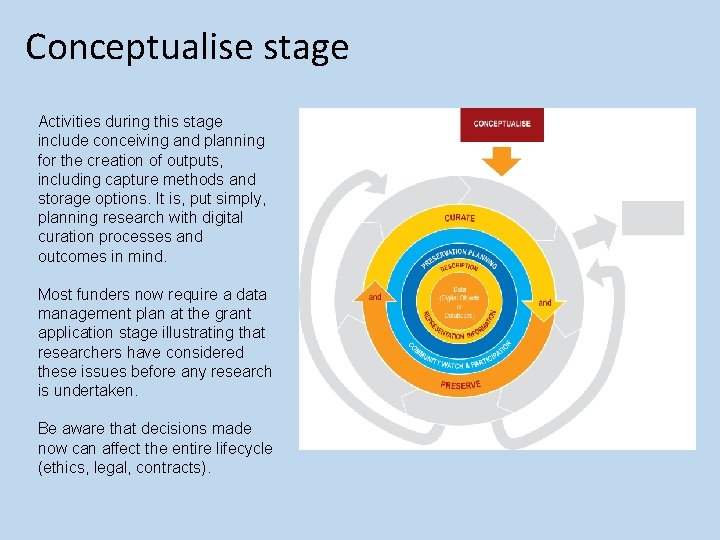
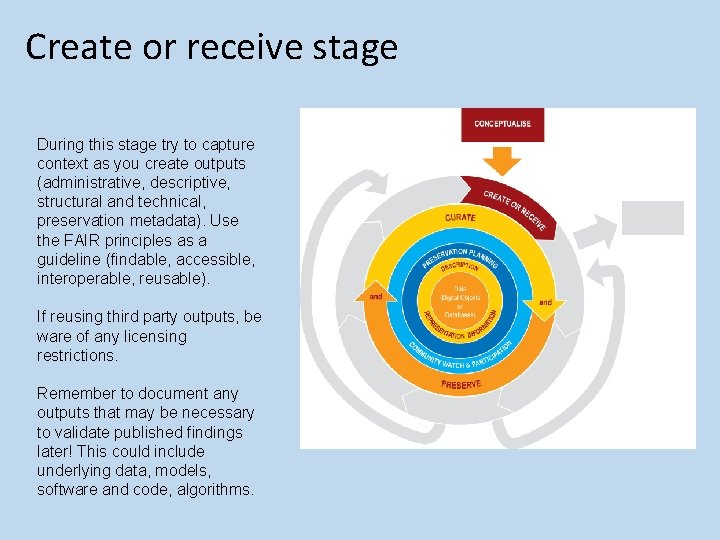
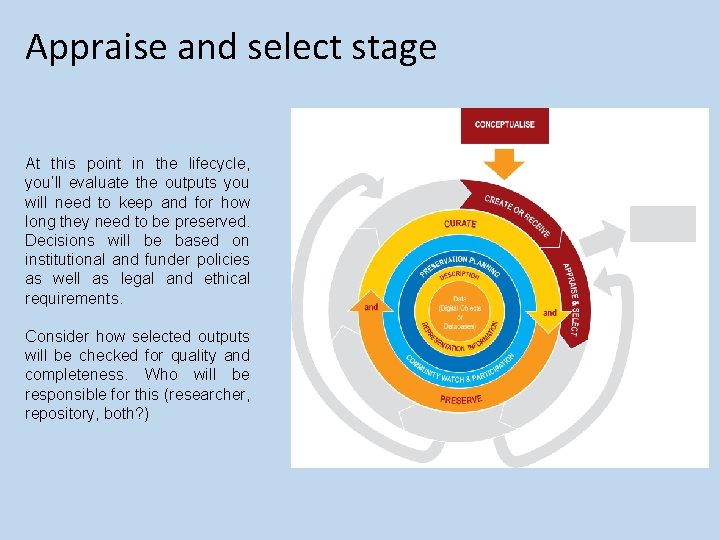
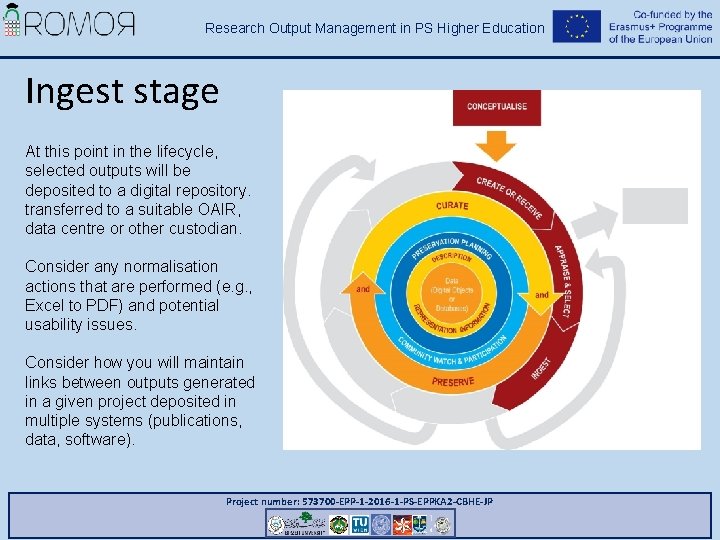
Research Output Management in PS Higher Education The DCC Curation Lifecycle Model provides a graphical high level overview of the stages required for successful curation and preservation of data from initial conceptualisation or receipt. The model enables: • mapping of granular functionality • definition of roles and responsibilities • building frameworks of standards and technologies to implement • identification of additional steps required • identification of actions which are not required • ensuring adequate documentation of processes and policies Project number: 573700 -EPP-1 -2016 -1 -PS-EPPKA 2 -CBHE-JP
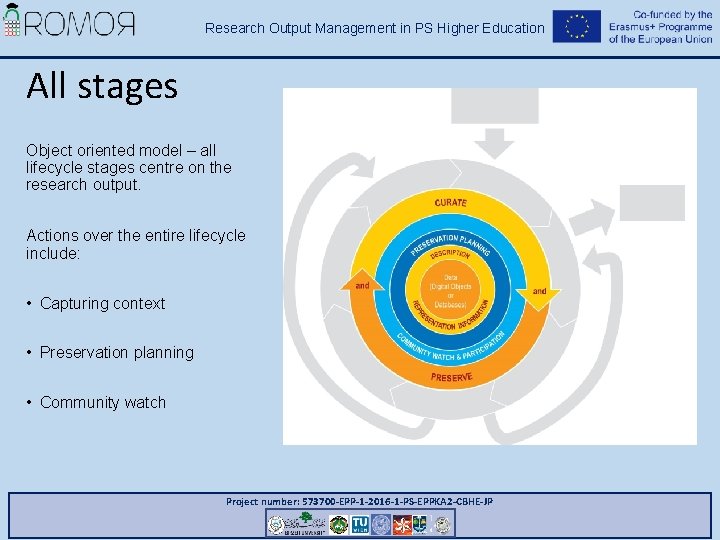
Research Output Management in PS Higher Education All stages Object oriented model – all lifecycle stages centre on the research output. Actions over the entire lifecycle include: • Capturing context • Preservation planning • Community watch Project number: 573700 -EPP-1 -2016 -1 -PS-EPPKA 2 -CBHE-JP
Conceptualise stage Activities during this stage include conceiving and planning for the creation of outputs, including capture methods and storage options. It is, put simply, planning research with digital curation processes and outcomes in mind. Most funders now require a data management plan at the grant application stage illustrating that researchers have considered these issues before any research is undertaken. Be aware that decisions made now can affect the entire lifecycle (ethics, legal, contracts).
Create or receive stage During this stage try to capture context as you create outputs (administrative, descriptive, structural and technical, preservation metadata). Use the FAIR principles as a guideline (findable, accessible, interoperable, reusable). If reusing third party outputs, be ware of any licensing restrictions. Remember to document any outputs that may be necessary to validate published findings later! This could include underlying data, models, software and code, algorithms.
Appraise and select stage At this point in the lifecycle, you’ll evaluate the outputs you will need to keep and for how long they need to be preserved. Decisions will be based on institutional and funder policies as well as legal and ethical requirements. Consider how selected outputs will be checked for quality and completeness. Who will be responsible for this (researcher, repository, both? )
Research Output Management in PS Higher Education Ingest stage At this point in the lifecycle, selected outputs will be deposited to a digital repository. transferred to a suitable OAIR, data centre or other custodian. Consider any normalisation actions that are performed (e. g. , Excel to PDF) and potential usability issues. Consider how you will maintain links between outputs generated in a given project deposited in multiple systems (publications, data, software). Project number: 573700 -EPP-1 -2016 -1 -PS-EPPKA 2 -CBHE-JP
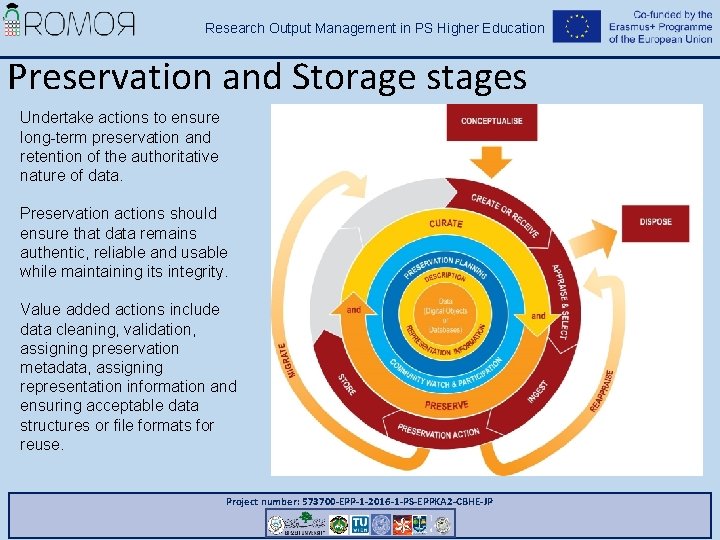
Research Output Management in PS Higher Education Preservation and Storage stages Undertake actions to ensure long-term preservation and retention of the authoritative nature of data. Preservation actions should ensure that data remains authentic, reliable and usable while maintaining its integrity. Value added actions include data cleaning, validation, assigning preservation metadata, assigning representation information and ensuring acceptable data structures or file formats for reuse. Project number: 573700 -EPP-1 -2016 -1 -PS-EPPKA 2 -CBHE-JP
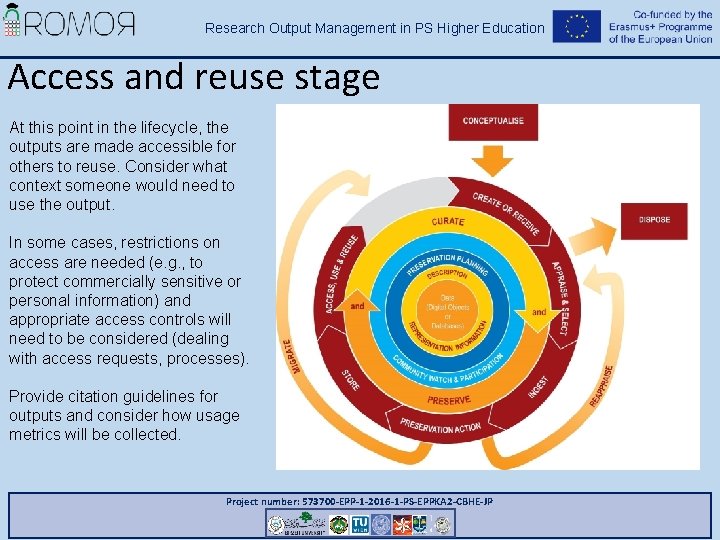
Research Output Management in PS Higher Education Access and reuse stage At this point in the lifecycle, the outputs are made accessible for others to reuse. Consider what context someone would need to use the output. In some cases, restrictions on access are needed (e. g. , to protect commercially sensitive or personal information) and appropriate access controls will need to be considered (dealing with access requests, processes). Provide citation guidelines for outputs and consider how usage metrics will be collected. Project number: 573700 -EPP-1 -2016 -1 -PS-EPPKA 2 -CBHE-JP
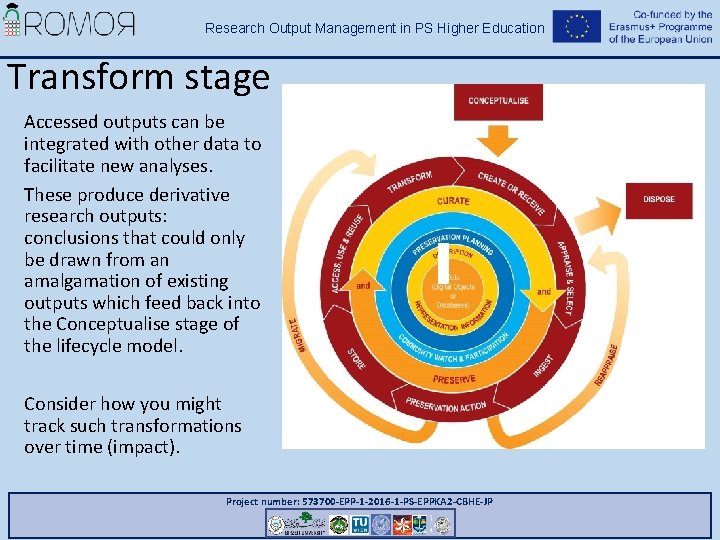
Research Output Management in PS Higher Education Transform stage Accessed outputs can be integrated with other data to facilitate new analyses. These produce derivative research outputs: conclusions that could only be drawn from an amalgamation of existing outputs which feed back into the Conceptualise stage of the lifecycle model. Consider how you might track such transformations over time (impact). Project number: 573700 -EPP-1 -2016 -1 -PS-EPPKA 2 -CBHE-JP
Open Archival Information System ROMOR Workshop 5 September 2017 Project number: 573700 -EPP-1 -2016 -1 -PS-EPPKA 2 -CBHE-JP This project has been co-funded with support from the European Commission. The European Commission support for the production of this publication does not constitute endorsement of the contents which reflects the views only of the authors, and the Commission cannot be held responsible for any use which may be made of the information contained therein.
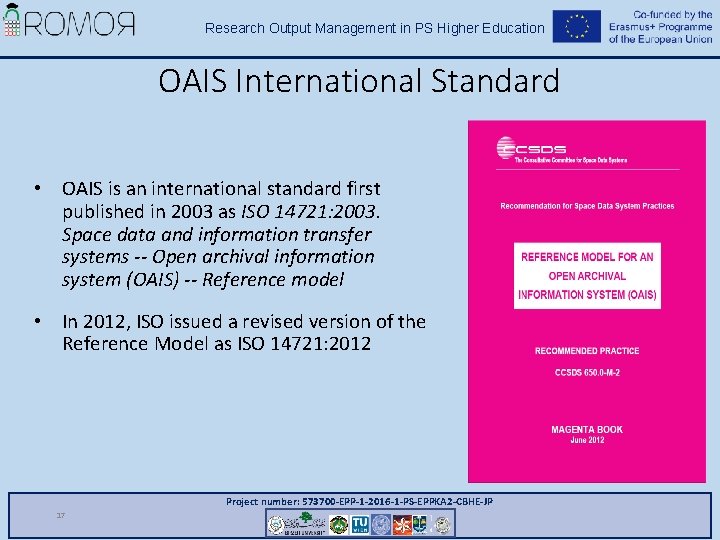
Research Output Management in PS Higher Education OAIS International Standard • OAIS is an international standard first published in 2003 as ISO 14721: 2003. Space data and information transfer systems -- Open archival information system (OAIS) -- Reference model • In 2012, ISO issued a revised version of the Reference Model as ISO 14721: 2012 Project number: 573700 -EPP-1 -2016 -1 -PS-EPPKA 2 -CBHE-JP 17
Research Output Management in PS Higher Education The OAIS is a ‘reference model’ What is a reference model? 1. A framework • for understanding relationships among entities of its domain • for development of consistent standards or specifications supporting the domain 2. A conceptual model which • is based on a small number of underlying concepts • describes key concepts and relationships, and how they interface to each other and the external environment • may be used as a basis for explaining domain specific concepts to non-specialists 3. OAIS is NOT an implementation model! Project number: 573700 -EPP-1 -2016 -1 -PS-EPPKA 2 -CBHE-JP 18
Research Output Management in PS Higher Education Purpose, Scope, and Applicability • Primary goal of an OAIS: to preserve information for a designated community over an indefinite period of time • The standard is a framework for understanding and applying concepts necessary for long-term preservation of digital objects (of any sort) • Note, here long-term means long enough to be concerned about technological change • Addresses the full range of archival functions • Actually applicable to all sorts of organisations and individuals dealing with information that needs long-term preservation (not just ‘archives’) Project number: 573700 -EPP-1 -2016 -1 -PS-EPPKA 2 -CBHE-JP 19
Research Output Management in PS Higher Education What is OAIS about? • Defining an OAIS: “An archive, consisting of an organization of people and systems that has accepted the responsibility to preserve information and make it available for a Designated Community” • ‘Designated Community’ is a singularly important concept within the OAIS model and is defined as the community of stakeholders and users that the OAIS serves • The Reference Model is a high-level description of the • Environment • Functional model • Information model • of an OAIS Project number: 573700 -EPP-1 -2016 -1 -PS-EPPKA 2 -CBHE-JP 20
Research Output Management in PS Higher Education OAIS is NOT an implementation model! Project number: 573700 -EPP-1 -2016 -1 -PS-EPPKA 2 -CBHE-JP
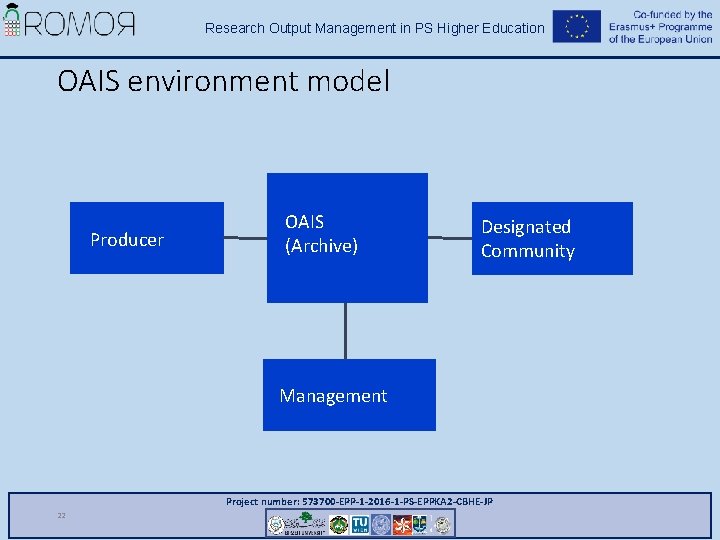
Research Output Management in PS Higher Education OAIS environment model Producer OAIS (Archive) Designated Community Management Project number: 573700 -EPP-1 -2016 -1 -PS-EPPKA 2 -CBHE-JP 22
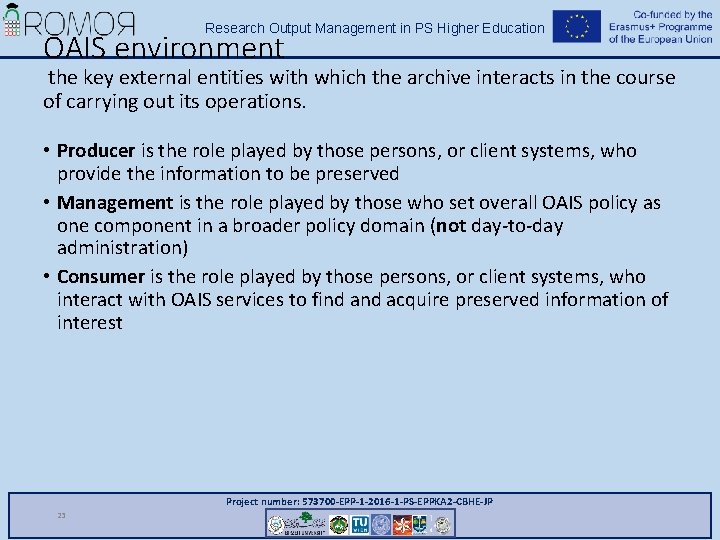
Research Output Management in PS Higher Education OAIS environment the key external entities with which the archive interacts in the course of carrying out its operations. • Producer is the role played by those persons, or client systems, who provide the information to be preserved • Management is the role played by those who set overall OAIS policy as one component in a broader policy domain (not day-to-day administration) • Consumer is the role played by those persons, or client systems, who interact with OAIS services to find acquire preserved information of interest Project number: 573700 -EPP-1 -2016 -1 -PS-EPPKA 2 -CBHE-JP 23
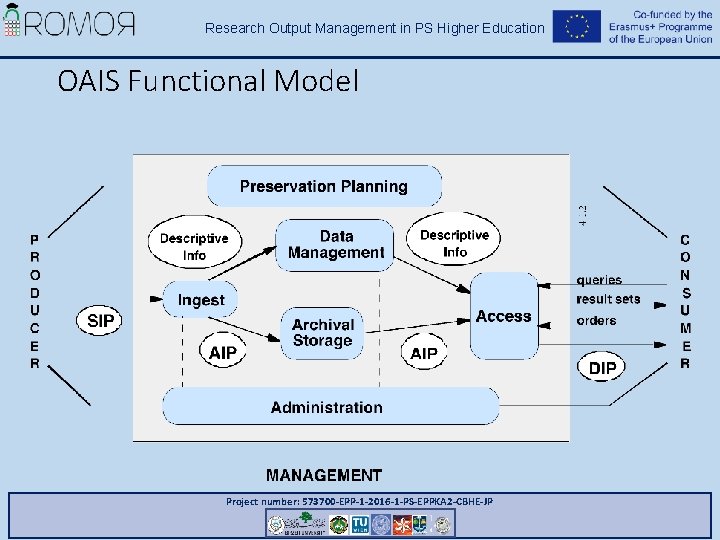
Research Output Management in PS Higher Education OAIS Functional Model Project number: 573700 -EPP-1 -2016 -1 -PS-EPPKA 2 -CBHE-JP
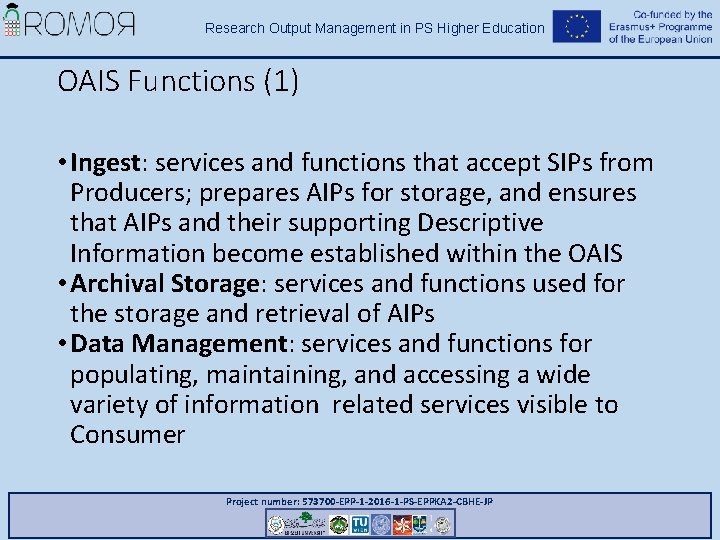
Research Output Management in PS Higher Education OAIS Functions (1) • Ingest: services and functions that accept SIPs from Producers; prepares AIPs for storage, and ensures that AIPs and their supporting Descriptive Information become established within the OAIS • Archival Storage: services and functions used for the storage and retrieval of AIPs • Data Management: services and functions for populating, maintaining, and accessing a wide variety of information related services visible to Consumer Project number: 573700 -EPP-1 -2016 -1 -PS-EPPKA 2 -CBHE-JP
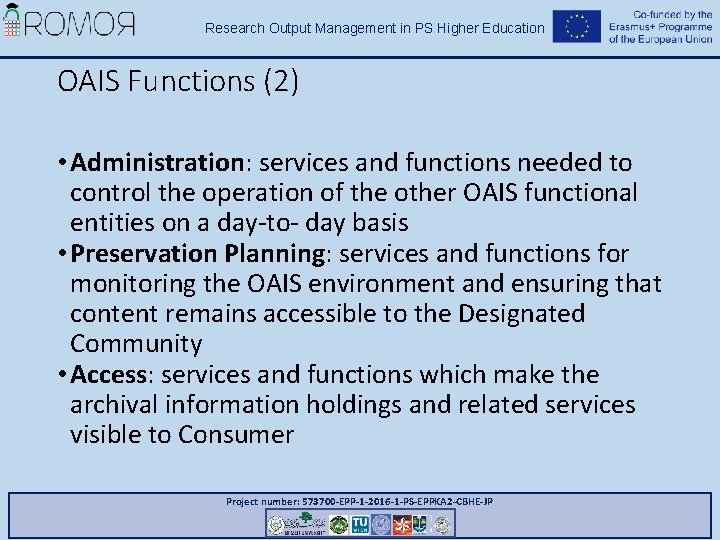
Research Output Management in PS Higher Education OAIS Functions (2) • Administration: services and functions needed to control the operation of the other OAIS functional entities on a day-to- day basis • Preservation Planning: services and functions for monitoring the OAIS environment and ensuring that content remains accessible to the Designated Community • Access: services and functions which make the archival information holdings and related services visible to Consumer Project number: 573700 -EPP-1 -2016 -1 -PS-EPPKA 2 -CBHE-JP
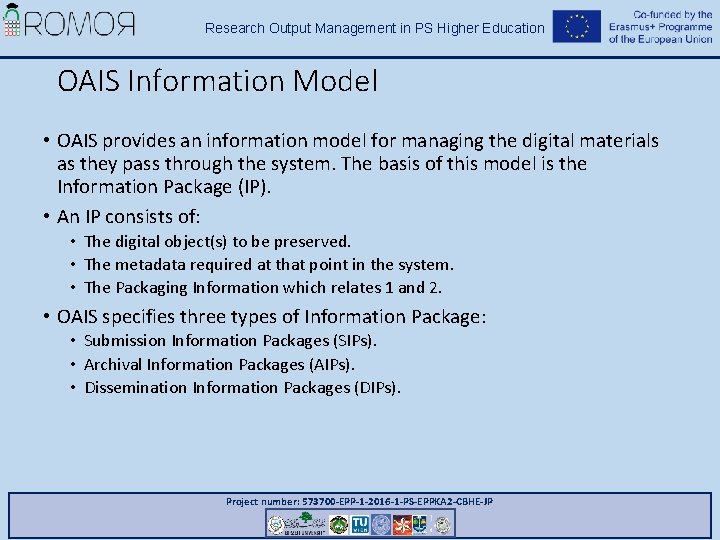
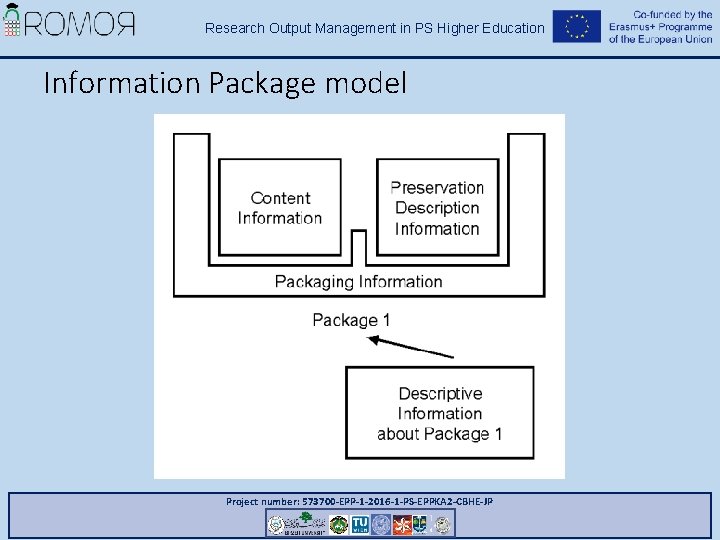
Research Output Management in PS Higher Education OAIS Information Model • OAIS provides an information model for managing the digital materials as they pass through the system. The basis of this model is the Information Package (IP). • An IP consists of: • The digital object(s) to be preserved. • The metadata required at that point in the system. • The Packaging Information which relates 1 and 2. • OAIS specifies three types of Information Package: • Submission Information Packages (SIPs). • Archival Information Packages (AIPs). • Dissemination Information Packages (DIPs). Project number: 573700 -EPP-1 -2016 -1 -PS-EPPKA 2 -CBHE-JP
Research Output Management in PS Higher Education Information Package model Project number: 573700 -EPP-1 -2016 -1 -PS-EPPKA 2 -CBHE-JP
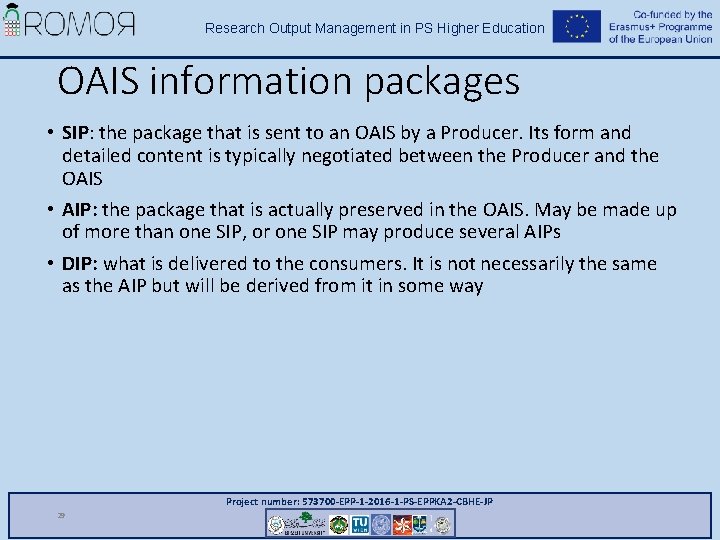
Research Output Management in PS Higher Education OAIS information packages • SIP: the package that is sent to an OAIS by a Producer. Its form and detailed content is typically negotiated between the Producer and the OAIS • AIP: the package that is actually preserved in the OAIS. May be made up of more than one SIP, or one SIP may produce several AIPs • DIP: what is delivered to the consumers. It is not necessarily the same as the AIP but will be derived from it in some way Project number: 573700 -EPP-1 -2016 -1 -PS-EPPKA 2 -CBHE-JP 29
Research Output Management in PS Higher Education QUESTIONS Project number: 573700 -EPP-1 -2016 -1 -PS-EPPKA 2 -CBHE-JP