Reproduction system Reproduction systems in plants Seed propagated



- Slides: 72
Reproduction system
Reproduction systems in plants • Seed propagated species – self-pollinated – cross pollinated – self- and cross pollinated • Vegetatively propagated species
Sexual reproduction ü In animals: It’s easy because you have separate male and female individuals. ü In flowering plants: Not so easy, because most flowers have both male and female parts in them, called perfect flowers. ü So flowering plants have evolved special ways to insure out-breeding/out-crossing – and to prevent inbreeding.
Plant Reproduction
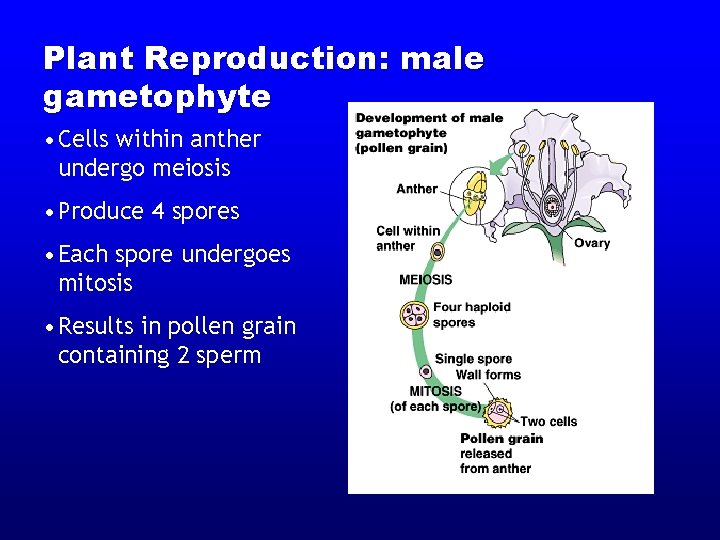
Plant Reproduction: male gametophyte • Cells within anther undergo meiosis • Produce 4 spores • Each spore undergoes mitosis • Results in pollen grain containing 2 sperm
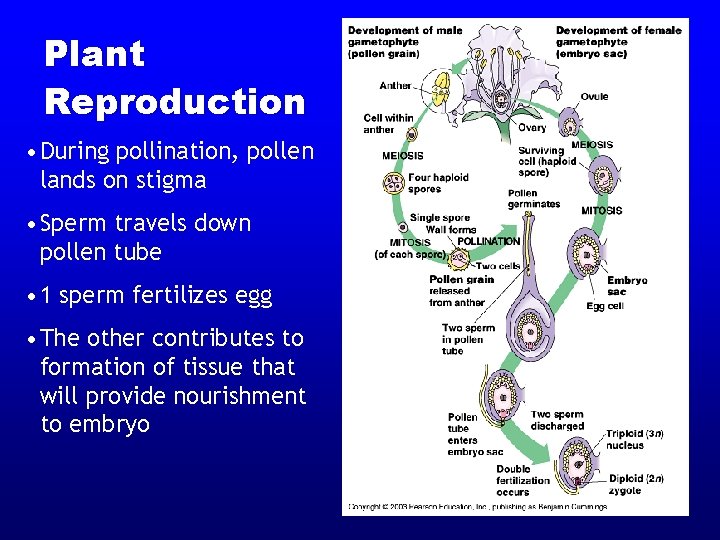
Plant Reproduction: female gametophyte • Within ovule, a cell undergoes meiosis • Produces 4 spores • 1 spore undergoes mitosis • Produces embryo sac • Egg is contained within embryo sac
Plant Reproduction • During pollination, pollen lands on stigma • Sperm travels down pollen tube • 1 sperm fertilizes egg • The other contributes to formation of tissue that will provide nourishment to embryo
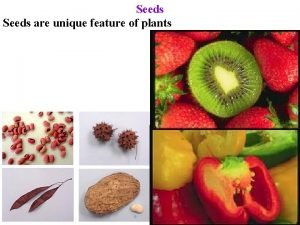
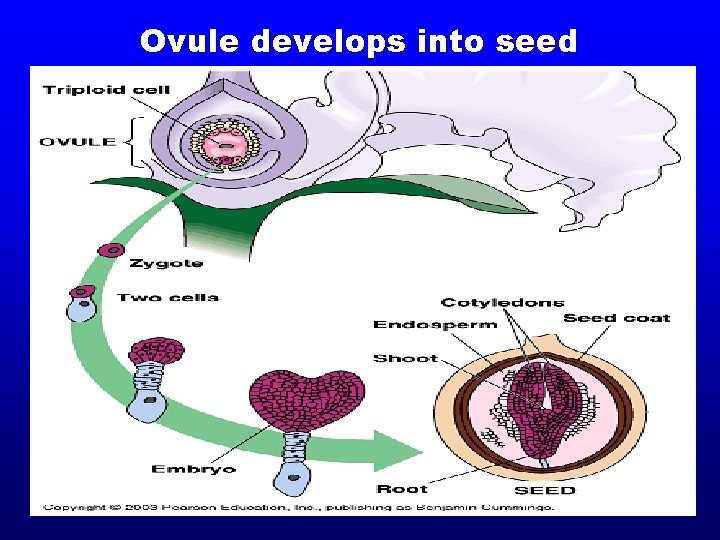
Ovule develops into seed
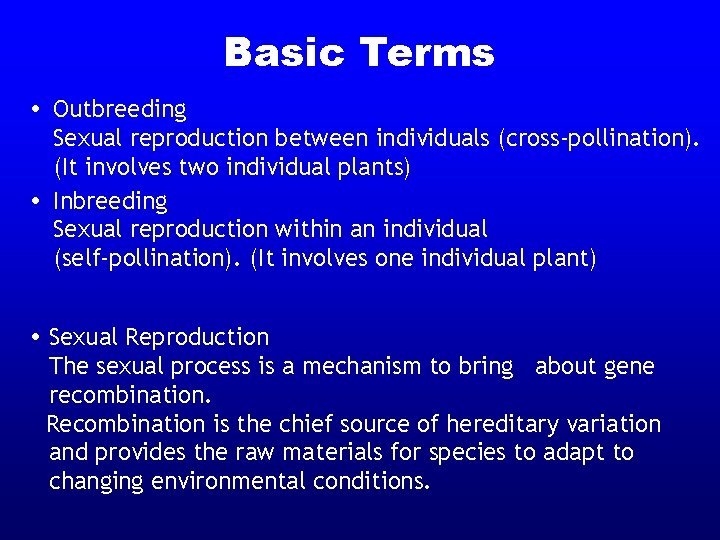
Basic Terms • Outbreeding Sexual reproduction between individuals (cross-pollination). (It involves two individual plants) • Inbreeding Sexual reproduction within an individual (self-pollination). (It involves one individual plant) • Sexual Reproduction The sexual process is a mechanism to bring about gene recombination. Recombination is the chief source of hereditary variation and provides the raw materials for species to adapt to changing environmental conditions.
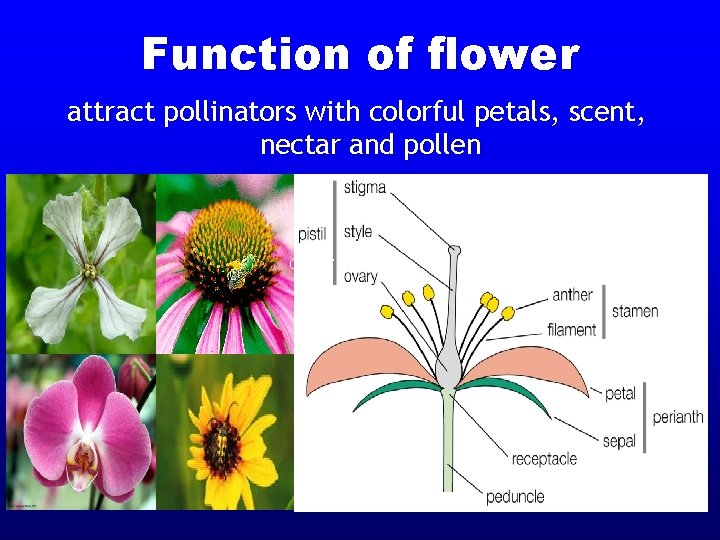
Function of flower attract pollinators with colorful petals, scent, nectar and pollen Carpel/
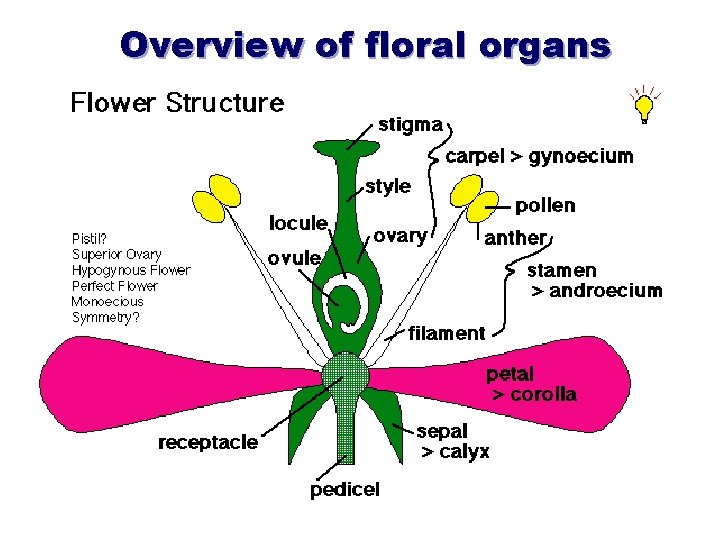
Overview of floral organs
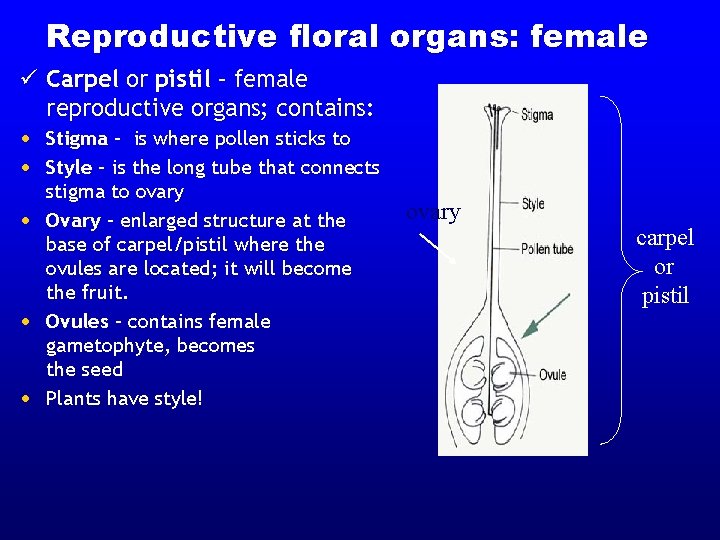
Reproductive floral organs: female ü Carpel or pistil – female reproductive organs; contains: • Stigma – is where pollen sticks to • Style – is the long tube that connects • • • stigma to ovary Ovary – enlarged structure at the base of carpel/pistil where the ovules are located; it will become the fruit. Ovules – contains female gametophyte, becomes the seed Plants have style! ovary carpel or pistil
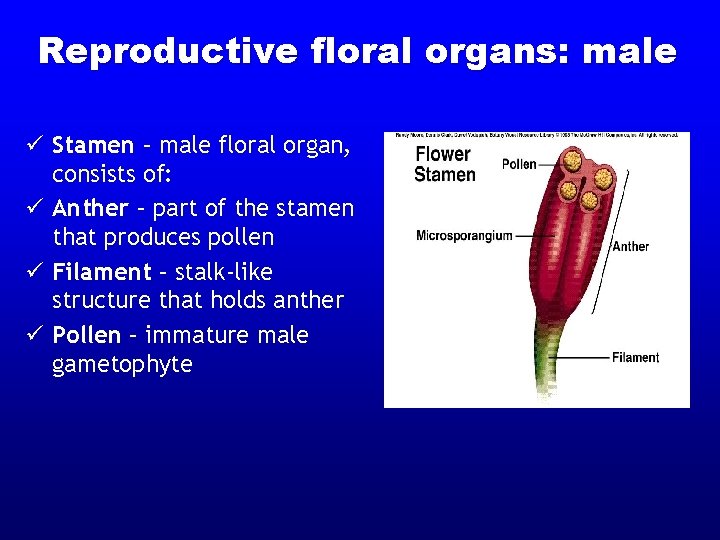
Reproductive floral organs: male ü Stamen – male floral organ, consists of: ü Anther – part of the stamen that produces pollen ü Filament – stalk-like structure that holds anther ü Pollen – immature male gametophyte
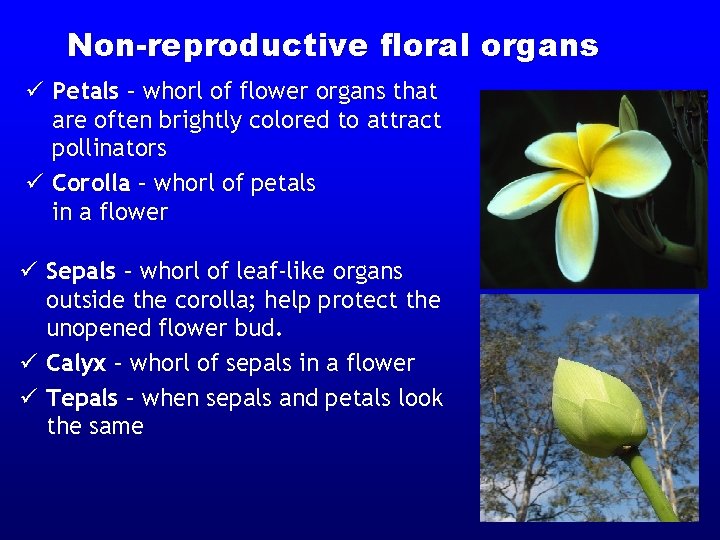
Non-reproductive floral organs ü Petals – whorl of flower organs that are often brightly colored to attract pollinators ü Corolla – whorl of petals in a flower ü Sepals – whorl of leaf-like organs outside the corolla; help protect the unopened flower bud. ü Calyx – whorl of sepals in a flower ü Tepals – when sepals and petals look the same
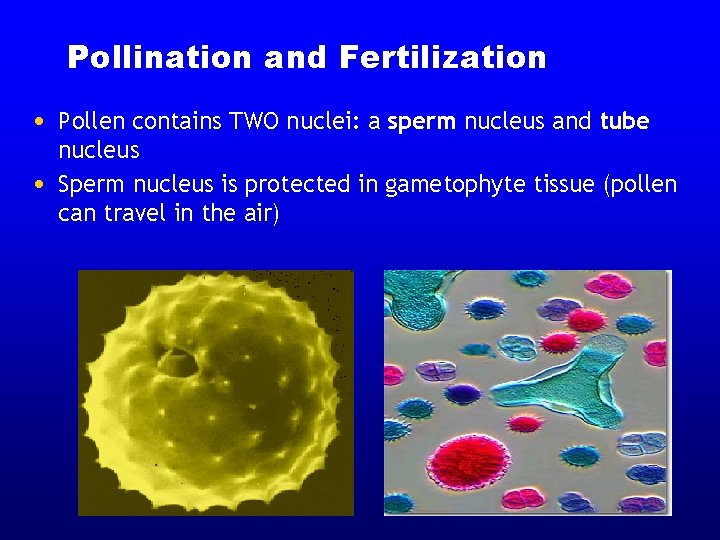
Pollination and Fertilization • Pollen contains TWO nuclei: a sperm nucleus and tube • nucleus Sperm nucleus is protected in gametophyte tissue (pollen can travel in the air)
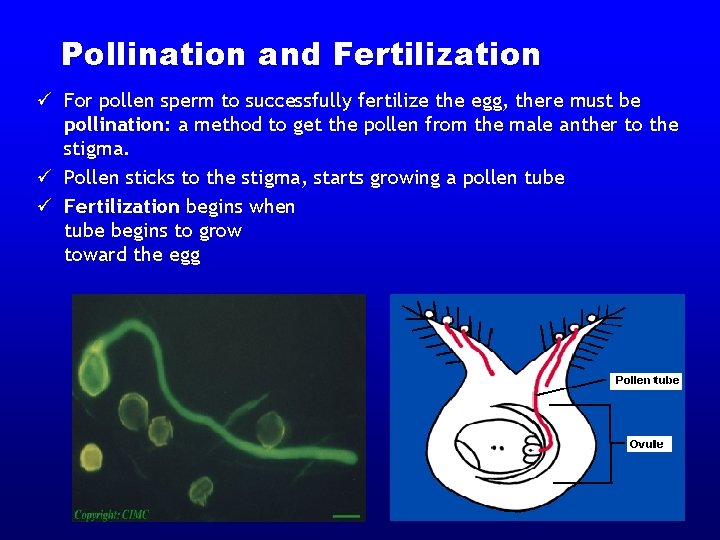
Pollination and Fertilization ü For pollen sperm to successfully fertilize the egg, there must be pollination: a method to get the pollen from the male anther to the stigma. ü Pollen sticks to the stigma, starts growing a pollen tube ü Fertilization begins when tube begins to grow toward the egg
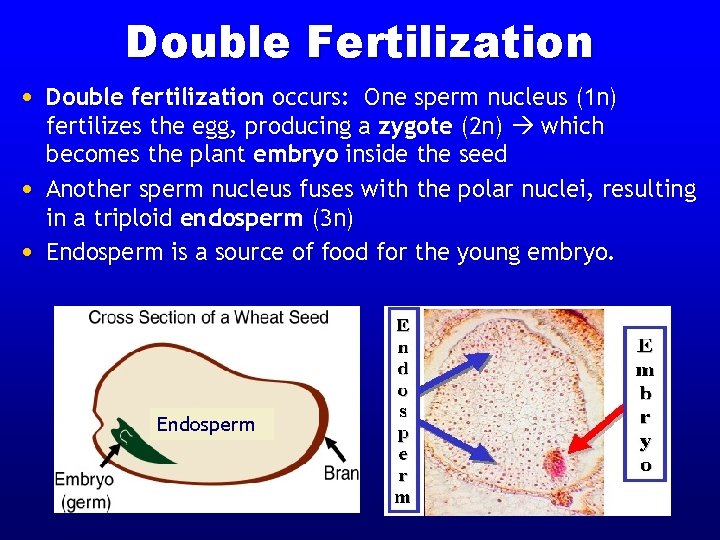
Double Fertilization • Double fertilization occurs: One sperm nucleus (1 n) • • fertilizes the egg, producing a zygote (2 n) which becomes the plant embryo inside the seed Another sperm nucleus fuses with the polar nuclei, resulting in a triploid endosperm (3 n) Endosperm is a source of food for the young embryo. Endosperm
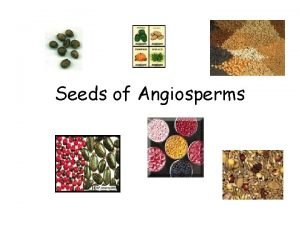
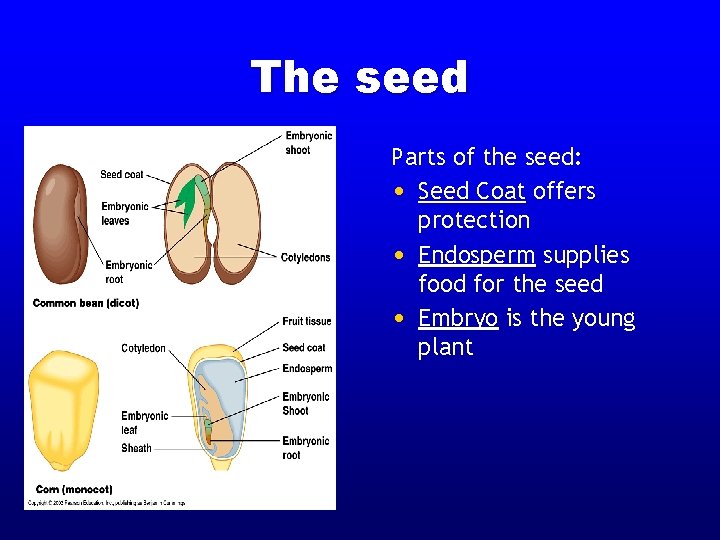
The seed Parts of the seed: • Seed Coat offers protection • Endosperm supplies food for the seed • Embryo is the young plant
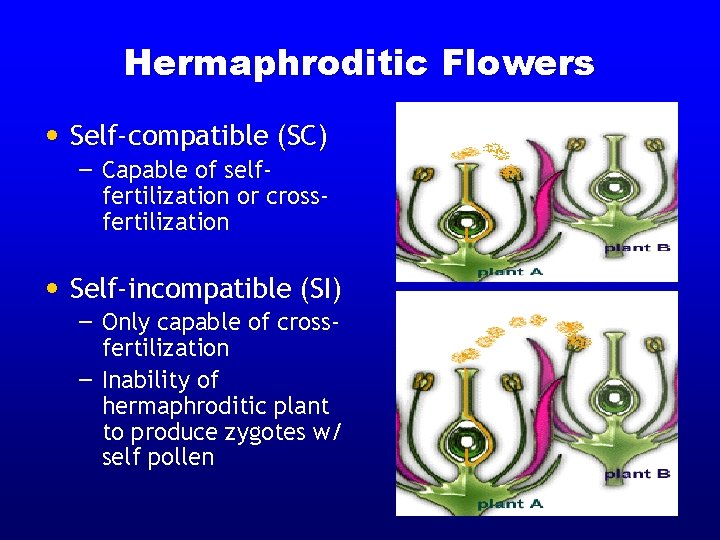
Hermaphroditic Flowers • Self-compatible (SC) – Capable of selffertilization or crossfertilization • Self-incompatible (SI) – Only capable of crossfertilization – Inability of hermaphroditic plant to produce zygotes w/ self pollen
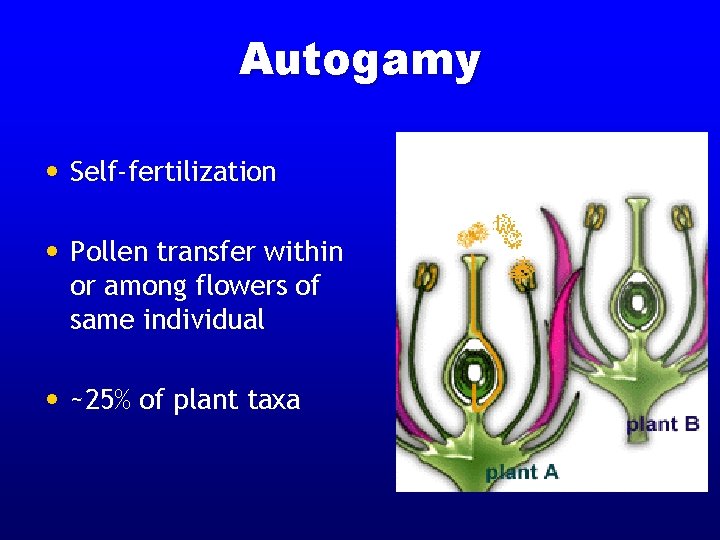
Autogamy • Self-fertilization • Pollen transfer within or among flowers of same individual • ~25% of plant taxa
Advantages of Autogamy • Insures seed set in absence of pollinators. • Overcomes sterility. • Selectively advantageous by transmitting both sets of genes to offspring. – Well-adapted genotypes preserved. • Only single colonizing individual needed.
Disadvantages of Autogamy • Decreases genetic variability. • Inability to adapt to changing conditions. • Increases inbreeding depression. – Reduces heterozygosity and increases homozygosity of deleterious alleles. – More uniform populations.
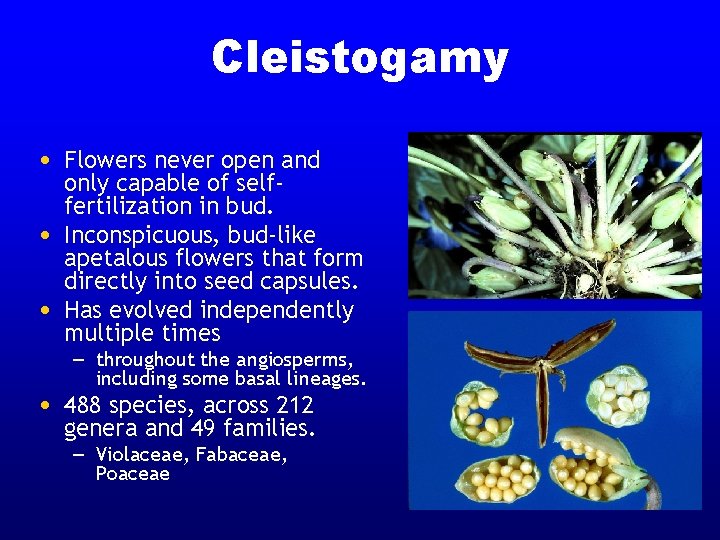
Cleistogamy • Flowers never open and • • only capable of selffertilization in bud. Inconspicuous, bud-like apetalous flowers that form directly into seed capsules. Has evolved independently multiple times – throughout the angiosperms, including some basal lineages. • 488 species, across 212 genera and 49 families. – Violaceae, Fabaceae, Poaceae
Outbreeding (Cross-pollination) • Advantages: Increases genetic variability Strong evolutionary potential Adaptation to changing conditions Successful long-term • Disadvantages: Can destroy well-adapted genotypes Relies on effective cross-pollination, seed dispersal and establishment
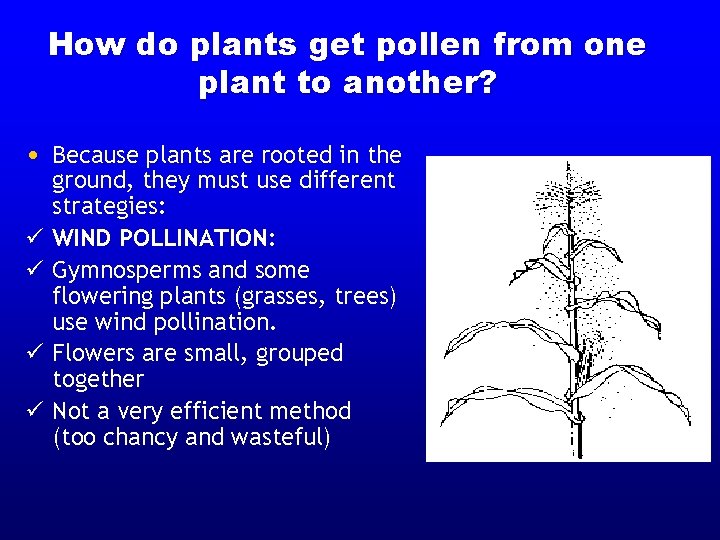
How do plants get pollen from one plant to another? • Because plants are rooted in the ground, they must use different strategies: ü WIND POLLINATION: ü Gymnosperms and some flowering plants (grasses, trees) use wind pollination. ü Flowers are small, grouped together ü Not a very efficient method (too chancy and wasteful)
ANIMALS Many flowering plants rely on animals for crosspollination: ü Insects – bees, wasps, flies, butterflies, moths ü Birds – hummingbirds, honey creepers ü Mammals – bats, mice, monkeys ü Even some reptiles and amphibians!
Coevolution • Coevolution interactions between two different species as selective forces on each other, resulting in adaptations that increase their interdependency. • Animal-flowering plant interaction is a classic example of coevolution: 1. Plants evolve elaborate methods to attract animal pollinators 2. Animals evolved specialized body parts and behaviors that aid plant pollination
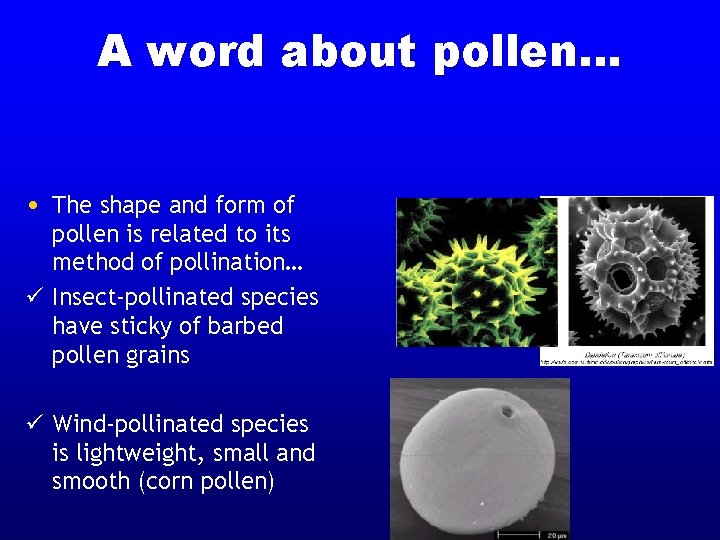
A word about pollen… • The shape and form of pollen is related to its method of pollination… ü Insect-pollinated species have sticky of barbed pollen grains ü Wind-pollinated species is lightweight, small and smooth (corn pollen)
Palynology: the study of pollen • Palynology is useful in many fields: ü Petroleum geology – fossil pollen can determine if a field will have oil-rich deposits ü Archeology – studying ancient pollen samples, archeologists can determine agricultural practices, diet, etc. ü Anthropology – uses of pollen in rituals ü Criminology – to determine the whereabouts of an individual, examine pollen clinging to clothes ü Aerobiology – to determine what plants cause hay fever and allergic reactions – in landscaping
Animal pollinators: Bees • Bees – the most important group of flower pollinators ü They live on the nectar and feed larvae, also eat the pollen. ü Bees are guided by sight and smell ü See yellow and blue colors, also ultraviolet light (not red) ü Flowers have “honey guides” and bee landing platforms. .
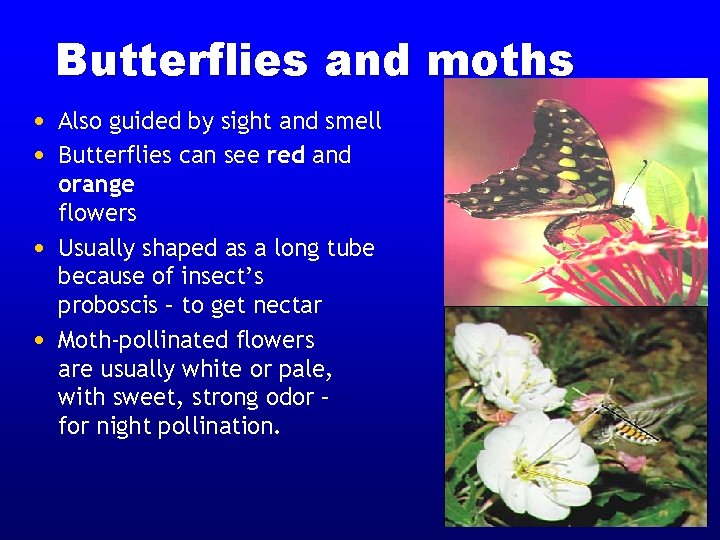
Butterflies and moths • Also guided by sight and smell • Butterflies can see red and • • orange flowers Usually shaped as a long tube because of insect’s proboscis – to get nectar Moth-pollinated flowers are usually white or pale, with sweet, strong odor – for night pollination.
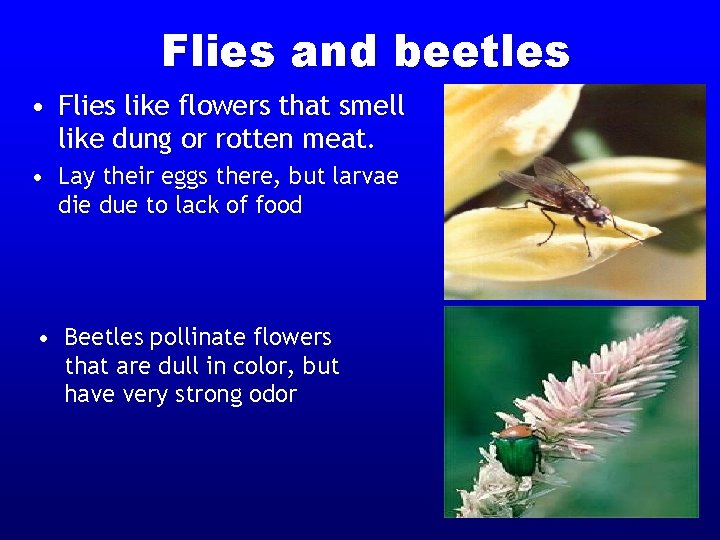
Flies and beetles • Flies like flowers that smell like dung or rotten meat. • Lay their eggs there, but larvae die due to lack of food • Beetles pollinate flowers that are dull in color, but have very strong odor
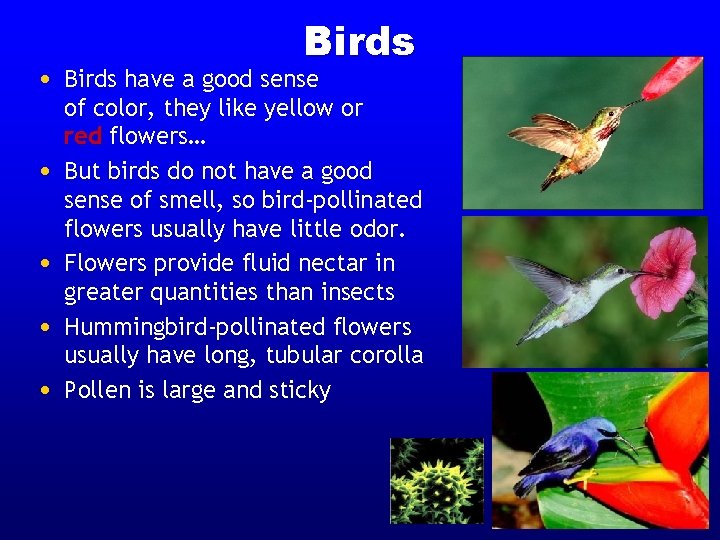
Birds • Birds have a good sense • • of color, they like yellow or red flowers… But birds do not have a good sense of smell, so bird-pollinated flowers usually have little odor. Flowers provide fluid nectar in greater quantities than insects Hummingbird-pollinated flowers usually have long, tubular corolla Pollen is large and sticky
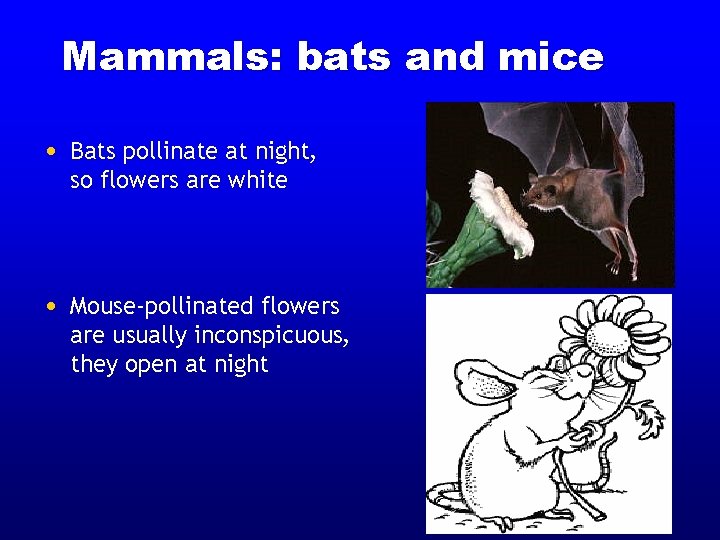
Mammals: bats and mice • Bats pollinate at night, so flowers are white • Mouse-pollinated flowers are usually inconspicuous, they open at night
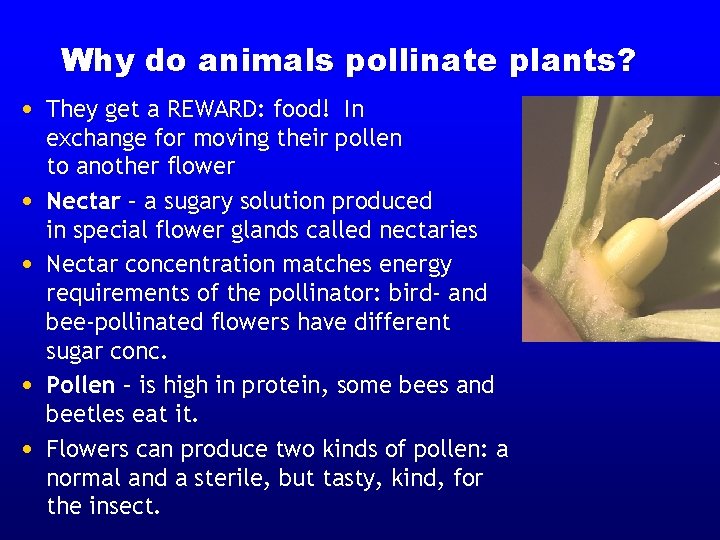
Why do animals pollinate plants? • They get a REWARD: food! In • • exchange for moving their pollen to another flower Nectar – a sugary solution produced in special flower glands called nectaries Nectar concentration matches energy requirements of the pollinator: bird- and bee-pollinated flowers have different sugar conc. Pollen – is high in protein, some bees and beetles eat it. Flowers can produce two kinds of pollen: a normal and a sterile, but tasty, kind, for the insect.
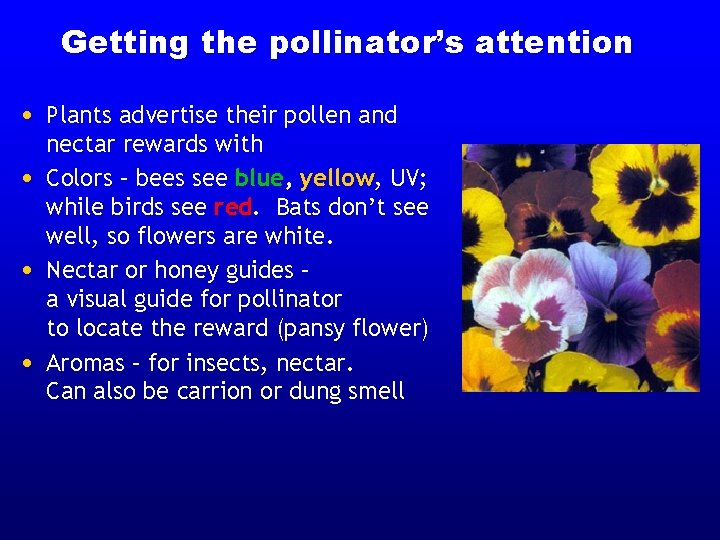
Getting the pollinator’s attention • Plants advertise their pollen and • • • nectar rewards with Colors – bees see blue, yellow, UV; while birds see red. Bats don’t see well, so flowers are white. Nectar or honey guides – a visual guide for pollinator to locate the reward (pansy flower) Aromas – for insects, nectar. Can also be carrion or dung smell
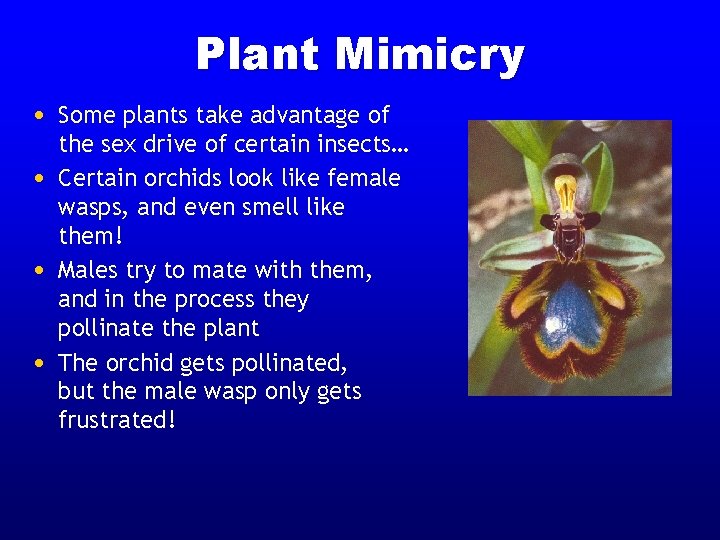
Plant Mimicry • Some plants take advantage of • • • the sex drive of certain insects… Certain orchids look like female wasps, and even smell like them! Males try to mate with them, and in the process they pollinate the plant The orchid gets pollinated, but the male wasp only gets frustrated!
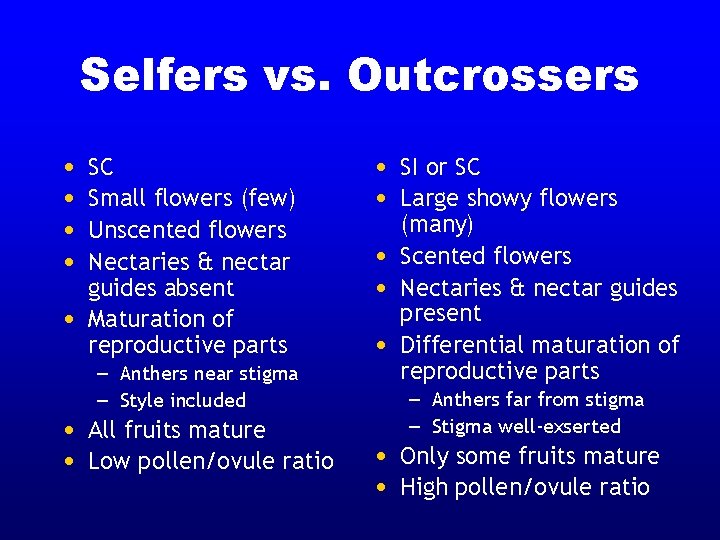
Selfers vs. Outcrossers • • • SC Small flowers (few) Unscented flowers Nectaries & nectar guides absent Maturation of reproductive parts – Anthers near stigma – Style included • All fruits mature • Low pollen/ovule ratio • SI or SC • Large showy flowers • • • (many) Scented flowers Nectaries & nectar guides present Differential maturation of reproductive parts – Anthers far from stigma – Stigma well-exserted Only some fruits mature High pollen/ovule ratio
Strategies to Prevent Selffertilization
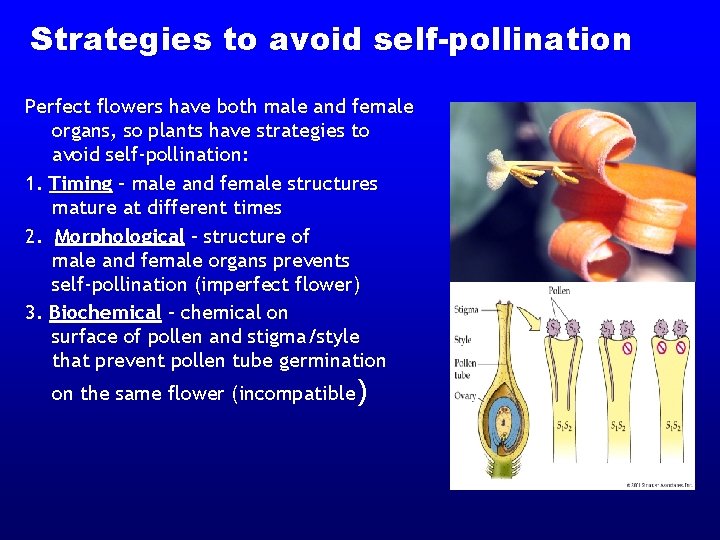
Strategies to avoid self-pollination Perfect flowers have both male and female organs, so plants have strategies to avoid self-pollination: 1. Timing – male and female structures mature at different times 2. Morphological – structure of male and female organs prevents self-pollination (imperfect flower) 3. Biochemical – chemical on surface of pollen and stigma/style that prevent pollen tube germination on the same flower (incompatible)
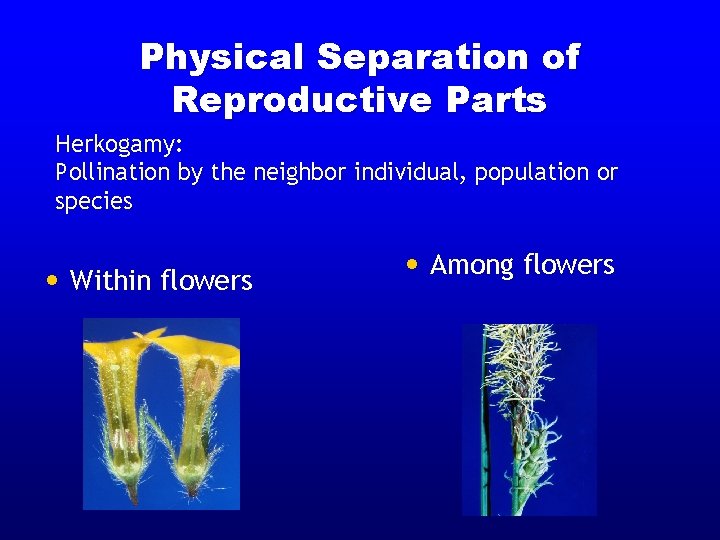
Physical Separation of Reproductive Parts Herkogamy: Pollination by the neighbor individual, population or species • Within flowers • Among flowers
Heterostyly A polymorphism among flowers that ensures crossfertilization through pollination by visiting insects Flowers have anthers and styles of different length Flowers in different individuals of the same species having 2 or 3 different style lengths 1. With stamen lengths varying inversely • Distyly • Tristyly
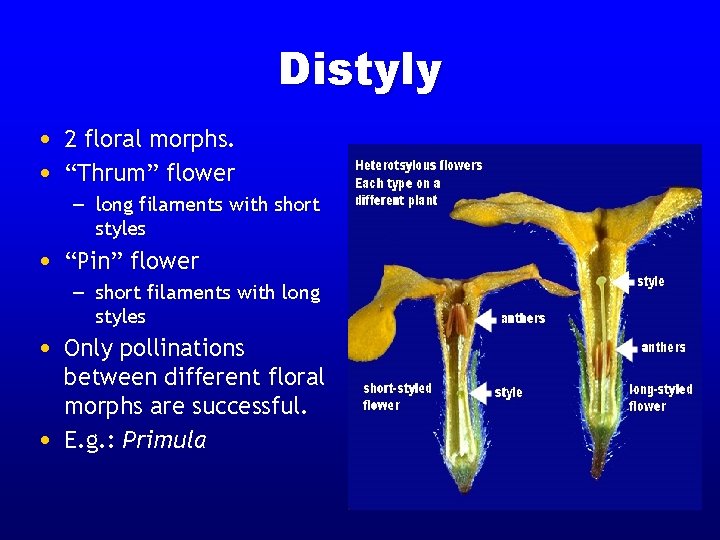
Distyly • 2 floral morphs. • “Thrum” flower – long filaments with short styles • “Pin” flower – short filaments with long styles • Only pollinations • between different floral morphs are successful. E. g. : Primula
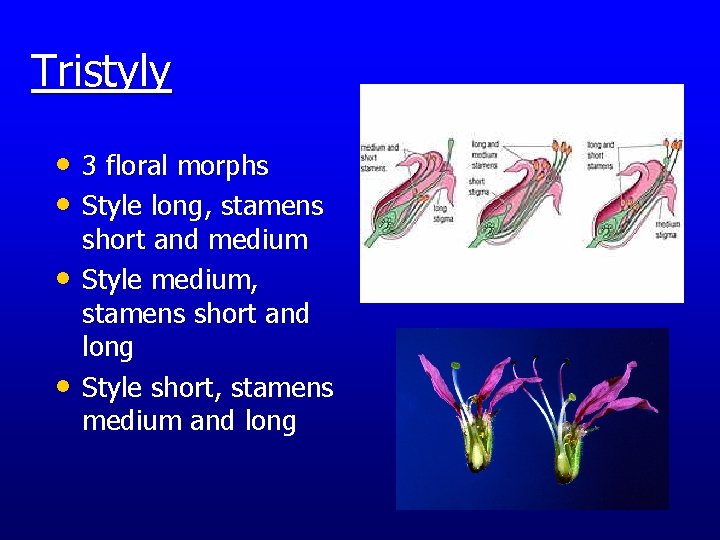
Tristyly • 3 floral morphs • Style long, stamens • • short and medium Style medium, stamens short and long Style short, stamens medium and long
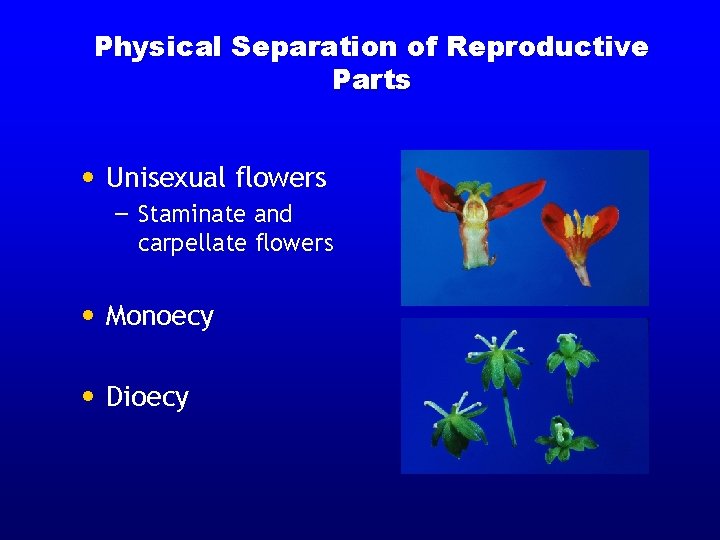
Physical Separation of Reproductive Parts • Unisexual flowers – Staminate and carpellate flowers • Monoecy • Dioecy
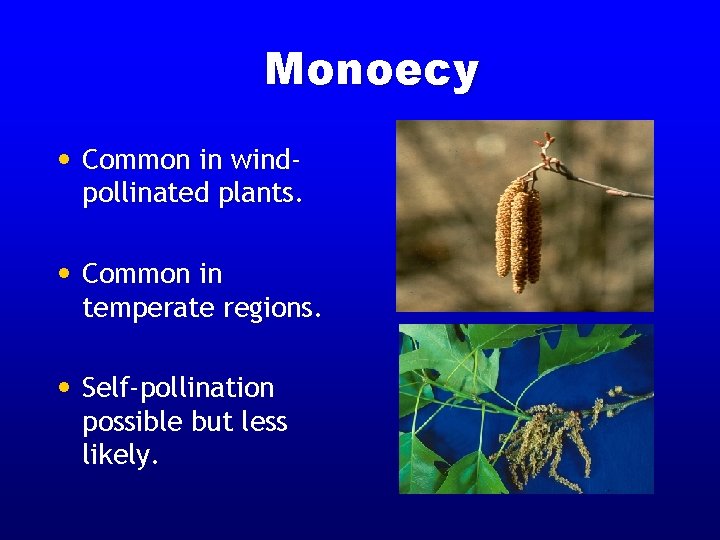
Monoecy • Common in wind- pollinated plants. • Common in temperate regions. • Self-pollination possible but less likely.
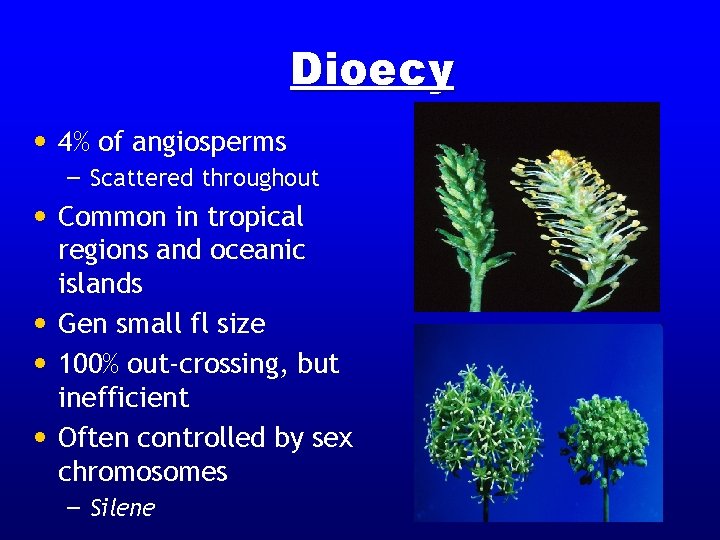
Dioecy • 4% of angiosperms – Scattered throughout • Common in tropical regions and oceanic islands • Gen small fl size • 100% out-crossing, but inefficient • Often controlled by sex chromosomes – Silene
Polygamous Flowers • Both bisexual and unisexual flowers on the same plant. – Androdioecy = bisexual and staminate individuals in a population. – Andromonoecy = bisexual and staminate flowers on same individual. • Euphorbia, Solanum – Gynodioecy = bisexual and carpellate individuals in a population. • Sidalcea hendersonii, Silene – Gynomonoecy = bisexual and carpellate flowers on same individual. • Silene, Solidago – Polygamodioecy = some plants with bisexual and staminate flowers & some plants with bisexual and carpellate flowers in a population. – Polygamomonoecy = bisexual, staminate, and carpellate flowers on same individual.
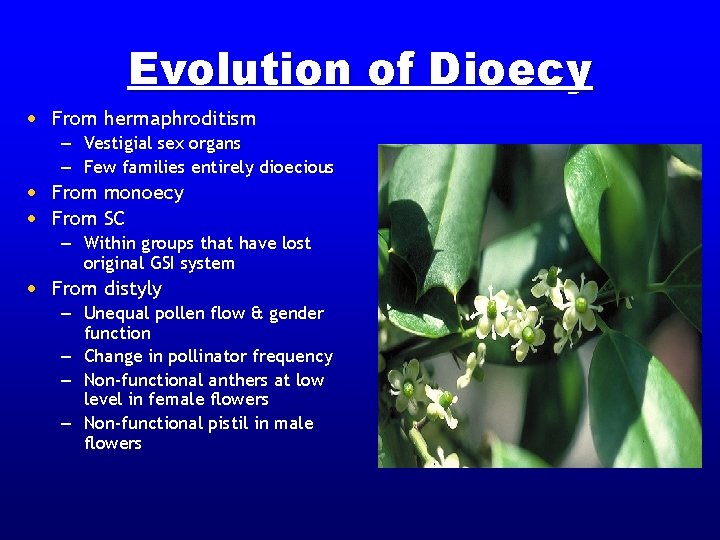
Evolution of Dioecy • From hermaphroditism – Vestigial sex organs – Few families entirely dioecious • From monoecy • From SC – Within groups that have lost original GSI system • From distyly – Unequal pollen flow & gender function – Change in pollinator frequency – Non-functional anthers at low level in female flowers – Non-functional pistil in male flowers
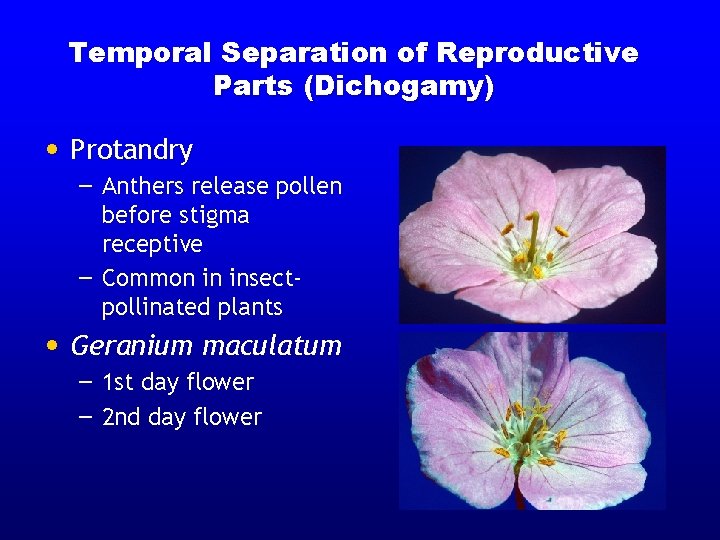
Temporal Separation of Reproductive Parts (Dichogamy) • Protandry – Anthers release pollen before stigma receptive – Common in insectpollinated plants • Geranium maculatum – 1 st day flower – 2 nd day flower
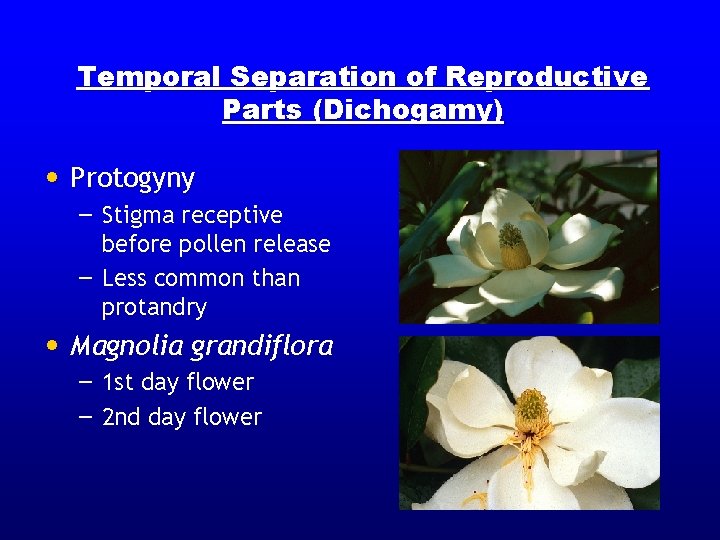
Temporal Separation of Reproductive Parts (Dichogamy) • Protogyny – Stigma receptive before pollen release – Less common than protandry • Magnolia grandiflora – 1 st day flower – 2 nd day flower
Geitonogamy • Self pollination between different flowers on same plant.
Asexual propagation. . . “vegetative reproduction, i. e. , multiplication that does not involve the seed cycle - clonal propagation. ”
Clone. . . A genetically identical assemblage of individuals produced from a plant entirely by vegetative means. Hartmann and Kester
Benefits of clonal propagation. . . • Some plants produce few (if any) viable seeds. • Clonal progeny are highly uniform in all characters. • Outcrossing plants produce highly variable progeny. • Plants may have extended juvenile period. • Cloning allows for combining genotypes in one plant. • Seeds may have lengthy and complex dormancies.
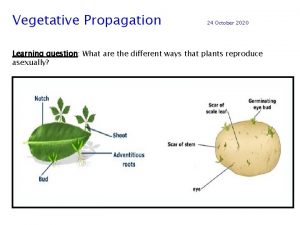
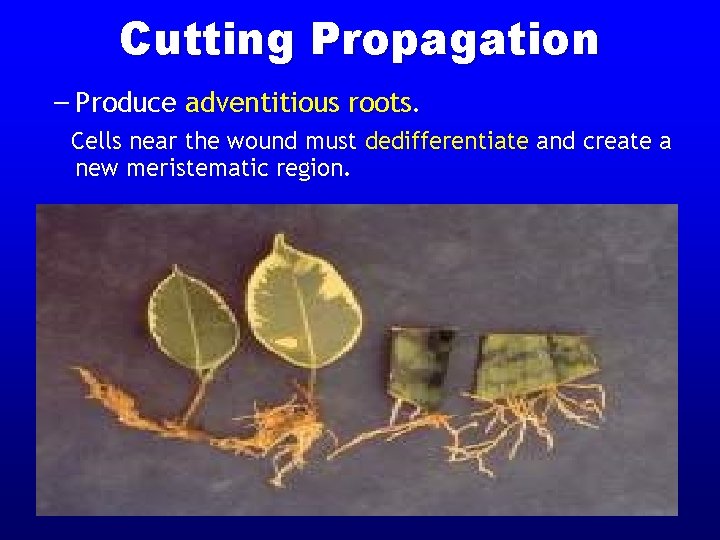
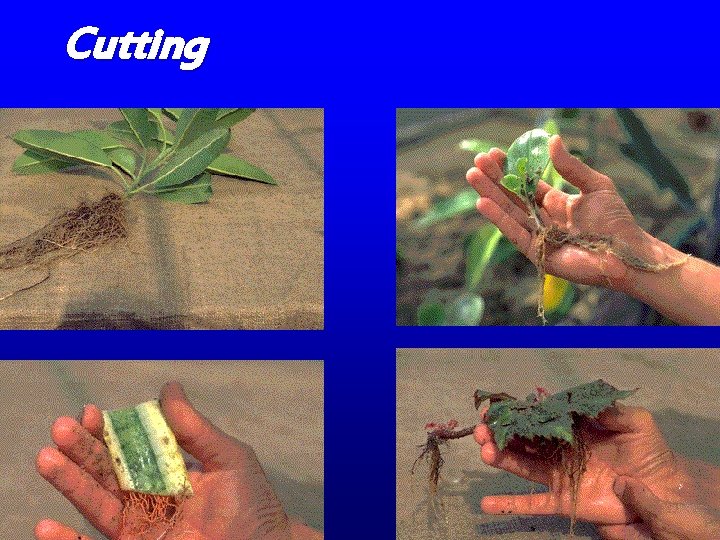
Cutting Propagation – Produce adventitious roots. Cells near the wound must dedifferentiate and create a new meristematic region.
Cutting •
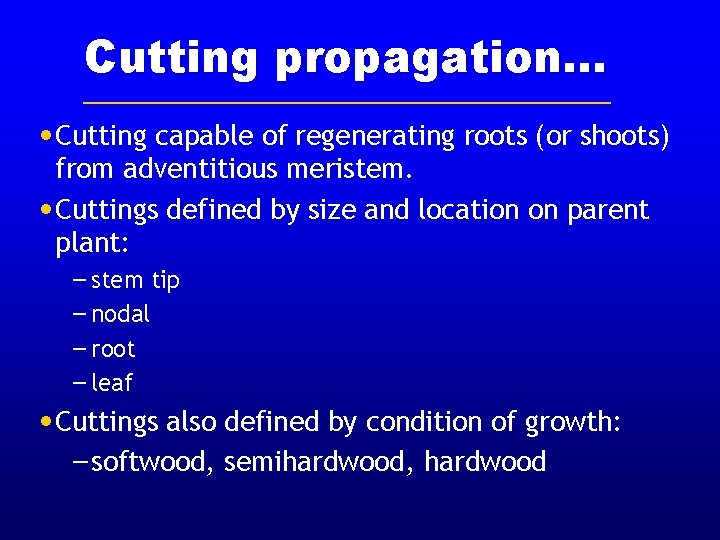
Cutting propagation. . . • Cutting capable of regenerating roots (or shoots) from adventitious meristem. • Cuttings defined by size and location on parent plant: – stem tip – nodal – root – leaf • Cuttings also defined by condition of growth: – softwood, semihardwood, hardwood
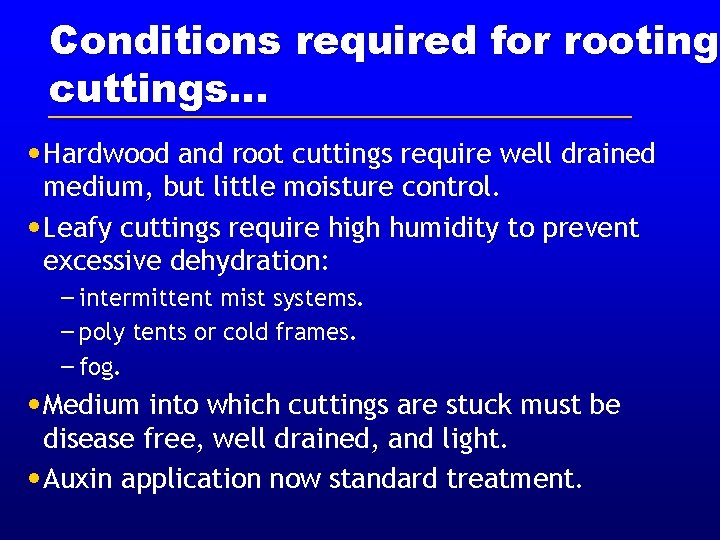
Conditions required for rooting cuttings. . . • Hardwood and root cuttings require well drained medium, but little moisture control. • Leafy cuttings require high humidity to prevent excessive dehydration: – intermittent mist systems. – poly tents or cold frames. – fog. • Medium into which cuttings are stuck must be disease free, well drained, and light. • Auxin application now standard treatment.
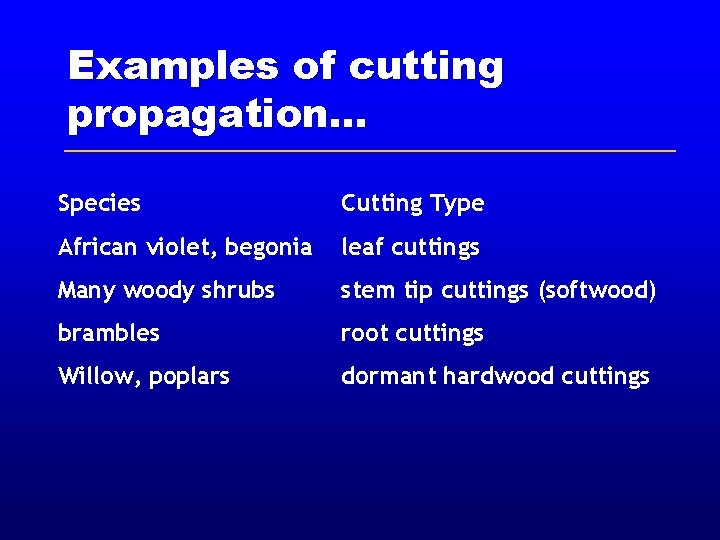
Examples of cutting propagation. . . Species Cutting Type African violet, begonia leaf cuttings Many woody shrubs stem tip cuttings (softwood) brambles root cuttings Willow, poplars dormant hardwood cuttings
Grafting and budding. . . “The vascular cambium can regenerate the vascular connections between the scion and rootstock resulting in a complete plant composed of more than one genotype. ” • Can graft scion cultivar onto size controlling rootstock. • Many difficult to root plants are graft compatible. • Grafting defined by season and type of tissue. – budding (T-budding, inverted T, patch) – wedge, veneer, whip and tongue, cleft, etc. • Scion cultivar may be changed on mature trees (top working)
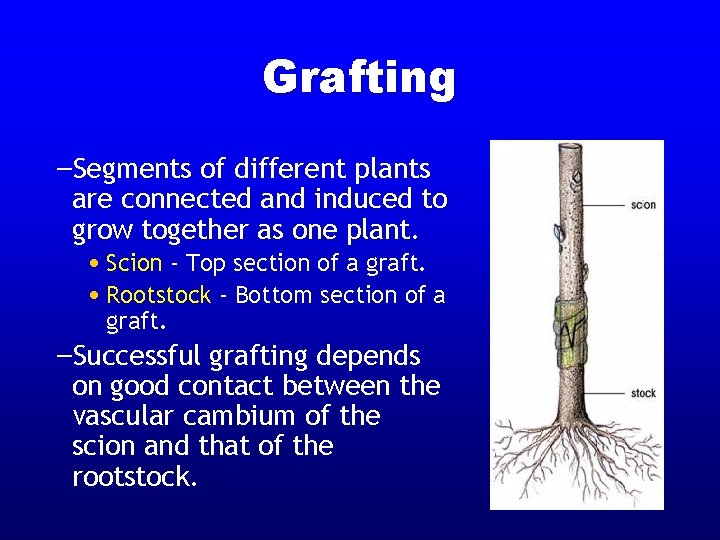
Grafting –Segments of different plants are connected and induced to grow together as one plant. • Scion - Top section of a graft. • Rootstock - Bottom section of a graft. –Successful grafting depends on good contact between the vascular cambium of the scion and that of the rootstock.
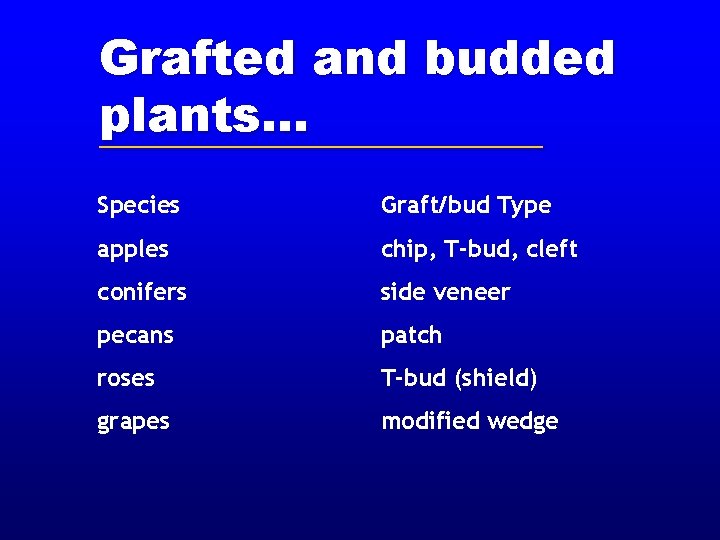
Grafted and budded plants. . . Species Graft/bud Type apples chip, T-bud, cleft conifers side veneer pecans patch roses T-bud (shield) grapes modified wedge
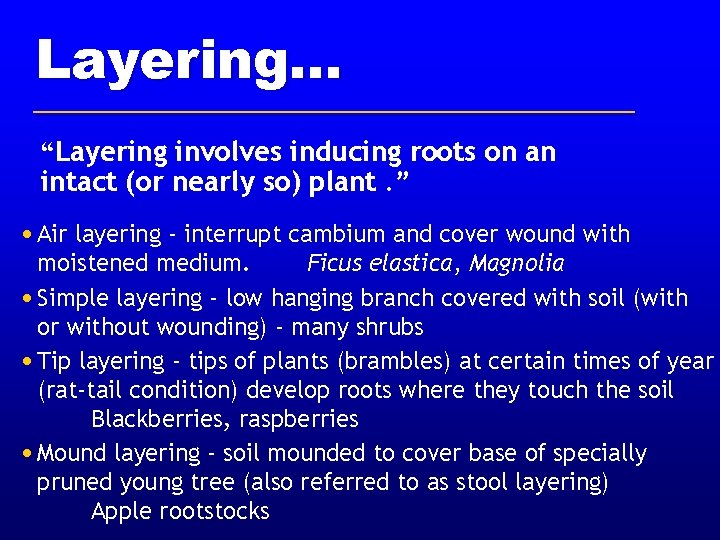
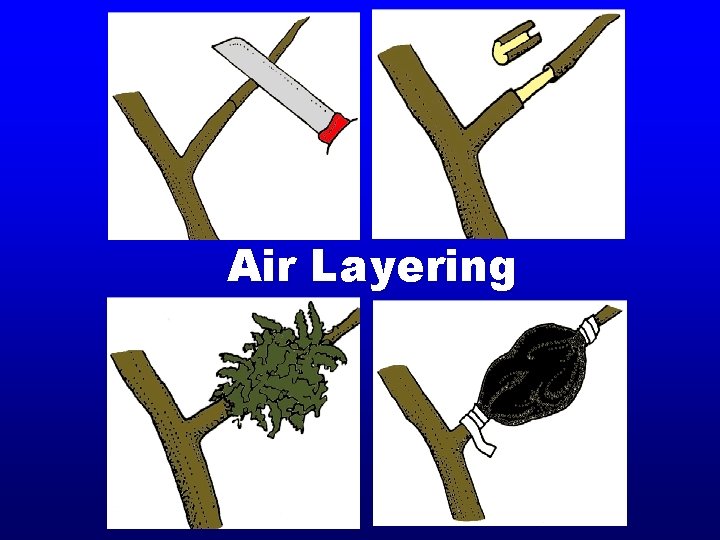
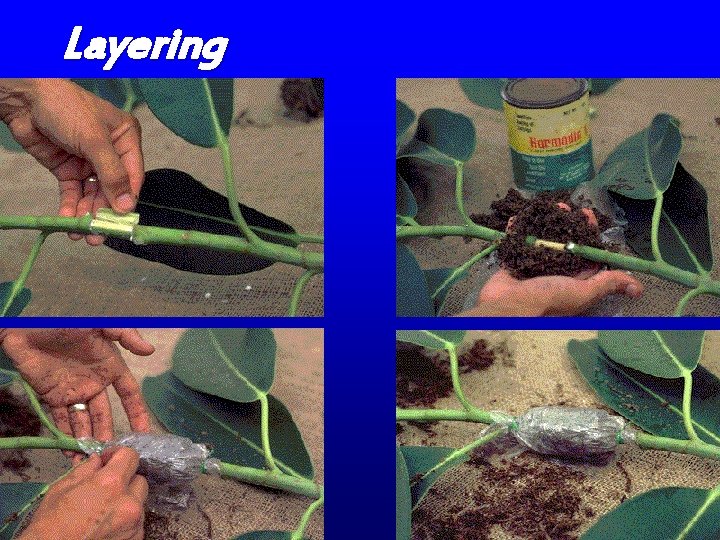
Layering. . . “Layering involves inducing roots on an intact (or nearly so) plant. ” • Air layering - interrupt cambium and cover wound with moistened medium. Ficus elastica, Magnolia • Simple layering - low hanging branch covered with soil (with or without wounding) - many shrubs • Tip layering - tips of plants (brambles) at certain times of year (rat-tail condition) develop roots where they touch the soil Blackberries, raspberries • Mound layering - soil mounded to cover base of specially pruned young tree (also referred to as stool layering) Apple rootstocks
Air Layering
Layering •
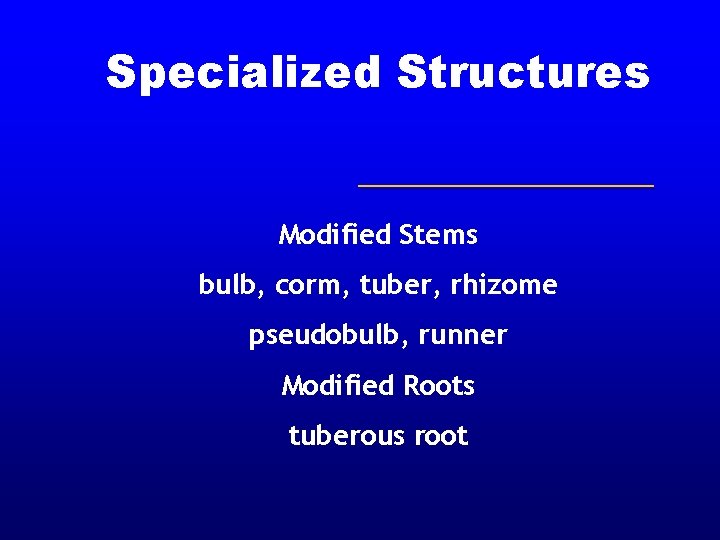
Specialized Structures Modified Stems bulb, corm, tuber, rhizome pseudobulb, runner Modified Roots tuberous root
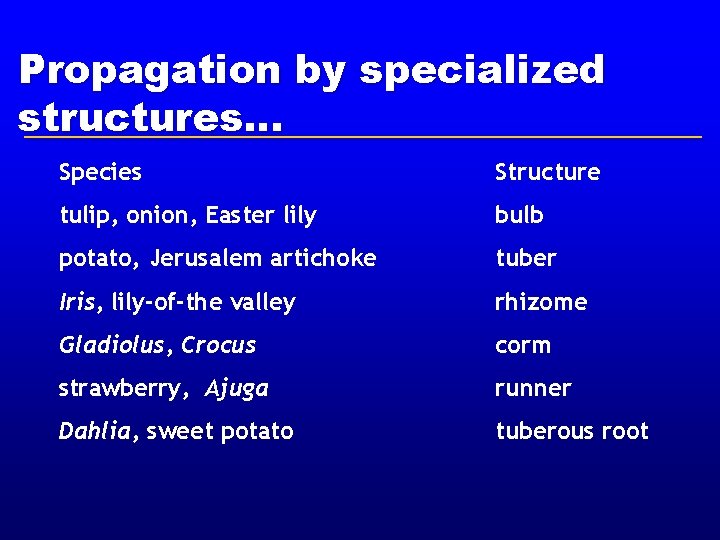
Propagation by specialized structures. . . Species Structure tulip, onion, Easter lily bulb potato, Jerusalem artichoke tuber Iris, lily-of-the valley rhizome Gladiolus, Crocus corm strawberry, Ajuga runner Dahlia, sweet potato tuberous root
Apomixis. . . “an exception to the rule of nonclonal embryony. ” “the development of an embryo within a seed or flowering structure from a source other than the egg, resulting in the formation of an embryo (sometimes in addition to the sexual embryo) that is a clone of the maternal parent. Examples include polyembryony in citrus and crabapples, and the formation of bulbils in garlic. ”
Micropropagation. . . “Micropropagation has many synonyms tissue culture, mass propagation, in vitro culture, cloning. ” • Micropropagation is rapid, continuous, and efficient. • Specialized equipment, facilities, and technically trained personnel are required. • Steps can be taken to obtain and maintain certified pest-free plants. • Cost effective if large numbers of a given clone are produced. • Widely used for orchids, ferns, many interior foliage plants, rootstocks, etc.
Plants amenable to micropropagation. . . Flowering pot plants - Begonia, African violets, orchids Interior foliage plants - ferns, Syngonium, Ficus, Diffenbachia Woody ornamentals - red maples, Rhododendrons, Nandina Forest trees - Poplar, birch, loblolly pine Fruit trees - apple, cherry, pear (many rootstocks) Vegetable crops - potato, celery, tomato, onion (male sterile) Plantation crops - banana, date palm, coffee
Types of development in vitro. . . üProliferation of axillary buds from shoot tip cultures. üDifferentiation of adventitious shoots from leaves, stems, or roots. üFormation and proliferation of somatic embryos. üSeed germination - orchids. üDevelopment of haploid plants from anthers or ovules. üProtoplast fusion and somatic hybrid development.