Recurrences It continues Jeff Chastine Recurrences When an
- Slides: 18
Recurrences It continues… Jeff Chastine
Recurrences • When an algorithm calls itself recursively, its running time is described by a recurrence. • A recurrence describes itself in terms of its value on smaller inputs • There are four methods of solving these: substitution, iteration, recursion tree, or master method Jeff Chastine
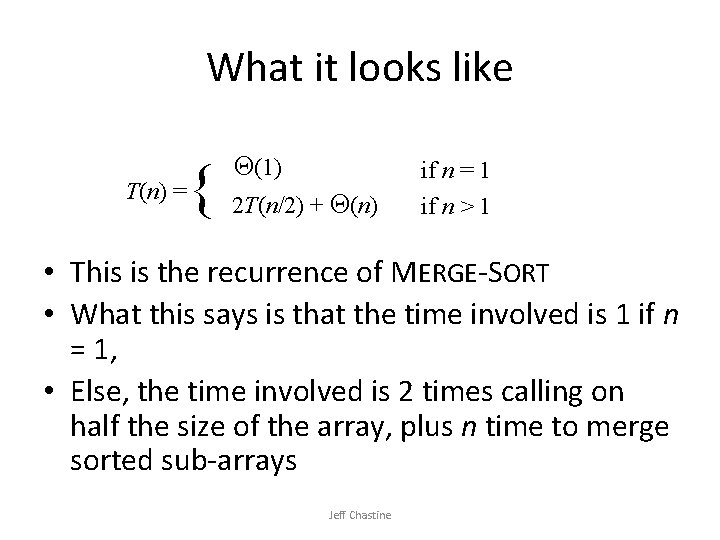
What it looks like T(n) = { Θ(1) 2 T(n/2) + Θ(n) if n = 1 if n > 1 • This is the recurrence of MERGE-SORT • What this says is that the time involved is 1 if n = 1, • Else, the time involved is 2 times calling on half the size of the array, plus n time to merge sorted sub-arrays Jeff Chastine
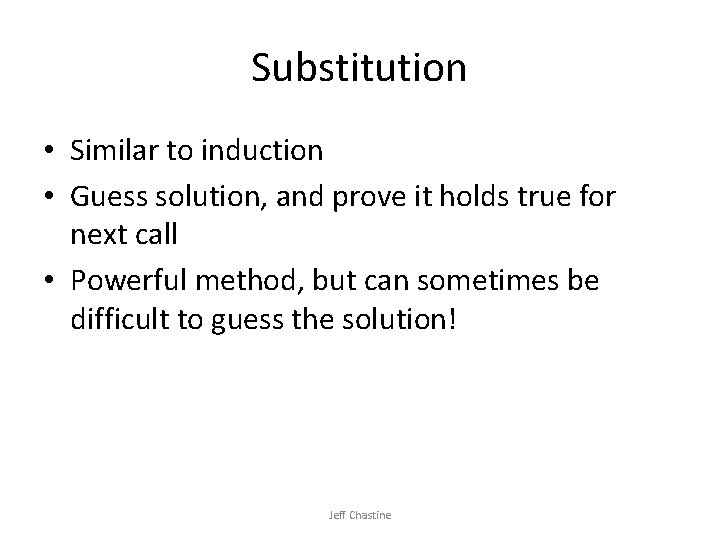
Substitution • Similar to induction • Guess solution, and prove it holds true for next call • Powerful method, but can sometimes be difficult to guess the solution! Jeff Chastine
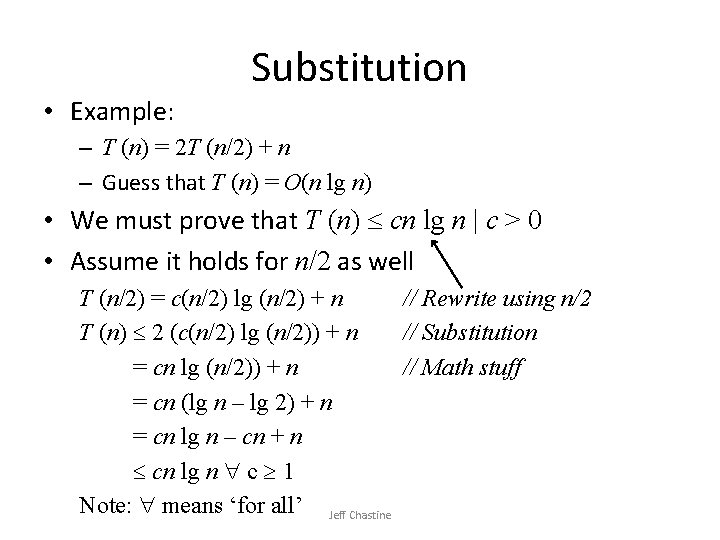
• Example: Substitution – T (n) = 2 T (n/2) + n – Guess that T (n) = O(n lg n) • We must prove that T (n) cn lg n | c > 0 • Assume it holds for n/2 as well T (n/2) = c(n/2) lg (n/2) + n // Rewrite using n/2 T (n) 2 (c(n/2) lg (n/2)) + n // Substitution = cn lg (n/2)) + n // Math stuff = cn (lg n – lg 2) + n = cn lg n – cn + n cn lg n c 1 Note: means ‘for all’ Jeff Chastine
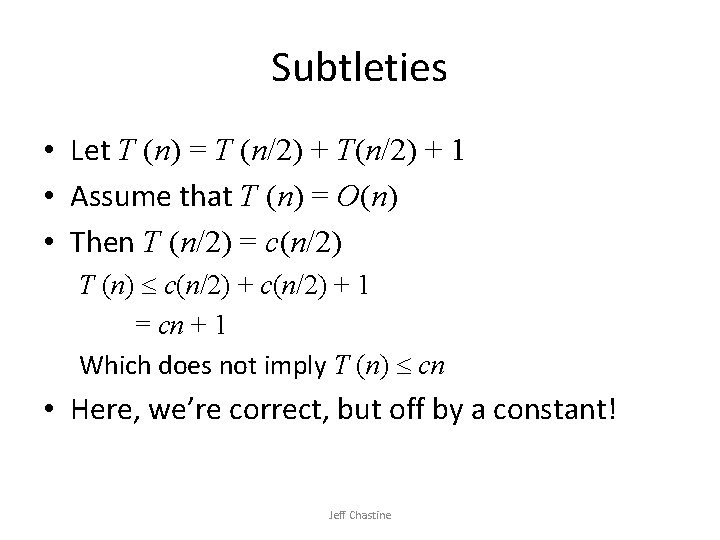
Subtleties • Let T (n) = T (n/2) + T(n/2) + 1 • Assume that T (n) = O(n) • Then T (n/2) = c(n/2) T (n) c(n/2) + 1 = cn + 1 Which does not imply T (n) cn • Here, we’re correct, but off by a constant! Jeff Chastine
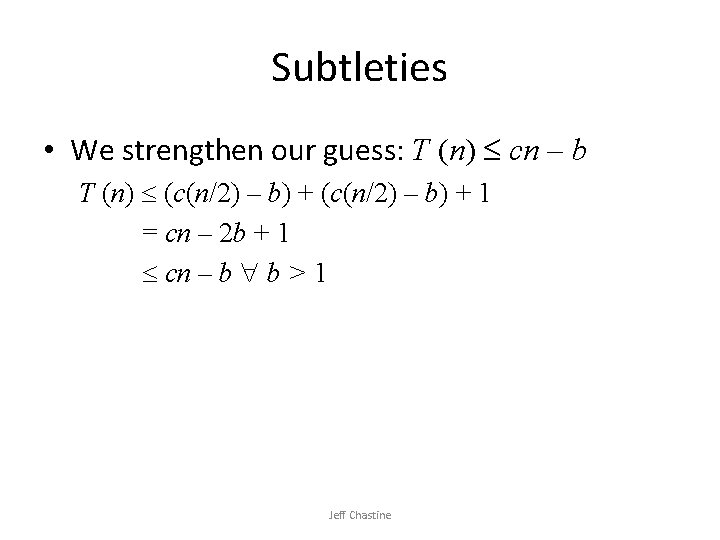
Subtleties • We strengthen our guess: T (n) cn – b T (n) (c(n/2) – b) + 1 = cn – 2 b + 1 cn – b b > 1 Jeff Chastine
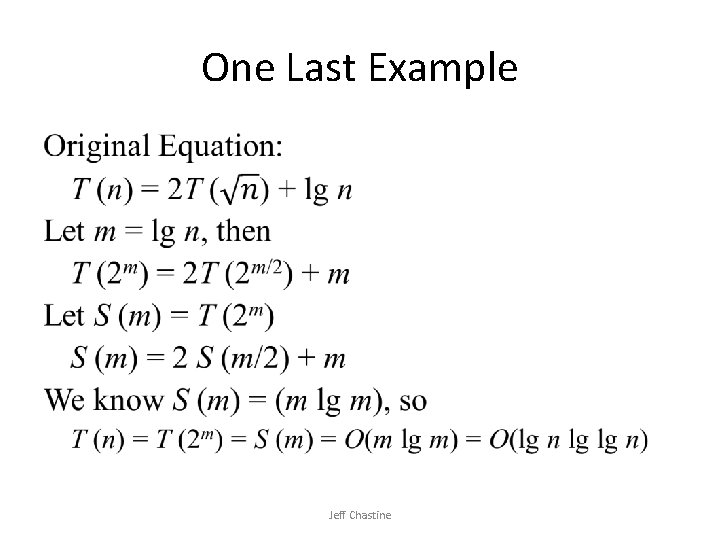
One Last Example • Jeff Chastine
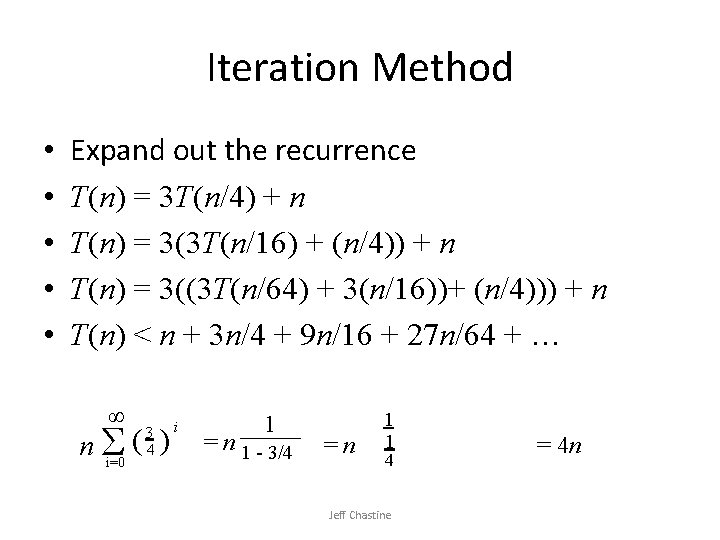
Iteration Method • • • Expand out the recurrence T(n) = 3 T(n/4) + n T(n) = 3(3 T(n/16) + (n/4)) + n T(n) = 3((3 T(n/64) + 3(n/16))+ (n/4))) + n T(n) < n + 3 n/4 + 9 n/16 + 27 n/64 + … ∞ ( ) nΣ i=0 3 4 i 1 = n 1 - 3/4 =n 1 1 4 Jeff Chastine = 4 n
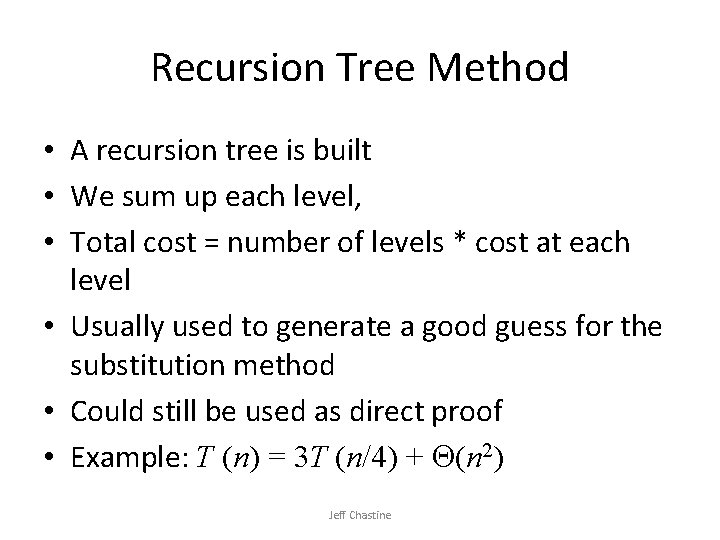
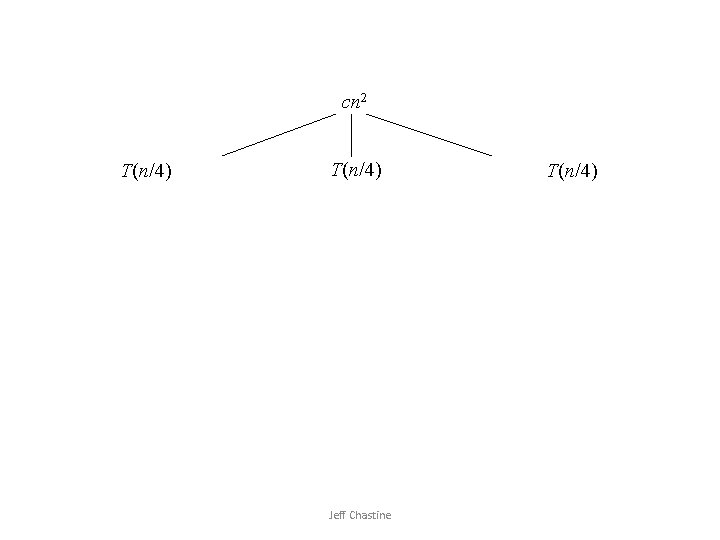
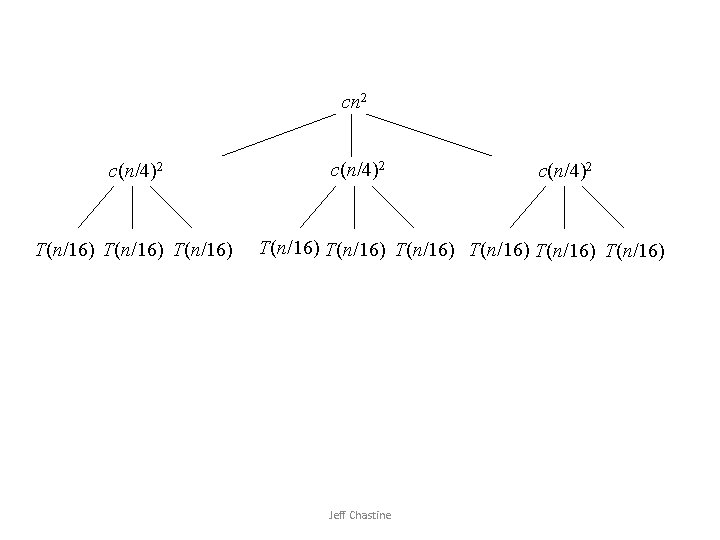
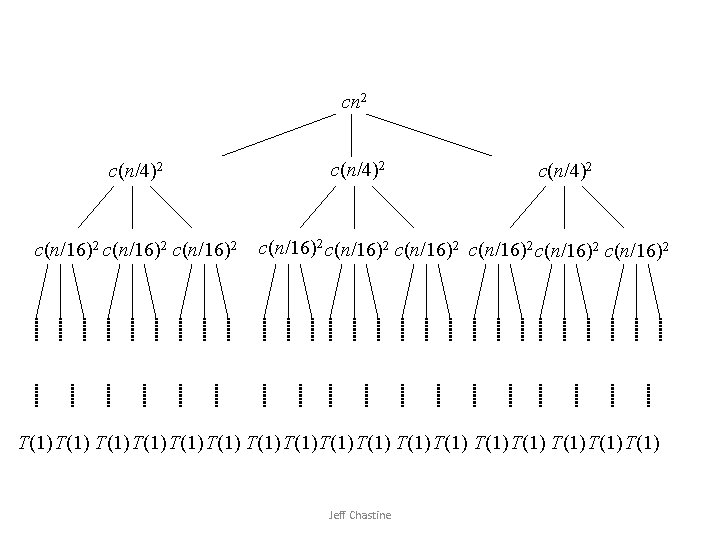
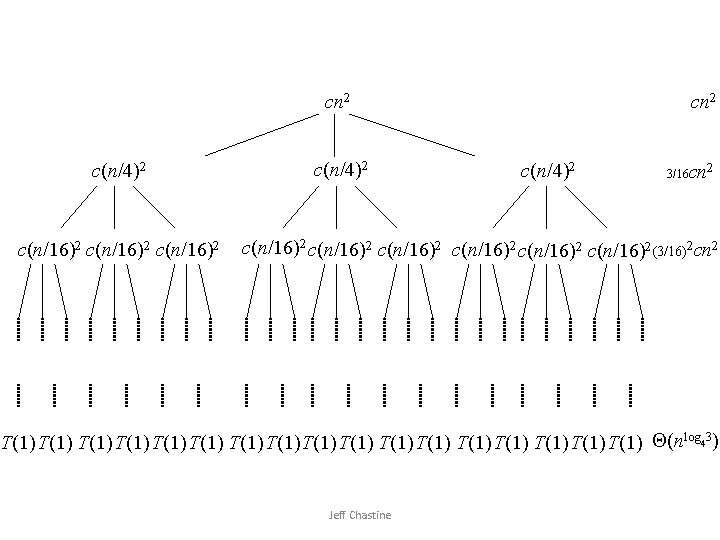
Recursion Tree Method • A recursion tree is built • We sum up each level, • Total cost = number of levels * cost at each level • Usually used to generate a good guess for the substitution method • Could still be used as direct proof • Example: T (n) = 3 T (n/4) + (n 2) Jeff Chastine
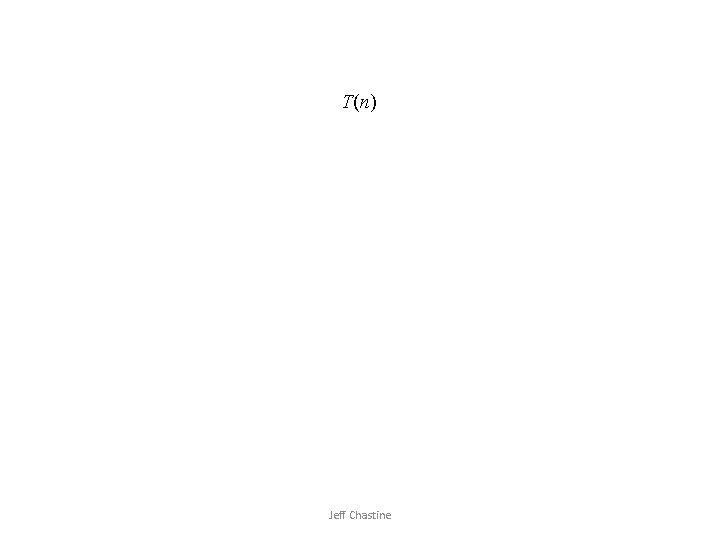
T(n) Jeff Chastine
cn 2 T(n/4) Jeff Chastine T(n/4)
cn 2 c(n/4)2 T(n/16) T(n/16) T(n/16) Jeff Chastine
cn 2 c(n/4)2 c(n/16)2 c(n/16)2 c(n/16)2 T(1) T(1)T(1) T(1) T(1) Jeff Chastine
cn 2 c(n/4)2 c(n/16)2 c(n/4)2 3/16 cn 2 c(n/16)2 c(n/16)2 (3/16)2 cn 2 T(1) T(1)T(1) T(1) T(1) (nlog 43) Jeff Chastine
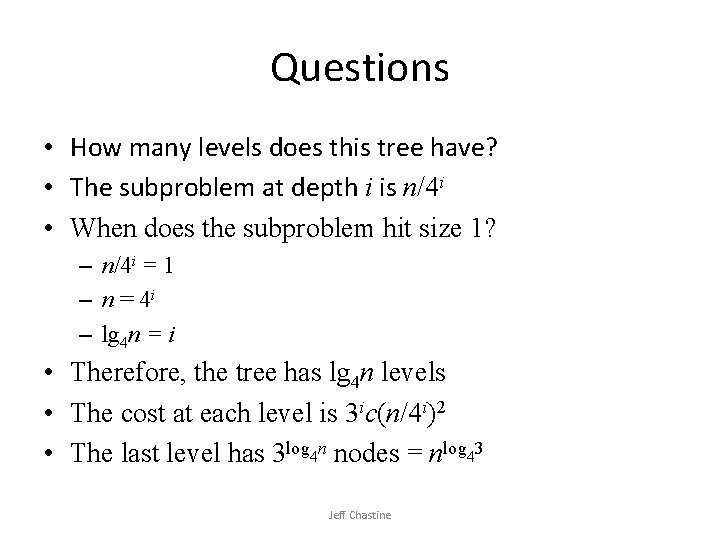
Questions • How many levels does this tree have? • The subproblem at depth i is n/4 i • When does the subproblem hit size 1? – n/4 i = 1 – n = 4 i – lg 4 n = i • Therefore, the tree has lg 4 n levels • The cost at each level is 3 ic(n/4 i)2 • The last level has 3 log 4 n nodes = nlog 43 Jeff Chastine
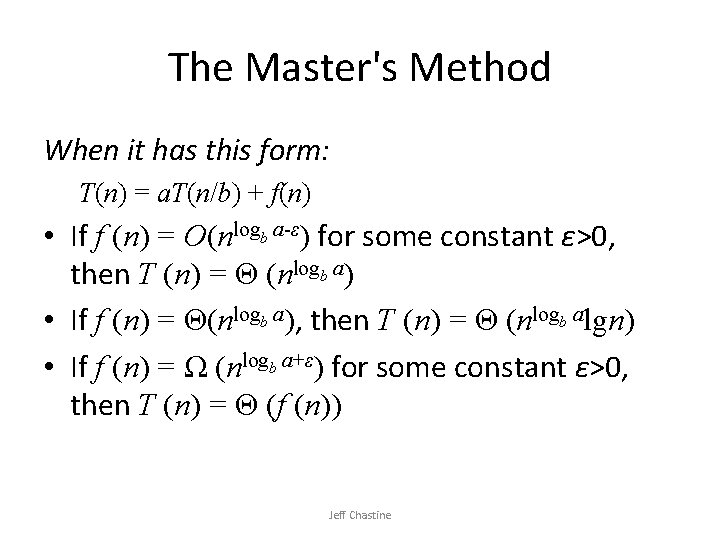
The Master's Method When it has this form: T(n) = a. T(n/b) + f(n) • If f (n) = Ο(nlogb a-ε) for some constant ε>0, then T (n) = Θ (nlogb a) • If f (n) = Θ(nlogb a), then T (n) = Θ (nlogb algn) • If f (n) = Ω (nlogb a+ε) for some constant ε>0, then T (n) = Θ (f (n)) Jeff Chastine
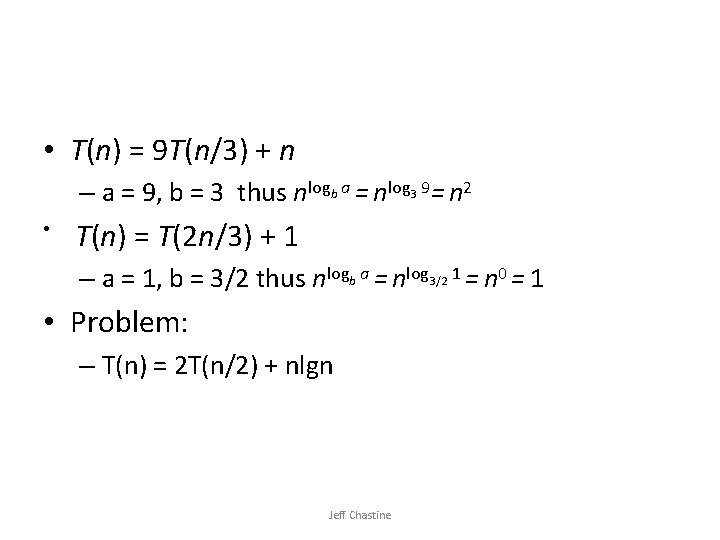
• T(n) = 9 T(n/3) + n – a = 9, b = 3 thus nlogb a = nlog 3 9= n 2 • T(n) = T(2 n/3) + 1 – a = 1, b = 3/2 thus nlogb a = nlog 3/2 1 = n 0 = 1 • Problem: – T(n) = 2 T(n/2) + nlgn Jeff Chastine