Really Practical Neuropsychology KRIS FERNANDO MALCOLM STEWART JOHN







- Slides: 22
Really Practical Neuropsychology KRIS FERNANDO MALCOLM STEWART JOHN R SMITH PRESENTATION TO NEW ZEALAND COLLEGE OF CLINICAL PSYCHOLOGISTS MARCH 2011
Structure Different types and levels of assessment Barriers to Neuropsychological Assessment Different levels of assessment Ecological validity Neuropsychology and vocational functioning Recommended practice Group exercise
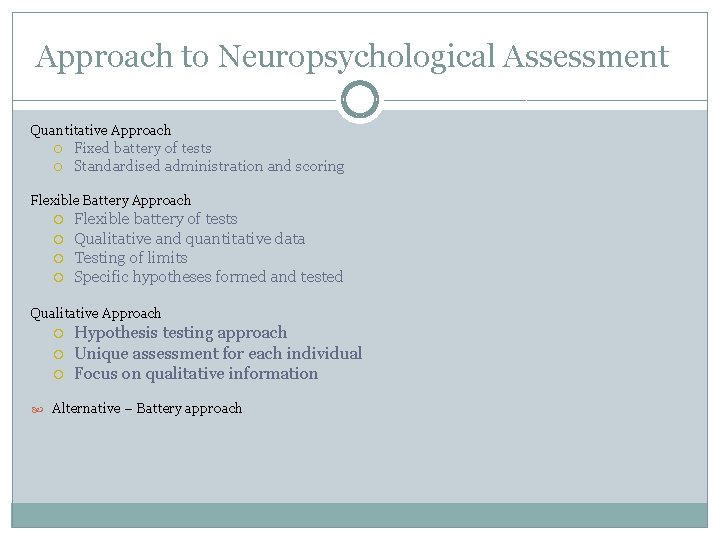
Approach to Neuropsychological Assessment Quantitative Approach Fixed battery of tests Standardised administration and scoring Flexible Battery Approach Flexible battery of tests Qualitative and quantitative data Testing of limits Specific hypotheses formed and tested Qualitative Approach Hypothesis testing approach Unique assessment for each individual Focus on qualitative information Alternative – Battery approach
Barriers to Neuropsychological Assessment Time Resources Clinical psychologists for whom neuropsychology is not their specialty Lack of provision of appropriate supervision A lack of understanding as to the value of neuropsychological assessment – what does it add relative to the resources required.
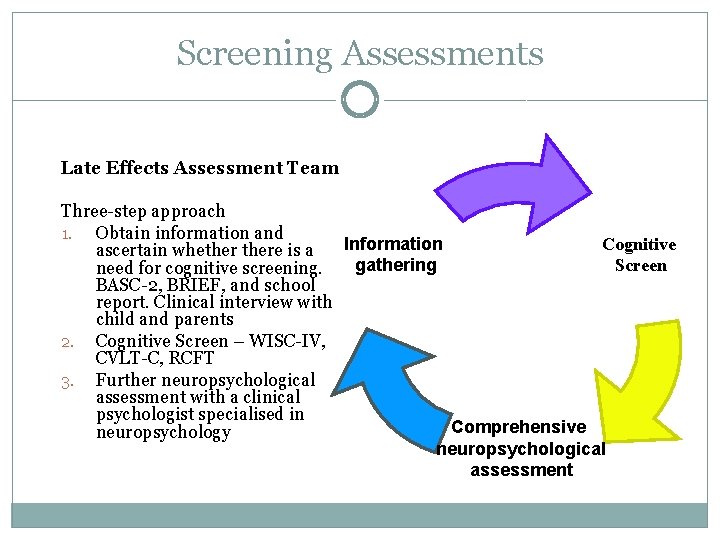
Screening Assessments Late Effects Assessment Team Three-step approach 1. Obtain information and Cognitive Information ascertain whethere is a Screen gathering need for cognitive screening. BASC-2, BRIEF, and school report. Clinical interview with child and parents 2. Cognitive Screen – WISC-IV, CVLT-C, RCFT 3. Further neuropsychological assessment with a clinical psychologist specialised in Comprehensive neuropsychology neuropsychological assessment
ACC Concussion Clinic Former system Medical and neuropsychological screen a requirement Often occurred within 2 -4 weeks following mild traumatic brain injury Limitations – how valid were results for functioning in 36 months etc Deficits – created concern for some clients Rehabilitation provided
Concussion Services Model Referral from Registered Medical Professional no early than 10 days post-injury Triage – OT/Nurse etc – some input from Clin Psychs in some clinics Short-term OT/PT/SLT/RN intervention depending on what is required Neuropsychological assessment (screen) if deemed necessary – allocation of five hours – short report only required Medical assessment if deemed necessary Short-term psychological intervention if required Referral out of concussion services if problems more complex. Full neuropsychological assessment and/or Psychological Services may be indicated.
ACC Concussion Services Cont … Neuropsychological Screen Accident history/presenting problems Personal Background and current history Educational and occupational history Medical history Prior history of psychological problems Forensic history Quantitative Information Estimated pre-accident level of cognitive, emotional and cognitive functioning Attention, immediate and working memory, learning and memory abilities, executive functioning Formulation/summary/recommendations
High Case Loads – CMHC’S CAMHS Consistent and identifiable relationships between clinical conditions and cognitive functioning e. g. TBI, epilepsy, learning disorders, intellectual disability, depression, chronic pain, alcohol/drug abuse Assessment is the start not the end of the process – contributes to an understanding of the client’s needs, to treatment planning and improved quality of life Reporting with a high workload – what are the implications of the assessment for the adult’s/child’s functioning and treatment?
Ecological Validity Definition The degree to which basic abilities assessed in controlled clinical settings apply to real-world performance Inferences need to be made – how an individual’s pattern of strengths and deficits predict his/her ability to carry out everyday activities in the real world Person’s ability to live independently, employment prospects and rehabilitation and need for environmental support
Ecological Validity Cont … Methods of identifying real world functioning Direct observation Self-report Proxy/caregiver reports Clinicians ratings All have strengths and limitations Limited face validity of traditional neuropsychological tests for determining competence with specific everyday activities. Absence of established understanding as to specific abilities required by specific daily functions and how they relate to neuropsych tests – considerable clinical judgement is still required.
Ecological Validity Cont …. In general, neuropsychological measures do measure abilities required for everyday functioning Predictive of Academic success Current and future employment status Performance of tasks required for everyday living Medication management Driving Independent living Reported correlations between test scores and functional outcomes generally do not exceed 40% of explained variance Need to consider demographics, health status, level of experience with the activities in question and emotional/behavioural and environmental factors
Ecological Validity Cont … Neuropsychological indices best for making global predictions such as employment status are summary scores Complex tests better predictors of functioning in complex everyday lives Most promising predictors of everyday functioning – executive functioning and learning and memory
Factors to be considered in Neuropsych Assessment Clinic setting Demands of home and work environments vary widely – types and degrees of impairment that can impact on performance of daily activities will vary with the situation An individual who shows no impairment in routine aspects of everyday functioning – may be unable to respond in less common, high demand or emergency type situations which could put the individual or others at risk. How can this be assessed? Important to consider an individual’s previous experience with a particular task or activities – will influence the degree to which an acquired cognitive deficit affects success in future task performance Compensation for deficits possible but depends on individual’s strengths and environmental demands.
Instruments – Ecological Validity Tests emphasising ecological validity – increased interest More closely resemble tasks undertaken in everyday life to better predict real world functioning Assess functional capacity – ability to perform tasks under optimal circumstances RBMT-3 – TEA – BADS Survey of 750 members of major NP societies No clear consensus regarding which ecologically standardised measures most useful for predicting everyday functioning Most common standardised measure used by <10% of respondents
Why such little use of newer EV Measures? Assumption that traditional tests are ecologically valid Tendency to stay with measures on which one received graduate training Belief that traditional tests measure specific constructs even through application of labels to cognitive domains not necessarily reflective of unambiguous empirical findings Belief that tests based on verisimilitude encroach on OT practice Mimicking everyday tasks in the clinic does not necessarily mean findings will relate to how clients function in the real world
Vocational Functioning Common question Is this person able to maintain employment and perform work functions? Research – neuropsychological predictions of employment status and job performance quite good but non-specific – TBI, Schizophrenia, MS Research – supports a relationship between neuropsych test results and global vocational outcomes –dichotomous variables – more recent emphasis on quality and stability of employment
Vocational Functioning Cont … Need to consider the differing cognitive demands of specific occupational when basing predictions of vocational functioning on an individual’s pattern of neuropsych strengths and difficulties Always will be a role of substantial clinical judgement – more research needed in determining accuracy of such decisions and the client, job and environmental factors that contribute to success or failure. Further research required to guide decisions regarding specific requirements of specific occupations; Many types of abilities required for most jobs and variable patterns of deficits may significantly interfere. Need to be very careful in stating no likelihood of returning to work – self-fulfilling
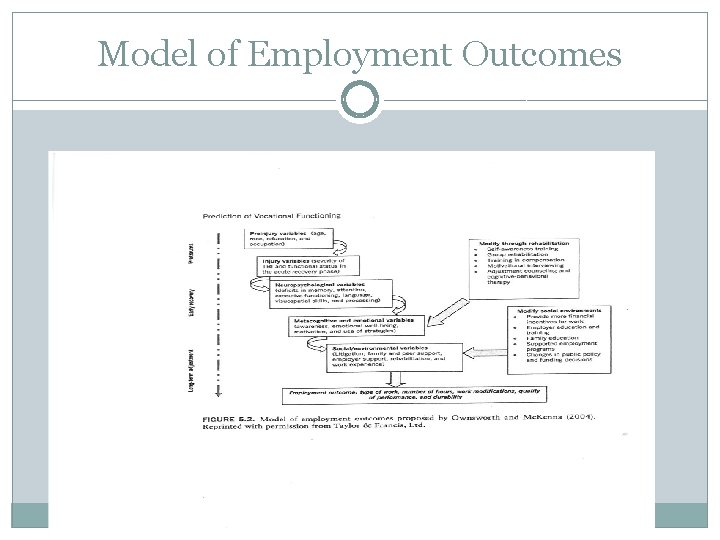
Model of Employment Outcomes
Recommended Practice Traditional neuropsychological tests are useful in terms of assessing individual’s capacity and are generally predictive of everyday functioning A focus on memory and executive functioning using such measures Information gleaned from well-developed ecologically oriented measures such as the BRIEF, RBMT-3 & Tinker Toy Test Merging of traditional approaches with more ecologically valid measures Assessing environmental, emotional, motivational and psychosocial factors in the context of a clinical interview Collateral information – multidisciplinary approach
References Grant, I. , & Adams, K. M. (2009). Neuropsychological Assessment of Neuropsychiatric and Neuromedical Disorders. (3 rd ed. ). Oxford: Oxford University Press. Marcotte, T. D. , & Grant, I. (2010). Neuropsychology of Everyday Functioning. New York: Guilford Press. Reed, J. , & Warner-Rogers, J. (2008). Child Neuropsychology. Concepts, Theory and Practice. Sussex: Wiley Blackwell
Group Exercise