r MPP meeting https indico cern chevent576967 13





- Slides: 15
r. MPP meeting https: //indico. cern. ch/event/576967/ 13. October 2016 2
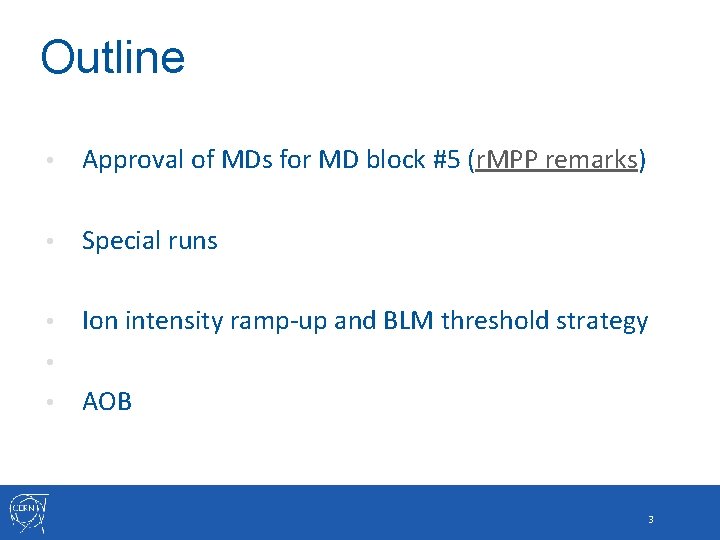
Outline • Approval of MDs for MD block #5 (r. MPP remarks) • Special runs Ion intensity ramp-up and BLM threshold strategy • • AOB • 3
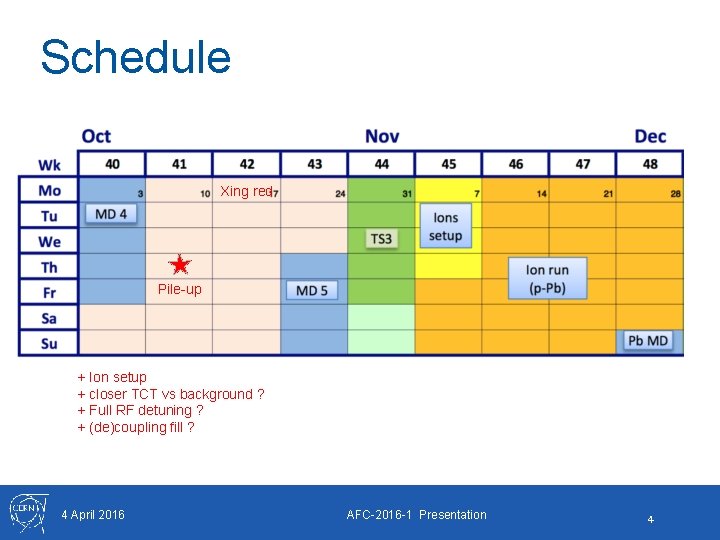
Schedule Xing red Pile-up + Ion setup + closer TCT vs background ? + Full RF detuning ? + (de)coupling fill ? 4 April 2016 AFC-2016 -1 Presentation 4
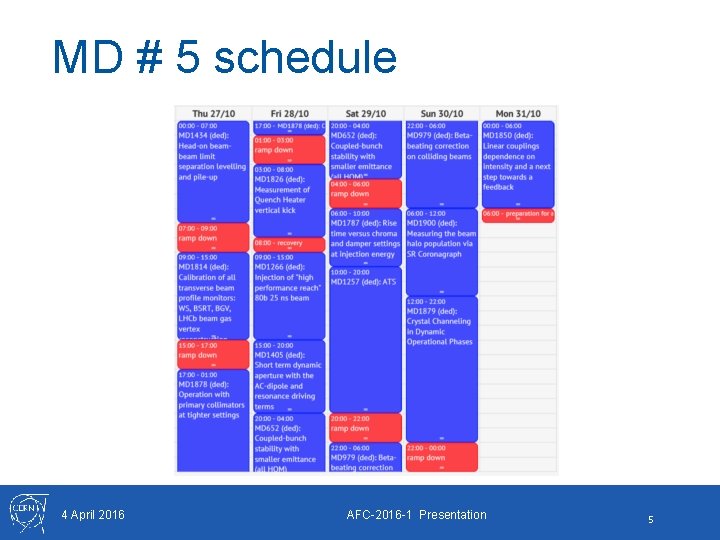
MD # 5 schedule 4 April 2016 AFC-2016 -1 Presentation 5
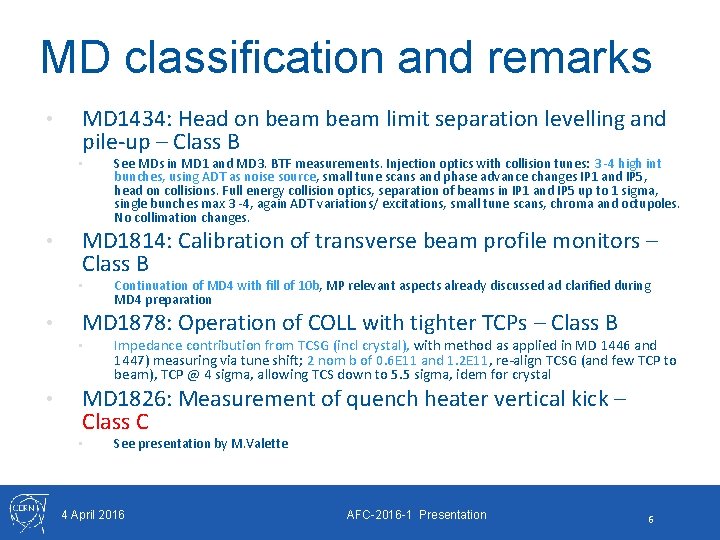
MD classification and remarks • MD 1434: Head on beam limit separation levelling and pile-up – Class B • • MD 1814: Calibration of transverse beam profile monitors – Class B • • Continuation of MD 4 with fill of 10 b, MP relevant aspects already discussed ad clarified during MD 4 preparation MD 1878: Operation of COLL with tighter TCPs – Class B • • See MDs in MD 1 and MD 3. BTF measurements. Injection optics with collision tunes: 3 -4 high int bunches, using ADT as noise source, small tune scans and phase advance changes IP 1 and IP 5, head on collisions. Full energy collision optics, separation of beams in IP 1 and IP 5 up to 1 sigma, single bunches max 3 -4, again ADT variations/ excitations, small tune scans, chroma and octupoles. No collimation changes. Impedance contribution from TCSG (incl crystal), with method as applied in MD 1446 and 1447) measuring via tune shift; 2 nom b of 0. 6 E 11 and 1. 2 E 11, re-align TCSG (and few TCP to beam), TCP @ 4 sigma, allowing TCS down to 5. 5 sigma, idem for crystal MD 1826: Measurement of quench heater vertical kick – Class C • See presentation by M. Valette 4 April 2016 AFC-2016 -1 Presentation 6
MD classification and remarks • MD 1266: Injection of 80 b/25 ns – Class B • • MD 1405: Short term DA with AC dipole and resonance driving terms - Class B • • Pilots at injection, COLL at coarse settings with TCPs at 12 sigma for use of AC dipole and MKA. Inject with COLL already opened, should NOT mask the PIC input MD 652: Coupled bunch stability with smaller emittance – Class B • • 80 b injections at injection, filling entire machine, observe injection losses, emittance blow-up, ghost bunches, MKI vacuum and temperature Measure intensity threshold for coupled bunch instabilities using smaller longitudinal emittance. Modified RF settings for target bunch length of 1. 0 ns (instead of nominal 1. 1 ns), full machine with 2200 b, then opening RF phase loop and observe stability using phase acquisitions. Keep AGC cleaning switched ON. MD 1787: Rise time versus damper and chroma settings at injection – Class A/B • Single bunch growth rate and octupole current instability threshold at LHC injection. 1 nominal and 1 pilot per beam at injection. Change ADT, chromaticity and octupole settings. 4 April 2016 AFC-2016 -1 Presentation 7
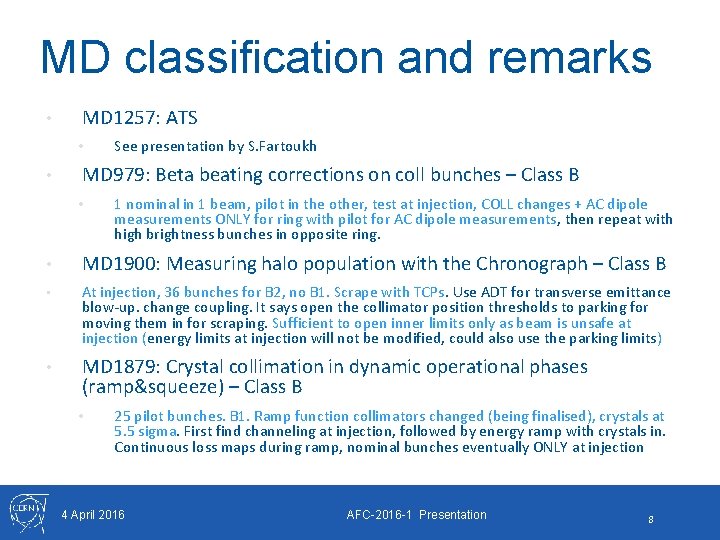
MD classification and remarks • MD 1257: ATS • • See presentation by S. Fartoukh MD 979: Beta beating corrections on coll bunches – Class B • 1 nominal in 1 beam, pilot in the other, test at injection, COLL changes + AC dipole measurements ONLY for ring with pilot for AC dipole measurements, then repeat with high brightness bunches in opposite ring. • MD 1900: Measuring halo population with the Chronograph – Class B • At injection, 36 bunches for B 2, no B 1. Scrape with TCPs. Use ADT for transverse emittance blow-up. change coupling. It says open the collimator position thresholds to parking for moving them in for scraping. Sufficient to open inner limits only as beam is unsafe at injection (energy limits at injection will not be modified, could also use the parking limits) • MD 1879: Crystal collimation in dynamic operational phases (ramp&squeeze) – Class B • 25 pilot bunches. B 1. Ramp function collimators changed (being finalised), crystals at 5. 5 sigma. First find channeling at injection, followed by energy ramp with crystals in. Continuous loss maps during ramp, nominal bunches eventually ONLY at injection 4 April 2016 AFC-2016 -1 Presentation 8
MD classification and remarks • MD 1850: Linear coupling dependence on intensity – Class B • Full machine at injection, using ADT in special excitation mode. Test this excitation mode first with a nominal bunch at injection, then with 12 b train to demonstrate excitation window / bunch. 4 April 2016 AFC-2016 -1 Presentation 9
4 April 2016 AFC-2016 -1 Presentation 10
Special runs High Pile-up Test Fill – Jamie • Closer TCT settings for EXP background - Roderik • Reduction of Xing angle for ATLAS/CMS luminosity difference - Jorg • RF with full detuning – Philippe and John • 4 April 2016 AFC-2016 -1 Presentation 11
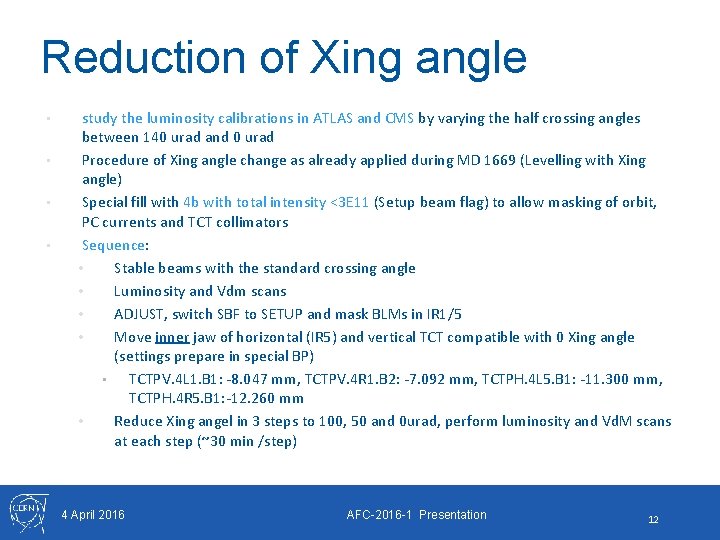
Reduction of Xing angle • • study the luminosity calibrations in ATLAS and CMS by varying the half crossing angles between 140 urad and 0 urad Procedure of Xing angle change as already applied during MD 1669 (Levelling with Xing angle) Special fill with 4 b with total intensity <3 E 11 (Setup beam flag) to allow masking of orbit, PC currents and TCT collimators Sequence: • Stable beams with the standard crossing angle • Luminosity and Vdm scans • ADJUST, switch SBF to SETUP and mask BLMs in IR 1/5 • Move inner jaw of horizontal (IR 5) and vertical TCT compatible with 0 Xing angle (settings prepare in special BP) • TCTPV. 4 L 1. B 1: -8. 047 mm, TCTPV. 4 R 1. B 2: -7. 092 mm, TCTPH. 4 L 5. B 1: -11. 300 mm, TCTPH. 4 R 5. B 1: -12. 260 mm • Reduce Xing angel in 3 steps to 100, 50 and 0 urad, perform luminosity and Vd. M scans at each step (~30 min /step) 4 April 2016 AFC-2016 -1 Presentation 12
RF with full detuning • • EOF MD following successful MD 249 to test with full machine the ‘full detuning’ scheme (RF voltage phase modulation) • Towards the end of a physics fill, go to ADJUST • RF team will ramp the gain of the Voltage Phase Modulation algorithm, resulting in a modulation of bunch spacing along the ring. • Expect 10 degrees pk-pk at 400. 8 MHz (70 ps pk-pk), i. e. ~12. 5 mm displacement of zvertex in IP 2 and 8 • After checking that losses or debunching are “normal”, go back to STABLE • Physics for 1 -2 hours to let the experiments observe possible problems with acquisitions. Feedback from John Molendijk • Installed firmware already features required algorithm, enabling done through nonpersisted FESA property • Active phase modulation can be engaged/disengaged at any time, changes are done adiabatically 4 April 2016 AFC-2016 -1 Presentation 13
4 April 2016 AFC-2016 -1 Presentation 14
Ion run ramp-up (proposal) 3 configurations • 4 Te. V p-Pb (11, 2, 11, 10 m) • 6. 5 Te. V p-Pb (0. 6, 2, 0. 6, 1. 5 m) • 6. 5 Te. V Pb-p (0. 6, 2, 0. 6, 1. 5 m) Intensity envelope: • Protons: <702 b of ~2 -4 E 10 -> Watch out to stay away from BPM sensitivity switch (probably initially use 2 E 10) • Ions: 588 b of ~1. 4 E 8 ions / ~1. 15 E 10 charges (~65 nom b equivalent) Each configuration is preceded by appropriate validation fills (see slides by Daniele M. in Ion prep meeting) for collisions, orbit, loss-maps and asynchronous dumps r. MPP recommendation for each configuration: • After validation, 1 intermediate intensity step ~ 50/25 nominal b equivalent, ie. 200 b of p of 2 E 10 vs 200 b of Pb of 1. 4 E 8 in respective ring • In 2 nd part of run bunch intensity can be further increased, preceded by a short validation fill when crossing the BPM sensitivity range (e. g. with steps to 6 E 10, 1 E 11) • If firmware of BPMs + BPMS are modified, validation program needs tbd 15