
https indico cern chevent755856 K Long 09 November

https: //indico. cern. ch/event/755856 K. Long, 09 November 2020 1

Authors and acknowledgements … 2
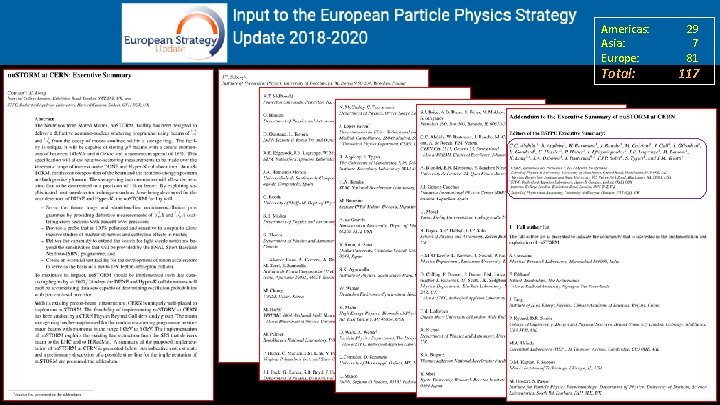
Americas: Asia: Europe: Total: 29 7 81 117 3
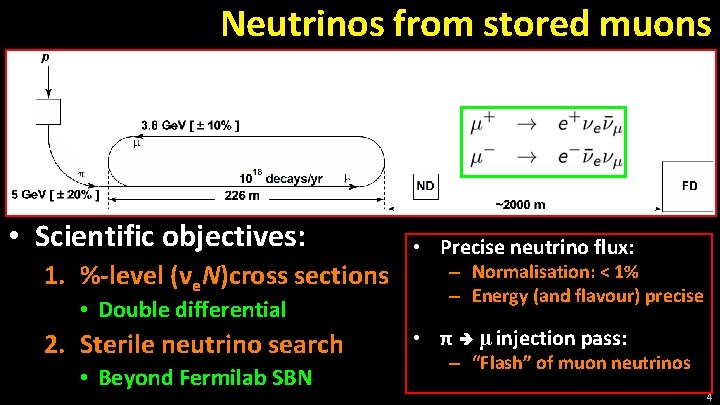
Neutrinos from stored muons • Scientific objectives: 1. %-level (νe. N)cross sections • Double differential 2. Sterile neutrino search • Beyond Fermilab SBN • Precise neutrino flux: – Normalisation: < 1% – Energy (and flavour) precise • π μ injection pass: – “Flash” of muon neutrinos 4
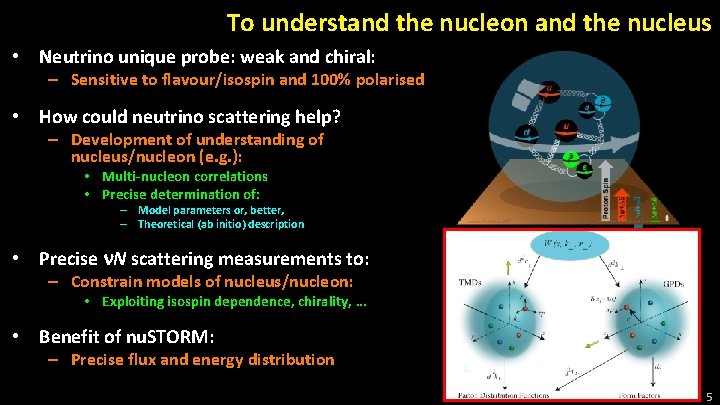
To understand the nucleon and the nucleus • Neutrino unique probe: weak and chiral: – Sensitive to flavour/isospin and 100% polarised • How could neutrino scattering help? – Development of understanding of nucleus/nucleon (e. g. ): • Multi-nucleon correlations • Precise determination of: – Model parameters or, better, – Theoretical (ab initio) description • Precise n. N scattering measurements to: – Constrain models of nucleus/nucleon: • Exploiting isospin dependence, chirality, … • Benefit of nu. STORM: – Precise flux and energy distribution 5
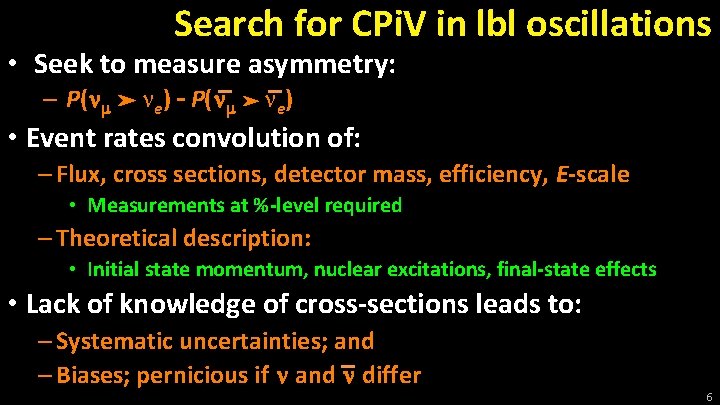
Search for CPi. V in lbl oscillations • Seek to measure asymmetry: – P(nm ➤ ne) • Event rates convolution of: – Flux, cross sections, detector mass, efficiency, E-scale • Measurements at %-level required – Theoretical description: • Initial state momentum, nuclear excitations, final-state effects • Lack of knowledge of cross-sections leads to: – Systematic uncertainties; and – Biases; pernicious if n and n differ 6
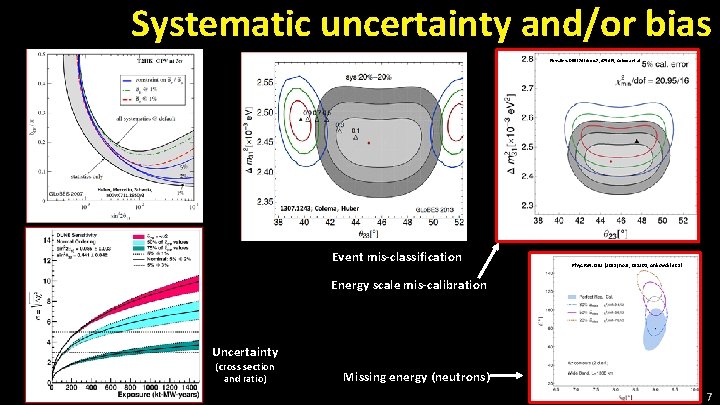
Systematic uncertainty and/or bias Phys. Rev. D 89 (2014) no. 7, 073015; Coloma et al Event mis-classification Phys. Rev. D 92 (2015) no. 9, 091301; Ankowski et al Energy scale mis-calibration Uncertainty (cross section and ratio) Missing energy (neutrons) 7
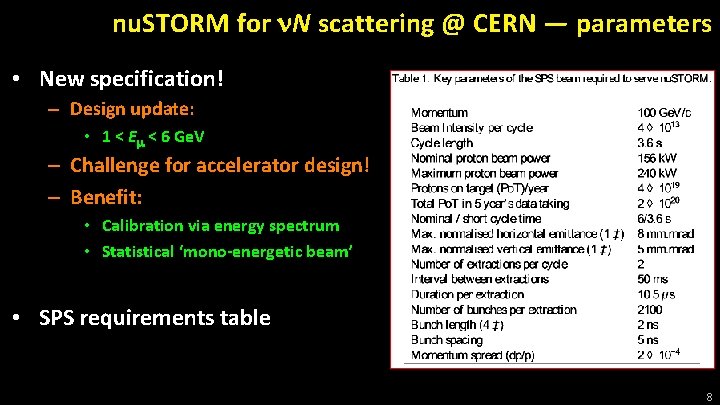
nu. STORM for n. N scattering @ CERN — parameters • New specification! – Design update: • 1 < Em < 6 Ge. V – Challenge for accelerator design! – Benefit: • Calibration via energy spectrum • Statistical ‘mono-energetic beam’ • SPS requirements table 8
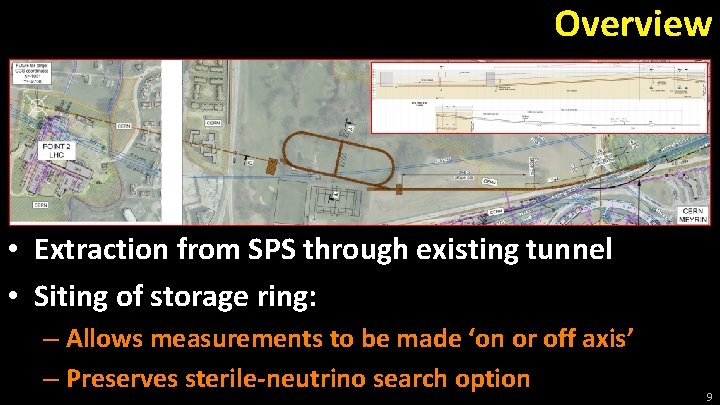
Overview • Extraction from SPS through existing tunnel • Siting of storage ring: – Allows measurements to be made ‘on or off axis’ – Preserves sterile-neutrino search option 9
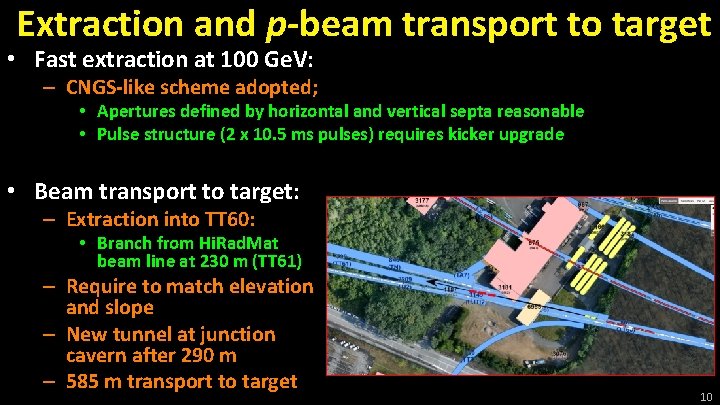
Extraction and p-beam transport to target • Fast extraction at 100 Ge. V: – CNGS-like scheme adopted; • Apertures defined by horizontal and vertical septa reasonable • Pulse structure (2 x 10. 5 ms pulses) requires kicker upgrade • Beam transport to target: – Extraction into TT 60: • Branch from Hi. Rad. Mat beam line at 230 m (TT 61) – Require to match elevation and slope – New tunnel at junction cavern after 290 m – 585 m transport to target 10
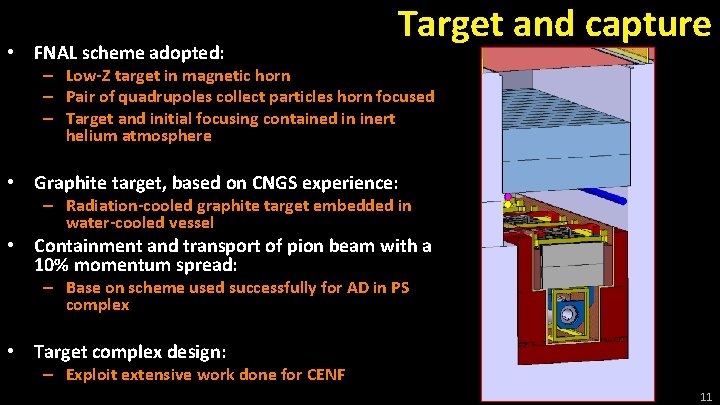
• FNAL scheme adopted: Target and capture – Low-Z target in magnetic horn – Pair of quadrupoles collect particles horn focused – Target and initial focusing contained in inert helium atmosphere • Graphite target, based on CNGS experience: – Radiation-cooled graphite target embedded in water-cooled vessel • Containment and transport of pion beam with a 10% momentum spread: – Base on scheme used successfully for AD in PS complex • Target complex design: – Exploit extensive work done for CENF 11
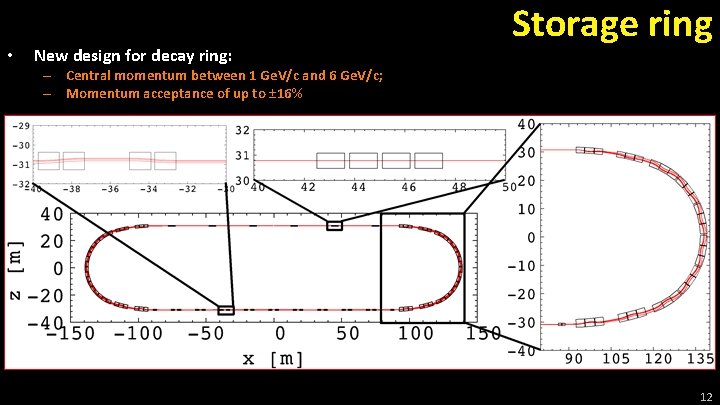
• New design for decay ring: Storage ring – Central momentum between 1 Ge. V/c and 6 Ge. V/c; – Momentum acceptance of up to ± 16% • Hybrid FODO/FFA concept developed: – Maintain large momentum and transverse dynamic acceptance simultaneously – FODO optics used in the production straight – Zero-chromaticity FFA cells used in arcs and return straight • Hybrid ring properties: – Zero dispersion in the quadrupole injection/production straight; and – Zero chromaticity in the arcs and return straight • Limits overall chromaticity of ring. • Magnets: – – Superconducting combined-function magnets (B up to 2. 6 T) in arcs Warm combined-function magnets used in return straight Large-aperture warm quadrupoles used in production straight Mean betatron functions in production and return straights large: • Minimise betatron oscillations to minimise spread of the neutrino beam 12
• New design for decay ring: Storage ring – Central momentum between 1 Ge. V/c and 6 Ge. V/c; – Momentum acceptance of up to ± 16% • Hybrid FODO/FFA concept developed: – Maintain large momentum and transverse dynamic acceptance simultaneously – FODO optics used in the production straight – Zero-chromaticity FFA cells used in arcs and return straight • Hybrid ring properties: – Zero dispersion in the quadrupole injection/production straight; and – Zero chromaticity in the arcs and return straight • Limits overall chromaticity of ring. • Magnets: – – Superconducting combined-function magnets (B up to 2. 6 T) in arcs Warm combined-function magnets used in return straight Large-aperture warm quadrupoles used in production straight Mean betatron functions in production and return straights large: • Minimise betatron oscillations to minimise spread of the neutrino beam 13
Civil engineering Radiation protection • Major CE elements: • ~200 k. W proton beam required: 40 m long junction cavern 545 m long extraction tunnel Target complex 625 m circumference decay ring Near detector facility Support buildings and infrastructure – Option: far detector on CERN land – – – • Ground well understood – Tunnelling within molasse – ~35 m vertical clearance to LHC • CE works believed to be ‘relatively straight forward’ – Radiation protection places strong constraints on facility design – Use radiological/environmental assessments carried out for CENF • Preliminary evaluation: – General feasibility of project established in terms of: • Exposure of persons • Environmental impact – Detailed studies according to the ALARA principle required later • Initial conclusion: – “At the present state of technological development, engineering solutions by which the radiological impact can be minimised are available. ” 14
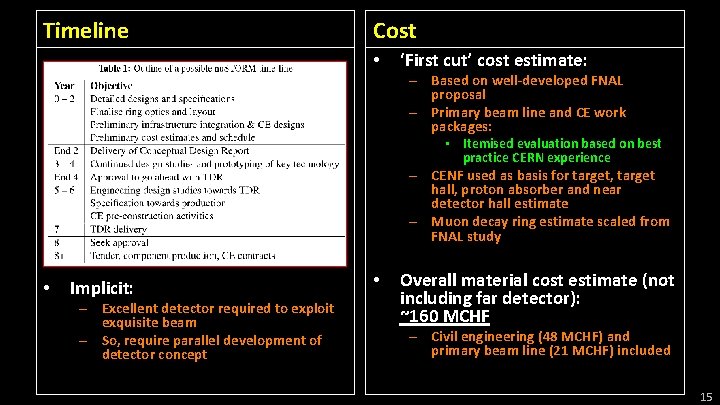
Timeline Cost • ‘First cut’ cost estimate: – Based on well-developed FNAL proposal – Primary beam line and CE work packages: • Itemised evaluation based on best practice CERN experience – CENF used as basis for target, target hall, proton absorber and near detector hall estimate – Muon decay ring estimate scaled from FNAL study • Implicit: – Excellent detector required to exploit exquisite beam – So, require parallel development of detector concept • Overall material cost estimate (not including far detector): ~160 MCHF – Civil engineering (48 MCHF) and primary beam line (21 MCHF) included 15

• Goal of PBC nu. STORM study: nu. STORM feasibility – “A credible proposal for siting at CERN …” achieved. “ … the SPS can provide the beam and offers a credible fast extraction location allowing the beam to be directed towards a green field site at a suitable distance from existing infrastructure. Initial civil engineering sketches have established a potential footprint and the geology is amenable to an installation at an appropriate depth. ” • Challenges: – Muon decay ring: • FFA concept though feasible • Require magnet development to allow production at a reasonable cost – Detailed evaluation of: • Proton-beam extraction, target and target complex • Civil engineering studies and radiological implications • Full report will be prepared for May 19; basis for continued development 16

17
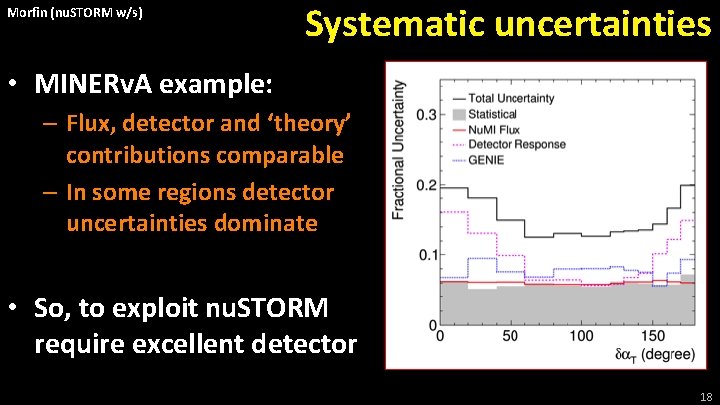
Morfin (nu. STORM w/s) Systematic uncertainties • MINERv. A example: – Flux, detector and ‘theory’ contributions comparable – In some regions detector uncertainties dominate • So, to exploit nu. STORM require excellent detector 18
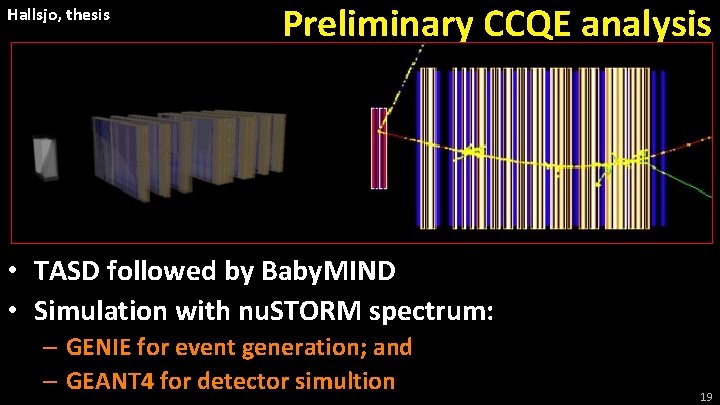
Hallsjo, thesis Preliminary CCQE analysis • TASD followed by Baby. MIND • Simulation with nu. STORM spectrum: – GENIE for event generation; and – GEANT 4 for detector simultion 19
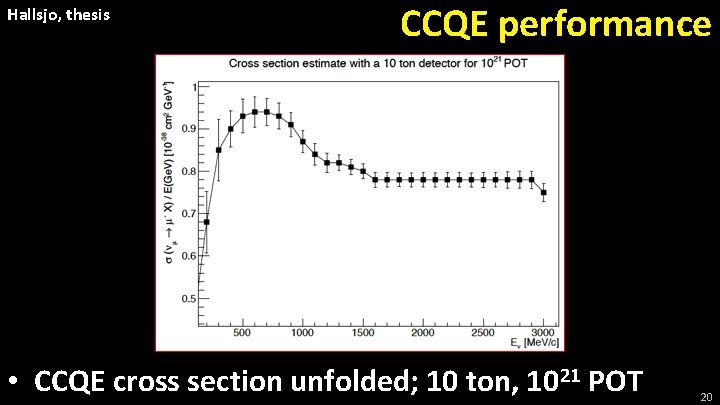
Hallsjo, thesis CCQE performance • CCQE cross section unfolded; 10 ton, 1021 POT 20
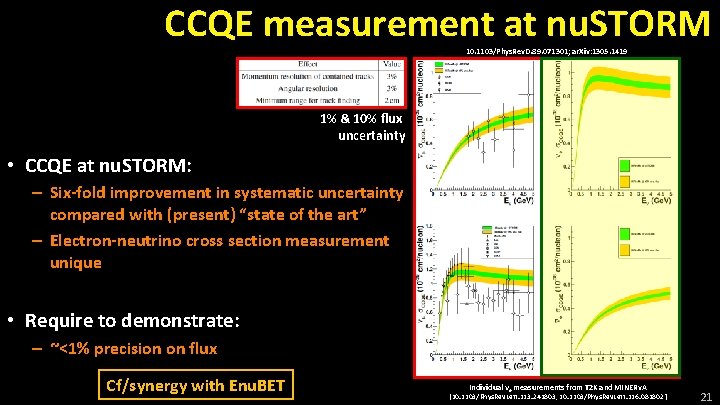
CCQE measurement at nu. STORM 10. 1103/Phys. Rev. D. 89. 071301; ar. Xiv: 1305. 1419 1% & 10% flux uncertainty • CCQE at nu. STORM: – Six-fold improvement in systematic uncertainty compared with (present) “state of the art” – Electron-neutrino cross section measurement unique • Require to demonstrate: – ~<1% precision on flux Cf/synergy with Enu. BET Individual νe measurements from T 2 K and MINERv. A [10. 1103/Phys. Rev. Lett. 113. 241803, 10. 1103/Phys. Rev. Lett. 116. 081802 ] 21
- Slides: 21