Project Management An Introduction Dr Devendra Verma DDG


- Slides: 23
Project Management. An Introduction Dr. Devendra Verma DDG (PI) Mo. SPI
What is a Project ? A Project is any work that produces a specific result and is Temporary in nature. Project always have beginning and an end and Progressively Elaborated. Project creates a Unique product or service Projects can be a part of a Program or Portfolios, But Portfolios and Programs can not be a part of a Project.
What is a Project Phase? Project could be spread over more than one Phase. A Phase could identified with the completion of one or more deliverable Project phases are collectively called project life cycles Phase end reviews are also called phase exits, Stage Gates or Kill points.
Examples of Projects Planning a wedding Hosting a holiday party Designing and implementing a computer software system Building a Power Plant / Steel Plant Executing an environmental clean-up of a contaminated site Construction of Highway/Railway/ Pipelines/ Ports etc.
Project Success Criteria On time Within budget Achieving all goals that have been planned or agreed upon i. e. meeting the scope of the project.
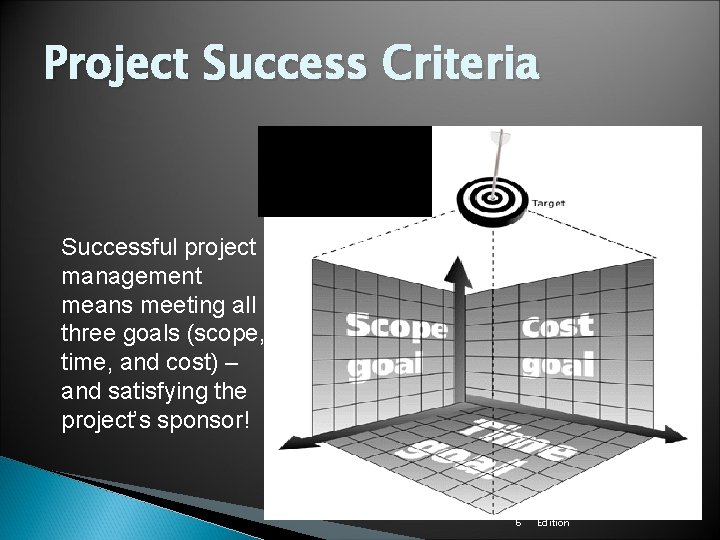
Project Success Criteria Successful project management means meeting all three goals (scope, time, and cost) – and satisfying the project’s sponsor! 6 Information Technology Project Management, Fourth Edition
Reasons for Project Failure 1. Poor project and program management discipline 2. Lack of executive-level support 3. No linkage to the business strategy 4. Wrong team members 5. No measures for evaluating the success of the project 6. No risk management 7. Inability to manage change (change management)
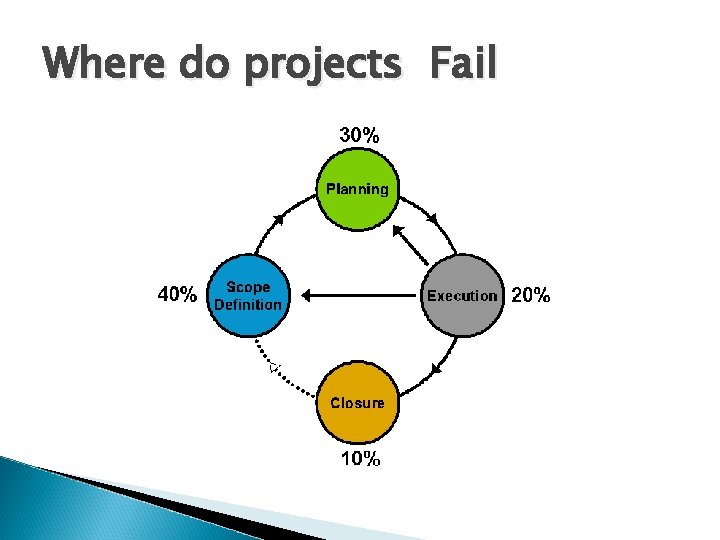
Where do projects Fail
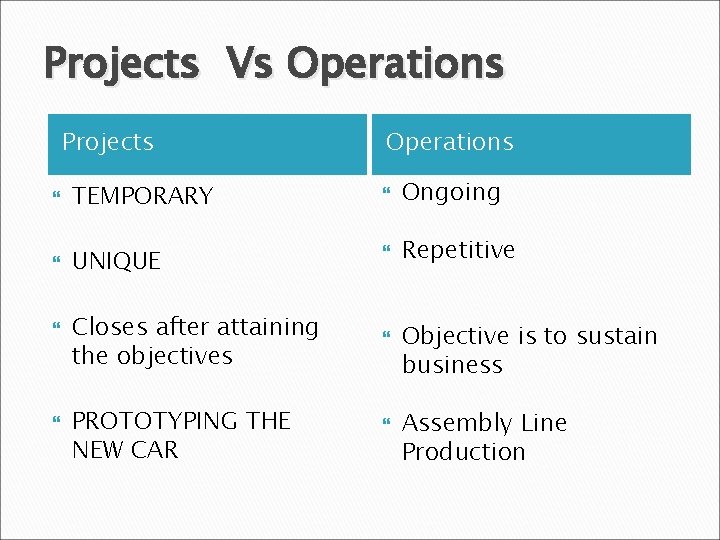
Projects Vs Operations Projects Operations TEMPORARY Ongoing UNIQUE Repetitive Closes after attaining the objectives PROTOTYPING THE NEW CAR Objective is to sustain business Assembly Line Production
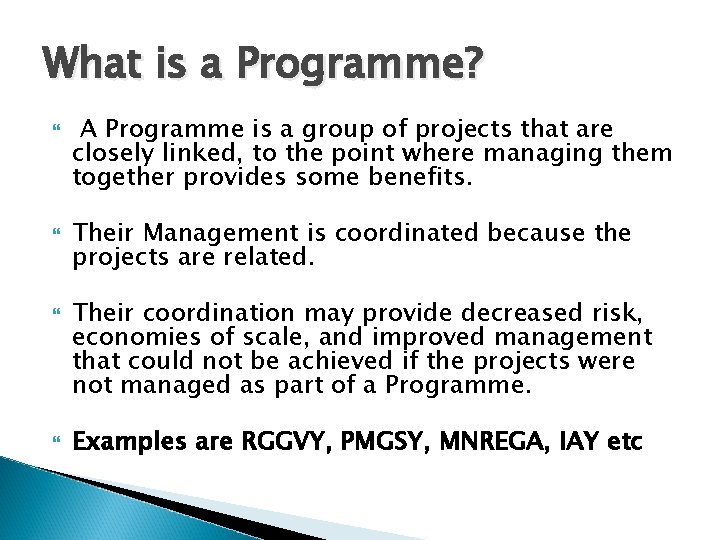
What is a Programme? A Programme is a group of projects that are closely linked, to the point where managing them together provides some benefits. Their Management is coordinated because the projects are related. Their coordination may provide decreased risk, economies of scale, and improved management that could not be achieved if the projects were not managed as part of a Programme. Examples are RGGVY, PMGSY, MNREGA, IAY etc
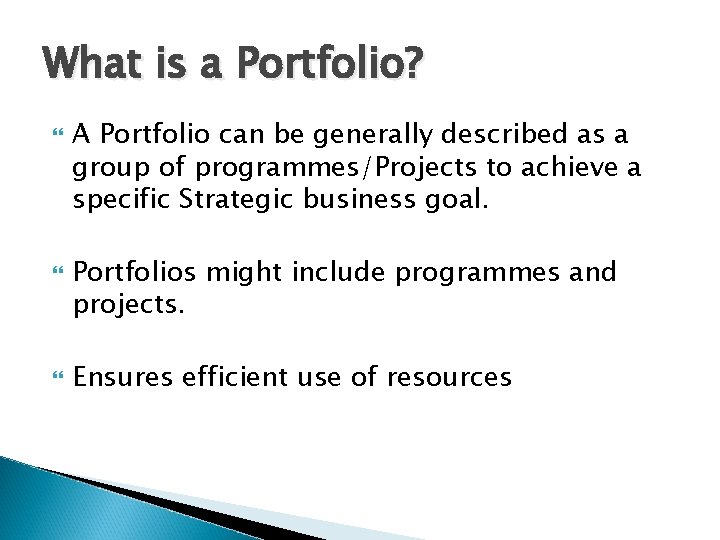
What is a Portfolio? A Portfolio can be generally described as a group of programmes/Projects to achieve a specific Strategic business goal. Portfolios might include programmes and projects. Ensures efficient use of resources
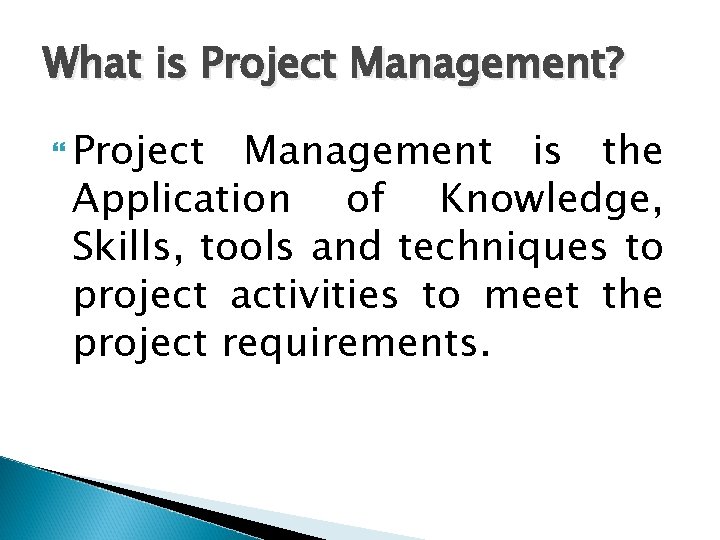
What is Project Management? Project Management is the Application of Knowledge, Skills, tools and techniques to project activities to meet the project requirements.
What is Project Management? Ø Accomplished through the application and integration of PM processes-Initiating, Executing, Monitoring Controlling and Closing. Planning, and
Contd. Establishing clear projects objectives and requirements Balancing the competing demands of scope, time, cost and quality Manage uncertain events
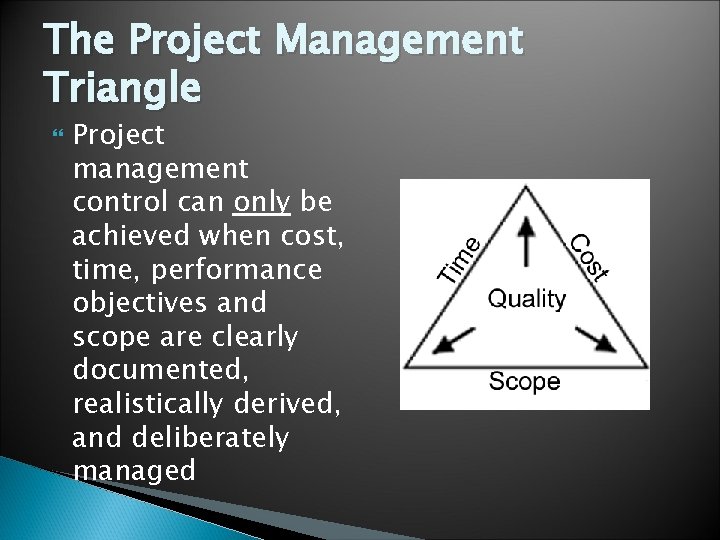
The Project Management Triangle Project management control can only be achieved when cost, time, performance objectives and scope are clearly documented, realistically derived, and deliberately managed
The Project Management Triangle (Contd. ) ◦ Cost refers to the labor cost to do a job. (This may or may not include capital equipment and material costs which may by accounted for separately. ) ◦ Time refers to the time required to complete the project. ◦ Scope is the amount of work that must be done to complete the project; it is the magnitude of the job. ◦ Quality is the area of the triangle. Projects must meet customer quality requirements.
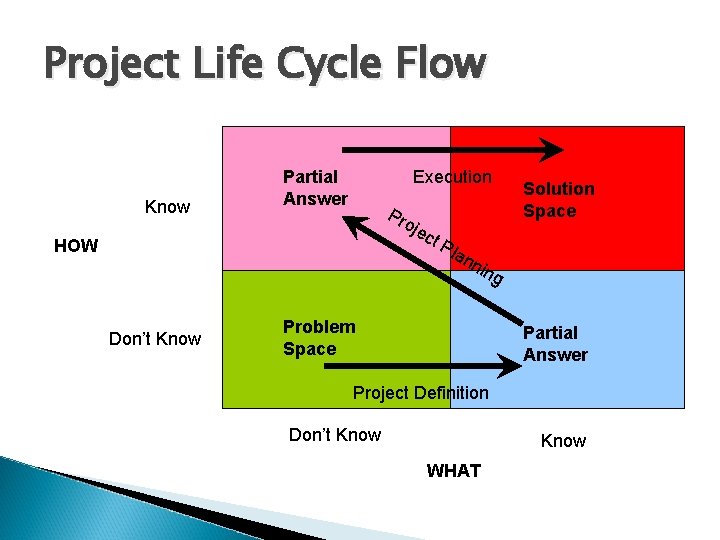
Project Life Cycle Flow Know Partial Answer Execution Pr oje ct HOW Solution Space Pla nn ing Don’t Know Problem Space Partial Answer Project Definition Don’t Know WHAT
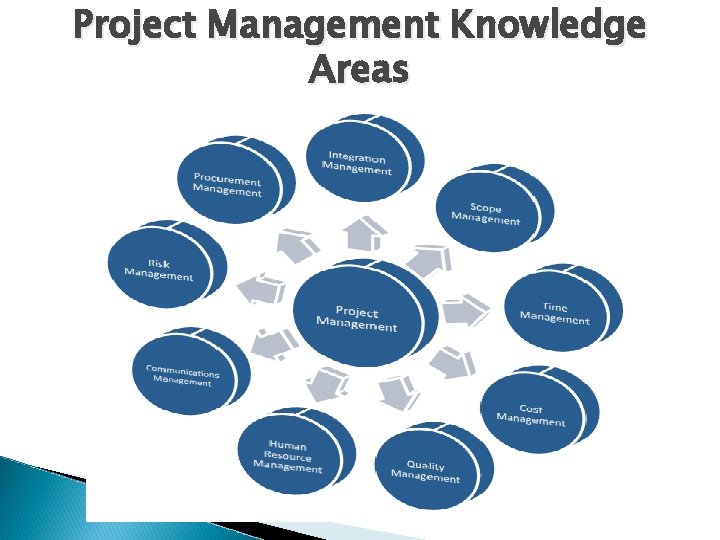
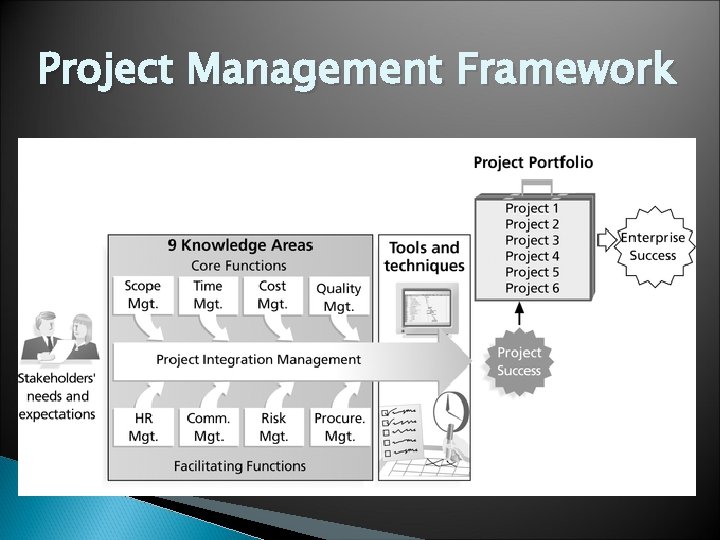
Project Management Knowledge Areas
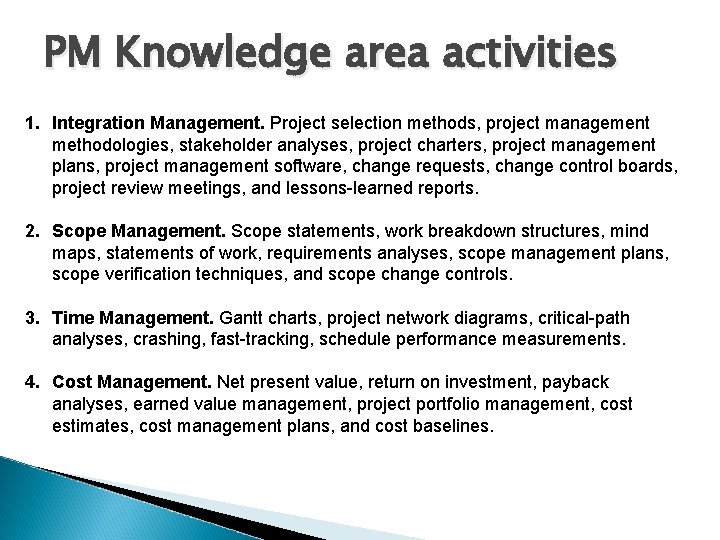
PM Knowledge area activities 1. Integration Management. Project selection methods, project management methodologies, stakeholder analyses, project charters, project management plans, project management software, change requests, change control boards, project review meetings, and lessons-learned reports. 2. Scope Management. Scope statements, work breakdown structures, mind maps, statements of work, requirements analyses, scope management plans, scope verification techniques, and scope change controls. 3. Time Management. Gantt charts, project network diagrams, critical-path analyses, crashing, fast-tracking, schedule performance measurements. 4. Cost Management. Net present value, return on investment, payback analyses, earned value management, project portfolio management, cost estimates, cost management plans, and cost baselines.
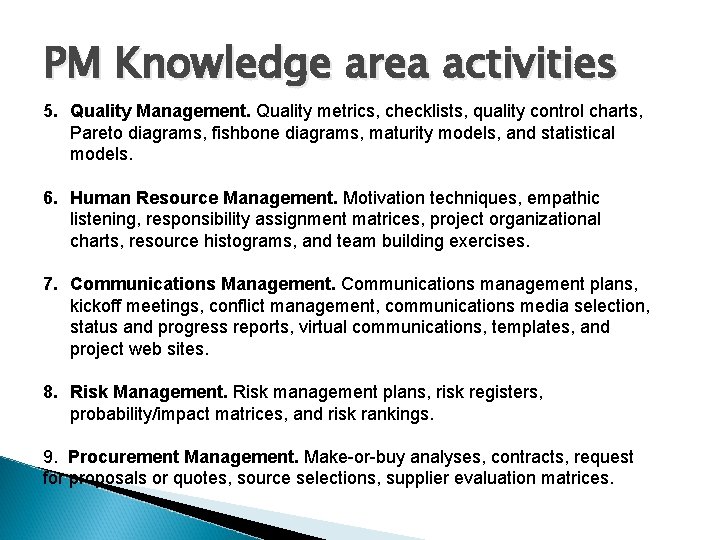
PM Knowledge area activities 5. Quality Management. Quality metrics, checklists, quality control charts, Pareto diagrams, fishbone diagrams, maturity models, and statistical models. 6. Human Resource Management. Motivation techniques, empathic listening, responsibility assignment matrices, project organizational charts, resource histograms, and team building exercises. 7. Communications Management. Communications management plans, kickoff meetings, conflict management, communications media selection, status and progress reports, virtual communications, templates, and project web sites. 8. Risk Management. Risk management plans, risk registers, probability/impact matrices, and risk rankings. 9. Procurement Management. Make-or-buy analyses, contracts, request for proposals or quotes, source selections, supplier evaluation matrices.
Project Management Framework
Summary ü Defined project/program/portfolio ü Defined project management ü Project management triangle ü Project management process groups ü Project management process Areas ü Keys to successful projects
THANKS