
Blood Component Therapy Dr Nishant Verma Department of
Blood Component Therapy Dr Nishant Verma Department of Pediatrics, KGMU, Lucknow
Historical Time Line • 17 th century- 1 st recorded transfusion (from man to animal) • 1901 - Karl Landsteiner’s discovery of ABO grouping laid foundation for scientific transfusion practices • 1920’s - development of anti-coagulation solutions to store donated blood • 1950’s - disposable plastic systems for collection and aseptic separation of blood components came into use
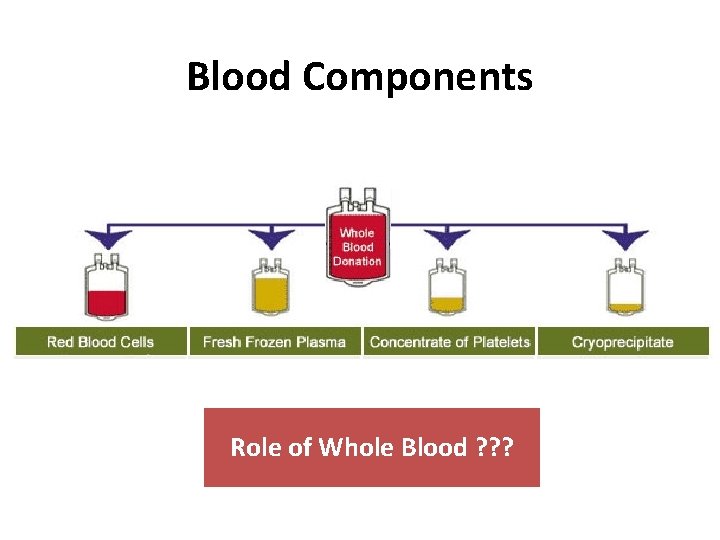
Blood Components Role of Whole Blood ? ? ?
APROPRIATE USE OF BLOOD COMPONENTS • Use Blood Components – Only if necessary • Risk Of Adverse Reactions • Use Screened Blood • Avoid Blood Transfusions as much as possible
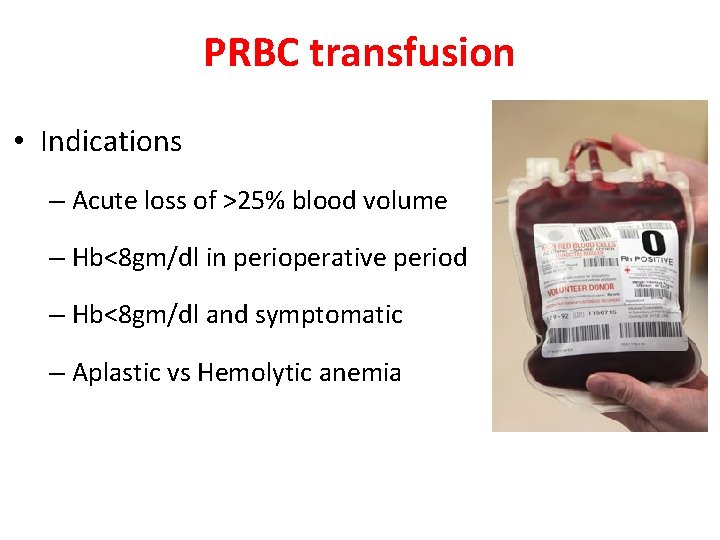
PRBC transfusion • Indications – Acute loss of >25% blood volume – Hb<8 gm/dl in perioperative period – Hb<8 gm/dl and symptomatic – Aplastic vs Hemolytic anemia
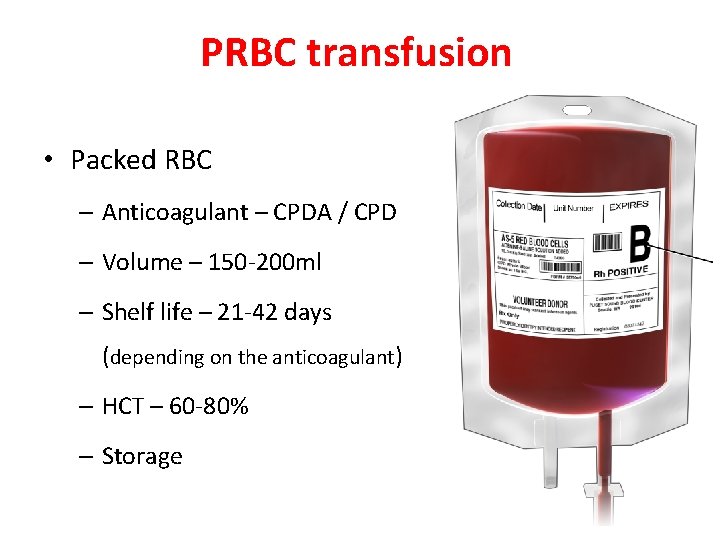
PRBC transfusion • Packed RBC – Anticoagulant – CPDA / CPD – Volume – 150 -200 ml – Shelf life – 21 -42 days (depending on the anticoagulant) – HCT – 60 -80% – Storage
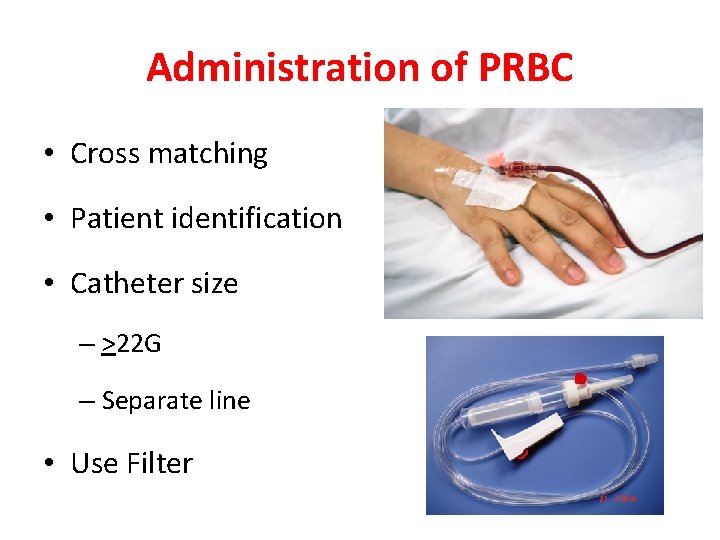
Administration of PRBC • Cross matching • Patient identification • Catheter size – >22 G – Separate line • Use Filter
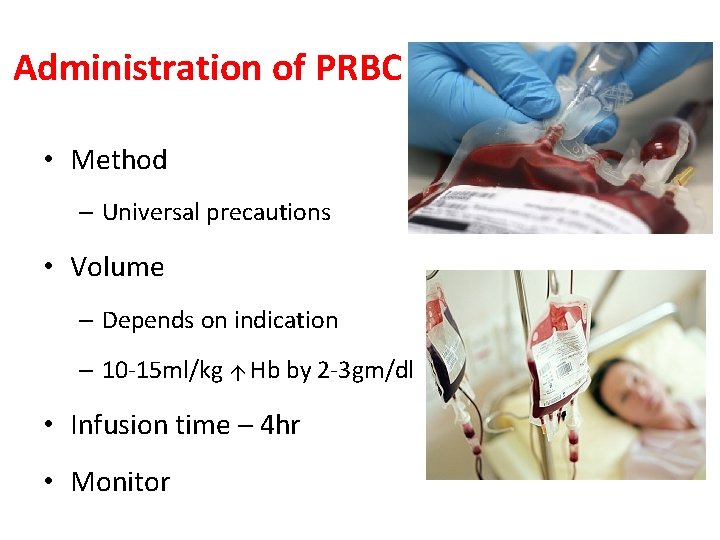
Administration of PRBC • Method – Universal precautions • Volume – Depends on indication – 10 -15 ml/kg Hb by 2 -3 gm/dl • Infusion time – 4 hr • Monitor
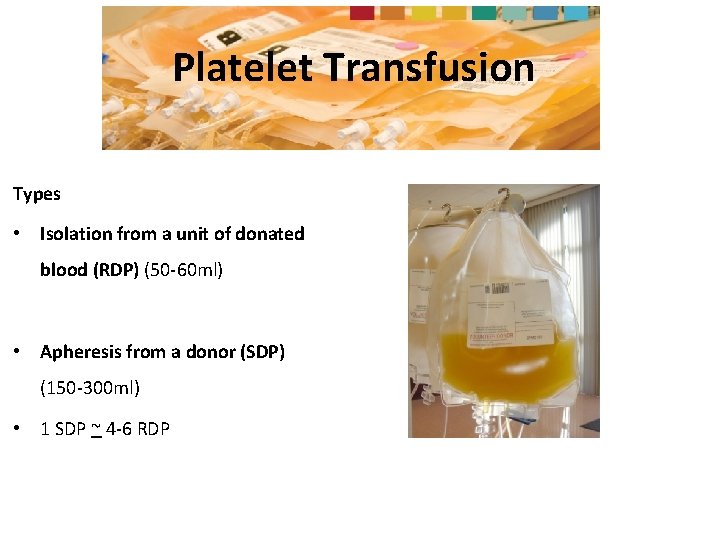
Platelet Transfusion Types • Isolation from a unit of donated blood (RDP) (50 -60 ml) • Apheresis from a donor (SDP) (150 -300 ml) • 1 SDP ~ 4 -6 RDP
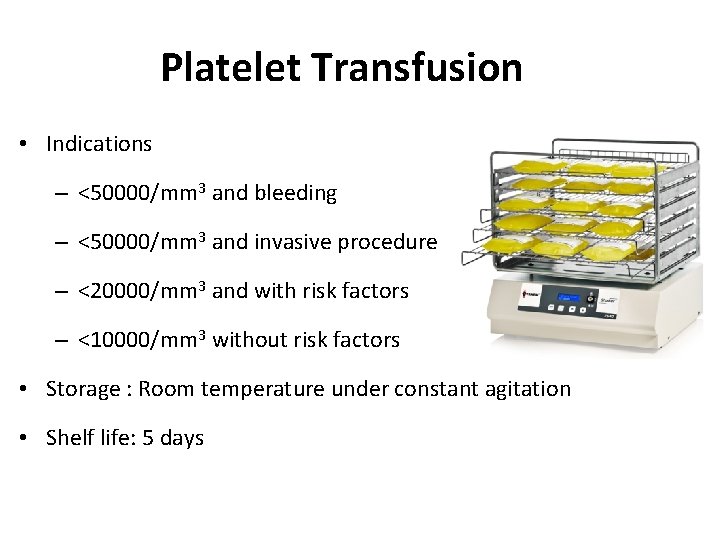
Platelet Transfusion • Indications – <50000/mm 3 and bleeding – <50000/mm 3 and invasive procedure – <20000/mm 3 and with risk factors – <10000/mm 3 without risk factors • Storage : Room temperature under constant agitation • Shelf life: 5 days
Platelet Transfusion • Dose – 1 U RDP / 10 kg body wt, or – 10 ml/kg ( Plt count by 30000/mm 3) • Cross matching • Administration • Rate – Over 20 -30 min
FRESH FROZEN PLASMA • Plasma Frozen At – 18 to -300 C within 8 hrs • Shelf life – 1 yr • Stable Clotting Factors as well as Factor VIII • 200 - 250 ml • Ideally Thawed in Blood Bank • ABO matching – Donor plasma contains A and/or B alloantibodies – Must be either ABO-identical or ABO-compatible with the recipient.
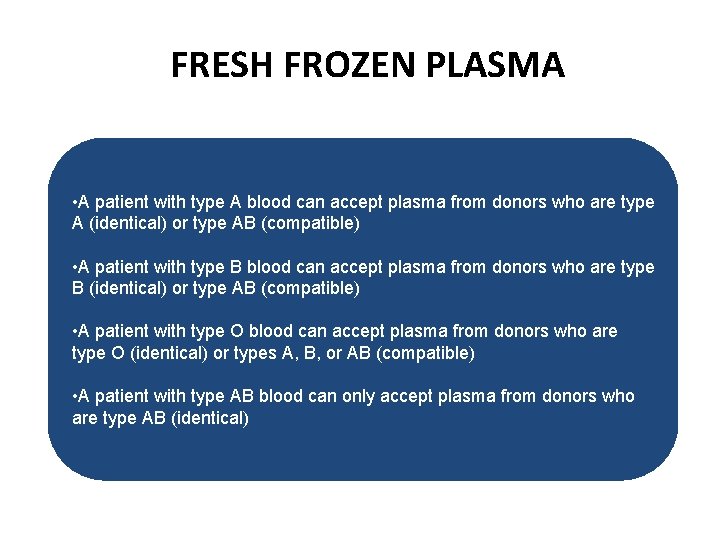
FRESH FROZEN PLASMA • A patient with type A blood can accept plasma from donors who are type A (identical) or type AB (compatible) • A patient with type B blood can accept plasma from donors who are type B (identical) or type AB (compatible) • A patient with type O blood can accept plasma from donors who are type O (identical) or types A, B, or AB (compatible) • A patient with type AB blood can only accept plasma from donors who are type AB (identical)
FFP- INDICATIONS Indications • Hereditary clotting factor deficiencies • von Willebrand disease • Acquired coagulation defects – severe liver disease – DIC – Severe Vitamin K deficiency bleeding • Availability of purified and recombinant coagulation factors - the use of FFP has markedly declined • Dose – 10 ml/kg
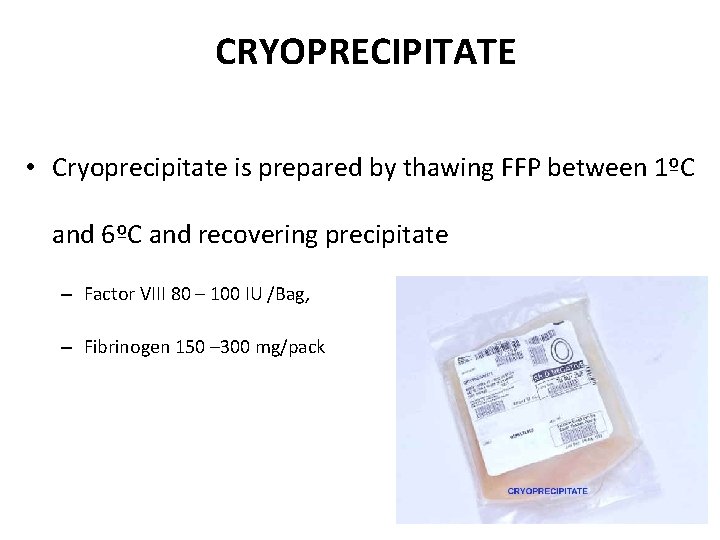
CRYOPRECIPITATE • Cryoprecipitate is prepared by thawing FFP between 1ºC and 6ºC and recovering precipitate – Factor VIII 80 – 100 IU /Bag, – Fibrinogen 150 – 300 mg/pack
INDICATIONS • von Willebrandt Disease • Hemophilia A • Factor XIII deficiency • DIC • Dys & Hypofibrinogenemia • One Unit per 7 – 10 Kg. BW
Complications of Blood Transfusion
Types • Infection • Transfusion reactions • Circulatory overload • Metabolic • Iron overload
Types • Infection • Transfusion reactions • Circulatory overload • Metabolic • Iron overload
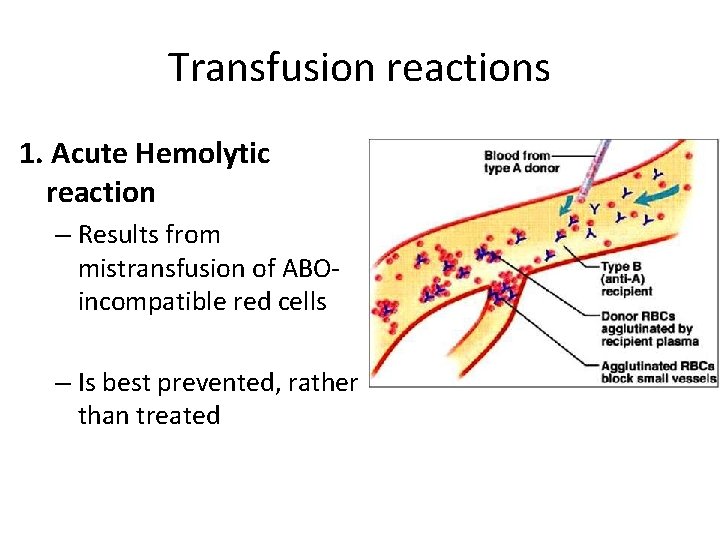
Transfusion reactions 1. Acute Hemolytic reaction – Results from mistransfusion of ABOincompatible red cells – Is best prevented, rather than treated
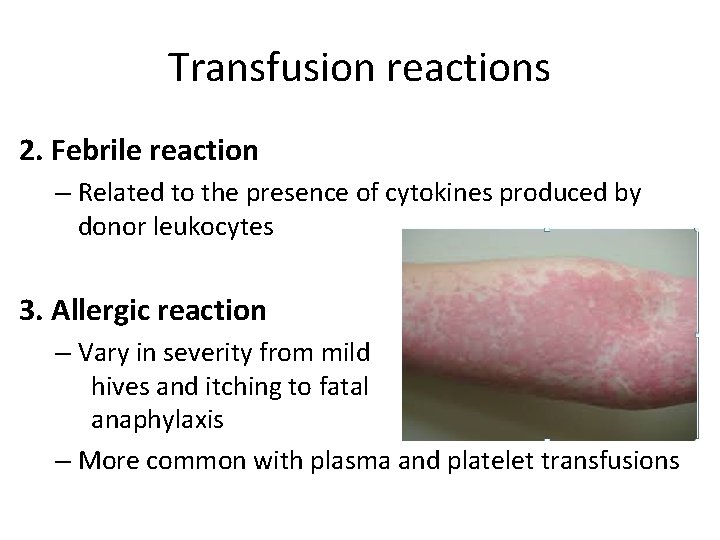
Transfusion reactions 2. Febrile reaction – Related to the presence of cytokines produced by donor leukocytes 3. Allergic reaction – Vary in severity from mild hives and itching to fatal anaphylaxis – More common with plasma and platelet transfusions
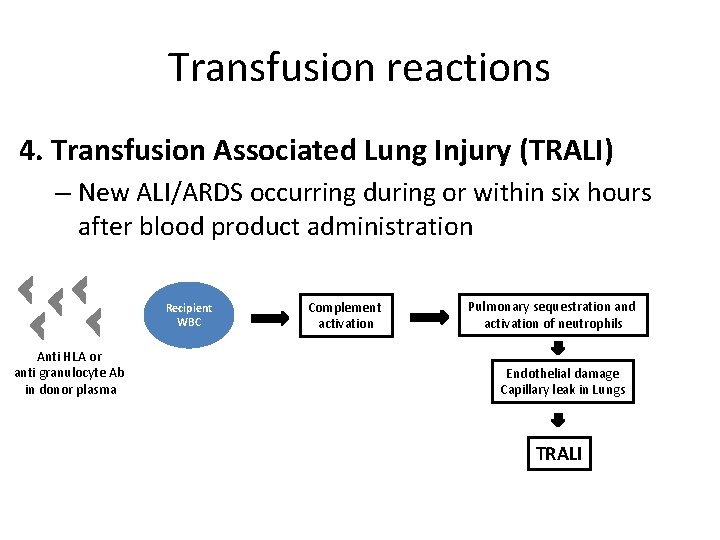
Transfusion reactions 4. Transfusion Associated Lung Injury (TRALI) – New ALI/ARDS occurring during or within six hours after blood product administration Recipient WBC Anti HLA or anti granulocyte Ab in donor plasma Complement activation Pulmonary sequestration and activation of neutrophils Endothelial damage Capillary leak in Lungs TRALI
TRALI • C/F – Dyspnea, bilateral noncardiogenic pulmonary edema, hypotension, fever • Tt – Supportive
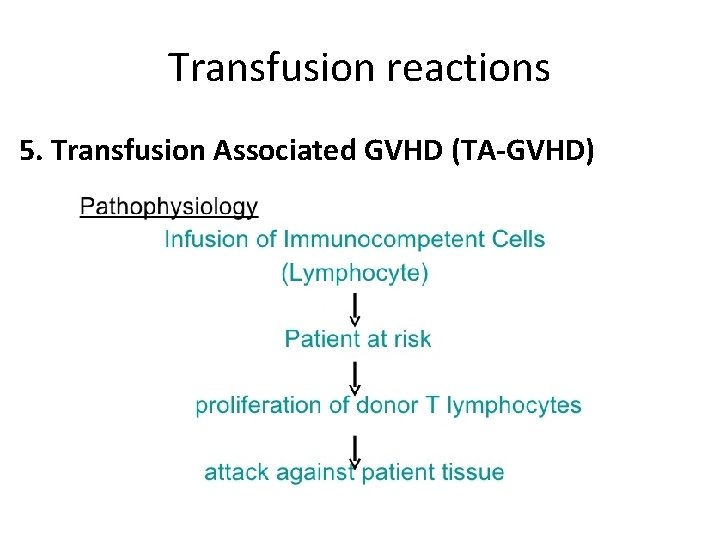
Transfusion reactions 5. Transfusion Associated GVHD (TA-GVHD)
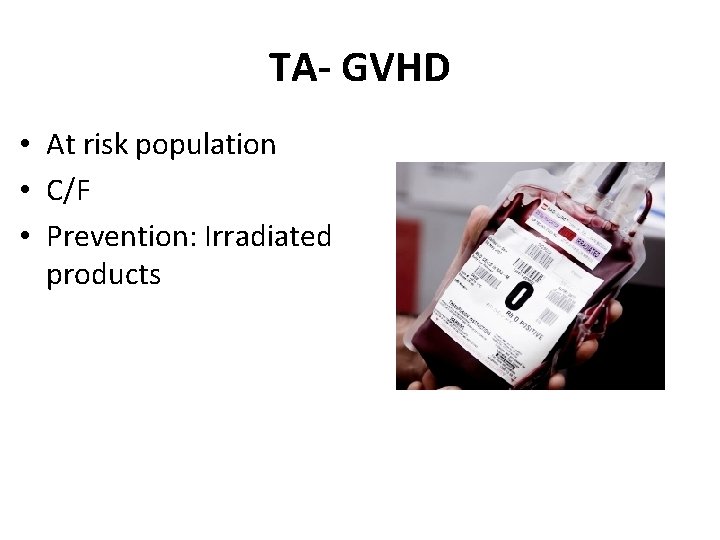
TA- GVHD • At risk population • C/F • Prevention: Irradiated products
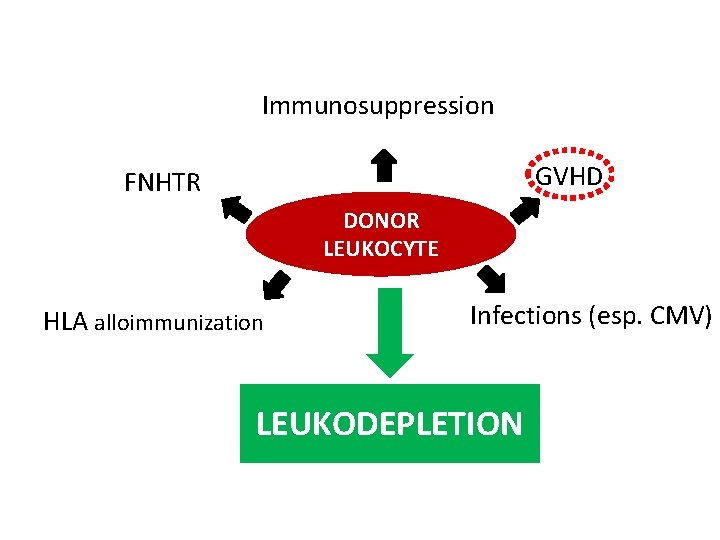
Immunosuppression GVHD FNHTR DONOR LEUKOCYTE HLA alloimmunization Infections (esp. CMV) LEUKODEPLETION
Leukodepletion • Each unit of whole blood or unmodified PRBC contains roughly 2 to 5 x 10⁹ leukocytes • Filters – 2 nd generation: 90 -99% reduction [1 -2 Log ] – 3 rd generation: 99. 9 -99. 99% reduction [3 -4 Log ]
If possible always avoid a transfusion…… Risk of infections/ reactions Transfusion may prove fatal (TRALI)
If transfusion is must… Use appropriate blood component not just blood
- Slides: 30