PROGRAM PRESENTATION INVESTMENTCENTRIC PROJECT MANAGEMENT NAIAD Company Ltd

- Slides: 34
PROGRAM PRESENTATION INVESTMENT-CENTRIC PROJECT MANAGEMENT NAIAD Company Ltd 2017. All rights reserved www. naiad. ca
1. THE POINT 2. ICPM 3. BASIS OF ORCHESTRATION 4. METHODS OF PROJECT MANAGEMENT
1. THE POINT Project Management The Next Generation NAIAD Company Ltd 2017. All rights reserved www. naiad. ca
” In an age of depressed commodity prices, who can afford the odds of failure that plague industrial projects, small and large, far and wide? Projects are risky. Their execution, riskier. Their success? Unlikely, if the status quo is allowed to prevail. Steven Keays (2016)
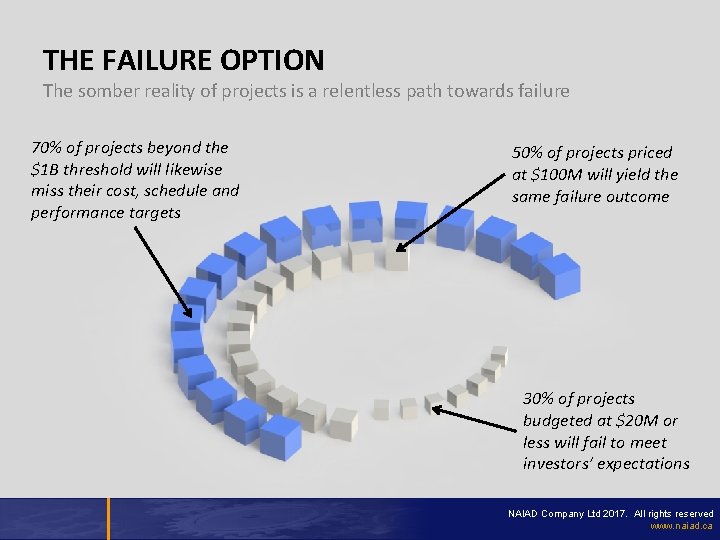
THE FAILURE OPTION The somber reality of projects is a relentless path towards failure 70% of projects beyond the $1 B threshold will likewise miss their cost, schedule and performance targets 50% of projects priced at $100 M will yield the same failure outcome 30% of projects budgeted at $20 M or less will fail to meet investors’ expectations NAIAD Company Ltd 2017. All rights reserved www. naiad. ca
A new paradigm The status quo is often justified but rarely justifiable THE PROJECT A project is the development of a profitably performing asset. Development includes everything between the first inkling of the asset and the first successful quarterly performance of the operated asset. The project ends when the asset has been proven profitably performing. The project is only the means to the end: the commercially successful asset. THE POINT The asset is the point of the project and its sole purpose. The performing asset maximizes revenues. The profitable performance minimizes its costs of ownership. The profitably performing asset yields sustained ROI to its shareholders over its economic life. PROJECT MANAGEMENT Project management is the controlled execution of the project. Functionally, PM is simultaneously an organization, a business and a relationship nexus. ICPM Investment-centric project management is a comprehensive methodology for executing industrial projects. ICPM is both a management system and an execution strategy. It mandates that all decisions during development be resolved in favor of the ROI objective.
Terminology Terms, acronyms and concepts AAR BAEF / PEP After-Action Review Baseline Asset Execution Framework / Phase Execution Plan Collection substrate Integrated datum management database, based on the asset’s physical configuration. Constraint diamond PPA execution constraints Constraint trifecta Execution constraints cost-schedule-quality Construction basis The entirety of the drawings, specifications, material lists, manuals and other deliverables from which the asset is constructed. Directrix Management principle that divides accountability into three separate elements: the accountable party (AP), responsible party (RP) and probate party (PP). ICPM Investment-Centric Project Management PAM Project Assessment Metrics PPA Profitably Performing Asset SOE /SOL Standard Operating Environment / Standard Operating Landscape TIC / TCO Total Installed Costs / Total Costs of Ownership TPM Traditional Project Management UTP Unit Transformation Process Valunomy Measure of economic value of a product service. NAIAD Company Ltd 2017. All rights reserved www. naiad. ca
2. ICPM Projects as investment vehicles NAIAD Company Ltd 2017. All rights reserved www. naiad. ca
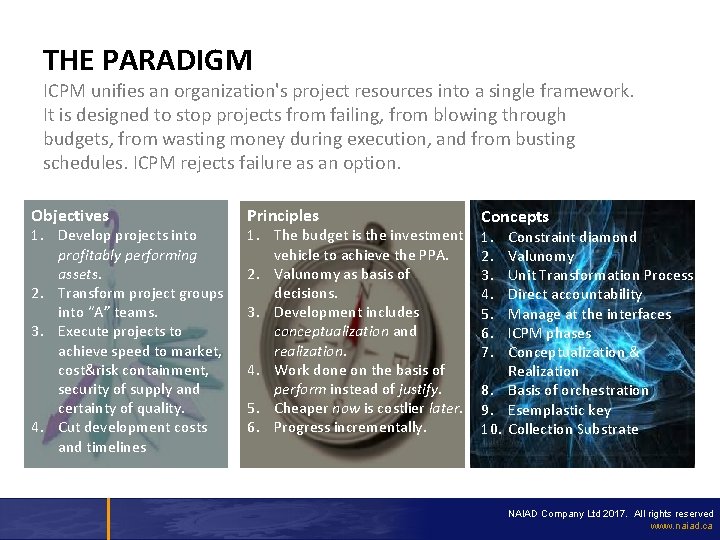
THE PARADIGM ICPM unifies an organization's project resources into a single framework. It is designed to stop projects from failing, from blowing through budgets, from wasting money during execution, and from busting schedules. ICPM rejects failure as an option. Objectives 1. Develop projects into profitably performing assets. 2. Transform project groups into “A” teams. 3. Execute projects to achieve speed to market, cost&risk containment, security of supply and certainty of quality. 4. Cut development costs and timelines Principles 1. The budget is the investment vehicle to achieve the PPA. 2. Valunomy as basis of decisions. 3. Development includes conceptualization and realization. 4. Work done on the basis of perform instead of justify. 5. Cheaper now is costlier later. 6. Progress incrementally. Concepts 1. 2. 3. 4. 5. 6. 7. Constraint diamond Valunomy Unit Transformation Process Direct accountability Manage at the interfaces ICPM phases Conceptualization & Realization 8. Basis of orchestration 9. Esemplastic key 10. Collection Substrate NAIAD Company Ltd 2017. All rights reserved www. naiad. ca
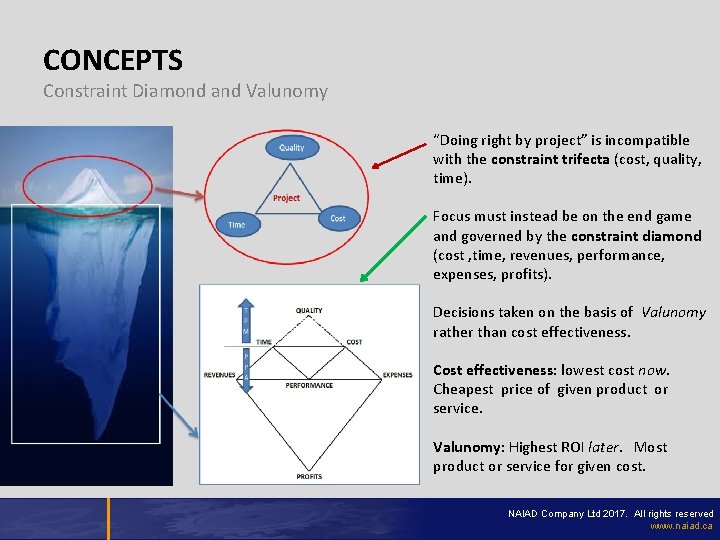
CONCEPTS Constraint Diamond and Valunomy “Doing right by project” is incompatible with the constraint trifecta (cost, quality, time). Focus must instead be on the end game and governed by the constraint diamond (cost , time, revenues, performance, expenses, profits). Decisions taken on the basis of Valunomy rather than cost effectiveness. Cost effectiveness: lowest cost now. Cheapest price of given product or service. Valunomy: Highest ROI later. Most product or service for given cost. NAIAD Company Ltd 2017. All rights reserved www. naiad. ca
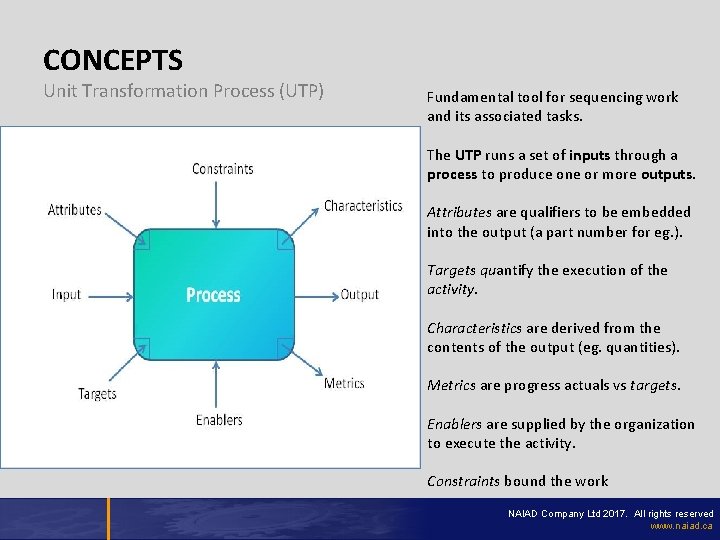
CONCEPTS Unit Transformation Process (UTP) Fundamental tool for sequencing work and its associated tasks. The UTP runs a set of inputs through a process to produce one or more outputs. Attributes are qualifiers to be embedded into the output (a part number for eg. ). Targets quantify the execution of the activity. Characteristics are derived from the contents of the output (eg. quantities). Metrics are progress actuals vs targets. Enablers are supplied by the organization to execute the activity. Constraints bound the work NAIAD Company Ltd 2017. All rights reserved www. naiad. ca
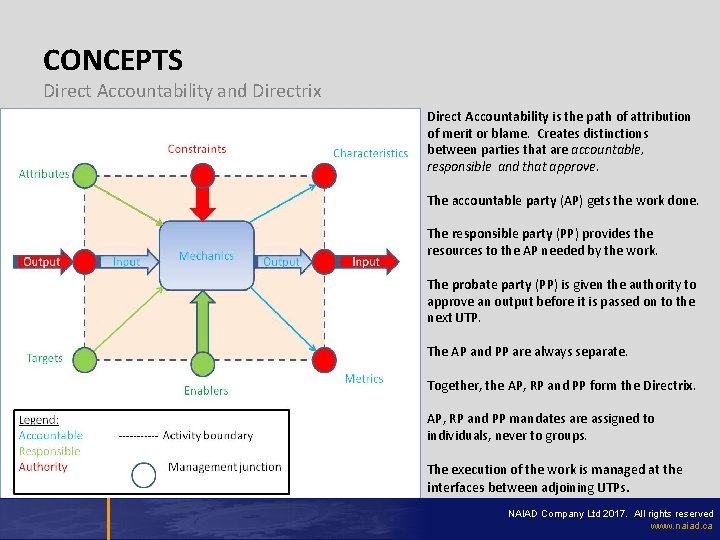
CONCEPTS Direct Accountability and Directrix Direct Accountability is the path of attribution of merit or blame. Creates distinctions between parties that are accountable, responsible and that approve. The accountable party (AP) gets the work done. The responsible party (PP) provides the resources to the AP needed by the work. The probate party (PP) is given the authority to approve an output before it is passed on to the next UTP. The AP and PP are always separate. Together, the AP, RP and PP form the Directrix. AP, RP and PP mandates are assigned to individuals, never to groups. The execution of the work is managed at the interfaces between adjoining UTPs. NAIAD Company Ltd 2017. All rights reserved www. naiad. ca
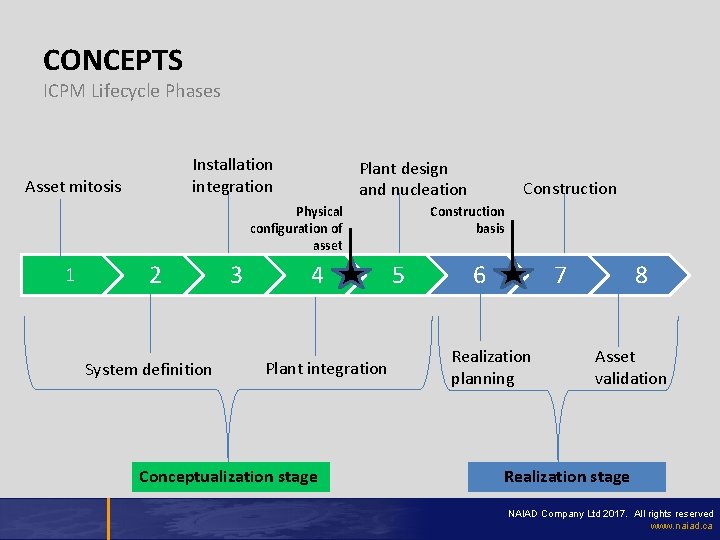
CONCEPTS ICPM Lifecycle Phases Installation integration Asset mitosis Plant design and nucleation Physical configuration of asset 1 2 System definition 3 4 Plant integration Conceptualization stage Construction basis 5 6 7 Realization planning 8 Asset validation Realization stage NAIAD Company Ltd 2017. All rights reserved www. naiad. ca
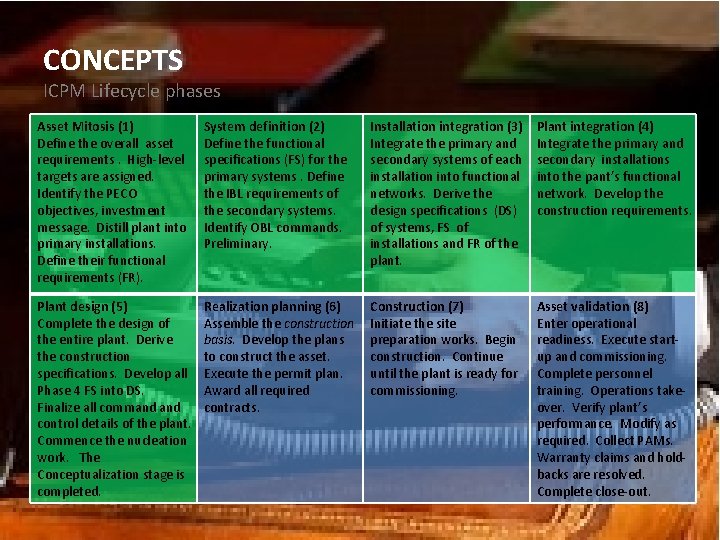
CONCEPTS ICPM Lifecycle phases Asset Mitosis (1) Define the overall asset requirements. High-level targets are assigned. Identify the PECO objectives, investment message. Distill plant into primary installations. Define their functional requirements (FR). System definition (2) Define the functional specifications (FS) for the primary systems. Define the IBL requirements of the secondary systems. Identify OBL commands. Preliminary. Installation integration (3) Integrate the primary and secondary systems of each installation into functional networks. Derive the design specifications (DS) of systems, FS of installations and FR of the plant. Plant integration (4) Integrate the primary and secondary installations into the pant’s functional network. Develop the construction requirements. Plant design (5) Complete the design of the entire plant. Derive the construction specifications. Develop all Phase 4 FS into DS. Finalize all command control details of the plant. Commence the nucleation work. The Conceptualization stage is completed. Realization planning (6) Assemble the construction basis. Develop the plans to construct the asset. Execute the permit plan. Award all required contracts. Construction (7) Initiate the site preparation works. Begin construction. Continue until the plant is ready for commissioning. Asset validation (8) Enter operational readiness. Execute startup and commissioning. Complete personnel training. Operations takeover. Verify plant’s performance. Modify as required. Collect PAMs. Warranty claims and holdbacks are resolved. Complete close-out.
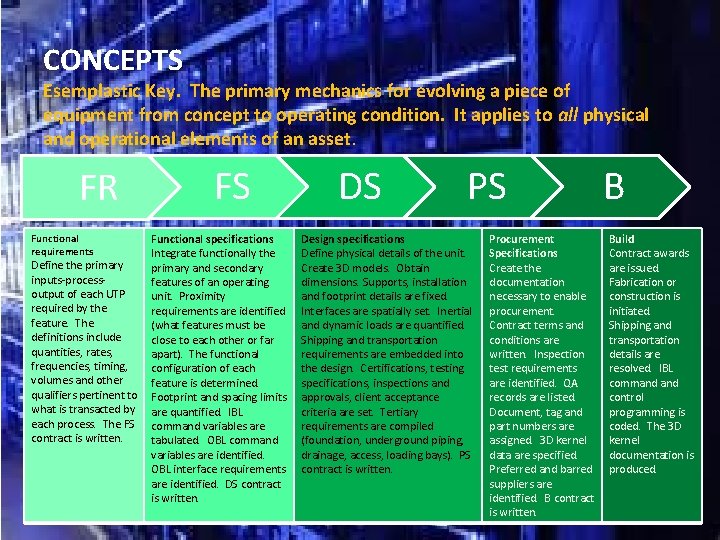
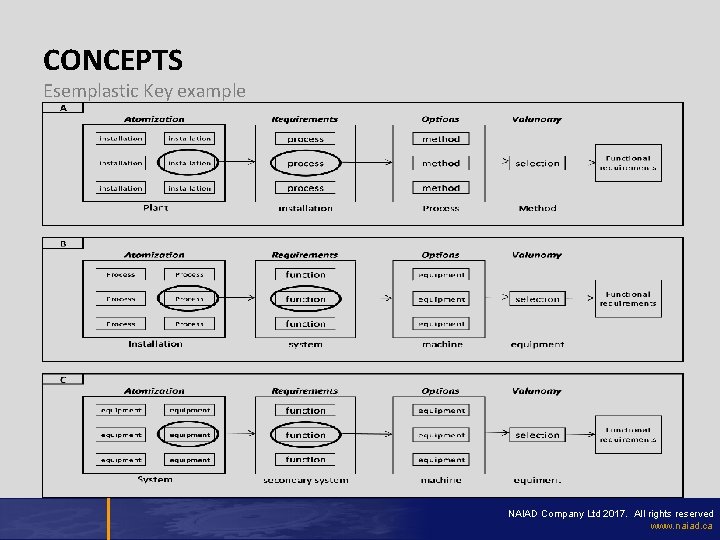
CONCEPTS Esemplastic Key. The primary mechanics for evolving a piece of equipment from concept to operating condition. It applies to all physical and operational elements of an asset. FR Functional requirements Define the primary inputs-processoutput of each UTP required by the feature. The definitions include quantities, rates, frequencies, timing, volumes and other qualifiers pertinent to what is transacted by each process. The FS contract is written. FS Functional specifications Integrate functionally the primary and secondary features of an operating unit. Proximity requirements are identified (what features must be close to each other or far apart). The functional configuration of each feature is determined. Footprint and spacing limits are quantified. IBL command variables are tabulated. OBL command variables are identified. OBL interface requirements are identified. DS contract is written. DS PS Design specifications Define physical details of the unit. Create 3 D models. Obtain dimensions. Supports, installation and footprint details are fixed. Interfaces are spatially set. Inertial and dynamic loads are quantified. Shipping and transportation requirements are embedded into the design. Certifications, testing specifications, inspections and approvals, client acceptance criteria are set. Tertiary requirements are compiled (foundation, underground piping, drainage, access, loading bays). PS contract is written. Procurement Specifications Create the documentation necessary to enable procurement. Contract terms and conditions are written. Inspection test requirements are identified. QA records are listed. Document, tag and part numbers are assigned. 3 D kernel data are specified. Preferred and barred suppliers are identified. B contract is written. B Build Contract awards are issued. Fabrication or construction is initiated. Shipping and transportation details are resolved. IBL command control programming is coded. The 3 D kernel documentation is produced.
CONCEPTS Esemplastic Key example NAIAD Company Ltd 2017. All rights reserved www. naiad. ca
3. BASIS OF ORCHESTRATION Physical configuration of the asset
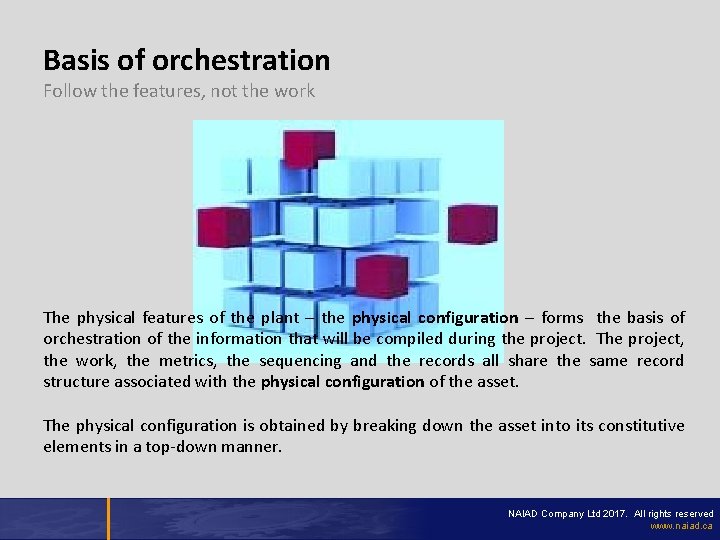
Basis of orchestration Follow the features, not the work The physical features of the plant – the physical configuration – forms the basis of orchestration of the information that will be compiled during the project. The project, the work, the metrics, the sequencing and the records all share the same record structure associated with the physical configuration of the asset. The physical configuration is obtained by breaking down the asset into its constitutive elements in a top-down manner. NAIAD Company Ltd 2017. All rights reserved www. naiad. ca
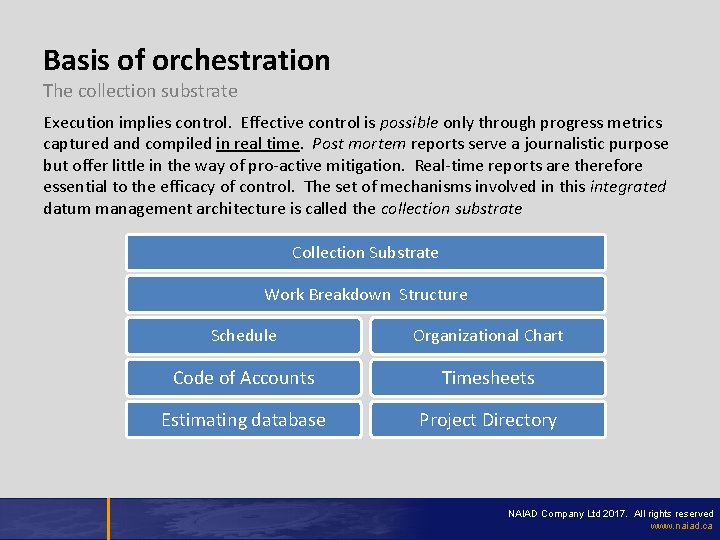
Basis of orchestration The collection substrate Execution implies control. Effective control is possible only through progress metrics captured and compiled in real time. Post mortem reports serve a journalistic purpose but offer little in the way of pro-active mitigation. Real-time reports are therefore essential to the efficacy of control. The set of mechanisms involved in this integrated datum management architecture is called the collection substrate Collection Substrate Work Breakdown Structure Schedule Organizational Chart Code of Accounts Timesheets Estimating database Project Directory NAIAD Company Ltd 2017. All rights reserved www. naiad. ca
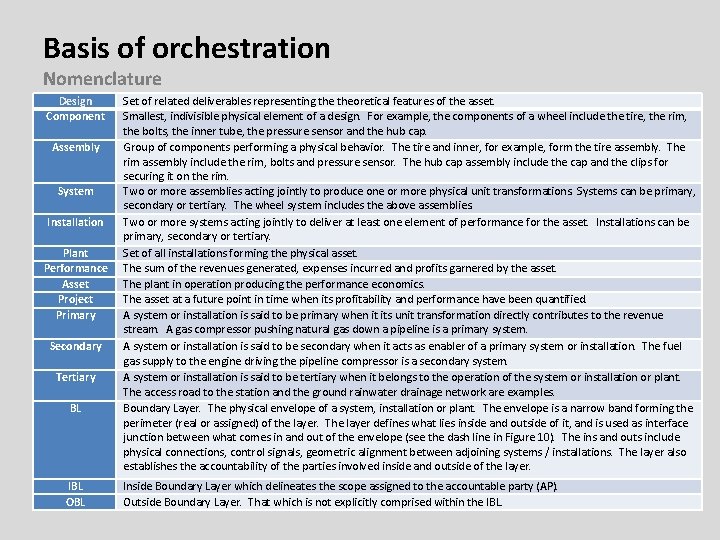
Basis of orchestration Nomenclature Design Component Assembly System Installation Plant Performance Asset Project Primary Secondary Tertiary BL IBL OBL Set of related deliverables representing theoretical features of the asset. Smallest, indivisible physical element of a design. For example, the components of a wheel include the tire, the rim, the bolts, the inner tube, the pressure sensor and the hub cap. Group of components performing a physical behavior. The tire and inner, for example, form the tire assembly. The rim assembly include the rim, bolts and pressure sensor. The hub cap assembly include the cap and the clips for securing it on the rim. Two or more assemblies acting jointly to produce one or more physical unit transformations. Systems can be primary, secondary or tertiary. The wheel system includes the above assemblies. Two or more systems acting jointly to deliver at least one element of performance for the asset. Installations can be primary, secondary or tertiary. Set of all installations forming the physical asset. The sum of the revenues generated, expenses incurred and profits garnered by the asset. The plant in operation producing the performance economics. The asset at a future point in time when its profitability and performance have been quantified. A system or installation is said to be primary when it its unit transformation directly contributes to the revenue stream. A gas compressor pushing natural gas down a pipeline is a primary system. A system or installation is said to be secondary when it acts as enabler of a primary system or installation. The fuel gas supply to the engine driving the pipeline compressor is a secondary system. A system or installation is said to be tertiary when it belongs to the operation of the system or installation or plant. The access road to the station and the ground rainwater drainage network are examples. Boundary Layer. The physical envelope of a system, installation or plant. The envelope is a narrow band forming the perimeter (real or assigned) of the layer. The layer defines what lies inside and outside of it, and is used as interface junction between what comes in and out of the envelope (see the dash line in Figure 10). The ins and outs include physical connections, control signals, geometric alignment between adjoining systems / installations. The layer also establishes the accountability of the parties involved inside and outside of the layer. Inside Boundary Layer which delineates the scope assigned to the accountable party (AP). Outside Boundary Layer. That which is not explicitly comprised within the IBL.
4. METHODS of Project Management
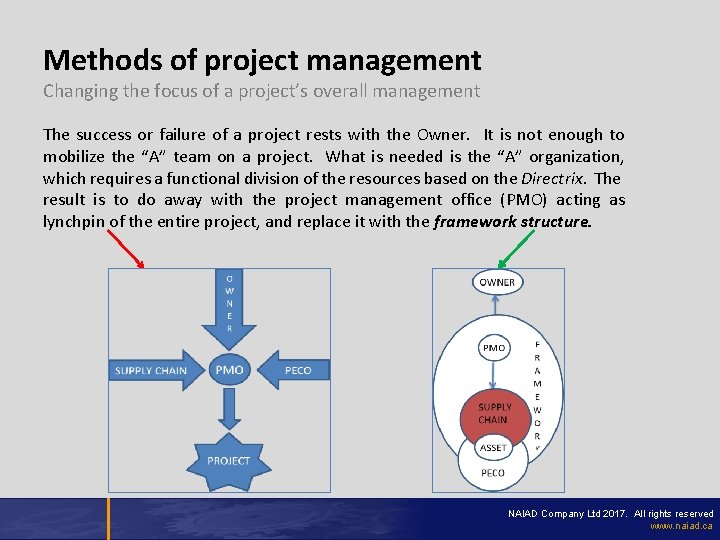
Methods of project management Changing the focus of a project’s overall management The success or failure of a project rests with the Owner. It is not enough to mobilize the “A” team on a project. What is needed is the “A” organization, which requires a functional division of the resources based on the Directrix. The result is to do away with the project management office (PMO) acting as lynchpin of the entire project, and replace it with the framework structure. NAIAD Company Ltd 2017. All rights reserved www. naiad. ca
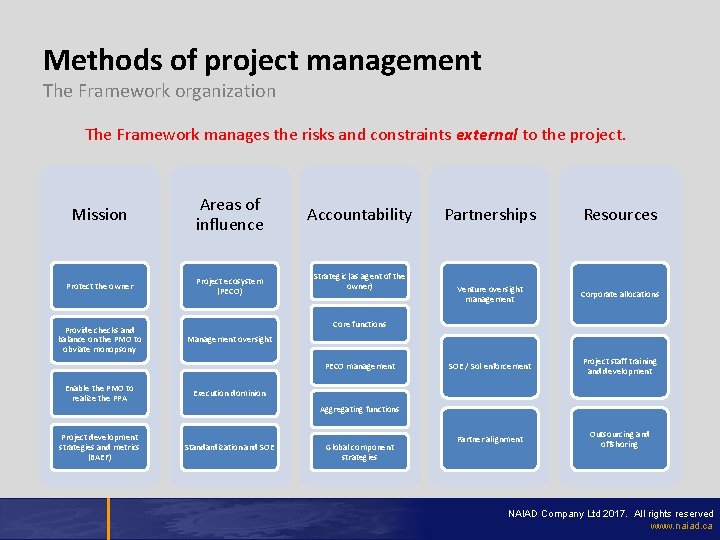
Methods of project management The Framework organization The Framework manages the risks and constraints external to the project. Mission Areas of influence Protect the owner Project ecosystem (PECO) Provide checks and balance on the PMO to obviate monopsony Accountability Strategic (as agent of the owner) Partnerships Resources Venture oversight management Corporate allocations SOE / Sol enforcement Project staff training and development Partner alignment Outsourcing and offshoring Core functions Management oversight PECO management Enable the PMO to realize the PPA Execution dominion Project development strategies and metrics (BAEF) Standardization and SOE Aggregating functions Global component strategies NAIAD Company Ltd 2017. All rights reserved www. naiad. ca
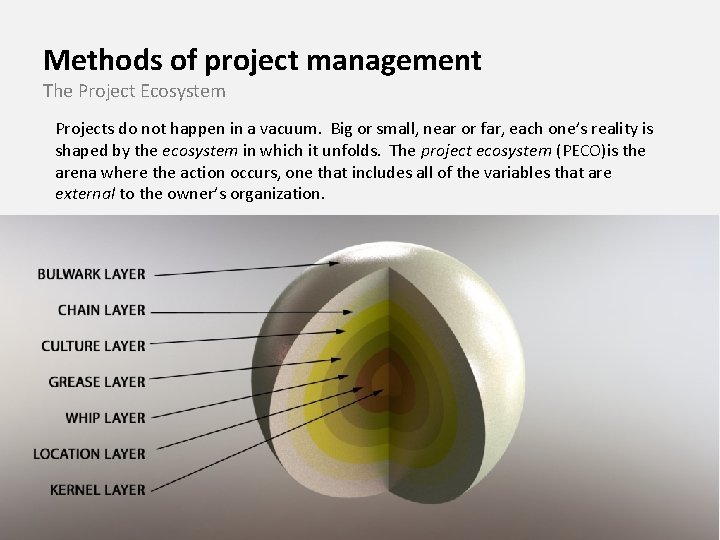
Methods of project management The Project Ecosystem Projects do not happen in a vacuum. Big or small, near or far, each one’s reality is shaped by the ecosystem in which it unfolds. The project ecosystem (PECO)is the arena where the action occurs, one that includes all of the variables that are external to the owner’s organization.
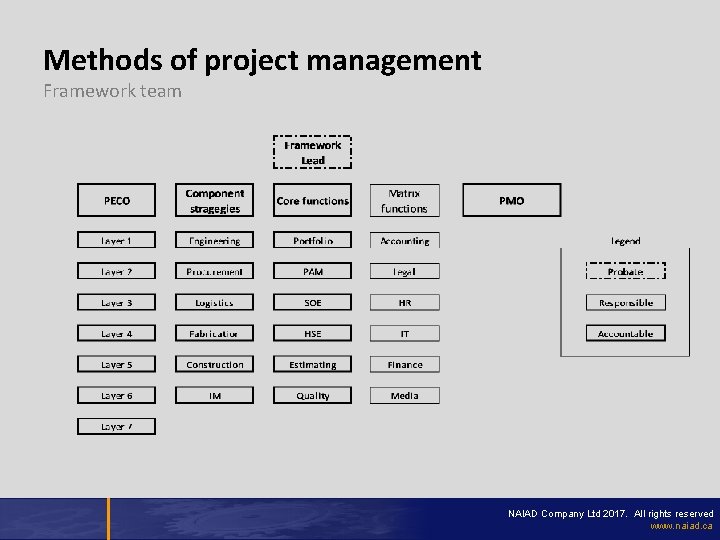
Methods of project management Framework team NAIAD Company Ltd 2017. All rights reserved www. naiad. ca
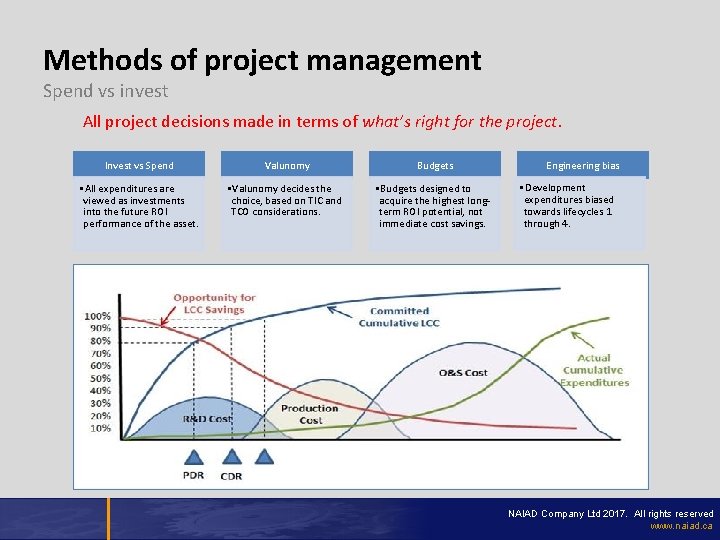
Methods of project management Spend vs invest All project decisions made in terms of what’s right for the project. Invest vs Spend Valunomy Budgets • All expenditures are viewed as investments into the future ROI performance of the asset. • Valunomy decides the choice, based on TIC and TCO considerations. • Budgets designed to acquire the highest longterm ROI potential, not immediate cost savings. Engineering bias • Development expenditures biased towards lifecycles 1 through 4. NAIAD Company Ltd 2017. All rights reserved www. naiad. ca
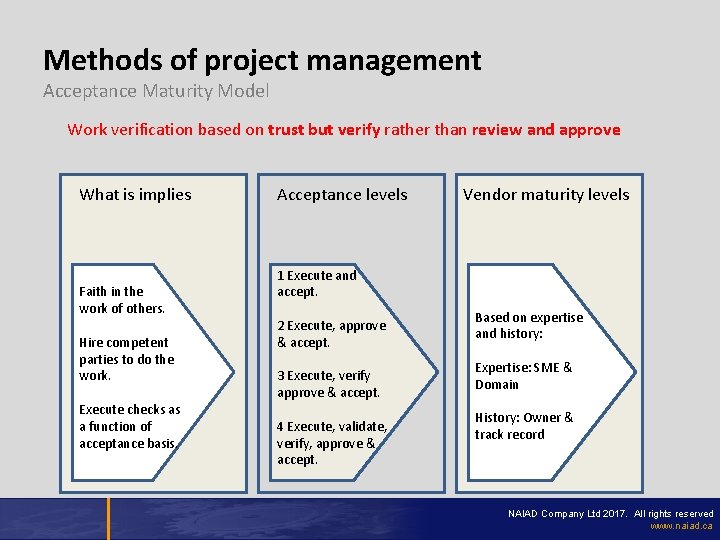
Methods of project management Acceptance Maturity Model Work verification based on trust but verify rather than review and approve What is implies Faith in the work of others. Hire competent parties to do the work. Execute checks as a function of acceptance basis. Acceptance levels Vendor maturity levels 1 Execute and accept. 2 Execute, approve & accept. 3 Execute, verify approve & accept. 4 Execute, validate, verify, approve & accept. Based on expertise and history: Expertise: SME & Domain History: Owner & track record NAIAD Company Ltd 2017. All rights reserved www. naiad. ca
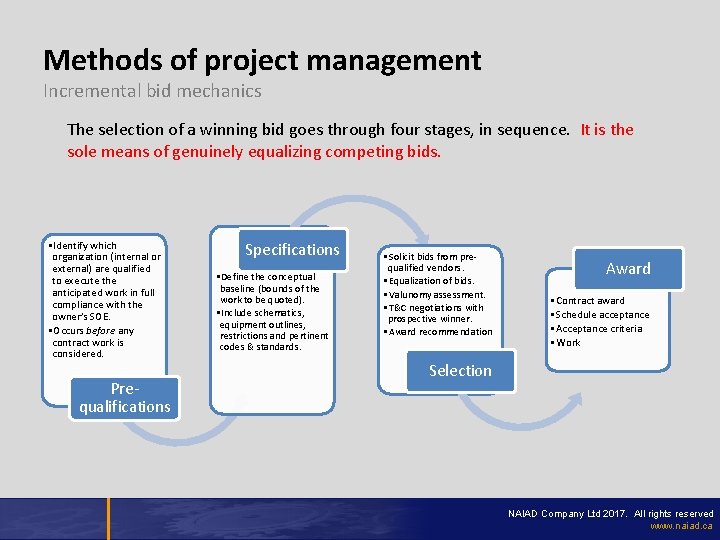
Methods of project management Incremental bid mechanics The selection of a winning bid goes through four stages, in sequence. It is the sole means of genuinely equalizing competing bids. • Identify which organization (internal or external) are qualified to execute the anticipated work in full compliance with the owner’s SOE. • Occurs before any contract work is considered. Prequalifications Specifications • Define the conceptual baseline (bounds of the work to be quoted). • Include schematics, equipment outlines, restrictions and pertinent codes & standards. • Solicit bids from prequalified vendors. • Equalization of bids. • Valunomy assessment. • T&C negotiations with prospective winner. • Award recommendation Award • Contract award • Schedule acceptance • Acceptance criteria • Work Selection NAIAD Company Ltd 2017. All rights reserved www. naiad. ca
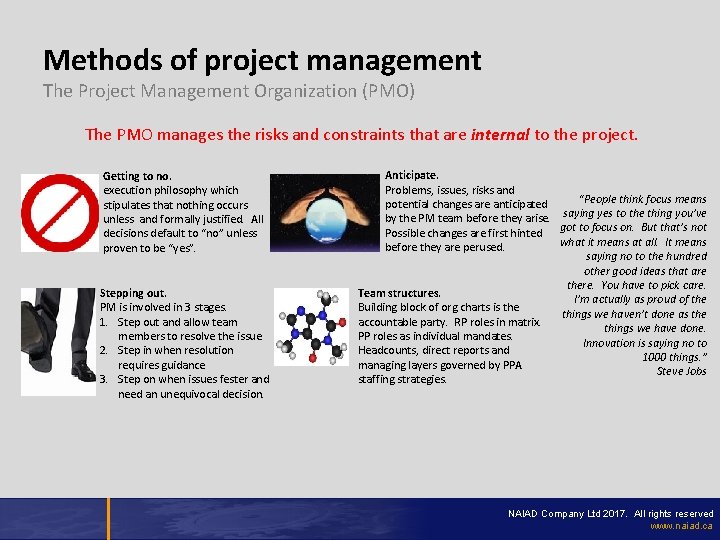
Methods of project management The Project Management Organization (PMO) The PMO manages the risks and constraints that are internal to the project. Getting to no. execution philosophy which stipulates that nothing occurs unless and formally justified. All decisions default to “no” unless proven to be “yes”. Stepping out. PM is involved in 3 stages. 1. Step out and allow team members to resolve the issue. 2. Step in when resolution requires guidance 3. Step on when issues fester and need an unequivocal decision. Anticipate. Problems, issues, risks and “People think focus means potential changes are anticipated by the PM team before they arise. saying yes to the thing you’ve Possible changes are first hinted got to focus on. But that’s not what it means at all. It means before they are perused. saying no to the hundred other good ideas that are there. You have to pick care. Team structures. I’m actually as proud of the Building block of org charts is the things we haven’t done as the accountable party. RP roles in matrix. things we have done. PP roles as individual mandates. Innovation is saying no to Headcounts, direct reports and 1000 things. ” managing layers governed by PPA Steve Jobs staffing strategies. NAIAD Company Ltd 2017. All rights reserved www. naiad. ca
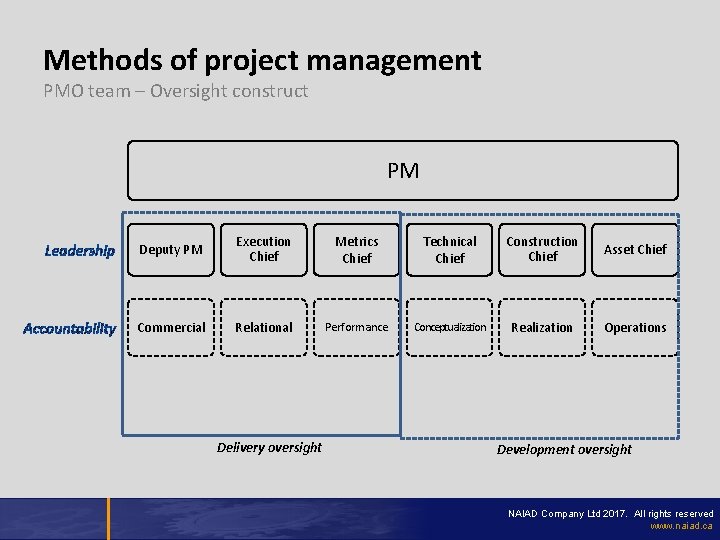
Methods of project management PMO team – Oversight construct PM Leadership Deputy PM Execution Chief Metrics Chief Technical Chief Construction Chief Asset Chief Accountability Commercial Relational Performance Conceptualization Realization Operations Delivery oversight Development oversight NAIAD Company Ltd 2017. All rights reserved www. naiad. ca
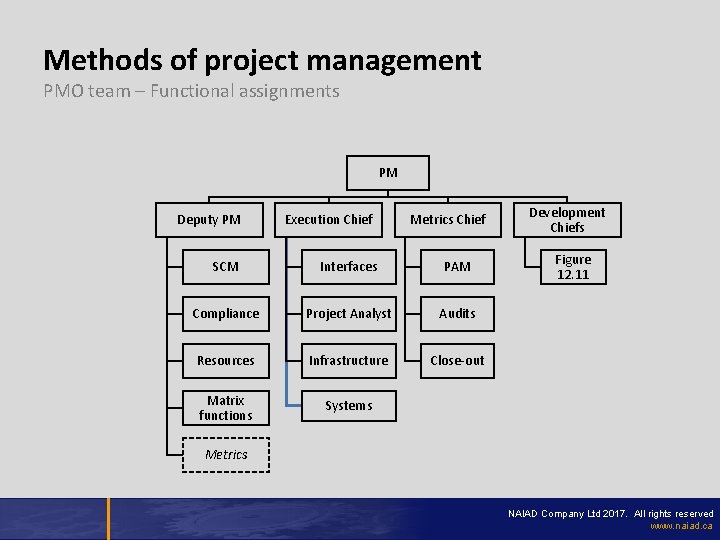
Methods of project management PMO team – Functional assignments PM Deputy PM Execution Chief Metrics Chief SCM Interfaces PAM Compliance Project Analyst Audits Resources Infrastructure Close-out Matrix functions Systems Development Chiefs Figure 12. 11 Metrics NAIAD Company Ltd 2017. All rights reserved www. naiad. ca
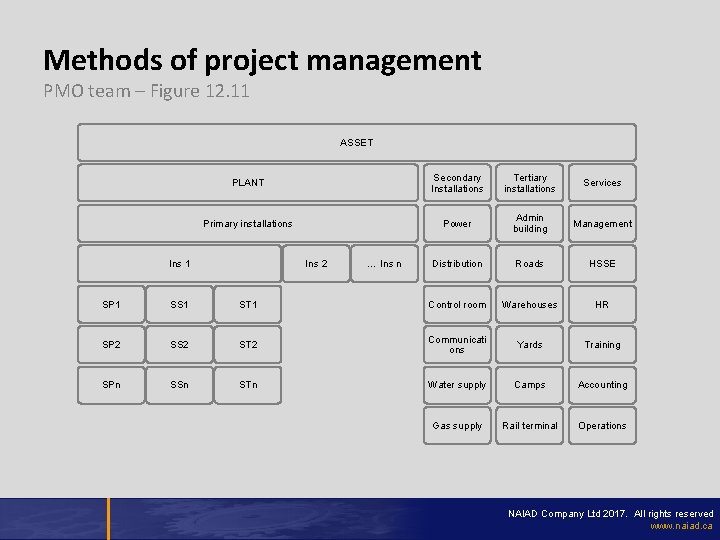
Methods of project management PMO team – Figure 12. 11 ASSET PLANT Secondary Installations Tertiary installations Services Primary installations Power Admin building Management Distribution Roads HSSE Ins 1 Ins 2 … Ins n SP 1 SS 1 ST 1 Control room Warehouses HR SP 2 SS 2 ST 2 Communicati ons Yards Training SPn SSn STn Water supply Camps Accounting Gas supply Rail terminal Operations NAIAD Company Ltd 2017. All rights reserved www. naiad. ca
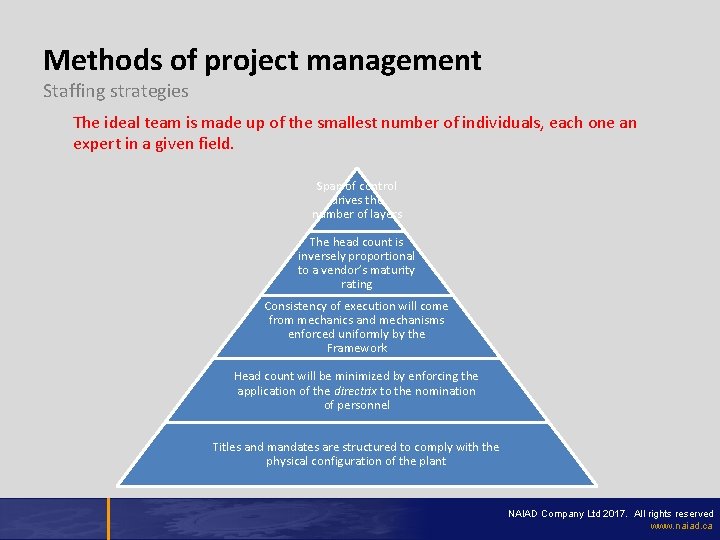
Methods of project management Staffing strategies The ideal team is made up of the smallest number of individuals, each one an expert in a given field. Span of control drives the number of layers The head count is inversely proportional to a vendor’s maturity rating Consistency of execution will come from mechanics and mechanisms enforced uniformly by the Framework Head count will be minimized by enforcing the application of the directrix to the nomination of personnel Titles and mandates are structured to comply with the physical configuration of the plant NAIAD Company Ltd 2017. All rights reserved www. naiad. ca
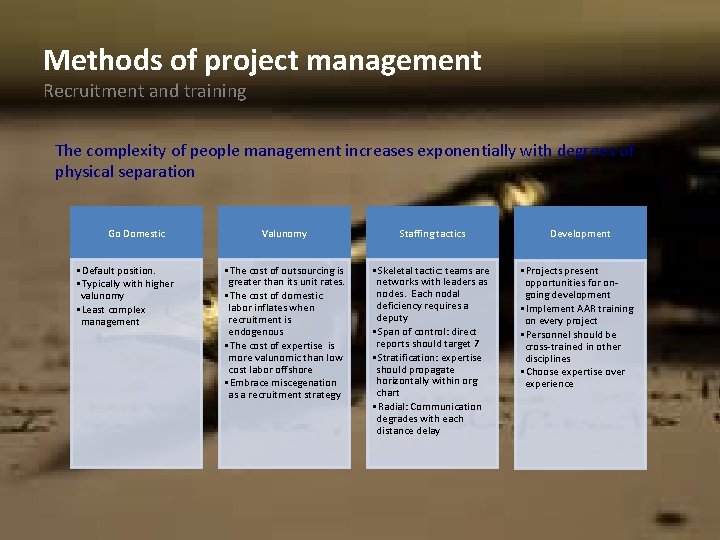
Methods of project management Recruitment and training The complexity of people management increases exponentially with degrees of physical separation Go Domestic • Default position. • Typically with higher valunomy • Least complex management Valunomy Staffing tactics • The cost of outsourcing is greater than its unit rates. • The cost of domestic labor inflates when recruitment is endogenous • The cost of expertise is more valunomic than low cost labor offshore • Embrace miscegenation as a recruitment strategy • Skeletal tactic: teams are networks with leaders as nodes. Each nodal deficiency requires a deputy • Span of control: direct reports should target 7 • Stratification: expertise should propagate horizontally within org chart • Radial: Communication degrades with each distance delay Development • Projects present opportunities for ongoing development • Implement AAR training on every project • Personnel should be cross-trained in other disciplines • Choose expertise over experience