
FLEET MANAGEMENT LTD HONG KONG VETTING GUIDELINES TECH6

- Slides: 26
FLEET MANAGEMENT LTD, HONG KONG. VETTING GUIDELINES TECH-6 QUESTIONNAIRE
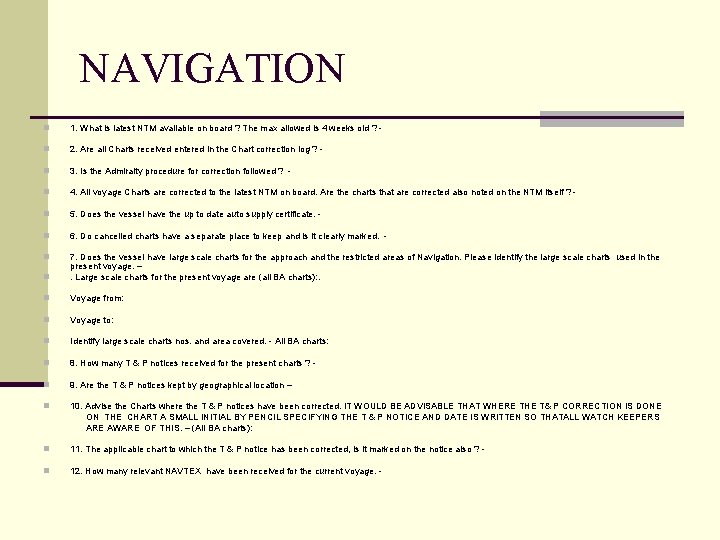
NAVIGATION n 1. What is latest NTM available on board ? The max allowed is 4 weeks old ? - n 2. Are all Charts received entered in the Chart correction log ? - n 3. Is the Admiralty procedure for correction followed ? - n 4. All voyage Charts are corrected to the latest NTM on board. Are the charts that are corrected also noted on the NTM itself ? - n 5. Does the vessel have the up to date auto supply certificate. - n 6. Do cancelled charts have a separate place to keep and is it clearly marked. - n n 7. Does the vessel have large scale charts for the approach and the restricted areas of Navigation. Please identify the large scale charts used in the present voyage. –. Large scale charts for the present voyage are (all BA charts): . n Voyage from: n Voyage to: n Identify large scale charts nos. and area covered. - All BA charts: n 8. How many T & P notices received for the present charts ? - n 9. Are the T & P notices kept by geographical location – n 10. Advise the Charts where the T & P notices have been corrected. IT WOULD BE ADVISABLE THAT WHERE THE T& P CORRECTION IS DONE ON THE CHART A SMALL INITIAL BY PENCIL SPECIFYING THE T & P NOTICE AND DATE IS WRITTEN SO THATALL WATCH KEEPERS ARE AWARE OF THIS. – (All BA charts): n 11. The applicable chart to which the T & P notice has been corrected, is it marked on the notice also ? - n 12. How many relevant NAVTEX have been received for the current voyage. -
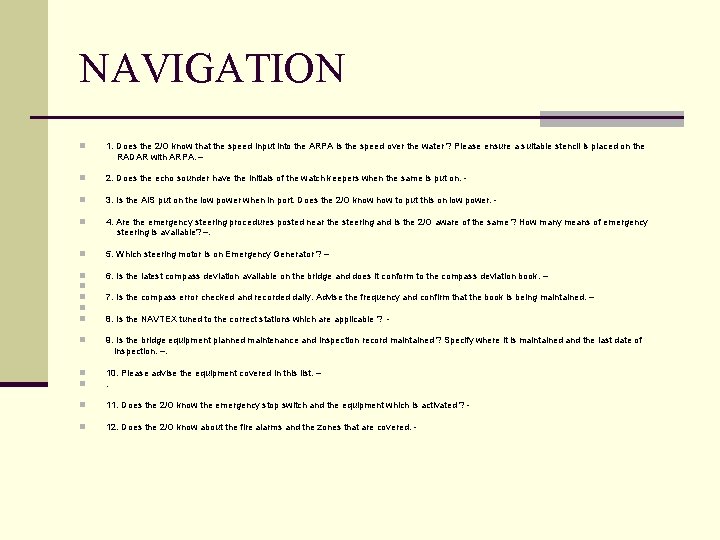
NAVIGATION n 1. Does the 2/O know that the speed input into the ARPA is the speed over the water ? Please ensure a suitable stencil is placed on the RADAR with ARPA. – n 2. Does the echo sounder have the initials of the watch keepers when the same is put on. - n 3. Is the AIS put on the low power when in port. Does the 2/O know how to put this on low power. - n 4. Are the emergency steering procedures posted near the steering and is the 2/O aware of the same ? How many means of emergency steering is available? –. n 5. Which steering motor is on Emergency Generator ? – n n n 6. Is the latest compass deviation available on the bridge and does it conform to the compass deviation book. – n 9. Is the bridge equipment planned maintenance and inspection record maintained ? Specify where it is maintained and the last date of inspection. –. n n 10. Please advise the equipment covered in this list. –. n 11. Does the 2/O know the emergency stop switch and the equipment which is activated ? - n 12. Does the 2/O know about the fire alarms and the zones that are covered. - 7. Is the compass error checked and recorded daily. Advise the frequency and confirm that the book is being maintained. – 8. Is the NAVTEX tuned to the correct stations which are applicable ? -
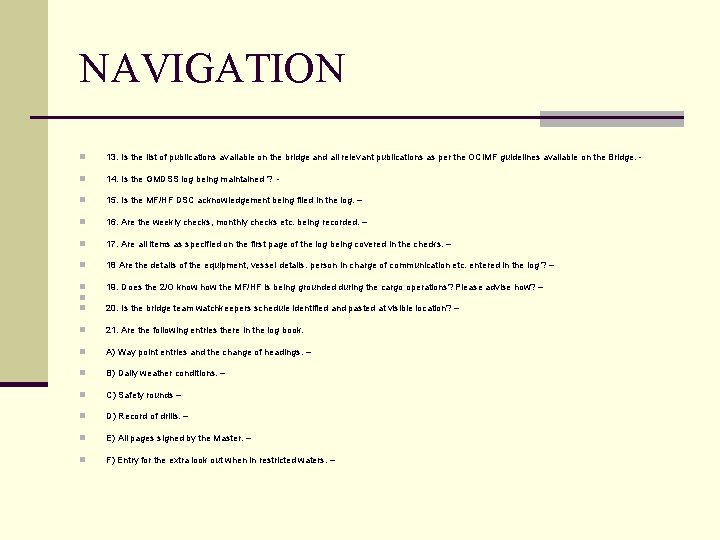
NAVIGATION n 13. Is the list of publications available on the bridge and all relevant publications as per the OCIMF guidelines available on the Bridge. - n 14. Is the GMDSS log being maintained ? - n 15. Is the MF/HF DSC acknowledgement being filed in the log. – n 16. Are the weekly checks, monthly checks etc. being recorded. – n 17. Are all items as specified on the first page of the log being covered in the checks. – n 18 Are the details of the equipment, vessel details. person in charge of communication etc. entered in the log ? – n n n 19. Does the 2/O know how the MF/HF is being grounded during the cargo operations? Please advise how? – n 21. Are the following entries there in the log book. n A) Way point entries and the change of headings. – n B) Daily weather conditions. – n C) Safety rounds – n D) Record of drills. – n E) All pages signed by the Master. – n F) Entry for the extra look out when in restricted waters. – 20. Is the bridge team watchkeepers schedule identified and pasted at visible location? –
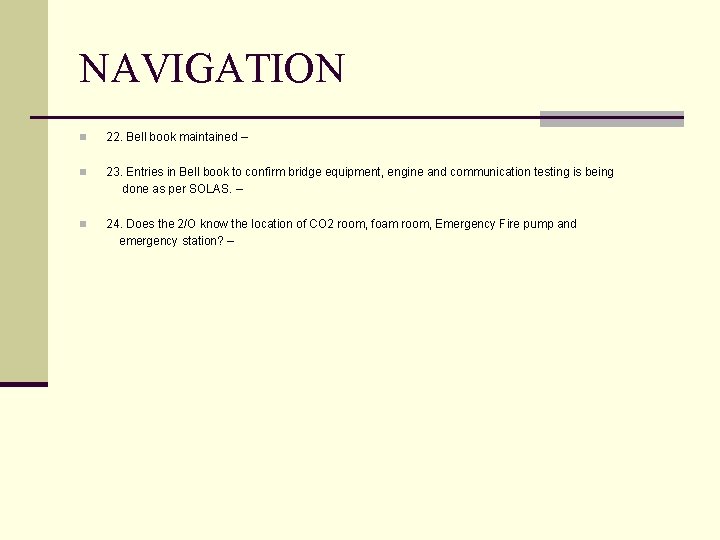
NAVIGATION n 22. Bell book maintained – n 23. Entries in Bell book to confirm bridge equipment, engine and communication testing is being done as per SOLAS. – n 24. Does the 2/O know the location of CO 2 room, foam room, Emergency Fire pump and emergency station? –
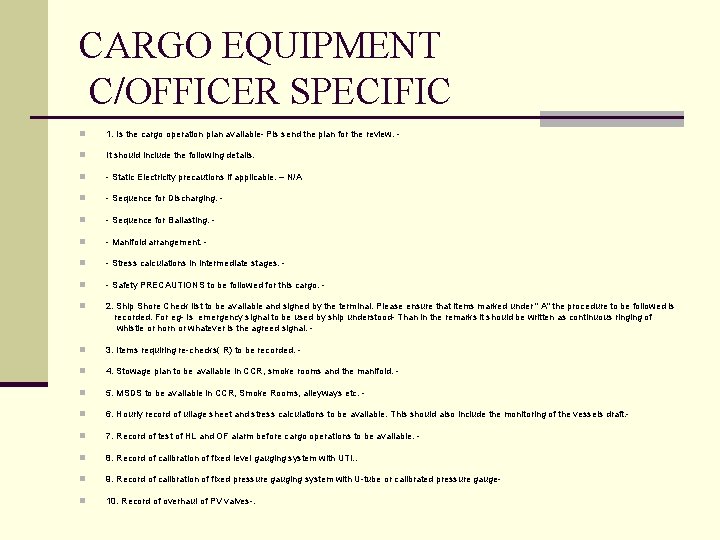
CARGO EQUIPMENT C/OFFICER SPECIFIC n 1. Is the cargo operation plan available- Pls send the plan for the review. - n It should include the following details. n - Static Electricity precautions if applicable. – N/A n - Sequence for Discharging. - n - Sequence for Ballasting. - n - Manifold arrangement. - n - Stress calculations in intermediate stages. - n - Safety PRECAUTIONS to be followed for this cargo. - n 2. Ship Shore Check list to be available and signed by the terminal. Please ensure that items marked under " A" the procedure to be followed is recorded. For eg- Is emergency signal to be used by ship understood- Than in the remarks it should be written as continuous ringing of whistle or horn or whatever is the agreed signal. - n 3. Items requiring re-checks( R) to be recorded. - n 4. Stowage plan to be available in CCR, smoke rooms and the manifold. - n 5. MSDS to be available in CCR, Smoke Rooms, alleyways etc. - n 6. Hourly record of ullage sheet and stress calculations to be available. This should also include the monitoring of the vessels draft. - n 7. Record of test of HL and OF alarm before cargo operations to be available. - n 8. Record of calibration of fixed level gauging system with UTI. . n 9. Record of calibration of fixed pressure gauging system with U-tube or calibrated pressure gauge- n 10. Record of overhaul of PV valves-.
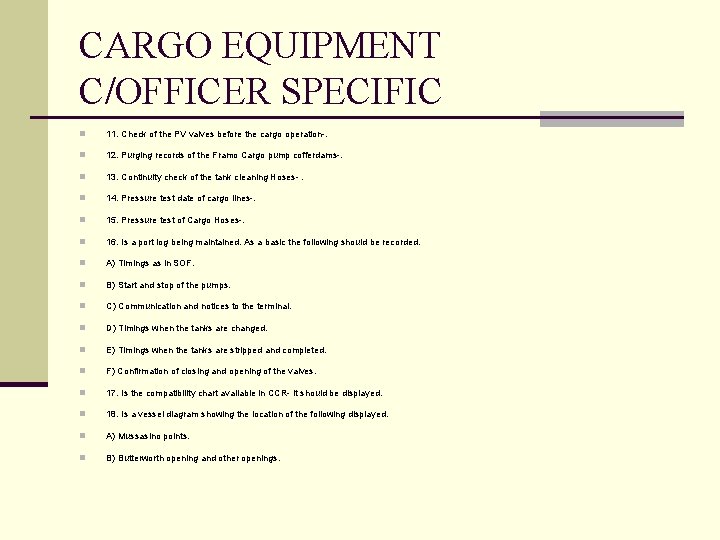
CARGO EQUIPMENT C/OFFICER SPECIFIC n 11. Check of the PV valves before the cargo operation-. n 12. Purging records of the Framo Cargo pump cofferdams-. n 13. Continuity check of the tank cleaning Hoses-. n 14. Pressure test date of cargo lines-. n 15. Pressure test of Cargo Hoses-. n 16. Is a port log being maintained. As a basic the following should be recorded. n A) Timings as in SOF. n B) Start and stop of the pumps. n C) Communication and notices to the terminal. n D) Timings when the tanks are changed. n E) Timings when the tanks are stripped and completed. n F) Confirmation of closing and opening of the valves. n 17. Is the compatibility chart available in CCR- It should be displayed. n 18. Is a vessel diagram showing the location of the following displayed. n A) Mussasino points. n B) Butterworth opening and other openings.
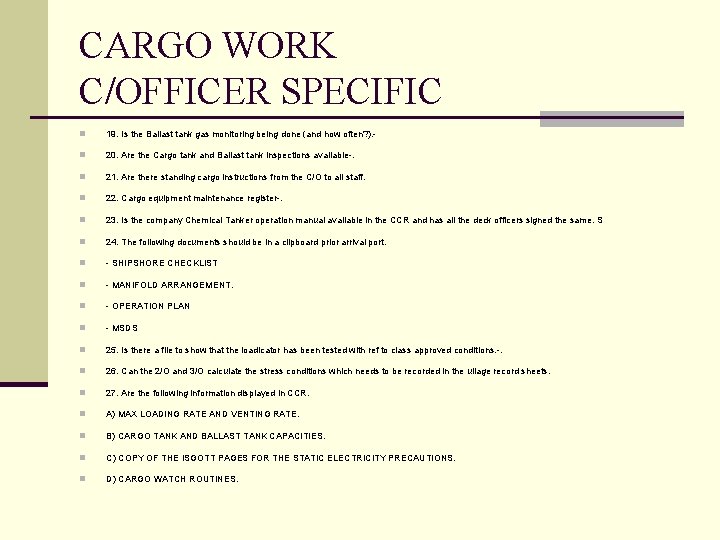
CARGO WORK C/OFFICER SPECIFIC n 19. Is the Ballast tank gas monitoring being done (and how often? ). - n 20. Are the Cargo tank and Ballast tank inspections available-. n 21. Are there standing cargo instructions from the C/O to all staff. n 22. Cargo equipment maintenance register-. n 23. Is the company Chemical Tanker operation manual available in the CCR and has all the deck officers signed the same. S n 24. The following documents should be in a clipboard prior arrival port. n - SHIPSHORE CHECKLIST n - MANIFOLD ARRANGEMENT. n - OPERATION PLAN n - MSDS n 25. Is there a file to show that the loadicator has been tested with ref to class approved conditions. -. n 26. Can the 2/O and 3/O calculate the stress conditions which needs to be recorded in the ullage record sheets. n 27. Are the following information displayed in CCR. n A) MAX LOADING RATE AND VENTING RATE. n B) CARGO TANK AND BALLAST TANK CAPACITIES. n C) COPY OF THE ISGOTT PAGES FOR THE STATIC ELECTRICITY PRECAUTIONS. n D) CARGO WATCH ROUTINES.
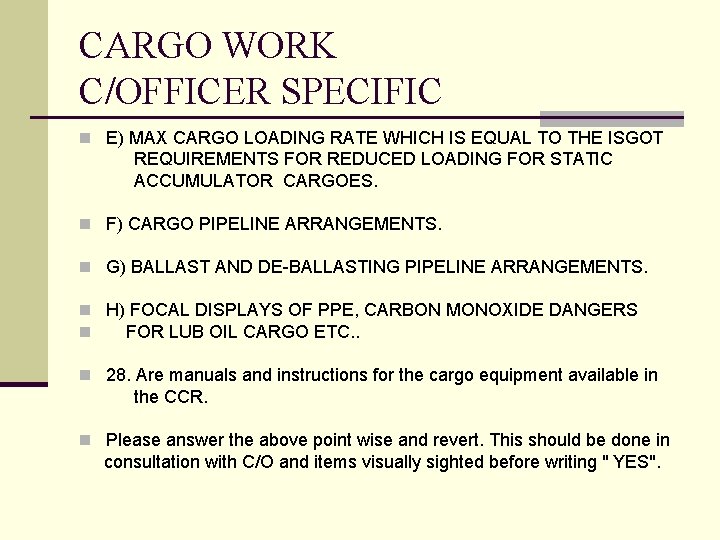
CARGO WORK C/OFFICER SPECIFIC n E) MAX CARGO LOADING RATE WHICH IS EQUAL TO THE ISGOT REQUIREMENTS FOR REDUCED LOADING FOR STATIC ACCUMULATOR CARGOES. n F) CARGO PIPELINE ARRANGEMENTS. n G) BALLAST AND DE-BALLASTING PIPELINE ARRANGEMENTS. n H) FOCAL DISPLAYS OF PPE, CARBON MONOXIDE DANGERS n FOR LUB OIL CARGO ETC. . n 28. Are manuals and instructions for the cargo equipment available in the CCR. n Please answer the above point wise and revert. This should be done in consultation with C/O and items visually sighted before writing " YES".
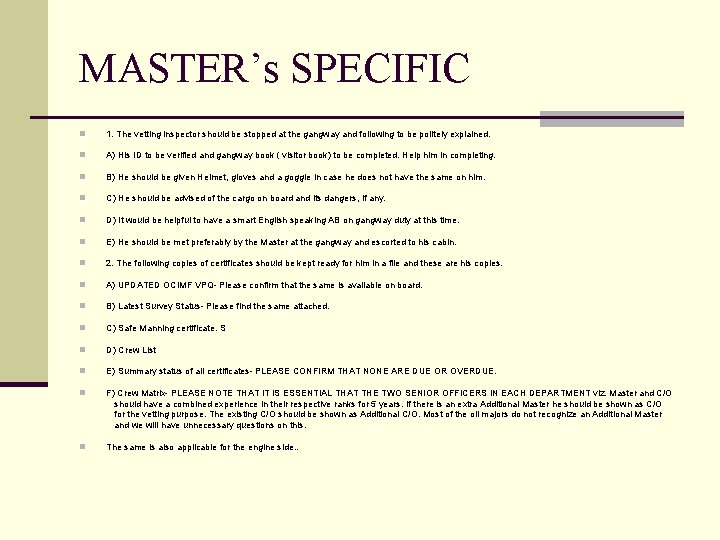
MASTER’s SPECIFIC n 1. The vetting inspector should be stopped at the gangway and following to be politely explained. n A) His ID to be verified and gangway book ( visitor book) to be completed. Help him in completing. n B) He should be given Helmet, gloves and a goggle in case he does not have the same on him. n C) He should be advised of the cargo on board and its dangers, if any. n D) It would be helpful to have a smart English speaking AB on gangway duty at this time. n E) He should be met preferably by the Master at the gangway and escorted to his cabin. n 2. The following copies of certificates should be kept ready for him in a file and these are his copies. n A) UPDATED OCIMF VPQ- Please confirm that the same is available on board. n B) Latest Survey Status- Please find the same attached. n C) Safe Manning certificate. S n D) Crew List n E) Summary status of all certificates- PLEASE CONFIRM THAT NONE ARE DUE OR OVERDUE. n F) Crew Matrix- PLEASE NOTE THAT IT IS ESSENTIAL THAT THE TWO SENIOR OFFICERS IN EACH DEPARTMENT viz. Master and C/O should have a combined experience in their respective ranks for 5 years. If there is an extra Additional Master he should be shown as C/O for the vetting purpose. The existing C/O should be shown as Additional C/O. Most of the oil majors do not recognize an Additional Master and we will have unnecessary questions on this. n The same is also applicable for the engine side. .
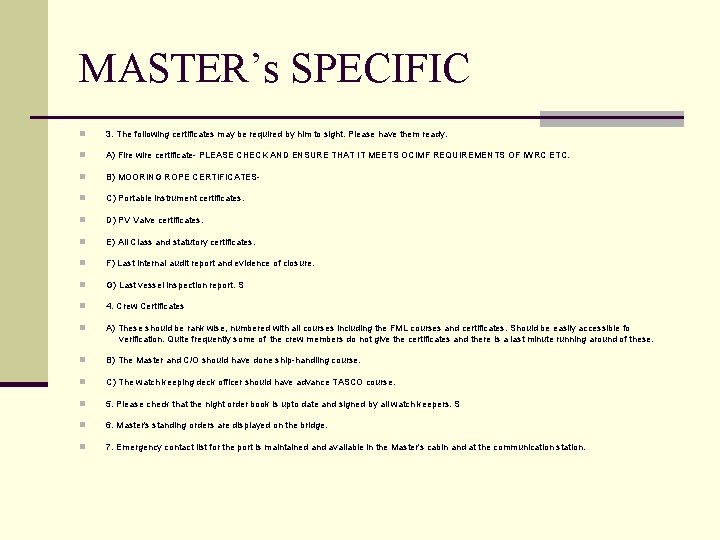
MASTER’s SPECIFIC n 3. The following certificates may be required by him to sight. Please have them ready. n A) Fire wire certificate- PLEASE CHECK AND ENSURE THAT IT MEETS OCIMF REQUIREMENTS OF IWRC ETC. n B) MOORING ROPE CERTIFICATES- n C) Portable instrument certificates. n D) PV Valve certificates. n E) All Class and statutory certificates. n F) Last internal audit report and evidence of closure. n G) Last vessel inspection report. S n 4. Crew Certificates n A) These should be rank wise, numbered with all courses including the FML courses and certificates. Should be easily accessible fo verification. Quite frequently some of the crew members do not give the certificates and there is a last minute running around of these. n B) The Master and C/O should have done ship-handling course. n C) The watch keeping deck officer should have advance TASCO course. n 5. Please check that the night order book is upto date and signed by all watch keepers. S n 6. Master's standing orders are displayed on the bridge. n 7. Emergency contact list for the port is maintained and available in the Master's cabin and at the communication station.
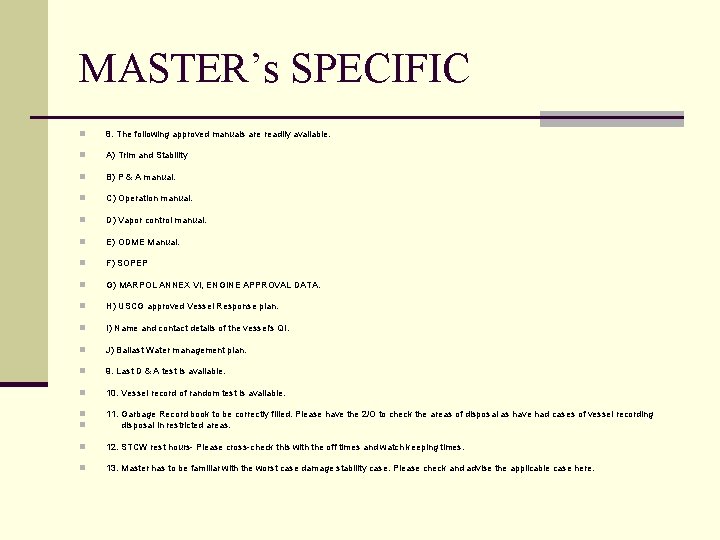
MASTER’s SPECIFIC n 8. The following approved manuals are readily available. n A) Trim and Stability n B) P & A manual. n C) Operation manual. n D) Vapor control manual. n E) ODME Manual. n F) SOPEP n G) MARPOL ANNEX VI, ENGINE APPROVAL DATA. n H) USCG approved Vessel Response plan. n I) Name and contact details of the vessel's QI. n J) Ballast Water management plan. n 9. Last D & A test is available. n 10. Vessel record of random test is available. n n 11. Garbage Record book to be correctly filled. Please have the 2/O to check the areas of disposal as have had cases of vessel recording disposal in restricted areas. n 12. STCW rest hours- Please cross-check this with the off times and watch keeping times. n 13. Master has to be familiar with the worst case damage stability case. Please check and advise the applicable case here.
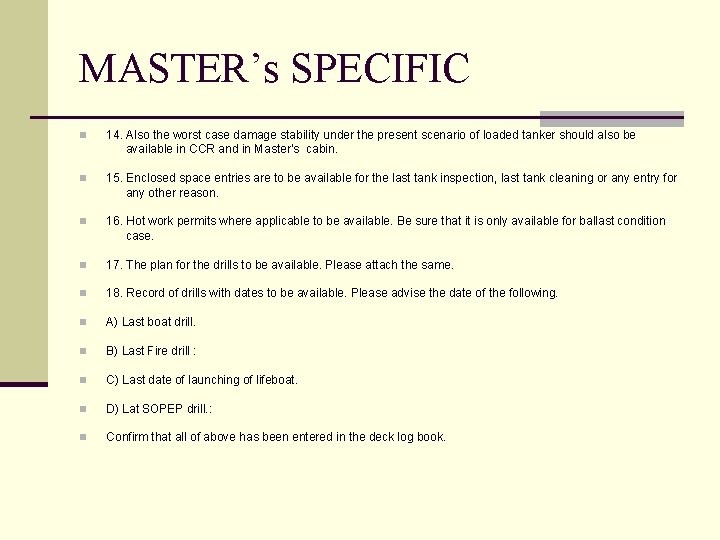
MASTER’s SPECIFIC n 14. Also the worst case damage stability under the present scenario of loaded tanker should also be available in CCR and in Master's cabin. n 15. Enclosed space entries are to be available for the last tank inspection, last tank cleaning or any entry for any other reason. n 16. Hot work permits where applicable to be available. Be sure that it is only available for ballast condition case. n 17. The plan for the drills to be available. Please attach the same. n 18. Record of drills with dates to be available. Please advise the date of the following. n A) Last boat drill. n B) Last Fire drill : n C) Last date of launching of lifeboat. n D) Lat SOPEP drill. : n Confirm that all of above has been entered in the deck log book.
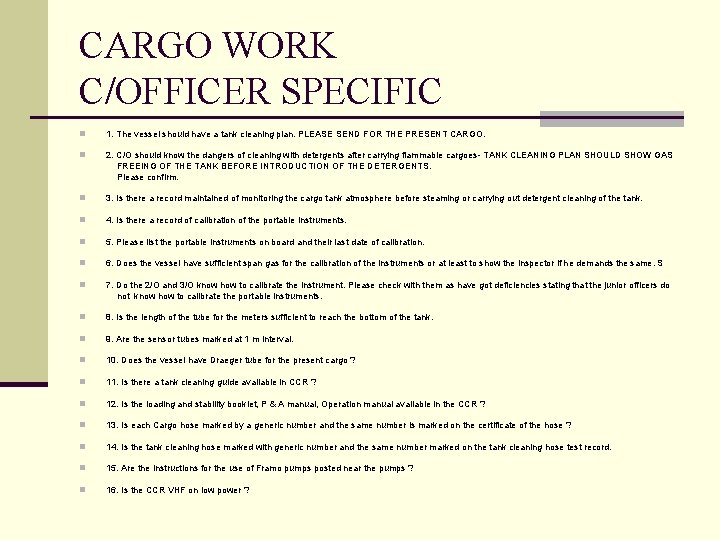
CARGO WORK C/OFFICER SPECIFIC n 1. The vessel should have a tank cleaning plan. PLEASE SEND FOR THE PRESENT CARGO. n 2. C/O should know the dangers of cleaning with detergents after carrying flammable cargoes- TANK CLEANING PLAN SHOULD SHOW GAS FREEING OF THE TANK BEFORE INTRODUCTION OF THE DETERGENTS. Please confirm. n 3. Is there a record maintained of monitoring the cargo tank atmosphere before steaming or carrying out detergent cleaning of the tank. n 4. Is there a record of calibration of the portable instruments. n 5. Please list the portable instruments on board and their last date of calibration. n 6. Does the vessel have sufficient span gas for the calibration of the instruments or at least to show the inspector if he demands the same. S n 7. Do the 2/O and 3/O know how to calibrate the instrument. Please check with them as have got deficiencies stating that the junior officers do not know how to calibrate the portable instruments. n 8. Is the length of the tube for the meters sufficient to reach the bottom of the tank. n 9. Are the sensor tubes marked at 1 m interval. n 10. Does the vessel have Draeger tube for the present cargo ? n 11. Is there a tank cleaning guide available in CCR ? n 12. Is the loading and stability booklet, P & A manual, Operation manual available in the CCR ? n 13. Is each Cargo hose marked by a generic number and the same number is marked on the certificate of the hose ? n 14. Is the tank cleaning hose marked with generic number and the same number marked on the tank cleaning hose test record. n 15. Are the instructions for the use of Framo pumps posted near the pumps ? n 16. Is the CCR VHF on low power ?
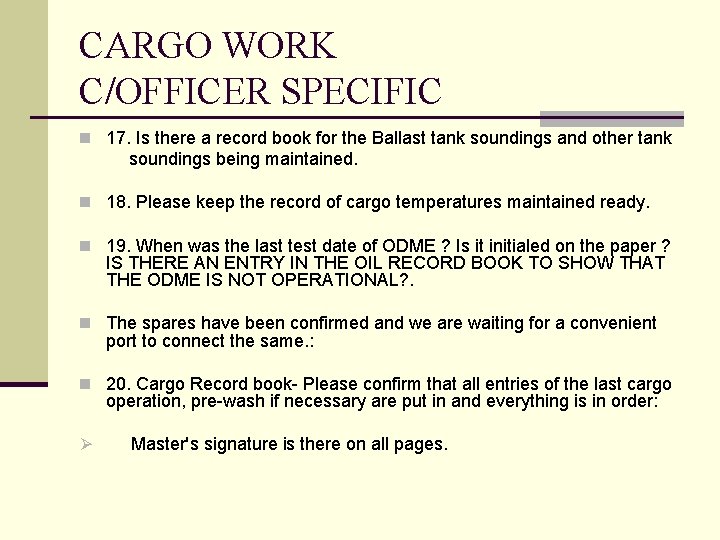
CARGO WORK C/OFFICER SPECIFIC n 17. Is there a record book for the Ballast tank soundings and other tank soundings being maintained. n 18. Please keep the record of cargo temperatures maintained ready. n 19. When was the last test date of ODME ? Is it initialed on the paper ? IS THERE AN ENTRY IN THE OIL RECORD BOOK TO SHOW THAT THE ODME IS NOT OPERATIONAL? . n The spares have been confirmed and we are waiting for a convenient port to connect the same. : n 20. Cargo Record book- Please confirm that all entries of the last cargo operation, pre-wash if necessary are put in and everything is in order: Ø Master's signature is there on all pages.
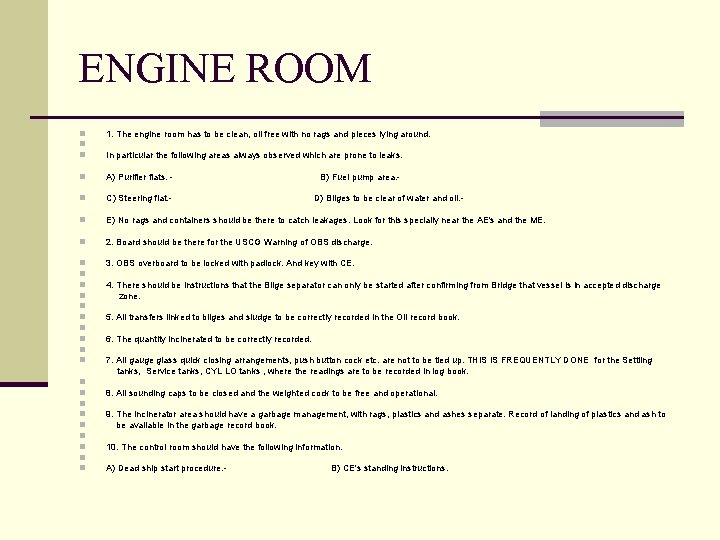
ENGINE ROOM n n n 1. The engine room has to be clean, oil free with no rags and pieces lying around. n A) Purifier flats. - n C) Steering flat. - n E) No rags and containers should be there to catch leakages. Look for this specially near the AE's and the ME. n 2. Board should be there for the USCG Warning of OBS discharge. n n n n n 3. OBS overboard to be locked with padlock. And key with CE. n n n n n In particular the following areas always observed which are prone to leaks. B) Fuel pump area. D) Bilges to be clear of water and oil. - 4. There should be instructions that the Bilge separator can only be started after confirming from Bridge that vessel is in accepted discharge zone. 5. All transfers linked to bilges and sludge to be correctly recorded in the Oil record book. 6. The quantity incinerated to be correctly recorded. 7. All gauge glass quick closing arrangements, push button cock etc. are not to be tied up. THIS IS FREQUENTLY DONE for the Settling tanks, Service tanks, CYL LO tanks , where the readings are to be recorded in log book. 8. All sounding caps to be closed and the weighted cock to be free and operational. 9. The incinerator area should have a garbage management, with rags, plastics and ashes separate. Record of landing of plastics and ash to be available in the garbage record book. 10. The control room should have the following information. A) Dead ship start procedure. - B) CE's standing instructions.
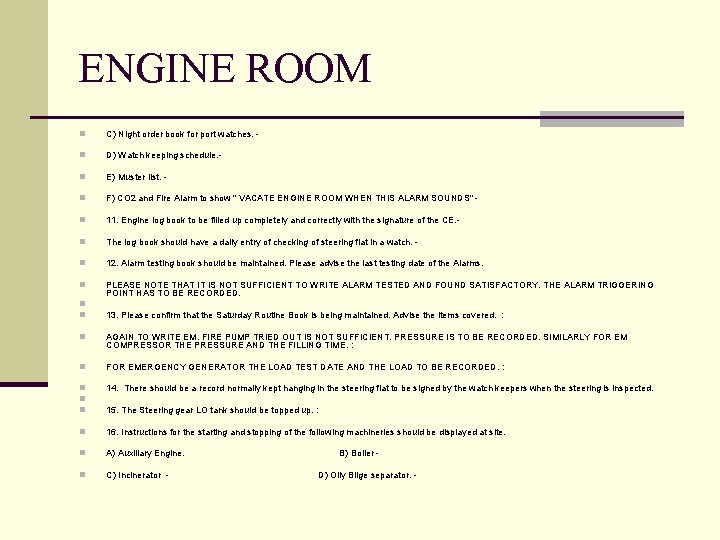
ENGINE ROOM n C) Night order book for port watches. - n D) Watch keeping schedule. - n E) Muster list. - n F) CO 2 and Fire Alarm to show " VACATE ENGINE ROOM WHEN THIS ALARM SOUNDS" - n 11. Engine log book to be filled up completely and correctly with the signature of the CE. - n The log book should have a daily entry of checking of steering flat in a watch. - n 12. Alarm testing book should be maintained. Please advise the last testing date of the Alarms. n PLEASE NOTE THAT IT IS NOT SUFFICIENT TO WRITE ALARM TESTED AND FOUND SATISFACTORY. THE ALARM TRIGGERING POINT HAS TO BE RECORDED. n n 13. Please confirm that the Saturday Routine Book is being maintained. Advise the items covered. : n AGAIN TO WRITE EM. FIRE PUMP TRIED OUT IS NOT SUFFICIENT. PRESSURE IS TO BE RECORDED. SIMILARLY FOR EM COMPRESSOR THE PRESSURE AND THE FILLING TIME. : n FOR EMERGENCY GENERATOR THE LOAD TEST DATE AND THE LOAD TO BE RECORDED. : n n n 14. There should be a record normally kept hanging in the steering flat to be signed by the watch keepers when the steering is inspected. n 16. Instructions for the starting and stopping of the following machineries should be displayed at site. n A) Auxiliary Engine. n C) Incinerator - 15. The Steering gear LO tank should be topped up. : B) Boiler D) Oily Bilge separator. -
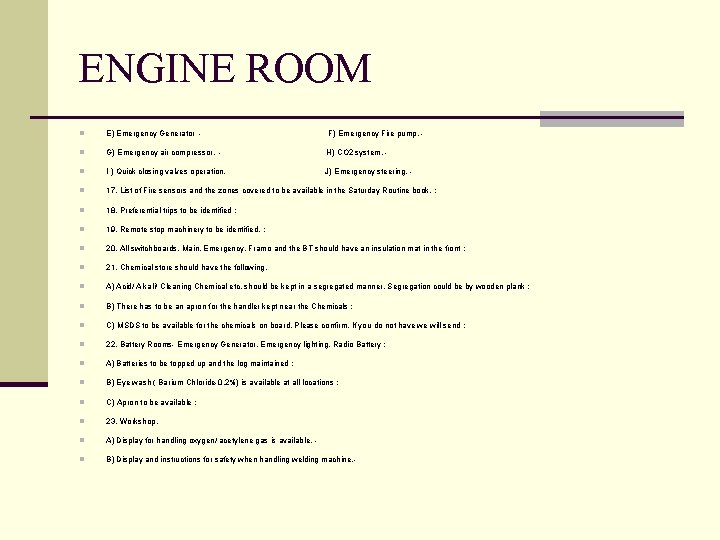
ENGINE ROOM n E) Emergency Generator - F) Emergency Fire pump. - n G) Emergency air compressor. - H) CO 2 system. - n I ) Quick closing valves operation. J) Emergency steering. - n 17. List of Fire sensors and the zones covered to be available in the Saturday Routine book. : n 18. Preferential trips to be identified : n 19. Remote stop machinery to be identified. : n 20. All switchboards, Main, Emergency, Framo and the BT should have an insulation mat in the front : n 21. Chemical store should have the following. n A) Acid/ Alkali/ Cleaning Chemical etc. should be kept in a segregated manner. Segregation could be by wooden plank : n B) There has to be an apron for the handler kept near the Chemicals : n C) MSDS to be available for the chemicals on board. Please confirm. If you do not have we will send : n 22. Battery Rooms- Emergency Generator, Emergency lighting, Radio Battery : n A) Batteries to be topped up and the log maintained : n B) Eye wash ( Barium Chloride-0. 2%) is available at all locations : n C) Apron to be available : n 23. Workshop. n A) Display for handling oxygen/ acetylene gas is available. - n B) Display and instructions for safety when handling welding machine. -
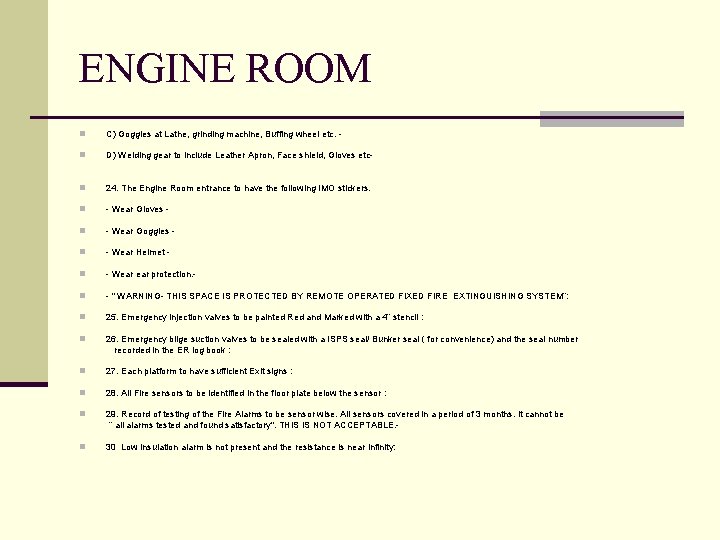
ENGINE ROOM n C) Goggles at Lathe, grinding machine, Buffing wheel etc. - n D) Welding gear to include Leather Apron, Face shield, Gloves etc- n 24. The Engine Room entrance to have the following IMO stickers. n - Wear Gloves - n - Wear Goggles - n - Wear Helmet - n - Wear protection. - n - " WARNING- THIS SPACE IS PROTECTED BY REMOTE OPERATED FIXED FIRE EXTINGUISHING SYSTEM“: n 25. Emergency injection valves to be painted Red and Marked with a 4“ stencil : n 26. Emergency bilge suction valves to be sealed with a ISPS seal/ Bunker seal ( for convenience) and the seal number recorded in the ER log book : n 27. Each platform to have sufficient Exit signs : n 28. All Fire sensors to be identified in the floor plate below the sensor : n 29. Record of testing of the Fire Alarms to be sensor wise. All sensors covered in a period of 3 months. It cannot be “ all alarms tested and found satisfactory". THIS IS NOT ACCEPTABLE. - n 30 Low insulation alarm is not present and the resistance is near infinity:
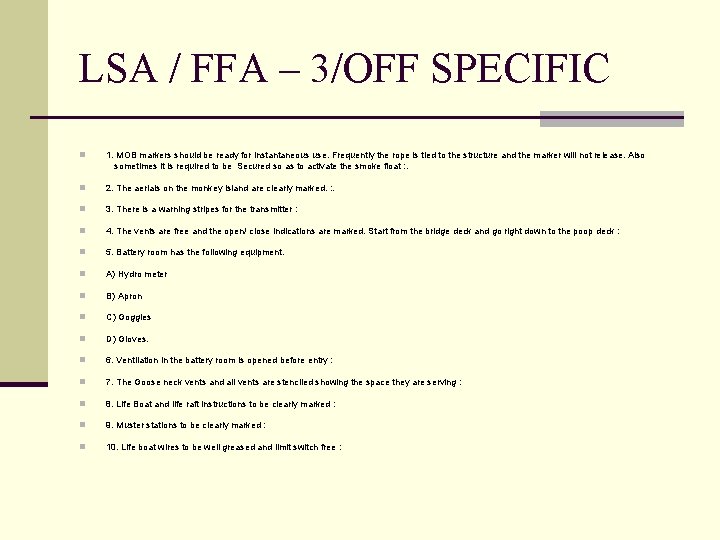
LSA / FFA – 3/OFF SPECIFIC n 1. MOB markers should be ready for instantaneous use. Frequently the rope is tied to the structure and the marker will not release. Also sometimes it is required to be Secured so as to activate the smoke float : . n 2. The aerials on the monkey island are clearly marked. : . n 3. There is a warning stripes for the transmitter : n 4. The vents are free and the open/ close indications are marked. Start from the bridge deck and go right down to the poop deck : n 5. Battery room has the following equipment. n A) Hydro meter n B) Apron n C) Goggles n D) Gloves. n 6. Ventilation in the battery room is opened before entry : n 7. The Goose neck vents and all vents are stenciled showing the space they are serving : n 8. Life Boat and life raft instructions to be clearly marked : n 9. Muster stations to be clearly marked : n 10. Life boat wires to be well greased and limit switch free :
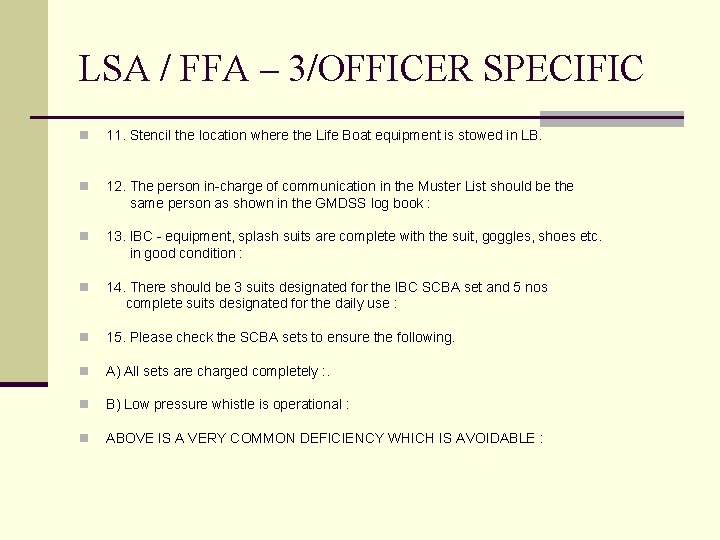
LSA / FFA – 3/OFFICER SPECIFIC n 11. Stencil the location where the Life Boat equipment is stowed in LB. n 12. The person in-charge of communication in the Muster List should be the same person as shown in the GMDSS log book : n 13. IBC - equipment, splash suits are complete with the suit, goggles, shoes etc. in good condition : n 14. There should be 3 suits designated for the IBC SCBA set and 5 nos complete suits designated for the daily use : n 15. Please check the SCBA sets to ensure the following. n A) All sets are charged completely : . n B) Low pressure whistle is operational : n ABOVE IS A VERY COMMON DEFICIENCY WHICH IS AVOIDABLE :
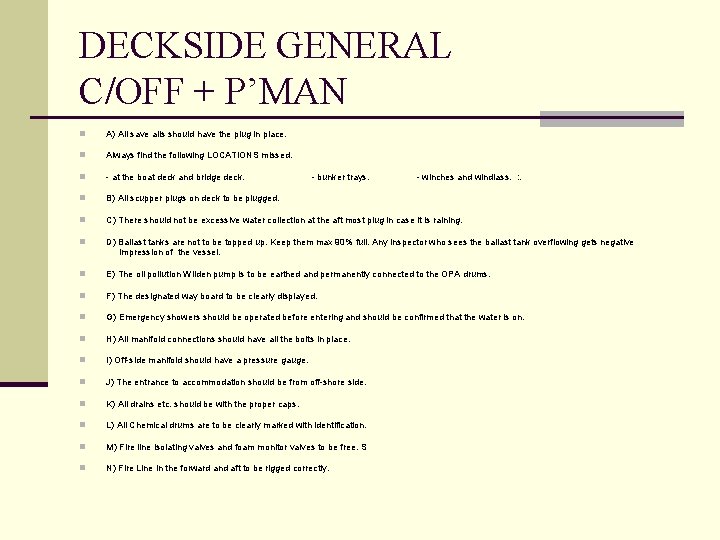
DECKSIDE GENERAL C/OFF + P’MAN n A) All save alls should have the plug in place. n Always find the following LOCATIONS missed. n - at the boat deck and bridge deck. n B) All scupper plugs on deck to be plugged. n C) There should not be excessive water collection at the aft most plug in case it is raining. n D) Ballast tanks are not to be topped up. Keep them max 90% full. Any inspector who sees the ballast tank overflowing gets negative impression of the vessel. n E) The oil pollution Wilden pump is to be earthed and permanently connected to the OPA drums. n F) The designated way board to be clearly displayed. n G) Emergency showers should be operated before entering and should be confirmed that the water is on. n H) All manifold connections should have all the bolts in place. n I) Off-side manifold should have a pressure gauge. n J) The entrance to accommodation should be from off-shore side. n K) All drains etc. should be with the proper caps. n L) All Chemical drums are to be clearly marked with identification. n M) Fire line isolating valves and foam monitor valves to be free. S n N) Fire Line in the forward and aft to be rigged correctly. - bunker trays. - winches and windlass. : .
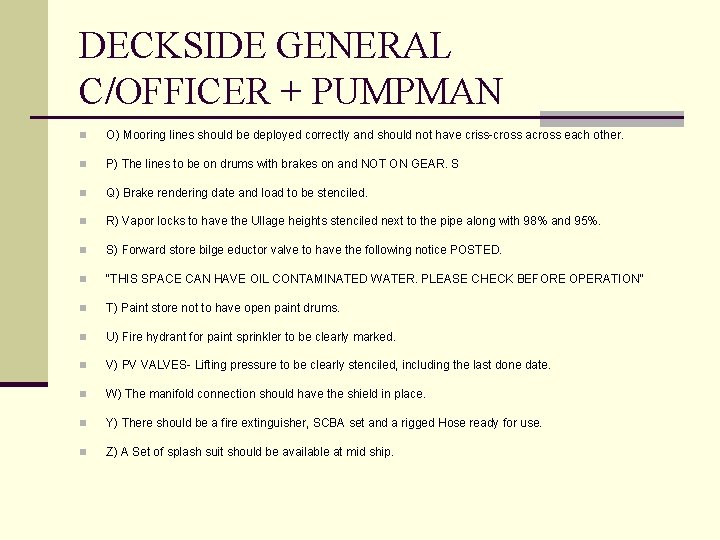
DECKSIDE GENERAL C/OFFICER + PUMPMAN n O) Mooring lines should be deployed correctly and should not have criss-cross across each other. n P) The lines to be on drums with brakes on and NOT ON GEAR. S n Q) Brake rendering date and load to be stenciled. n R) Vapor locks to have the Ullage heights stenciled next to the pipe along with 98% and 95%. n S) Forward store bilge eductor valve to have the following notice POSTED. n "THIS SPACE CAN HAVE OIL CONTAMINATED WATER. PLEASE CHECK BEFORE OPERATION" n T) Paint store not to have open paint drums. n U) Fire hydrant for paint sprinkler to be clearly marked. n V) PV VALVES- Lifting pressure to be clearly stenciled, including the last done date. n W) The manifold connection should have the shield in place. n Y) There should be a fire extinguisher, SCBA set and a rigged Hose ready for use. n Z) A Set of splash suit should be available at mid ship.
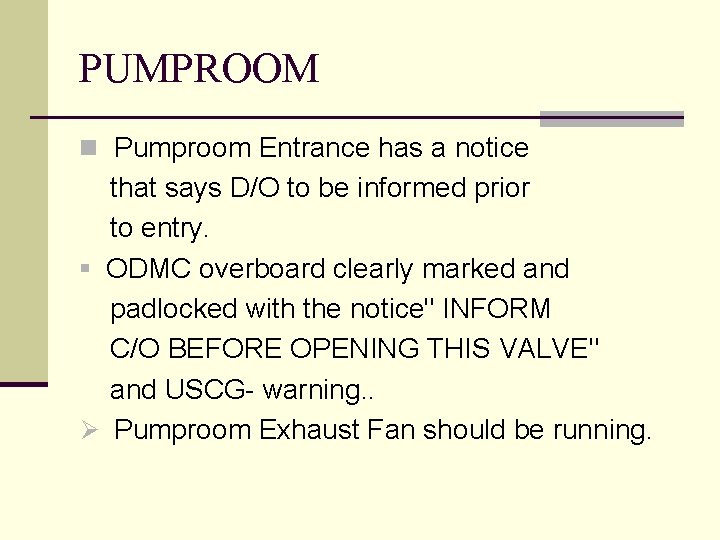
PUMPROOM n Pumproom Entrance has a notice that says D/O to be informed prior to entry. § ODMC overboard clearly marked and padlocked with the notice" INFORM C/O BEFORE OPENING THIS VALVE" and USCG- warning. . Ø Pumproom Exhaust Fan should be running.
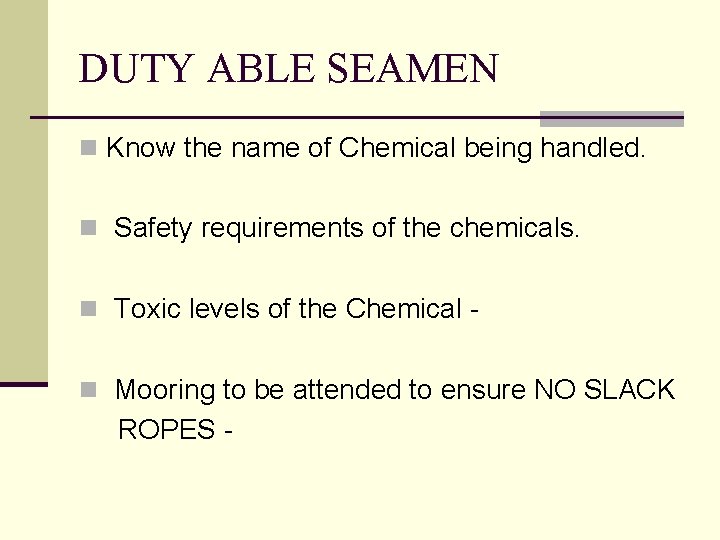
DUTY ABLE SEAMEN n Know the name of Chemical being handled. n Safety requirements of the chemicals. n Toxic levels of the Chemical n Mooring to be attended to ensure NO SLACK ROPES -
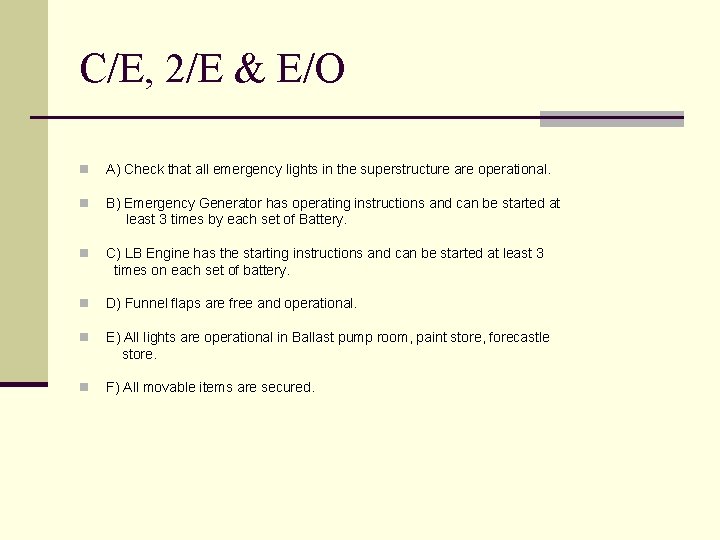
C/E, 2/E & E/O n A) Check that all emergency lights in the superstructure are operational. n B) Emergency Generator has operating instructions and can be started at least 3 times by each set of Battery. n C) LB Engine has the starting instructions and can be started at least 3 times on each set of battery. n D) Funnel flaps are free and operational. n E) All lights are operational in Ballast pump room, paint store, forecastle store. n F) All movable items are secured.