Professionalization of Preschool Teachers Zora Syslov Competencies of

- Slides: 18
Professionalization of Pre-school Teachers Zora Syslová
Competencies of preschool teachers: • • • Didactic competence Competence of Education Diagnostic competence Organizational competence Social and communicative competence
DIAGNOSTIC COMPETENCE For child support and creating suitable educational offer it is necessary to get to know childs personality very well, child´s possibilities and limits. Challenge of preschool: to facilitate every child evolves his potentiality maximally in conditions respecting his/her individuality.
Recognize the uniqueness of each child Every child is a carrier of a unique pattern and timing of the development. The same as: Individual personality, Unique style of learning, Temperament, Needs, Interests, Characteristic structure of intelligence, talent and virtues.
ORGANIZATIONAL COMPETENCE Teacher prepares substantial number of activities (according to types of intelligence/Gardner). Children have opportunity to choose activity according to their interests and virtues.
The offer of numerous different activities in one moment makes cooperation possible. Children can work in groups and naturally the frontal activities are turning away.
The prepared activities facilitates children to: • Experience success • Work by their own rate and resolve problems their own way • Work independently, decide, be responsible for their work • Cooperate in groups and adopt social skills.
COMUNICATIVE COMPETENCE Authoritative approach is: Based on using power. Based on superiority and subordinated. Resulted in defiance or obedience. This approach is connected with child rebellion and fight for power. Partnership approach: Is Based on respect. Induces children to responsibility Creates safe social environment.
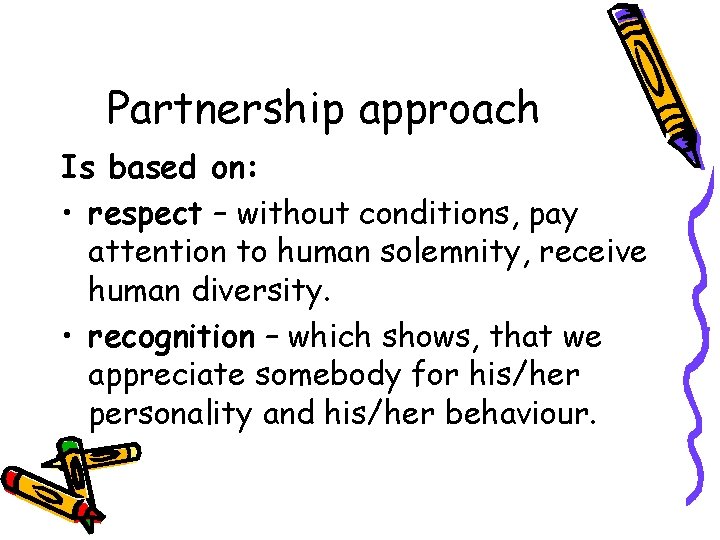
Partnership approach Is based on: • respect – without conditions, pay attention to human solemnity, receive human diversity. • recognition – which shows, that we appreciate somebody for his/her personality and his/her behaviour.
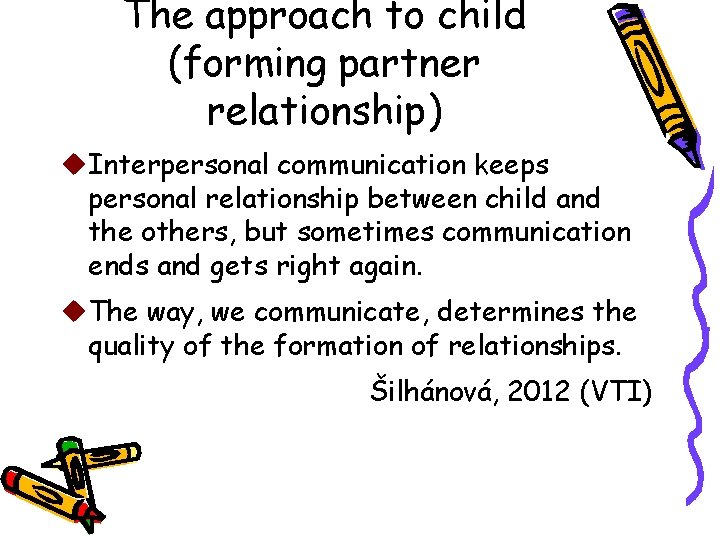
The approach to child (forming partner relationship) u. Interpersonal communication keeps personal relationship between child and the others, but sometimes communication ends and gets right again. u. The way, we communicate, determines the quality of the formation of relationships. Šilhánová, 2012 (VTI)
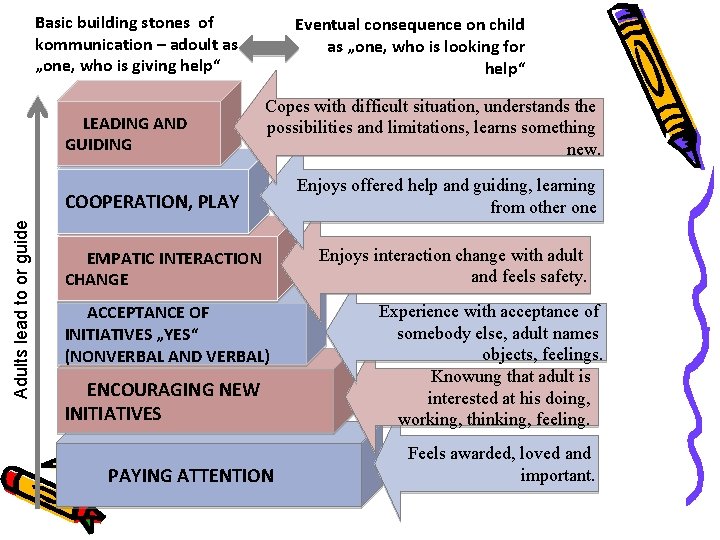
Basic building stones of kommunication – adoult as „one, who is giving help“ LEADING AND GUIDING Eventual consequence on child as „one, who is looking for help“ Copes with difficult situation, understands the possibilities and limitations, learns something new. Adults lead to or guide COOPERATION, PLAY EMPATIC INTERACTION CHANGE ACCEPTANCE OF INITIATIVES „YES“ (NONVERBAL AND VERBAL) ENCOURAGING NEW INITIATIVES PAYING ATTENTION Enjoys offered help and guiding, learning from other one Enjoys interaction change with adult and feels safety. Experience with acceptance of somebody else, adult names objects, feelings. Knowung that adult is interested at his doing, working, thinking, feeling. Feels awarded, loved and important.
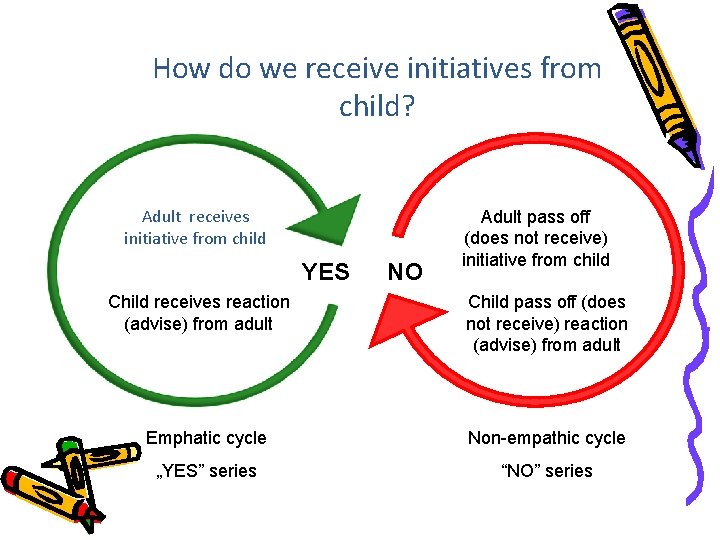
How do we receive initiatives from child? Adult receives initiative from child YES Child receives reaction (advise) from adult NO Adult pass off (does not receive) initiative from child Child pass off (does not receive) reaction (advise) from adult Emphatic cycle Non-empathic cycle „YES” series “NO” series
The level of nonverbal communication – „YES series“ • • • Frequent eye contact Expressive signs, gesture Good work with voice, face expression Appropriate body position and turning Right distance, body contact Acknowledge the initiatives of the child, nodding
Level of verbal communication „YES series“ • Clear and understandable announcement • To name (the naming shows other person that we received the initiative and we understood its meaning, the naming is a basic part of understanding between each other and learning something new)
Experience from seminars in Czech republic • Name child activity • Name relationship between children • Name child´s feelings
Teacher´s competencies as presumption of good cooperation with parents Useful skills of kindergarten teacher: • To Get in contact with child´s parents • To Open child results properly to each parent or group of parents • To be initiative and lead discussion with parents • To communicate requirements and instructions in way that parents can accept • To persuade parents about teacher´s guiding to positive development of every child.
• • Empathy Listening Professional argumentation Respect without prejudice
Thank you for your attention