Process isolation for cloud computing using commodity operating
- Slides: 17
Process isolation for cloud computing using commodity operating systems Wenbo Mao EMC Research China April 15, 2008 © Copyright 2008 EMC Corporation. All rights reserved. 1
Outline Isolation for guest applications in multi-tenancy service provisioning: – Utility, grid, and nowadays very trendy cloud computing – Two sorts of players: “lessor” (resourceful) and “lessee” (resource scarce) – Necessary isolation between applications, and widely known to be done by virtualization techniques: natural isolation between virtual machines (VMs) Reasoning why inter VM isolation is no good – Inadequate – Impractical This work: fine-granularity Intra-VM process isolation Usecase: Green Cloud © Copyright 2008 EMC Corporation. All rights reserved. 2
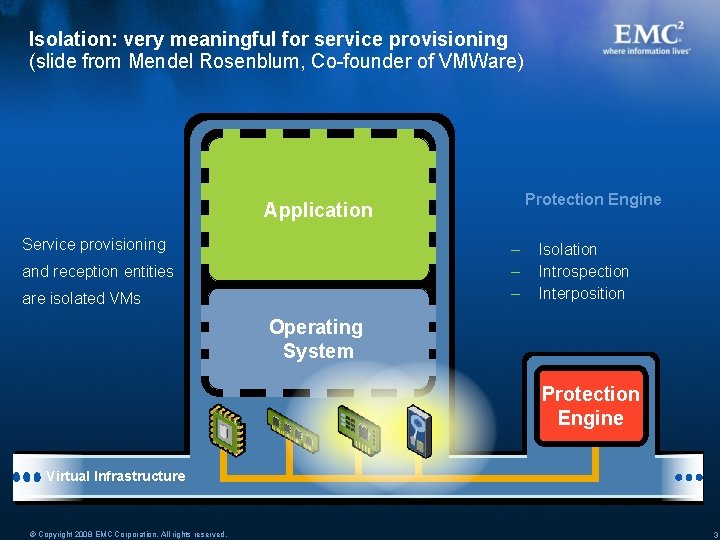
Isolation: very meaningful for service provisioning (slide from Mendel Rosenblum, Co-founder of VMWare) Protection Engine Application Service provisioning – – – and reception entities are isolated VMs Isolation Introspection Interposition Operating System Protection Engine Virtual Infrastructure © Copyright 2008 EMC Corporation. All rights reserved. 3
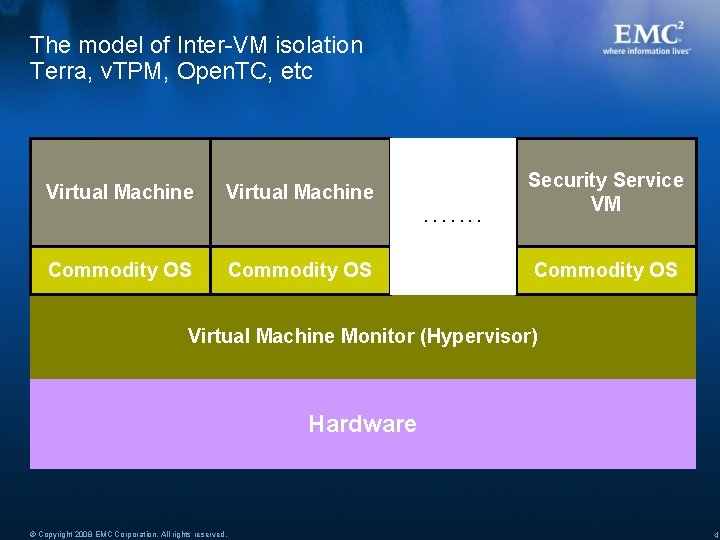
The model of Inter-VM isolation Terra, v. TPM, Open. TC, etc Virtual Machine. . . . Commodity OS Security Service VM Commodity OS Virtual Machine Monitor (Hypervisor) Hardware © Copyright 2008 EMC Corporation. All rights reserved. 4
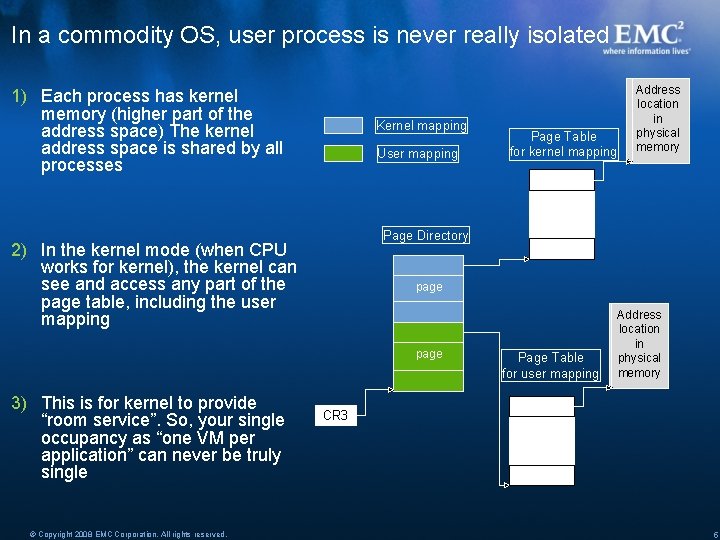
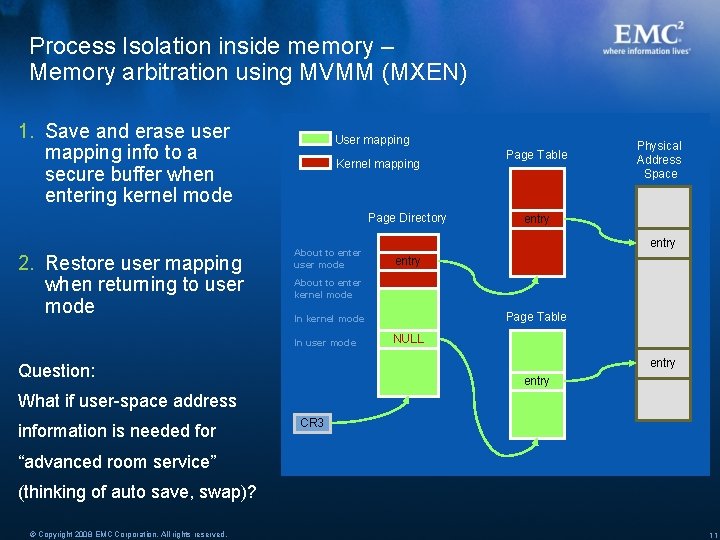
In a commodity OS, user process is never really isolated 1) Each process has kernel memory (higher part of the address space) The kernel address space is shared by all processes Kernel mapping User mapping page © Copyright 2008 EMC Corporation. All rights reserved. . . Page Directory 2) In the kernel mode (when CPU works for kernel), the kernel can see and access any part of the page table, including the user mapping 3) This is for kernel to provide “room service”. So, your single occupancy as “one VM per application” can never be truly single Page Table for kernel mapping Address location in physical memory CR 3 Page Table for user mapping Address location in physical memory . . 5
Impracticality for inter-VM isolation Inter-VM isolation is not only inadequate, it’s impractical too In multi-tenancy service provisioning, a service provider may need to host thousands of guests at a time; if guest isolation is achieved by one VM per guest application, then Too many VMs are a wastage of system resources (e. g. , IP addresses) Too many VMs mean more hardware demand: against the original motivation of virtualization for improving resource utilization Usually an application involves using commercial-off-the-shelf 3 rd party software library which is shared by many applications; inter-VM isolation means each application will use a huge library alone, and hence make huge sized VMs © Copyright 2008 EMC Corporation. All rights reserved. 6
Fine granularity process isolation Isolation done at the process level – Hiding the memory content of user processes from the OS and other processes Preventing attack from the OS and system services Even the system administrator can’t launch an attack Secure integration of third-party software Making OS security an irrelevant issue Saving system resources: can run many applications inside one VM © Copyright 2008 EMC Corporation. All rights reserved. 7
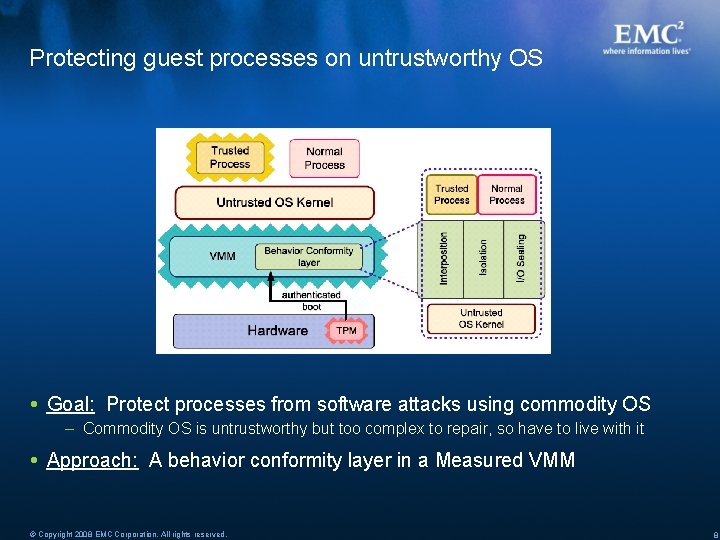
Protecting guest processes on untrustworthy OS Goal: Protect processes from software attacks using commodity OS – Commodity OS is untrustworthy but too complex to repair, so have to live with it Approach: A behavior conformity layer in a Measured VMM © Copyright 2008 EMC Corporation. All rights reserved. 8
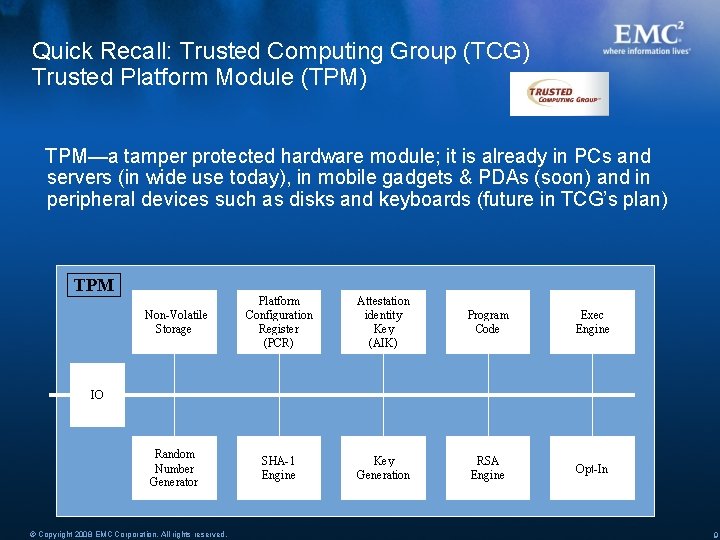
Quick Recall: Trusted Computing Group (TCG) Trusted Platform Module (TPM) TPM—a tamper protected hardware module; it is already in PCs and servers (in wide use today), in mobile gadgets & PDAs (soon) and in peripheral devices such as disks and keyboards (future in TCG’s plan) TPM Non-Volatile Storage Platform Configuration Register (PCR) Attestation identity Key (AIK) Program Code Exec Engine Random Number Generator SHA-1 Engine Key Generation RSA Engine Opt-In IO © Copyright 2008 EMC Corporation. All rights reserved. 9
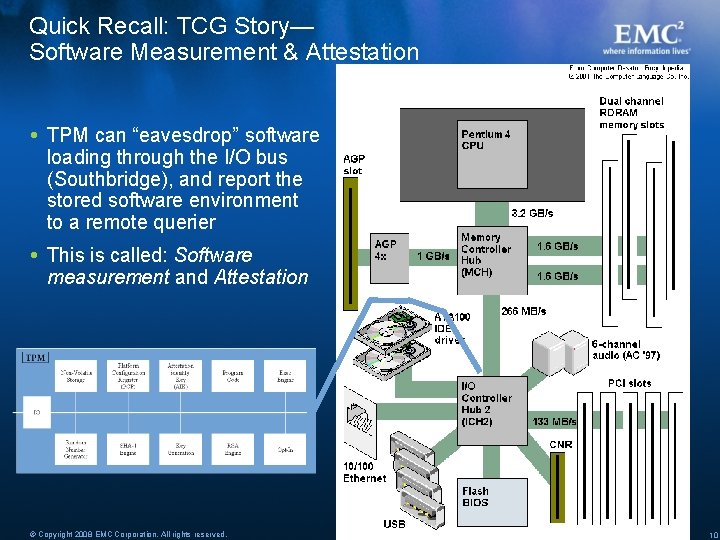
Quick Recall: TCG Story— Software Measurement & Attestation TPM can “eavesdrop” software loading through the I/O bus (Southbridge), and report the stored software environment to a remote querier This is called: Software measurement and Attestation © Copyright 2008 EMC Corporation. All rights reserved. 10
Process Isolation inside memory – Memory arbitration using MVMM (MXEN) 1. Save and erase user mapping info to a secure buffer when entering kernel mode User mapping Kernel mapping Page Directory 2. Restore user mapping when returning to user mode About to enter user mode Page Table Physical Address Space entry About to enter kernel mode Page Table In kernel mode In user mode NULL entry Question: entry What if user-space address information is needed for CR 3 “advanced room service” (thinking of auto save, swap)? © Copyright 2008 EMC Corporation. All rights reserved. 11
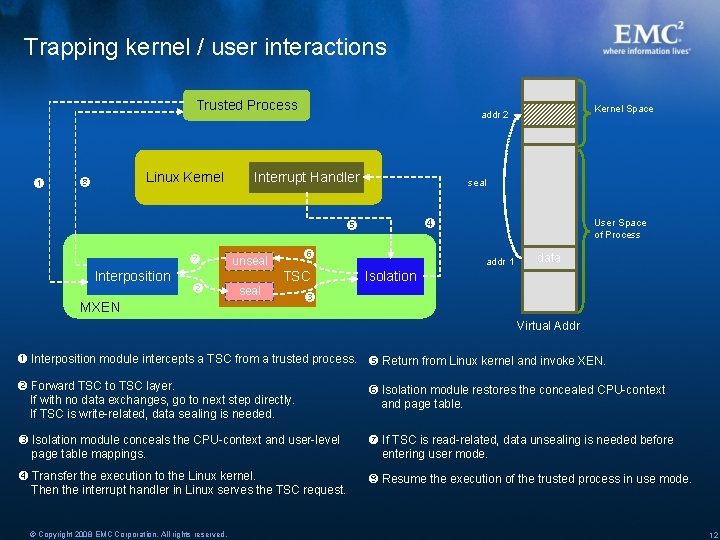
Trapping kernel / user interactions Trusted Process Linux Kernel Interrupt Handler seal Interposition unseal MXEN Kernel Space addr 2 TSC User Space of Process addr 1 data Isolation Virtual Addr. Interposition module intercepts a TSC from a trusted process. Return from Linux kernel and invoke XEN. Forward TSC to TSC layer. If with no data exchanges, go to next step directly. If TSC is write-related, data sealing is needed. Isolation module restores the concealed CPU-context and page table. Isolation module conceals the CPU-context and user-level page table mappings. If TSC is read-related, data unsealing is needed before entering user mode. Transfer the execution to the Linux kernel. Then the interrupt handler in Linux serves the TSC request. Resume the execution of the trusted process in use mode. © Copyright 2008 EMC Corporation. All rights reserved. 12
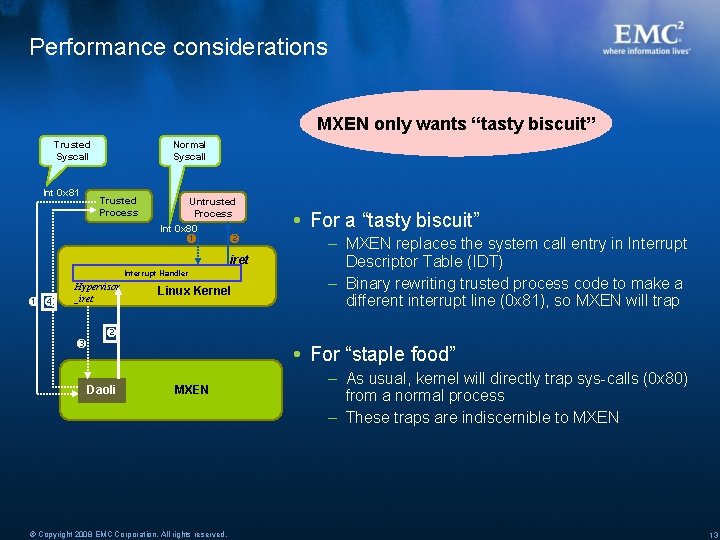
Performance considerations MXEN only wants “tasty biscuit” Trusted Syscall Int 0 x 81 Normal Syscall Trusted Process Untrusted Process Int 0 x 80 iret Interrupt Handler Hypervisor _iret Linux Kernel For a “tasty biscuit” – MXEN replaces the system call entry in Interrupt Descriptor Table (IDT) – Binary rewriting trusted process code to make a different interrupt line (0 x 81), so MXEN will trap For “staple food” Daoli MXEN © Copyright 2008 EMC Corporation. All rights reserved. – As usual, kernel will directly trap sys-calls (0 x 80) from a normal process – These traps are indiscernible to MXEN 13
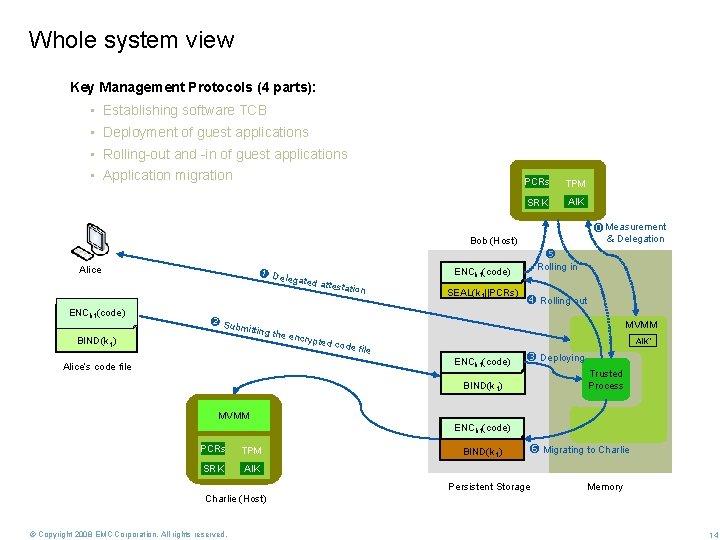
Whole system view Key Management Protocols (4 parts): • Establishing software TCB • Deployment of guest applications • Rolling-out and -in of guest applications • Application migration PCRs TPM SRK AIK Measurement & Delegation Bob (Host) Alice ENCk 1(code) Deleg ENCk 1(code) ated att Subm itting th BIND(k 1) estation SEAL(k 1||PCRs) Rolling out MVMM e encry pted co de file AIK’ ENCk 1(code) Alice’s code file Rolling in Deploying Trusted Process BIND(k 1) MVMM ENCk 1(code) PCRs TPM SRK AIK BIND(k 1) Migrating to Charlie Persistent Storage Memory Charlie (Host) © Copyright 2008 EMC Corporation. All rights reserved. 14
Usecase: “Green Cloud” Green is hot in China too (“Green GDP”) Conventionally (historically) thinking, utility computing should only be done with reputable service providers (that’s why “multi-tenancy” with a large resource lessor), a long term contractual relation between lessor and lessee To increase utilization, a reputable host needs to prepare for “overflow buffers” for off-loading peak time service requests – An “overflow buffer” can be a host of not so reputable – It can be in a location of competitive pricing – Considering peak and trough times in a day and seasonal highs (e. g. , Amazon in Christmas season), a host may be in the other side of the world – Ad-hoc relation between a reputable host and an “overflow buffer” So, behavior conformity from process isolation is necessary for a green cloud © Copyright 2008 EMC Corporation. All rights reserved. 15
Green Cloud Consortium Fudan University – Process isolation & secure VM migration; VMM techniques (XEN) Huazhong University of Science and Technology (HUST) – Grid & cloud computing; constructing VO by dynamic making & deploying VMs Wuhan University – Trusted Computing: platform measurement & attestation – VM migration key management protocols Tsinghua University – “Green Cloud” Usecase © Copyright 2008 EMC Corporation. All rights reserved. 16
Advertisement 3 rd Asia-Pacific Trusted Infrastructure Technologies Conference On a cruiser on Yangtze River near Three Gorges Dam, China October 14 -17, 2008 Proceedings to be published by IEEE Computer Society Press Sponsored by EMC and VMWare, and co-chaired by EMC Research China http: //grid. hust. edu. cn/aptc 08/ © Copyright 2008 EMC Corporation. All rights reserved. 17